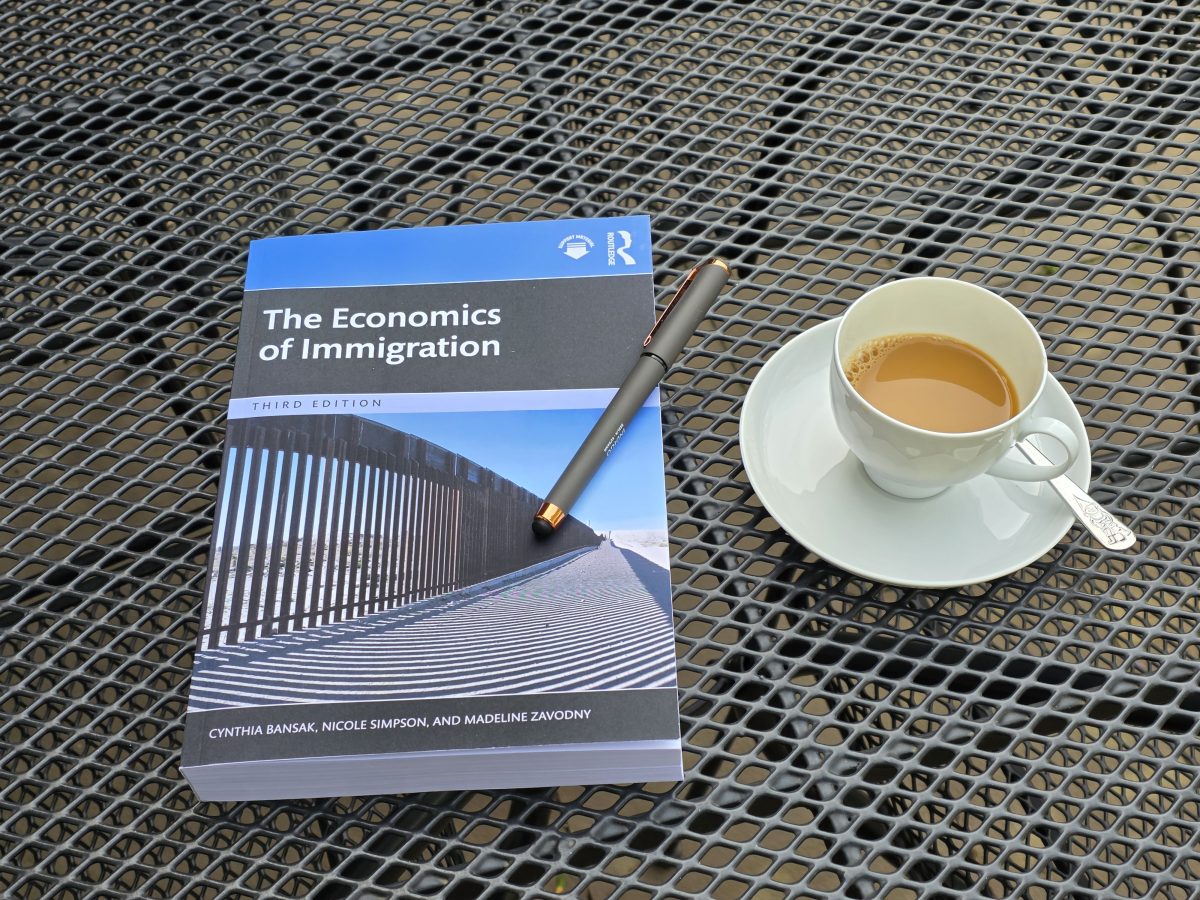

Routledge has just published the third edition of The Economics of Immigration, the leading textbook of the field, by Cynthia Bansak, Nicole Simpson, & Madeline Zavodny. Given the big challenges and large benefits societies may have with migration flows, an update of the rigorous economic analysis is very welcome. Klaus F. Zimmermann spoke with the authors about the value added of their work.
The authors
Cynthia Bansak is the Charles A. Dana Professor of Economics at St. Lawrence University. Prior to her current position, she was a professor at San Diego State University and an Economist at the Board of Governors of the Federal Reserve System. She received a Ph.D. in economics from the University of California at San Diego and a B.A. in economics from Yale University.
Nicole B. Simpson is the W Bradford Wiley Professor of Economics at Colgate University and the current department chair. She has been an Economics professor at Colgate since 2001. She has a PhD from the University of Iowa and a BA in economics from the University of St Thomas.
Madeline Zavodny is the Donna L. Harper and First Coast Systems Professor of Economics at the University of North Florida. She previously taught at Occidental College and Agnes Scott College as well as worked as an economist at the Federal Reserve Bank of Atlanta and the Federal Reserve Bank of Dallas. She has a PhD from MIT and a BA in economics from Claremont McKenna College.
The INTERVIEW
1. Purpose: What gap in how immigration economics is usually taught does this book try to fill, and what do you want a student to be able to achieve (analytically) after finishing it?
- Cynthia: The three of us found while teaching undergraduates that there wasn’t a book that provided a thorough introduction to immigration from an economic perspective that was aimed at students taking an undergraduate or introductory course on the topic. We wanted to fill that gap.

- Nicole: Overall, we want to show our students how useful economics can be in analyzing complex social issues such as immigration. And we want to get them excited to learn more about immigration so that they are informed world citizens. Students will be able to apply the supply and demand model to understand how immigration affects a myriad of markets, from labor markets to housing to ethnic food. We also expect students to be able to explain the potential macroeconomic determinants and effects of immigration. We want students to be able to distinguish carefully between correlation and causation and to begin to understand how economists evaluate causal claims regarding the impact of immigration. And we hope students will be able to explain immigration policy in major destination countries and some of the effects of those policies.
2. Textbook level: What prerequisites are you assuming (micro, labor, international, econometrics), and what does ‘success’ look like for an undergraduate vs a master’s student using the book?
- Nicole: Students who have had an introductory course in economics have enough foundation for our book. Students who have had a course in labor or econometrics will find the material easier to tackle, but students who have not should be fine. The book includes appendices that review basic topics, like supply and demand and producer and consumer surplus, and appendices that cover more advanced material, like the CES production function and identification strategies.

- Madeline: We hope that students who take a course that uses this book will be better equipped to apply economic tools – the “economic way of thinking” – to questions related to immigration. They should be better able to support arguments and claims regarding immigration using economic theory and evidence after taking this class. Master’s-level students and advanced economics undergraduates should have a better understanding of how economists attempt to evaluate causal claims regarding the economics of immigration and be better equipped to read research papers on immigration.
3. What’s new vs 2nd edition: What are the 3–4 most substantive changes in the third edition (new chapters/sections, new datasets, new policy episodes), and what motivated each change?

- Cynthia: I’d say first and foremost, the 3rd edition of the textbook places a significantly greater emphasis on refugees and asylum seekers. The sizable increase in forced displacement since the 2010s motivated us to shift our focus towards including refugees and asylees in our analysis of the economics of immigration, despite these groups not directly being categorized as economic migrants.
Second, we’ve added to our coverage of European immigration reflecting the central role that Europe has played in recent migration flows, particularly during the Syrian refugee crisis and the more recent war in Ukraine.
Third, we added more to our coverage of climate migration, political outcomes related to migration, and innovation by immigrants. These are areas of emerging research and increased policy relevance.
Lastly, we restructured the text to be more policy-oriented, with a focus on global policy. For example, we added recent changes in immigration policies in Japan and Korea – countries with historically few immigrants – and document important effects on population growth and fertility rates in those countries. In response to instructor feedback, we’ve moved our chapter on global immigration policies before those of US policies.
4. Competitors and differentiation: Which competing textbooks would you expect instructors to compare you to, and where is your value-add with respect to coverage breadth, theory-first framing, empirical identification, or policy institutions?
- Madeline: We wrote the textbook because we perceived a gap in the market, particularly for undergraduate students. There are at least two excellent books aimed at more advanced students: Örn Bodvarsson & Hendrik van den Berg’s The Economics of Immigration: Theory and Policy seems to be aimed at graduate students, and George Borjas’s Immigration Economics is probably best suited to PhD students and faculty. In addition, Amelie Constant & Klaus F. Zimmermann’s International Handbook on the Economics of Migration and Barry Chiswick & Paul Miller’s Handbook of the Economics of International Migration are terrific resources for PhD students and faculty. Like us, however, those books are all becoming older – this third edition of our textbook brings in more recent studies and covers immigration policy as of 2024. Our approach is grounded in theory, supported by data, with dashes of policy sprinkled throughout and then two chapters devoted to policy toward the end of the book.
- Cynthia: We all assign complementary books when teaching this course, either requiring all students to read them or giving a list and having students pick one or two and complete an assignment related to the book. This can be a great way for faculty to add country-specific material. Books we have assigned include Tara Watson & Kalee Thompson’s The Border Within, Jason DeParle’s A Good Provider Is One Who Leaves, and Jonathan Blitzer’s Everyone Who Is Gone Is Here.
5. Geographic scope (U.S. vs rest of world): Your description emphasizes cross-country policy comparisons and recent European policy changes: how systematically do you cover Europe, Asia, and Australia, and where do you think the U.S.-centric evidence base does ‘not travel well’ ?
- Madeline: All three of us teach in the United States, so the book includes a lot of U.S. coverage, but it also discusses immigration patterns, policy, and impacts in Canada and much of Europe. There is a fair amount about Australia and New Zealand, in part because they have such interesting migration policies. The book has less coverage of Asia, Latin America, and Africa, mainly because there is less research that is published in English and relatively easily accessible about those areas. We would like to include more discussion of non-Western areas and the global South if we do a 4th edition and would be delighted to have other GLO fellows send us their research or let us know about studies we should incorporate.
I think one area where the U.S. experience is quite different from a lot of Europe is with regard to immigrants and crime. As Chapter 14 discusses, the evidence for the U.S. is clear and compelling that immigration does not increase crime, particularly violent crime. Evidence for some European countries seems more mixed. Public perceptions of the impact of immigration on crime are related to how people vote, so crime is an important issue for researchers to study carefully.
- Cynthia: A couple of areas come to mind and as Madeline mentioned, we hope to increase coverage of these areas and point out these differences in future iterations of our textbook. An area that may not generalize well is the treatment of (or lack of focus on) informal labor markets. Much of the U.S. literature assumes high levels of formal employment and enforced labor laws. However, large informal sectors impact how immigrants work, earn income, and interact with native-born workers in many other parts of the world. Second, in many parts of the “Global South,” internal migration is more prevalent than international migration, particularly in China. The current focus on the decision to migrate abroad may not translate well to contexts where the decision to migrate is more local (rural to urban) or seasonal.
- Nicole: In Chapter 14 of the third edition, we added more findings about how immigrants impact voting outcomes and natives’ attitudes towards immigration. There is a lot of exciting new work coming out of Europe about how immigrants affect political outcomes. Our sense is that these results may be unique to Europe and may not be generalizable to other contexts. It’s too early to say, as we need more research in countries like Canada, the U.S., Australia, Japan, etc., to fully understand the effects.
6. Internal migration: Do you use internal migration as a benchmark case for the models and empirics (e.g., selection, adjustment, local labor markets), or do you treat it as conceptually different, and why?
- Nicole: The book discusses internal migration, particularly in the U.S. and China, and points out that internal migration is similar to international migration but, in most cases, has lower migration costs – there are usually fewer legal barriers and lower psychic costs, for example, if someone is moving within the same country instead of to another country. Most domestic students can relate easily to internal migration, while international students add their own experiences to the class. In addition, understanding the response in native internal mobility when immigrants enter or exit a local market is essential to accurately capturing the economic effects of immigration.
7. Net benefits question: If a policymaker asks ‘is immigration good for the economy?,’ what’s your disciplined answer in terms of (I) aggregate surplus, (ii) distributional impacts, and (iii) fiscal incidence?
- Cynthia: To answer this question and its subcomponents, I would stress that a disciplined answer must be grounded in evidence rather than anecdotes and people’s perceptions. I’d say that the large body of empirical work finds that immigration generates net gains overall, but there are winners and losers. The aggregate surplus depends on the size of the immigrant flows, the elasticity of labor demand, substitutability vs. complementarity of immigrants, the timing (capital adjustment), and skill composition. Estimates of the immigration surplus tend to be positive but small relative to the size of the economy. The fiscal incidence depends on the time period under study, the methodology utilized, the region under focus, and the polices in place that provide (or prohibit) government services to immigrants. Our textbook aims to cover these topics in Chapter 1 (Immigration Surplus), Chapters 4-6 (Selection), and Chapter 10 (Fiscal Effects).
- Nicole: When I teach this course, I emphasize the importance of assumptions. Economic analysis of immigration almost always hinges on the assumptions that are being made (explicitly or implicitly) by the researcher. And bias can dictate some of the assumptions being made. Students must be skeptical by making sure that the assumptions are clear and make sense in the relevant context. I always tell my students to think about the questions in unbiased ways and to question if the assumptions are driving the results. The bottom line is that there are always winners and losers with immigration; who wins and who loses and by how much depends on the assumptions and the quality and quantity of the data being analyzed.
- Madeline: (i) More people means higher aggregate output and income. Whether it means high per-capita output and income is trickier and depends in part on the characteristics of the immigrants, but in most countries this has been positive since immigrants tend to be working age. (ii) The distributional impacts depend on the characteristics of the immigrants relative to the native-born population. The economic benefits are largest when immigrants are very different from the people already there, but some of the people already there who are the most similar to immigrants may experience adverse impacts. But I think, at its heart, most objections to immigration are about culture, not economics. (iii) The fiscal impact depends on how the fiscal system is designed – a system that has relatively limited redistribution, like the U.S., may gain nationally, but areas that receive large numbers of immigrants may bear considerable fiscal costs.
8. From selection to assimilation mechanisms: Across your chapters on selection, assimilation, and the second generation, which mechanisms do you treat as first-order for outcomes (human capital, language, networks, discrimination, legal status)?
- Madeline: The book covers human capital in considerable depth since education is one of the best predictors of how well immigrants will do in the labor market. Fluency in the destination language tends to be correlated with education, and the evidence on age at migration and critical windows for becoming fluent in a language is compelling. We also devote a lot of attention to networks, particularly with regard to selection and assimilation of the first generation, since the evidence is clear that networks influence the volume and characteristics of immigrants. We do not devote much attention to discrimination, which I think is an under-researched area when it comes to immigrants. Legal status affects assimilation, and parents’ legal status tends to affect their children’s outcomes – the book discusses legal status some with regard to assimilation and other outcomes, but we tend to focus more on it in the policy chapters.
9. Beyond wages: “In ‘effects on other markets in the destination,’ you go beyond labor markets: what do you regard as the most credible findings on the housing/consumption/industry mix, and what identification pitfalls should readers be most wary of?”
- Nicole: Recent research on the effects of immigration on the housing markets is really interesting. The housing sector is a very important sector in most advanced economies’ macroeconomic situations. Immigrants are often important contributors to the supply of housing but can also have nontrivial effects on housing demand. The elasticity of housing supply is especially important in estimating the quantitative effects of immigrants on rents and housing stocks, but varies across countries, regions, and cities. How natives respond to changes in local housing markets is critical in measuring the impacts. So far, the evidence is mixed, with some research finding sizable effects on house prices and rents, while others find negligible effects. Importantly, the general equilibrium effects must be considered.
10. Source countries and new frontiers: When you turn to source-country effects and ‘frontiers’ (e.g., remittances, brain drain, trafficking, climate/forced migration), where does the welfare calculus genuinely hinge on parameter values or institutional context rather than ideology, and what research design do you think will move that debate next?
- Cynthia: This is a complicated question. For remittances, the key parameters are how much remittances increase productive capital versus increase consumption, reduce labor supply, and crowd out public funding. Some research shows that remittances increase schooling, health, and insurance against shocks, while other research finds that remittances can lead to inflation and increased dependence on emigration. For brain drain, the main issue is what happens to the domestic human capital stock per capita due to emigration of skilled workers. Ultimately, these are empirical questions where the answer may depend on the specific immigration flow. Lastly, while possibly adding to the immigration surplus, irregular migration coupled with enforcement efforts can lead to increased costs of trafficking and dangerous crossings, which can worsen welfare. Going forward, I believe research that emphasizes both the origin and destination simultaneously would help policy makers coordinate mutually beneficial policies. Ideally, researchers can examine a natural experiment that cleanly identifies a migration shock, can measure who leaves and who stays, and can examine the impact on wages, public goods, human capital formation, and household welfare in a more general-equilibrium-informed empirical analysis.
Klaus: Thank you very much for a great exchange. Best success for your book.