The traditional annual signature conference of the Global Labor Organization (GLO) with support of the Journal of Population Economics (JOPE) takes place in Bonn and online globally (GLO-Bonn-2026).
Deadline extended to 26 September 2026 on many requests. Already many more than 100 papers accepted: LINK
Contribute or just participate at the Global GLO-JOPE Bonn Conference 2026, Nov 30 to Dec 4, either in-person or online on population economics topics broadly defined.
In-person in Bonn November 30 – December 2, 2026. Online access to sessions. Deadline for proposals September 26, 2026.
Online sessions December 3-4, 2026. Global in different time-zones. World-wide access from all participants. Deadline for proposals September 26, 2026.
GLO Job Market Sessions online only on December 3-4, 2026. Deadlinefor proposals November 1, 2026.
We invite contributions addressing human resources issues, including topics related to labor, population, development, family, fertility, migration, refugees, health, crime, conflict, religion, and behavioral economics.
We are particularly interested in papers focusing on
Call for Papers: Register your interest to participate and submit a CONTRIBUTED PAPER PROPOSAL (paper or abstract) until 26 September2026 (6:00 am Eastern Standard Time) to:
Matthias Sutter (Max Planck Institute for Research on Collective Goods & University of Cologne): How to be a good leader: Insights from behavioral economics
Klaus Prettner (Vienna University of Economics and Business; JOPE Associate Editor): AI, wage inequality, and the labor share
ONLINE (Dec 3 – 4) Dec. 3: 2-3 pm CET. GLO Monthly Seminar. Chair: Viola Angelini (University of Groningen; JOPE Associate Editor) Julie Hotchkiss (Federal Reserve Bank of Atlanta) What’s Behind Declining Birth Rates in the U.S.?
The traditional annual signature conference of the Global Labor Organization (GLO) with support of the Journal of Population Economics (JOPE) takes place in Bonn and online globally (GLO-Bonn-2026).
Contribute or just participate at the Global GLO-JOPE Bonn Conference 2026, Nov 30 to Dec 4, either in-person or online on population economics topics broadly defined.
In-person in Bonn November 30 – December 2, 2026. Online access to sessions. Deadline for proposals September 26, 2026.
Online sessions December 3-4, 2026. Global in different time-zones. World-wide access from all participants. Deadline for proposals September 26, 2026.
GLO Job Market Sessions online only on December 3-4, 2026. Deadlinefor proposals November 1, 2026.
We invite contributions addressing human resources issues, including topics related to labor, population, development, family, fertility, migration, refugees, health, crime, conflict, religion, and behavioral economics.
We are particularly interested in papers focusing on
Call for Papers: Register your interest to participate and submit a CONTRIBUTED PAPER PROPOSAL (paper or abstract) until 26 September2026 (6:00 am Eastern Standard Time) to:
KEYNOTE SPEAKERS (in-person: Nov 30 – Dec 2) Matthias Sutter (Max Planck Institute for Research on Collective Goods & University of Cologne): How to be a good leader: Insights from behavioral economics Klaus Prettner (Vienna University of Economics and Business; JOPE Associate Editor): AI, wage inequality, and the labor share
ONLINE (Dec 3 – 4) Dec. 3: 2-3 pm CET. GLO Monthly Seminar. Chair: Viola Angelini (University of Groningen; JOPE Associate Editor) Julie Hotchkiss (Federal Reserve Bank of Atlanta) What’s Behind Declining Birth Rates in the U.S.?
Abstract. This paper develops and tests a life-cycle hypothesis of sleep investment. Motivated by evidence from psychology, aging, and sleep research that the consequences of insufficient sleep become increasingly severe with age, we argue that individuals facing stronger productivity incentives should increasingly preserve sleep as they age. We formalize this idea in a simple life-cycle framework in which sleep is a productive activity that competes with work and leisure for time. We test the framework using longitudinal data from the National Longitudinal Study of Adolescent to Adult Health (Add Health). We focus on adolescent physical attractiveness and college education as two characteristics associated with occupational sorting and long-run productivity incentives. While both characteristics exhibit little association with sleep duration in early adulthood, their relationships with sleep become increasingly positive over the life cycle. Attractive individuals and college graduates experience substantially less negative declines in sleep duration with age and increasingly sleep longer relative to their counterparts in later adulthood. Additional analyses show that these patterns are strongest among workers and are not readily explained by mental health, sleep difficulties, social participation, or reverse causality through sleep affecting later attractiveness. More broadly, the findings suggest that differences in long-run productivity incentives contribute to divergent sleep trajectories over adulthood and support a life-cycle perspective on sleep investment.
Featured image: Jordan-Whitt-EerxztHCjM8-unsplash
Structured Overview (links to papers below)
TOPIC
PAPER
SUMMARY
Household time, gender & life-cycle behavior
1808 – Who Absorbs a School Day? School Schedules and Household Time Allocation
School-day changes mainly alter children’s time use, with limited effects on mothers’ market work.
1804 – Gender Convergence in Paid Work, but Not in Care Activities
Paid-work gender gaps narrowed, while inequalities in unpaid care persisted or increased.
1802 – Sleeping Investment: A Life-Cycle Hypothesis
Sleep increasingly acts as a productive investment over the life cycle.
Climate, environment & sustainability
1807 – Surviving the Daily Heat: Climate Change and Labor Productivity
Extreme heat reduces earnings and labor supply among daily-wage workers.
1803 – Land Use, Food-Energy-Environment Trade-Offs & the SDGs
Sustainable development requires integrated policies across land, food, energy and biodiversity.
Firms, workplace institutions & resilience
1806 – Works Council Elections and Voter Turnout
Works council election turnout depends on workplace institutions, economic conditions and union support.
1801 – Relative Productivity and SME Closure During COVID-19
Low relative productivity increases SME closure risk during economic shocks.
Technology, regional transformation & inequality
1805 – Agglomeration, Complexity and Unequal Gains
Agglomeration raises income inequality, while economic complexity moderates this effect.
1798 – How Amazon Shapes Local Labour Markets
Amazon entry lowers local wages and shifts incomes toward the lower end of the distribution.
1796 – Applications of Artificial Intelligence in the Vietnamese Economy
AI can raise productivity, but gains depend on skills, training and job quality.
Education, health & human capital
1800 – Education and Earnings in Europe
Additional education causally raises earnings, with particularly high returns to tertiary education.
1799 – Labour Market and Health Effects of a Diabetes Warning
Diabetes-risk information changes health behavior and labor-market activity, with heterogeneous effects by age and gender.
Migration attitudes & policy
1797 – Perceptions of Immigrant Privilege and Immigration Policy Preferences
Perceived immigrant privilege is strongly associated with support for restrictive immigration policies.
The Global Labor Organization (GLO) is pleased to announce a call for submissions for its annual conference (GLO-JOPE-Bonn-2026), which will be held from November 30 – December 2, 2026 in-person in Bonn/Germany and December 3-4, 2026 online. (Submission deadline for regular contributed papers is September 14, 2026.)
Affiliated to this online part of the conference are onlineJob Market Sessions for young scholars, which have been very successful in previous years. The submission deadline for these sessions is November 1, 2026.
GLO Young Scholars Program invites job market candidates (PhD students or postdocs currently on the market in North America, Europe or Asia) to submit their research for presentation in dedicated job market sessions. This is a valuable opportunity to showcase your work and gain exposure in a supportive and high-profile environment. A special social event, including a networking and mentoring session for the selected presenters, will take place after the presentations.
Session Focus: The job market sessions will focus on research related to labor, demography, health, or human resources broadly defined. We welcome submissions from candidates in all related disciplines.
Submission Requirements: Proposals must include:
A paper or extended abstract of one’s Job Market Paper
A CV
Session Regions Preferences: The job market sessions will also be organized by region based on their preferences for the timing of their presentations and the market of potential employers:
North America
Europe
Asia
Please indicate your session preference in your submission. Presentations will be in English.
Submission Deadline: All submissions must be received by November 1, 2026 Notification of decision will be sent on November 8, 2026.
Submission Process: Please click on the link below (or scan the QR code below) to submit your information and the required documents. If you have any questions regarding the submission process, feel free to contact Dr. Le Wang, Director of GLO Young Scholars Program.
Presenters are invited to provide a link to their personal websites which will be featured on the GLO website in the conference program, enhancing their portfolio’s visibility within the global research community.
Presenters will also be invited to a special social event featuring networking and a mentoring session focused on the job market experience, where committee members and peers share insights and advice.
Presenters will also have the opportunity to serve as a discussant for another selected paper, gaining valuable experience engaging with and providing constructive feedback on research by fellow job market candidates.
The online format minimizes costs, making participation accessible to candidates with limited financial resources. To further support early-career scholars, registration fees are waived for all job market candidates. This encourages a diverse set of institutions to be represented.
Gain valuable experience presenting your research in a highly supportive environment, helping you refine your job market pitch and assess the progress of your work.
Presenters will be eligible for an invitation to join the prestigious GLO network as a research affiliate, providing further opportunities for collaboration and professional growth.
We look forward to your participation and to supporting the next generation of scholars in labor and related fields.
To meet the continuously rising supply of submissions, the Journal of Population Economics (JOPE) announces the appointments of three new Associate Editors
Bruno Martorano, UNU-MERIT and Maastricht University, Maastricht, The Netherlands
Klaus Prettner, WU Vienna University of Economics and Business, Vienna, Austria
Further: Fiona Tregenna, United Nations University – MERIT, Maastricht, The Netherlands, has joined JOPE’s Advisory Board. She is the Director of UNU-MERIT. The institute is supporting the mission of the Journal and is collaborating with GLO.
Springer Nature as the publisher and the entire JOPE editorial team are delighted to welcome the colleagues in their new roles and look forward to a dynamic, productive, and inspiring collaboration that will further elevate the exceptional service the journal provides to its users.
JOPE expects to receive over 1,500 submissions in 2026, and has just started to invite contributions to two new Collections:
Perspectives of Population Economics This Collection features peer-reviewed research articles in a perspective and agenda-setting style that advance debates in population economics through synthesis, forward-looking argumentation, and policy relevance, while meeting the same empirical or theoretical standards as regular submissions.
Restricting Migration Restricting migration, including immigration, emigration, and remigration, has become a policy objective in many countries worldwide. Does it work, and what are its economic and social consequences?
Interested to interact with the JOPE editorial team? Contribute or just participate at the Global GLO-JOPE Bonn Conference 2026, Nov 30 to Dec 4, either in-person or online on these or related population economics topics broadly defined. For further details see CONFERENCE CALL.
“InGuidelines for the Responsible Practice of Economics, Dr. Steven Payson provides a thoughtful, constructive framework for navigating the modern analytical landscape. Drawing on extensive experience across both academia and the federal government, he offers 36 practical guidelines designed to strengthen empirical research, enhance methodological transparency and scientific integrity, and bridge the gap between abstract theory and effective public policy.” amazon
Dr. Steven Payson is a Senior Lecturer and Program Coordinator in Applied Economics at Johns Hopkins University. He holds a Ph.D. in economics from Columbia University and has an extensive professional background spanning major academic institutions—including Georgetown University, the University of Maryland, and Virginia Tech—as well as leadership roles as a senior economist across multiple U.S. federal agencies. A widely published author on economic measurement, technological change, public policy analysis, and the scientific integrity of economic methods, Dr. Payson brings decades of rigorous, real-world experience to examining the foundational practices of the profession.
With Steven Payson spoke GLO President Klaus F. Zimmermann.
1. What sparked your interest in research and publication ethics, and why does economics need explicit ethical guidelines?
My interest in this general topic began when I was a graduate student in economics during the 1980s, as I observed the extent to which graduate-level economic theory had become overly reliant on mathematical showmanship rather than the advancement of useful knowledge. I have pursued this area throughout my career, addressing it partially in my dissertation, through founding the nonprofit Association for Integrity and Responsible Leadership in Economics and Associated Professions (AIRLEAP), and in prior publications leading up to this book. These efforts were fueled by a personal desire to see economics improve, believing it can do much better for the benefit of society.
However, that initial focus on “research and publication ethics” does not fully capture the scope of my new book, Guidelines for the Responsible Practice of Economics. While responsibility certainly includes ethical behavior, it also encompasses a leadership commitment and professional actions that extend well beyond research and publishing—and which most people, and economists in particular, do not typically associate with ethics.
For example, if you asked most economists whether they are ethical, the vast majority would immediately answer yes. In their minds, they are ethical because they have never abused a relationship with a coworker, taken a bribe, or falsified data. Responsible leadership, however, has a much wider scope. Suppose an economist in a position of great authority upholds a public policy simply because it aligns with an esoteric model—one they may not even fully understand or care to study—driven by the sycophantic assumption that the model must be correct because its developer is a famous, highly acclaimed economist. If that model has the potential to cause real societal harm, but the authority figure dismisses any concerns simply because those concerns were raised by sources with lower professional prestige, then that would be deeply irresponsible. Yet, few people would view that failure as a violation of traditional research and publication ethics. The word “ethics” narrows the scope too much, masking real-world problems of professional responsibility that go far beyond conventional definitions.
As for why economics needs guidelines for responsible practice, Guideline #3 provides the most vital answer: “do no harm”—a fundamental directive that every profession requires. The absence of such guidelines causes genuine harm to society, alongside losses in economic efficiency and basic human dignity, but the primary issue is avoiding the very real damage that bad economics can inflict.
2. Why has economics been more resistant than other social sciences to professional ethics, and where is that resistance most visible?
To frame this question constructively, I prefer to substitute the term “responsibility” for “ethics,” restructuring the query as: “Why has economics been slower than other social sciences to embrace professional responsibility, and where is that hesitation most apparent?”
While this question is surely posed in good faith rather than as a trap, it carries an inherent paradox. My writings do not declare that economics is uniquely insular compared to sister social sciences—a proposition whose factual basis is far from certain, given that professional blind spots and ethical lapses surface everywhere. To brand economics as the absolute worst offender would cast me as an isolated, uncharitable alarmist; conversely, to claim it is no worse than any other field would undermine the very premise for examining its unique institutional failures. Navigating this dilemma has required a consistent approach across decades of work.
Even under the most generous assumption that the vast majority of economic research is conducted honorably, a dangerous complacency takes root. Presuming the system functions smoothly allows widespread professional oversight to be swept aside by institutional apathy. At the same time, sliding into pure defeatism—the belief that the entire apparatus is hopelessly compromised—merely breeds a cynicism that defenders of the status quo can easily dismiss.
Discussions with colleagues in the physical and life sciences often surface a comforting yet misleading premise: the notion that maintaining scientific integrity is equally arduous across all intellectual domains. This argument treats integrity lapses as an immutable consequence of human nature, using universal fallibility as an excuse to insulate economics from specific critique. Yet economics occupies a distinct structural position. Its integrity failures are unmistakable, marked by an insular publishing ecosystem that prioritizes methodological abstraction over actual discovery. As I noted in previous investigations of journal metrics, the race for high-impact placements has increasingly converted scholarly publishing into an inward-looking exercise rather than an authentic pursuit of empirical truth. Because the discipline acts as a primary arbiter for how societal resources and incomes are apportioned, the neutrality of its frameworks carries immense weight. When analytical justifications for resource allocation are underwritten by the very beneficiaries of those arrangements, the independence of the science is deeply compromised.
Other fields face analogous pressures—medicine, for instance, operates under a severe “fatality constraint” where flawed clinical claims or dangerous remedies that directly harm patients are quickly exposed by undeniable physical outcomes. Economics lacks such immediate, unambiguous feedback loops; establishing causal links across complex macroeconomic systems is inherently difficult. For example, the severe global downturn of 2007–2008 undoubtedly triggered widespread hardship and elevated mortality across vulnerable populations worldwide, yet because those tragic outcomes are diffused through a complex global economy, the discipline largely shields itself from direct accountability.
Furthermore, locating where “resistance” manifests requires a slight reframing, as true resistance implies a deliberate, active defiance. My critique is not structured as an adversarial campaign, nor is the problem driven primarily by deliberate malice; rather, it stems from institutional inertia and a lack of awareness. Practitioners frequently operate simply by following the established paradigms passed down through their training, adopting conventional norms without critically evaluating their broader societal implications. The primary objective of my work is to illuminate these blind spots so that practitioners can recognize what responsible economic stewardship truly entails.
3. Of your 36 guidelines, which three address the most serious ethical problems in economics today?
While the question presumes that each of the 36 guidelines addresses an entirely isolated problem and that selecting the top three is straightforward, the guidelines are deeply interconnected rather than independent. To answer meaningfully, we can examine importance through three distinct lenses: hierarchical dependency, harm reduction, and the introduction of critical new perspectives that correct major professional blind spots.
When evaluating through the lens of hierarchical dependency, the very first guideline—realizing the need for guidelines—stands out as foundational, because without it, the entire discussion is mute. Dismissing that background premise leaves 35 guidelines, among which numbers 2, 3, and 4 are paramount: recognizing the important responsibility of being an economist, doing no harm, and acting with honor and integrity. All subsequent rules, such as Guideline #27 on confronting institutional deception, logically derive from these foundational principles, as complicity in deception inherently risks causing harm and abandoning integrity.
If we set aside dependency and focus instead on which rules prevent the greatest real-world harm (extending from Guideline #3), three stand out:
Guideline #25 (Avoiding Alternative Realities Made Possible by Subfield Isolation): Insular academic subfields can generate catastrophic real-world outcomes, such as the financial crisis of 2007–2008, where self-referencing echo chambers insulate analytic models from external reality. When governments treat fringe theoretical models as valid equivalents, it allows policy to be captured by narrow political or corporate agendas at the expense of society.
Guideline #28 (Distinguishing Between Science and Running Experiments): The broader issue here is the deep-seated methodological misunderstanding that simply running an experiment automatically confers scientific validity—a form of “experimental-scientist cosplay”. While the uncritical contemporary obsession with randomized controlled trials (RCTs) in development economics is a major corollary of this delusion (a topic I also explored in my recent book, Nobel Laureates Caring about Poverty), the overall problem is much larger, carrying a massive opportunity cost that diverts analytical energy and resources away from more productive and holistic forms of structural observation.
Guideline #30 (Eliminating “Hategoatism” and Upholding Analytical Objectivity): This guideline addresses a pervasive distortion where complex economic difficulties are falsely blamed on targeted groups rather than undergoing rigorous systemic evaluation. To justify coining the term “Hategoatism,” we rely specifically on the less common term “scapegoatism” rather than “scapegoating,” pairing it with dehumanization on the basis that these two behaviors most often coincide and reinforce each other.
Alternatively, if we evaluate importance through the lens of unique intellectual contributions that challenge industry blind spots, other critical areas emerge: Guideline #8 regarding the bibliometric citation-count and journal-ranking ecosystem, which impedes the accumulation of genuinely useful knowledge; Guideline #14 on scholastic escapism and the “nice bartender” mentality at the academic apex, which explains how the profession often lacks true, responsible leadership at the very top; and Guideline #34 on grounding technological change and economic models in scientific literacy to keep pace with the ongoing artificial intelligence revolution.
4. You criticize the “prestige engine” of top journals, citations, and rankings. Are these metrics fundamentally corrupting, or simply imperfect measures of research quality?
It is not even close—they are worse than “fundamentally corrupting”. They have placed a stranglehold on the profession’s ability to identify and accumulate useful knowledge.
Instead of operating as a legitimate science, the metrics turn the discipline into an intellectual sport, much like chess. Furthermore, they contaminate the thinking and culture of economics, making many practitioners proud to be winning an intellectual game rather than having a positive effect on the world. I realize this sounds outrageous and delusional to readers who are seeing these claims for the first time, but reading the book will easily eliminate such skepticism.
5. Economics has made major advances in replication, open data, and reproducibility. Does your book underestimate this progress?
I discuss these advances directly in the book, and I would not call them “major” advances, nor does the book underestimate this “progress”. Instead, the book explains why this progress has been greatly overestimated by the profession and misunderstood as reflecting scientific integrity when it does not.
Replication is merely a bare minimum requirement for any respectable science—the fact that economics has tried to achieve it is nothing for the profession to brag about. In the book, I liken it to a five-year-old child baseball player receiving an award from the coach for “best team spirit” for showing up to practice on time. Major league players do not get team-spirit awards; they are recognized for how well they actually perform on the field. The fact that a model can be reproduced means very little regarding its scientific validity.
In our profession, repetition has been completely misunderstood as scientific validation. For example, in my forthcoming book examining the estimated Value of a Statistical Life (VSL) used for cost-benefit analysis, that estimated value—derived from regressions of wages against safety risk probabilities—has been replicated across several studies. Yet each study repeats the same egregious error of omitted variables and failed robustness: adding just one dummy variable for the airline pilot occupation entirely strips away the statistical significance and value of the estimated parameter in every single replicated study. (While airline pilots earn high wages and face high risks, their higher compensation is driven by factors far beyond a simple personal risk premium that the model must assume.) Subfield isolation has allowed all VSL calculations to ignore this fundamental econometric and statistical inference error. And yet, the VSL subfield continues to announce the “replicability” of its results with pride, as if it attests to the scientific validity of the estimated VSL value.
As this suggests, using replicability as evidence of scientific validity is like rewarding sports players for how often they show up to practice. Economics is not T-ball for kindergarteners. Because economics has major-league effects on our society, it needs to be a major-league science, and that requires, at a minimum, understanding the difference between replication and scientific validity.
6. If, as you argue, reproducibility is only a minimum standard, what should matter more: robustness, external validity, better measurement, or substantive economic importance?
Objective truth is what matters. Are we truly learning how the world actually works, or are we putting on a good show to score points in the citation-publication tournament? It is that simple.
The situation has become so skewed that many economists view the pursuit of objective truth as comical naivete, much like a science fiction writer dismissing someone who points out that their movie violates the known laws of physics—dismissing the critique simply because violating physical laws does not hurt ticket sales. The fundamental question all economists need to ask themselves is: what effect will their work actually have on the world? If that effect is completely peripheral to the impact their work has on their career, then that is the real problem.
7. Your book notes that AI can now generate models, code, text, and references very well calls for greater “post-AI intellectual transparency.” Can you explain this and why one cannot find much about what ethical rules economists’ use of AI in research and publishing should follow?
What I meant by post-AI transparency is the following, quoted directly from the book: “In an era where machine-generated complexity is ubiquitous, individual economists must distinguish themselves not through their ability to produce esoteric notation, but through their ability to look inside the assumptions of a model, validate its variables against physical data, and articulate its relevance to the actual challenges of the global economy.”
This goes beyond the normal scope of discourse on ethical rules for using AI; it addresses the reality that artificial intelligence has eliminated the traditional competition among economists to demonstrate sheer mathematical prowess. Because showcasing complex math is no longer a differentiator—since anyone can generate it—we now need far greater transparency regarding what makes the underlying math scientifically valid or not.
Most current AI ethics discussions focus on authorship credit—specifically, how much credit a writer should receive for work that was assisted by or entirely generated from AI. That is an entirely separate can of worms that could have been discussed in the book, but because so many others are already addressing it, I did not think it would add as much unique value.
One thing I will note, however, is that economic journals are showing their hand lately by asking contributors to specify the extent of their AI use, operating under the assumption that greater AI reliance makes a paper less deserving of publication. If artificial intelligence can be used to expand useful knowledge in economics—which it certainly can, provided glitches are properly addressed—it should be embraced in the same way computers were embraced during my lifetime. Restricting AI merely to preserve the citation tournament as a fairer test of human intellectual ability would mean throwing out the baby of useful scientific discovery with the bathwater of the citation tournament, ultimately reducing science to a mere sport. As I argue in the book, just as the historical idiom regarding the Colt-45 famously captured a shift in physical power during the 1800s—”God created men, but Sam Colt made them equal”—we are witnessing a similar, radical democratization of intellectual labor: “The universities created economists, but AI made them equal.” The profession needs to recognize this, accept it, and move past it, allowing AI to improve economic science, which it has the power to do.
8. Similar: Social media increasingly shapes academic visibility and debate; is its absence from the book a gap? Or are ethical standards when promoting findings, criticizing others, or communicating uncertainty online straightforward applications of your general guidelines?
I do not spend much time in the book tracking how various historical shifts have altered the profession. From my perspective, the effects of social media are peripheral to the core issues discussed, because I assume that social media is simply present as part of the background environment for everything mentioned. The same foundational ethical standards apply regardless of the communication medium used.
9. If unethical research behavior is largely driven by incentives, which institutional reforms in publishing, tenure decisions, or research assessment would matter most?
First, I prefer that we discuss “irresponsible research behavior” rather than “unethical research behavior,” as the former encompasses a much wider and more accurate scope.
I avoid singling out specific institutional reforms as “matter[ing] the most” because it is a trap that implicitly dismisses the factors left off the list and creates an easier target among the ones that are left standing.
In the book, I barely touch upon recommended institutional reforms for one primary reason: until our profession truly embraces these guidelines, any institutional reforms proposed will be rejected out of hand by the academic apex. Instituting those reforms would require admitting that a fundamental problem exists; if the establishment refuses to acknowledge a problem in the first place, their dismissal of suggested reforms will simply be misinterpreted by the broader community as proof that the issue was trivial all along.
I learned this the hard way when I argued in my earlier article, “Cite this Economics Paper!”, that reference lists should categorize citations—differentiating between essential citations, normal citations, citation fodder, and negative citations where authors cite work they are actively criticizing. Such categorization could have made the citation-counting tournament far more meaningful and useful. Yet no one ever adopted this reform in any reference sections other than my own work for a few years, until I gave up as well, realizing I was the only one following my own suggestion.
Meaningful reforms cannot be imposed top-down; they must originate from a fundamental re-examination of the true motivations driving why economists do their work. That internal reckoning is the hard part—once that shift occurs, the rest should follow relatively easily. In other words, before we can begin making structural changes, we must first determine and agree upon what the actual problems are that need to be solved.
10. Why does ethics still play such a limited role in economics education, and how should it be integrated into undergraduate and graduate training?
Again, the title of the book is Guidelines for the Responsible Practice of Economics—not Guidelines for the Ethical Practice of Economics, which would have resulted in a much smaller volume. “Responsibility” plays such a limited role in economic education because the principles of responsibility are not well known or understood by the educators themselves. Frankly, as the book clearly demonstrates, educators, themselves, need a lesson on responsibility before they can teach others about it, especially those who have defined success in their professional lives by how well they have fared in the publication-citation tournament.
With a smile, I dare say that the teaching of responsibility in economics can be easily integrated into undergraduate and graduate training through one simple act: having students assigned to read my book, and having professors cover it in class. I do not see this recommendation as a conflict of interest—I wrote the book for this very purpose.
11. Your book uses strong terms such as “Scholasticism,” “Hagiocracy,” and “citation tournament.” What achievement would make you revise your diagnosis of the economics profession?
There is only one achievement that would revise my diagnosis of the economics profession: the complete elimination of scholasticism, hagiocracy, and the citation tournament from economic discourse.
These terms are not designed to be insults—even though they may function that way in effect—but are simply accurate observations. When those observations change and the underlying practices disappear, the words will no longer apply.
12. What is the single most important piece of advice a young economist should follow who wants to maintain scientific integrity while still performing in the academic system?
Don’t be a coward! Stand up for what you believe. If you find yourself in a situation where your career goals conflict with your moral compass to be responsible, know first that you are not alone.
Of course, you cannot simply dismiss your career—you have to make the tradeoffs that make the most sense to you. But never let your career goals damage your thinking. Being forced to do something irresponsible is a cost you may sometimes have to pay, but do not let the situation distort your understanding of what responsibility actually means. When you can, plan your escape and find a situation where there is no longer a conflict between responsibility and your career. When you get old, you will look back on it and be glad that, whatever you had to do, you did it with full consciousness of your decisions.
Klaus F. Zimmermann: Many thanks for this inspiring exchange.
Five years after the Taliban returned to power in August 2021, their restrictions on women and girls have created a severe human-capital crisis with long-term consequences for Afghanistan. The most damaging measure has been the exclusion of girls from secondary school and women from universities, making Afghanistan the only country where secondary and higher education are formally prohibited for females. This means that an entire generation is losing skills, qualifications and professional experience that would otherwise contribute to the country’s teachers, doctors, entrepreneurs and public institutions. The education restrictions also reduce women’s future independence and increase risks such as early marriage, early childbearing and maternal mortality. Women’s wellbeing has deteriorated as restrictions on mobility, employment and participation in public life have increased isolation and psychological distress. Economically, Afghanistan is losing a large part of its potential labor force, as many women are excluded from education and employment. This reduces productivity, household incomes, entrepreneurship and long-term economic growth. These policies are weakening both women’s wellbeing and Afghanistan’s long-term economic development.
The Journal of Population Economics has recently published a study dealing with some of the economic consequences of mis-education of women in Afghanistan:
Najam, R., Patrinos, H.A. & Kattan, R.B. The mis-education of women in Afghanistan: from wage premiums to economic losses. Journal of Population Economics 39, 21 (2026). OPEN – FREE – ACCESS. https://doi.org/10.1007/s00148-026-01148-0
Abstract. This study examines the private monetary rate of return to schooling in Afghanistan. We use two novel datasets—a series of nationally representative household surveys (2007, 2014, 2020) and administrative data on public employees in 2018—and apply OLS, Heckman selection correction, and instrumental-variables estimation to measure returns to education. We find that one additional year of schooling, on average, is associated with a 3 to 7 percent increase in monthly income for wage earners, with higher returns for women. The schooling premium extends beyond the public sector into the broader labor market, where the gender pay gap is noticeable. We show that bans on women’s employment and schooling can translate into substantial income losses at both individual and national levels. These findings contribute to the literature on the economics of education in conflict-affected settings and underscore the role of sustained human capital investment.
Perth, 10-12 February 2027: The Australian Gender Economics Workshop 2027 will be hosted by the ARC Centre of Excellence for the Elimination of Violence Against Women (CEVAW) and the School of Accounting, Economics and Finance at Curtin University in partnership with Women in Economics Network (WEN). Location: Curtin University, Perth, Western Australia.
AGEW includes special sessions on the Economics of Violence Against Women, co-organised with CEVAW (Centre of Excellence for the Elimination of Violence against Women), GLO (Global Labor Organization), and the Journal of Population Economics (JOPE). These sessions are organised in the context of JOPE’s “Sexual and Domestic Violence” article collection.
Please indicate in your submission if you’d like your paper considered for these sessions. Submission to the JOPE collection after the workshop is optional and subject to standard peer review.
For enquiries on the special session, please contact JOPE Editor Prof. Astghik Mavisakalyan at astghik.mavisakalyan@curtin.edu.au.
Featured Image: dainis-graveris-lpyHSTHO7LM-unsplash
Interested to interact with the JOPE editorial team? Contribute or just participate at the Global GLO-JOPE Bonn Conference 2026, Nov 30 to Dec 4, either in-person or online on population economics topics broadly defined.
We invite contributions addressing human resources issues, including topics related to labor, population, development, family, fertility, migration, refugees, health, crime, conflict, religion, and behavioral economics.
We are particularly interested in papers focusing on
KEYNOTE SPEAKERS (in-person: Nov 30 – Dec 2) Matthias Sutter (Max Planck Institute for Research on Collective Goods & University of Cologne): How to be a good leader: Insights from behavioral economics Klaus Prettner (Vienna University of Economics and Business; JOPE Associate Editor): AI, wage inequality, and the labor share
ONLINE (Dec 3 – 4) Dec. 3: 2-3 pm CET. GLO Monthly Seminar. Chair: Viola Angelini (University of Groningen; JOPE Associate Editor) Julie Hotchkiss (Federal Reserve Bank of Atlanta) What’s Behind Declining Birth Rates in the U.S.?
This paper provides the first causal evidence that merely attributing identical creative work to AI rather than to a human affects how much meaning people derive from a task and how much effort they are willing to contribute. We conducted a preregistered survey experiment in nationally representative samples from the United States (N = 1,511) and the Netherlands (N = 2,117). Participants evaluated identical public health campaign slogans that were randomly attributed either to an AI system or to a human professional, allowing us to isolate the causal effect of AI attribution while holding the creative output constant. AI attribution reduced perceived task meaning modestly and made participants 13% less likely to contribute a slogan of their own, indicating lower voluntary effort. These findings suggest that AI can influence work not only by changing productivity but also by altering the perceived value of human contribution itself.
Structured Overview (links to papers below)
Topic
Paper
Summary
AI, technology & work
1792 – AI and Technological Relatedness in European Innovation (Europe)
How AI interacts with regional technological structures to shape innovation.
1788 – When AI Does the Work: Attribution, Meaning & Effort
Whether attributing work to AI changes perceived meaning and personal effort.
1787 – Job Quality Under AI and Human Oversight
How AI‑based vs. human oversight affects job quality.
Migration, refugees & social change
1795 – Refugee Absorption and Electoral Change (India)
How Partition‑era refugee inflows reshaped political outcomes.
1790 – Integrated Labour Markets, Fragmented Welfare Systems (EU)
How cross‑border work interacts with mismatched welfare systems and affects disposable income measurement.
Health, aging & mental well‑being
1794 – Dementia Diagnosis Underreporting (US)
How underdiagnosis affects downstream care engagement and planning for older adults.
1783 – The Good Old Days? Mental Health Across Birth Cohorts
Whether mental health has improved or worsened across generations.
Identity, discrimination & social norms
1793 – Skin Colour Salience and Perceived Discrimination (India)
Experimental evidence on how skin‑tone salience shapes perceived discrimination.
1786 – Norm Beliefs and Women’s Work (Pakistan)
How beliefs about others’ norms influence women’s labor force participation.
Climate shocks & labor markets
1789 – Temperature Shocks and Protest Voting
How extreme temperatures influence protest voting behavior.
1785 – Heat Stress and Labor Demand in India’s Informal Sector (India)
How rising temperatures affect labor demand in informal markets.
Education pressure & student outcomes
1781 – High‑Stakes Exams and Media‑Reported Student Suicides (India)
How exam pressure correlates with media‑reported student suicides.
Innovation systems & measurement limits
1782 – GDP and the Limits of Macroeconomic Measurement in the Age of AI
Why traditional GDP metrics struggle to capture AI‑driven economic activity.
Governance & institutions
1784 – Modern Slavery Governance in Universities
Why compliance‑only approaches fail to address modern slavery risks in higher education.
The international economics profession mourns the passing of Ira N. Gang, Professor of Economics at Rutgers University, a widely respected scholar of development, migration, labor economics, political economy, and public policy. His death is a profound loss to Rutgers and the global community of economists working on migration, development, and population issues.
Ira Gang received his Ph.D. in Economics from Cornell University in 1983. Before joining Rutgers University in 1986, he taught at Pitzer College and Claremont Graduate School and at Duke University. Rutgers remained his academic home for four decades. His international orientation was reinforced by many research visits across Europe and Asia and several appointments as an Alexander von Humboldt Research Fellow in Germany. He was also a Research Fellow of the Institute for the Study of Labor, IZA, and the Global Labor Organization, GLO.
Ira Gang
His research combined economic theory with careful empirical analysis. He made important contributions to the study of developing and transition economies, international migration, immigrant integration, ethnic identity, education, poverty, governance, foreign aid, and the political economy of migration. His work has appeared in leading journals, including the Quarterly Journal of Economics, Journal of Human Resources, Journal of Development Economics, Journal of Economic Theory, Industrial and Labor Relations Review, Economic Development and Cultural Change, and Journal of Population Economics. He was one of the founding editors of the Review of Development Economics and served on the editorial boards of several international journals, including as an Associate Editor of the Journal of Population Economics.
A significant part of his scholarly path was his collaboration with Klaus F. Zimmermann, GLO President and Founding Director of IZA. Their joint article, “Is Child Like Parent? Educational Attainment and Ethnic Origin,” published in the Journal of Human Resources in 2000, examined the educational attainment of second-generation immigrants in Germany and demonstrated the continuing importance of ethnic origin and networks. The research originated during Gang’s stay at the University of Munich as an Alexander von Humboldt Fellow and was further developed during Zimmermann’s visiting professorship at Dartmouth College. It became an influential contribution to the economics of immigrant integration, intergenerational mobility, and human capital formation, and it became the most cited article on Gang’s publication list.
The collaboration with Zimmermann formed part of a much broader intellectual partnership involving migration research, the Journal of Population Economics, and the international research community surrounding IZA. Gang became an IZA Research Fellow in 1998 and contributed repeatedly to its research activities and international conferences.
Ira Gang has also been a committed supporter of the Global Labor Organization (GLO) since its creation in 2017. As a GLO Fellow, he contributed to the international research network, disseminated his research through the GLO Discussion Paper Series, and actively participated in its scholarly activities. For instance, he presented his work on education and migration in the GLO Virtual Seminar Series. His support reflects a broader commitment to international academic cooperation, open intellectual exchange, and the advancement of younger researchers.
Ira Gang leaves behind a substantial scientific legacy and the memory of a scholar who strengthened institutions and young researchers, sustained international collaborations, and generously supported the global community of labor, migration, and development economists. He will be greatly missed.
The past year concluded with GLO Bonn 2025, the network’s European flagship event, supported by the Journal of Population Economics (JOPE). For a detailed report on this impressive gathering, please see LINK. We just concluded GLO Guangzhou 2026, the Asia flagship conference of GLO, another impressive event, please see LINK.
NOW: Please save the dates for GLO Bonn 2026.
November 30 to December 4, 2026, once again in hybrid form, both in Bonn and globally.
The event will take place at the dawn of two major milestones, the 40th volume of JOPE and the 10th anniversary of GLO, both to be celebrated in 2027.
November 30 to December 2, 2026 will see presentations in-person only with world-wide onlineaccess hosted with full hotel capacity by the Gustav Stresemann Institut (GSI) in the heart of Bonn. A great chance to foster academic exchange even after the hour and to visit the former German capital in the Christmas season.
December 3-4, 2026 will be online only with world-wide coverage.
The program will feature Invited and Contributed Paper Sessions, GLO Job Market Sessions, the GLO VirtYS Session, Special JOPE Paper Sessions, and several Keynote Speeches.
We invite contributions addressing human resources issues in a broad sense, including topics related to labor, population, development, family, fertility, migration, refugees, health, crime, conflict, religion, and behavioral economics.
We are particularly interested in papers focusing on Africa, India, China, globalization, or topics represented in the JOPE Collections.
Call for Papers: Register your interest to participate and submit a paper proposal (paper or abstract, submission portal open after July 26, 2026) to:
Submit early: Acceptance decisions are made continuously to allow for early travel and visa arrangements.
Visit Bonn and other near-by German destinations during the Christmas season to enjoy the many local Christmas markets. Explore the Beethoven House, discover the city’s wide range of museums, and tour the numerous art galleries of the former capital. Visit the Drachenfels and take in the spectacular views of the Rhine Valley.
More detailsannounced soon on this page.
Our team & I are looking forward to interact with you during the conference – in person or online!
Klaus F. Zimmermann GLO President & Editor-in-Chief, Journal of Population Economics
Further Conference Details
KEYNOTE SPEAKER Matthias Sutter (Max Planck Institute for Research on Collective Goods & University of Cologne)
PROGRAM COMMITTEE Including: Matloob Piracha, Max Tani, Klaus F. Zimmermann; JOPE Editors, Olena Nizalova (VirtYS), (IESR Invited Session), Le Wang (GLO Jobmarked Sessions)
ORGANIZATIONAL COMMITTEE Including: Klaus F. Zimmermann; Mehrzad Baktash, Yumei Yang
NOTE: Once included in the program, the fee per paper presenter is € 400 online, € 600 in-person, and € 950 in-person with accommodation and breakfast at GSI for up to 3 nights. For students and participants from low-middle income economies, following the World Bank definition, it is € 200 online, € 300 in-person, and € 650 in-person with accommodation and breakfast at GSI for up to 3 nights. Also included are coffee breaks, lunches and the conference dinner on December 2, 2026. These fees will also apply to non-presenting participants. Participants are encouraged to stay the full conference to maximize academic exchange.
57th EBES Conference – Prague will take place on October 15th, 16th, and 17th, 2026 in Prague, Czechia. The conference will be hosted by Pan-European University with the support of the Istanbul Economic Research Association.
Interested researchers from around the world are cordially invited to submit their abstracts or papers for presentation considerations. The event is HYBRID with both in-person and online paper presentations.
The conference aims to bring together many distinguished researchers from all over the world. Participants will find opportunities to present new research, exchange information, and discuss current issues. Although the focus is on Europe and Asia, all papers from major economics, finance, and business fields – theoretical or empirical – are highly encouraged. The conference will be held as a hybrid event, allowing participants to present via the Zoom platform and in person.
Deadline for Abstract/Paper submission is September 16, 2026.
EBES Executive Board
Prof. Klaus F. Zimmermann, UNU-MERIT, Maastricht, and Free University Berlin, Germany Prof. Mehmet Huseyin Bilgin, Istanbul Medeniyet University, EBES, Turkey Prof. Jonathan Batten, University Utara Malaysia, Malaysia Prof. Iftekhar Hasan, Fordham University, U.S.A. Prof. Euston Quah, Nanyang Technological University, Singapore Prof. John Rust, Georgetown University, U.S.A. Prof. Dorothea Schäfer, German Institute for Economic Research DIW Berlin, Germany Prof. Marco Vivarelli, Università Cattolica Del Sacro Cuore, Italy
Abstract/Paper Submission
Authors are invited to submit their abstracts or papers no later than September 16, 2026.
General inquiries regarding the call for papers should be directed to ebes@ebesweb.org
Publication Opportunities
Qualified papers can be published in EBES journals (Eurasian Business Review and Eurasian Economic Review) or EBES Proceedings books after a peer review process without any submission or publication fees. EBES journals (EABR and EAER) are published by Springer and both are indexed in the SCOPUS, EBSCO EconLit with Full Text, Google Scholar, ABS Academic Journal Quality Guide, CNKI, EBSCO Business Source, EBSCO Discovery Service, ProQuest International Bibliography of the Social Sciences (IBSS), OCLC WorldCat Discovery Service, ProQuest ABI/INFORM, ProQuest Business Premium Collection, ProQuest Central, ProQuest Turkey Database, ProQuest-ExLibris Primo, ProQuest-ExLibris Summon, Research Papers in Economics (RePEc), Institute of Scientific and Technical Information of China, Naver, SCImago, ABDC Journal Quality List, Cabell’s Directory, and Ulrich’s Periodicals Directory. In addition, while EAER is indexed in the Emerging Sources Citation Index (Clarivate Analytics), EABR is indexed in the Social Science Citation Index (SSCI) and Current Contents / Social & Behavioral Sciences. Furthermore, the qualified papers from the conference will be published in the regular issues of Eastern European Economics (SSCI & Scopus) and Singapore Economic Review (SSCI & Scopus) after a fast-track review.
Also, all accepted abstracts will be published electronically in the Conference Program and the Abstract Book (with an ISBN number). It will be distributed to all conference participants at the conference via USB. Although submitting full papers are not required, all the submitted full papers will also be included in the conference proceedings in a USB.
After the conference, participants will also have the opportunity to send their paper to be published (after a refereeing process managed by EBES) in the Springer’s series Eurasian Studies in Business and Economics (no submission and publication fees). This is indexed by Scopus. It will also be sent to Clarivate Analytics in order to be reviewed for coverage in the Conference Proceedings Citation Index – Social Science & Humanities (CPCI-SSH). Please note that the 10th, 11th, 12th, 13th, 14th, 15th, 16th, 17th, 18th, 19th, 20th, 21st, 22nd, 23rd, 24th, 25th, 26th & 27th, 28th, 29 (Vol. 1), and 30th EBES Conference Proceedings are accepted for inclusion in the Conference Proceedings Citation Index – Social Science & Humanities (CPCI-SSH). Other conference proceedings are in progress.
Important Dates
Conference Date: October 15-17, 2026 Abstract Submission Deadline: September 16, 2026 Reply-by: September 20, 2026* Registration Deadline: September 23, 2026 Submission of the Virtual Presentation: September 23, 2026 Announcement of the Program: September 29, 2026 Paper Submission Deadline (Optional): September 23, 2026** Paper Submission for the EBES journals: December 16, 2026
* The decision regarding the acceptance/rejection of each abstract/paper will be communicated with the corresponding author within a week of submission. ** Completed paper submission is optional. If you want to be considered for the Best Paper Award or your full paper to be included in the conference proceedings in the USB, after submitting your abstract before September 16, 2026 you must also submit your completed (full) paper by September 23, 2026.
Contact
Ugur Can, Director of EBES (ebes@ebesweb.org) Dr. Ender Demir, Conference Coordinator of EBES (demir@ebesweb.org)
The 22 new GLO Discussion Papers deal with issues related toimmigration, labor markets, inequality, health shocks, climate change, education, demographic change, risk behavior, public policy evaluation, poverty measurement, human capital, gender gaps, and political attitudes.
The abstract submission deadline for the 56th EBES Conference(2-4 July 2026) is June 11, 2026. The conference will take place on July 2nd, 3rd, and 4th, 2026, in Istanbul, Türkiye.
Call for Papers: 56th EBES Conference – Istanbul, July 2-4, 2026 Hosted by Istanbul Ticaret University (HYBRID with both in-person and online paper presentation) Abstract Submission Deadline: June 15, 2026
The conference aims to bring together distinguished researchers from around the world. Participants will find opportunities to present new research, exchange information, and discuss current issues. Although we focus on Europe and Asia, all papers from major economics, finance, and business fields – theoretical or empirical – are highly encouraged. The conference will be held as a hybrid event, allowing participants to present via the Zoom platform and in person.
The 12 new GLO Discussion Papers deal with issues related to gender, trade union density, inequality, poverty, preference for redistribution, dementia, wellbeing and immigration policy.
Global Labor Organization (GLO) invites interested young scholars to apply for participation in the 2026-27GLO Virtual Young Scholars Program (GLO VirtYS). This marks the eighth cohort of this successful GLO initiative, designed to support the career development of early‑stage researchers. The program also offers a unique opportunity to engage with GLO’s large and highly active global research network.
The application deadline is August 17, 2026, 5 PM GMT. For general information see GLO VirtYS Website.
DETAILS – Abstract
The 2026–27 GLO Virtual Young Scholars Program (GLO VirtYS) is a 10-month international research and mentoring initiative designed for early-career scholars committed to producing policy-relevant, high-quality academic work. Starting on October 1, 2026, selected participants will join a global cohort as GLO Affiliate and receive individual guidance from thematic cluster advisors, structured feedback on their research, and opportunities to present their findings within the GLO community. Upon successful completion by July 30, 2027, scholars will have the opportunity to submit their work to the GLO Discussion Paper Series and may be considered for appointment as a GLO Fellow.
Featured image: The-Coherent-Team-on-Unsplash
DETAILS – Call
2026-27 GLO Virtual Young Scholars Program (GLO VirtYS)
About GLO: The Global Labor Organization (GLO) is a global, independent, non-partisan and non-governmental organization that has no institutional position. The GLO functions as an international network and virtual platform for researchers, policy makers, practitioners and the general public interested in scientific research and its policy and societal implications on global labor markets, demographic challenges and human resources. These topics are defined broadly in line with its Mission to embrace the global diversity of labor markets, institutions, and policy challenges, covering advanced economies as well as transition and less developed countries.
Program’s Goal: In the spirit of the GLO Mission, the GLO VirtYS program’s goal is to contribute to the development of the future generation of researchers, who are committed to the creation of policy-relevant research, are well equipped to work in collaboration with policy makers and other stakeholders, and adhere to the highest standards of academic integrity. This goal is achieved through the process of working on a specific research paper within the duration of the program, which is 10 months starting from October 1st, 2026.
Program’s Advisory Board:
Jan van Ours, Professor of Applied Economics, Erasmus School of Economics Rotterdam, Netherlands, & Professorial Fellow, University of Melbourne, Australia
Marco Vivarelli, Professor at the Università Cattolica del Sacro Cuore in Milano and Director of the Department of Economic Policy
Le Wang, Chong K. Liew Chair and Professor & President’s Associates Presidential Professor, University of Oklahoma, USA
Klaus F. Zimmermann, Professor Emeritus, Bonn University, UNU-MERIT & President of GLO
Program’s Activities:
Virtual kick-off meeting of all the participants and Thematic Cluster advisors.
One-to-one activities with the Thematic Cluster Advisor will be agreed upon at the beginning of the scholarship period in an Individual Research Plan. These activities at a minimum shall include 2-3 virtual consultations, 1 review round of the completed research work and a discussion of the amendments (if needed) to follow up.
Provide a virtual platform for the GLO VirtYS program participants to present their findings and receive feedback from their peers and the GLO wider community.
The scholarship will conclude in July 2027 followed by the presentations of the scholars within a GLO-wide event. Then the GLO Management Board will make a decision on whether to promote the graduate to GLO Fellow based on the recommendations from their GLO VirtYS Advisors and the GLO VirtYS Director.
Research proposals are invited onhuman resources issues in particular related to Africa, AI and Human Resources, China, Conflict and War, Crime, Development, Environment and Human Capital, Family, Fertility Decline, Gender, Happiness, Health, Inequality, Labor-Management Relations, Migration, Regional Labor, Religion, Sexual and Domestic Violence, South-East Asia, Technology and Human Capital, Voting.
Benefits to the GLO VYSP Scholars:
All GLO VirtYS program participants will become GLO Affiliates, if they are not already, and receive a GLO Bio page.
GLO VirtYS program participants will be listed with pictures on the www.glabor.org website.
Feedback on their research from leading researchers in the area of their interest.
Networking opportunities with researchers from other countries within the same area and beyond
Access to GLO activities.
Interactions with the scholars of the cohort, program’s alumni, and the future cohorts.
Opportunity to promote own research via GLO channels.
Completed research paper ready for submission to the GLO Discussion Paper series.
Possibility of promotion to GLO Fellow after exceptional performance.
Eligibility criteria:
Applicant must be either currently enrolled in a doctoral program or be within 2 years after graduation as evidenced by the letter from the degree awarding institution or a degree certificate.
Applicant must be at an advanced stage of the analysis of the specific research question outlined in the research proposal evidenced by the submitted draft.
Applicant must be supported by a letter of endorsement from either one of the GLO Fellows or from the administration of one of the GLO supporting institutions.
The GLO Virtual Young Scholars will be selected by a Scientific Selection Committee consisting of the GLO VirtYS Program Director, GLO thematic cluster leads and other GLO VirtYS Faculty, and a member of the GLO Management Board.
The results of the selection will be posted on the GLO site www.glabor.org by September 21st, 2026. Scholars will be notified via email. In the 2026-27 academic year we expect to select 5-7 scholars.
The final research paper should be submitted by July 30th, 2027, by 5 pm GMT.
Upon completion of the program and based on the quality of the produced research paper, some of the GLO VirtYS programme graduates may be invited to become GLO Fellows and their paper accepted as a GLO Discussion Paper.
Evaluation criteria for applications:
Research excellence (30 points)
Policy relevance of the research question in a local and/or global context (25 points)
Potential for capacity development (25 points) (preference will be given to the applicants for which the GLO Young Scholars Program can bring the highest capacity development, compared to what the applicant would have achieved without being a GLO Young Scholar)
Feasibility of completion within the duration of the scholarship (20 points)
Application procedure:
Many applicants submit in the last days before the submission deadline. To avoid last minute problems, we ask applicants to apply in advance. Applications received after the deadline or applications that do not meet the requirements set out below will not be accepted.
To apply please complete the online application form with three attachments:
1. Research proposal (maximum 2 pages including references, single-spaced, font size 12) should include the following information:
• Formulation of the problem/ research question.
• Research methodology (data and empirical approach).
• (Potential) Practical/Policy implications.
• Reference list.
2. A 2-page CV
3. Transcript from the doctoral program or doctoral degree certificate
4. Letter of endorsement for the candidate and the research proposal from either one of the GLO fellows or from the administration of one of the GLO supporting institutions reflecting on the potential of the candidate to benefit from the Program and the merits of the research proposal.
Prior to the finalisation of the offer, short-listed candidates may be invited for a short interview to further assist with the assessment of the match of the candidate to what the program can offer.
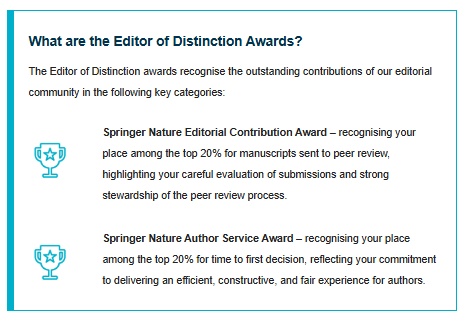
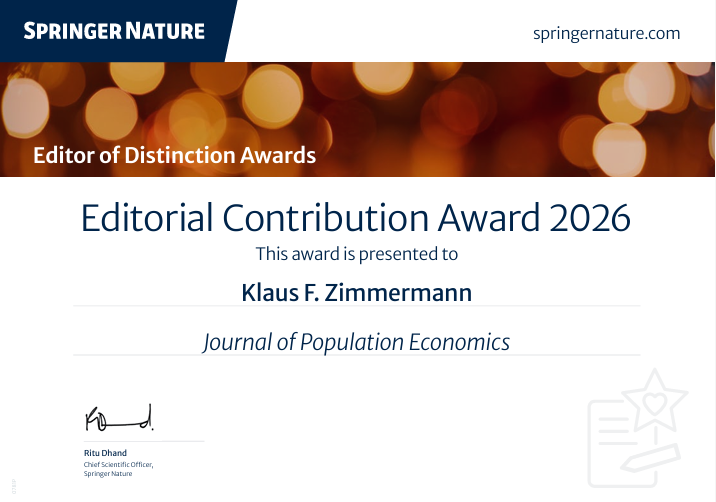
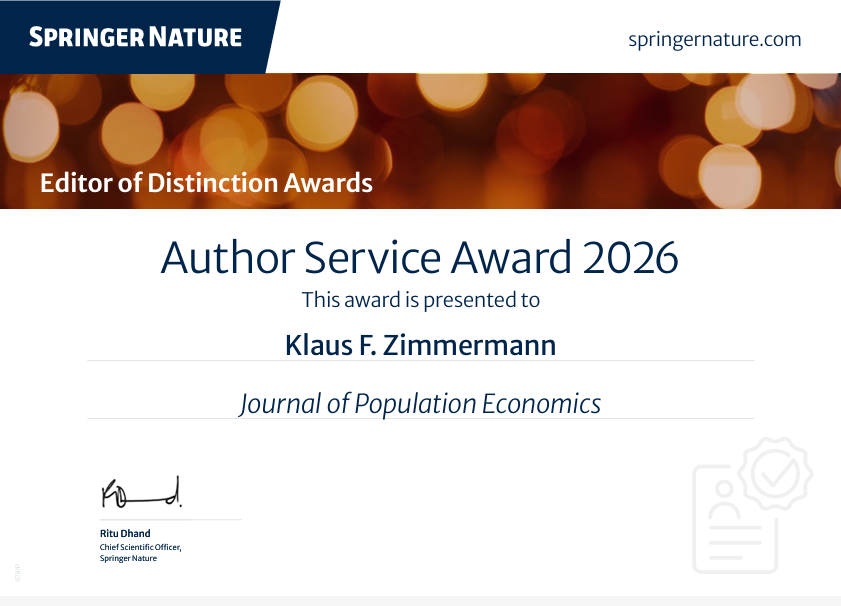
In 2026, like in the 2025 editorial cycle, Klaus F. Zimmermann and the Journal of Population Economics (JOPE) are again honored with the Springer Nature Editor of Distinction Awards, receiving both the Editorial Contribution Award and the Author Service Award.
The Editor‑in‑Chief, Klaus F. Zimmermann, and the entire editorial team express their sincere appreciation for this recognition of their substantial daily editorial efforts. JOPE handled more than 1,200 submissions in 2025, publishing 88 manuscripts, and anticipates approximately 1,500 submissions in 2026.
As Chief Scientific Officer Ritu Dhand writes on May 26, 2026:
“Dear Klaus F Zimmermann,
Your dedication to your journals and research communities is truly inspiring. By expanding your journal’s network, supporting your authors, and advocating for your communities, you play a vital role in advancing discovery.
This outstanding contribution deserves recognition, and you are being honoured through the Springer Nature Editor of Distinction Awards…
By rewarding you, we recognise the vital role you play in managing the peer review process and demonstrate our commitment to showcasing these activities. We greatly appreciate the time and expertise you dedicate to helping authors improve their manuscripts and are proud to work with you to build successful journals.
Congratulations and thank you for your dedication to your authors and advancing discovery!”
To meet the continuously rising supply of submissions, the Journal of Population Economics (JOPE) announces the appointments of two new Associate Editors
Eva Dziadula, University of Notre Dame, Notre Dame, United States
and the promotion from Associate Editor to Editor of
Ainoa Aparicio Fenoll, Collegio Carlo Alberto, Moncalieri, Italy; University of Turin, Turin, Italy
Springer Nature as the publisher, together with the entire JOPE editorial team, is delighted to welcome the colleagues in their new roles and looks forward to a dynamic, productive, and inspiring collaboration that will further elevate the exceptional service the journal provides to its users.
Ainoa Aparicio Fenoll Siyu ChenEva Dziadula
JOPE expects to receive about 1,500 submissions in 2026, and has just started to invite contributions to two new Collections:
Perspectives of Population Economics This Collection features peer-reviewed research articles in a perspective and agenda-setting style that advance debates in population economics through synthesis, forward-looking argumentation, and policy relevance, while meeting the same empirical or theoretical standards as regular submissions.
Restricting Migration Restricting migration, including immigration, emigration, and remigration, has become a policy objective in many countries worldwide. Does it work, and what are its economic and social consequences?
Again in 2025, over half of the articles published in Journal of Population Economics (JOPE) are related to one or more of the Sustainable Development Goals (SDGs). To celebrate this impact, the journal website displays again the Springer Nature SDG badge as was just announced (see below).
From: Springer Nature Date: Thu, May 21, 2026 at 11:02 AM Subject: Celebrating your journal’s contributions to the SDGs
Dear Klaus F Zimmermann,
We are delighted to let you know that in 2025, over half of the articles you published in Journal of Population Economics related to one or more of the Sustainable Development Goals.
In celebration of this important contribution, we want to acknowledge your journal’s significant impact on SDG-related research with your community. The journal website now displays our SDG badge along with the following text:
“We are proud to acknowledge that over 50% of the articles published in Journal of Population Economics in 2025 were related to one or more of the 17 Sustainable Development Goals (SDGs). Springer Nature supports the SDGs through a dedicated SDG Programme and is a signatory of the SDG Publishers Compact.”
The 23 new GLO Discussion Papers deal with issues related to (i) labor markets, migration, and demographic change, (ii) education, skills, and human‑capital formation, (iii) gender gaps, family policies, and household behavior, (iv) inequality, poverty, and social protection, (v) health, well‑being, and aging, (vi) technological change, AI, and productivity, (vii) environmental and climate‑related economic impacts, and (viii) development, institutions, and policy evaluation.
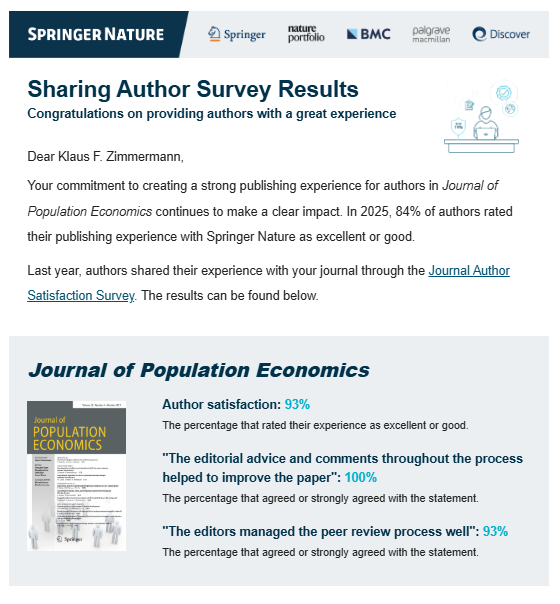
The Journal of Population Economics (JOPE) was just ranked A* on the Australian Business Deans Council (ABDC) Journal Quality List. This is the highest ranking a journal can achieve, reserved for a select group of journals demonstrating truly exceptional global impact. In 2025, JOPE’s Editor-in-Chief had received for his work two Springer Nature Editor of Distinction Awards. This success of the journal is the result of a strong and hard working editorial team: 606,400+ downloads in 2025 with over 1,200 submissions and a final acceptance rate of 7%.
This strength also reflects a deep commitment to service. While in 2025, 84% of authors rated their publishing experience with Springer Nature as excellent or good, the figure was 93% among JOPE authors. JOPE authors also stated:
“The editors managed the peer review process well” (93%).
“The editorial advice and comments throughout the process helped to improve the paper” (100%).
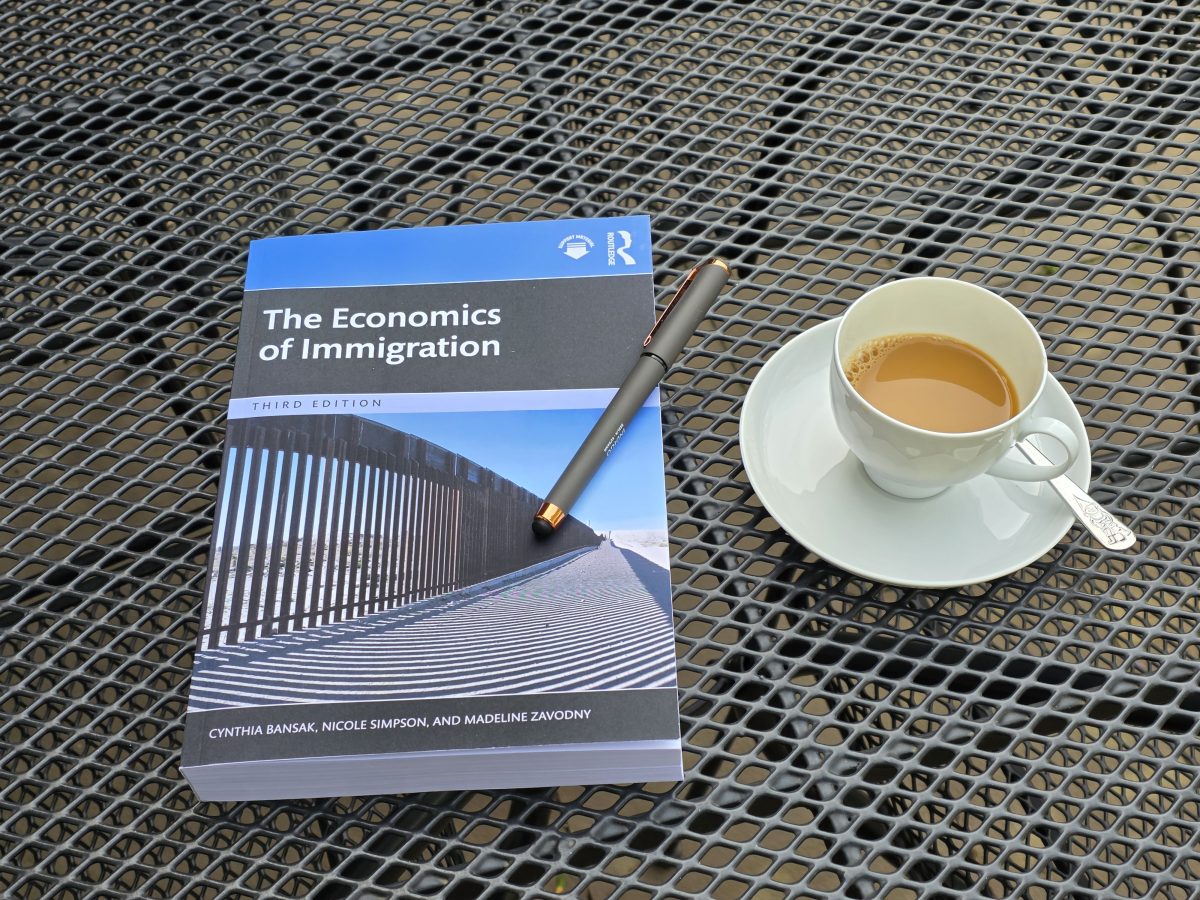
Routledge has just published the third edition of The Economics of Immigration, the leading textbook of the field, by Cynthia Bansak, Nicole Simpson, & Madeline Zavodny. Given the big challenges and large benefits societies may have with migration flows, an update of the rigorous economic analysis is very welcome. Klaus F. Zimmermann spoke with the authors about the value added of their work.
The authors
Cynthia Bansakis the Charles A. Dana Professor of Economics at St. Lawrence University. Prior to her current position, she was a professor at San Diego State University and an Economist at the Board of Governors of the Federal Reserve System. She received a Ph.D. in economics from the University of California at San Diego and a B.A. in economics from Yale University.
Nicole B. Simpson is the W Bradford Wiley Professor of Economics at Colgate University and the current department chair. She has been an Economics professor at Colgate since 2001. She has a PhD from the University of Iowa and a BA in economics from the University of St Thomas.
Madeline Zavodnyis the Donna L. Harper and First Coast Systems Professor of Economics at the University of North Florida. She previously taught at Occidental College and Agnes Scott College as well as worked as an economist at the Federal Reserve Bank of Atlanta and the Federal Reserve Bank of Dallas. She has a PhD from MIT and a BA in economics from Claremont McKenna College.
The INTERVIEW
1. Purpose: What gap in how immigration economics is usually taught does this book try to fill, and what do you want a student to be able to achieve (analytically) after finishing it?
Cynthia: The three of us found while teaching undergraduates that there wasn’t a book that provided a thorough introduction to immigration from an economic perspective that was aimed at students taking an undergraduate or introductory course on the topic. We wanted to fill that gap.
Nicole: Overall, we want to show our students how useful economics can be in analyzing complex social issues such as immigration. And we want to get them excited to learn more about immigration so that they are informed world citizens. Students will be able to apply the supply and demand model to understand how immigration affects a myriad of markets, from labor markets to housing to ethnic food. We also expect students to be able to explain the potential macroeconomic determinants and effects of immigration. We want students to be able to distinguish carefully between correlation and causation and to begin to understand how economists evaluate causal claims regarding the impact of immigration. And we hope students will be able to explain immigration policy in major destination countries and some of the effects of those policies.
2. Textbook level: What prerequisites are you assuming (micro, labor, international, econometrics), and what does ‘success’ look like for an undergraduate vs a master’s student using the book?
Nicole: Students who have had an introductory course in economics have enough foundation for our book. Students who have had a course in labor or econometrics will find the material easier to tackle, but students who have not should be fine. The book includes appendices that review basic topics, like supply and demand and producer and consumer surplus, and appendices that cover more advanced material, like the CES production function and identification strategies.
Madeline: We hope that students who take a course that uses this book will be better equipped to apply economic tools – the “economic way of thinking” – to questions related to immigration. They should be better able to support arguments and claims regarding immigration using economic theory and evidence after taking this class. Master’s-level students and advanced economics undergraduates should have a better understanding of how economists attempt to evaluate causal claims regarding the economics of immigration and be better equipped to read research papers on immigration.
3. What’s new vs 2nd edition: What are the 3–4 most substantive changes in the third edition (new chapters/sections, new datasets, new policy episodes), and what motivated each change?
Cynthia: I’d say first and foremost, the 3rd edition of the textbook places a significantly greater emphasis on refugees and asylum seekers. The sizable increase in forced displacement since the 2010s motivated us to shift our focus towards including refugees and asylees in our analysis of the economics of immigration, despite these groups not directly being categorized as economic migrants.
Second, we’ve added to our coverage of European immigration reflecting the central role that Europe has played in recent migration flows, particularly during the Syrian refugee crisis and the more recent war in Ukraine.
Third, we added more to our coverage of climate migration, political outcomes related to migration, and innovation by immigrants. These are areas of emerging research and increased policy relevance.
Lastly, we restructured the text to be more policy-oriented, with a focus on global policy. For example, we added recent changes in immigration policies in Japan and Korea – countries with historically few immigrants – and document important effects on population growth and fertility rates in those countries. In response to instructor feedback, we’ve moved our chapter on global immigration policies before those of US policies.
4. Competitors and differentiation: Which competing textbooks would you expect instructors to compare you to, and where is your value-add with respect to coverage breadth, theory-first framing, empirical identification, or policy institutions?
Madeline: We wrote the textbook because we perceived a gap in the market, particularly for undergraduate students. There are at least two excellent books aimed at more advanced students: Örn Bodvarsson & Hendrik van den Berg’s The Economics of Immigration: Theory and Policy seems to be aimed at graduate students, and George Borjas’s Immigration Economics is probably best suited to PhD students and faculty. In addition, Amelie Constant & Klaus F. Zimmermann’s International Handbook on the Economics of Migration and Barry Chiswick & Paul Miller’s Handbook of the Economics of International Migration are terrific resources for PhD students and faculty. Like us, however, those books are all becoming older – this third edition of our textbook brings in more recent studies and covers immigration policy as of 2024. Our approach is grounded in theory, supported by data, with dashes of policy sprinkled throughout and then two chapters devoted to policy toward the end of the book.
Cynthia: We all assign complementary books when teaching this course, either requiring all students to read them or giving a list and having students pick one or two and complete an assignment related to the book. This can be a great way for faculty to add country-specific material. Books we have assigned include Tara Watson & Kalee Thompson’s The Border Within, Jason DeParle’s A Good Provider Is One Who Leaves, and Jonathan Blitzer’s Everyone Who Is Gone Is Here.
5. Geographic scope (U.S. vs rest of world): Your description emphasizes cross-country policy comparisons and recent European policy changes: how systematically do you cover Europe, Asia, and Australia, and where do you think the U.S.-centric evidence base does ‘not travel well’ ?
Madeline: All three of us teach in the United States, so the book includes a lot of U.S. coverage, but it also discusses immigration patterns, policy, and impacts in Canada and much of Europe. There is a fair amount about Australia and New Zealand, in part because they have such interesting migration policies. The book has less coverage of Asia, Latin America, and Africa, mainly because there is less research that is published in English and relatively easily accessible about those areas. We would like to include more discussion of non-Western areas and the global South if we do a 4th edition and would be delighted to have other GLO fellows send us their research or let us know about studies we should incorporate.
I think one area where the U.S. experience is quite different from a lot of Europe is with regard to immigrants and crime. As Chapter 14 discusses, the evidence for the U.S. is clear and compelling that immigration does not increase crime, particularly violent crime. Evidence for some European countries seems more mixed. Public perceptions of the impact of immigration on crime are related to how people vote, so crime is an important issue for researchers to study carefully.
Cynthia: A couple of areas come to mind and as Madeline mentioned, we hope to increase coverage of these areas and point out these differences in future iterations of our textbook. An area that may not generalize well is the treatment of (or lack of focus on) informal labor markets. Much of the U.S. literature assumes high levels of formal employment and enforced labor laws. However, large informal sectors impact how immigrants work, earn income, and interact with native-born workers in many other parts of the world. Second, in many parts of the “Global South,” internal migration is more prevalent than international migration, particularly in China. The current focus on the decision to migrate abroad may not translate well to contexts where the decision to migrate is more local (rural to urban) or seasonal.
Nicole: In Chapter 14 of the third edition, we added more findings about how immigrants impact voting outcomes and natives’ attitudes towards immigration. There is a lot of exciting new work coming out of Europe about how immigrants affect political outcomes. Our sense is that these results may be unique to Europe and may not be generalizable to other contexts. It’s too early to say, as we need more research in countries like Canada, the U.S., Australia, Japan, etc., to fully understand the effects.
6. Internal migration: Do you use internal migration as a benchmark case for the models and empirics (e.g., selection, adjustment, local labor markets), or do you treat it as conceptually different, and why?
Nicole: The book discusses internal migration, particularly in the U.S. and China, and points out that internal migration is similar to international migration but, in most cases, has lower migration costs – there are usually fewer legal barriers and lower psychic costs, for example, if someone is moving within the same country instead of to another country. Most domestic students can relate easily to internal migration, while international students add their own experiences to the class. In addition, understanding the response in native internal mobility when immigrants enter or exit a local market is essential to accurately capturing the economic effects of immigration.
7. Net benefits question: If a policymaker asks ‘is immigration good for the economy?,’ what’s your disciplined answer in terms of (I) aggregate surplus, (ii) distributional impacts, and (iii) fiscal incidence?
Cynthia: To answer this question and its subcomponents, I would stress that a disciplined answer must be grounded in evidence rather than anecdotes and people’s perceptions. I’d say that the large body of empirical work finds that immigration generates net gains overall, but there are winners and losers. The aggregate surplus depends on the size of the immigrant flows, the elasticity of labor demand, substitutability vs. complementarity of immigrants, the timing (capital adjustment), and skill composition. Estimates of the immigration surplus tend to be positive but small relative to the size of the economy. The fiscal incidence depends on the time period under study, the methodology utilized, the region under focus, and the polices in place that provide (or prohibit) government services to immigrants. Our textbook aims to cover these topics in Chapter 1 (Immigration Surplus), Chapters 4-6 (Selection), and Chapter 10 (Fiscal Effects).
Nicole: When I teach this course, I emphasize the importance of assumptions. Economic analysis of immigration almost always hinges on the assumptions that are being made (explicitly or implicitly) by the researcher. And bias can dictate some of the assumptions being made. Students must be skeptical by making sure that the assumptions are clear and make sense in the relevant context. I always tell my students to think about the questions in unbiased ways and to question if the assumptions are driving the results. The bottom line is that there are always winners and losers with immigration; who wins and who loses and by how much depends on the assumptions and the quality and quantity of the data being analyzed.
Madeline: (i) More people means higher aggregate output and income. Whether it means high per-capita output and income is trickier and depends in part on the characteristics of the immigrants, but in most countries this has been positive since immigrants tend to be working age. (ii) The distributional impacts depend on the characteristics of the immigrants relative to the native-born population. The economic benefits are largest when immigrants are very different from the people already there, but some of the people already there who are the most similar to immigrants may experience adverse impacts. But I think, at its heart, most objections to immigration are about culture, not economics. (iii) The fiscal impact depends on how the fiscal system is designed – a system that has relatively limited redistribution, like the U.S., may gain nationally, but areas that receive large numbers of immigrants may bear considerable fiscal costs.
8. From selection to assimilation mechanisms: Across your chapters on selection, assimilation, and the second generation, which mechanisms do you treat as first-order for outcomes (human capital, language, networks, discrimination, legal status)?
Madeline: The book covers human capital in considerable depth since education is one of the best predictors of how well immigrants will do in the labor market. Fluency in the destination language tends to be correlated with education, and the evidence on age at migration and critical windows for becoming fluent in a language is compelling. We also devote a lot of attention to networks, particularly with regard to selection and assimilation of the first generation, since the evidence is clear that networks influence the volume and characteristics of immigrants. We do not devote much attention to discrimination, which I think is an under-researched area when it comes to immigrants. Legal status affects assimilation, and parents’ legal status tends to affect their children’s outcomes – the book discusses legal status some with regard to assimilation and other outcomes, but we tend to focus more on it in the policy chapters.
9. Beyond wages: “In ‘effects on other markets in the destination,’ you go beyond labor markets: what do you regard as the most credible findings on the housing/consumption/industry mix, and what identification pitfalls should readers be most wary of?”
Nicole: Recent research on the effects of immigration on the housing markets is really interesting. The housing sector is a very important sector in most advanced economies’ macroeconomic situations. Immigrants are often important contributors to the supply of housing but can also have nontrivial effects on housing demand. The elasticity of housing supply is especially important in estimating the quantitative effects of immigrants on rents and housing stocks, but varies across countries, regions, and cities. How natives respond to changes in local housing markets is critical in measuring the impacts. So far, the evidence is mixed, with some research finding sizable effects on house prices and rents, while others find negligible effects. Importantly, the general equilibrium effects must be considered.
10. Source countries and new frontiers: When you turn to source-country effects and ‘frontiers’ (e.g., remittances, brain drain, trafficking, climate/forced migration), where does the welfare calculus genuinely hinge on parameter values or institutional context rather than ideology, and what research design do you think will move that debate next?
Cynthia: This is a complicated question. For remittances, the key parameters are how much remittances increase productive capital versus increase consumption, reduce labor supply, and crowd out public funding. Some research shows that remittances increase schooling, health, and insurance against shocks, while other research finds that remittances can lead to inflation and increased dependence on emigration. For brain drain, the main issue is what happens to the domestic human capital stock per capita due to emigration of skilled workers. Ultimately, these are empirical questions where the answer may depend on the specific immigration flow. Lastly, while possibly adding to the immigration surplus, irregular migration coupled with enforcement efforts can lead to increased costs of trafficking and dangerous crossings, which can worsen welfare. Going forward, I believe research that emphasizes both the origin and destination simultaneously would help policy makers coordinate mutually beneficial policies. Ideally, researchers can examine a natural experiment that cleanly identifies a migration shock, can measure who leaves and who stays, and can examine the impact on wages, public goods, human capital formation, and household welfare in a more general-equilibrium-informed empirical analysis.
Klaus: Thank you very much for a great exchange. Best success for your book.
According to the ABDC’s 2025 Journal Quality List released on March 26, 2026, the Journal of Population Economics (JOPE) has been upgraded from A to A*. This is not a marginal move….
*****
The Editor-in-Chief and the Board of Editors are proud to announce that the Journal of Population Economics has been upgraded from A to A* on the ABDC Journal Quality List, the highest ranking a journal can achieve, reserved for a select group of journals demonstrating truly exceptional global impact.
This recognition is especially timely, reflecting the journal’s commitment to high-quality research. JOPE has been firing on all cylinders for some time, including:
📈 606,400+ downloads in 2025 with over 1,200 submissions and a final acceptance rate of 7%.
🏆 Ranked 2nd out of 140 journals in demography (CiteScore 2024, Scopus) and in the top 10% of all economics journals worldwide
🌍 Over 50% of articles published in 2025 were linked to the United Nations Sustainable Development Goals: evidence of research that matters beyond academia!
⭐ 44% (2024) and 79% (2023) greater citation impact than the average journal in its category
📚 An h-index of 91 (reported by Scopus in 2025) meaning that 91 of all published articles have each been cited more than 91 times
A five-year Impact Factor of 4.3 and a CiteScore of 8.7 (both measured in 2025 for 2024) further underscore the journal’s standing.
The A* designation places the Journal of Population Economicsamong the most elite publications across all business and economics disciplines globally. It is the culmination of decades of rigorous, policy-relevant research on the forces that shape human societies, namely fertility, migration, ageing, labour markets, health, and beyond.
To our authors, reviewers, editorial board, and readers: this is your achievement. Thank you for making this journal a home for the world’s best population economics research.
The bar is high. We wouldn’t have it any other way. 🏆
Contributed papers are invited to cover human resources issues broadly defined about labor, population, development, family, fertility, migration, refugees, health, crime, conflict, religion, and behavioral economics among other topics. Special interests include papers on China or contributions related to the themes of the JOPE Collections.
Submissions: Please submit complete manuscripts or extended abstracts by March 23, 2026.
Notification of acceptance will be sent by April 10, 2026. Participants based in Mainland China are exempt from the registration fee upon acceptance.
Event details: The event will be held in-person only. Present JOPE Editors may recommend authors to submit their presented papers for review at the Journal passing the desk-rejection stage. IESR, as the local host, will provide hotel recommendations and invitations for visa applications, the conference venue, and meals. Participants must cover their travel expenses. The fee per presented paper is € 500 for international participants (€ 250 for students and participants from low-middle income economies, following the World Bank definition).
The 16 new GLO Discussion Papers deal with issues related to (i) deep roots of collaboration, (ii) gender-based crime & violence, (iii) female political leaders, (iv) wellbeing and mental health behind bars, (v) schooling and human capital, (vi) teleworking, (vii) migration and fertility, (viii) cancer screening and (ix) else. Papers, among others, by Journal of Population Economics editors Xi Chen, Oded Galor and Astghik Mavisakalyan.
The handbook in “Labor, Human Resources and Population Economics” provides an integrated picture of knowledge about the economic and social behaviors and interactions of human beings in markets, households, companies, and societies. Submit your proposal today.
The Project
With a core basis in labor economics, human resources, demography, and econometrics, it will provide a large and complete summary and evaluation of the scientific state of the art. Some chapters have a policy focus or a multidisciplinary perspective. Long survey chapters on core knowledge are combined with shorter frontier research chapters. See below for a listing of all section topics with links to the published and requested materials.
This innovative research handbook contains 30 sections with about 20 chapters per section and an average of 20 pages in the range of 5,000 – 15,000 words per (10-30 pages) article. Each chapter is freshly produced, discussed, and evaluated for quality, and immediately published on the Springer Nature Handbook website, and will/can be regularly updated. A hardcover version of the handbook is also scheduled for 2027.
Over 400 chapters are already available online and 100 more will be available soon: List of published papers. The articles are divided into topical sections for orientation, as shown below.
Springer is part of Springer Nature, one of the world’s leading global research, educational, and professional publishers, created in 2015 through the combination of Nature Publishing Group, Palgrave Macmillan, Macmillan Education, and Springer Science+Business Media. The Handbook project is further supported by the Global Labor Organization (GLO).
What is Expected?
Expected is an academic review and evaluation of the state-of-the-art of the literature, NOT a research article, focusing on all global knowledge with no focus on a particular country or region. The survey article can be written alone or with co-author(s) within a period of about 6 months.
Quality control is taken by section editors, anonymous reviewers, and/or workshop discussions of draft papers.
Technical instructions for authors are available HERE.
Chapter proposals are invited and should contain title, abstract, link to CV or website revealing details of academic qualifications for the purpose. We look for senior authors at best in the suggested fields of study.
Submit by email to office@glabor.org with the subject title “Handbook Proposal – Section Name”.
DEADLINE FOR SUBMITTING PROPOSALS: Collection of articles for the first edition of the Handbook closes in 2026. The entire project will be published as hardcover in 2027. If you have a good suggestion, there might be still a slot available. Contact office@glabor.org
What Topic to Submit?
Submissions are possible for all sections below; when you click the section title, you will find lists of published articles as well as those titles in preparation and further suggestions for chapters. If you have any alternatives, please feel free to suggest them. SUBMIT indicates that suggestions are particularly welcome.
Just published: Sharma, A., Sinha, K. (2026). The Economics of a Sin Tax on Sugar-Sweetened Beverages. In: Zimmermann, K.F. (eds) Handbook of Labor, Human Resources and Population Economics. Springer, Cham.
ABSTRACT. The increasing global prevalence of non-communicable diseases (NCDs), including type II diabetes, cardiovascular disease, and obesity, represents a major public health challenge. This chapter reviews the effectiveness of price-based policy interventions, with a focus on taxes on sugar-sweetened beverages (SSBs), as a strategy to address these health concerns. By analyzing the evidence from simulation-based studies and real-world implementation, the chapter explores the application of economic theory to understand consumer behavior and the potential impacts of SSB taxes. Key considerations include the price sensitivity of SSB consumption, the substitution effects—both desirable and undesirable—on other food and beverage choices, and the distributional consequences across income levels and age groups. Additionally, the chapter evaluates the health benefits, such as reductions in obesity and chronic disease rates, as well as the economic benefits stemming from lower healthcare expenditures. The evidence indicates that well-implemented SSB taxes can effectively reduce consumption, improve population health outcomes, and generate significant government revenue, positioning them as a promising tool in the global effort to combat the NCD epidemic.
Frisvold, D., Lensing, C. (2021). Economics of Obesity. In: Zimmermann, K.F. (eds) Handbook of Labor, Human Resources and Population Economics. Springer, Cham. https://doi.org/10.1007/978-3-319-57365-6_134-1
ABSTRACT. This chapter provides an overview of the levels, trends, causes, and consequences of obesity, related market failures, and the evidence of the impact of policies that could potentially address the market failures. More than 40% of adults in the United States are obese, and obesity-related healthcare accounts for over 20% of total annual medical expenditures. The decrease in the price of calorie-dense foods, which led to an increase in average calories consumed, is a primary cause of the rise in obesity since the 1970s. There are also significant market failures associated with obesity, including negative externalities due to pooled health insurance and asymmetric information between food producers and consumers. The presence of market failures provides support for government policies aimed at decreasing and preventing obesity. Public policy tactics to address this issue include price-based, information-based, and school-based policies. Of these, school-based policies may be the most effective as they help form healthy nutrition habits and prevent obesity in adulthood when healthcare costs are much higher. Overall, obesity rates remain high and continued government intervention is necessary to improve the market failures related to this epidemic.
Obesity Epidemic in Germany
These findings support a recent initiative of the German National Academy of Sciences Leopoldina. A Leopoldina “Policy Brief” of 21 January 2026 is recommending comprehensive measures, including a tax on sugary and fatty foods, to fight the obesity epidemic in Germany. MORE DETAILS.
The past year concluded with GLO Bonn 2025, the network’s flagship event, supported by the Journal of Population Economics (JOPE). For a detailed report on this impressive gathering, please see LINK.
NOW: Please save the dates for GLO Bonn 2026.
November 30 to December 4, 2026, once again in hybrid form, both in Bonn and globally.
The event will take place at the dawn of two major milestones, the 40th volume of JOPE and the 10th anniversary of GLO, both to be celebrated in 2027.
November 30 to December 2, 2026 will see presentations in-person only with world-wide onlineaccess hosted with full hotel capacity by the Gustav Stresemann Institut (GSI) in the heart of Bonn. A great chance to foster academic exchange even after the hour and to bring partners to visit the former German capital in the Christmas season.
December 3-4, 2026 will be online only with world-wide coverage.
The program will feature Invited and Contributed Paper Sessions, GLO Job Market Sessions, the GLO VirtYS Session, Special JOPE Paper Sessions, and several Keynote Speeches.
We invite contributions addressing human resources issues in a broad sense, including topics related to labor, population, development, family, fertility, migration, refugees, health, crime, conflict, religion, and behavioral economics.
We are particularly interested in papers focusing on Africa, India, China, globalization, or topics represented in the JOPE Collections.
55th EBES Conference – Budapest will take place on April 16th, 17th, and 18th, 2026 in Budapest, Hungary. The conference will be hosted by Mathias Corvinus Collegium with the support of the Istanbul Economic Research Association. Interested researchers from around the world are cordially invited to submit their abstracts or papers for presentation considerations. The event is HYBRID with both in-person and online paper presentations.
The conference aims to bring together many distinguished researchers from all over the world. Participants will find opportunities to present new research, exchange information, and discuss current issues. Although the focus is on Europe and Asia, all papers from major economics, finance, and business fields – theoretical or empirical – are highly encouraged. The conference will be held as a hybrid event, allowing participants to present via the Zoom platform and in person.
Deadline for Abstract/Paper submission is March 17, 2026.
EBES Executive Board
Prof. Klaus F. Zimmermann, UNU-MERIT, Maastricht, and Free University Berlin, Germany Prof. Mehmet Huseyin Bilgin, Istanbul Medeniyet University, EBES, Turkey Prof. Jonathan Batten, University Utara Malaysia, Malaysia Prof. Iftekhar Hasan, Fordham University, U.S.A. Prof. Euston Quah, Nanyang Technological University, Singapore Prof. John Rust, Georgetown University, U.S.A. Prof. Dorothea Schäfer, German Institute for Economic Research DIW Berlin, Germany Prof. Marco Vivarelli, Università Cattolica Del Sacro Cuore, Italy
Abstract/Paper Submission
Authors are invited to submit their abstracts or papers no later than March 17, 2026.
General inquiries regarding the call for papers should be directed to ebes@ebesweb.org
Publication Opportunities
Qualified papers will be published in EBES journals (Eurasian Business Review and Eurasian Economic Review) after a peer review process without any submission or publication fees. EBES journals (EABR and EAER) are published by Springer and both are indexed in the SCOPUS, EBSCO EconLit with Full Text, Google Scholar, ABS Academic Journal Quality Guide, CNKI, EBSCO Business Source, EBSCO Discovery Service, ProQuest International Bibliography of the Social Sciences (IBSS), OCLC WorldCat Discovery Service, ProQuest ABI/INFORM, ProQuest Business Premium Collection, ProQuest Central, ProQuest Turkey Database, ProQuest-ExLibris Primo, ProQuest-ExLibris Summon, Research Papers in Economics (RePEc), Institute of Scientific and Technical Information of ChinaNaver, SCImago, ABDC Journal Quality List, Cabell’s Directory, and Ulrich’s Periodicals Directory. In addition, while EAER is indexed in the Emerging Sources Citation Index (Clarivate Analytics), EABR is indexed in the Social Science Citation Index (SSCI) and Current Contents / Social & Behavioral Sciences. Furthermore, the qualified papers from the conference will be published in the regular issues of Eastern European Economics (SSCI & Scopus) and Singapore Economic Review (SSCI & Scopus) after a fast-track review.
Also, all accepted abstracts will be published electronically in the Conference Program and the Abstract Book (with an ISBN number). It will be distributed to all conference participants at the conference via USB. Although submitting full papers are not required, all the submitted full papers will also be included in the conference proceedings in a USB.
After the conference, participants will also have the opportunity to send their paper to be published (after a refereeing process managed by EBES) in the Springer’s series Eurasian Studies in Business and Economics (no submission and publication fees). This is indexed by Scopus. It will also be sent to Clarivate Analytics in order to be reviewed for coverage in the Conference Proceedings Citation Index – Social Science & Humanities (CPCI-SSH). Please note that the 10th, 11th, 12th, 13th, 14th, 15th, 16th, 17th, 18th, 19th, 20th, 21st, 22nd, 23rd, 24th, 25th, 26th & 27th, 28th, 29 (Vol. 1), and 30th EBES Conference Proceedings are accepted for inclusion in the Conference Proceedings Citation Index – Social Science & Humanities (CPCI-SSH). Other conference proceedings are in progress.
Important Dates
Conference Date: April 16-18, 2026 Abstract Submission Deadline: March 17, 2026 Reply-by: March 19, 2026* Registration Deadline: March 25, 2026 Submission of the Virtual Presentation: March 25, 2026 Announcement of the Program: April 3, 2026 Paper Submission Deadline (Optional): March 26, 2026** Paper Submission for the EBES journals: July 15, 2026
* The decision regarding the acceptance/rejection of each abstract/paper will be communicated with the corresponding author within a week of submission.
** Completed paper submission is optional. If you want to be considered for the Best Paper Award or your full paper to be included in the conference proceedings in the USB, after submitting your abstract before March 16, 2026, you must also submit your completed (full) paper by March 25, 2026.
Contact
Ugur Can, Director of EBES (ebes@ebesweb.org) Dr. Ender Demir, Conference Coordinator of EBES (demir@ebesweb.org)
The nine new GLO Discussion Papers deal with (i) China’s One-Child Policy, (ii) issues of inequality, (iii) education, (iv) working from home, (v) migration, trade and economic growth, and (vi) green investments and worker voice.
Abstract. China’s One-Child Policy (OCP) restricted most couples to a single birth, leading to a rapid increase in the prevalence of only children. Using longitudinal data and a regression discontinuity design around the policy’s start, we estimate the effects on grandchildren’s human capital. We find that children with only-child mothers perform significantly better in cognitive skills (0.71 SD) and noncognitive skills (0.50 SD) than comparable peers. The effects are larger for boys, consistent with son preference, and for those with less-educated grandparents, for whom quantity-quality trade-offs are more applicable. Additionally, we find that only-child parents have higher educational attainment and provide more favorable home environments, which may explain their children’s advantages in human capital outcomes. These findings suggest that, in the presence of quantity-quality trade-offs, fertility restrictions can improve human capital across multiple generations.
Abstract. This paper assesses the fiscal and distributional effects of personal income tax expenditures in Portugal using EUROMOD and 2022 EU-SILC microdata. We compare the 2023 tax-benefit system with a counterfactual scenario in which tax expenditures are removed to estimate first-round impacts. We find that tax expenditures account for almost 40% of personal income tax revenues and predominantly benefit middle- and higher-income households, with large variation in redistributive effectiveness across instruments. While the Net Minimum Income Guarantee is progressive and cost-efficient in reducing inequality, most work- and pensionrelated allowances deliver limited equity gains, suggesting scope for reform.
Abstract. What ignited humanity’s momentous ascent from millennia of stagnation to an era of sustained economic growth? And what are the roots of the vast disparities in the wealth of nations? These enduring mysteries, which have preoccupied scholars across generations, lie at the core of Unified Growth Theory. This encompassing framework captures the evolution of societies over the entire course of human history and identifies the universal wheels of change that governed humanity’s long journey, propelled the growth process, and shaped inequality across the globe. The theory uncovers the forces underlying the dramatic transformation in living standards over the past two centuries, emerging from an economic ice age of near stagnation, while highlighting the enduring historical roots of the immense divergence in the prosperity of nations. It suggests that forces set in motion in the distant past played a pivotal role in shaping development across the globe and remain essential for the design of effective policies that foster economic progress and mitigate inequality in the wealth of nations.
Abstract. This paper estimates the returns to education in Arkansas-one of the last states to extend compulsory schooling-using ACS 2023 data and the 1987 Compulsory Schooling Law (CSL) reform as an instrument. OLS estimates imply returns of 9.5-10.4 percent per year of schooling. The CSL reform increased schooling among compliers by 0.67-0.73 years and yields IV returns of 10.4-11.7 percent, exceeding OLS estimates. The results indicate that those compelled to remain in school benefited most, consistent with global evidence on higher causal returns for disadvantaged students.
Abstract. During and shortly after the height of the COVID-19 pandemic, concerns were expressed that working from home (WFH) was creating a ‘mental health crisis’. Australia experienced a three-phase ‘WFH experiment’, with widespread high-intensity WFH imposed by lockdowns in 2020, deepened restrictions in 2021, and a transition to flexible work arrangements and more autonomy in 2022 as vaccination rates increased. Using data from the Household, Income and Labour Dynamics in Australia survey, this study estimates the impact of WFH on worker mental health across these phases. Findings show that WFH led to a modest, statistically significant deterioration in average worker mental health outcomes during the lockdown years (2020-2021), particularly among women. Negative effects were present in workers across the social support and job control spectrum, suggesting limited buffering capacity to counter the stress of lockdown restrictions. However, by 2022, the negative effects of WFH dissipated with positive effects for those WFH 25-50% of time, indicating that pandemic-related lockdowns, rather than WFH itself, were primarily responsible for mental health declines. The exception was workers with low job control, and females with dependents, who continued to experience negative effects, highlighting that job autonomy and unequal caregiving responsibilities may shape longer-term wellbeing outcomes.
Abstract. I examine the impact of population growth and endogenous migration on renewable natural resources (NR) and welfare in a general equilibrium model with two sectors – a commodity and a manufacturing sector, and with two inputs – labor and NR. Under population growth and no migration, a country’s NR and welfare are unchanged (increase) (decline and eventually collapse) over time for constant (increasing) (decreasing) returns to scale in the manufacturing sector, i.e., for R = (>)(<)1. Migration’s impact is more complex. For instance, migration is nil under R = 1. It results in convergence (divergence) between home and host countries under R < (>)1, and benefits both countries only if R < (>) 1 in the home (host) country. Thus, ignoring how the level of the manufacturing sector’s returns to scale affects migration flows and their impact on NR and welfare is likely to lead to erroneous conclusions and policy implications.
Abstract. I examine whether trade can improve the impact of population growth on natural resources (NR) and welfare over time. Under autarky, population growth results in NR and welfare collapse over time for any value of the returns to scale in the manufacturing sector, R. Under trade, NR and welfare are unchanged (increase) (collapse) over time for R = (>)(<)1– though the decrease in welfare under R < 1 is dampened relative to autarky. Thus, countries experiencing rapid population growth may benefit from opening up to trade.
Abstract. The interaction between organised employee representation (ER) and firms’ engagement in the green transition remains insufficiently understood. Theoretically, two opposing mechanisms may operate. In the bargaining view, representation can slow green investments by increasing adjustment costs and exposing firms to rent-seeking pressures. In contrast, the employee voice perspective holds that ER enables sustainability by facilitating information exchange, eliciting workers’ environmental preferences, and supporting joint problem-solving when organisational adaptation is required. We test these predictions using survey and administrative data from nearly 2,000 firms in Emilia-Romagna. Firms with ER are systematically more likely to pursue green investments, especially in climate mitigation, water use, circularity, and pollution prevention. These results also hold when accounting for the endogeneity of ER via IV. Consistent with the voice mechanism, the association between ER and green investments is stronger in firms employing younger and more educated workers, who are more likely to hold proenvironmental preferences and contribute specialised knowledge relevant for organisational change. Taken together, our findings challenge the view that organised labour inhibits the green transition. Instead, ER emerges as a strategic policy lever that can foster decarbonisation pathways that are technologically feasible, socially negotiated, and democratically anchored at the workplace level.
*****
Anam BilgramiMichael ChristlShuaizhang FengOded GalorHarry PatrinosMaurice Schiff
Contributed papers are invited to cover human resources issues broadly defined about labor, population, development, family, fertility, migration, refugees, health, crime, conflict, religion, and behavioral economics among other topics. Special interests include papers on China or contributions related to the themes of the JOPE Collections.
Submissions: You are invited to submit complete manuscripts or extended abstracts by March 23, 2026. International submissions should be directed to conference@glabor.org, while submissions from Mainland China should be directed to junoqiu@foxmail.com. Notification of acceptance will be sent by April 10, 2026. Participants based in Mainland China are exempt from the registration fee upon acceptance.
Event details: The event will be held in-person only. Present JOPE Editors may recommend authors to submit their presented papers for review at the Journal passing the desk-rejection stage. IESR, as the local host, will provide hotel recommendations and invitations for visa applications, the conference venue, and meals. Participants must cover their travel expenses. The fee per presented paper is € 500 for international participants (€ 250 for students and participants from low-middle income economies, following the World Bank definition).
Great GLO GLO Discussion Papers are on Sexual Satisfaction and Frequency of Sex, Women’s Financial Autonomy, Internet & Intimate Partner Violence, Inequality in the Sahel Region, Fertility responses to tropical cyclones, Effects of Artificial Intelligence on Jobs, Pope Francis & Violence Against Women, Women’s Financial Inclusion in India, Well-being Paradox in Sub-Saharan Africa, Does Performance Pay Add Anything?, Black-White Pay Gap in the United States, Internal Mobility in Italy, among other topics.
Using representative data from Germany, this study compares the role of the Big Five personality traits in the sex life of single and partnered individuals. While extraversion has a positive influence on the sex life of both single and partnered individuals, the influence is much stronger for singles. By contrast, the positive role of conscientiousness in sexual fulfillment is stronger for partnered than for single individuals. Openness to experience and agreeableness play a positive role only in the sex life of partnered individuals. Neuroticism has a detrimental impact on people’s sex life with the impact being stronger for singles than for partnered individuals. The empirical findings fit our theoretical considerations. Personality traits play different roles in the sex life of single and partnered individuals as the sexual relationships of these individuals are characterized by different time horizons.
In light of growing concerns over escalating natural disaster risks and persistently low fertility rates, this paper quantifies the causal impacts of tropical cyclones and identifies the pathways through which they influence childbearing decisions among Australians of reproductive age. Using an individual fixed effects model and exogenous variation in cyclone exposure, we find a robust and substantial decline in fertility, occurring only after the most severe category 5 cyclones, with the effect weakening as distance from the cyclone’s eye increases. We find no evidence of delayed cyclone effects, indicating that the fertility loss attributable to these most severe cyclones is permanent. Our findings are robust to extensive validity checks, including a falsification test and various randomization tests. The fertility decline is most pronounced among younger adults, individuals with lower educational attainment, those childless at baseline, and those lacking prior private health or residential insurance. While physical health, financial constraints, and migration appear unlikely to drive the effect, the evidence points to reduced family formation, increased marital breakdown, child mortality, cyclone-induced home damage, elevated psychological stress, and heightened risk perceptions as plausible mechanisms.
This study examines the influence of religious leaders on social attitudes by analysing Pope Francis’ impact on beliefs about the justification of violence against women (VAW). Using a content analysis of his speeches, we document sustained engagement with topics related to women’s rights. Exploiting variation in speech timing, religious affiliation, and proximity to the Vatican, we find that greater exposure to the Pope’s statements is associated with lower acceptance of VAW. The effect appears to operate through heightened salience of religious values, reinforcing moral norms, and immediate increases in online search activity and media coverage of VAW-related topics. These findings highlight the power of religious authority figures to shape social attitudes and public discourse on gender-based violence.
The past year concluded with GLO Bonn 2025, the network’s flagship event, supported by the Journal of Population Economics (JOPE). For a detailed report on this impressive gathering, please see LINK. We are now preparing a number of activities for 2026, which will be announced in time. One will be GLO Bonn 2026.
Please save the dates for GLO Bonn 2026: 2–4 December 2026, once again in hybrid form, both in Bonn and globally. The event will take place at the dawn of two major milestones, the 40th volume of JOPE and the 10th anniversary of GLO, both to be celebrated in 2027.
The program will feature Invited and Contributed Paper Sessions, GLO Job Market Sessions, the GLO VirtYS Session, Special JOPE Paper Sessions, and several Keynote Speeches.
We will invite contributions addressing human resources issues in a broad sense, including topics related to labor, population, development, family, fertility, migration, refugees, health, crime, conflict, religion, and behavioral economics.
We are particularly interested in papers focusing on Africa, India, China, globalization, or topics represented in the JOPE Collections.