GLO Fellows Constant and Massey give keynotes at Yale University
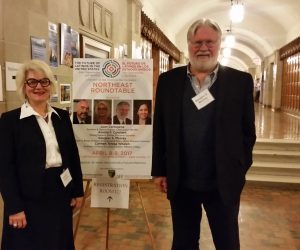
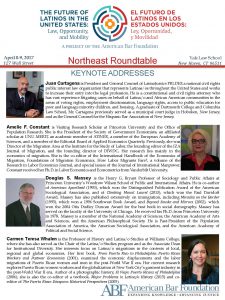
GLO Fellows Amelie F. Constant (Princeton University and UNU-MERIT) and Douglas S. Massey (Princeton University) will give keynotes at Yale University on April 8-9, 2017 at the Northeast Roundtable for the Future of Latinos conference – a project of the American Bar Association. The other keynote speakers are Juan Cartagena (President and General Counsel of LatinoJustice) and Carmen Teresa Whalen (Williams College).
Constant and Massey have co-authored the White Paper “Latinos in the Northeastern United States: Trends and Patterns.” It is now available as GLO Discussion Paper No. 60.
Based on U.S. census data, Latinos in the Northeast grew from 1.9 million in 1975 to 7.7 million in 2015, constituting 10.5% of the regional population in 2015. They are predominantly documented and the majority is U.S. citizens.
GLO Discussion Papers are research and policy papers from GLO Fellows and are provided in cooperation with EconStor, a service of the ZBW – Leibniz Information Centre for Economics, and RePEc.
GLO Discussion Papers are among others listed in RePEc – see IDEAS and EconPapers.
Any opinions expressed in the GLO Discussion Paper Series are those of the author(s) and not those of the GLO and while they may contain specific views on policy, the GLO itself does not take any institutional policy positions.
Budapest, Hungary: The Central European University (CEU) fights for survival.
“Concerned citizens in Hungary, Europe, and around the world, express their solidarity with Central European University (CEU) and express concern at proposed legislative changes to CEU’s status in Hungary. These changes would endanger the academic freedom vital for CEU’s continued operation in Budapest and would strike a blow against the academic freedom that enables all universities, including those in Hungary, to flourish.
In twenty-five years, Central European University has established itself as a private international university with a global reputation for teaching and research in the social sciences and humanities. It attracts students from 117 countries and faculty from 40. The University as a whole is accredited by the US Middle States Commission on Higher Education (MSCHE), and its masters and doctoral programs are registered by the New York State Education Department (NYSED). Its programs are also certified by appropriate Hungarian authorities and it has complied in full with all Hungarian laws.
In international rankings, some of CEU’s departments are rated among the top 50 in the world. CEU also makes Hungary a regional leader in winning highly competitive European Research Council grants. Several of its faculty, in fields as various as medieval studies, network and cognitive science, have won the most prestigious awards in their disciplines.
CEU is a valued member of the international academic community and its presence in Hungary has added to the reputation of Hungarian academic life on the international stage. The government’s proposed legislation to alter its statute of operation in Hungary would compromise its academic freedom and set a dangerous precedent for academic life in other countries.
Those who share those concerns should urge the government to withdraw the proposed legislation and enter consultation with CEU, bearing in mind the damage such legislation might do to Hungary’s well-founded international academic reputation, to its relationships with its European partners and with the United States.”
Adapted text following the proposed letter in https://www.ceu.edu/node/17842 , where you also find the addresses where to send statements of solidarity.
Supporting the struggle for survival of CEU is at the core of the vision of the Global Labor Organization (GLO), although the GLO has no institutional position. The President of the GLO, Klaus F. Zimmermann, as its Director, Alessio Brown, and many members of the GLO, which assembles about 500 distinguished scientists in more than 80 countries around the world, do support this struggle.
The Ecomomics Stars present the top cited, highly downloaded, and most shared journal articles published 2016 in Springer economics journals.
GLO Supporter the Journal of Population Economicshas 2 articles in the top 15 articles most shared in the Social Web, 2 articles among the 15 top cited articles and 3 in the 15 highly dowloaded articles.
The increasing happiness of US parents, by Chris M. Herbst, John Ifcher, Review of Economics of the Household September 2016, Volume 14, Issue 3, pp 529–551.
The Global Labor Organization (GLO) is affiliated with organizations and institutions with a thematic interest and a strong ambition to contribute to an effective global network and to benefit from it.