Category Archives: Post-20

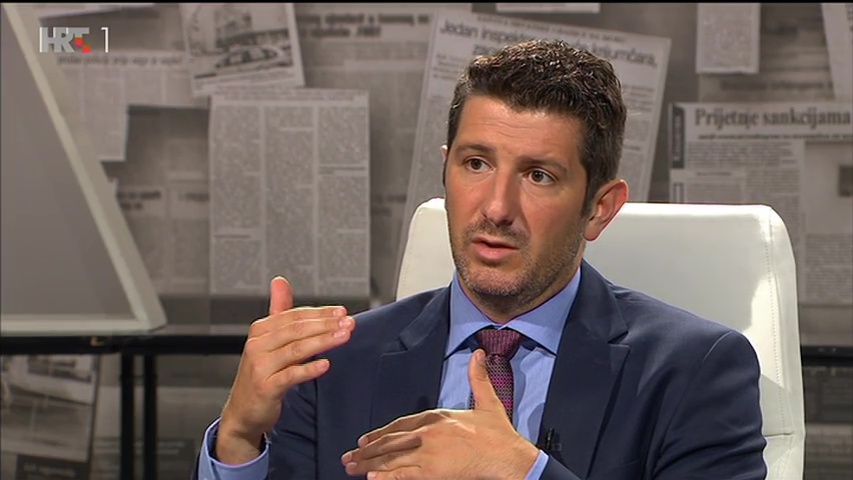
Interview with GLO Fellow Dejan Kovač: After the Race for President of Croatia

In 2019, Dejan Kovač, GLO fellow and a former postdoc at Princeton University, left his position in the US and joined the presidential race in Croatia as a candidate. He did not become the president of Croatia, but in his campaign he highlighted the need for structural reforms, promoted civic and economic freedoms, and most importantly attacked corruption relying on his previous research experience.

Besides his research on corruption, Dejan Kovač is taking another promising research endeavor – rethinking the design of Croatia’s labor market to increase its global competitiveness.

In 2017, the Global Labor Organization (GLO) had supported a large international conference Dejan Kovač had organized in Umag to debate the challenges of the global world for labor markets.  The event was hosting some of the best labor economists of our time, including the former chief economist  to president Obama, the late Alan Krueger, a legendary figure and GLO Fellow (see picture below).
Interview

GLO: The scientist and politics: How has the presidential campaign changed you?

Dejan Kovač: Before the campaign I was an economist, during the campaign I remained an economist, and after the campaign I am still an economist.

GLO: Was knowledge of economics and of scientific evidence helpful for you during the race?

Dejan Kovač: Not really. Presidential races in Croatia historically have a problem. This is not a competition about the better program, but rather about to what part of the political spectrum one belongs. I was not able to push any economics topic, because we are still trapped by tales from our history and historical revisionism. It is very unfortunate that there is so little voters’ awareness about the importance of particular topics. Especially because Croatia “lost” close to 10% of its population through emigration due to several main issues: high corruption, bad economic conditions and lack of structural reforms.

GLO: Is emigration the main motivation for your newly started project “Designing Croatia’s labor market for global competitiveness” or are there other important issues at play?

Dejan Kovač: The 10% loss of population is a great shock to our economy. One does not have to have a PhD in economics to realize that this will have a detrimental  effect on  GDP. A larger problem than size is the issue of “brain drain” not only in Croatia, but in the entire region. High-skilled workers are leaving and they would otherwise contribute the most to economic growth. Another problem of our labor market is that the  entire education system is not adequate to satisfy domestic labor market needs and especially global trends.

GLO: What is wrong with Croatia’s education system?

Dejan Kovač: Quotas are such that we are “over-producing” some occupations, which we realistically do not need, while we lack for instance STEM workers, who are “under-supplied”. This is still a residue from our past, when both skills and quantities were defined through central planning. Today not only domestic, but also global market forces are at play. Nevertheless, we have a rigid set of quotas for higher education which has not changed in a reasonable manner in decades. That is the first step to take. It is not an easy task, because redesigning the entire education system implies evaluating labor demand and supply in the future. For this we need the entire Croatia, not just a government which represents one part of the political spectrum only. Either policy makers will realize that and do the urgent structural reforms, or with the next wave of emigrations, our problems will intensify significantly.

GLO: What are decisive elements of the needed university reform and how does this relate to the vitalization of the labor market?

Dejan Kovač: Beyond quotas, we need to raise the skill levels of our workers in such a way that knowledge learned at our universities is up to date with the frontier of innovations at the labor market. We lack “intermediaries” such as incubators who can “translate” knowledge from pure theory to applied science which can be used at the labor market. Also we need to revise the entire curriculum at most universities.

***
With Dejan Kovač spoke Klaus F. Zimmermann, GLO President.
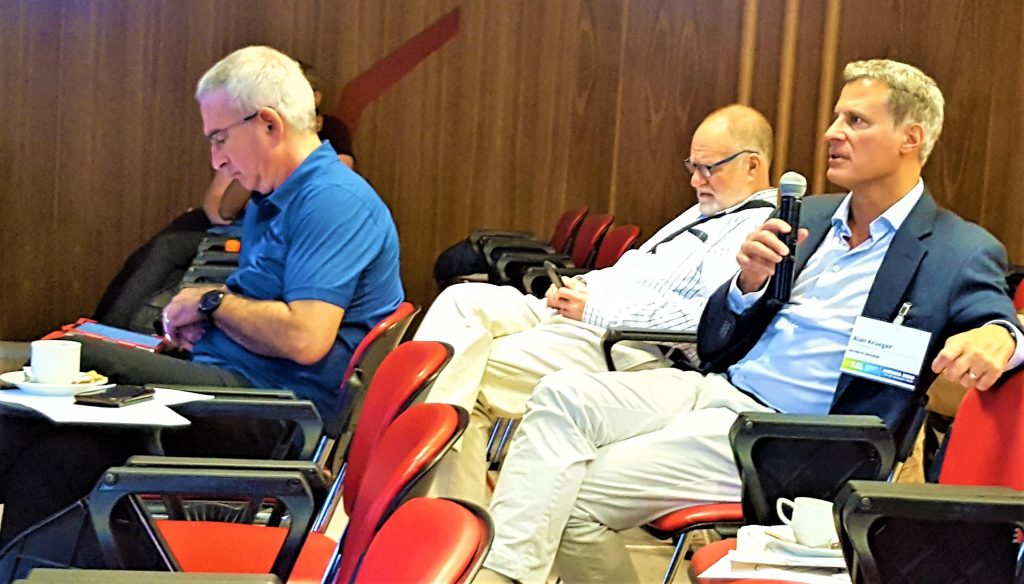
From the left: GLO Fellows Joshua Angrist (MIT), Hank Farber (Princeton University) and Alan Krueger (Princeton University and former Chief Economist of President Obama); 2017 in Umea/Croatia.

Ends;

Age discrimination: What recruiters have in mind when hiring. New GLO Discussion Paper.

A new GLO Discussion Paper finds that older age signals to recruiters that applicants have lower technological skill, flexibility, and trainability levels. The relevance of these factors decline with higher levels of older workers in the company.

The Global Labor Organization (GLO) is an independent, non-partisan and non-governmental organization that functions as an international network and virtual platform to stimulate global research, debate and collaboration.

GLO Discussion Paper No. 434, 2019

What Does a Job Candidate’s Age Signal to Employers? –  Download PDF
by
Van Borm, Hannah & Burn, Ian & Baert, Stijn

GLO Fellow Stijn Baert

Author Abstract: Research has shown that hiring discrimination is a barrier for older job candidates in many OECD countries. However, little research has delved into why older job candidates are discriminated against. Therefore, we have conducted an online scenario experiment involving recruiters to empirically investigate 15 potential stigma related to older age drawn from a systematic review of the literature. We found that older age particularly signals to recruiters that the applicant has lower technological skill, flexibility, and trainability levels. Together, these perceptions explain about 41% of the effect of age on the probability of being invited to a job interview. In addition, we found that the negative association between age and invitation probability is smaller when recruiters work for firms with a higher percentage of older employees.

GLO Discussion Papers are research and policy papers of the GLO Network which are widely circulated to encourage discussion. Provided in cooperation with EconStor, a service of the ZBW – Leibniz Information Centre for Economics, GLO Discussion Papers are among others listed in RePEc (see IDEAS,  EconPapers)Complete list of all GLO DPs – downloadable for free.

Ends;

AI and Robotics Innovation: Findings from a new GLO Discussion Paper

A new GLO Discussion Paper reveals a tremendous increase in AI patenting activities since 2013 with a significant boom in 2015-2016. While most of AI patenting activities remain concentrated in the sectors of software programing and manufacturing of electronic equipment and machinery, there are clear signs of cross-fertilization towards non-tech sectors.

The Global Labor Organization (GLO) is an independent, non-partisan and non-governmental organization that functions as an international network and virtual platform to stimulate global research, debate and collaboration.

GLO Discussion Paper No. 433, 2019

AI and Robotics Innovation: a Sectoral and Geographical Mapping using Patent Data –  Download PDF
by
Van Roy, Vincent & Vertesy, Daniel & Damioli, Giacomo

GLO Fellows Vincent Van Roy, Daniel Vertesy & Giacomo Damioli

Author Abstract: Economic activities based on the invention, production and distribution of artificial intelligence (AI) technologies have recently emerged worldwide. Yet, little is known about the innovative activities, location and growth performance of AI innovators. This chapter aims to map and analyse the global innovative landscape of AI by exploring 155,000 patents identified as AI-related by means of text-mining techniques. It highlights the emergence and evolution of AI technologies and identifies AI hotspots across the world. It explores the scale and pervasiveness of AI activities across sectors, and evaluates the economic performance of AI innovators using firm accounting information. Finally, it assesses recent trends in venture capital investments towards AI as financial support to promising AI startups. Findings of this chapter reveal a tremendous increase in AI patenting activities since 2013 with a significant boom in 2015-2016. While most of AI patenting activities remain concentrated in the sectors of software programming and manufacturing of electronic equipment and machinery, there are clear signs of cross-fertilisation towards non-tech sectors. The market of AI patenting firms is very vibrant and characterised by a large increase of new and small players with economic performances above industry average. This trend is also reflected by the recent increase in venture capital towards AI startups.

GLO Discussion Papers are research and policy papers of the GLO Network which are widely circulated to encourage discussion. Provided in cooperation with EconStor, a service of the ZBW – Leibniz Information Centre for Economics, GLO Discussion Papers are among others listed in RePEc (see IDEAS,  EconPapers)Complete list of all GLO DPs – downloadable for free.

Ends;

Have corrupt societies deleterious effects on health? New GLO Discussion Paper.

A new GLO Discussion Paper finds that bribing for public services worsens self-assessed health using individual-level data from 28 post-communist countries.

The Global Labor Organization (GLO) is an independent, non-partisan and non-governmental organization that functions as an international network and virtual platform to stimulate global research, debate and collaboration.

GLO Discussion Paper No. 432, 2019

Can bribery buy health? Evidence from post-communist countries –  Download PDF
by
Mavisakalyan, Astghik & Otrachshenko, Vladimir & Popova, Olga

GLO Fellows Astghik Mavisakalyan & Olga Popova

Author Abstract: Corruption is pervasive, but we know little about its effects on individual lives. This paper examines whether living in a corrupt society has deleterious effects on health. Using individual-level data from 28 post-communist countries, we demonstrate that bribing for public services worsens self-assessed health. Unlike other studies, we account for endogeneity of bribery and show that bribing for any type of public service, not just for health services, has an adverse impact. We also find that bribery lowers the quality of services received. Moreover, there are potentially high indirect costs of bribery since, as we show, it comes at the expense of cutting food consumption. These findings suggest that corruption is a potentially important source behind the poor health outcomes in many developing countries.

GLO Discussion Papers are research and policy papers of the GLO Network which are widely circulated to encourage discussion. Provided in cooperation with EconStor, a service of the ZBW – Leibniz Information Centre for Economics, GLO Discussion Papers are among others listed in RePEc (see IDEAS,  EconPapers)Complete list of all GLO DPs – downloadable for free.

Ends;

Female Entrepreneurs in Africa: New GLO Discussion Paper studies the sources of success of startups

A new GLO Discussion Paper analyzes the role of networks in the access of female entrepreneurs to start-up capital and firm performance in Eswatini, a country with one of the highest female unemployment rates in Africa. Women who receive support from professional networks have higher initial capital.

The Global Labor Organization (GLO) is an independent, non-partisan and non-governmental organization that functions as an international network and virtual platform to stimulate global research, debate and collaboration.

GLO Discussion Paper No. 431, 2019

Networks, Start-up Capital and Women’s Entrepreneurial Performance in Africa: Evidence from Eswatini –  Download PDF
by
Brixiová, Zuzana & Kangoye, Thierry

GLO Fellow Zuzana Brixiová

Author Abstract: This paper analyzes the role of networks in the access of female entrepreneurs to start-up capital and firm performance in Eswatini, a country with one of the highest female unemployment rates in Africa. The paper first shows that higher initial capital is associated with better sales performance for both men and women entrepreneurs. Women entrepreneurs start their firms with smaller start-up capital than men and are more likely to fund it from their own sources, which reduces the size of their firm and sales level. However, women with higher education start their firms with more capital than their less educated counterparts. Moreover, women who receive support from professional networks have higher initial capital, while those trained in financial literacy more often access external funding sources, including through their networks.

GLO Discussion Papers are research and policy papers of the GLO Network which are widely circulated to encourage discussion. Provided in cooperation with EconStor, a service of the ZBW – Leibniz Information Centre for Economics, GLO Discussion Papers are among others listed in RePEc (see IDEAS,  EconPapers)Complete list of all GLO DPs – downloadable for free.

Ends;

Reminder: International Economic Association World Congress, Bali – July 3-7, 2020. Extended submission deadline is January 15.

In 2019 (Report), the Global Labor Organization (GLO) has joined the International Economic Association (IEA). The two organizations support each other in their common missions. Therefore, GLO will contribute to the Bali, Indonesia, International Economic Association World Congress, July 3-7, 2020.

Note that due to the numerous requests received to extend the call for papers, the deadline had been changed to 15 January 2020. Notification to authors is 15 February 2020. Those who still want to submit papers should consult the IEA conference website: www.ieawc2020.org

Ends;

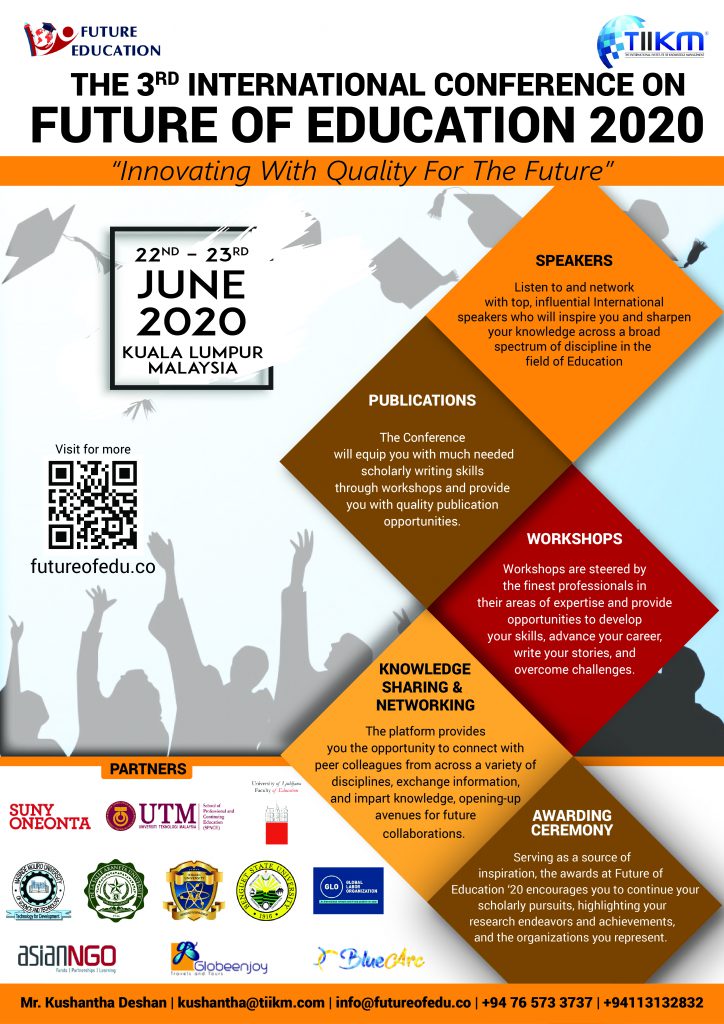
Future Education 2020: Conference Call for Kuala Lumpur, June 22-23, out.

GLO is an Strategic Partner for The 3rd International Conference on Future Education 2020 to be held in 22nd – 23rd June 2020 in Kuala Lumpur, Malaysia. Niaz Asadullah of the University of Malaya and the GLO Lead for South-East Asia is a keynote speaker at the conference.

As the strategic partner, members of GLO receive special discount rates and partial scholarship opportunities. They also have the possibility to (i) publish in SCOPUS indexed journals, (ii) serve as a Scientific Committee Member for the conference, and (iii) serve as a Session Chair or Evaluation Panel Member of the conference.

For any inquires or questions regarding the conference please contact Austin Joseph (austin@tiikm.com).

Conference Website

Call for Papers. The deadline for submitting an abstract is February 19, 2020.

Ends;

GLO Discussion Paper of the Month December 2019: Smartphone Use and Academic Performance

The GLO Discussion Paper of the Month of December uses longitudinal data to investigate the relationship between smartphone use and academic performance in universities. It suggests that smartphone use has a causal negative effect on academic performance. The paper makes a significant contribution to current policy debates around the world, on whether smartphones should be banned from schools. 

GLO Discussion Papers are research and policy papers of the GLO Network which are widely circulated to encourage discussion. Provided in cooperation with EconStor, a service of the ZBW – Leibniz Information Centre for Economics, GLO Discussion Papers are among others listed in RePEc (see IDEAS, EconPapers)Complete list of all GLO DPs downloadable for free.

GLO Discussion Paper of the Month: December

GLO Discussion Paper No.  438, 2019

Smartphone Use and Academic Performance: First Evidence from Longitudinal Data –  Download PDF
by Amez, Simon & Vujić, Sunčica & De Marez, Lieven & Baert, Stijn

GLO Fellows Stijn Baert & Sunčica Vujić

Author Abstract:  To study the causal impact of smartphone use on academic performance, we collected—for the first time worldwide—longitudinal data on students’ smartphone use and educational performance. For three consecutive years we surveyed all students attending classes in eleven different study programs at two Belgian universities on general smartphone use and other drivers of academic achievement. These survey data were merged with the exam scores of these students. We analyzed the resulting data by means of panel data random effects estimation controlling for unobserved individual characteristics. A one standard deviation increase in overall smartphone use results in a decrease of 0.349 points (out of 20) and a decrease of 2.616 percentage points in the fraction of exams passed.

GLO Discussion Papers of December 2019

438 Smartphone Use and Academic Performance: First Evidence from Longitudinal Data –  Download PDF
by 
Amez, Simon & Vujić, Sunčica & De Marez, Lieven & Baert, Stijn

437 Does loneliness lurk in temp work? Exploring the associations between temporary employment, loneliness at work and job satisfaction –  Download PDF
by 
Moens, Eline & Baert, Stijn & Verhofstadt, Elsy & Van Ootegem, Luc

436 Labour Market Outcomes for Cancer Survivors: A Review of the Reviews –  Download PDF
by 
Sharipova, Adelina & Baert, Stijn

435 The effect of same-sex marriage legalization on interstate migration in the United States –  Download PDF
by 
Marcén, Miriam & Morales, Marina

434 What Does a Job Candidate’s Age Signal to Employers?  –  Download PDF
by 
Van Borm, Hannah & Burn, Ian & Baert, Stijn

433 AI and Robotics Innovation: a Sectoral and Geographical Mapping using Patent Data –  Download PDF
by 
Van Roy, Vincent & Vertesy, Daniel & Damioli, Giacomo

432 Can bribery buy health? Evidence from post-communist countries  –  Download PDF
by 
Mavisakalyan, Astghik & Otrachshenko, Vladimir & Popova, Olga

431 Networks, Start-up Capital and Women’s Entrepreneurial Performance in Africa: Evidence from Eswatini –  Download PDF
by 
Brixiová, Zuzana & Kangoye, Thierry

430 An exploratory study of populism: the municipality-level predictors of electoral outcomes in Italy  –  Download PDF
by 
Levi, Eugenio & Patriarca, Fabrizio

429 Estimating Poverty for Refugee Populations: Can Cross-Survey Imputation Methods Substitute for Data Scarcity? –  Download PDF
by 
Dang, Hai-Anh H. & Verme, Paolo

428 The Microeconomic Impacts of Employee Representatives: Evidence from Membership Thresholds –  Download PDF
by 
Martins, Pedro S.

427 Trade in Information Technologies and Changes in the Demand for Occupations –  Download PDF
by 
Jerbashian, Vahagn

426 The Mental Health Effects of Retirement –  Download PDF
by 
Picchio, Matteo & van Ours, Jan C.

425 The Impact of Internship Experience During Secondary Education on Schooling and Labour Market Outcomes –  Download PDF
by 
Neyt, Brecht & Verhaest, Dieter & Baert, Stijn

424 Training, Human Capital, and Gender Gaps in Entrepreneurial Performance –  Download PDF
by 
Brixiová, Zuzana & Kangoye, Thierry

GLO DP Team
Senior Editors: Matloob Piracha (University of Kent) & GLO; Klaus F. Zimmermann (UNU-MERIT, Maastricht University and Bonn University).
Managing Editor: Magdalena Ulceluse, University of GroningenDP@glabor.org  

Ends;

GLO Discussion Paper of the Month November 2019: Former Communist Party Membership and Entrepreneurial Activities

The GLO Discussion Paper of the Month of November 2019 explores the implications of post-communist party membership on the ethics and the nature of doing business in transition economies. It is found that former communist party members often become successful entrepreneurs. The Discussion Paper is the first study separating the causal effect of former communist party membership from self-selection.

GLO Discussion Papers are research and policy papers of the GLO Network which are widely circulated to encourage discussion. Provided in cooperation with EconStor, a service of the ZBW – Leibniz Information Centre for Economics, GLO Discussion Papers are among others listed in RePEc (see IDEAS, EconPapers)Complete list of all GLO DPs downloadable for free.

GLO Discussion Paper of the Month: November

GLO Discussion Paper No.  423, 2019

Former Communist party membership and present-day entrepreneurship in Central and Eastern Europe –  Download PDF
by Ivlevs, Artjoms & Nikolova, Milena & Popova, Olga

GLO Fellows Milena Nikolova & Olga Popova

Author Abstract:  After the collapse of Communism in Central and Eastern Europe, former party members were particularly likely to start businesses and become entrepreneurs. However, it remains unclear whether this entrepreneurial activity was driven by the resources, information and opportunities provided by former party membership or because people with specific individual attributes were more likely to become party members (self-selection). This study is the first to separate the causal effect of former Communist party membership from self-selection. Using individual-level Life in Transition–III survey and instrumental variables analysis, we find that, in Central and Eastern European countries, membership of former Communist party has facilitated business set-up but not business longevity. Our results also suggest evidence of negative self-selection, meaning that people who joined the former ruling party tended have fewer of the traits associated with entrepreneurship such as motivation, risk tolerance, and entrepreneurial spirit. We show that former Communist party membership still matters for business practices, business ethics, and the nature of doing business in transition economies.

GLO Discussion Papers of November 2019

426 The Mental Health Effects of Retirement –  Download PDF
by 
Picchio, Matteo & van Ours, Jan C.

425 The Impact of Internship Experience During Secondary Education on Schooling and Labour Market Outcomes –  Download PDF
by 
Neyt, Brecht & Verhaest, Dieter & Baert, Stijn

424 Training, Human Capital, and Gender Gaps in Entrepreneurial Performance –  Download PDF
by 
Brixiová, Zuzana & Kangoye, Thierry

423 Former Communist party membership and present-day entrepreneurship in Central and Eastern Europe –  Download PDF
by 
Ivlevs, Artjoms & Nikolova, Milena & Popova, Olga

422 Job Prestige and Mobile Dating Success: A Field Experiment  –  Download PDF
by 
Neyt, Brecht & Baert, Stijn & Vynckier, Jana

421 Greater US Gun Ownership, Lethality and Murder Rates: Analysis and Policy Proposals  –  Download PDF
by  
Schiff, Maurice

GLO DP Team
Senior Editors: Matloob Piracha (University of Kent) & GLO; Klaus F. Zimmermann (UNU-MERIT, Maastricht University and Bonn University).
Managing Editor: Magdalena Ulceluse, University of GroningenDP@glabor.org  

Ends;

Successful Kuznets Prize Ceremony with Nobel Prize Winner Jim Heckman at ASSA 2020 in San Diego. Impressions from the Reception.

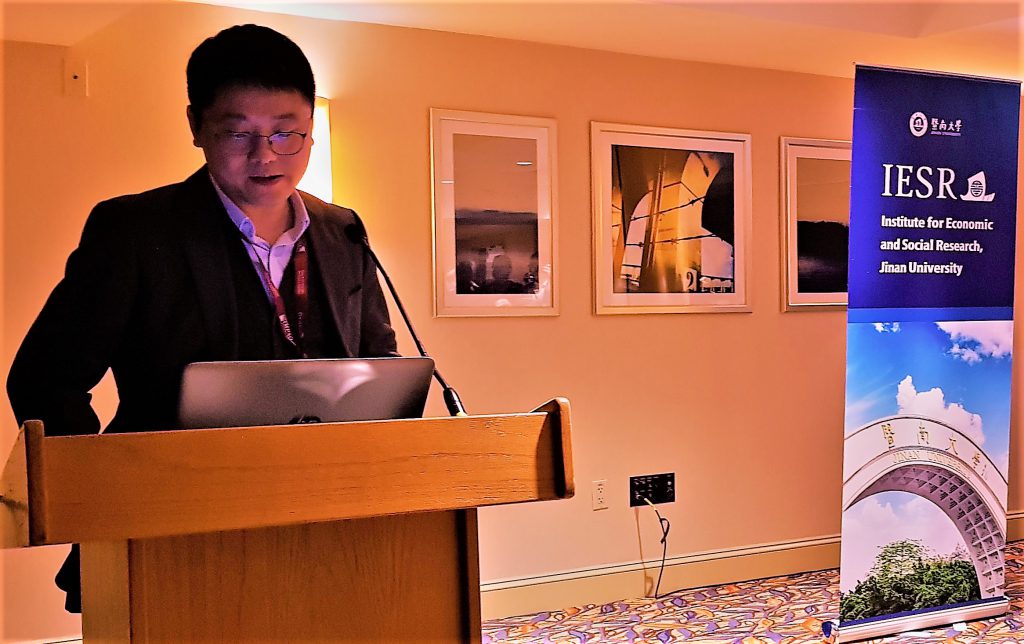
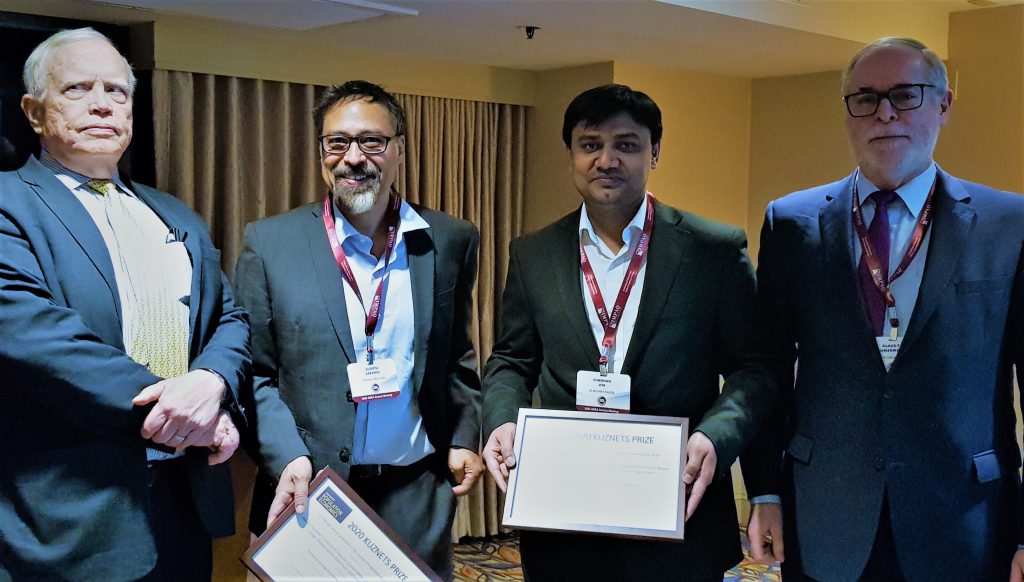
On January 3, the Kuznets Prize of the Journal of Population Economics was given to Gautam Hazarika, Chandan Kumar Jha, and Sudipta Sarangi at the IESR/Jinan University reception with Jim Heckman, Klaus F. Zimmermann and Shuaizhang Feng:

Award and event details.
Prize paper: Ancestral ecological endowments and missing women
(Please click title for FREE READ LINK) Published in the Journal of Population Economics (2019), 32(4), pp. 1101-1123. The annual prize honors the best article published in the Journal of Population Economics.

1. Paper examines the relationship between ecological endowments in antiquity and contemporary female to male sex ratios in the population.
2. It finds robust evidence that there are proportionately more missing women in countries whose ancestral ecological endowments were poorer.
3. Gender inequality is larger, that is, the female to male sex ratio lower, in regions whose peoples’ ancestors experienced greater resource stress captured by historical crop yields measures.
4. A conclusion is that ecological resource scarcity led to gender inequality in the intra-household allocation of resources in the past and that the associated behaviors have been culturally transmitted to the present as norms.

Shuaizhang Feng (Dean of IESR) introduced IESR and gave a warm welcome to the participants. Klaus F. Zimmermann introduced the Kuznets Prize, the award article and the authors. Jim Heckman congratulated the authors and the responsible organizations for the success and presented the award certificates. Chandan Kumar Jha and Sudipta Sarangi took the honors for all three authors and received the deserved applause of the large audience. Greetings went to author Gautam Hazarika and the responsible editor of the awarded article, Alessandro Cigno, who both could not be in San Diego.

Since 2019, Shuaizhang Feng is also an Editor of the Journal of Population Economics, Jim Heckman has been an Associate Editor for decades, while Klaus F. Zimmermann is the Founder and Editor-in-Chief. Heckman and Zimmermann supported IESR from the beginning. GLO is proud to note that all authors have joined the organization as Fellows, as Cigno, Feng and Heckman.


Ends;

ASSA 2020 started: Kuznets Prize Ceremony tonight with Nobel Prize Winner Jim Heckman

The Kuznets Prize of the Journal of Population Economics is given tonight in San Diego/USA at the IESR reception (6-8pm) at the ASSA 2020 Conference.

Details on the prize -winning article, the authors and the event. Entry is open freely for ASSA 2020 participants.

IESR Dean Shuaizhang Feng (Jinan University), also an Editor of the Journal of Population Economics will open the event as the host. Editor-in-Chief and GLO President Klaus F. Zimmermann will introduce the award; and Nobel Prize Winner Jim Heckman (University of Chicago), also an Associate Editor of the Journal, will present the award certificates to the three authors.

The article:
Gautam Hazarika, Chandan Kumar & Sudipta Sarangi:
(please click title for FREE READ LINK)
Ancestral ecological endowments and missing women
Journal of Population Economics, Vol. 32 (2019), Issue 4 (October), pp. 1101-1123.

Ends;