A new paper published in the Journal of Population Economics shows that the share of students in a class who are low achievers has a significant negative impact on the academic achievement of regular students.
Journal of Population Economics (2020) 33, Issue 4: 1343-1380 FREE READLINK
Author Abstract: This paper examines the causal effects of the proportion of low-ability students in the classroom on the academic performance of regular students, exploiting random assignment of students to classes within middle schools in China. We show that the share of students in a class who are low achievers has a significant negative impact on the academic achievement of regular students in the seventh grade. The peer effects are heterogeneous along their achievement distribution, with the strongest adverse impact at the bottom end but no discernable impact at the top end. In contrast, there is no evidence that low-ability students influence any part of the achievement distribution of regular students in the ninth grade. Therefore, peer effects in academic outcomes can vary with the length of regular students’ exposure to the same group of low-ability classmates. We further show that the differences in peer effects of low-ability students in seventh and ninth grades are driven by the adjustments of students’ friendship formation and learning environment when approaching the completion of middle school.
LEAD ARTICLE OF ISSUE 4: Yun Qiu, Xi Chen & Wei Shi, Impacts of social and economic factors on the transmission of coronavirus disease 2019 (COVID-19) in China Journal of Population Economics33, 1127–1172 (2020). OPEN ACCESS
A new paper published in the Journal of Population Economics finds for the USA thatethnic attrition biases conventional estimates of health disparities between Mexican Americans and non-Hispanic whites as well as those between Mexican Americans and recent Mexican immigrants.
Francisca M. Antman, Brian Duncan & Stephen J. Trejo
Journal of Population Economics (2020) 33, Issue 4: 1499-1522 FREE READLINK
GLO Fellow Francisca M. Antman
Author Abstract: The literature on immigrant assimilation and intergenerational progress has sometimes reached surprising conclusions, such as the puzzle of immigrant advantage which finds that Hispanic immigrants sometimes have better health than US-born Hispanics. While numerous studies have attempted to explain these patterns, almost all studies rely on subjective measures of ethnic self-identification to identify immigrants’ descendants. This can lead to bias due to “ethnic attrition,” which occurs whenever a US-born descendant of a Hispanic immigrant fails to self-identify as Hispanic. In this paper, we exploit information on parents’ and grandparents’ place of birth to show that Mexican ethnic attrition, operating through intermarriage, is sizable and positively selected on health, making subsequent generations of Mexican immigrants appear less healthy than they actually are. Consequently, conventional estimates of health disparities between Mexican Americans and non-Hispanic whites as well as those between Mexican Americans and recent Mexican immigrants have been significantly overstated.
LEAD ARTICLE OF ISSUE 4: Yun Qiu, Xi Chen & Wei Shi, Impacts of social and economic factors on the transmission of coronavirus disease 2019 (COVID-19) in China Journal of Population Economics33, 1127–1172 (2020). OPEN ACCESS
A new GLO Discussion Papersuggests that a society with high income inequality, in which a small proportion of the population earns a large proportion of society’s income, will have lower collective life satisfaction.
The Global Labor Organization (GLO) is an independent, non-partisan and non-governmental organization that functions as an international network and virtual platform to stimulate global research, debate and collaboration.
Author Abstract: This study investigates why the strong form of the spatial equilibrium is weakly supported in the literature. Using a discrete choice model, it shows that the strong form of the spatial equilibrium is rarely observed because workers are imperfectly mobile from the perspective of researchers. Incorporating the discrete choice model, a Markov chain is used to model the spatial dynamics of the population distribution. For a given location choice set, the population distribution is shown to converge to a unique spatial steady state. Microdata from the American Community Survey show that the model assumption is reasonable and support the model predictions.
A new paper just published in the Journal of Population Economics attributes the academic advantage of children of Asian immigrants mainly to their allocating more time to educational activities or their favorable initial cognitive abilities, not to socio-demographics or so-called “tiger parenting” styles.
Ha Trong Nguyen, Luke B. Connelly, Huong Thu Le, Francis Mitrou, Catherine L. Taylor & Stephen R. Zubrick
Journal of Population Economics (2020) 33, Issue 4: 1381–1418 FREE READLINK
GLO Fellows Ha Trong Nguyen & Luke B. Connelly
Ha Nguyen
Luke Connelly
Author Abstract: In most English-speaking countries, the children of Asian immigrants have better academic outcomes than other children, yet the underlying causes of their advantages are unclear. Using decade-long time use diaries on two cohorts of children, we present new evidence that children of Asian immigrants spend more time than their peers on educational activities beginning at school entry and that the ethnicity gap in the time allocated to educational activities increases as children age. We can attribute the academic advantage of children of Asian immigrants mainly to their allocating more time to educational activities or their favorable initial cognitive abilities, not to socio-demographics or so-called “tiger parenting” styles. Furthermore, our results show substantial heterogeneity in the contributions of initial cognitive abilities and time allocations by test subjects, children’s ages, and points of the test score distribution.
LEAD ARTICLE OF ISSUE 4: Yun Qiu, Xi Chen & Wei Shi, Impacts of social and economic factors on the transmission of coronavirus disease 2019 (COVID-19) in China Journal of Population Economics33, 1127–1172 (2020). OPEN ACCESS
A new GLO Discussion Paper finds for Portugal that public-sector appointments increase significantly over the months just after elections but only if the new government is of a different political color than its predecessor suggesting a misallocation of public resources.
The Global Labor Organization (GLO) is an independent, non-partisan and non-governmental organization that functions as an international network and virtual platform to stimulate global research, debate and collaboration.
Author Abstract: Politicians can use the public sector to give jobs to cronies, at the expense of the efficiency of those organizations and general welfare. In this paper, we regress monthly hires across all firms in Portugal with some degree of public ownership on the country’s 1980-2018 political cycle. We find that public-sector appointments increase significantly over the months just after elections but only if the new government is of a different political color than its predecessor. These results are consistent with a simple model of cronyism and hold in multiple robustness checks. Overall, we find our evidence to be consistent with politically-induced misallocation of public resources.
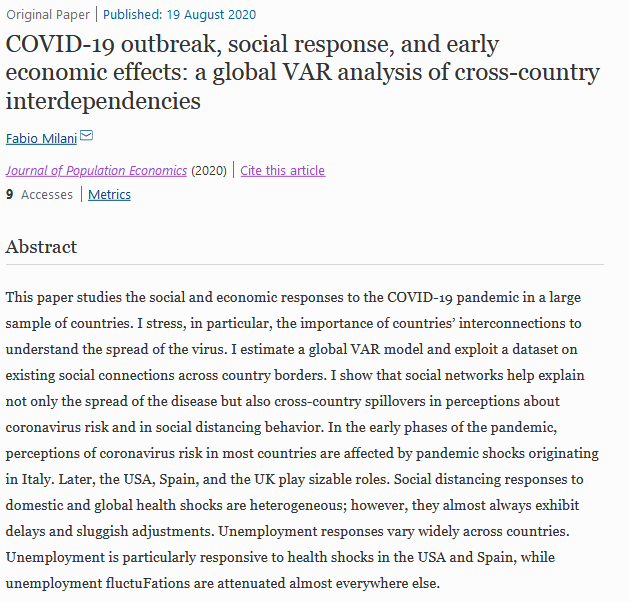
A new paper published in the Journal of Population Economics shows that social networks help explain not only the spread of the disease but also cross-country spillovers in perceptions about coronavirus risk and in social distancing behavior.
LEAD ARTICLE OF ISSUE 4: Yun Qiu, Xi Chen & Wei Shi, Impacts of social and economic factors on the transmission of coronavirus disease 2019 (COVID-19) in China Journal of Population Economics33, 1127–1172 (2020). OPEN ACCESS
A new paper published in the Journal of Population Economics finds that Filipinos are more likely to work abroad when they experience less-intense tropical cyclones and storm warnings but are more likely to stay when very intense storms occur or are forecasted.
Journal of Population Economics (2020) 33, Issue 4: 1419-1461 FREE READLINK
GLO Fellow Marjorie C. Pajaron & GLO Affiliate Glacer Niño A. Vasquez
Author Abstract: The environmental migration literature presents conflicting results: While some research finds that natural disasters induce international migration, other work discovers a dampening effect. We construct an innovative longitudinal provincial dataset for the Philippines, a country prone to natural disasters and a major exporter of labor. Using a comprehensive list of weather shocks, it is possible to identify major channels behind those conflicting findings. Filipinos are more likely to work abroad when they experience less-intense tropical cyclones and storm warnings but are more likely to stay when very intense storms occur or are forecasted.
LEAD ARTICLE OF ISSUE 4: Yun Qiu, Xi Chen & Wei Shi, Impacts of social and economic factors on the transmission of coronavirus disease 2019 (COVID-19) in China Journal of Population Economics33, 1127–1172 (2020). OPEN ACCESS
A new paper published in the Journal of Population Economics finds substantial heterogeneity in the effects of extreme temperature exposure on birth outcomes. In particular, prenatal exposure to heat waves has stronger negative effects than exposure to cold spells on surviving births.
Journal of Population Economics (2020) 33, Issue 4: 1263-1302 FREE READLINK
GLO FellowXi Chen
Author Abstract: This paper investigates the effects of prenatal exposure to extreme temperatures on birth outcomes—specifically, the log of birth weight and an indicator for low birth weight—using a nationally representative dataset on rural China. During the time period we examine (1991–2000), indoor air conditioning was not widely available and migration was limited, allowing us to address identification issues endemic in the climate change literature related to adaptation and location sorting. We find substantial heterogeneity in the effects of extreme temperature exposure on birth outcomes. In particular, prenatal exposure to heat waves has stronger negative effects than exposure to cold spells on surviving births.
LEAD ARTICLE OF ISSUE 4: Yun Qiu, Xi Chen & Wei Shi, Impacts of social and economic factors on the transmission of coronavirus disease 2019 (COVID-19) in China Journal of Population Economics33, 1127–1172 (2020). OPEN ACCESS
A new paper published in the Journal of Population Economics indicates that the decrease in public sector employment, which is particularly appealing to women, may have contributed to the recent rise in fertility in Egypt.
Journal of Population Economics (2020) 33, Issue 4: 1173-1218 FREE READLINK
GLO FellowCaroline Krafft
Author Abstract: Can declining employment opportunities for women reverse the fertility transition? This paper presents evidence that the demographic transition has not just stalled but in fact reversed in Egypt. After falling for decades, fertility rates increased. The paper examines the drivers of rising fertility rates, with a particular focus on the role of declining public sector employment opportunities for women. Estimates show the effect of public sector employment on the spacing and occurrence of births using discrete-time hazard models. The paper then uses the results to simulate total fertility rates. The models address the potential endogeneity of employment by incorporating woman-specific fixed effects, incorporating local employment opportunities rather than women’s own employment, and using local employment opportunities as an instrument. Results indicate that the decrease in public sector employment, which is particularly appealing to women, may have contributed to the rise in fertility but is unlikely to be its main cause.
LEAD ARTICLE OF ISSUE 4: Yun Qiu, Xi Chen & Wei Shi, Impacts of social and economic factors on the transmission of coronavirus disease 2019 (COVID-19) in China Journal of Population Economics33, 1127–1172 (2020). OPEN ACCESS
Journal of Population Economics (2020) 33, Issue 4: 1303-1341 FREE READLINK
GLO Fellow Weiguang Deng and GLO Affiliate Dayang Li
Author Abstract: This study uses a field experiment to resolve the difficulties of quantifying personal appearance and identify a direct causal relationship between appearance and employment in China. The experiment reveals that taste-based pure appearance discrimination exists at the pre-interview stage. There are significant gender-specific heterogeneous effects of education on appearance discrimination: having better educational credentials reduces appearance discrimination among men but not among women. Moreover, attributes of the labor market, companies, and vacancies matter. Beauty premiums are larger in big cities with higher concentrations of women and in male-focused research positions. Similarly, the beauty premium is larger for vacancies with higher remuneration.
The paper has beenGLO Discussion Paper No. 369, 2020.
LEAD ARTICLE OF ISSUE 4: Yun Qiu, Xi Chen & Wei Shi, Impacts of social and economic factors on the transmission of coronavirus disease 2019 (COVID-19) in China Journal of Population Economics33, 1127–1172 (2020). OPEN ACCESS
A new paper published in the Journal of Population Economics finds that raising the school leaving age can be effective in reducing the incidence of teenage pregnancy among socially excluded women, even if it does not affect the general population. An important policy implication is the potentially heterogeneous impact of educational interventions across different ethnic groups.
Journal of Population Economics (2020) 33, Issue 4: 1219-1261 OPEN ACCESS
Author Abstract: This paper examines the effects of an increase in the compulsory school leaving age on the teenage fertility of Roma women, a disadvantaged ethnic minority in Hungary. We use a regression discontinuity design identification strategy and show that the reform decreased the probability of teenage motherhood among Roma women by 13.4–26.0% and delayed motherhood by 2 years. We separate the incapacitation and human capital effects of education on fertility by exploiting a database that covers live births, miscarriages, abortions, and still births and contains information on the time of conception. We find that longer schooling decreases the probability of getting pregnant during the school year but not during summer and Christmas breaks, which suggests that the estimated effects are generated mostly through the incapacitation channel.
The paper has beenGLO Discussion Paper No. 474, 2020.
LEAD ARTICLE OF ISSUE 4: Yun Qiu, Xi Chen & Wei Shi, Impacts of social and economic factors on the transmission of coronavirus disease 2019 (COVID-19) in China Journal of Population Economics33, 1127–1172 (2020). OPEN ACCESS
Completing a very successfulfirst cohort 2019-20, Global Labor Organization (GLO) invites interested young scholars to apply for participation in the GLO VirtYS Program.
A new paper published in the Journal of Population Economics finds that risk aversion has a robust and statistically significant negative impact on willingness to migrate within countries as well as abroad.
Journal of Population Economics (2020) 33, Issue 4: 1463-1498 OPEN ACCESS
Author Abstract: This paper uses individual-level data covering 30 transition countries that account for over one-quarter of the worldwide immigrant stock to assess the impact of risk aversion on willingness to migrate. It extends the previous literature by allowing the effect of risk aversion to depend on the level of risk in the sending country. Consistent with theories of individual-level migration decisions, we find that risk aversion has a robust and statistically significant negative impact on willingness to migrate within countries as well as abroad. As predicted by theory, this impact is robustly less negative in riskier sending countries. Furthermore, this negative impact is significantly larger for willingness to migrate abroad than willingness to migrate internally. We also find that, even after controlling for an extensive set of control variables, willingness to migrate internally and abroad are highly correlated. This suggests that internal and international mobility decisions are closely linked.
LEAD ARTICLE OF ISSUE 4: Yun Qiu, Xi Chen & Wei Shi, Impacts of social and economic factors on the transmission of coronavirus disease 2019 (COVID-19) in China Journal of Population Economics33, 1127–1172 (2020). OPEN ACCESS
The GLO Discussion Paper of the Month of July finds that the inclusion of family workers more than triples the free female labor force participation rate in the 1860 Census of the USA, from 16 percent to 56 percent, which is comparable to today’s rate (57 percent in 2018).
Author Abstract:Rates of labor force participation in the US in the second half of the nineteenth century among free women were exceedingly (and implausibly) low, about 11 percent. This is due, in part, to social perceptions of working women, cultural and societal expectations of female’s role, and lack of accurate or thorough enumeration by Census officials. This paper develops an augmented free female labor force participation rate for 1860. It is calculated by identifying free women (age 16 and older) who were likely providing informal and unenumerated labor for market production in support of a family business, that is, unreported family workers. These individuals are identified as not having a reported occupation, but are likely to be working on the basis of the self-employment occupation of other relatives in their households. Family workers are classified into three categories: farm, merchant, and craft. The inclusion of this category of workers more than triples the free female labor force participation rate in the 1860 Census, from 16 percent to 56 percent, which is comparable to today’s rate (57 percent in 2018).
GLO DP Team Senior Editors: Matloob Piracha (University of Kent) & GLO; Klaus F. Zimmermann (UNU-MERIT, Maastricht University and Bonn University). Managing Editor: Magdalena Ulceluse, University of Groningen. DP@glabor.org
In GLO Discussion Paper No. 450, GLO FellowsStepan Jurajda and Dejan Kovač have recently provided research evidence revealing that given first names of leaders from World War II can predict behavior in the 1991-1995 Croatian war of independence and beyond in society including voting. It provides hard evidence for intergenerational transmission of nationalism. This research work has found already much interest in the scientific community and beyond. It is now published online first in the Journal of Population Economics (see details and access link below). Recently, the authors were interviewed by GLO about the background and context of this research.
Stepan Jurajda & Dejan Kovač: Names and Behavior in a War, GLO Discussion Paper 450, 2020. Online First: Journal of Population Economics. Click to read: READLINK!
Abstract
We implement a novel empirical strategy for measuring and studying a strong form of nationalism—the willingness to fight and die in a war for national independence—using name choices corresponding to a previous war leader. Based on data on almost half a million soldiers, we first show that having been given a first name that is synonymous with the leader(s) of the Croatian state during World War II predicts volunteering for service in the 1991–1995 Croatian war of independence and dying during the conflict. Next, we use the universe of Croatian birth certificates and the information about nationalism conveyed by first names to suggests that in ex-Yugoslav Croatia, nationalism rose continuously starting in the 1970s and that its rise was curbed in areas where concentration camps were located during WWII. Our evidence on intergenerational transmission of nationalism is consistent with nationalist fathers purposefully reflecting the trade-off between within-family and society-wide transmission channels of political values. We also link the nationalist values we proxy using first name choices to right-wing voting behavior in 2015, 20 years after the war.
A new GLO Discussion Paperuses a Markov chain to model the spatial dynamics of the population distribution for microdata from the American Community Survey.
The Global Labor Organization (GLO) is an independent, non-partisan and non-governmental organization that functions as an international network and virtual platform to stimulate global research, debate and collaboration.
Author Abstract: This study investigates why the strong form of the spatial equilibrium is weakly supported in the literature. Using a discrete choice model, it shows that the strong form of the spatial equilibrium is rarely observed because workers are imperfectly mobile from the perspective of researchers. Incorporating the discrete choice model, a Markov chain is used to model the spatial dynamics of the population distribution. For a given location choice set, the population distribution is shown to converge to a unique spatial steady state. Microdata from the American Community Survey show that the model assumption is reasonable and support the model predictions.
TheGLO Virtual Seminar is a monthly internal GLO research event chaired by GLO Director Matloob Piracha and hosted by the GLO partner institution University of Kent. The results are available on the GLO website and the GLO News section, where also the video of the presentation is posted. All GLO related videos are also available in the GLO YouTube channel. (To subscribe go there.)
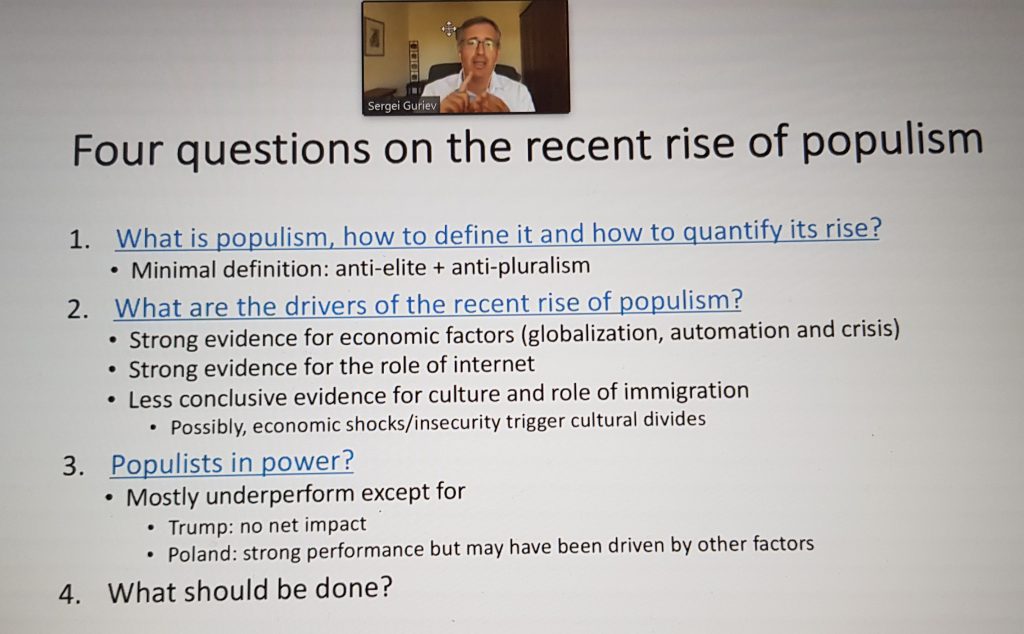
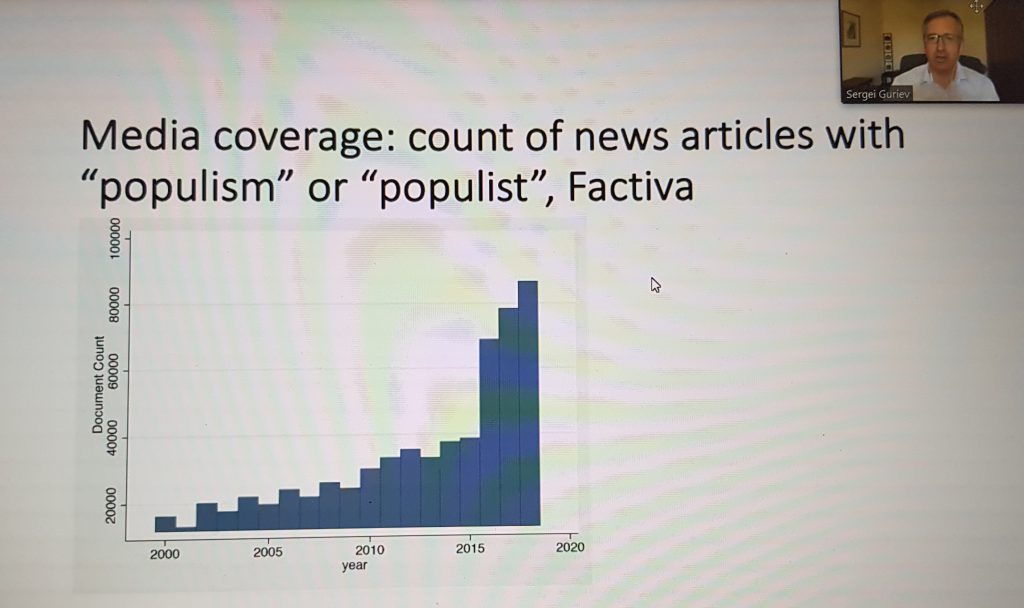
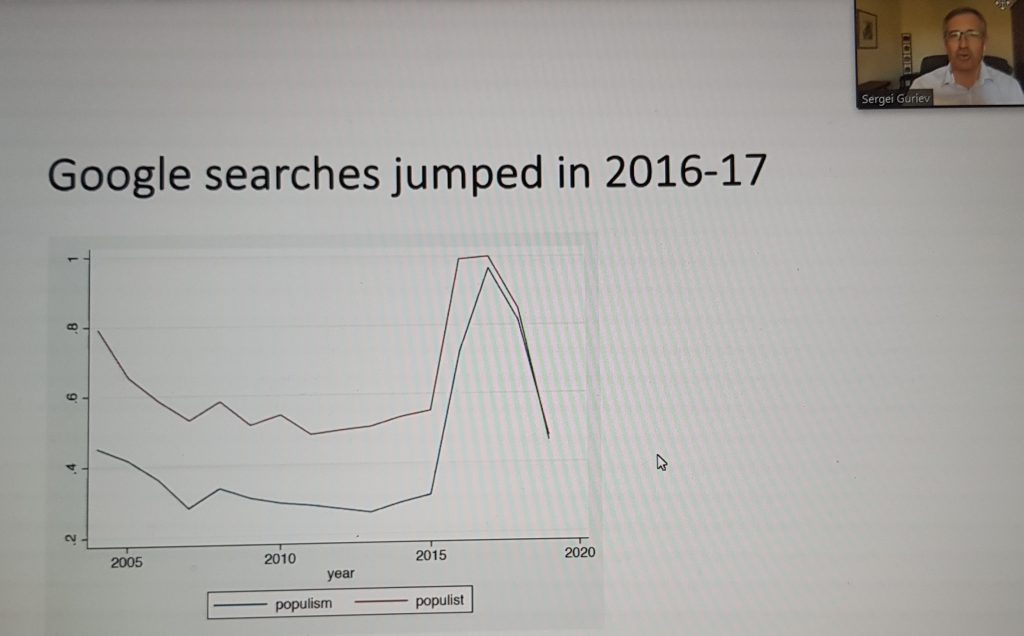
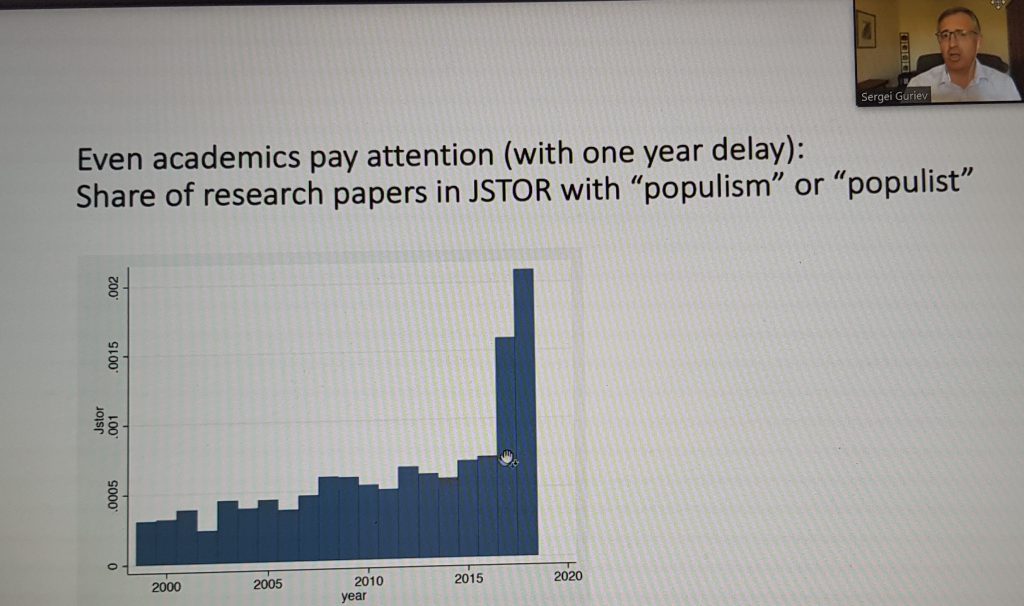
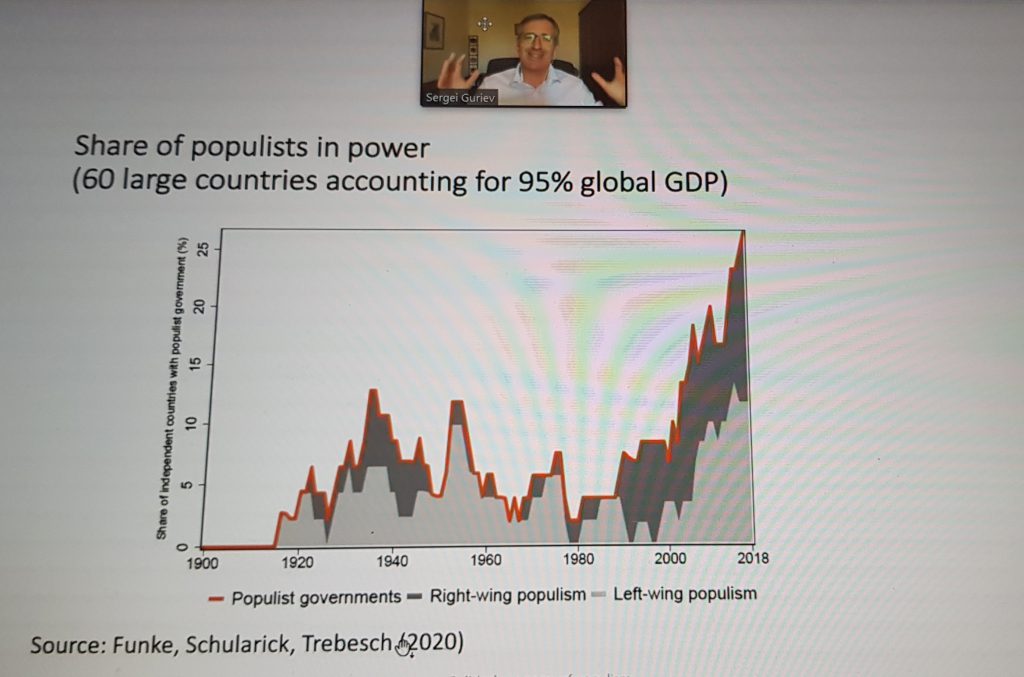
The last seminar was given by Sergei Guriev on The Political Economy of Populism. Below find a report, the video of the seminar and the background paper.
Announcement/forthcoming seminar: September 3, 2020:London/UKat 1-2 pm —Kompal Sinha, Macquarie University and GLO Topic: To be announced. Registration details will be provided in time.
Report
The Political Economy of Populism
GLO Virtual Seminar on August 6, 2020 with Sergei Guriev (Sciences Po & GLO). Video !!!
Related paper: Sergei Guriev and Elias Papaioannou, The Political Economy of Populism.PDF Draft prepared for the Journal of Economic Literature.
A new GLO Discussion Paperstudies the Australian labor market for native and foreign students and finds that acquiring education in the host country does not appear to eliminate uneven labor market outcomes between natives and foreigners.
The Global Labor Organization (GLO) is an independent, non-partisan and non-governmental organization that functions as an international network and virtual platform to stimulate global research, debate and collaboration.
Author Abstract: This paper studies the labor market outcomes of native and foreign PhD graduates staying as migrants in Australia, using data on career destinations over the period 1999-2015. Natives with an English-speaking background emerge as benefiting from positive employer discrimination, especially if graduating in Science, Technology, Engineering and Mathematics (STEM), for which they receive a premium that is unrelated to observed characteristics such as gender, age, and previous work experience. In contrast, foreign PhD graduates with a non-English speaking background experience worse labor market outcomes, especially if they work in the university sector. Acquiring education in the host country does not appear to eliminate uneven labor market outcomes between natives and foreigners.
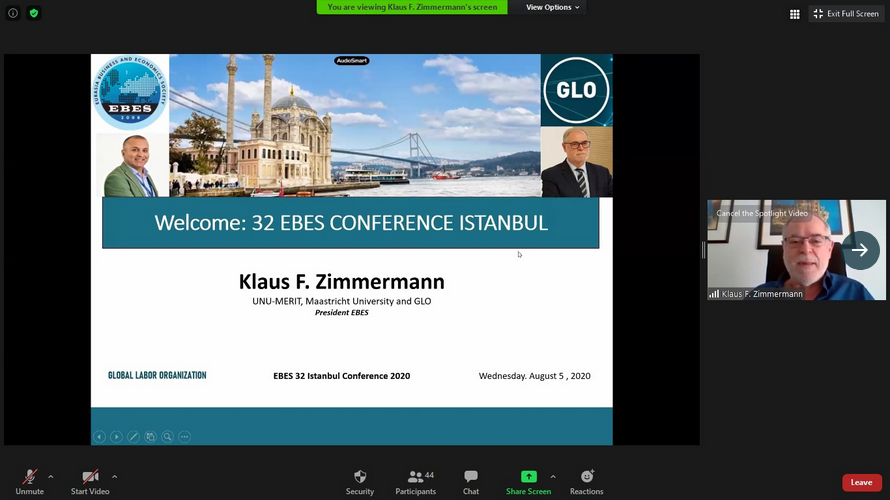
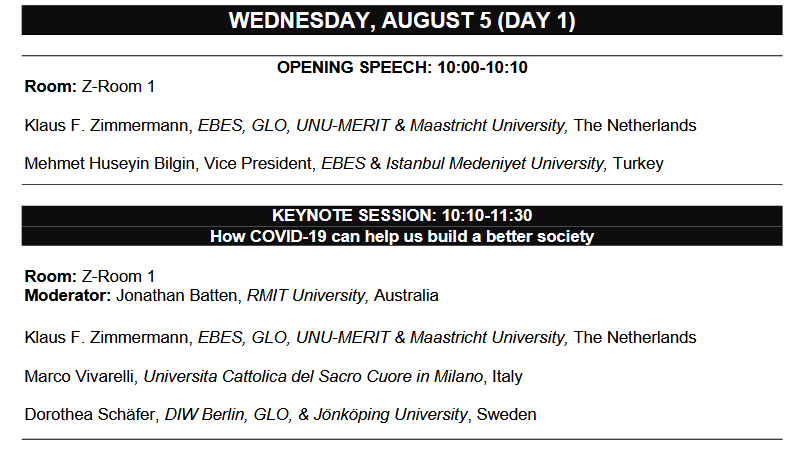
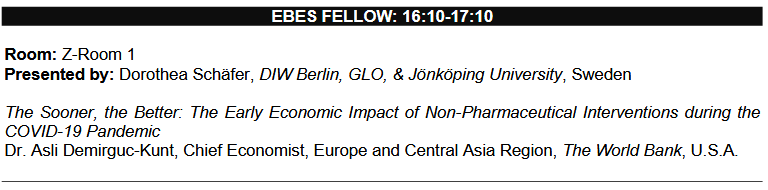
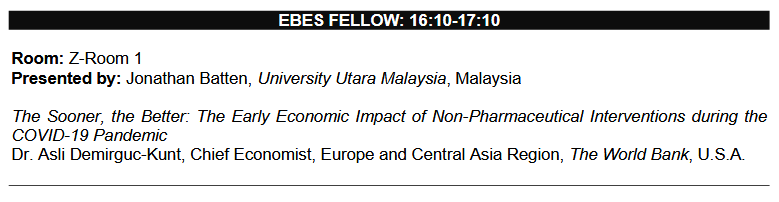
EBES and GLO are partner organizations. GLO President Klaus F. Zimmermann is also President of EBES. Among the highlights were the sessions below with GLO Fellows Mehmet Huseyin Bilgin, Jonathan Batten, Marco Vivarelli and Dorothea Schäfer. Asli Demirguc-Kunt (World Bank) spoke on the occasion of her appointment as EBES Fellow 2020. Klaus F. Zimmermann congratulated her to this honor and closed the appointment session.
From the left: Batten, Bilgin, Schäfer, Vivarelli, Zimmermann
In his opening speech, EBES President Klaus F. Zimmermann was using his recent joint paper in The World Economy with EBES colleagues to introduce the inter-country transmission challenge of the Covid-19 pandemic and outlined the consequences for academic networking and conferencing. He was calling for attempts to introduce social components into virtual conferences.
The Keynote Panel on How Covid-19 can help us build a better society?was chaired and guided by Jonathan Batten. Klaus F. Zimmermann spoke on human resources issues, Marco Vivarelli an the labor market and Dorothea Schäfer on financial markets.
****************************************** BACKGROUND PAPERmentioned by Zimmermann as an example in his panel contribution. UNU-MERIT Discussion Paper No. 2020-015 Taking the challenge: A joint European policy response to the corona crisis to strengthen the public sector and restart a more sustainable and social Europe by Jo Ritzen, Javi Lopez, André Knottnerus, Salvador Pérez-Moreno, George Papandreou & Klaus F. Zimmermann
• Strong & social Europe • Joint Euro area monetary funding • Joint Euro area borrowing conditional on strong commitments for sustainable development • Better public sector with joint taxation • Sound fiscal behavior • Full employment strategy with vocational training, retraining • Free internal mobility, open labor immigration policy; joint refugee policy. ********************************************
A new GLO Discussion Paperpresents a model which shows that wages, prices and real income should grow faster in countries with low increase in their labor force.
The Global Labor Organization (GLO) is an independent, non-partisan and non-governmental organization that functions as an international network and virtual platform to stimulate global research, debate and collaboration.
Author Abstract: We develop a model which shows that wages, prices and real income should grow faster in countries with low increase in their labor force. If not, other countries experience growing unemployment and/or trade deficit. This result is applied to the case of Germany, which has displayed a significantly lower increase in its labour force than its trade partners, except in the moment of the reunification. By assuming that goods are differentiated according to their country of origin (Armington’s hypothesis), a low growth of the working population constrains the production of German goods, which entails an increase in their prices and in German wages. This mechanism is magnified by the low price elasticity of the demand for German goods. Hence, the German policy of wage moderation could severely constrain other countries’ policy options. The simulations of an extended model which encompasses offshoring to emerging countries and labor market imperfections suggest that (i) the impact of differences in labor force growth upon unemployment in Eurozone countries has been significant and (ii) the German demographic shock following unification could explain a large part of the 1995-2005 German economic turmoil.
A new GLO Discussion Paperpresents a model where better-off individuals mate genetically close partners, and then use wealth to treat their children’s health problems.
The Global Labor Organization (GLO) is an independent, non-partisan and non-governmental organization that functions as an international network and virtual platform to stimulate global research, debate and collaboration.
Author Abstract: In this note, I address the trade-off between children’s health and parental preference toward similarity with children. In my model, better-off individuals mate genetically close partners and then use wealth to treat their children’s health problems, caused by inbreeding depression. As a result, the relationship between parental wealth and children’s health includes decreasing portions. Siblings health inequality is also nonmonotonically related to parental wealth, if parents discriminate in favor of more similar children.
A new GLO Discussion Paper finds that all caste groups lost jobs in the first month of the Covid-19 lockdown, the job losses for lowest-ranked caste are greater by factor of three.
The Global Labor Organization (GLO) is an independent, non-partisan and non-governmental organization that functions as an international network and virtual platform to stimulate global research, debate and collaboration.
Author Abstract: Using nationally representative panel data for 21,799 individuals between May 2018 and April 2020, this paper investigates whether the Covid-19 pandemic was indeed a “Great Leveler” in the sense that it imposed similar and equivalent labour market shocks on different caste groups. We find that while all caste groups lost jobs in the first month of the lockdown, the job losses for lowest-ranked caste are greater by factor of three. The data shows that the disproportionate effects stems from lower levels of human capital and over-representation in vulnerable jobs for the lowest ranked caste groups in the country.
A new GLO Discussion Paper using mortality data for Italy finds that the growth in total mortality rates can potentially be used as a statistically reliable predictor of mortality crises.
The Global Labor Organization (GLO) is an independent, non-partisan and non-governmental organization that functions as an international network and virtual platform to stimulate global research, debate and collaboration.
Author Abstract: The paper provides initial evidence that excess mortality rates by locality can be used as a statistically reliable predictor of looming mortality crises. Using recently published daily deaths figures for 7,357 Italian municipalities, we estimate the growth in daily mortality rates between the period 2015-2019 and 2020 by province. All provinces that experienced a major mortality shock in mid-March 2020 had increases in mortality rates of 100% or above already in mid-February 2020. This increase was particularly strong for males and older people, two recognizable features of COVID-19. Using panel data models, we find a strong positive and significant association between overall deaths and COVID-19 related deaths, and between early increases in mortality rates in February 2020 for any cause and the March 2020 outbreak in COVID-19 deaths. We conclude that the growth in mortality rates can potentially be used as a statistically reliable predictor of mortality crises, including COVID- 19 crises.
A new GLO Discussion Papersurveys the empirical literature to find that taste-based discriminationcanbetter explain ethnic discrimination in hiring than statistical discrimination.
The Global Labor Organization (GLO) is an independent, non-partisan and non-governmental organization that functions as an international network and virtual platform to stimulate global research, debate and collaboration.
Author Abstract: Scholars have gone to great lengths to chart the incidence of ethnic labour market discrimination. To effectively mitigate this discrimination, however, we need to understand its underlying mechanisms because different mechanisms lead to different counteracting measures. To this end, we reviewed the recent literature that confronts the seminal theories of taste-based and statistical discrimination against the empirical reality. First, we observed that the measurement operationalisation of the mechanisms varied greatly between studies, necessitating the development of a measurement standard. Second, we found that 20 out of 30 studies examining taste-based discrimination and 18 out of 34 studies assessing statistical discrimination produced supportive evidence for said mechanisms. However, (field) experimental research, which predominantly focuses on hiring outcomes, yielded more evidence in favour of taste-based vis-à-vis statistical discrimination, suggesting that the taste-based mechanism might better explain ethnic discrimination in hiring.
A new GLO Discussion Paperprovides anunderstanding of the mechanisms of hiring discrimination towards former burnout patients .
The Global Labor Organization (GLO) is an independent, non-partisan and non-governmental organization that functions as an international network and virtual platform to stimulate global research, debate and collaboration.
Author Abstract: Hiring discrimination towards (former) burnout patients has been extensively documented in the literature. To tackle this problem, it is important to understand the underlying mechanisms of such discrimination. Therefore, we conducted a vignette experiment with 425 genuine recruiters and jointly tested the potential stigma against job candidates with a history of burnout that were mentioned earlier in the literature. We found candidates revealing a history of burnout elicit perceptions of requiring work adaptations, likely having more unpleasant collaborations with others as well as diminished health, autonomy, ability to work under pressure, leadership capacity, manageability, and learning ability, when compared to candidates with a comparable gap in working history due to physical injury. Led by perceptions of a reduced ability to work under pressure, the tested perceptions jointly explained over 90% of the effect of revealing burnout on the probability of being invited to a job interview. In addition, the negative effect on interview probability of revealing burnout was stronger when the job vacancy required higher stress tolerance. In contrast, the negative impact of revealing burnout on interview probability appeared weaker when recruiters were women and when recruiters had previously had personal encounters with burnout.
A new GLO Discussion Paperfinds long-term evidence that the youngest cohort students participate less often in the Erasmus exchange program than older cohort members.
The Global Labor Organization (GLO) is an independent, non-partisan and non-governmental organization that functions as an international network and virtual platform to stimulate global research, debate and collaboration.
GLO Fellow Magnus Carlsson & GLO Affiliate Luca Fumarco
Magnus Carlsson
Luca Fumarco
Author Abstract: This study contributes to the literature on long-term effects of relative age (i.e. age differences between classmates in compulsory school) by examining tertiary education outcomes. We investigate whether there is evidence of relative age effects on university students enrolled in the Erasmus exchange program. We use administrative data on all exchange students who visited the Linnaeus University, in Sweden, in the four years since its founding. We find long-term evidence of RAEs—the youngest cohort students participate less often to the Erasmus exchange program than older cohort members.
A new GLO Discussion Paperreviews the economic literature on social remittances.
The Global Labor Organization (GLO) is an independent, non-partisan and non-governmental organization that functions as an international network and virtual platform to stimulate global research, debate and collaboration.
Author Abstract: This article reviews the economic literature on social remittances. Unlike financial remittances, which are flows of cash or goods sent by migrants to their origin countries, social remittances refer to economic, social, political attitudes, behaviours and norms that are transmitted through migration. Although economists are newcomers to this literature, they have contributed to advancing knowledge on the causal effects of migration on social remittances. The evidence reviewed in this article unanimously points at the important role played by international migration in the transfer of norms. However, host countries matter greatly in explaining the types of attitudes and knowledge that are transferred back to countries of origin. Overall, there are still clear gaps in our understanding of social remittances that future research would need to address to enable us to appreciate better the mechanisms through which norms are transferred.
A new GLO Discussion Paperpredicts that in the presence of natural resources and rent seeking, ethnic diversity increases concentration of political power, reduces income per capita and increases income inequality.
The Global Labor Organization (GLO) is an independent, non-partisan and non-governmental organization that functions as an international network and virtual platform to stimulate global research, debate and collaboration.
Author Abstract: The empirical evidence suggests that the resource rich countries tend to have poor economic performance and higher rent seeking. In this paper, we develop a general equilibrium model explaining why natural resources turn out to be a curse in an economy divided into two classes: elite and workers. Our model explains the resource curse in a setup in which governing elite expropriate rents from natural resources which reduces the productive use of these resources. The expected costs and benefits of such rent seeking activities depend on the degree of ethnic polarization which affects the concentration of political power, and on the quality of institutions which constraints rent seeking. The model predicts that in the presence of natural resources and rent seeking, ethnic diversity increases concentration of political power, reduces income per capita and increases income inequality. Moreover, the impact will be higher in economies that depend more on natural resources.
EBES and GLO are partner organizations. GLO President Klaus F. Zimmermann is also President of EBES.
Among the highlights are the sessions below with GLO Fellows Mehmet Huseyin Bilgin, Jonathan Batten, Marco Vivarelli and Dorothea Schäfer.
Asli Demirguc-Kunt will speak on the occasion of her appointment as EBES Fellow 2020.
Dr. Asli Demirguc-Kunt is the Chief Economist of Europe and Central Asia Region of the World Bank. Over her 30-year career in the World Bank, she has also served as the Director of Research, Director of Development Policy, and the Chief Economist of the Finance and Private Sector Development Network, conducting research and advising on financial and private sector development issues. She has published articles in many of the leading economics and finance journals such as Journal of Finance, Journal of Financial Economics, Journal of Financial and Quantitative Analysis, The Review of Financial Studies, Journal of Banking and Finance, Journal of Monetary Economics, Journal of Money, Credit and Banking, Journal of Economic Perspectives etc. and is among the most-cited researchers in the world (Google Scholar = 76K). Her research has focused on the links between financial development, firm performance, and economic development. Banking and financial crises, financial regulation, access to financial services and inclusion, as well as SME finance and entrepreneurship are among her areas of research. She has also created the Global Financial Development Report series and the Global Findex financial inclusion database. She was the President of the International Atlantic Economic Society (2013-14) and Director of the Western Economic Association (2015-18) and serves on the editorial boards of professional journals. Prior to her position in the World Bank, she was an Economist at the Federal Reserve Bank of Cleveland. She holds a Ph.D. and M.A. in economics from Ohio State University.
A new GLO Discussion Paperadvertises for the unemployment-to-population ratio and the inactivity-to-population ratio as two highly appropriate and complementary measures of labor market health.
The Global Labor Organization (GLO) is an independent, non-partisan and non-governmental organization that functions as an international network and virtual platform to stimulate global research, debate and collaboration.
Author Abstract: This article introduces the metaphor of the iceberg in the labor market. While policy in most OECD countries has historically focused on reducing unemployment (the tip of the iceberg), the group of inactive people (below the waterline) is much larger. Therefore, we point to the clear limitations of the unemployment rate as the (single) key macro-economic indicator of the health of the labor market. A parsimonious dashboard approach utilizing the unemployment-to-population ratio and the inactivity-to-population ratio as two highly appropriate and complementary measures is defended. We show that the ratio of these two indices varies greatly between countries, which calls for different policies for different countries.
Report of the Editor-in-Chief 2020 (23 July, 2020) PDF of Report
The Journal of Population of Economicsis an international quarterly that publishes original theoretical and applied research in all areas of population economics, household economics, and human resources. This report contains information about the Journal and its editorial process in the past year and some earlier years.
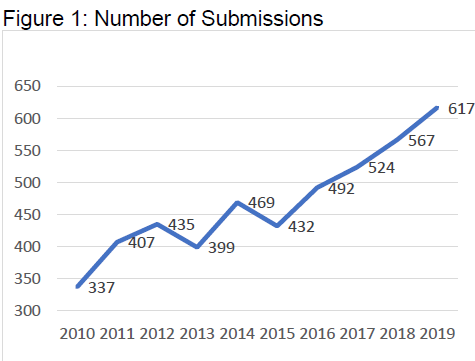
The number of submissions has substantially increased over recent years (Figure 1). Between 2011 and 2013, the Journal received about 400 submissions per year; by 2016 the number of submissions neared 500, and in 2019, 617 manuscripts were received. The inflow appears to be holding steady; as of the end of July 2020, the journal had received 485 new manuscripts; during the same period last year, a much smaller number of manuscripts (327) had been received.
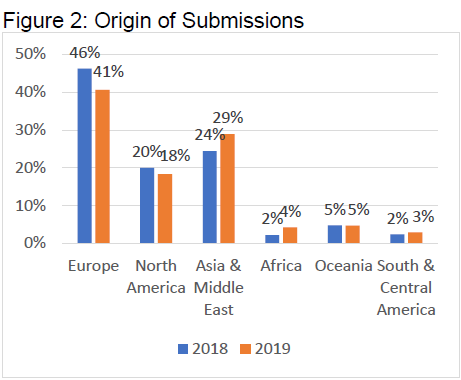
In line with past years, the largest single share of submissions made in 2019 were from corresponding authors based in Europe (Figure 2). Over 40% of all submissions originated from Europe, and nearly one-third (29%) of submissions came from authors based in Asia and the Middle East. Under one-fifth (20%) of submissions came from authors based in North America. The remaining submissions came from contributors from Africa (4%), Oceania (Australia and New Zealand; 5%), and South and Central America (3%).
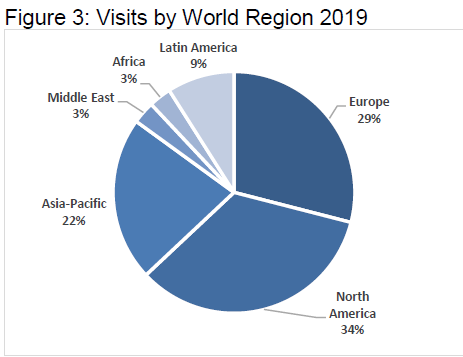
Figure 3 contains the internet visits to the Journal on the Springer website from the world regions. With over a third of visits coming from North America and 29% from Europe, followed by the Asia-pacific region (22%), the Journal is globally accessed and read.
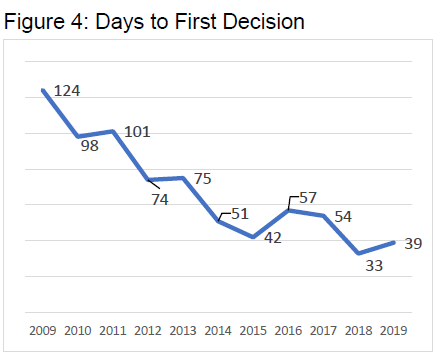
Figure 4 shows that the average number of days between submission and first decision has generally declined over time. Despite a slight uptick in the turnaround time for first decisions between 2015 and 2016, which may be partially attributed to the increased volume of submissions, there was a substantial reduction in turnaround time in following years. In 2019, the average time for first decisions was 30 days. The Journal is committed to keep the time between submission and decisions low, including eventual publication. Since 2013 the Journal has executed a desk rejection policy to provide authors with an early signal for better targeting of their work. The large number of submissions combined with an annual quota of 40 manuscripts keeps the acceptance rates of the Journal very low.
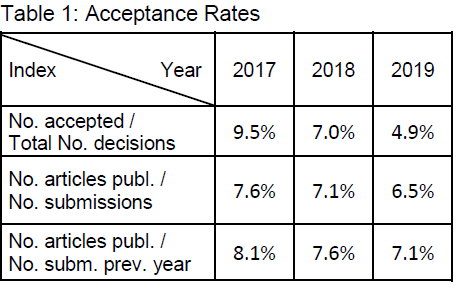
Table 1 shows three acceptance rate measures: 1) the number of manuscripts accepted in a given year as a share of all final decisions made in that year; 2) the number of published articles in a given year as a share of all submissions in that year; and; 3) the number of articles published in a given year divided by the number of the previous year’s submissions.
The number of accepted papers (submitted at any point in time) in a given year as a share of all decisions made in that year has shifted over time. Compared to 9.5% in 2017, the acceptance rate has declined from 7% in 2018 to 4.9% in 2019. If acceptance rate is measured as the number of published manuscripts as a share of total submissions received in that year, the acceptance rate was slightly higher, at 6.5% in 2019 (or 40 manuscripts from among 617 submissions), falling 7.6% in 2017 and 7.1% in 2018. Measuring the acceptance rate as the number of publications as a share of the number of submissions received in the previous year (2018) would yield a 2019 rate of 7.1%, which is lower than the previous years (8.1% in 2017 and 7.6% in 2018).
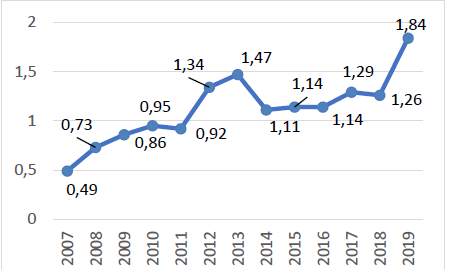
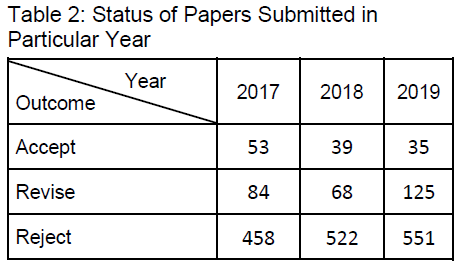
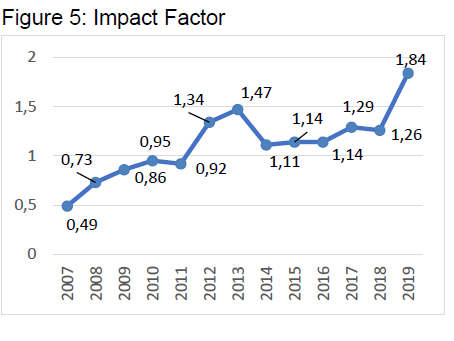
Table 2 reports the status of papers submitted in the given year for years 2017 – 2019. The Journal’s Impact Factor has increased substantially over time (Figure 5). In 2019, the just published simple Impact Factor was 1.840, and the 5-year Impact Factor was 2.353. The Journal ranked 120/371 in economics and 11/29 in demography in 2019. As of July 2020, the Journal’s IDEAS/RePEc ranking was 77/2,485 (based on the Simple Impact Factor 15.682, for Journals and all years).
The Journal is ranked in: Social Science Citation Index, Journal Citation Reports/Social Sciences, SCOPUS, EconLit, Google Scholar, EBSCO Discovery Service, ProQuest, CAB International, ABS Academic Journal Quality Guide, Academic OneFile, Academic Search, Bibliography of Asian Studies, CAB Abstracts, CSA Environmental Sciences, Current Contents/Social & Behavioral Sciences, ECONIS, ERIH PLUS, Gale, Global Health, International Bibliography of the Social Sciences (IBSS), JSTOR, OCLC, Research Papers in Economics (RePEc), Review of Population Reviews, SCImago, and Summon by ProQuest.
Klaus F. Zimmermann, Editor-in-Chief Journal of Population Economics
A new GLO Discussion Paper finds that the stay-at-home order led to a large decrease in traffic accidents as a large decrease in mobility in Louisiana. Further, the composition of accidents has changed.
The Global Labor Organization (GLO) is an independent, non-partisan and non-governmental organization that functions as an international network and virtual platform to stimulate global research, debate and collaboration.
Author Abstract: We use a regression discontinuity design to study the effect of the COVID-19 lockdown on mobility and traffic accidents. Based on data from Google Community Mobility reports and Uniform Traffic Crash Report from the Louisiana Department of Transportation and Development (LaDOTD), we find that the stay-at-home order led to a large decrease in traffic accidents (-47 percent). In particular, we find a large decrease in accidents involving injury (-46 percent), distracted drivers (-43 percent), and ambulances (-41 percent). We also find evidence of a change in the composition of accidents, with more incidents involving individuals aged 25 to 64, male, and nonwhite drivers. Interestingly, we find no impact on ambulance response time, despite lower traffic. Finally, we document a large decrease in mobility in Louisiana. Our results have important policy implications for traffic management policies.
A new GLO Discussion Paper finds that restrictions on migration causes unemployment while the effects of restrictions on trade are not so clear.
The Global Labor Organization (GLO) is an independent, non-partisan and non-governmental organization that functions as an international network and virtual platform to stimulate global research, debate and collaboration.
Author Abstract: To combat COVID-19 the entire world has resorted to global lockdown implying restriction on international labor migration and trade. This paper aims to check the effect of such restrictions on the unemployment of unskilled labor in the source country. In competitive general equilibrium framework with three goods and four factors restriction on migration raises unemployment for given factor intensity. The results remain same even in a slightly different structure of the economy. In case of trade restriction, however, the rise or fall in unemployment depends on both the structure of the economy and the factor intensity assumption.
A new GLO Discussion Paper suggests that in Greece during the COVID-19 period job separations were lower than usual but employment declined due to a dramatic slowdown in hiring.
The Global Labor Organization (GLO) is an independent, non-partisan and non-governmental organization that functions as an international network and virtual platform to stimulate global research, debate and collaboration.
Author Abstract: We use administrative, survey, and online vacancy data to analyze the short-term labor market impacts of the COVID-19 lockdown in Greece. We find that flows into unemployment have not increased; in fact, separations were lower than would have been expected given trends in recent years. At the same time, employment was about 12 percent lower at the end of June than it would have been without the pandemic. Our interrupted time series and difference-in-differences estimates indicate that this was due to a dramatic slowdown in hiring during months when job creation typically peaks in normal years, mostly in tourism. While we do not formally test the reasons for these patterns, our analysis suggests that the measures introduced to mitigate the effects of the crisis in Greece have played an important role. These measures prohibited layoffs in industries affected by the crisis and tied the major form of income support to the maintenance of employment relationships.
A new GLO Discussion Paper suggests that COVID-19 may further accentuate the existing divide between globally competitive advanced producer services and more locally focused sectors providing lower-value personal and household services, posing a number of significant policy challenges for London.
The Global Labor Organization (GLO) is an independent, non-partisan and non-governmental organization that functions as an international network and virtual platform to stimulate global research, debate and collaboration.
Author Abstract: Over the last 50 years, London has successfully adapted to technological change and globalization, making it the major driver of the UK economy. But its strengths have also made the city particularly vulnerable to the health impacts of COVID-19, and potentially also to wider negative economic implications of the crisis. Many of London’s key sectors rely on proximity, agglomeration economies and externalities. We evaluate the available data on the impact of the pandemic on London to date, with a particular focus on the differential effects between sectors. We also identify seven key trends, affecting both the demand and supply side of the economy, that are likely to have significant medium- to long-term economic impacts, and assess the potential impacts on London’s major industrial sectors. Our findings suggest that COVID-19 may further accentuate the existing divide between globally competitive advanced producer services and more locally focused sectors providing lower-value personal and household services, posing a number of significant policy challenges.
A new paper published in the Journal of Population Economics finds that immigration indeed decreases far-right votes in Finland and provides an explanation.
OPEN ACCESS – Published Online. Forthcoming in print version: Journal of Population Economics (2021), volume 34.
Author Abstract: Across Europe, far-right parties have made significant electoral gains in recent years. Their anti-immigration stance is considered one of the main factors behind their success. Using data from Finland, this paper studies the effect of immigration on voting for the far-right Finns Party on a local level. Exploiting a convenient setup for a shift-share instrument, I find that a 1 percentage point increase in the share of foreign citizens in a municipality decreases the Finns Party’s vote share by 3.4 percentage points. Placebo tests using pre-period data confirm this effect is not driven by persistent trends at the municipality level. The far-right votes lost to immigration are captured by the two pro-immigration parties. Turning to potential mechanisms, immigration is found to increase voter turnout, potentially activating local pro-immigration voters. Moreover, the negative effect is only present in municipalities with high initial exposure to immigrants, consistent with the intergroup contact theory. Finally, I also provide some evidence for the welfare-state channel as a plausible mechanism behind the main result.
A new GLO Discussion Paper provides evidence that Indian men contribute more hours to homework during lockdown in the Covid-19 crisis.
The Global Labor Organization (GLO) is an independent, non-partisan and non-governmental organization that functions as an international network and virtual platform to stimulate global research, debate and collaboration.
Author Abstract: Based on national-level panel data from Centre for Monitoring Indian Economy (CMIE)’s Consumer Pyramids Household Survey (CPHS) database, this paper investigates the first effects of Covid-19 induced lockdown on employment and the gendered pattern of time allocation inside the home. Examining the employment status during the last 12 months of over 40,000 individuals surveyed in April 2020 (i.e. during the strict nationwide lockdown), the paper finds that overall employment, which was relatively stable during the pre-pandemic time period, dropped sharply post-lockdown. This drop in employment was not gender neutral. Given the large pre-existing gender gaps in employment, in absolute terms, more men lost employment than women. However, conditional on being employed pre-lockdown, women were roughly 20 percentage points less likely to be employed than men who were employed pre-lockdown. India has amongst the most unequal gender division of household work globally. Comparing hours spent on domestic work pre- and post-lockdown, I find that men increased hours spent on domestic work during lockdown. The male distribution continues to be right-skewed, but the proportions of men doing between 0.5 to 4 hours of housework per day increased post-lockdown. This seems to be driven by increased male unemployment. The time spent with friends decreased for both men and women, but relatively more for women.
A new GLO Discussion Paper provides evidence that Covid-related lockdowns result in significant decreases in global air pollution.
The Global Labor Organization (GLO) is an independent, non-partisan and non-governmental organization that functions as an international network and virtual platform to stimulate global research, debate and collaboration.
Author Abstract: Despite a growing literature on the impacts of the COVID-19 pandemic, scant evidence currently exists on its impacts on air quality. We offer the first study that provides cross-national evidence on the causal impacts of COVID-19 on air pollution. We assemble a rich database consisting of daily, sub-national level data of air quality for 178 countries before and after the COVID-19 lockdowns, and investigate their impacts on air quality using a Regression Discontinuity Design approach. We find the lockdowns to result in significant decreases in global air pollution. These results are consistent across measures of air quality and data sources and robust to various model specifications. Some limited evidence emerges that countries with a higher share of trade and manufacturing in the economy or with an initially lower level of air pollution witness more reduced air pollution after the lockdowns; but the opposite result holds for countries near the equator. We also find that mobility restrictions following the lockdowns are a possible explanation for improved air quality.
A new GLO Discussion Paperuses a randomized field experiment in Viet Nam to estimate the effects of computer-assisted personal interviewing (CAPI) on interview duration, number of errors, respondent perceptions, and cost.
The Global Labor Organization (GLO) is an independent, non-partisan and non-governmental organization that functions as an international network and virtual platform to stimulate global research, debate and collaboration.
Author Abstract: We use a randomized field experiment to estimate the effect of computer-assisted personal interviewing (CAPI) on interview duration, number of errors, respondent perceptions, and cost. During Quarter 3 of the 2017 Labor Force Survey data collection for Ho Chi Minh City, Viet Nam, 15 households were randomly selected and interviewed using pencil-and-paper interviewing (PAPI), while another 15 households were randomly selected and interviewed using CAPI within each of a total of 180 sample enumeration areas. On average, CAPI interviews lasted 9.4 minutes less and had 0.8 less errors per questionnaire relative to PAPI. Respondents were more likely to perceive interview duration as long or very long when the enumerator was female or educated to college level or above, which is contrary to our experimental findings. Finally, the break-even number of interviews that make CAPI cost-effective is 1,769, which is lower than prior estimates and reflects the rapidly decreasing cost of technology.
A new GLO Discussion Paperstudies the effects of the rise in property taxes in Greece during the recent structural reforms to conclude that they led to increases in inequality and (relative) poverty.
The Global Labor Organization (GLO) is an independent, non-partisan and non-governmental organization that functions as an international network and virtual platform to stimulate global research, debate and collaboration.
Author Abstract: During the last decade, Greece faced one of the most severe debt crises among developed countries, leading to Economic Adjustment Programs in order to avoid a disorderly default. Public expenditure was cut, tax rates were increased and new taxes were introduced aiming at restoring public finances. Prominent among the latter were recurrent property taxes that were playing a very minor role before the crisis. These taxes helped boosting public revenues but were hugely unpopular. The paper examines in detail their distributional impact and finds that they led to increases in inequality and (relative) poverty. The result is stronger in the case of inequality indices that are relatively more sensitive to changes close to the bottom of the distribution and poverty indices that are sensitive to the distribution of income among the poor.
A new GLO Discussion Papersuggests that a higher penetration of industrial robots in the local labor market is positively related to the health of the low-skilled population.
The Global Labor Organization (GLO) is an independent, non-partisan and non-governmental organization that functions as an international network and virtual platform to stimulate global research, debate and collaboration.
Author Abstract: Technological advancements bring changes to our life, altering our behaviors as well as our role in the economy. In this paper, we examine the potential effect of the rise of robotic technology on health. The results of the analysis suggest that higher penetration of industrial robots in the local labor market is positively related to the health of the low-skilled population. A ten percent increase in robots per 1,000 workers is associated with an approximately 10% reduction in the fraction of low-skilled individuals reporting poor health. Further analysis suggests that reallocation of tasks and reduction in unhealthy behavior partly explain this finding.
It is so sad to learn about the sudden and unexpected death of GLO Fellow Ansgar Belke (*March 28, 1965; + July 22, 2020), Professor of Economics at the University of Duisburg-Essen. He is sadly mourned by his many friends including the GLO community. We remember a great scientist and productive colleague.
Ansgar Belke obtained his BA and MA in Economics in Münster, Paris, and Kiel, and a PhD in Economics and Habilitation in Economics and Econometrics from the Ruhr University Bochum, Germany.
He has been since 2008 a Full Professor of Macroeconomics and Director of the Institute of Business and Economic Studies (IBES) at the University of Duisburg-Essen. He has been (ad personam) Jean Monnet Professor since 2012. Before, he was Full Professor of Economics, in particular Macroeconomics, Applied Economics, and Economic Policy, at the University of Vienna (2000-2001); C4 Professor of Economics, in particular Foreign Trade, at the University of Hohenheim (2001-2007); Head of the Eastern European Centre at the University of Hohenheim (2001-2007); and Head of the Centre for European Integration Research at the University of Hohenheim (2001-2007).
Ansgar Belke has been an Associate Senior Research Fellow at the Centre for European Policy Studies (CEPS), Brussels; and a Visiting Researcher at the IMF in Washington, DC, CentER Tilburg, CEPS Brussels, IfW Kiel, DIW Berlin, and OeNB Vienna. Furthermore, he has been Research Director for International Macroeconomics at the German Institute for Economic Research (DIW Berlin), and a Visiting Professor at the Hertie School of Governance, Berlin. He served as a member of the “Monetary Expert Panel” of the European Parliament from 2009 to 2014 and has again been appointed for the legislative period of the European Parliament 2020 to 2024.
He has published widely in international refereed journals and other outlets, and had regular appearances in the print media and in national and international television broadcasts.
His main research interests were in the fields of international macroeconomics, monetary economics, European integration, and applied econometrics.
As external DIW Research Director for International Macroeconomics, Ansgar Belke supported Klaus F. Zimmermann during his time as President of the German Institute for Economic Research (DIW) in the reforms of the institute.
Ansgar Belke was a GLO Fellow from the beginning and has contributed substantially, e.g. by publishing his research in the GLO Discussion Paper series.
For his academic achievements, Academia Europaea, the Academy of Europe, had elected Ansgar Belke in July 2020 as a member, which is considered to be a huge honor and a sign of great respect.
A new GLO Discussion Paper finds that women in the Caribbean tourism work for less productive and profitable firms. However, those firms with females at the top employ more women, particularly in management roles.
The Global Labor Organization (GLO) is an independent, non-partisan and non-governmental organization that functions as an international network and virtual platform to stimulate global research, debate and collaboration.
Author Abstract: This study contributes to the rapidly growing literature on women in tourism. It focuses on a group of 13 Caribbean countries. The study analyses the impact of women in apical positions within firms (top manager or owner) on firm performance – productivity, profitability and female employment. For this both a decomposition model and the Inverse Probability Weighted Regression Adjustment (IPWRA) estimator are used. The analysis finds that opportunities for women in these positions in the Caribbean are constrained to less productive and profitable firms, as elsewhere. However, those firms with females at the top employ more women, particularly in management roles.
Featured image: Photo-by-Cristian-Newman-on-Unsplash
A new GLO Discussion Paper provides first evidence that race does affect COVID-19 outcomes.A heterogeneity analysis reveals that the main channels of transmission are socioeconomic status and household composition.
The Global Labor Organization (GLO) is an independent, non-partisan and non-governmental organization that functions as an international network and virtual platform to stimulate global research, debate and collaboration.
Author Abstract: Discussion on the disproportionate impact of COVID-19 on African Americans has been at center stage since the outbreak of the epidemic in the United States. To present day, however, lack of race-disaggregated individual data has prevented a rigorous assessment of the extent of this phenomenon and the reasons why blacks may be particularly vulnerable to the disease. Using individual and georeferenced death data collected daily by the Cook County Medical Examiner, we provide first evidence that race does affect COVID-19 outcomes. The data confirm that in Cook County blacks are overrepresented in terms of COVID-19 related deaths since|as of June 16, 2020|they constitute 35 percent of the dead, so that they are dying at a rate 1.3 times higher than their population share. Furthermore, by combining the spatial distribution of mortality with the 1930s redlining maps for the Chicago area, we obtain a block group level panel dataset of weekly deaths over the period January 1, 2020-June 16, 2020, over which we establish that, after the outbreak of the epidemic, historically lower-graded neighborhoods display a sharper increase in mortality, driven by blacks, while no pre-treatment differences are detected. Thus, we uncover a persistence influence of the racial segregation induced by the discriminatory lending practices of the 1930s, by way of a diminished resilience of the black population to the shock represented by the COVID-19 outbreak. A heterogeneity analysis reveals that the main channels of transmission are socioeconomic status and household composition, whose influence is magnified in combination with a higher black share.
The last issue 4 (October) 2020, Volume 33, of the Journal of Population Economics is now published. Access the Table of Content and the papers.
Clarivate Analytics Social Sciences Citation Index Factor released July 2020: IMPACT FACTOR1.840 (2019) from 1.253 (2018); 5-YEAR IF 2.353 (2019) from 2.072 (2018)
A new GLO Discussion Paper studies the effects of grade retention in school on later labor market success. For occupations where on-the-job training is important, job candidates with a record of grade retention are less likely to receive a positive reaction on job applications.
The Global Labor Organization (GLO) is an independent, non-partisan and non-governmental organization that functions as an international network and virtual platform to stimulate global research, debate and collaboration.
Author Abstract: This article contributes to the nascent literature on the effect of grade retention in school on later labour market success. A field experiment is conducted to rule out the endogeneity of both outcomes. More concretely, various treatments of grade retention are randomly assigned to fictitious résumés sent in application to real vacancies. Overall, grade retention does not significantly affect positive call-back by employers. However, when narrowing in on vacancies for occupations where on-the-job training is important, job candidates with a record of grade retention are 16% less likely to receive a positive reaction. This finding is consistent with Queuing theory.
Featured image: Photo-by-Kimberly-Farmer-on-Unsplash
A new GLO Discussion Paper surveys the emerging and rapidly growing literature on the economic consequences of COVID-19 and governmental responses, and attempts to synthetize the insights emerging from a very large number of studies.
The Global Labor Organization (GLO) is an independent, non-partisan and non-governmental organization that functions as an international network and virtual platform to stimulate global research, debate and collaboration.
Author Abstract: We develop a possibility to work index (PWI) taking the ability to work from home and workplace closures into account. By using the data from the HLFS in Turkey, we examine the individual level determinants of PWI. Our findings reveal that PWI and ability to work from home are significantly different, and essential or closed jobs are not necessarily concentrated at the bottom of the wage distribution. Therefore, from a policy perspective, PWI can be a more encompassing measure of risk and can assist the public authorities to design better targeted social policies. Our results also point out that wage inequality is likely to deteriorate as a result of the supply shocks from confinement policies. However, the overall negative distributional effects of lockdown and disparity between employees in different economic activities become more substantial with duration. These suggest that in order to avoid major increases in earning inequalities and related social problems, governments would be better off with shorter and stricter lockdowns.
A new GLO Discussion Paper assesses whether students respond to messages about majoring in Economics, and whether this response varies by student gender. While males respond positively, there are no significant effects for female students.
The Global Labor Organization (GLO) is an independent, non-partisan and non-governmental organization that functions as an international network and virtual platform to stimulate global research, debate and collaboration.
Author Abstract: Why is the proportion of women who study Economics so low? This study assesses whether students respond to messages about majoring in Economics, and whether this response varies by student gender. We conducted an experiment among more than 2,000 students enrolled in Economics Principles courses, with interventions proceeding in two phases. In the first phase, randomly assigned students received a message with basic information about the Economics major, or the basic message combined with an emphasis on the rewarding careers or financial returns associated with the major. A control group received no such messages. In the second phase, all students receiving a grade of B- or better received a message after the course ended encouraging them to major in Economics. For a randomly chosen subset of these students, the message also encouraged them to persist in Economics even if their grade was disappointing. The basic message increased the proportion of male students majoring in Economics by 2 percentage points, equivalent to the control mean. We find no significant effects for female students. Extrapolating to the full sample, the basic message would nearly double the male/female ratio among Economics majors. Our results suggest the limits of light-touch interventions to promote diversity in Economics.
A new GLO Discussion Paper surveys the emerging and rapidly growing literature on the economic consequences of COVID-19 and governmental responses, and attempts to synthetize the insights emerging from a very large number of studies.
The Global Labor Organization (GLO) is an independent, non-partisan and non-governmental organization that functions as an international network and virtual platform to stimulate global research, debate and collaboration.
Author Abstract: The goal of this piece is to survey the emerging and rapidly growing literature on the economic consequences of COVID-19 and governmental responses, and to synthetize the insights emerging from a very large number of studies. This survey (i) provides an overview of the data sets used to measure social distancing and COVID-19 cases and deaths; (ii) reviews the literature on the determinants of compliance and effectiveness of social distancing; (iii) summarizes the literature on the socio-economic consequences of COVID-19 and governmental interventions, focusing on labor, health, gender, discrimination and environmental aspects; and (iv) discusses policy proposals.
A new GLO Discussion Paper provides worldwide evidence that poor labor market conditions as proxied by unemployment and involuntary part-time employment are associated with lower ‘subjective well-being efficiency,’ while social support, freedom, and the rule of law improve it.
The Global Labor Organization (GLO) is an independent, non-partisan and non-governmental organization that functions as an international network and virtual platform to stimulate global research, debate and collaboration.
Author Abstract: Most of the studies on subjective well-being focus on the determinants of absolute life satisfaction or happiness levels. This paper asks an important but understudied question, namely, could countries achieve the same or even higher subjective well-being by using the same resources more efficiently? We provide the first country panel evidence on whether nations efficiently transform their endowments (income, education, and health) into subjective well- being and which factors influence the conversion efficiency. Using data on 91 countries from 2009-2014, we find that that well-being efficiency gains are possible worldwide. We show that poor labor market conditions as proxied by unemployment and involuntary part-time employment are associated with lower ‘subjective well-being efficiency,’ while social support, freedom, and the rule of law improve it. These findings are useful to policymakers in helping identify inefficiencies, reducing wasteful resource use, and developing policies that promote sustainable development and human well-being. Our results are robust to a battery of sensitivity checks and raise policy-relevant questions about the appropriate instruments to improve subjective well-being efficiency.

















 DP of the Month July