
Category Archives: Discussion Paper

Who lost the most? Distributive effects of COVID-19 pandemic. A new GLO Discussion Paper by GLO Fellows Chiara Mussida & Sergio Scicchitano and colleagues.

A new GLO Discussion Paper details what happened to the wage distribution in Italy during the first wave of the COVID-19 pandemic.

The Global Labor Organization (GLO) is an independent, non-partisan and non-governmental organization that functions as an international network and virtual platform to stimulate global research, debate and collaboration.

Sergio Scicchitano

GLO Discussion Paper No. 829, 2021

Who lost the most? Distributive effects of COVID-19 pandemic Download PDF
by
Ainaa, Carmen & Brunetti, Irene & Mussida, Chiara & Scicchitano, Sergio

GLO Fellows Chiara Mussida & Sergio Scicchitano

Author Abstract: This paper investigates what happened to the wage distribution in Italy during the first wave of the COVID-19 pandemic. It shows which categories of workers and economic sectors have suffered more than others and to what extent both the actual level of smart-working and the ability to Working From-Home can influence the wage distribution. We use a unique dataset relying on the merging of two sample surveys: the Italian Labor Force Survey set up by National Institute of Statistics and the Italian Survey of Professions conducted by the National Institute for Public Policy Analysis. We estimate quantile regression models accounting for selection. First, the findings reveal that the pandemic has affected the wages of the whole workers, but the effect is higher at the bottom of the wage distribution. Second, the actual working from home mitigates the negative distributional consequences of the COVID-19 observed for those at the bottom of the wage distribution. However, the advantage of workers at the bottom tail of the wage distribution seems to lessen in the long term once the health emergency is passed. Third, looking at sectoral heterogeneity, retail and the restaurant are the most hit sectors in terms of wage loss. Fourth, separating by gender, men have been mostly hit by the pandemic, particularly at lowest deciles, though they benefited more from working at home at higher deciles. Finally, women appear as the one that in the long run would benefit more from increasing working from home possibility.

More from the GLO Coronavirus Cluster

Featured image: fusion-medical-animation-on-unsplash

GLO Discussion Papers are research and policy papers of the GLO Network which are widely circulated to encourage discussion. Provided in cooperation with EconStor, a service of the ZBW – Leibniz Information Centre for Economics, GLO Discussion Papers are among others listed in RePEc (see IDEAS,  EconPapers)Complete list of all GLO DPs – downloadable for free.

Ends;

What shifts did covid-19 year 2020 bring to the labour market in Europe? A new GLO Discussion Paper by GLO Fellow Stijn Baert.

A new GLO Discussion Paper finds that previous crises have typically lead not only to more unemployment but also to larger numbers of discouraged unemployed and thus more inactivity.

The Global Labor Organization (GLO) is an independent, non-partisan and non-governmental organization that functions as an international network and virtual platform to stimulate global research, debate and collaboration.

Stijn Baert

GLO Discussion Paper No. 828, 2021

What shifts did covid-19 year 2020 bring to the labour market in Europe?Download PDF
by
Baert, Stijn

GLO Fellow Stijn Baert

Author Abstract: This article discusses the evolution of key labour market indicators in the EU-27 countries between 2019 and 2020, i.e. between the year before the covid-19 crisis broke out and the year in which it impacted the economy heavily. Whereas earlier policy-oriented studies have dealt with the evolution of unemployment in 2020, often country by country, this article focuses on the evolution of unemployment as well as inactivity across European countries. Indeed, previous crises have typically lead not only to more unemployment but also to larger numbers of discouraged unemployed and thus more inactivity. It appears that the Southern European countries, in particular, recorded increases in inactivity, while the Baltic States experienced higher unemployment. In many other countries, unemployment and inactivity remained remarkably stable despite covid-19.

More from the GLO Coronavirus Cluster

Featured image: fusion-medical-animation-on-unsplash

GLO Discussion Papers are research and policy papers of the GLO Network which are widely circulated to encourage discussion. Provided in cooperation with EconStor, a service of the ZBW – Leibniz Information Centre for Economics, GLO Discussion Papers are among others listed in RePEc (see IDEAS,  EconPapers)Complete list of all GLO DPs – downloadable for free.

Ends;

Variation in labour skills and offshoring across time zones. A new GLO Discussion Paper by Alaka Shree Prasad and GLO Fellow Biswajit Mandal.

A new GLO Discussion Paper provides a theoretical framework to show that offshoring to a different time zone is beneficial even when the complexity of stages of production varies.

The Global Labor Organization (GLO) is an independent, non-partisan and non-governmental organization that functions as an international network and virtual platform to stimulate global research, debate and collaboration.

Biswajit Mandal


GLO Discussion Paper No. 827, 2021

Variation in labour skills and offshoring across time zones Download PDF
by
Prasad, Alaka Shree & Mandal, Biswajit

GLO Fellow Biswajit Mandal

Author Abstract: The paper extends Dei (2010) to check the role of time zone difference on offshoring of service tasks when the quality of workers varies between the partner countries. We frame a model where partner countries are located in non-overlapping time zones, and the skill level of the partner country workers is lower than that of the domestic workers. In our model, service production is divided into two sequential stages, and output is a supermodular function of the skill of workers and time. The problem of the service producers is to choose between domestic production and offshoring. Domestic production employs high-quality skilled labours but the time management is inefficient. On the other hand, offshoring to a non-overlapping time zone helps a firm to work round the clock, but the low quality of skilled labour lowers the output, though they cost less. In such a framework, we check under what conditions offshoring is beneficial. The analysis provides a condition where firms decide to offshore through a tradeoff between time and skill. We observe that the lesser of 24 hours domestic production use, the lower will be the threshold of acceptable skill level. Results show that offshoring to a different time zone is beneficial even when the complexity of stages of production vary. However, it is observed that only the relatively less-critical task is offshored. We further observe that availability of domestic lowquality labour does not benefit the firm, but foreign low-quality labour can be beneficially utilized through time-zone exploitation.

GLO Discussion Papers are research and policy papers of the GLO Network which are widely circulated to encourage discussion. Provided in cooperation with EconStor, a service of the ZBW – Leibniz Information Centre for Economics, GLO Discussion Papers are among others listed in RePEc (see IDEAS,  EconPapers)Complete list of all GLO DPs – downloadable for free.

Ends;

What Explains Vietnam’s Exceptional Performance in Education Relative to Other Countries? Analysis of the 2012 and 2015 PISA Data. A new GLO Discussion Paper by GLO Fellow Hai-Anh Dang and colleagues.

A new GLO Discussion Paper explains part of this success story not by differences in students’ and schools’ observed characteristics, but instead by Vietnam’s greater “productivity” of those characteristics in comparison to other countries.

The Global Labor Organization (GLO) is an independent, non-partisan and non-governmental organization that functions as an international network and virtual platform to stimulate global research, debate and collaboration.

Hai-Anh Dang


GLO Discussion Paper No. 826, 2021

What Explains Vietnam’s Exceptional Performance in Education Relative to Other Countries? Analysis of the 2012 and 2015 PISA Data Download PDF
by
Dang, Hai-Anh & Glewwe, Paul & Vu, Khoa & Lee, Jongwook

GLO Fellow Hai-Anh Dang

Author Abstract: Despite being the poorest or second poorest participant, Vietnam performed much better than all other developing countries, and even ahead of wealthier countries such as the U.S. and the U.K., on the 2012 and 2015 PISA assessments. We provide a rigorous investigation of Vietnam’s strong performance. After making various parametric and non-parametric corrections for potentially non-representative PISA samples, including bias due to Vietnam’s large out-of-school population, Vietnam still remains a large positive outlier conditional on its income. Possible higher motivation of, and coaching given to, Vietnamese students only partly explains Vietnam’s performance, and this is also the case for various observed household- and school-level variables. Finally, Blinder-Oaxaca decompositions indicate that the gap in average test scores between Vietnam and the other participating countries is due not to differences in students’ and schools’ observed characteristics, but instead to Vietnam’s greater “productivity” of those characteristics.

Featured image: Element5-Digital-on-Unsplash

GLO Discussion Papers are research and policy papers of the GLO Network which are widely circulated to encourage discussion. Provided in cooperation with EconStor, a service of the ZBW – Leibniz Information Centre for Economics, GLO Discussion Papers are among others listed in RePEc (see IDEAS,  EconPapers)Complete list of all GLO DPs – downloadable for free.

Ends;
Neo-humanism and COVID-19: Opportunities for a socially and environmentally sustainable world. A new GLO Discussion Paper by GLO Fellows Francesco Sarracino and Kelsey J. O’Connor.

A new GLO Discussion Paper advocates neo-humanism for a world in which the well-being of people comes before the wellbeing of markets, in which promoting cooperation and social relations represents the starting point for better lives, and a peaceful and respectful coexistence with other species on Earth.

The Global Labor Organization (GLO) is an independent, non-partisan and non-governmental organization that functions as an international network and virtual platform to stimulate global research, debate and collaboration.

GLO Discussion Paper No. 825, 2021

Neo-humanism and COVID-19: Opportunities for a socially and environmentally sustainable world Download PDF
by
Sarracino, Francesco & O’Connor, Kelsey J.

GLO Fellows Francesco Sarracino and Kelsey J. O’Connor

Author Abstract: A series of crises, culminating with COVID-19, shows that going “Beyond GDP” is urgently necessary. Social and environmental degradation are consequences of emphasizing GDP as a measure of progress. This degradation created the conditions for the COVID-19 pandemic and limited the efficacy of counter-measures. Additionally, rich countries did not fare the pandemic much better than poor ones. COVID-19 thrived on inequalities and a lack of cooperation. In this article we leverage on defensive growth models to explain the complex relationships between these factors, and we put forward the idea of neohumanism, a cultural movement grounded on evidence from quality-of-life studies. The movement proposes a new culture leading towards a socially and environmentally sustainable future. Specifically, neo-humanism suggests that prioritizing well-being by, for instance, promoting social relations, would benefit the environment, enable collective action to address public issues, which in turn positively affects productivity and health, among other behavioral outcomes, and thereby instills a virtuous cycle. Arguably, such a society would have been better endowed to cope with COVID-19, and possibly even prevented the pandemic. Neo-humanism proposes a world in which the well-being of people comes before the wellbeing of markets, in which promoting cooperation and social relations represents the starting point for better lives, and a peaceful and respectful coexistence with other species on Earth.

More from the GLO Coronavirus Cluster

Featured image: Adli-Wahid-on-Unsplash

GLO Discussion Papers are research and policy papers of the GLO Network which are widely circulated to encourage discussion. Provided in cooperation with EconStor, a service of the ZBW – Leibniz Information Centre for Economics, GLO Discussion Papers are among others listed in RePEc (see IDEAS,  EconPapers)Complete list of all GLO DPs – downloadable for free.

Ends;

Perturbed Nuptiality, Delayed Fertility: Childbirth Effects of Covid19. A new GLO Discussion Paper by GLO Fellow Rashid Javed and Mazhar Mughal.

A new GLO Discussion Paper expects a decline in fertility in Pakistan caused by the disease.

The Global Labor Organization (GLO) is an independent, non-partisan and non-governmental organization that functions as an international network and virtual platform to stimulate global research, debate and collaboration.

GLO Discussion Paper No. 824, 2021

Perturbed Nuptiality, Delayed Fertility: Childbirth Effects of Covid19 Download PDF
by
Mughal, Mazhar & Javed, Rashid

GLO Fellow Rashid Javed

Author Abstract: An aspect of the Covid-19 pandemic that merits attention is its effects on marriage and childbirth. Although the direct fertility effects of people getting the virus may be minor, the impact of delayed marriages due to the first preventive lockdown, such as that imposed in Pakistan from March 14 to May 8 2020, and the closure of marriage halls that lasted till September 14 may be non-negligible. These demographic consequences are of particular import to developing countries such as Pakistan where birth rates remain high, marriage is nearly universal, and almost all child- bearing takes place within marriage. Based on historic marriage patterns, we estimate that the delay in nuptiality during the first phase of coronavirus outbreak may affect about half of the marriages that were to take place during the year. In Pakistan, childbearing begins soon after marriage, and about 37% of Pakistani married women give birth to their first child within twelve months of marriage. A sizeable number out of these around 400,000 annual births that occur within twelve months of the marriage may consequently be delayed. Postponement of marriages due to the accompanying difficult economic situation and employment precariousness should accentuate this fertility effect. The net fertility impact of the Covid-19 outbreak would ultimately depend not only on the delay in marriages but also on the reproductive behavior of existing couples.

More from the GLO Coronavirus Cluster

Featured image: fusion-medical-animation-on-unsplash

GLO Discussion Papers are research and policy papers of the GLO Network which are widely circulated to encourage discussion. Provided in cooperation with EconStor, a service of the ZBW – Leibniz Information Centre for Economics, GLO Discussion Papers are among others listed in RePEc (see IDEAS,  EconPapers)Complete list of all GLO DPs – downloadable for free.

Ends;
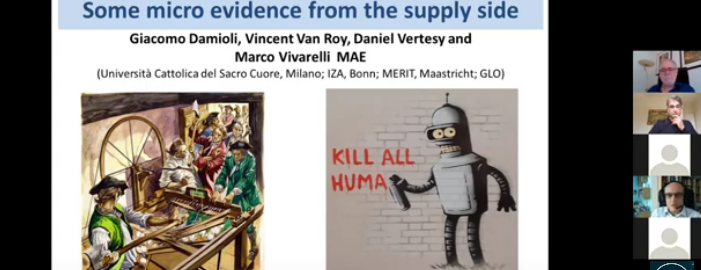
May AI revolution be labour-friendly? Some micro evidence from the supply side. A new GLO Discussion Paper by GLO Fellows Giacomo Damioli, Daniel Vertesy, Vincent Van Roy and Marco Vivarelli.

A new GLO Discussion Paper finds a positive and significant impact of AI patent families on employment, supporting the labour friendly nature of product innovation in the AI supply industries.

The Global Labor Organization (GLO) is an independent, non-partisan and non-governmental organization that functions as an international network and virtual platform to stimulate global research, debate and collaboration.

Marco Vivarelli


GLO Discussion Paper No. 823, 2021

May AI revolution be labour-friendly? Some micro evidence from the supply side Download PDF
by
Damioli, G. & Van Roy, V. & Vertesy, D. & Vivarelli, M.

GLO Fellows Giacomo Damioli, Daniel Vertesy, Vincent Van Roy and Marco Vivarelli

Author Abstract: This study investigates the possible job-creation impact of AI technologies, focusing on the supply side, namely the providers of the new knowledge base. The empirical analysis is based on a worldwide longitudinal dataset of 3,500 front-runner companies that patented the relevant technologies over the period 2000-2016. Obtained from GMM-SYS estimates, our results show a positive and significant impact of AI patent families on employment, supporting the labour friendly nature of product innovation in the AI supply industries. However, this effect is small in magnitude and limited to service sectors and younger firms, which are the leading actors of the AI revolution. Finally, some evidence of increasing returns seems to emerge; indeed, the innovative companies which are more focused on AI technologies are those obtaining the larger impacts in terms of job creation.

See also the recent GLO virtual Seminar on this paper: LINK

GLO Discussion Papers are research and policy papers of the GLO Network which are widely circulated to encourage discussion. Provided in cooperation with EconStor, a service of the ZBW – Leibniz Information Centre for Economics, GLO Discussion Papers are among others listed in RePEc (see IDEAS,  EconPapers)Complete list of all GLO DPs – downloadable for free.

Ends;

Overeducation in Trinidad and Tobago’s Labour Market: A Quantile Regression Approach. A new GLO Discussion Paper by GLO Affiliate Roshnie Doon.

A new GLO Discussion Paper finds a large number of over-educated workers with secondary and university level qualifications.

The Global Labor Organization (GLO) is an independent, non-partisan and non-governmental organization that functions as an international network and virtual platform to stimulate global research, debate and collaboration.


GLO Discussion Paper No. 822, 2021

Overeducation in Trinidad and Tobago’s Labour Market: A Quantile Regression Approach Download PDF
by
Doon, Roshnie

GLO Affiliate Roshnie Doon

Author Abstract: This study examines the impact that over-education has on the earnings of private and public sector workers in Trinidad and Tobago. Using individual person’s data from the Continuous Sample Survey of the Population (CSSP) for the period 1991-2015, the returns of over-educated workers is estimated using a simple Quantile Regression approach. The labour force comprises of a large amount of over-educated workers who hold secondary and university level qualifications. The returns of workers employed in high-income jobs seems to be falling throughout the entire 1991-2015 period, while that of low and middle-income workers improved during 2004-2009 but declined thereafter the 2010-2015 as Trinidad and Tobago entered an economic recession. In addition, even though the wage returns of over-educated men, improves over the wage distribution, those in low and high-income jobs degenerated consistently throughout the 1991-2015 period. When compared to that of women, the opposite is true as their returns tends to worsen across much of the wage distribution. With any improvement being observed during 1991-2009 by low-income women.

Featured image: Mikael-Kristenson-on-Unsplash

GLO Discussion Papers are research and policy papers of the GLO Network which are widely circulated to encourage discussion. Provided in cooperation with EconStor, a service of the ZBW – Leibniz Information Centre for Economics, GLO Discussion Papers are among others listed in RePEc (see IDEAS,  EconPapers)Complete list of all GLO DPs – downloadable for free.

Ends;

Platform Work and Economic Insecurity: Evidence from Italian Survey Data. A new GLO Discussion Paper by GLO Fellow Dario Guarascio and colleagues.

A new GLO Discussion Paper investigates whether the socio-economic disadvantages that platform workers are likely to face are primarily channeled through lower incomes or more precarious working conditions. They are primarily students and face greater economic insecurity relative to all other occupations.

The Global Labor Organization (GLO) is an independent, non-partisan and non-governmental organization that functions as an international network and virtual platform to stimulate global research, debate and collaboration.


GLO Discussion Paper No. 821, 2021

Platform Work and Economic Insecurity: Evidence from Italian Survey Data Download PDF
by
Cirillo, Valeria & Guarascio, Dario & Parolin, Zachary

GLO Fellow Dario Guarascio

Author Abstract: The emergence of the platform economy has served as a defining feature of increasing fragmented labour markets in modern economies. Recent research on platform work, however, has struggled to quantify the socio-economic conditions of platform workers relative to other occupation groups. Moreover, it remains unclear if the socio-economic disadvantages that platform workers are likely to face are primarily channeled through lower incomes or their more precarious working conditions. This study uses representative survey data of platform workers in Italy to investigate their size, composition, and socio- economic conditions relative to individuals in other occupations. Our findings reveal that platform workers tend to be students and of younger age, but are diverse with respect to sex, educational attainment, and native-born status. We find that platform workers face greater economic insecurity relative to all other occupation classes. Strikingly, they also feature a rate of economic insecurity that is not significantly different from that of unemployed adults. Moreover, we find that the higher levels of insecurity are not primarily channeled through lower incomes; instead, higher rates of insecurity persist even when taking family incomes into account, suggesting that the precarity and volatility of platform work matter as much as income differences in shaping economic disadvantage. Results hold under analyses that account for selection into platform work. Our findings carry important consequences for understandings of the intensity and sources of socio- economic disadvantage of individuals engaged in platform work.

Featured image: Coherent-Team-on-Unsplash

GLO Discussion Papers are research and policy papers of the GLO Network which are widely circulated to encourage discussion. Provided in cooperation with EconStor, a service of the ZBW – Leibniz Information Centre for Economics, GLO Discussion Papers are among others listed in RePEc (see IDEAS,  EconPapers)Complete list of all GLO DPs – downloadable for free.

Ends;

How the Earnings Growth of U.S. Immigrants Was Underestimated. A new GLO Discussion Paper by GLO Fellows Harriet Orcutt Duleep, Xingfei Liu and Mark Regets forthcoming in the Journal of Population Economics.

A new GLO Discussion Paper demonstrates how immigrant men following the 1965 Immigration and Nationality Act in the United States have low initial earnings and high earnings growth after all. A re-visit of an influential debate in migration economics.

The Global Labor Organization (GLO) is an independent, non-partisan and non-governmental organization that functions as an international network and virtual platform to stimulate global research, debate and collaboration.

Harriet Duleep


GLO Discussion Paper No. 820, 2021

How the Earnings Growth of U.S. Immigrants Was Underestimated Download PDF
by
Duleep, Harriet & Liu, Xingfei & Regets, Mark

GLO Fellows Harriet Orcutt Duleep, Xingfei Liu and Mark Regets

FORTHCOMING: Journal of Population Economics.

Author Abstract: Two radically different descriptions of immigrant earnings trajectories in the U.S. have emerged. One asserts that immigrant men following the 1965 Immigration and Nationality Act have low initial earnings and high earnings growth. Another asserts that post-1965 immigrants have low initial earnings and low earnings growth. We describe the methodological issues that create this divide and show that low earnings growth becomes high earnings growth when immigrants are followed from their initial years in the U.S., earnings growth is allowed to vary with entry earnings, and-when following cohorts instead of individuals-sample restrictions commonly used by labor economists are avoided.

GLO Discussion Papers are research and policy papers of the GLO Network which are widely circulated to encourage discussion. Provided in cooperation with EconStor, a service of the ZBW – Leibniz Information Centre for Economics, GLO Discussion Papers are among others listed in RePEc (see IDEAS,  EconPapers)Complete list of all GLO DPs – downloadable for free.

Ends;

The Unintended Consequences of Relaxing Birth Quotas: Theory and Evidence. A new GLO Discussion Paper by GLO Fellow Zhangfeng Jin and colleagues.

A new GLO Discussion Paper finds that the recent adoption of a two-child policy in China has substantially increased the number of second-child births.

The Global Labor Organization (GLO) is an independent, non-partisan and non-governmental organization that functions as an international network and virtual platform to stimulate global research, debate and collaboration.


GLO Discussion Paper No. 819, 2021

The Unintended Consequences of Relaxing Birth Quotas: Theory and Evidence Download PDF
by
Jin, Zhangfeng & Pan, Shiyuan & Zheng, Zhijie

GLO Fellow Zhangfeng Jin

Author Abstract: This study examines the consequences of relaxing birth quotas by exploiting an exogenous two-child policy adopted by local Chinese governments on different dates. Using China’s 2015 population census combined with a difference-in-differences framework, we find that the adoption of a two-child policy substantially increases the number of second-child births. The impact of the policy is more pronounced among couples who have higher fertility preferences and who are less sensitive to child-rearing costs. At the same time, this policy substantially decreases the number of first-child births. Child-rearing costs are a likely underlying mechanism for this decrease. All of these findings are in line with an extended Barro-Becker model.

GLO Discussion Papers are research and policy papers of the GLO Network which are widely circulated to encourage discussion. Provided in cooperation with EconStor, a service of the ZBW – Leibniz Information Centre for Economics, GLO Discussion Papers are among others listed in RePEc (see IDEAS,  EconPapers)Complete list of all GLO DPs – downloadable for free.

Ends;

The Dynamics of Working Hours and Wages Under Implicit Contracts. A new GLO Discussion Paper by GLO Fellow Marco Guerrazzi and Pier Giuseppe Giribone.

A new GLO Discussion Paper studies a model economy where a firm and its workforce are linked by an implicit contract and examine the dynamic behavioral properties.

The Global Labor Organization (GLO) is an independent, non-partisan and non-governmental organization that functions as an international network and virtual platform to stimulate global research, debate and collaboration.


GLO Discussion Paper No. 818, 2021

The Dynamics of Working Hours and Wages Under Implicit Contracts Download PDF
by
Guerrazzi, Marco & Giribone, Pier Giuseppe

GLO Fellow Marco Guerrazzi

Author Abstract: In this paper, we explore the dynamics of working hours and wages in a model economy where a firm and its workforce are linked to each other by an implicit contract. Specifically, we develop a deterministic and a stochastic framework in which the firm sets its level of labour utilization by considering that workers’ earnings tend to adjust in the direction of a fixed level. Without any uncertainty in firm’s profitability, we show that the existence and the properties of stationary solutions rely on factors that usually determine the enforceability of contracts and we provide evidence that wages tend to move countercyclically towards the allocation preferred by the firm. Moreover, we show that adding uncertainty does not overturn the counter-cyclical pattern of wages but is helpful in explaining their dynamic behaviour in response to demand shocks as well as their typical stickiness observed at the macro level.

GLO Discussion Papers are research and policy papers of the GLO Network which are widely circulated to encourage discussion. Provided in cooperation with EconStor, a service of the ZBW – Leibniz Information Centre for Economics, GLO Discussion Papers are among others listed in RePEc (see IDEAS,  EconPapers)Complete list of all GLO DPs – downloadable for free.

Ends;

Decent Work and the Quality of Work and Employment. A new GLO Discussion Paper by GLO Fellow Francis Green.

A new GLO Discussion Paper reviews and evaluates the concept of the quality of work and employment including both ‘decent work’ and the narrower concept of ‘job quality’.

The Global Labor Organization (GLO) is an independent, non-partisan and non-governmental organization that functions as an international network and virtual platform to stimulate global research, debate and collaboration.


GLO Discussion Paper No. 817, 2021

Decent Work and The Quality of Work and Employment Download PDF
by
Green, Francis

GLO Fellow Francis Green

Author Abstract: This review examines the concept of the quality of work and employment (QWE), including both ‘Decent Work’ and the narrower concept of ‘job quality’. The key axiom is that ‘quality’ relates to the extent and manner in which working conditions meet people’s needs from work. The review emphasises the multi-disciplinary nature of the topic. It discusses the concept’s objective character, its relationship with well-being, and its link with productivity. Important measurement issues are considered, including cost, international comparability, the choice of how many indices, the treatment of inequality and the problem of discipline insularity. Some theories of the antecedents of QWE imply universal trends, while others predict differentiation across countries and regions, attributable to labour market institutions and policy. The effects on well-being and health are studied in several disciplines, including a substantial research programme in psychology. Summary trends in Europe and distributions of job quality are presented for context, including gender gaps. This description shows gradual improvement in the physical environment of work and in working time quality over the decade from 2005. Yet the distribution of job quality in several domains is not at all closely related to a country’s GDP. The review concludes with a discussion of job quality policy making, and frames the ongoing research agenda.

Featured image: John W. Budd book cover.

GLO Discussion Papers are research and policy papers of the GLO Network which are widely circulated to encourage discussion. Provided in cooperation with EconStor, a service of the ZBW – Leibniz Information Centre for Economics, GLO Discussion Papers are among others listed in RePEc (see IDEAS,  EconPapers)Complete list of all GLO DPs – downloadable for free.

Ends;

The Labour Market Impact of Covid-19: Early Evidence for a Sample of Enterprises from Southern Europe. A new GLO Discussion Paper by Sangeeta Khorana & GLO Fellows Allan Webster and Francesco Pastore.

A new GLO Discussion Paper assesses firm data from World Bank enterprise surveys to obtain lessons from the early stages of the Coronavirus pandemic.

The Global Labor Organization (GLO) is an independent, non-partisan and non-governmental organization that functions as an international network and virtual platform to stimulate global research, debate and collaboration.

GLO Discussion Paper No. 815, 2021

The Labour Market Impact of Covid-19: Early Evidence for a Sample of Enterprises from Southern Europe Download PDF
by
Webster, Allan & Khorana, Sangeeta & Pastore, Francesco

GLO Fellows Allan Webster and Francesco Pastore

Author Abstract: This study uses evidence from World Bank enterprise surveys of a sample of firms from six countries in Southern Europe. It examines the early evidence of the effects of Covid-19 on labour markets. The evidence and the analysis are provided at a time when the pandemic is still in progress. The future progress of Covid-19 and government containment measures is uncertain, and the full economic consequences will probably continue to emerge after the end of the pandemic. The full extent of the impact on labour will probably not be the first of these. Nonetheless the possibility of learning lessons from the early stages of the pandemic is sufficiently important to make the exercise valuable. The study suggests that, despite efforts to support firms and hoard labour, there is a prospect of a significant number of firm closures with a consequent loss of employment. Temporary firm closures also represent a substantial loss of labour weeks. These are partly related to a significant number of workers subject to furloughs. Both temporary closures and furloughs impose costs that will be borne by firms, workers and government. The effects of Covid-19 on firms differ across sectors. Adverse effects tend to be higher in hospitality, non-essential retail and travel. A degree of gender segregation means that these are sectors with a high proportion of female workers and, in consequence, most of the countries in the sample exhibit an early decline of the share of women in employment. That many firms lack the capacity to survive further temporary closures of a similar duration to those in the earlier stages emphasises that the support provided in the near future is of critical importance to control employment losses through permanent firm closures.

More from the GLO Coronavirus Cluster

Featured image: fusion-medical-animation-on-unsplash

GLO Discussion Papers are research and policy papers of the GLO Network which are widely circulated to encourage discussion. Provided in cooperation with EconStor, a service of the ZBW – Leibniz Information Centre for Economics, GLO Discussion Papers are among others listed in RePEc (see IDEAS,  EconPapers)Complete list of all GLO DPs – downloadable for free.

Ends;

The fiscal impact of immigration in the EU: A new GLO Discussion Paper by GLO Fellow Michael Christl and colleagues.

A new GLO Discussion Paper finds that seen from an average age-specific life-cycle perspective natives generally make a higher net fiscal contribution than both, intra-EU and extra-EU migrants, while extra-EU migrants contribute on average less than intra-EU migrants.

The Global Labor Organization (GLO) is an independent, non-partisan and non-governmental organization that functions as an international network and virtual platform to stimulate global research, debate and collaboration.


GLO Discussion Paper No. 814, 2021

The fiscal impact of immigration in the EU Download PDF
by
Christl, Michael & Bélanger, Alain & Conte, Alessandra & Mazza, Jacopo & Narazani, Edlira

GLO Fellow Michael Christl

Author Abstract: The increasing flows of immigrants in Europe over the last decade has generated a range of considerations in the policy agenda of many receiving countries. One of the main considerations for policy makers and public opinions alike is whether immigrants contribute their ”fair” share to their host country tax and welfare system. This paper seeks to answer this question based on an empirical assessment of the net fiscal contributions of immigrants in the 27 EU Member States using EUROMOD, a EU-wide tax-benefit microsimulation model. In addition to the traditional view of the tax-benefit system, we add indirect taxation and in-kind benefits to the analysis of net contributions. Our findings highlight that migrants on average contributed about 250 euro per year more than natives to the welfare state in 2015. However, when we take an average age-specific life-cycle perspective, we find that natives generally show a higher net fiscal contribution than both, intra-EU and extra-EU migrants, while extra-EU migrants contribute on average less than intra-EU migrants.

Featured image: dawid-zawila-on-unsplash

GLO Discussion Papers are research and policy papers of the GLO Network which are widely circulated to encourage discussion. Provided in cooperation with EconStor, a service of the ZBW – Leibniz Information Centre for Economics, GLO Discussion Papers are among others listed in RePEc (see IDEAS,  EconPapers)Complete list of all GLO DPs – downloadable for free.

Ends;
Culture and the cross-country differences in the gender commuting gap: Evidence from immigrants in the United States. A new GLO Discussion Paper by GLO Fellows Miriam Marcén and Marina Morales.

A new GLO Discussion Paper finds that a culture with more gender equality in the country of ancestry of early-arrival first- and second-generation immigrants to the United States may reduce the observed gender commuting gap to/from work.

The Global Labor Organization (GLO) is an independent, non-partisan and non-governmental organization that functions as an international network and virtual platform to stimulate global research, debate and collaboration.

GLO Discussion Paper No. 813, 2021

Culture and the cross-country differences in the gender commuting gap: Evidence from immigrants in the United States Download PDF

by
Marcén, Miriam & Morales, Marina

GLO Fellows Miriam Marcén and Marina Morales

Author Abstract: This paper explores the role of the gender equality culture in cross-country gender commuting gap differences. To avoid inter-relationships between culture, institutions, and economic conditions in a simple cross-country analysis, we adopt the epidemiological approach. We merge data from the American Time Use Survey for the years 2006–2018 on early-arrival first- and second-generation immigrants living in the United States with their corresponding annual country of ancestry’s Gender Gap Index (GGI). Because all these immigrants (with different cultural backgrounds) have grown up under the same laws, institutions, and economic conditions in the US, the gender differences among them in the time devoted to commuting to/from work can be interpreted as evidence of the existence of a cultural impact. Our results show that a culture with more gender equality in the country of ancestry may reduce the gender commuting gap of parents. Specifically, an increase of 1 standard deviation in the GGI increases women’s daily commuting time relative to men by almost 5 minutes, a sizeable effect representing 23 percent of the standard deviation in the gender commuting gap across countries of ancestry. A supplementary analysis provides possible mechanisms through which culture operates and is transmitted, showing the potential existence of horizontal transmission and the importance of the presence of children in commuting. Our results are robust to the use of different subsamples, geographical controls, and selection into employment and telework.

GLO Discussion Papers are research and policy papers of the GLO Network which are widely circulated to encourage discussion. Provided in cooperation with EconStor, a service of the ZBW – Leibniz Information Centre for Economics, GLO Discussion Papers are among others listed in RePEc (see IDEAS,  EconPapers)Complete list of all GLO DPs – downloadable for free.

Ends;

Influence in Economics and Aging. A new GLO Discussion Paper by Pavel Jelnov and Yoram Weiss.

A new GLO Discussion Paper finds that ranking among leading economists peak at age 60 or 30 years after Ph.D. graduation, but Nobel laureates do not experience deterioration.

The Global Labor Organization (GLO) is an independent, non-partisan and non-governmental organization that functions as an international network and virtual platform to stimulate global research, debate and collaboration.

Pavel Jelnov

GLO Discussion Paper No. 810, 2021

Influence in Economics and Aging Download PDF
by
Jelnov, Pavel & Weiss, Yoram


GLO Fellow Pavel Jelnov

Author Abstract: We study the relationship between age and influence in a closed group of leading economists. We consider, as a measure of influence, monthly RePEc rankings and address the dynamics of rankings within the top group as a function of age. We find that the rankings peak at age 60 or 30 years after Ph.D. graduation. Differently from other leaders, current and future Nobel laureates do not experience deterioration of the rankings if their works and citations are discounted by recursive impact factor, and their ranking with respect to the breadth of citations across fields improves at old age.

Featured image: Photo-by-J-Zamora-on-Unsplash

GLO Discussion Papers are research and policy papers of the GLO Network which are widely circulated to encourage discussion. Provided in cooperation with EconStor, a service of the ZBW – Leibniz Information Centre for Economics, GLO Discussion Papers are among others listed in RePEc (see IDEAS,  EconPapers)Complete list of all GLO DPs – downloadable for free.

Ends;

On Synthetic Income Panels. A new GLO Discussion Paper by Héctor Moreno and GLO Fellows François Bourguignon and Hai-Anh Dang.

A new GLO Discussion Paper provides methodological advances to develop synthetic panels based on matching individuals with the same time-invariant characteristics in consecutive cross-sections to improve the potentials for analysis.

The Global Labor Organization (GLO) is an independent, non-partisan and non-governmental organization that functions as an international network and virtual platform to stimulate global research, debate and collaboration.

GLO Discussion Paper No. 809, 2021

On Synthetic Income Panels Download PDF
by
Moreno, Héctor & Bourguignon, François & Dang, Hai-Anh

GLO Fellows François Bourguignon and Hai-Anh Dang

Author Abstract: In many developing countries, the increasing public interest in monitoring economic inequality and mobility is hindered by the scarce availability of longitudinal data. Synthetic panels based on matching individuals with the same time-invariant characteristics in consecutive cross-sections have been recently proposed as a substitute to such data. We extend the methodology to construct such synthetic panels in several directions by: a) explicitly assuming the unobserved or time variant determinants of (log) income are AR(1) and relying on pseudo-panel procedures to estimate the corresponding auto-regressive coefficient; b) abstracting from (log) normality assumptions; c) generating a close to perfect match of the terminal year income distribution and d) considering the whole income mobility matrix rather than mobility in and out of poverty. We exploit the cross-sectional dimension of a national-representative Mexican panel survey to evaluate the validity of this approach. With the median estimate of the AR coefficient, the income mobility matrix in the synthetic panel closely approximates that of the genuine matrix observed in the actual panel, except for out-lying values of the AR coefficient.

Featured image: Photo-by-Mika-Baumeister-on-Unsplash

GLO Discussion Papers are research and policy papers of the GLO Network which are widely circulated to encourage discussion. Provided in cooperation with EconStor, a service of the ZBW – Leibniz Information Centre for Economics, GLO Discussion Papers are among others listed in RePEc (see IDEAS,  EconPapers)Complete list of all GLO DPs – downloadable for free.

Ends;

Personal Characteristics and Intention for Entrepreneurship. A new GLO Discussion Paper by GLO Fellow Gokhan Karabulut and colleagues.

A new GLO Discussion Paper identifies the characteristics of senior university students in Turkey to understand and enhance entrepreneurship potential.

The Global Labor Organization (GLO) is an independent, non-partisan and non-governmental organization that functions as an international network and virtual platform to stimulate global research, debate and collaboration.

Gokhan Karabulut

GLO Discussion Paper No. 808, 2021

Personal Characteristics and Intention for Entrepreneurship Download PDF
by
Yalcintas, Murat & Iyigun, Oykü & Karabulut, Gokhan

GLO Fellow Gokhan Karabulut

Author Abstract: This study analyzes the relationship between entrepreneurship intention and personal characteristics and skills by using the surveys we conducted in Turkey on 1465 senior university students. We use a modified version of the Entrepreneurial Orientation (EO) scale and the Political Skills Inventory to measure some personal characteristics and skills. We also use the nine sub-dimensions of these two scales. Probit model and wavelet coherence analysis results show that proactivity, entrepreneurship, and networking sub-dimensions of the scales are related to entrepreneurship intention. We also find that gender, the number of siblings, the grade point average (GPA) of the students, their family’s education level, the parent’ ownership of an enterprise, and the number of non-governmental organizations (NGO) that they are a member of are also related to entrepreneurship intention. Results may be useful to understand and enhance entrepreneurship potential.

GLO Discussion Papers are research and policy papers of the GLO Network which are widely circulated to encourage discussion. Provided in cooperation with EconStor, a service of the ZBW – Leibniz Information Centre for Economics, GLO Discussion Papers are among others listed in RePEc (see IDEAS,  EconPapers)Complete list of all GLO DPs – downloadable for free.

Ends;

Is Gender Destiny? Gender Bias and Intergenerational Educational Mobility in India. A new GLO Discussion Paper by GLO Affiliate Hanchen Jiang and colleagues.

A new GLO Discussion Paper finds for India gender equality in absolute intergenerational educational mobility for children of urban college educated fathers, but not in rural areas.

The Global Labor Organization (GLO) is an independent, non-partisan and non-governmental organization that functions as an international network and virtual platform to stimulate global research, debate and collaboration.

Hanchen Jiang

GLO Discussion Paper No. 807, 2021

Is Gender Destiny? Gender Bias and Intergenerational Educational Mobility in India Download PDF
by
Emran, M. Shahe & Jiang, Hanchen & Shilpi, Forhad

GLO Affiliate Hanchen Jiang

Author Abstract: We develop a model of intergenerational educational mobility incorporating gender bias against girls in the family, school, and labor market. Mobility and investment equations from the model are estimated for India using data not truncated by coresidency. The standard linear model misses important heterogeneity and yields misleading conclusions. Daughters of uneducated fathers face lower relative and absolute mobility (rural and urban). We find gender equality in absolute mobility for children of urban college educated fathers, but not in rural areas. Theoretical insights help understand the mechanisms. Parental nonfinancial inputs, unwanted girls, and patrilineal states are important for explaining the findings.

GLO Discussion Papers are research and policy papers of the GLO Network which are widely circulated to encourage discussion. Provided in cooperation with EconStor, a service of the ZBW – Leibniz Information Centre for Economics, GLO Discussion Papers are among others listed in RePEc (see IDEAS,  EconPapers)Complete list of all GLO DPs – downloadable for free.

Ends;

Labour supply and informal care responses to health shocks within couples. A new GLO Discussion Paper by GLO Fellow Andrew Jones and colleagues.

A new GLO Discussion Paper uses UK longitudinal data to investigate within households both the labour supply and informal care responses of an individual to the event of an acute health shock to their partner to find no evidence of a health-related ‘added worker effect’ .

The Global Labor Organization (GLO) is an independent, non-partisan and non-governmental organization that functions as an international network and virtual platform to stimulate global research, debate and collaboration.

Andrew Jones

GLO Discussion Paper No. 806, 2021

Labour supply and informal care responses to health shocks within couples: evidence from the UKHLSDownload PDF
by
Macchioni Giaquinto, Annarita & Jones, Andrew M. & Rice, Nigel & Zantomio, Francesca

GLO Fellow Andrew Jones

Author Abstract: Shocks to health have been shown to reduce labour supply for the individual affected. Less is known about household self-insurance through a partner’s response to a health shock. Previous studies have presented inconclusive empirical evidence on the existence of a healthrelated ‘added worker effect’. We use UK longitudinal data to investigate within households both the labour supply and informal care responses of an individual to the event of an acute health shock to their partner. Relying on the unanticipated timing of shocks, we combine coarsened exact matching and entropy balancing algorithms with parametric analysis and exploit lagged outcomes to remove bias from observed confounders and time-invariant unobservables. We find no evidence of a health-related ‘added worker effect’. A significant and sizeable increase in spousal informal care, irrespective of spousal labour market position or household financial status and ability to purchase formal care provision, suggests a substitution to informal care provision, at the expense of time devoted to leisure activities.

GLO Discussion Papers are research and policy papers of the GLO Network which are widely circulated to encourage discussion. Provided in cooperation with EconStor, a service of the ZBW – Leibniz Information Centre for Economics, GLO Discussion Papers are among others listed in RePEc (see IDEAS,  EconPapers)Complete list of all GLO DPs – downloadable for free.

Ends;

The COVID-19 Pandemic’s Effects on Voter Turnout. A new GLO Discussion Paper by GLO Fellow Matteo Picchio and Raffaella Santolini.

A new GLO Discussion Paper assesses whether the voter turnout in the 2020 local government elections in Italy was affected by the COVID-19 pandemic. It indeed finds that higher elderly mortality rates induced a decline in voter turnout.

The Global Labor Organization (GLO) is an independent, non-partisan and non-governmental organization that functions as an international network and virtual platform to stimulate global research, debate and collaboration.

Matteo Picchio

GLO Discussion Paper No. 812, 2021

The COVID-19 Pandemic’s Effects on Voter Turnout Download PDF
by
Picchio, Matteo & Santolini, Raffaella

GLO Fellow Matteo Picchio

Author Abstract: The COVID-19 pandemic has increased the risk of participating in public events, among them elections. We assess whether the voter turnout in the 2020 local government elections in Italy was affected by the COVID-19 pandemic. We do so by exploiting the variation among municipalities in the intensity of the COVID-19 outbreak as measured by the mortality rate among the elderly. We find that a 1 percentage point increase in the elderly mortality rate decreased the voter turnout by 0.5 percentage points, with no gender differences in the behavioural response. The effect was especially strong in densely populated municipalities. We do not detect statistically significant heterogeneous effects between the North and the South or among different levels of autonomy from the central government.

More from the GLO Coronavirus Cluster

Featured image: Photo-by-Adli-Wahid-on-Unsplash

GLO Discussion Papers are research and policy papers of the GLO Network which are widely circulated to encourage discussion. Provided in cooperation with EconStor, a service of the ZBW – Leibniz Information Centre for Economics, GLO Discussion Papers are among others listed in RePEc (see IDEAS,  EconPapers)Complete list of all GLO DPs – downloadable for free.

Ends;
COVID-19, Race, and Gender. A new GLO Discussion Paper by GLO Fellows Graziella Bertocchi and Arcangelo Dimico

A new GLO Discussion Paper using data for the Cook County in the USA establishes that Black individuals are affected earlier and more harshly by the disease and that the effect is driven by Black women. The Black female bias is associated with poverty and channeled by occupational segregation in the health care and transportation sectors and by commuting on public transport.

The Global Labor Organization (GLO) is an independent, non-partisan and non-governmental organization that functions as an international network and virtual platform to stimulate global research, debate and collaboration.

GLO Discussion Paper No. 811, 2021

COVID-19, Race, and Gender Download PDF
by
Bertocchi, Graziella & Dimico, Arcangelo

GLO Fellows Graziella Bertocchi and Arcangelo Dimico

Author Abstract: The mounting evidence on the demographics of COVID-19 fatalities points to an overrepresentation of minorities and an underrepresentation of women. Using individual-level, race-disaggregated, and georeferenced death data collected by the Cook County Medical Examiner, we jointly investigate the racial and gendered impact of COVID-19, its timing, and its determinants. Through an event study approach we establish that Black individuals are affected earlier and more harshly and that the effect is driven by Black women. Rather than comorbidity or aging, the Black female bias is associated with poverty and channeled by occupational segregation in the health care and transportation sectors and by commuting on public transport. Living arrangements and lack of health insurance are instead found not influential. The Black female bias is spatially concentrated in neighborhoods that were subject to historical redlining.

More from the GLO Coronavirus Cluster

Featured image: Photo-by-Adli-Wahid-on-Unsplash

GLO Discussion Papers are research and policy papers of the GLO Network which are widely circulated to encourage discussion. Provided in cooperation with EconStor, a service of the ZBW – Leibniz Information Centre for Economics, GLO Discussion Papers are among others listed in RePEc (see IDEAS,  EconPapers)Complete list of all GLO DPs – downloadable for free.

Ends;

Your Driver is Didi and Minutes Away from Your Pick-Up Point’: Understanding Employee Motivation in the Gig Economy of China

A new GLO Discussion Paper tries to understand the Chinese gig economy by studying how employee motivation and retention are managed by the mobile app-based, multiple payment platform enabled, car-pooling Chinese giant DiDi.

The Global Labor Organization (GLO) is an independent, non-partisan and non-governmental organization that functions as an international network and virtual platform to stimulate global research, debate and collaboration.

GLO Discussion Paper No. 805, 2021

Your Driver is Didi and Minutes Away from Your Pick-Up Point’: Understanding Employee Motivation in the Gig Economy of China Download PDF
by
Mukhopadhyay, Boidurjo & Chatwin, Chris

GLO Fellow Boidurjo Rick Mukhopadhyay

Author Abstract: In recognition of the importance and expansion of the gig economy, largely in developed and BRICs economies, along with the growing literature surrounding it, this research contributes towards an empirical and conceptual understanding of how employee motivation and retention are managed by the mobile app-based, multiple payment platform enabled, car-pooling Chinese giant DiDi. Both the exponential usage and evidently a diversified range of services offered by Didi has not only transformed the Chinese perception of using cabs, over their personal vehicle, in the 1.4 billion demographics but also invites emerging research in learning the tools for employee retention of a company that has a high regional scale of operations across all provinces in China. While the company employs over a million people at various contractual levels, the objective of this paper is to evaluate how levels of employee motivation, in a gig economy setting, largely affects employee effort and performance of DiDi drivers working long hours in major Chinese cities. The objective of this research is to qualitatively investigate the nature and effectiveness of Didi as a customer customiser using a thematic analysis and a conceptual framework, while also adding contextual knowledge on how a relatively new transport company retain employees in a leading BRICS economy, that is embedded with many faces of the gig economy.

GLO Discussion Papers are research and policy papers of the GLO Network which are widely circulated to encourage discussion. Provided in cooperation with EconStor, a service of the ZBW – Leibniz Information Centre for Economics, GLO Discussion Papers are among others listed in RePEc (see IDEAS,  EconPapers)Complete list of all GLO DPs – downloadable for free.

Ends;

Informal employment and wages in Poland. A new GLO Discussion Paper by GLO Fellow Jacek Liwiński.

A new GLO Discussion Paper identifies the two-tier structure of the informal labor market in Poland.

The Global Labor Organization (GLO) is an independent, non-partisan and non-governmental organization that functions as an international network and virtual platform to stimulate global research, debate and collaboration.

GLO Discussion Paper No. 804, 2021

Informal employment and wages in Poland Download PDF
by
Liwiński, Jacek

GLO Fellow Jacek Liwiński

Author Abstract: This paper tries to identify the wage gap between informal and formal workers and tests for the two-tier structure of the informal labour market in Poland. Design/methodology/approach: I employ the propensity score matching (PSM) technique and use data from the Polish Labour Force Survey (LFS) for the period 2009-2017 to estimate the wage gap between informal and formal workers, both at the means and along the wage distribution. I use two definitions of informal employment: a) employment without a written agreement and b) employment while officially registered as unemployed at a labour office. In order to reduce the bias resulting from the non-random selection of individuals into informal employment, I use a rich set of control variables representing several individual characteristics. After controlling for observed heterogeneity, I find that on average informal workers earn less than formal workers, both in terms of monthly earnings and hourly wage. This result is not sensitive to the definition of informal employment used and is stable over the analysed time period (2009-2017). However, the wage penalty to informal employment is substantially higher for individuals at the bottom of the wage distribution, which supports the hypothesis of the two-tier structure of the informal labour market in Poland. The main contribution of this study is that it identifies the two-tier structure of the informal labour market in Poland: informal workers in the first quartile of the wage distribution and those above the first quartile appear to be in two partially different segments of the labour market.

Featured image: Photo-by-Jose-Antonio-Gallego-Vázquez-on-Unsplash

GLO Discussion Papers are research and policy papers of the GLO Network which are widely circulated to encourage discussion. Provided in cooperation with EconStor, a service of the ZBW – Leibniz Information Centre for Economics, GLO Discussion Papers are among others listed in RePEc (see IDEAS,  EconPapers)Complete list of all GLO DPs – downloadable for free.

Ends;

Differentiating Retirement Age to Compensate for Career Arduousness. A new GLO Discussion Paper by GLO Fellow Vincent Vandenberghe.

A new GLO Discussion Paper estimates the degree of retirement age differentiation needed to compensate individuals for their career-related health handicap/advantage and get closer to “real” actuarial fairness.

The Global Labor Organization (GLO) is an independent, non-partisan and non-governmental organization that functions as an international network and virtual platform to stimulate global research, debate and collaboration.

GLO Discussion Paper No. 803, 2021

Differentiating Retirement Age to Compensate for Career Arduousness Download PDF
by
Vandenberghe, Vincent

GLO Fellow Vincent Vandenberghe

Author Abstract: Population ageing in Europe calls for an overall rise in the age of retirement. However, many argue that this age should be differentiated to account for individuals’ career arduousness. This paper explores the relevance of this idea. It combines the 7th wave of the SHARE panel data on health at an older age and US occupational O*NET data. With these unique data it first quantifies the impact of entire career arduousness on health at typical retirement age, relative to other key determinants (gender, childhood health, parental longevity). It then estimates the degree of retirement age differentiation that would be needed to compensate individuals for their career-related health handicap/advantage and get closer to “real” actuarial fairness. Using the age of 65 as a reference, results point at the need for differentiation ranging from 60 to 71. But the paper also shows that systematic retirement age differentiation would fail to match a significant portion of the full distribution of health at an older age. In a world where retirement policy compensates for career-related arduousness there would still be a lot of unaccounted health differences; in particular those related to health endowment. Using variance decomposition methods, we estimate that career-arduousness represents at most 5.83% of the model-explained variance of health at an older age.

Featured image: Mark-Timberlake-on-Unsplash

GLO Discussion Papers are research and policy papers of the GLO Network which are widely circulated to encourage discussion. Provided in cooperation with EconStor, a service of the ZBW – Leibniz Information Centre for Economics, GLO Discussion Papers are among others listed in RePEc (see IDEAS,  EconPapers)Complete list of all GLO DPs – downloadable for free.

Ends;

Does the Legal Form Matter for Firm Performance in the MENA Region? A new GLO Discussion Paper by Issam Abdo Ahmad and GLO Fellow and Country Lead Lebanon Ali Fakih.

A new GLO Discussion Paper provides directions for strategies targeting at improving the performance of firms in MENA countries.

The Global Labor Organization (GLO) is an independent, non-partisan and non-governmental organization that functions as an international network and virtual platform to stimulate global research, debate and collaboration.

Ali Fakih

GLO Discussion Paper No. 801, 2021

Does the Legal Form Matter for Firm Performance in the MENA Region? Download PDF
by
Abdo Ahmad, Issam & Fakih, Ali

GLO Fellow and GLO Country Lead Lebanon Ali Fakih

Author Abstract: This paper attempts to study the relationship between firm legal form and firm performance in the Middle East and North Africa Region (MENA) using the World Bank Enterprise Survey (WBES) database. Our analysis shows that open shareholding, closed shareholding, partnership, and limited partnership companies demonstrate an advantage in terms of annual sales and annual productivity growth rates over sole proprietorship firms, and that medium-sized and large-sized firms also demonstrate an advantage over small ones. Our analysis also shows that foreign ownership, exporting activities, the usage of the web in communication with clients and suppliers, and the presence of full-time workers positively affect firm performance. These findings are robust when running the analysis for firms with female participation in ownership. This paper provides directions for strategists targeting at improving the performance of firms.

GLO Discussion Papers are research and policy papers of the GLO Network which are widely circulated to encourage discussion. Provided in cooperation with EconStor, a service of the ZBW – Leibniz Information Centre for Economics, GLO Discussion Papers are among others listed in RePEc (see IDEAS,  EconPapers)Complete list of all GLO DPs – downloadable for free.

Ends;

Performance Pay and Alcohol Use in Germany. A new GLO Discussion Paper by GLO Fellows Mehrzad B. Baktash, John Heywood and Uwe Jirjahn. Related work published in the Journal of Population Economics.

A new GLO Discussion Paper finds for Germany that the likelihood of consuming each of four types of alcohol (beer, wine, spirits, and mixed drinks) is higher for those receiving performance pay, and their total number of types of alcohol consumed is larger. This confirms previous results published in the Journal of Population Economics for the USA.

The Global Labor Organization (GLO) is an independent, non-partisan and non-governmental organization that functions as an international network and virtual platform to stimulate global research, debate and collaboration.

GLO Discussion Paper No. 800, 2021

Performance Pay and Alcohol Use in Germany Download PDF
by
Baktash, Mehrzad B. & Heywood, John S. & Jirjahn, Uwe

GLO Fellows Mehrzad B. Baktash, John Heywood and Uwe Jirjahn

Author Abstract: We study the link between performance pay and alcohol use in Germany, a country with mandated health insurance. Previous research from the US argues that alcohol use as a form of “self-medication” may be a natural response to the stress and uncertainty of performance pay when many workers do not have access to health insurance. We find that the likelihood of consuming each of four types of alcohol (beer, wine, spirits, and mixed drinks) is higher for those receiving performance pay even controlling for a long list of economic, social and personality characteristics and in sensible IV estimates. We also show that the total number of types of alcohol consumed is larger for those receiving performance pay. We conclude that even in the face of mandated health insurance, the link found in the US persists in Germany.

This image has an empty alt attribute; its file name is 002-Cover-Page-JPopEa.jpg

Related paper published ONLINE FIRST 2020 in the Journal of Population Economics:

Does performance pay increase alcohol and drug use?

by Benjamin Artz, Colin P. Green and GLO Fellow John S. Heywood

Forthcoming in a regular issue 2021: Read for free — READLINK: https://rdcu.be/chTbM

GLO Discussion Papers are research and policy papers of the GLO Network which are widely circulated to encourage discussion. Provided in cooperation with EconStor, a service of the ZBW – Leibniz Information Centre for Economics, GLO Discussion Papers are among others listed in RePEc (see IDEAS,  EconPapers)Complete list of all GLO DPs – downloadable for free.

Ends;

A Bigger House at the Cost of an Empty Fridge? The Effect of Households’ Indebtedness on Their Consumption: Micro-Evidence Using Belgian HFCS Data. A new GLO Discussion Paper by GLO Fellows François Rycx and Ilan Tojerow and colleagues.

A new GLO Discussion Paper finds for Belgium a negative effect of households’ indebtedness on their consumption.

The Global Labor Organization (GLO) is an independent, non-partisan and non-governmental organization that functions as an international network and virtual platform to stimulate global research, debate and collaboration.

GLO Discussion Paper No. 799, 2021

A Bigger House at the Cost of an Empty Fridge? The Effect of Households’ Indebtedness on Their Consumption: Micro-Evidence Using Belgian HFCS Data Download PDF
by
Du Caju, Philip & Périlleux, Guillaume & Rycx, François & Tojerow, Ilan

GLO Fellows François Rycx and Ilan Tojerow

Author Abstract: This paper investigates the potentially non-linear relation between households’ indebtedness and their consumption between 2010 and 2014 in Belgium, using panel data from the two waves of the Household Finance and Consumption Survey. Unlike previous studies, we find a negative effect of households’ indebtedness on their consumption, even in the absence of negative shock on their assets. Our findings suggest that, without such a shock, it is the day-to-day sustainability of the debt, rather than its overall sustainability, that leads households to reduce their consumption. We perform as well a threshold analysis, whose results suggest that households should not have a debt-service-to-income ratio greater than 30%. The effect appears to be robust to various specifications, to result from a trade-off between housing and consumption, and to be more prevalent among more fragile households.

Featured image: Dawid-Zawila-on-Unsplash

GLO Discussion Papers are research and policy papers of the GLO Network which are widely circulated to encourage discussion. Provided in cooperation with EconStor, a service of the ZBW – Leibniz Information Centre for Economics, GLO Discussion Papers are among others listed in RePEc (see IDEAS,  EconPapers)Complete list of all GLO DPs – downloadable for free.

Ends;

Stop worrying and love the robot: An activity-based approach to assess the impact of robotization on employment dynamics. A new GLO Discussion Paper by GLO Fellows Sergio Scicchitano and Silvio Traverso and colleagues.

A new GLO Discussion Paper studies for Italy the impact of robotization on the shares of workers employed as robot operators and in occupations deemed exposed to robots to reveal for the first time reinstatement effects among robot operators and heterogeneous results among exposed occupations.

The Global Labor Organization (GLO) is an independent, non-partisan and non-governmental organization that functions as an international network and virtual platform to stimulate global research, debate and collaboration.

GLO Discussion Paper No. 802, 2021

Stop worrying and love the robot: An activity-based approach to assess the impact of robotization on employment dynamics Download PDF
by
Caselli, Mauro & Fracasso, Andrea & Scicchitano, Sergio & Traverso, Silvio & Tundis, Enrico


GLO Fellows Sergio Scicchitano and Silvio Traverso

Author Abstract: This work investigates the impact that the change in the exposure to robots had on the Italian local employment dynamics over the period 2011-2018. A novel empirical strategy focusing on a match between occupations’ activities and robots’ applications at a high level of disaggregation makes it possible to assess the impact of robotization on the shares of workers employed as robot operators and in occupations deemed exposed to robots. In a framework consistently centered on workers’ and robots’ activities, rather than on their industries of employment, the analysis reveals for the first time reinstatement effects among robot operators and heterogeneous results among exposed occupations.

Featured image: Photo-by-Alex-Knight-on-Unsplash

GLO Discussion Papers are research and policy papers of the GLO Network which are widely circulated to encourage discussion. Provided in cooperation with EconStor, a service of the ZBW – Leibniz Information Centre for Economics, GLO Discussion Papers are among others listed in RePEc (see IDEAS,  EconPapers)Complete list of all GLO DPs – downloadable for free.

Ends;

Government-Led Urbanization and Natural Gas Demand in China: A new GLO Discussion Paper by GLO Fellow Zhengyu Cai and colleagues.

A new GLO Discussion Paper shows that government-led urbanization in China has a positive impact on natural gas demand conditional on total energy use.

The Global Labor Organization (GLO) is an independent, non-partisan and non-governmental organization that functions as an international network and virtual platform to stimulate global research, debate and collaboration.

GLO Discussion Paper No. 798, 2021

Government-Led Urbanization and Natural Gas Demand in China Download PDF
by
Cai, Zhengyu & Yu, Chin-Hsien & Zhu, Chunhui


GLO Fellow Zhengyu Cai

Author Abstract: The Chinese government is actively promoting urbanization to stimulate its economic growth while facing increasingly prominent environmental concerns. The main objective of this research is to assess whether the Chinese government is making efforts to promote cleaner energy demand while pushing for urbanization. This study employs system GMM models to empirically investigate the causal relationship between urbanization and natural gas demand by using a sample of 30 provinces in China over the period 2005–2018. The estimates of the preferred specifications show that government-led urbanization has a positive impact on natural gas demand conditional on total energy use. By attaching natural gas facilities to new structures through the use of administrative power, the government induces natural gas demand while promoting urbanization. Robustness checks indicate that adding more potentially influential factors will not qualitatively change the results from the baseline. A constrained two-step static panel data estimation is used to estimate the depreciation rates of natural gas and of all fuel appliances, suggesting that the promotion of natural gas demand provides a relatively economical way to balance the trade-off between economic growth and the reduction of emissions. The empirical results also show that the dynamic model outperforms its static counterpart in predictions. Based on the results, policy recommendations are made towards the goals of the Fourteenth Five-Year Plan for the National Economic and Social Development of China.

GLO Discussion Papers are research and policy papers of the GLO Network which are widely circulated to encourage discussion. Provided in cooperation with EconStor, a service of the ZBW – Leibniz Information Centre for Economics, GLO Discussion Papers are among others listed in RePEc (see IDEAS,  EconPapers)Complete list of all GLO DPs – downloadable for free.

Ends;

Electoral Earthquake: Natural Disasters and the Geography of Discontent. A new GLO Discussion Paper by GLO Fellow Marco Letta and colleagues.

A new GLO Discussion Paper finds for Italy that “places that don’t recover” after events like an earthquake can become populist hotbeds.

The Global Labor Organization (GLO) is an independent, non-partisan and non-governmental organization that functions as an international network and virtual platform to stimulate global research, debate and collaboration.

GLO Discussion Paper No. 790, 2021

Electoral Earthquake: Natural Disasters and the Geography of Discontent Download PDF
by
Cerqua, A. & Ferrante, C. & Letta, M.

GLO Fellow Marco Letta

Author Abstract: The recent literature on the determinants of populism has highlighted the role of long-term trends of progressive isolation and prolonged economic stagnation in engendering discontent and, in turn, demand for political change. We investigate, instead, the potential of unanticipated local shocks in shaping the ‘geography of discontent’. Using comprehensive data at a fine spatial scale and a comparative natural experiment approach, we document that the occurrence of two destructive earthquakes in Italy resulted in sharply diverging electoral outcomes: while the 2012 Emilia quake did not alter voting behaviour, the 2009 L’Aquila earthquake paved the way for an impressive and persistent surge in right-wing populism in the most affected areas. Such heterogeneous patterns mainly originate from a stark contrast in post-disaster reconstruction processes and shifts in institutional trust. Our findings are consistent with the idea that not only “places that don’t matter”, but also “places that don’t recover”, can become populist hotbeds.

Featured image: Jose Pablo Dominguez on Unsplash

GLO Discussion Papers are research and policy papers of the GLO Network which are widely circulated to encourage discussion. Provided in cooperation with EconStor, a service of the ZBW – Leibniz Information Centre for Economics, GLO Discussion Papers are among others listed in RePEc (see IDEAS,  EconPapers)Complete list of all GLO DPs – downloadable for free.

Ends;

The Effects of Overeducation on Wages in Trinidad and Tobago: An Unconditional Quantile Regression Analysis. A new GLO Discussion Paper by GLO Affiliate Roshnie Doon.

A new GLO Discussion Paper finds that within the studied period 1991-2015 the earnings of overeducated workers eroded at the lower and upper segments of the wage distribution.

The Global Labor Organization (GLO) is an independent, non-partisan and non-governmental organization that functions as an international network and virtual platform to stimulate global research, debate and collaboration.

GLO Discussion Paper No. 797, 2021

The Effects of Overeducation on Wages in Trinidad and Tobago: An Unconditional Quantile Regression Analysis Download PDF
by
Doon, Roshnie

GLO Affiliate Roshnie Doon

Author Abstract: The main aim of this study is to analyse the wage returns of Overeducated workers employed in Trinidad and Tobago. To undertake such a study, data from the Continuous Sample Survey of Population (CSSP) for the period 1991-2015 is used to estimate an initial OLS and Quantile regression version of the Mincerian Earnings equations, which is commonly used in the education mismatch literature. To observe the unconditional partial effects of small changes in wage returns of overeducated workers at the mean, the Recentred Influence Function is estimated. The results reveal that if the earnings of overeducated workers who receive low wages, was replaced with that of high wages, then this would lead to a rise, or shift in the returns of overeducated workers, if only their biographical information is considered. The inclusion of their skill and geographic location would cause their earnings to shift further. The shift in the earnings of overeducated workers, when examined across the wage distribution, would tend to favor those who were married, younger, i.e., in the 25-35 age group, who were highly skilled at their jobs. These groups of overeducated workers would experience the lowest wage penalties in comparison to their single, mature, and semi-skilled colleagues.

Featured image: j-zamora-on-unsplash

GLO Discussion Papers are research and policy papers of the GLO Network which are widely circulated to encourage discussion. Provided in cooperation with EconStor, a service of the ZBW – Leibniz Information Centre for Economics, GLO Discussion Papers are among others listed in RePEc (see IDEAS,  EconPapers)Complete list of all GLO DPs – downloadable for free.

Ends;

Work Beyond the Age of 50. What Role for Mental v.s. Physical Health? A new GLO Discussion Paper by GLO Fellow Vincent Vandenberghe.

A new GLO Discussion Paper finds a rather limited role of mental health in comparison to physical health for older individuals’ work.

The Global Labor Organization (GLO) is an independent, non-partisan and non-governmental organization that functions as an international network and virtual platform to stimulate global research, debate and collaboration.

GLO Discussion Paper No. 796, 2021

Work Beyond the Age of 50. What Role for Mental v.s. Physical Health? Download PDF
by
Vandenberghe, Vincent

GLO Fellow Vincent Vandenberghe

Author Abstract: This paper contributes to the literature on old employment barriers by exploring empirically the relative importance of mental v.s. physical health in determining work. It combines regression and variance decomposition analyses to quantify the respective role of mental v.s. physical health. The data used are from SHARE and inform in great detail on the health but also work status (i.e. employment and hours) of individuals aged 50+, interviewed between 2004 and 2017 in 21 European countries. The main result of the paper is that of the rather limited role of mental health – in comparison to physical health – in accounting for older individuals’ work. The paper also shows that health (physical or mental) is much better at predicting old people’s propensity to be in employment than the number of hours they work. Finally, the paper reveals that, in comparison to women, men’s work is more driven by their health status.

Featured image: mark-timberlake-unsplash

GLO Discussion Papers are research and policy papers of the GLO Network which are widely circulated to encourage discussion. Provided in cooperation with EconStor, a service of the ZBW – Leibniz Information Centre for Economics, GLO Discussion Papers are among others listed in RePEc (see IDEAS,  EconPapers)Complete list of all GLO DPs – downloadable for free.

Ends;

Cross-national comparison of job types: analysis using the EU LFS and Albanian LFS. A new GLO Discussion Paper by GLO Affiliate Elvisa Drishti.

A new GLO Discussion Paper finds that in less affluent transition economies, more workers use involuntary non-standard jobs as a means to escape unemployment, while in affluent economies, interventionist policies are associated with high levels of voluntary non-standard work and low unemployment.

The Global Labor Organization (GLO) is an independent, non-partisan and non-governmental organization that functions as an international network and virtual platform to stimulate global research, debate and collaboration.

Elvisa Drishti

GLO Discussion Paper No. 795, 2021

Cross-national comparison of job types: analysis using the EU LFS and Albanian LFS Download PDF
by
Drishti, Elvisa

GLO Affiliate Elvisa Drishti

Author Abstract: This paper is dedicated to the cross-national comparison of the labour markets of the EU member countries and Albania. The aim is to establish whether or not cross-national variations in propensities of being hired in a non-standard job are the result of differences in national institutional regimes and labour market regulations. An adapted version of the Fraser Index is used to explain cross-country differences in relation to the application of rigid labour market regulation. The econometric analyses indicate that the net effect of more stringent labour market regulation, increase job quality in different senses: in less affluent transition economies, more workers use involuntary non-standard jobs as a means to escape unemployment. On the other hand, in affluent economies, interventionist policies are associated with high levels of voluntary non-standard work and low unemployment.

GLO Discussion Papers are research and policy papers of the GLO Network which are widely circulated to encourage discussion. Provided in cooperation with EconStor, a service of the ZBW – Leibniz Information Centre for Economics, GLO Discussion Papers are among others listed in RePEc (see IDEAS,  EconPapers)Complete list of all GLO DPs – downloadable for free.

Ends;

Adverse Childhood Circumstances and Cognitive Function in Middle-aged and Older Chinese Adults: Lower Level or Faster Decline? A new GLO Discussion Paper by Zhuoer Lin and GLO Fellow Xi Chen

A new GLO Discussion Paper suggests that exposure to disadvantaged childhood circumstances can exacerbate cognitive deficits as well as cognitive decline over time.

The Global Labor Organization (GLO) is an independent, non-partisan and non-governmental organization that functions as an international network and virtual platform to stimulate global research, debate and collaboration.

Xi Chen

GLO Discussion Paper No. 794, 2021

Adverse Childhood Circumstances and Cognitive Function in Middle-aged and Older Chinese Adults: Lower Level or Faster Decline? Download PDF
by
Lin, Zhuoer & Chen, Xi

GLO Fellow Xi Chen

Author Abstract: We examine the long-term relationship between childhood circumstances and cognitive aging. In particular, we differentiate the level of cognitive deficit from the rate of cognitive decline. Applying a linear mixed-effect model to three waves of China Health and Retirement Longitudinal Surveys (CHARLS 2011, 2013, 2015) and matching cognitive outcomes to CHARLS Life History Survey (2014), we find that key domains of childhood circumstances, including family socioeconomic status (SES), neighborhood cohesion, friendship and health conditions, are significantly associated with both the level of cognitive deficit and the rate of decline. In contrast, childhood neighborhood safety only affects the level of cognitive deficit. Childhood relationship with mother only affects the rate of cognitive decline. The effects of adverse childhood circumstances are generally larger on level of cognitive deficit than on rate of cognitive decline. Moreover, education plays a more important role in mediating the relationships compared to other later-life factors. These findings suggest that exposure to disadvantaged childhood circumstances can exacerbate cognitive deficit as well as cognitive decline over time, which may be partially ameliorated by educational attainment.

GLO Discussion Papers are research and policy papers of the GLO Network which are widely circulated to encourage discussion. Provided in cooperation with EconStor, a service of the ZBW – Leibniz Information Centre for Economics, GLO Discussion Papers are among others listed in RePEc (see IDEAS,  EconPapers)Complete list of all GLO DPs – downloadable for free.

Ends;

Does education predict gender role attitudes?: Evidence from European datasets. A new GLO Discussion Paper by GLO Fellow Sumit Deole and Tugba Zeydanli.

A new GLO Discussion Paper finds that education indeed affects gender role attitudes.

The Global Labor Organization (GLO) is an independent, non-partisan and non-governmental organization that functions as an international network and virtual platform to stimulate global research, debate and collaboration.

Sumit Deole

GLO Discussion Paper No. 793, 2021

Does education predict gender role attitudes?: Evidence from European datasets Download PDF
by
Deole, Sumit S. & Zeydanli, Tugba

GLO Fellow Sumit Deole

Author Abstract: This paper presents the first empirical evidence of the causal impact of individuals’ education on their attitudes towards traditional gender roles. We employ two national panel datasets from the UK and Switzerland and a repeated cross-sectional dataset with information from 13 Western European countries for the analysis. The causal impact of education on gender role attitudes is estimated by exploiting the exogenous variation in individuals’ education induced by the compulsory school reforms undertaken in European countries in the second half of the 20th century. We find evidence that an additional year of education instigates egalitarian gender role attitudes equivalent of 0.1-0.3 of a standard deviation. While education’s moderating effect is particularly prominent among women, no evidence of effect heterogeneity is found concerning the individuals’ religiosity. Our findings are robust to numerous checks performed and are briefly discussed for their policy relevance.

Featured image: Element5-Digital-on-Unsplash

GLO Discussion Papers are research and policy papers of the GLO Network which are widely circulated to encourage discussion. Provided in cooperation with EconStor, a service of the ZBW – Leibniz Information Centre for Economics, GLO Discussion Papers are among others listed in RePEc (see IDEAS,  EconPapers)Complete list of all GLO DPs – downloadable for free.

Ends;

Culture as a Hiring Criterion: Systemic Discrimination in a Procedurally Fair Hiring Process. A new GLO Discussion Paper by Dominique Meurs & GLO Fellow Patrick Puhani.

A new GLO Discussion Paper finds systemic discrimination in a procedurally fair hiring process using culture as hiring criterion.

The Global Labor Organization (GLO) is an independent, non-partisan and non-governmental organization that functions as an international network and virtual platform to stimulate global research, debate and collaboration.

Patrick A. Puhani

GLO Discussion Paper No. 792, 2021

Culture as a Hiring Criterion: Systemic Discrimination in a Procedurally Fair Hiring Process Download PDF
by
Meurs, Dominique & Puhani, Patrick A.

GLO Fellow Patrick Puhani

Author Abstract: Criteria used in hiring workers often do not reflect the skills required on the job. By comparing trainee performance for newly hired workers conditional on competitive civil service examination scores for hiring French public sector workers, we test whether women and men with the same civil service examination score exhibit similar performance in a job-related trainee programme. Both the civil service examination and trainee scores contain anonymous and non-anonymous components that we observe separately. We find that by the end of the trainee programme (first year of employment), women are outperforming men on both anonymous written and non-anonymous oral evaluations, a finding that holds both conditionally and unconditionally for the civil service examination results. According to further analysis, however, it is the anonymously graded “essay on common culture” civil service examination that, unlike the other CSE components, disadvantages women in this particular context.

Featured image: Dawid-Zawila-on-Unsplash

GLO Discussion Papers are research and policy papers of the GLO Network which are widely circulated to encourage discussion. Provided in cooperation with EconStor, a service of the ZBW – Leibniz Information Centre for Economics, GLO Discussion Papers are among others listed in RePEc (see IDEAS,  EconPapers)Complete list of all GLO DPs – downloadable for free.

Ends;

Home Sweet Home: Working from home and employee performance during the COVID-19 pandemic in the UK. A new GLO Discussion Paper by GLO Fellow Sumit Deole and colleagues.

A new GLO Discussion Paper shows that the enforced increase in work from home in the pandemic in the United Kingdom is associated with a higher self-perceived productivity per hour, and an increase in weekly working hours among the employed. 

The Global Labor Organization (GLO) is an independent, non-partisan and non-governmental organization that functions as an international network and virtual platform to stimulate global research, debate and collaboration.

Sumit Deole

GLO Discussion Paper No. 791, 2021

Home Sweet Home: Working from home and employee performance during the COVID-19 pandemic in the UK Download PDF
by
Deole, Sumit S. & Deter, Max & Huang, Yue

GLO Fellow Sumit Deole

Author Abstract: In 2020, the COVID-19 pandemic forced governments in many countries to ask employees to work from home (WFH) where possible. Using representative data from the UK, we show that increases in WFH frequency are associated with a higher self-perceived productivity per hour and an increase in weekly working hours among the employed. The WFH-productivity relationship is stronger for employees residing in regions worse affected by the pandemic and those who previously commuted longer distances, while it is weaker for mothers with childcare responsibilities. Also, we find that employees with higher autonomy over job tasks and work hours and those with childcare responsibilities worked longer hours when working from home. With prospects that WFH possibility may remain permanently open for some employees, we discuss our results’ labor market policy implications.

More from the GLO Coronavirus Cluster

Featured image: Charles-Deluvio-on-Unsplash

GLO Discussion Papers are research and policy papers of the GLO Network which are widely circulated to encourage discussion. Provided in cooperation with EconStor, a service of the ZBW – Leibniz Information Centre for Economics, GLO Discussion Papers are among others listed in RePEc (see IDEAS,  EconPapers)Complete list of all GLO DPs – downloadable for free.

Ends;

Wage Determination in the Shadow of the Law: The Case of Works Councilors in Germany. A new GLO Discussion Paper by GLO Fellows Laszlo Goerke & Markus Pannenberg.

A new GLO Discussion Paper finds that payments to works councilors in Germany are broadly in line with legal regulations.

The Global Labor Organization (GLO) is an independent, non-partisan and non-governmental organization that functions as an international network and virtual platform to stimulate global research, debate and collaboration.

GLO Discussion Paper No. 789, 2021

Wage Determination in the Shadow of the Law: The Case of Works Councilors in Germany Download PDF
by
Goerke, Laszlo & Pannenberg, Markus

GLO Fellows Laszlo Goerke & Markus Pannenberg

Author Abstract: The German law on co-determination at the plant level (Betriebsverfassungsgesetz) stipulates that works councilors are neither to be financially rewarded nor penalized for their activities. This regulation contrasts with publicized instances of excessive payments. The divergence has sparked a debate about the need to reform the law. This paper provides representative evidence on wage payments to works councilors for the period 2001 to 2015. We find wage premia of 2% to 6% in OLS-specifications, which are more pronounced for long-term works councilors. Moreover, we observe no wage premia in linear fixed-effects panel data specifications, suggesting that the OLS-results capture the effect of selection into works councillorship. We obtain no evidence for a delayed compensation or a special treatment of works councilors released from work. Hence, our results indicate that payments to works councilors are broadly in line with legal regulations.

GLO Discussion Papers are research and policy papers of the GLO Network which are widely circulated to encourage discussion. Provided in cooperation with EconStor, a service of the ZBW – Leibniz Information Centre for Economics, GLO Discussion Papers are among others listed in RePEc (see IDEAS,  EconPapers)Complete list of all GLO DPs – downloadable for free.

Ends;

COVID-19: A Crisis of the Female Self-employed. A new GLO Discussion Paper by GLO Fellow Alexander Kritikos & Colleagues.

A new GLO Discussion Paper finds that due to COVID-19 female self-employed are 35% more likely to experience income losses than their male counterparts, whereas no comparable gender gap is observed among employees. Self-employed women are significantly more likely to be impacted by government-imposed restrictions.

The Global Labor Organization (GLO) is an independent, non-partisan and non-governmental organization that functions as an international network and virtual platform to stimulate global research, debate and collaboration.

Alexander Kritikos

GLO Discussion Paper No. 788, 2021

COVID-19: a crisis of the female self-employedDownload PDF
by
Graeber, Daniel & Kritikos, Alexander S. & Seebauer, Johannes
Forthcoming: Journal of Population Economics

GLO Fellow Alexander Kritikos

Author Abstract: We investigate how the economic consequences of the pandemic, and of the government mandated measures to contain its spread, affect the self-employed – particularly women – in Germany. For our analysis, we use representative, real-time survey data in which respondents were asked about their situation during the COVID-19 pandemic. Our findings indicate that among the self-employed, who generally face a higher likelihood of income losses due to COVID-19 than employees, women are 35% more likely to experience income losses than their male counterparts. Conversely, we do not find a comparable gender gap among employees. Our results further suggest that the gender gap among the self-employed is largely explained by the fact that women disproportionately work in industries that are more severely affected by the COVID-19 pandemic. Our analysis of potential mechanisms reveals that women are significantly more likely to be impacted by government-imposed restrictions, i.e. the regulation of opening hours. We conclude that future policy measures intending to mitigate the consequences of such shocks should account for this considerable variation in economic hardship.

More from the GLO Coronavirus Cluster

Featured image: Adli-Wahid-on-Unsplash

GLO Discussion Papers are research and policy papers of the GLO Network which are widely circulated to encourage discussion. Provided in cooperation with EconStor, a service of the ZBW – Leibniz Information Centre for Economics, GLO Discussion Papers are among others listed in RePEc (see IDEAS,  EconPapers)Complete list of all GLO DPs – downloadable for free.

Ends;

“Study hard and make progress every day”: Updates on returns to education in China. A new GLO Discussion Paper by GLO Fellow Francesco Pastore and GLO Affiliate Jie Chen.

Using various estimation techniques, a new GLO Discussion Paper finds that returns to education in China experienced a slight decrease in 2010-2015, but reverted back in 2017. University education remained to have higher returns than those to secondary or compulsory education.

The Global Labor Organization (GLO) is an independent, non-partisan and non-governmental organization that functions as an international network and virtual platform to stimulate global research, debate and collaboration.

GLO Discussion Paper No. 787, 2021

“Study hard and make progress every day”: Updates on returns to education in China Download PDF
by
Chen, Jie & Pastore, Francesco

GLO Fellow Francesco Pastore and GLO Affiliate Jie Chen

Author Abstract: In this paper, we apply Generalized Propensity Score matching (GPSM) method, which deals with a continuous treatment variable, to estimate the returns to education in China from 2010 to 2017. Results are compared with OLS estimates from the classical Mincerian equation, as well as estimates from two instrumental variable methods (i.e., 2SLS and Lewbel). We use the Chinese General Social Survey data, including a subset newly released in 2020. We find that returns to education in China experienced a slight decrease in 2010-2015, but reverted back in 2017. With the more flexible GPSM method, we also find that returns to university education remain higher than returns to secondary or compulsory education. The GPSM estimates are also closer to OLS estimates, compared to both instrumental variable methods.

Featured image: j-zamora-on-Unsplash

GLO Discussion Papers are research and policy papers of the GLO Network which are widely circulated to encourage discussion. Provided in cooperation with EconStor, a service of the ZBW – Leibniz Information Centre for Economics, GLO Discussion Papers are among others listed in RePEc (see IDEAS,  EconPapers)Complete list of all GLO DPs – downloadable for free.

Ends;

Political economy of labour market institutions in a globalised era. A new GLO Discussion Paper by GLO Fellow Sumon Bhaumik and colleagues.

A new GLO Discussion Paper extends the literature on the political economy of labour market institutions by developing a framework in which owners of capital can benefit from both greater labour market flexibility and better rule of law.

The Global Labor Organization (GLO) is an independent, non-partisan and non-governmental organization that functions as an international network and virtual platform to stimulate global research, debate and collaboration.

Sumon Bhaumik

GLO Discussion Paper No. 786, 2021

Political economy of labour market institutions in a globalised era Download PDF
by
Bhaumik, Sumon Kumar & Frensch, Richard & Huber, Stephan

GLO Fellow Sumon Bhaumik

Author Abstract: The paper extends the literature on the political economy of labour market institutions by developing a framework in which owners of capital can benefit from both greater labour market flexibility and better rule of law. Their choice of location of manufacturing centres can, therefore, by influenced both by reduction in expropriation that is associated with better rule of law and greater bargaining power vis-à-vis workers by way of greater labour market flexibility. It follows that where owners of capital are better placed to influence government choices of these institutions, labour market flexibility is influenced by both labour market institutions intensity of exports and as well as rule of law intensity of exports. These predictions are borne out by a cross-country empirical analysis.

Featured image: Dawid-Zawila-Unsplash

GLO Discussion Papers are research and policy papers of the GLO Network which are widely circulated to encourage discussion. Provided in cooperation with EconStor, a service of the ZBW – Leibniz Information Centre for Economics, GLO Discussion Papers are among others listed in RePEc (see IDEAS,  EconPapers)Complete list of all GLO DPs – downloadable for free.

Ends;

Israel’s vaccination success story. Interview with Professor Gil S. Epstein, Bar Ilan University.

Israel is the front-runner in the global race for jabs. Its success story is a mixture of a competitive government move and efficient local management. Teva Pharmaceutical Industries has been the company responsible for the rollout of Covid-19 vaccines in Israel. It is the world’s largest generic drug manufacturer and the largest provider of healthcare products and services in the Israeli market. Placed in the middle of the small country, it has the capacity to store and hold the BionNTech – Pfizer vaccine developed in Mainz/Germany at a temperature of -70 C°. Their cars can leave in the morning and be at any point in Israel at a maximum of 4 hours. And there are forthcoming important elections….. While Europe remains slow, Israel’s public life starts again and the pandemic is expected to be soon under control. GLO Fellow Gil S. Epstein of Bar-Ilan University shares some background information and insights in the interview provided below.

Cars are back & the lights are on

Gil S. Epstein in the streets of Tel Aviv on February 25

Some core messages of the interview below:

  • Israel is a small country with very efficient medical organizations that can execute the vaccinations fast all over the country.
  • The older population has seen the large benefits of vaccinations, and there was an effective and strong public campaign introducing the mission.
  • There is a lot of pressure to open stores and go back to work.
  • The groups left to be vaccinated are the young assuming a low risk of mortality and those fearing negative side effects.
  • A green passport for all with a second vaccination was established. This enables going to concerts and shopping; going to work might be limited to those with such a document.
  • The role of scientists is crucial.
  • Incentives play a very important role. 


GLO Fellow Gil S. Epstein is a Professor of Economics and Dean of Social Science at Bar-Ilan University, GLO Country Lead Israel, and an Associate Editor of the Journal of Population Economics. He was already vaccinated against COVID-19 twice some time ago and carries a green passport. His fields of interest are labor economics, migration and political economy.

Interview

GLO: Why is Israel now by far the global front-runner in the vaccination race?

Gil S. Epstein: The main reason seems to be twofold: Obtaining a large number of vaccines and efficient distribution.  Israel is a relatively small country with just over a population of nine million people. Israel obtained a large number of vaccinations in a short period of time. Israel signed a contract with Pfizer to provide them with data regarding the vaccinated population and this seems to be the reason why we were able to obtain so many vaccinations and so fast. Israel is a small country with very efficient medical organizations that can execute the vaccinations fast all over the country.  Pfizer couldn’t ask for better conditions to test their vaccination. This gave them the incentive to provide Israel with the number of vaccinations needed.

GLO: What explains the initial dramatic speed of the vaccine campaign, luck or special Israeli factors?

Gil S. Epstein: The first vaccinations were given to the elderly. Those in the high-risk groups. Those that know that the probability of catching the virus with a high mortality rate is high. Elderly people that want to meet their kids and grand-kids want to be vaccinated. They understood that even if there are long run risks from taking the vaccination, the expected quality of life will increase by being vaccinated. Add to this a strong public campaign where the Prime Minister, the President and many other important people had their vaccination live on TV. The media talked about the benefits, and how this will change the life of those getting vaccinated.  

GLO: It seems that the corona crisis is over: Shops are opening, strategy or just caused by pressure from the public?

Gil S. Epstein: The crisis is not over. There is a lot of pressure to open stores and go back to work. The data show that those who have received two vaccinations have a very low probability of becoming sick. We have had three lockdowns and small businesses are not doing well. The government issued a green passport for all those who have had two vaccinations. Most of the shops and businesses will, by law, only serve those that have the green passport and this decreases the probability of being sick and increases the incentive to get vaccinated. This week we  had for the first time in a long-time live shows and concerts for those having the green passport with a limited number of attendants.  In addition, the upcoming elections (in one-month) provide incentives to move forward.

GLO: Israel has seen a drop in immunization rates since making the vaccine available to everyone recently. Who are the anti-vaxxers and will this endanger reaching herd immunity soon?

Gil S. Epstein: We have seen a drop in the immunization rate. The reason for this is that those in the high risk group have been vaccinated, and the groups left is the younger population that do not see themselves at high risk of mortality. The side effects of the vaccine are not yet clear and there are those thinking it may affect fertility or create other health issues, and those issues discourage them from getting vaccinated.   
In response, the medical institutes seeing that the public is not willing to be vaccinated decided to go to the public. For example, over the weekends when they saw that many people are vacationing in the parks, they went to the parks and offered to vaccinate those that hadn’t been vaccinated. The idea was to decrease the inconvenience of going to get vaccinated. This seems helping to increase the rate.
If we will not be able to increase the rate of vaccination, this may well decrease the chances of reaching herd immunity.

GLO: Israel has introduced a coronavirus vaccination certificate: A model for the world?

Gil S. Epstein: Israel has introduced a green passport for all those where at least one week has passed since the second vaccination.  This will enable them to go to concerts, shopping and there are even talks about limiting the right to work to only those who have the green passport. This creates a strong incentive for people to get vaccinated. The idea is twofold: To create a safe environment for vaccinated people and to provide an incentive to get vaccinated. This seems to work quite well.

GLO: What role have scientists played in the success?

Gil S. Epstein: The role of scientists is very important. Both by passing the information to the public and by helping the decision makers to make the right decisions.

GLO: What are major scientific insights so far we can learn about?

Gil S. Epstein: Incentives play a very important role.  Scientists have an important and major part in the decision making.  Economics, biology, chemistry, etc., all have a strong impact in getting us out of this crisis. This crisis has brought scientists to the stage.

*************
With Gil S. Epstein spoke Klaus F. Zimmermann, GLO President.

Ends;

Weather, psychological wellbeing and mobility during the first wave of the Covid-19 pandemic. A new GLO Discussion Paper by GLO Fellow Apostolos Davillas and colleagues.

A new GLO Discussion Paper studies important public health costs of lockdown restrictions for mental health and physical activity in the UK.

The Global Labor Organization (GLO) is an independent, non-partisan and non-governmental organization that functions as an international network and virtual platform to stimulate global research, debate and collaboration.

Apostolos Davillas


GLO Discussion Paper No. 785, 2021

Weather, psychological wellbeing and mobility during the first wave of the Covid-19 pandemic Download PDF
by
Burdett, Ashley & Davillas, Apostolos & Etheridge, Ben

GLO Fellow Apostolos Davillas

Author Abstract: To reduce infection rates during the first UK wave of the COVID-19 outbreak, a first lockdown was announced on March 23, 2020, with a final easing of the restrictions on July 4, 2020. Among the most important public health costs of lockdown restrictions are the potential adverse effects on mental health and physical activity. Using data from the UK Household Longitudinal Study (UKHLS) and Google COVID-19 Mobility Reports we find evidence of reduced park mobility during the initial period of the first UK lockdown and confirm existing evidence of worsening psychological wellbeing. Linkage with weather data shows that contrary to popular belief, weather conditions do not exacerbate the mental health consequences of the pandemic, while we find systematic links between park mobility and weather over the same period. Our results highlight the importance of promoting the existing guidelines on regular exercise during winter lockdowns.

More from the GLO Coronavirus Cluster

GLO Discussion Papers are research and policy papers of the GLO Network which are widely circulated to encourage discussion. Provided in cooperation with EconStor, a service of the ZBW – Leibniz Information Centre for Economics, GLO Discussion Papers are among others listed in RePEc (see IDEAS,  EconPapers)Complete list of all GLO DPs – downloadable for free.

Ends;

Life Satisfaction, Pro-Activity, and Employment. A new GLO Discussion Paper by Levent Yilmaz & GLO Fellows Alpaslan Akay and Gokhan Karabulut.

A new GLO Discussion Paper finds that pro-activity during unemployment increases subjective well-being and the likelihood of finding a new job.

The Global Labor Organization (GLO) is an independent, non-partisan and non-governmental organization that functions as an international network and virtual platform to stimulate global research, debate and collaboration.

GLO Discussion Paper No. 784, 2021

Life Satisfaction, Pro-Activity, and Employment Download PDF
by
Akay, Alpaslan & Karabulut, Gökhan & Yilmaz, Levent

GLO Fellows Alpaslan Akay and Gokhan Karabulut

Author Abstract: Using longitudinal data from the German Socio-Economic Panel (GSOEP), this paper investigates how pro-active time-use (e.g., in sports/arts/socializing) relates to subjective well-being of the unemployed and their probability of finding a new job. Allowing for a variety of socio-demographic and -economic observed characteristics, we find that pro-activity is negatively associated with the well-being loss upon unemployment. That is, the negative unemployment shock on their well-being is mitigated through various stress-reducing activities including, in particular, art participation, socializing, going on trips, and visiting a church. We also find that the probability of returning to the labor market later is positively associated with pro-activity during the unemployment period. The results are robust to various checks including estimators, measures, and individual personality characteristics which can correlate with time-use activities.

Featured image: Jude-Beck-on-Unsplash

GLO Discussion Papers are research and policy papers of the GLO Network which are widely circulated to encourage discussion. Provided in cooperation with EconStor, a service of the ZBW – Leibniz Information Centre for Economics, GLO Discussion Papers are among others listed in RePEc (see IDEAS,  EconPapers)Complete list of all GLO DPs – downloadable for free.

Ends;

Happiness, Work, and Identity. A new GLO Discussion Paper by Clemens Hetschko & GLO Fellows Andreas Knabe and Ronnie Schöb.

A new GLO Discussion Paper introduces identity utility to the study of (un)employment and (un)happiness and reviews the related literature in context.

The Global Labor Organization (GLO) is an independent, non-partisan and non-governmental organization that functions as an international network and virtual platform to stimulate global research, debate and collaboration.

GLO Discussion Paper No. 783, 2021

Happiness, Work, and Identity Download PDF
by
Hetschko, Clemens & Knabe, Andreas & Schöb, Ronnie

GLO Fellows Andreas Knabe and Ronnie Schöb

Author Abstract: This chapter introduces identity utility to the study of (un)employment and (un)happiness. The concept is described in terms of an augmented utility function, the implications of which are assessed in light of the empirical literature on unemployment and well-being. Studies on unemployed persons’ affective and cognitive well-being allow assessing the importance of the loss of identity utility relative to other nonmonetary consequences of joblessness, such as fewer social contacts and a lack of a structure in daily life. Unlike life satisfaction, unemployment leaves affective well-being mostly unaffected, which points to a major relevance of the loss of identity. This view is corroborated further by studies on the importance of the social norms to work and be self-reliant for the life satisfaction of the unemployed, as well as by studies showing the positive life satisfaction effect of retirement on unemployed workers. Based on this strong evidence for identity utility losses of unemployed persons, the notion of identity utility is used to explain heterogeneity in the effect of unemployment on life satisfaction. It is also linked to further consequences of unemployment, such as social exclusion and stigmatization. Moreover, this chapter uses identity utility to assess the likely effectiveness of labor market policies in alleviating the misery of the unemployed. Finally, research on work, happiness and identity is reconciled with a more standard economics view on labor supply based on studies examining the impact of working hours on workers’ well-being.

GLO Discussion Papers are research and policy papers of the GLO Network which are widely circulated to encourage discussion. Provided in cooperation with EconStor, a service of the ZBW – Leibniz Information Centre for Economics, GLO Discussion Papers are among others listed in RePEc (see IDEAS,  EconPapers)Complete list of all GLO DPs – downloadable for free.

Ends;

How effective is community quarantine in the Philippines? A quasi-experimental analysis in a new GLO Discussion Paper by GLO Fellow Marjorie Pajaron & GLO Affiliate Glacer Niño Vasquez.

A new GLO Discussion Paper studies whether the different types of lockdown measures imposed at different periods and areas in the Philippines were effective in mitigating the pernicious effects of COVID-19.

The Global Labor Organization (GLO) is an independent, non-partisan and non-governmental organization that functions as an international network and virtual platform to stimulate global research, debate and collaboration.

GLO Discussion Paper No. 782, 2021

How effective is community quarantine in the Philippines? A quasi-experimental analysis Download PDF
by
Pajaron, Marjorie C. & Vasquez, Glacer Niño A

GLO Fellow Marjorie Pajaron & GLO Affiliate Glacer Niño Vasquez

Author Abstract: As the world races to develop a COVID-19 vaccine, non-pharmaceutical interventions such as voluntary social distancing and community quarantine (CQ) have been the first line of defense in breaking the chains of transmission in most countries. The efficacy of a public health measure, however, depends on a myriad of factors including its timing and optimal implementation, the proclivity of individuals in following protocols and information dissemination. We examine whether the different types of CQ imposed at different periods and areas in the Philippines are effective in mitigating the pernicious effects of COVID-19 while controlling for other confounding factors. Our natural experiment (difference-in-differences fixed effects) using panel data that we constructed results in the following. First, a lockdown is effective only in reducing COVID-19 incidence and mortality when combined with health capacity and sociodemographic characteristics that could potentially capture preferences to comply. Second, the efficacy of a CQ persists over time but it is somewhat reduced. Third, heterogeneity in the effectiveness of a quarantine exists across the different types of CQ, with a stricter CQ apparently more effective. Fourth, the number of nurses and other health care workers, urbanity and population matter in improving the health outcomes of areas under quarantine.

GLO Discussion Papers are research and policy papers of the GLO Network which are widely circulated to encourage discussion. Provided in cooperation with EconStor, a service of the ZBW – Leibniz Information Centre for Economics, GLO Discussion Papers are among others listed in RePEc (see IDEAS,  EconPapers)Complete list of all GLO DPs – downloadable for free.

Ends;

How Does the Dramatic Rise of CPS Non-Response Impact Labor Market Indicators? A new GLO Discussion Paper by GLO Fellow David Munro and colleagues.

A new GLO Discussion Paper finds that the non-response rise in the important US CPS data set is caused largely by partially-responding households. The rising refusals artificially suppressed the measured labor force participation rate, among other effects.

The Global Labor Organization (GLO) is an independent, non-partisan and non-governmental organization that functions as an international network and virtual platform to stimulate global research, debate and collaboration.

GLO Discussion Paper No. 781, 2021

How Does the Dramatic Rise of CPS Non-Response Impact Labor Market Indicators? Download PDF
by
Bernhardt, Robert & Munro, David & Wolcott, Erin

GLO Fellow David Munro

Author Abstract: Since 2010 and before the pandemic hit, the share of households refusing to participate in the Current Population Survey (CPS) tripled. We show that partially-responding households – households that respond to some but not all of the survey’s eight panels – account for most of the rise. Leveraging the labor force status of partially-responding households in the months surrounding their non-response, we find that rising refusals artificially suppressed the labor force participation rate and employment-population ratio but had little discernible effect on the unemployment rate. Factors robustly correlated with state-level refusal rates include a larger urban population, a smaller Democratic vote share (our proxy for sentiment towards government), and the economic and social changes brought about by manufacturing decline.

Featured image: Mika-Baumeister-on-Unsplash

GLO Discussion Papers are research and policy papers of the GLO Network which are widely circulated to encourage discussion. Provided in cooperation with EconStor, a service of the ZBW – Leibniz Information Centre for Economics, GLO Discussion Papers are among others listed in RePEc (see IDEAS,  EconPapers)Complete list of all GLO DPs – downloadable for free.

Ends;
Job Training, Remote Working, and Self-Employment: Displaced Workers Beyond Employment Hysteresis. A new GLO Discussion Paper by GLO Fellow Enrico Santarelli and Chiara Natalie Focacci.

A new GLO Discussion Paper finds that employees who are under a dual condition of stress, the coronavirus pandemic and the risk of job loss, respond with training efforts.

The Global Labor Organization (GLO) is an independent, non-partisan and non-governmental organization that functions as an international network and virtual platform to stimulate global research, debate and collaboration.

GLO Discussion Paper No. 780, 2021

Job Training, Remote Working, and Self-Employment: Displaced Workers Beyond Employment Hysteresis Download PDF
by
Focacci, Chiara Natalie & Santarelli, Enrico

GLO Fellow Enrico Santarelli

Author Abstract: The recent SARS-Cov-2 pandemic has contributed to several corporate crises. As a result, many Small- and Medium-Sized Enterprises (SMEs) in Italy have filed for bankruptcy in the first quarter of 2020. In addition to a gigantic macroeconomic effect, the lockdown has impacted individuals to a large extent. In this article, we investigate the behavioral response of employees who are under a dual condition of stress; namely, the pandemic and the risk of job loss. The hypothesis of employment hysteresis is challenged by looking at the tendency of individuals who are employed in firms facing a crisis, or in difficulty, to participate in training measures for: a similar job, remote working, and self-employment. Findings from a seemingly unrelated regressions (SUR) model show a significant increase in the likelihood to participate in standard or high-commitment training measures for similar jobs and remote working for employees who: i) positively value their professional social capital, i.e. their membership in a trade union (+24.4 and +25.2 percentage points, respectively); ii) have some displaced colleagues (+29.6 and +40.7 percentage points, respectively). Finally, we find that employees with a lower educational background are less likely to consider the possibility of switching between occupations.

Featured image: Adli-Wahid-on-Unsplash

GLO Discussion Papers are research and policy papers of the GLO Network which are widely circulated to encourage discussion. Provided in cooperation with EconStor, a service of the ZBW – Leibniz Information Centre for Economics, GLO Discussion Papers are among others listed in RePEc (see IDEAS,  EconPapers)Complete list of all GLO DPs – downloadable for free.

Ends;