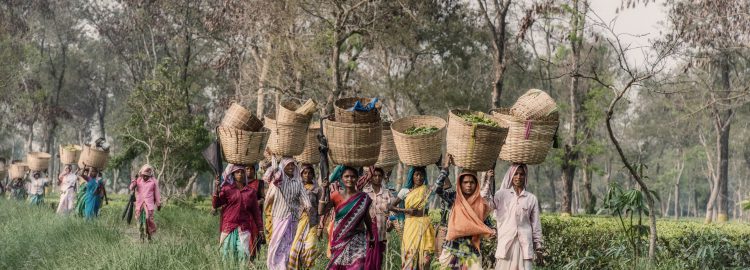
A new GLO Discussion Paperfinds an overall positive impact of parental migration on education, work, and temper of left-behind children in the Philippines.
The Global Labor Organization (GLO) is an independent, non-partisan and non-governmental organization that functions as an international network and virtual platform to stimulate global research, debate and collaboration.
Author Abstract: The Philippine government has focused most of its migration policy initiatives to encouraging international labour migration and protecting the rights of Filipino migrant workers. However, government interventions and aids to left-behind families and children left much to be desired. This paper aims to provide a better understanding of the impact of parental migration on the welfare of left-behind children in the Philippines so that policies can be devised to support them. This study’s analytical methods (instrumental variable analysis and propensity score matching) enable it to address several issues in migration research including endogeneity, migrant selectivity and community (regional) context, using previously unexamined nationally representative data from the Philippines. Our results suggest an overall positive impact on education, work, and temper of left-behind children. However, they tend to be more physically sickly. This warrants government attention to preclude any long-term negative health effects.
Governments around the world employ short-term re-election strategies.A new GLO Discussion Papertests whether longer program exposure has a causal effect on election outcomes in the context of a large anti-poverty program in India.It finds that length of program exposure lowers electoral support for the government.
The Global Labor Organization (GLO) is an independent, non-partisan and non-governmental organization that functions as an international network and virtual platform to stimulate global research, debate and collaboration.
Author Abstract: Short-term re-election strategies are widely used by governments around the world. This is problematic if governments can maximize their re-election chances by prioritizing short-term spending before an election over long-term reforms. This paper tests whether longer program exposure has a causal effect on election outcomes in the context of a large anti-poverty program in India. Using a regression-discontinuity framework, the results show that length of program exposure lowers electoral support for the government. The paper discusses a couple of potential explanations, finding that the most plausible mechanism is that voters hold the government accountable for the program’s implementation quality.
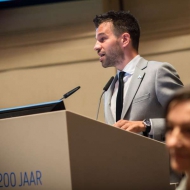
A new paper published online in the Journal of Population Economics updates research on son preferences in the United States. In contrast to previous research, any apparent son preference in fertility decisions have disappeared among natively born Americans, while some evidence for son preference in fertility persists among immigrants.
Read more in:
Francine D. Blau, Lawrence M. Kahn, Peter Brummund, Jason Cook & Miriam Larson-Koester Is there still son preference in the United States? See READLINK. Forthcoming: Journal of Population Economics (2020), Vol. 33, Issue 3. LEAD ARTICLE. https://doi.org/10.1007/s00148-019-00760-7
Author Abstract: In this paper, we use 2008–2013 American Community Survey data to update and further probe evidence on son preference in the USA. In light of the substantial increase in immigration, we examine this question separately for natives and immigrants. Dahl and Moretti (Review of Economic Studies 75, 1085-1120, 2008) found earlier evidence consistent with son preference in that having a female first child raised fertility and increased the probability that the family was living without a father. We find that for our more recent period, having a female first child still raises the likelihood of living without a father, but is instead associated with lower fertility, particularly for natives. Thus, by the 2008–2013 period, any apparent son preference in fertility decisions appears to have been outweighed by factors such as cost concerns in raising girls or increased female bargaining power. In contrast, some evidence for son preference in fertility persists among immigrants. Immigrant families that have a female first child have significantly higher fertility and are more likely to be living without a father (though not significantly so). Further, gender inequity in source countries is associated with son preference in fertility among immigrants. For both first- and second-generation immigrants, the impact of a female first-born child on fertility is more pronounced for immigrants from source countries with less gender equity. Finally, we find no evidence of sex selection for the general population of natives and immigrants, suggesting that it does not provide an alternative mechanism to account for the disappearance of a positive fertility effect for natives.
Related recent papers from the GLO network on son preferences:
A recent GLO Discussion Paper (also the GLO Discussion Paper of the Month March) had documented that the public health measures adopted in China have effectively contained the virus outbreak there already around February 15. Now a substantially revised version of the paper based on rigorous peer review has been accepted for publication in the Journal of Population Economics.
Stringent quarantine, city lockdown, and local public health measures imposed since late January significantly decreased the virus transmission rate.
Population outflow from the outbreak source region posed a higher risk to the destination regions than other factors including geographic proximity and similarity in economic conditions.
Over 1.4 million infections and 56,000 deaths could have been avoided according to the estimates based on the analysis.
Most effective was found to be “city lockdown” first followed by “closed management of communities” and “family outdoor restrictions”.
GLO Discussion Paper of the Month: March
GLO Discussion Paper No. 494, 2020: GLO Discussion Paper of the Month: March
Impacts of Social and Economic Factors on the Transmission of Coronavirus Disease 2019 (COVID-19) in China by Qiu, Yun & Chen, Xi & Shi, Wei PDF of the GLO Discussion Paper
Yun Qiu & Wei Shi are Professors at the Institute for Economic and Social Research (IESR), Jinan University, China
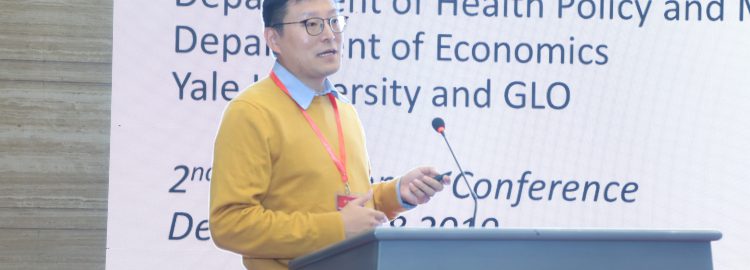
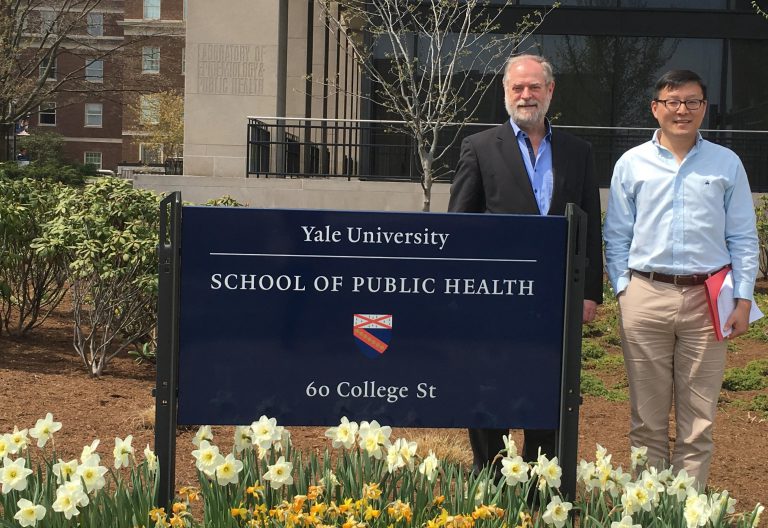
Xi Chen is a Professor at Yale University & President of the China Health Policy and Management Society
Yun Qiu
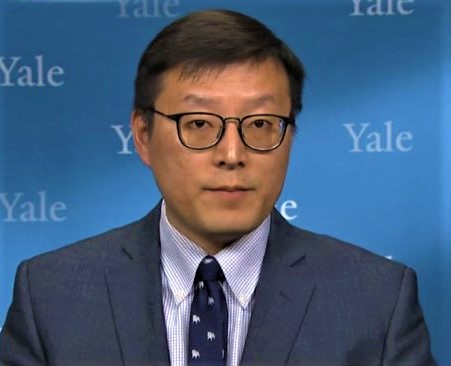
Xi Chen
Wei Shi
Revised Abstract: This paper models the local and cross-city transmissions of the novel coronavirus in China between January 19 and February 29 in 2020. We examine the role of various socioeconomic mediating factors, including public health measures that encourage social distancing in local communities. Weather characteristics two weeks ago are used as instrumental variables for causal inference. Stringent quarantine, city lockdown, and local public health measures imposed since late January significantly decreased the virus transmission rate. The virus spread was contained by the middle of February. Population outflow from the outbreak source region posed a higher risk to the destination regions than other factors including geographic proximity and similarity in economic conditions. We quantify the effects of different public health measures in reducing the number of infections through counterfactual analyses. Over 1.4 million infections and 56,000 deaths could have been avoided as a result of the national and provincial public health measures imposed in late January in China.
A new GLO Discussion Paper reviews recent literature on public program benefits to conclude that there may well be net social gains.
The Global Labor Organization (GLO) is an independent, non-partisan and non-governmental organization that functions as an international network and virtual platform to stimulate global research, debate and collaboration.
Author Abstract: Precipitated by rapid globalization, rising inequality, population growth, and longevity gains, social protection programs have been on the rise in low- and middle-income countries (LMICs) in the last three decades. However, the introduction of public benefits could displace informal mechanisms for riskprotection, which are especially prevalent in LMICs. If the displacement of private transfers is considerably large, the expansion of social protection programs could even lead to social welfare loss. In this paper, we critically survey the recent empirical literature on crowd-out effects in response to public policies, specifically in the context of LMICs. We review and synthesize patterns from the behavioral response to various types of social protection programs. Furthermore, we specifically examine for heterogeneous treatment effects by important socioeconomic characteristics. We conclude by drawing on lessons from our synthesis of studies. If poverty reduction objectives are considered, along with careful program targeting that accounts for potential crowd-out effects, there may well be a net social gain.
A new GLO Discussion Paperreveals the positive effects of a large Indian public works program showing thatthere is little evidence of a crowding out of private-sector jobs and that it functions as a safety net and encourages risk-taking.
The Global Labor Organization (GLO) is an independent, non-partisan and non-governmental organization that functions as an international network and virtual platform to stimulate global research, debate and collaboration.
Author Abstract: Most countries around the world implement some form of a safety net program for poor households. A widespread concern is that such programs crowd out private-sector jobs. But they could also improve workers’ welfare by allowing them to take on more risk, for example through self-employment. This paper analyzes the employment impacts of the world’s largest public-works program using a novel regression-discontinuity design. The analysis exploits detailed institutional information to describe the allocation formula of the program and to construct a benefit calculator that predicts early and late treatment of districts. The results show that there is little evidence of a crowding out of private-sector jobs. Instead, the scheme functions as a safety net after a bad rainfall shock. Male workers also take on more risk by moving into family employment. This self-revealed preference for a different type of job suggests other potential benefits of safety net programs which so far have received little attention in the literature.
Will happiness levels return to normal before the end of 2020? Talita Greyling and Stephanié Rossouw of GLO analyze the situation, as it happens – real-time happiness levels and emotions (www.gnh.today) during the evolution of the Coronavirus Crisis. The Gross National Happiness data set used (a real-time Happiness Index) is an ongoing project, the two researchers launched in April 2019 in South-Africa, New-Zealand and Australia.
The project is presented below and documents the development of real-time happiness in Australia, New Zealand and South Africa in the periods of the outbreak of the Coronacrisis in those countries.
The authors
Talita Greyling:School of Economics, University of Johannesburg, South Africa, and GLO; email: talitag@uj.ac.za Stephanié Rossouw:Faculty of Business, Economics and Law, Auckland University of Technology, Auckland, New Zealand,and GLO; email: stephanie.rossouw@aut.ac.nz
Stephanie Rossouw
Talita Greyling
The analysis
Traditionally, economists measured the well-being of people or a nation by using objective economic indicators such as gross domestic product (GDP). We know that these indicators do not measure well-being per se, but merely specific conditions, which is believed to lead to a good life. What we should be measuring is whether people’s lives are getting better? In general, when people are happy and satisfied with their life, it signals that they have a higher level of well-being.
Gross National Happiness (GNH) refers to the level of happiness for a group of citizens or nations and the best-known surveys that captures cross country data are the Gallup World Poll Survey data and World Value Survey data. In these surveys we find measures of subjective-wellbeing, thus evaluative happiness, which if averaged across a country gives the mean subjective well-being of a specific country. Although these measures of subjective well-being are very useful and informative there are significant time-lags between real-time events and the reporting of this evaluative happiness levels. What is needed is a real-time measure of happiness.
Using social media and the voluntary information sharing structure of Twitter, Greyling and Rossouw (in collaboration with AFSTEREO) have been determining the happiness in real-time (mood) of citizens in Australia, New Zealand and South Africa since April 2019 (http://gnh.today/), and lately also been analyzing the specific emotions of Tweets, distinguishing between eight emotions, anger, anticipation, disgust, fear, joy, sadness, trust and surprise.
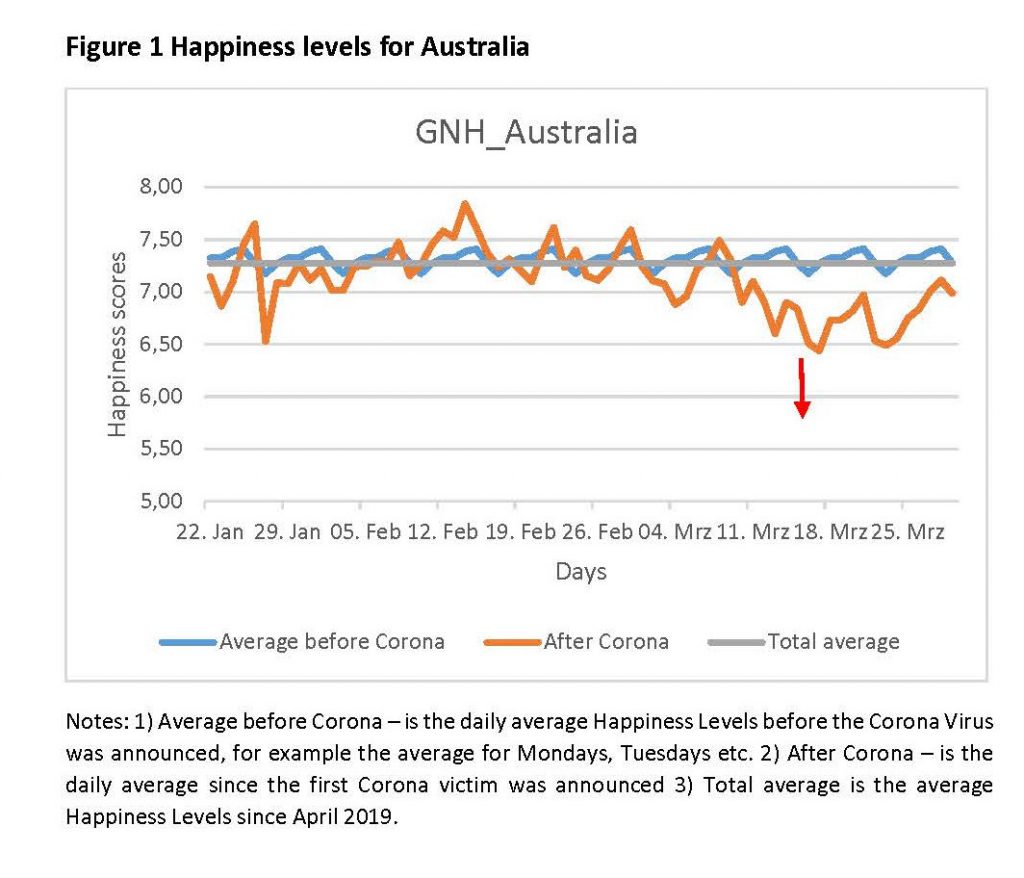
They analyze extracted Tweets using sophisticated software to determine the sentiment and the emotions of the Tweets. Sentiment analysis is used to label a ‘live’ stream of tweets of these countries as having either a positive, neutral or negative sentiment after which a sentiment balance algorithm is applied to derive a happiness score. The scale of the happiness scores is between 0 (not happy) and 10 (very happy), with 5 being neutral, thus neither happy nor unhappy. In this manner, they have been tracking the ‘mood’ of these nations and analyzed the impact of various economic (industrial actions), political (national elections), social (death of Kobe Bryant and COVID-19, xenophobia, music concerts) and sport events on happiness levels, as early as one hour after it happened. See Figures 1-3 for a peek into what the happiness index can ascertain.
As can be seen from Figure 1, on 25 January when Australia confirmed its first COVID-19 case, there was very little reaction. Happiness even increased somewhat after the announcement, though the higher levels of happiness were related to sport events. The dip in the happiness on 27 January was due to the death of the American basketball player, Kobe Bryant. On 17 March when Prime Minister Scott Morrison banned gatherings larger than 100 people, we for the first time saw a significant decrease in the happiness levels. The Australians are not on complete lockdown, but it seems that their happiness levels continue to stay below pre-Corona times. We will be tracking these changes in the coming weeks, to see if the happiness levels return to pre-Corona levels as time goes by.
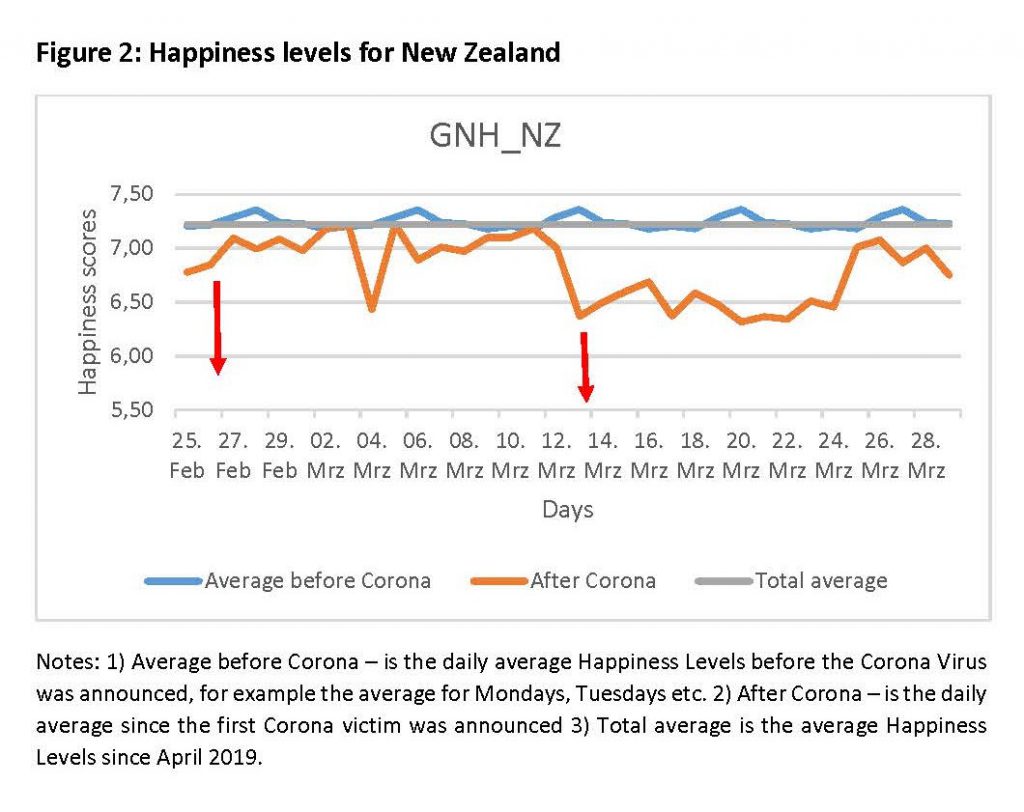
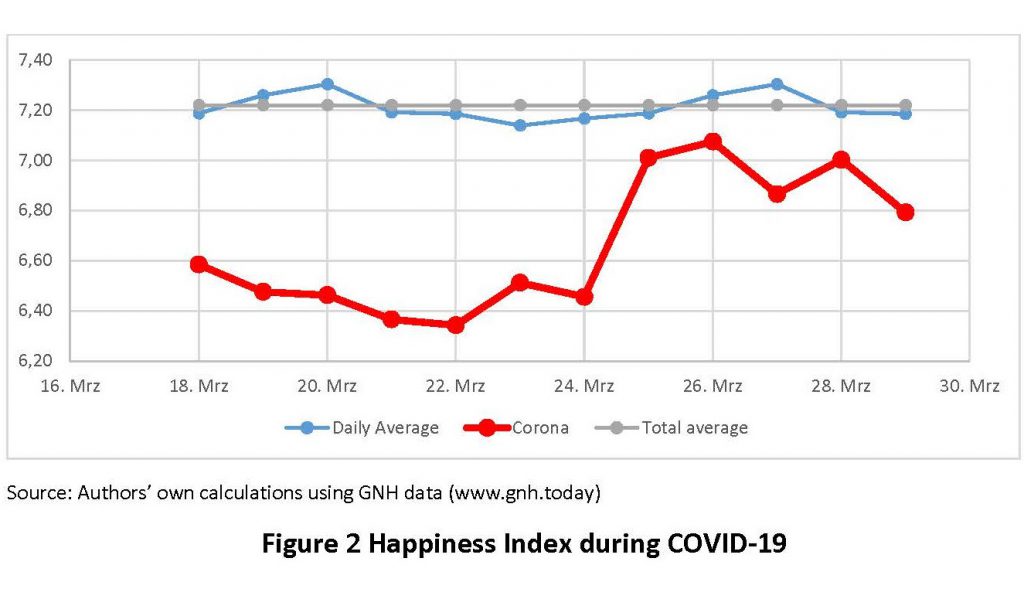
Coincidentally, until the outbreak of COVID-19, the lowest happiness level in New Zealand was on 27 January (6.43), also signalling New Zealanders’ empathy with Kobe Bryant’s death. As can be seen from the Figure 2, on 28 February when New Zealand confirmed its first COVID-19 case, there was very little reaction. On 4 March, New Zealand experienced the ‘Toilet paper apocalypse’, but it wasn’t until 13 March that the lowest level of happiness (6.37) was recorded. People were devastated by all the concert and festival cancellations, because of COVID-19. The first day of complete lockdown was on 26 March. We will be monitoring whether New Zealanders adjust to their new normal over the coming weeks.
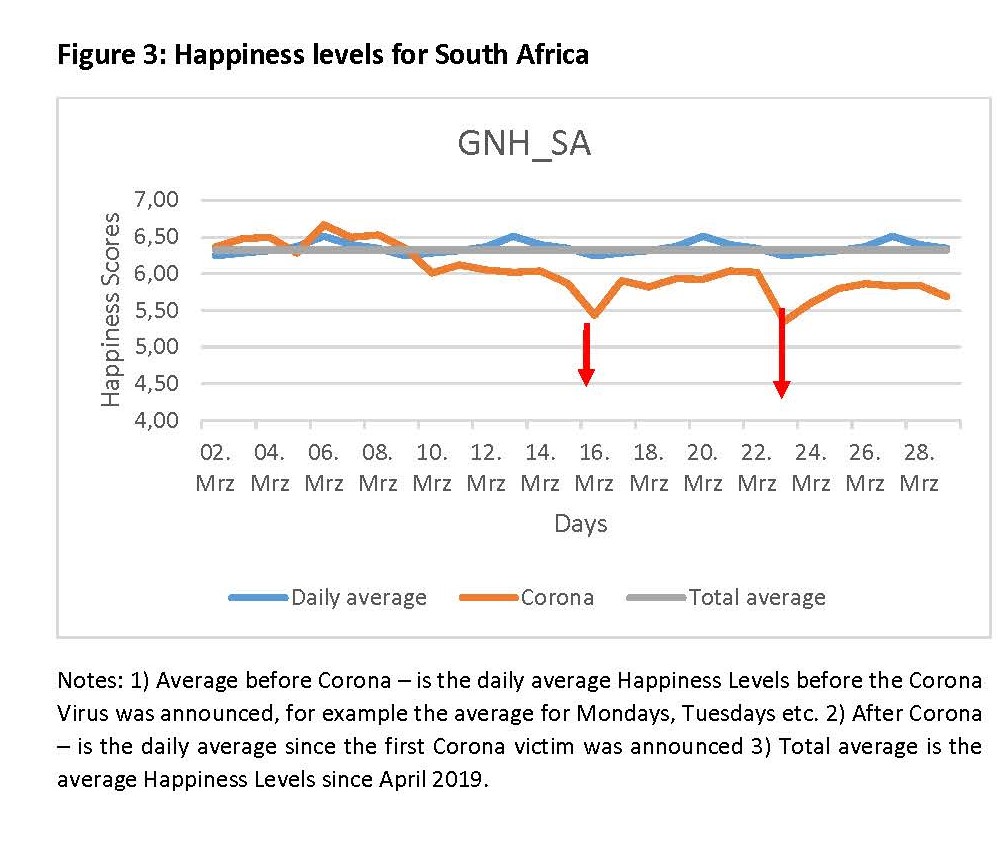
As can be seen from Figure 3, on 6 March when South Africa confirmed its first COVID-19 case, the happiness level was above the average for the period preceding the outbreak, as well as the total average. It wasn’t until 16 March when reality set in for most South Africans after President Cyril Ramaphosa declared a national state of disaster, that we saw a decrease in happiness levels. When the announcement came on 23 March, that a complete lockdown of South Africa will commence on 27 March, the index fell to its lowest level yet (5.35). We will be monitoring whether South Africans adjust to their new normal over the coming weeks.
Technical Support by AFSTEREO
Reference Greyling T. & Rossouw S. 2020. Gross National Happiness Project. Afstereo (IT partner). University of Johannesburg (funding agency). Pretoria, South Africa. www.gnh.today.
The world still struggles about a convincing strategy to handle the #coronavirus crisis. Radical alternatives focus around (i) herd immunity and selective social distancing and (ii) a total lockdown of the economy and the entire society. In previous posts the GLO website was reporting about the strategy of lockdown, the societal consequences and the arguments against it, and the alternative Swedish strategy. Today we listen to a feedback from Italy, the country hit hardest first after China.
Some core messages of the interview:
The course of the contagion is the same everywhere.
Italy is on its way out of the crisis.
It started in the most populated North with global connections, affecting the most vulnerable.
Italy has an efficient public health system which managed the crisis.
The radical lockdown had no alternative and saved very many lives.
The missing European solidarity may result in the end of European unification.
GLO Fellow Alessandro Cigno is a Professor of Economics at the University of Florence, and Editor of the Journal of Population Economics.
Interview
GLO: The coronacrisis in Italy has become a terrible catastrophe, and there is no end in sight…..
Alessandro Cigno: ….not quite true that there is no end in sight in Italy. The number of contagions has stabilized, and the number of intensive care cases is decreasing , the number cured or dead is larger than the number of new cases…..
GLO: But what can the other countries learn from the Italian experiences? Why was the coronavirus affecting Italy suddenly like a tsunami?
Alessandro Cigno: The course of the contagion is the same everywhere. It just started earlier in Italy.
GLO: Why has the disease largely affected first the North and so much the Old?
Alessandro Cigno: The North is more densely populated and has more intense relations with the rest of the world. The old are more likely to have other pathologies.
GLO: What role played the openness of the country, the strength of the healthcare system and the strong family relationships in the Italian culture? What role played missing data and slow government response?
Alessandro Cigno: Openness facilitated the contagion. Fortunately we have an efficient public health system. But the number of intensive care beds per 1000 inhabitants, while double that of the UK, was initially half of that of France and one third that of Germany. That number has been raised very quickly. Strong family relationships helped the contagion, especially from the young to the old. As Italy was the first to start, the government response was unavoidably tentative (that of other countries who started later had no excuse).
GLO: Italy is strongly related to China through the Belt & Road initiative. Has this played any role?
Alessandro Cigno: The Belt & Road initiative may have played a role.
GLO: Were the radical lockdown measures effective?
Alessandro Cigno: Radical lockdown is estimated to have saved 30 000 lives.
GLO: Did Italy discuss alternatives?
Alessandro Cigno: Alternatives to lockdown were and are discussed, but the scientific and medical consensus is that they are inferior.
GLO: How do Italians react to the missing European solidarity in this crisis?
Alessandro Cigno: Italians are offended by the missing European solidarity and fear that it will be the end of European unification.
************* With Alessandro Cigno spoke Klaus F. Zimmermann, GLO President.
A new GLO Discussion Paperfinds a weak trade-off between aggregated national-level wage inflation and unemployment.
The Global Labor Organization (GLO) is an independent, non-partisan and non-governmental organization that functions as an international network and virtual platform to stimulate global research, debate and collaboration.
Author Abstract: This paper examines the relationship between labour market conditions and wage dynamics by exploiting a unique dataset of 0.8 million online job vacancies. We find a weak trade-off between aggregated national-level wage inflation and unemployment. This link becomes more evident when wage inflation is disaggregated at sectoral and occupational levels. Using exogenous variations in local market unemployment as the main identification strategy, a negative correlation between vacancy-level wage and unemployment is also established. The correlation magnitude, however, is different across regions and skill segments. Our findings suggest the importance of micro data’s unique dimensions in examining wage setting – unemployment relationship.
The GLO Discussion Paperof the Month Marchsuggests that the public health measures adopted in China have effectively contained the virus outbreak there already around February 15.
Impacts of Social and Economic Factors on the Transmission of Coronavirus Disease 2019 (COVID-19) in China by Qiu, Yun & Chen, Xi & Shi, Wei PDF of the GLO Discussion Paper
Yun Qiu & Wei Shi are Professors at the Institute for Economic and Social Research (IESR), Jinan University, China
Xi Chen is a Professor at Yale University & President of the China Health Policy and Management Society
Yun Qiu
Xi Chen
Wei Shi
Author Abstract: This paper examines the role of various socioeconomic factors in mediating the local and cross-city transmissions of the novel coronavirus 2019 (COVID-19) in China. We implement a machine learning approach to select instrumental variables that strongly predict virus transmission among the rich exogenous weather characteristics. Our 2SLS estimates show that the stringent quarantine, massive lockdown and other public health measures imposed in late January significantly reduced the transmission rate of COVID-19. By early February, the virus spread had been contained. While many socioeconomic factors mediate the virus spread, a robust government response since late January played a determinant role in the containment of the virus. We also demonstrate that the actual population flow from the outbreak source poses a higher risk to the destination than other factors such as geographic proximity and similarity in economic conditions. The results have rich implications for ongoing global efforts in containment of COVID-19.
The world still struggles about a convincing strategy to handle the #coronavirus crisis. Radical alternatives focus around (i) herd immunity and selective social distancing and (ii) a total lockdown of the economy and the entire society. In previous posts the GLO website was reporting about the strategy of lockdown, the societal consequences and the arguments against it. Today we investigate a constructive alternative, the Swedish strategy.
Some core messages of the interview:
Sweden has clearly focused less on forcing people to increase social distance and more on encouraging people to act responsibly.
There’s clearly social pressure to comply with recommendations from the government.
Government agencies are more independent from political influence in Sweden.
The stated objective has been to “flatten the curve” to avoid overburdening the health care system.
A feared “crisis-fatigue” is one major reason why the Swedish Public Health Authority has been reluctant to push social distancing further.
Sweden’s great registry data will only in the long-run help to understand the viruscrisis better.
Covid-19 will not change the Swedish very positive outlook on globalization.
GLO Fellow Erik Lindqvist is a Professor of Economics at the Swedish Institute for Social Research (SOFI), Stockholm University, and Editor of the Scandinavian Journal of Economics.
Interview
GLO: While most of the European governments have applied very restrictive measures to fight the Coronacrisis, Sweden’s reaction remains more relaxed: What are the key elements of the Swedish strategy?
Erik Lindqvist: The Swedish government has implemented a number of measures similar (though less comprehensive) to those in other countries. Public gatherings larger than 50 people are no longer allowed; almost all education in upper secondary-school and universities is now online; visits to nursery homes are no longer allowed, etc. These sharp measures are combined with pleas to the public to reduce travel; to work from home in case it’s feasible; to avoid public transport during rush hour, etc. High-risk groups (especially people above age 70) are strongly encouraged to self-isolate to the extent possible. Yet unlike most other countries, restaurants, schools, gyms and similar facilities are still open. So, Sweden has clearly focused less on forcing people to increase social distance and more on encouraging people to act responsibly.
GLO:Has the Swedish population more “social discipline” than other nations that allow for such a strategy?
Erik Lindqvist: There’s clearly social pressure to comply with recommendations from the government and my impression is many (though not all) do. But whether this pressure is stronger in Sweden than in other countries I really don’t know.
GLO:While the decisive actors in most countries are policymakers, who use the moment to strengthen their profile as conflict managers which ends in what has been called “availability cascades”, Sweden’s policy seems to be more designed by the Swedish Public Health Authority than by the government.
Erik Lindqvist: Compared to most other countries, government agencies are more independent from political influence in Sweden. But I also think the Swedish government has deliberately chosen to rely on advice of the Swedish Public Health Authority regarding the public health-side of the crisis.
GLO:Are there outlined objectives of the Swedish policy, and how do the Swedish authorities measure success?
Erik Lindqvist: The stated objective has been to “flatten the curve” to avoid overburdening the health care system. My impression is that this is the key factor guiding policy. I am unaware of any explicit quantitative targets beyond that.
GLO:How important is it that an initial response is in line with a long-term consistent policy?
Erik Lindqvist: From what I gather, I think a fear “crisis-fatigue” is one major reason for why the Swedish Public Health Authority has been reluctant to push as far ahead with social distancing as other countries have done. My personal hope is that Sweden (and other countries) might be able to implement somewhat less restrictive measures in the long-term by ramping up testing for Covid-19. This also seems to be underway, though perhaps not yet quite as forcefully as I personally would have hoped for.
GLO:What is the data situation in Sweden, which typically has excellent individual-level data. Can those data be used to handle the situation effectively, by connecting them with good measures of infections, deaths and those recovered?
Erik Lindqvist: Sweden indeed has great registry data which in time will allow researchers to learn a lot about Covid-19. Yet because there is a lag of, say, 3-6 months before the relevant registries are updated, such analyses are not yet possible. I think this is unfortunate – analyses using real-time data could help inform policy as the crisis unfolds – but I also understand and respect the fact that updating the data is non-trivial and that the people responsible for it have many other pressing matters to attend to at this moment.
GLO:Will Swedes consider globalization as a burden after this crisis?
Erik Lindqvist: The effect of Covid-19 on globalization is, I think, one of the major issues for the years to come after the crisis. Swedes in general have a very positive outlook on globalization – we are, after all, a small, export-dependent country. My guess is Covid-19 will not change this. But a somewhat soberer view on the extent to which we can rely on global supply chains in times of crisis is inevitable, I think. There seems to be general agreement in Swedish policy circles that we need to increase our storage of basic medical supplies, for instance.
************* With Erik Lindqvist spoke Klaus F. Zimmermann, GLO President.
A new GLO Discussion Paperprovidesevidence that investor sentiments and emotions derived from stock market-related Twitter tweets are significant predictors of stock market movements in developed and emerging markets.
The Global Labor Organization (GLO) is an independent, non-partisan and non-governmental organization that functions as an international network and virtual platform to stimulate global research, debate and collaboration.
Author Abstract: This paper investigates the predictability of stock market movements using text data extracted from the social media platform, Twitter. We analyze text data to determine the sentiment and the emotion embedded in the tweets and use them as explanatory variables to predict stock market movements. The study contributes to the literature by analyzing high-frequency data and comparing the results obtained from analyzing emerging and developed markets, respectively. To this end, the study uses three different Machine Learning Classification Algorithms, the Naïve Bayes, K-Nearest Neighbors and the Support Vector Machine algorithm. Furthermore, we use several evaluation metrics such as the Precision, Recall, Specificity and the F-1 score to test and compare the performance of these algorithms. Lastly, we use the K-Fold Cross-Validation technique to validate the results of our machine learning models and the Variable Importance Analysis to show which variables play an important role in the prediction of our models. The predictability of the market movements is estimated by first including sentiment only and then sentiment with emotions. Our results indicate that investor sentiment and emotions derived from stock market-related Tweets are significant predictors of stock market movements, not only in developed markets but also in emerging markets.
“COVID-19 Lockdown plays havoc with emotions and our “Happiness Index” stays under pressure“, GLO Fellows Talita Greyling and Stephanié Rossouw find in a new study. The lockdown strategy shows immediate negative consequences for wellbeing in South Africa. The Gross National Happiness data set used (a real-time Happiness Index) is an ongoing project, the two researchers launched in April 2019 in South- Africa, New-Zealand and Australia. See the detailed analysis below.
The authors
Talita Greyling:School of Economics, University of Johannesburg, South Africa, and GLO; email: talitag@uj.ac.za Stephanié Rossouw:Faculty of Business, Economics and Law, Auckland University of Technology, Auckland, New Zealand,and GLO; email: stephanie.rossouw@aut.ac.nz
Stephanie Rossouw
Talita Greyling
The analysis
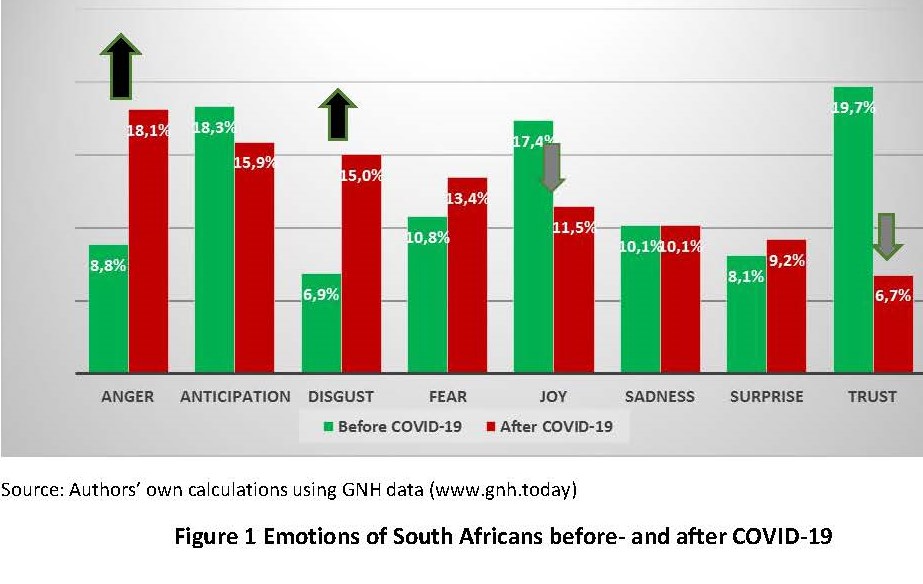
South Africans are “angry” after their first weekend under lockdown. COVID-19 has been playing havoc with South African’s emotions over the last month. We have made 180 degrees turn in our emotional state; from being joyful, anticipating good things to happen and showing trust, to being angry, anticipating the worst and showing disgust and fear. Over the period, the most significant gainers, among the emotions, were anger, up with almost 10%, followed by disgust (+8%) (see figure 1, indicated by the black arrows). In contrast, the biggest losers were trust (-13%) and joy (-6%) (see figure 1 indicated by grey arrows) (Greyling & Rossouw 2020).
These are the results of Prof Talita Greyling (University of Johannesburg) and Dr Stephanie Rossouw (Auckland University of Technology) who in collaboration with Afstereo launched South Africa’s Happiness Index in April 2019 and recently expanded their study to include the analysis of the emotions of South Africans.
Why are South Africans
so angry? From the analyses of the
Tweets (see www.gnh.today)
the team (Greyling & Rossouw, 2020) found the following:
Mad at police and military, because of the aggressive and violent manner the COVID – regulations are enforced.
Angry about people being greedy and making money out of COVID-19, when the country is suffering.
Angry at government playing politics in a time of fear, and uncertainty about the future.
Mad about Moody’s downgrade to junk status, “kicking the country when it is already down”.
Angry about being isolated, cut-off and no way to release stress or alleviate depression and anxiety.
Concerned about the increase in domestic violence, interesting not only men towards women, but among all members of the household.
Mad at not being able to buy alcohol (previously also cigarettes).
Being stuck at home and then also having to endure loadshedding
Lack of groceries after the rich has bought everything
God is mad, this is a sign of His wrath
Is there anything that South Africans are positive about at the moment? Well, it seems that in true South African spirit we cling to the silver lining in this storm that threatens to swallow us. “Family time” seems to be one of the few positives. In this never-ending rat race, being able to spend quality time with our loved ones seems to be our saving grace. Other positives mentioned are “time for self-reflection” and “time to turn to God”.
If we turn to the Happiness Index itself, which measures the sentiment levels of South Africans on a scale from zero to 10 J, with 5 being neutral (neither happy or unhappy) (see www.gnh.today), we note that the index stays under pressure. After the significant lows on the days before-, on- and after the announcement of the lockdown (23 March 2020), there was a short lived increase in happiness levels, as people rushed to shops and their home towns/steads (migrating out of the cities), in anticipation of the lockdown. However, the happiness levels soon returned to the “new lows” we have been experiencing since the announcement of the first COVID-19 patient in South Africa (see figure 2).
As reality sinks in
and the health and livelihoods of South Africans’ come under threat, it becomes
clear that “Twenty Plenty” has made a 180-degree turnaround to “Twenty
Catastrophe”.
Reference Greyling T. & Rossouw S. 2020. Gross National Happiness Project. Afstereo (IT partner). University of Johannesburg (funding agency). Pretoria, South Africa. www.gnh.today.
The world still struggles about a convincing strategy to handle the #coronavirus crisis. Radical alternatives focus around (i) herd immunity and selective social distancing and (ii) a total lockdown of the economy and the entire society. Heavily debated is a recent article in the “Jerusalem Post” on Corona and Lockdown on
by Robert M. Sauer, Professor at Royal Holloway, University of London, and Donald S. Siegel, Professor at Arizona State University.
Some core messages of the article:
The current experiment that is being conducted by supposedly democratic governments throughout the world follows not the standard ethical principles of social experiments.
There is no appropriate cost/benefit analysis of the consequences of the proposed actions.
Media have sensationalized the spread of the virus and pressured policymakers to lockdown entire economies with huge economic and social costs.
Social distancing and strong and focused reactions can be achieved differently.
One needs now to discuss the recovery.
In previous posts the GLO website was reporting about the strategy of lockdown; we now complete the picture by listening to the Sauer & Siegel arguments who also deserve attention. The topic is too important, globalization so much endangered so that we need to have this debate. The link to the article is above, below follows an interview with Robert M. Sauer about his position.
GLO Fellow Robert Sauer is a Professor of Economics, Royal Holloway, University of London, and the Editor-in-Chief of the European Economic Review, European Economic Review Plus and the Journal of Economics, Management and Religion.
Interview
GLO: China seems to have managed the Corona Crisis well at the end; what is wrong with the harsh lockdown strategy now implemented in most affected countries, in particular in Israel, following the Chinese model?
Robert Sauer: I believe it is hard to know whether China managed the crisis well. It is well known that all news and data coming out of China is highly suspect. It is also not surprising that a lockdown strategy was implemented in an authoritarian society. What is surprising is that a Chinese authoritarian model would be adopted in the liberal West. The West should rather follow the model of South Korea which is an open society. South Korea did not adopt a policy of indiscriminate lockdown and it seems to have, until now, verifiably handled the crisis with great success. The harsh lockdown policies being implemented in the West, including Israel, will have horrendous unintended consequences. These include massive increases in unemployment, increases in domestic violence and deaths of despair, just to name a few. It is not improbable that the cure will turn out to be worse than the disease. Lockdown is also a terrible precedent for future “crises” in public health and is, in my view, a violation of human rights. Anyone who cares about individual liberty should be very frightened.
GLO:Social distancing is crucial to keep the healthcare systems operational is the argument; and it cannot be sufficiently implemented without legal restrictions. Why do you think that this is wrong?
Robert Sauer: The argument that social distancing is a necessary condition for avoiding an inundation of healthcare systems is a spurious one. Instead of spending billions for unemployment insurance and corporate bailouts, governments can increase expenditures (by much less) by immediately producing more hospital space (e.g., building field hospitals and renting rooms in hotels) and ordering the production of more ventilators. A good example is Richard Branson’s recent offer to produce thousands of ventilators for the state of California. The health system may already be, and would certainly be in a very short time after these policies, able to handle the caseload while society remains mostly open for business as usual.
GLO:Some governments started hesitantly, but now policy actions are dramatic everywhere, why this “availability cascade”?
Robert Sauer: Certainly the government of Israel didn’t start hesitantly. It implemented lockdown when there were no deaths yet in the country. In fact, it would be interesting to see the number of deaths at the time that lockdown was implemented elsewhere. I’m guessing it would show that lockdown occurred very early in the “crisis” in most cases. This is because the international press made us believe that the Italian case was heading our way in a very short time. The data clearly show that Italy is an outlier in many health dimensions and the Italian case is hardly generalisable to other countries.
GLO: Do we have sufficient data to judge the situation well enough to develop a convincing strategy at all?
Robert Sauer: In my view, the best guesses at the death rate that we have now (they are guesses because the problem of selection bias is a huge one, however, it is most likely severely biased upwards) comes nowhere near justifying the affront on individual and economic liberty that the lockdown strategy constitutes. The default strategy should be to not violate freedom. If we do, we are setting a precedent that may lead to the West falling back into authoritarianism, this time through fear-mongering in the name of public health. The government may play a useful role in promoting voluntary social distancing and other recommendations for a healthy lifestyle. This should almost never be imposed by fiat.
GLO:Policymakers typically like to concentrate on short-term issues, while scientists focus on the long-run effects. Are policymakers too short-sighted?
Robert Sauer: They are absolutely short-sighted. In this case, as in many others, I believe politicians have a very strong incentive to over-insure against the number of deaths under their watch. As Dr. Peter Gotzsche MD of the Cochrane Collaboration has said, “Should it turn out that the epidemic wanes before long, there will be a queue of people wanting to take credit for this. And we can be damned sure draconian measures will be applied again next time. But remember the joke about tigers. ‘Why do you blow the horn?’ ‘To keep the tigers away.’ ‘But there are no tigers here.’ ‘There you see!’. I think he’s right. Our short-sighted politicians and our failed public health officials will indeed take the credit. And there seems to be little downside to imposing authoritarian lockdowns. There is little pushback by the public who are scared. It will be interesting to see if that may soon change.
GLO: What are the most important steps for a fast exit strategy?
Robert Sauer: The most important steps are increased production of hospital space, ventilators, test kits, massive testing, fast approval of drugs that are working in the field, and last but not least, immediately ending mandatory lockdown.
GLO: If this is not handled better, is this the end of globalism?
Robert Sauer: This is an extremely dangerous opening shot at the end of globalism and a resurgence of authoritarian government policies in the liberal West.
************* With Robert Sauer spoke Klaus F. Zimmermann, GLO President.
A new GLO Discussion Paper provides the first evidence on the determinants of uptake of two recent public dental benefit programs for Australian children and adolescents from disadvantaged families to find that only a third of all eligible families actually claim their benefits.
The Global Labor Organization (GLO) is an independent, non-partisan and non-governmental organization that functions as an international network and virtual platform to stimulate global research, debate and collaboration.
Author Abstract: Recent economic literature has advanced the notion that cognitive biases and behavioral barriers may be important influencers of uptake decisions in respect of public programs that are designed to help disadvantaged people. This paper provides the first evidence on the determinants of uptake of two recent public dental benefit programs for Australian children and adolescents from disadvantaged families. Using longitudinal data from a nationally representative survey linked to administrative data with accurate information on eligibility and uptake, we find that only a third of all eligible families actually claim their benefits. These actual uptake rates are about half of the targeted access rates that were announced for them. We provide new and robust evidence consistent with the idea that cognitive biases and behavioral factors are barriers to uptake. For instance, mothers with worse mental health or riskier lifestyles are much less likely to claim the available benefits for their children. These barriers to uptake are particularly large in magnitude: together they reduce the uptake rate by up to 10 percentage points (or 36%). We also find some indicative evidence about the presence of the lack of information barrier to uptake. The results are robust to a wide range of sensitivity checks, including controlling for possible endogenous sample selection.
A new GLO Discussion Paperprovidesevidencethat speakers of future-tensed languages are less likely to be religious.
The Global Labor Organization (GLO) is an independent, non-partisan and non-governmental organization that functions as an international network and virtual platform to stimulate global research, debate and collaboration.
Author Abstract: This paper identifies a new source of differences in religiosity: the presence of future tense marking in language. We argue that the rewards and punishments that incentivize religious behavior are less effective for speakers of languages that contain future tense marking. Consistent with this prediction, we show that speakers of future-tensed languages are less likely to be religious and to take up the short-term costs associated with religiosity. What is likely to drive this behavior, according to our results, is the relatively lower appeal of the religious rewards for these individuals. Our analysis is based on within country regressions comparing individuals with identical observable characteristics who speak a different language.
Does life satisfaction affect your career? The results of a new study demonstrate it does. The study, published in Kyklos by GLO Fellow Kelsey J. O’Connor, finds more satisfied people are less likely to lose their jobs and if unemployed, more likely to become reemployed within a year. These benefits can be explained in part through noncognitive skills. For instance, more satisfied people are also more optimistic, conscientious, extraverted, and emotionally stable, factors that are, unsurprisingly, useful in the labor force.
You may have suspected that happy people perform better at
work. Indeed, happier people are healthier and earn higher incomes, based on observational
and experimental
evidence. Happiness also contributes positively to countries’ production.
These represent just a few of the findings. For more evidence, see the chapter dedicated
to the benefits of happiness in the United Nations World Happiness Report 2013.
O’Connor (2020) differs by demonstrating greater life satisfaction today reduces the likelihood of being unemployed a year from now. The reverse, that unemployment brings unhappiness, is well known, see in particular the study of GLO Fellows Winkelmann and Winkelmann (1998) with over 2000 Google Scholarcites. Analyses are based on the German Socio-Economic Panel and include separate dynamic and fixed-effects regressions, and two instrumental variable approaches. Regressions include a rich set of controls, especially relevant are unemployment history, and perceptions of both job security and reemployment opportunities.
The impact of life satisfaction on unemployment is not negligible.
Increasing life satisfaction from approximately a 7 to an 8 on a scale from 0
to 10, reduces the likelihood of unemployment by approximately five percent.
To be precise, the focus of O’Connor (2020) is self-reported
life satisfaction, which is distinct but closely related to happiness. See the OECD
Guidelines on Measuring Subjective Well-Being for further details.
For responses to recent criticisms of subjective well-being measures like
happiness and life satisfaction, see Kaiser and Vendrik or
Chen
et al. (2019).
As suggested, noncognitive skills help to explain how life satisfaction affects unemployment. O’Connor (2020) offers evidence that noncognitive skills and life satisfaction are positively correlated in fixed effects regressions with complete socio-economic controls. A significant portion of life satisfaction is derived from noncognitive skills, and there are now quite a few studies that show noncognitive skills are important for workplace outcomes. In formal economic theory, they represent capabilities that are important for different outcomes, just like physical ability or intelligence. Similarly, in other work authored by O’Connor and GLO Fellow Carol Graham, the authors demonstrate that optimistic people live longer, based on nearly 50 years of longitudinal data. Indeed, they find an optimistic belief structure is more important for life expectancy than income or cognitive ability.
Happiness is important. Philosophers throughout time and
around the world have stated it. Yet many policy makers are reluctant to invest
explicitly in happiness. The findings of O’Connor (2020) give them
another reason. Policies that target noncognitive skills and life satisfaction,
in schools for example, should not only improve life satisfaction, but also labor
market performance.
The world struggles about a convincing strategy to handle the #coronavirus crisis and reflects the consequences thereafter: What are the recommendations from Beijing’s top policy advisor Henry Wang?
The most important thing is taking decisive and comprehensive action as soon as the virus starts to spread.
New formats of internet business, including online medical services, online education, and working at home through online apps, have grown significantly.
The virus may rebound if we relax our vigilance.
The pandemic reveals not the failure of globalization, but the need to innovate global governance systems and boost international cooperation.
In the long run, the movement of labor and talent has created more benefits than problems.
GLO Fellow Huiyao (“Henry”) Wang is a Professor and President of the Center for China and Globalization (CCG), the largest non-government think tank in China. CCG and GLO are collaborating institutions.
Henry Wang
Interview
GLO: China seems to have managed the Corona Crisis. What are the major lessons?
Huiyao Wang: I think the most important thing is taking decisive and comprehensive action as soon as the virus starts to spread. The non-pharmaceutical measures China took might seem economically damaging at first, but it is that the sacrifice gave us a better chance to control the pandemic as quickly as possible. If we had underestimated the coronavirus, the potential losses could have been far greater.
And another thing is the well-equipped internet infrastructure and the thriving internet industries that played a big role in distributing medical resources and basic supplies for people in quarantine during the coronavirus outbreak. Additionally, new formats of internet business, including online medical services, online education, and working at home through online apps, have grown significantly. These businesses helped to allow society to continue operating and lowered the economic pressure so that we could keep the economy going while employing social distancing.
GLO:Will the virus come back?
Huiyao Wang: I think there’s a chance that the virus rebounds if we relax our vigilance. Although China has made it to contain the coronavirus overall, it is too early to relax now due to the global outbreak. We can see that there are dozens of new cases appearing every day, mostly coming from other countries. The Chinese central government and local governments as well as every citizen are staying cautious and alert.
In this special time, all countries should work together and spare no effort against the virus, in line with the joint statement achieved at the G20 summit several days ago. Like President Xi Jinping said, we should build a community with shared future for mankind, since globalization has tied countries together. Discrimination and hatred will not do any good when facing the challenges brought by the virus, and other transnational challenges like climate change.
GLO:Some say the pandemic is the curse of globalism, did it go too far?
Huiyao Wang: The coronavirus indeed has caused a global crisis, however, if we believe globalization will go reverse or countries should decouple to protect themselves, then we are wrong. Coronavirus is just one of the global challenges that we are facing. Climate change, environmental degradation, WTO reforms – these challenges are all awaiting us and none of them can be overcome without international cooperation, bilaterally and multilaterally. The pandemic reveals not the failure of globalization, but the need to innovate global governance systems and boost international cooperation.
I think the G20 meeting was a good start. On the 27th, President Xi and President Trump had a phone call the day after the G20 meeting. This sent a good signal that China and the US are going to set aside the disputes and work together. Despite the talk about competition between China and the US, I believe the two countries have enough reasons to collaborate. Being rivals will do no good to either country.
GLO: How can global solidarity look like in this crisis?
Huiyao Wang: I think it failed to meet our expectations somehow at the beginning, but now after the G20, I hope countries can unite and fight against the virus together.
When the outbreak started in China, many countries donated and helped, which was significant for China to control the coronavirus domestically. However, after the coronavirus began to spread globally, global solidarity appeared vulnerable.
After the G20, the countries have presented a joint statement announcing a fund of 500 million US$ to combat the disease and other key messages about reviving the global economy. If these are carried out, I think we will walk out of the shadow cast by the pandemic.
GLO:The Coronavirus is a strike of nature against globalism: What is its future, in particular for labor migration?
Huiyao Wang: I think it is short-sighted if we blame the outbreak on labor migration, since the cause is more complex than that and we could have taken better precautions to avoid it. In the long run, the movement of labor and talent has created more benefits than problems.
I think we should improve and innovate the global governance of migration rather than go against it. Especially, we should establish an emergency mechanism to regulate transnational movement of people when an outbreak occurs like this time to minimize the impact.
************* With Huiyao Wang spoke Klaus F. Zimmermann, GLO President.
The Coronavirus (SARS-CoV-2) and the COVID-19 disease continue to spread across the world. A new Life with Corona study will provide valuable information for researchers studying the social and economic implications of the Coronavirus pandemic. LINK to the survey website.
The project is led by GLO Fellow Tilman Brück and his International Security and Development Center (ISDC) in Berlin. ISDC and its Director Tilman Brück are long-term partners of the GLO. GLO congratulates ISDC and Director Brück for this important new initiative at difficult times.
It is an innovative citizen science project that will help us understand how the Corona crisis is changing our lives. The findings will deliver important insights for policy-makers and researchers into how to better manage and mitigate the crisis.
Based on cutting-edge methodologies, the survey captures the voices and sentiments of citizens around the world.
Be part of the survey now! Just fill in the questionnaire and please forward this call in your networks. The more people participate, the more we know!
Amsterdam, 29 March, 2020. The WageIndicator Foundation announces the Continuous Global Online Survey ‘Living and Working in Corona Times’! Press Release.
The WageIndicator Foundation led by GLO Fellow Paulien Osse as the Director, is a long-term partner of the GLO. GLO congratulates the WageIndicator Foundation for this important new initiative at difficult times.
Continuous Global Online Survey ‘Living and Working in Corona Times’
WageIndicator shows coronavirus-induced changes in living and working conditions in 110 countries. The changes are visualized in maps and graphs. These infographics show, from day to day, the consequences the large majority of the working population of the world experiences, on the basis of answers on the following questions in the Corona survey:
– Is your work affected by the corona crisis? – Are precautionary measures taken at the workplace? – Do you have to work from home? – Has your workload increased/decreased? – Have you lost your job/work/assignments?
First results show an enormous impact of the coronavirus on work in general. In the Netherlands for instance, a country severely hit, 95 percent of participants in the survey state that their work is impacted by the corona-crisis.
The survey contains questions about the home situation of respondents as well as about the possible manifestation of the corona disease in members of the household. Also the effect of having a pet in the house in corona-crisis times is included.
WageIndicator – a respected partner of GLO – is a non-profit foundation, which aims to share and compare wages and labour law on a global scale through its national websites in 140 countries with millions of web visitors. WageIndicator’s web visitors are invited to complete the survey on Living and Working in Corona Times. The survey reaches out to all people in working age, contracted, self-employed and unemployed alike.
WageIndicator’s online infrastructure is built up over the past two decades and consists of online and offline surveys and data collection. For this particular survey, the international WageIndicator team cooperates with academic research institutes from half a dozen countries. The survey asks the same questions across countries. Therefore WageIndicator is able to closely monitor the development of the corona crisis and its impact on the world of work.
WageIndicator has rolled out its survey on March 26, 2020. From March 31 onwards WageIndicator maps changes in 110 countries, shown permanently online and updated each day.
Background interview with Diego Viana, reporter of the Brazilian daily Valor Econômico, who publishes a story on the relationship between the #Coronavirus Crisis and the future of work.Valor Econômico is the largest financial newspaper in Brazil.
A Federal Reserve official estimated a hike in unemployment of up to 30% in the second quarter for the United States. Is this the kind of figures we should be expecting worldwide? How calamitous is this? If the economy recovers quickly, does it leave long-term scars?
Klaus F. Zimmermann: The impression currently is that the damage will be much larger than during the Great Recession in the financial market crisis where the effects were substantially smaller and much more selective to economies and societies. There cannot be a fast recovery, and society will have to carry a long-term burden.
Can the incentive measures announced so far in the US, Europa, Asia, aimed at reducing the dimension of the economic slump, avoid a depression-like scenario of mass unemployment?
Klaus F. Zimmermann: A focus is on compensation (“whatever it takes for everybody”) and to stabilize jobs; but at the same time public life and large parts of production and consumption have been stopped on command. This is not the setting to avoid mass unemployment, just to make it more acceptable. The pressing question, however, is how long the available financial reserves of countries will allow governments to keep such a policy going.
With many people around the world working from home, some analysts see the epidemic as precipitating a trend towards an increase in remote working. Is this the case? Once the coronavirus crisis is over, will home office have become much stronger, maybe to the point where half of the time spent working is outside the office?
Klaus F. Zimmermann: Remote working will get some push, since the available technology now meets the forced increased demand with some persistence. But I nevertheless expect the adjustments to be small. Since two decades people speculate about the rise of the home office and the end of the traditional firm, with only slow practical changes. For instance, digital communication is no substitute for personal social interactions. Also the recent financial market crisis did not sufficiently change the constraints of the banking sector.
As autonomous workers are particularly exposed to a halt in activities, some analysts see the crisis as demanding – or rather precipitating a preexistence demand for – improved forms of social protection for these workers. What could be done for them in the short term, i.e. the acute moment of this crisis? And in the long term, is there anything in view that would correspond to unemployment insurances?
Klaus F. Zimmermann: Social protection for freelancers as the rising work model including health and unemployment is since long recognized as a challenge issue for the future of work. In the current acute crisis, many governments have already decided to offer self-employed individuals and all types of companies generous credit lines or even fixed amounts of non-repayable transfers.
Hong Kong, and now probably the US as well, are adopting a strategy of depositing a lump sum for everyone, which sounds like an emergency basic income. I reckon you are not in favor of a universal basic income, but how do you evaluate an emergency mechanism such as this one?
Klaus F. Zimmermann: All kinds of helicopter money and government transfers to everybody may help to stabilize consumer demand. But such measures are not helpful at this very moment where most government commands aim at social distancing and lower consumption. Such measures could be useful, however, to jump-start the economy after the end of the Corona pandemic.
Maybe I should wrap up the themes of all the previous questions into a more general one: for some, this pandemic will usher in a new “great transformation” in Polanyian terms, with a new form of welfare state, adapted to the 21st century. Could this be the case? Is it possible to give the outlines of what such a welfare state would be like?
Klaus F. Zimmermann: The much I am a believer of the old saying, “Never let a good crisis go to waste”, I am afraid that the Corona Crisis will not initiate the new welfare state needed for the 21st century. What we see will strengthen anti-globalism, nationalism and populism. One can only hope that the global threat of this disease reminds us of the benefits of collaborations and solidarity.
Another attempted response is the reduction of working hours and pay, but many economists consider that this is not a regular crisis and the effect of reduced hours would not be as expected (and may even backfire). Do you see this as a sound possibility?
Klaus F. Zimmermann: Creating jobs for all and re-distributing income through the current reduction of working hours and pay is a bad strategy in the middle and longer perspective, since it can only backfire to keep the most productive underemployed.
Labor conditions in the developing world are already much worse than in the developed world. Do you envisage an even more dire scenario in these countries?
Klaus F. Zimmermann: Core in this crisis is the strength of the health care system of the countries. Given the large differences between the developing and the developed world in health care, I am afraid, global inequality will rise with the Corona Crisis.
Another vulnerable category is that of immigrants, as they often occupy the worst positions in the labor market and also frequently lack any rights at all. How hard can we expect them to be hit?
Klaus F. Zimmermann: Refugees and labor migrants will both be affected strongly, since the short-term effects will be followed by even more powerful long-term consequences. Migrant workers, in general, have to fear a higher risk of unemployment and a stronger wage depression if at work. Further: It was now demonstrated that it is (at least seemingly) possible to close country borders, or even the European Union in general. Labor migration has to be expected to further decline with the end of the Carona Crisis.
A new GLO Discussion Paperprovidesevidence based on field experiments for the Roma community in Europe that when the cost of taste-based discrimination is made sufficiently high, such behavior disappears.
The Global Labor Organization (GLO) is an independent, non-partisan and non-governmental organization that functions as an international network and virtual platform to stimulate global research, debate and collaboration.
Author Abstract: In an unique lab-in-the-field experiment we design a novel labor market environment, the Game of Prejudice, to elicit preferences for discrimination towards the largest minority group in Europe (the Roma) at the intensive margins as well as at the extensive margins. Our unique experiment design allows us to separate taste-based discrimination from statistical discrimination and examine the impacts of raising the costs of discrimination in such situations. We find discrimination to be commonplace at both margins, with stronger incidence at the extensive margin. We also find higher incidence of taste-based discrimination compared to statistical discrimination. Importantly, we find that when the cost of taste-based discrimination is made sufficiently high, such behaviour disappears at the intensive and extensive margins, providing support for labor market policies that make discrimination very costly for the employer.
A new GLO Discussion Paperdecomposes gender bias in China and India.
The Global Labor Organization (GLO) is an independent, non-partisan and non-governmental organization that functions as an international network and virtual platform to stimulate global research, debate and collaboration.
Author Abstract: We incorporate gender bias against girls in the family, the school and the labor market in a model of intergenerational persistence in schooling where parents self-finance children’s education because of credit market imperfections. Parents may underestimate a girl’s ability, expect lower returns, and assign lower weights to their welfare (“pure son preference”). The model delivers the widely-used linear conditional expectation function (CEF) under constant returns and separability, but generates an irrelevance theorem: parental bias does not affect relative mobility. With diminishing returns and complementarity, the CEF can be concave or convex, and gender bias affects both relative and absolute mobility. We test these predictions in India and China using data not subject to coresidency bias. The evidence rejects the linear CEF, both in rural and urban India, in favor of a concave relation. The girls face lower mobility irrespective of location in India when born to fathers with low schooling, but the gender gap closes when the fathers are college educated. In China, the CEF is convex for sons in urban areas, but linear in all other cases. The convexity for urban sons supports the complementarity hypothesis of Becker et al. (2018), and leads to gender divergence in relative mobility for the children of highly educated fathers. In urban China, and urban and rural India, the mechanisms are underestimation of ability of girls and unfavorable school environment. There is some evidence of pure son preference in rural India. The girls in rural China do not face bias in financial investment by parents, but they still face lower mobility when born to uneducated parents. Gender barriers in rural schools seem to be the primary mechanism, with no convincing evidence of parental bias.
A new GLO Discussion Paperprovidesevidence thatimproved welfare benefits substantially increase internal migration in China.
The Global Labor Organization (GLO) is an independent, non-partisan and non-governmental organization that functions as an international network and virtual platform to stimulate global research, debate and collaboration.
Author Abstract: This study examines the causal effects of welfare benefits on internal migration decisions. Using a quasi-experimental migration reform across 283 Chinese cities from 2002 to 2015, combined with a difference-in-differences setup, I show that improved welfare benefits substantially increase migration. The observed impact is more pronounced for individuals such as the young, women and medium-low-skilled workers. It is relatively smaller in destinations exposed to larger positive demand shocks, suggesting that improved welfare benefits reduce migration costs. And it persists over the long term. All these findings confirm the existence of sizable welfare magnet effects.
A new GLO Discussion Paperprovidesevidence that Employer Associations affiliated firms in Portugal exhibit better outcomes concerning sales, employment, productivity, and wages.
The Global Labor Organization (GLO) is an independent, non-partisan and non-governmental organization that functions as an international network and virtual platform to stimulate global research, debate and collaboration.
Author Abstract: While trade unions have been studied in detail, there is virtually no economics research on employer associations (EAs), trade unions’ counterparts in many countries. However, besides conducting collective bargaining, EAs perform several other activities that can influence economic outcomes, including training and coordination. This paper studies the contributions of EAs by comparing affiliated and non-affiliated firms in terms of sales, employment, productivity, and wages. Using matched employer-employee panel data for Portugal, we find that affiliated firms exhibit better outcomes along most of these dimensions, even when drawing on changes in affiliation status over time; and that this affiliation premium tends to increase with EA coverage (defined as the percentage of workers in the relevant industry/region domain that are employed by affiliated firms). Sectors as a whole also appear to benefit from EA coverage, even if non-affiliated firms do worse.
A new GLO Discussion Paper finds that vocational education in China provides a wage premium vis-à-vis academic education of over 30%, but this holds only for individuals at the middle of the conditional wage distribution.
The Global Labor Organization (GLO) is an independent, non-partisan and non-governmental organization that functions as an international network and virtual platform to stimulate global research, debate and collaboration.
Abstract: As China’s firms upgrade their position in the quality ladder, vocational education may become more important. In this paper, we study returns to secondary vocational education in China paying attention to individual heterogeneity. We use instrumental variables based on geographical and longitudinal changes in enrollment to address the selection between the two types of education. We find that vocational education provides a wage premium vis-à-vis academic education of over 30% but which applies only for individuals at the middle of the conditional wage distribution.
In recent years, work time in many industries has become increasingly flexible. A new GLO Discussion Paper studies the resulting consequences for intertemporal substitution in individual households.
The Global Labor Organization (GLO) is an independent, non-partisan and non-governmental organization that functions as an international network and virtual platform to stimulate global research, debate and collaboration.
Abstract: In the past years, work time in many industries has become increasingly flexible opening up a new channel for intertemporal substitution. To study this, we set up a two-period model with wage uncertainty. This extends the standard savings model by allowing a worker to allocate a fixed time budget between two work-shifts or to save. To test the existence of these channels, we conduct laboratory consumption/saving experiments. A novel feature of our experiments is that we tie them to a real-effort style task. In four treatments, we turn on and off the two channels for consumption smoothing: saving and time allocation. Our four main findings are: (i) subjects exercise more effort under certainty than under risk; (ii) savings are strictly positive for at least 85 percent of subjects (iii) a majority of subjects uses time allocation to smooth consumption; (iv) saving and time shifting are substitutes, though not perfect substitutes.
A new GLO Discussion Paperprovides the first study on vulnerability adaptation to subjective well-being using panel data for Russia for the past two decades.
The Global Labor Organization (GLO) is an independent, non-partisan and non-governmental organization that functions as an international network and virtual platform to stimulate global research, debate and collaboration.
Abstract: We offer the first study on vulnerability adaptation to subjective well-being, using rich panel data over the past two decades for Russia. We found no adaption to vulnerability for life satisfaction and subjective wealth, with longer vulnerability spells being associated with more negative subjective welfare. Similar results hold for other outcomes including satisfaction with own economic conditions, work contract, job, pay, and career. Some evidence indicates that despite little differences between urban and rural areas with life satisfaction, rural areas exhibit a stronger lack of adaptation for subjective wealth, particularly for longer durations of vulnerability. Higher education levels generally exhibit a stronger lack of adaptation. The lack of adaptation to vulnerability is, however, similar at different education levels for subjective wealth. We also find a U-shaped relationship between age and durations of vulnerability and disability to have the most negative impacts on life satisfaction and subjective wealth.
In communities highly dependent on rainfed agriculture for their livelihoods, the common occurrence of climatic shocks can lower the marginal cost of a child and raise fertility. A new GLO Discussion Paper studies this issue using data for Madagascar.
The Global Labor Organization (GLO) is an independent, non-partisan and non-governmental organization that functions as an international network and virtual platform to stimulate global research, debate and collaboration.
Abstract: In communities highly dependent on rainfed agriculture for their livelihoods, the common occurrence of climatic shocks can lower the marginal cost of a child and raise fertility. We test this hypothesis using longitudinal data from Madagascar. Exploiting exogenous within-district year-to-year variation in rainfall deficits in combination with individual fixed effects, we find that drought occurring in the agricultural season increases the fertility of young women living in agricultural households. This effect is long-lasting, as it is not reversed within four years after the drought occurrence. Analyzing mechanisms, we find that drought does not affect common factors of high fertility such as marriage timing. It operates mainly through a reduction of female agricultural income. Indeed, agricultural drought reduces the number of hours worked by women in agriculture but not men. It has no effect on the fertility of young women living in non-agricultural households, or in non-agrarian communities. Moreover, it does not affect fertility if it occurs during the non-agricultural season. These findings validate the marginal cost hypothesis whereby drought, by reducing the value of women’s agricultural labor, lowers the marginal cost of a child, thus raising fertility.
A new GLO Discussion Paperprovides evidence thatin Latin American countries intergenerational occupational transmissions mainly relate to low skilled jobs, confirming a low degree of social mobility.
The Global Labor Organization (GLO) is an independent, non-partisan and non-governmental organization that functions as an international network and virtual platform to stimulate global research, debate and collaboration.
GLO Fellows Francesco Pastore & Hasan Bilgehan Yavuz; GLO Affiliate Ömer Tuğsal Doruk
Francesco Pastore
Hasan Bilgehan Yavuz
Ömer Tuğsal Doruk
Author Abstract: Identifying the determinants of intergenerational mobility is an important aim in the development literature. In this article, intergenerational transmission is examined for 6 neglected Latin American Economies (Brazil, Costa Rica, Ecuador, Mexico, Panama and Puerto Rico). We use a multinomial logit model of the determinants of choosing a white-collar job for a child of a father working in farming as compared to a child whose father had a blue- or a white-collar job. Our findings show that, in the studied countries, intergenerational occupation transmission is mainly linked to low skilled jobs. Our analysis confirms the low degree of social mobility typical of Latin America, contributing, in turn, to explain their low growth rate. Our findings help identifying specific target groups – talented young women coming from the agricultural sector – to develop in them soft skills while at primary or low secondary school and work-related skills while at the high secondary school or at the university.
A new GLO Discussion Paperprovides causal evidence thatfirm-provided training in Portugal leads to increased sales, value added, employment, productivity, and exports.
The Global Labor Organization (GLO) is an independent, non-partisan and non-governmental organization that functions as an international network and virtual platform to stimulate global research, debate and collaboration.
Author Abstract: As work changes, firm-provided training may become more relevant for good economic and social outcomes. However, so far there is little or no causal evidence about the effects of training on firms. This paper studies a large training grants programme in Portugal, contrasting successful firms that received the grants and unsuccessful firms that did not. Combining several rich data sets, we compare a large number of potential outcomes of these firms, while following them over long periods of time before and after the grant decision. Our difference-in-differences models estimate significant positive effects on take up (training hours and expenditure), with limited deadweight; and that such additional training led to increased sales, value added, employment, productivity, and exports. These effects tend to be of at least 5% and, in some cases, 10% or more.
A new GLO Discussion Papersuggests that the public health measures adopted in China have effectively contained the virus outbreak there around February 15.
The Global Labor Organization (GLO) is an independent, non-partisan and non-governmental organization that functions as an international network and virtual platform to stimulate global research, debate and collaboration.
GLO Discussion Paper No. 494, 2020
Impacts of Social and Economic Factors on the Transmission of Coronavirus Disease 2019 (COVID-19) in China by Qiu, Yun & Chen, Xi & Shi, Wei PDF of the GLO Discussion Paper
Yun Qiu & Wei Shi are Professors at the Institute for Economic and Social Research (IESR), Jinan University, China
Xi Chen is a Professor at Yale University & President of the China Health Policy and Management Society
Yun Qiu
Xi Chen
Wei Shi
Author Abstract: This paper examines the role of various socioeconomic factors in mediating the local and cross-city transmissions of the novel coronavirus 2019 (COVID-19) in China. We implement a machine learning approach to select instrumental variables that strongly predict virus transmission among the rich exogenous weather characteristics. Our 2SLS estimates show that the stringent quarantine, massive lockdown and other public health measures imposed in late January significantly reduced the transmission rate of COVID-19. By early February, the virus spread had been contained. While many socioeconomic factors mediate the virus spread, a robust government response since late January played a determinant role in the containment of the virus. We also demonstrate that the actual population flow from the outbreak source poses a higher risk to the destination than other factors such as geographic proximity and similarity in economic conditions. The results have rich implications for ongoing global efforts in containment of COVID-19.
The world is shaken by the #coronavirus crisis. Top health economist Xi Chen, who has done new and original research on the virus, explains his conclusions on the management of the crisis based on the Chinese experiences and the challenges for research.
In the past decade, many nations in the world de-invested in their disease control and prevention.
Now it is better to overreact than to underreact.
The Chinese experience shows that only after ten days the harsh measures already altered the infection growth trajectory.
The UK’s strategy of obtaining “herd immunity” is very risky given the little knowledge about this new virus.
Social distancing can saliently reduce the risk of contracting virus via avoiding inhaling droplets or touching through handshake.
This very likely to be a long pandemic.
GLO Fellow Xi Chenis a Professor of Global Health Policy and Economics at Yale University, the GLO Cluster Lead of “Environment and Human Capital in Developing Countries”, and the President of the China Health Policy and Management Society(CHPAMS).
Xi Chen
Interview
GLO:Your research is on health issues and their societal and economic consequences, how did you come to this research focus?
Xi Chen: The pursuit of health and longevity for mankind has no limits. As health spending has accounted for the largest share of GDP across many countries, it becomes very important to assess if our spending is cost-effective and affordable. A health and labor economist by training, I’m very passionate about using research findings to inform health resources allocation and improve actions at the individual, community, and societal levels.
GLO:You are currently the President of the China Health Policy and Management Society. What is the purpose of this society and what is your role as its head?
Xi Chen: China Health Policy and Management Society (CHPAMS) is a global professional organization with over 2,200 members around the world. Our mission is to improve health and health equity and contribute to the advancement of health research, practice, and education of areas including but not limited to, health policy and management, health economics, epidemiology, and global health. As president of CHPAMS, my Board of Directors and I have been striving to accomplish our mission by fostering and promoting scholarly exchanges among its members and with Chinese public health community, and by building health research capacities of China institutions.
GLO: As a frequent observer and researcher of the health conditions in China: How could the coronavirus outbreak happen and what is to learn?
Xi Chen: The heavily invested infectious disease surveillance system did not sound alarm for this novel virus. Part of the reasons include that the system did not allow medical workers to report new diseases, and that most medical professionals were not well trained to appropriately report cases. This important issue is not unique to China. In the past decade, many nations in the world de-invested in their disease control and prevention. In the meantime, they did not invest appropriately in building a primary care system to initial diagnosis of patients before they all flooded to overstretched hospitals. All these investments should be made ahead before the next pandemic.
GLO:Patient but careful responses or early harsh measures: Is the strict reaction of the Chinese government the right one as a model for the world?
Xi Chen: For infectious diseases, especially COVID-19 that is new to the world, it is better to overreacting than underreacting. The exponential growth trajectory of virus determines that the time it takes to double the number of cases keeps shrinking. Governments, social entities and individuals should intervene early and strong enough to flatten the curve for sustained medical resources to treat severely ill patients, rather than squandering the window of opportunity until reaching healthcare capacity. Overburdened health infrastructure leads to more infections and high fatality rate, like we are observing in Italy. China set a good example after it decided to lock down Hubei province with a number of stringent public health measures. Our latest study forthcoming as a GLO Discussion Paper shows that only after ten days the harsh measures already altered the infection growth trajectory.
GLO:Is re-infection with the virus possible? If the immune system is strengthened during an infection, harsh lock downs of the countries do not remove the need to adjust to the new threat at some time.
Xi Chen: Normally, people once contracted a virus will obtain at least temporary immunity for at least weeks or months. However, this time this is a novel coronavirus, we still know little about this. Some news and published clinical evidence already show cases people (in China’s Guangdong province and other areas) re-infected after being discharged from hospitals. Therefore, I thought the UK’s strategy of obtaining “herd immunity” is very risky given our little knowledge about this new virus. The “herd immunity” needs a threshold of at least 60% of population being infected, many of them are older adults, especially with multiple chronic conditions. A massive number of them will die. From a public policy perspective, we should try the best to protect these vulnerable groups, not leaving them behind as they were during pandemic in history. It is good to see that today the British government seems to change the strategy by offering protection to those above 70 and those living in nursing homes. In America, I was among the 15 Yale and Harvard colleagues to write an open letter to Vice President Mike Pence and the US government for an equitable response to this pandemic, and not unfairly operate at the cost of those most vulnerable.
GLO:What are the most effective single measures so far we understand this today to tame the speed of transitions?
Xi Chen: In my view it is social distancing, such as cancelling large social gathering, allowing flexible work schedule and working from home, leave more person-to-person space in public facilities. Social distancing can saliently reduce the risk of contracting virus via avoiding inhaling droplets or touching through handshake.
GLO:For the world-wide level: Can the disease be contained soon or do we have to accept a longer pandemic?
Xi Chen: I’m afraid it is very likely to be a long pandemic. Part of the reason is the lack of global coordination that delayed the joined efforts to contain the virus or avoid long scale community transmissions. While different countries are at different stages of this pandemic, we already see that most countries already abandoned the strategy of containment. Instead, the mitigating strategy has been widely adopted. Given the stronger infectiousness but weaker virulence of this novel coronavirus compared to other types of coronavirus like SARS and MERS, it is more likely we will see the recurring of this virus outbreak. In other words, we will have to adapt to the world where this virus will coexist with us. My hope is that this outbreak may not last too long to further disrupt the global supply chain.
GLO:Given the large economic and social impacts we observe, where are the larger challenges for research, on the medical or the psychological side?
Xi Chen: On the medical side, it is challenging so far to find the origin of the virus, and intermediate host. We are questing the answer to these questions in order to stop its transmissions to human society and to know the roots of the pandemic. Other challenges are more relevant to our economists. For example, what are the real social costs of this pandemic. We know that patients with other diseases were not able to be treated due to the crowding-out of medical resources. Many residents under lockdown suffer from mental illnesses which can be very costly to treat after the crisis. Finally, we know little about the potential benefits of stringent public health measures, which depends on our understanding of the counterfactual for this new virus outbreak.
A new GLO Discussion Papersuggests that containment measures may pay off in slowing down proliferation of the Corona virus.
The Global Labor Organization (GLO) is an independent, non-partisan and non-governmental organization that functions as an international network and virtual platform to stimulate global research, debate and collaboration.
Author Abstract: Measures to contain the Corona virus (COVID-19) may pay off in terms of slowing down proliferation. The proliferation trend in France and Germany now exceeds the one in Italy, South Korea and Japan. At the same time, the containment measures seem more intense in Italy, South Korea and Japan than in France and Germany. Nevertheless, decision makers in France and Germany as in other countries need to compare the costs of containment (such as various forms of shut downs, cancellations of events, school closures, isolation, quarantine) with the costs of a faster proliferation of the virus. This is a “quick and dirty Sunday morning” analysis of confirmed Corona cases as published in CSSEGISandData by the Johns Hopkins Whiting School of Engineering.
A new GLO Discussion Paperconfirms the key role of business visits as a productivity enhancing channel of technology transfer.
The Global Labor Organization (GLO) is an independent, non-partisan and non-governmental organization that functions as an international network and virtual platform to stimulate global research, debate and collaboration.
Author Abstract: This paper builds on and considerably extends Piva, Tani and Vivarelli (2018), confirming the key role of Business Visits as a productivity enhancing channel of technology transfer. Our analysis is based on a unique database on business visits sourced from the U.S. National Business Travel Association, merged with OECD and World Bank data and resulting in an unbalanced panel covering 33 sectors and 14 countries over the period 1998-2013 (3,574 longitudinal observations). We find evidence that BVs contribute to fostering labour productivity in a significant way. While this is consistent with what found by the previous (scant) empirical literature on the subject, we also find that short-term mobility exhibits decreasing returns, being more crucial in those sectors characterized by less mobility and by lower productivity performances.
A new GLO Discussion Paperusing data for Belgium finds not only that first-generation immigrants face a substantial employment penalty in comparison to their native counterparts, but also that their descendants continue to face serious difficulties in accessing the labor market.
The Global Labor Organization (GLO) is an independent, non-partisan and non-governmental organization that functions as an international network and virtual platform to stimulate global research, debate and collaboration.
Author Abstract: This paper provides a comprehensive quantitative assessment of the employment performance of first- and second-generation immigrants in Belgium compared to that of natives. Using detailed quarterly data for the period 2008-2014, we find not only that first-generation immigrants face a substantial employment penalty (up to -36% points) vis-à-vis their native counterparts, but also that their descendants continue to face serious difficulties in accessing the labour market. The social elevator appears to be broken for descendants of two non-EU-born immigrants. Immigrant women are also found to be particularly affected. Among the key drivers of access to employment, we find: i) education for the descendants of non-EU-born immigrants, and ii) proficiency in the host country language, citizenship acquisition, and (to a lesser extent) duration of residence for first-generation immigrants. Finally, estimates suggest that around a decade is needed for the employment gap between refugees and other foreign-born workers to be (largely) suppressed.
A new GLO Discussion Paper innovates in being one of the first to explore the relative empirical importance of dominant (theoretical) explanations for hiring discrimination against transgender men.
The Global Labor Organization (GLO) is an independent, non-partisan and non-governmental organization that functions as an international network and virtual platform to stimulate global research, debate and collaboration.
Author Abstract: Purpose – The purpose of this paper is to explore the mechanisms underlying hiring discrimination against transgender men. Design/methodology/approach – The authors conduct a scenario experiment with final-year business students in which fictitious hiring decisions are made about transgender or cisgender male job candidates. More importantly, these candidates are scored on statements related to theoretical reasons for hiring discrimination given in the literature. The resulting data are analysed using a bivariate analysis. Additionally, a multiple mediation model is run. Findings – Suggestive evidence is found for co-worker and customer taste-based discrimination, but not for employer taste-based discrimination. In addition, results show that transgender men are perceived as being in worse health, being more autonomous and assertive, and have a lower probability to go on parental leave, compared with cisgender men, revealing evidence for (positive and negative) statistical discrimination. Social implications – Targeted policy measures are needed given the substantial labour market discrimination against transgender individuals measured in former studies. However, to combat this discrimination effectively, one needs to understand its underlying mechanisms. This study provides the first comprehensive exploration of these mechanisms. Originality/value – This study innovates in being one of the first to explore the relative empirical importance of dominant (theoretical) explanations for hiring discrimination against transgender men. Thereby, the authors take the logical next step in the literature on labour market discrimination against transgender individuals.
You may wish to publish a book in “Population Economics”. The editors of the Journal of Population Economicssupport the “Population Economics” book series of Springer.
A new GLO Discussion Paper is the first to estimate automation risk rates for developing countries. It finds that occupations containing relatively more routine tasks are more likely to be automated, while workers with a higher level of education reduce their risks.
The Global Labor Organization (GLO) is an independent, non-partisan and non-governmental organization that functions as an international network and virtual platform to stimulate global research, debate and collaboration.
Author Abstract: In recent years, there has been an escalation of concern revolving around the effect that automation will have on the future of work. This anxiety has fueled the public and academic debate, fearing that soon this technology will displace jobs at a large scale. Numerous studies have begun to investigate automation’s impact on labor markets, although all have focused on industrialized nations, which consist of more service and skilled occupations. Utilizing the World Bank’s STEP Skills Measurement Program Database, we examine automation’s effect on 10 developing countries throughout Latin America, Africa, and Asia. To address the heterogeneity of occupations across the country, we apply a task-based approach and re-calibrate the effect of automation on labor market while analyzing the task structure across countries. Modeling off previous studies, we created an expectation-maximization algorithm to predict the percentage of tasks that are likely to be automated. Jobs whose task automation output was 70% or higher were then considered to be highly automatable. Our results suggest that these developing countries have higher levels of predicted automation risk. Countries range in their level of highly automatable jobs from the lowest being Yunnan -a Chinese province- with 7.7% to the highest of Ghana with 42.4%. We find that occupations containing relatively more routine tasks are more likely to be automated, while workers with a higher level of education reduce their risks. This is the first paper to estimate automation risk rates for developing nations.
What is the impact of performance feedback provision and peer effects on individuals’ performance?A new GLO Discussion Paperreviews the mechanisms behind peer effects which include conformism, social pressure, rivalry, social learning and distributional preferences, depending on the presence of payoff externalities or technological and organizational externalities.
The Global Labor Organization (GLO) is an independent, non-partisan and non-governmental organization that functions as an international network and virtual platform to stimulate global research, debate and collaboration.
Author Abstract: This paper reviews studies conducted in naturally-occurring work environments or in the laboratory on the impact of performance feedback provision and peer effects on individuals’ performance. First, it discusses to which extent feedback on absolute performance affects individuals’ effort for cognitive or motivational reasons, and how evaluations can be distorted strategically. Second, this paper highlights the positive and negative effects of feedback on relative performance and rank on individuals’ productivity and persistence, but also on the occurrence of anti-social behavior. Relative feedback stimulates effort by informing on the marginal return or the marginal cost of effort, and by activating behavioral forces even in the absence of monetary incentives. These behavioral mechanisms relate to self-esteem, status concerns, competitive preferences and social learning. Relative feedback sometimes discourages or distorts effort, notably if people collude or are disappointment averse. In addition to incentive schemes and social preferences, the management of self-confidence affects the way relative feedback impacts productivity. Third, the paper addresses the question of the identification of peer effects on employees’ performance, their size, their direction and their heterogeneity along the hierarchy. The mechanisms behind peer effects include conformism, social pressure, rivalry, social learning and distributional preferences, depending on the presence of payoff externalities or technological and organizational externalities.
GLO FellowFerdinand Dudenhöffer (St. Gallen University & University Duisburg-Essen) is the Founder and Director of the CAR – Center Automotive Research in Duisburg. A media star on issues dealing with the challenges and perspectives of cars and the industry, he operates at the interface between research, business and society. He regularly debates the future of electromobility, autonomous driving, artificial intelligence and their employment impacts, as well as the rise of China and the consequences of the coronavirus crisis. Dudenhöffer has been an early supporter of GLO as a member of the GLO Founding Council in 2017.
Prof. Dr. Ferdinand Dudenhöffer
Interview
GLO: Electromobility and autonomous driving: How fast will these issues dominate the automotive world?
Ferdinand Dudenhöffer: Electromobility willreach Europe, China and California fast. The rest of US is combustion engines with Donald Trump. Probably about 50% of all new cars sold in Europe & China around 2030 will be electric vehicles. Autonomous driving will take more time for passenger cars. I guess only after 2030 we will see progress in that field.
GLO: What are the employment perspectives in the car industry facing the rise of artificial intelligence?
Ferdinand Dudenhöffer: Innovation is the big thing and innovation means AI, 5G and very powerful chips. Thus, the car industry will convert from mechanical engineering to software engineering and computer science. Labor demand will shift in that direction in engineering departments. In car manufacturing, industry 4.0 will possibly lead to one third less blue collar workers by 2030 or so.
GLO: Will China dominate also the future of the automotive industry?
Ferdinand Dudenhöffer: Absolutely. China will become technology leader on a worldwide basis, and not just in the car industry. The USA had been the world innovation leader for the last 50 years. The next 50 years (and possibly forever) China will define the technology development in the world. Companies like Alibaba, Huawei, Geely, Great Wall, CATL will make the pace.
GLO: Facing the coronavirus crisis, how to you evaluate the damage for the industry and the expected role of China in the world?
Ferdinand Dudenhöffer: At the moment, we see the world passenger car market shrinking below the level of 2015, creating an overcapacity of about 10 million cars in 2020. Thus, big red ink will dominate business reports in the car industry in 2020. However, this is based on the assumption that the epidemic will becurtailed at the latest in about two or three months. If not, it will get worse. For the car industry the downturn in 2020 will be stronger than in 2008, when Lehman Brothers shocked the world.
GLO:How is the virus affecting your activities in China?
Ferdinand Dudenhöffer: We organize each year a larger conference in China. It was scheduled for April in line with the Beijing motor show, which is postponed to July or September. No more information is available currently. So, if the motor show will be cancelled for 2020, it would hurt our China program significantly. We could lose a very important year in our development.
With Ferdinand Dudenhöffer spoke Klaus F. Zimmermann, GLO President.
A new paper published in the Journal of Population Economics shows thatpapal visits lead to increased church attendance and a decline in abortions that is greater when the Pope mentions abortion in his speeches.
Author Abstract: We investigate the impact of papal visits to Italian provinces on abortions from 1979 to 2012. Using administrative data, we find a 10–20% decrease in the number of abortions that commences in the 3rd month and persists until the 14th month after the visits. However, we find no significant change in the number of live births. A decline in unintended pregnancies best explains our results. Papal visits generate intense local media coverage, and likely make salient the Catholic Church’s stance against abortions. We show that papal visits lead to increased church attendance, and that the decline in abortions is greater when the Pope mentions abortion in his speeches.
A new GLO Discussion Paperfinds that the academic advantage of children of Asian immigrants is mainly attributable to more time investments in educational activities or favorable initial cognitive abilities and not to socio-demographics or parenting styles.
The Global Labor Organization (GLO) is an independent, non-partisan and non-governmental organization that functions as an international network and virtual platform to stimulate global research, debate and collaboration.
Author Abstract: This paper evaluates the impact on the transition to work of a policy reform in Belgium that restricted the access to a specific unemployment insurance scheme for young labor market entrants. This scheme entitles youths with no or little labor market experience to unemployment benefits after a waiting period of one year. As of 2015, the Belgian government unexpectedly scrapped benefit eligibility for youths who start the waiting period at the age of 24 or older. The reform implied a change from an inclining to a flat rate (zero-level) benefit profile. We use a difference-in-differences approach to identify the causal impact of this reform on fresh university graduates. Our main finding is that this reform only increases the transition to very short-lived jobs.
A new GLO Discussion Paperfinds no significant relationship between Protestant missions and the development of democracy.
The Global Labor Organization (GLO) is an independent, non-partisan and non-governmental organization that functions as an international network and virtual platform to stimulate global research, debate and collaboration.
Author Abstract: In “The Missionary Roots of Liberal Democracy”, Robert D. Woodberry (2012) claims that the emergence of stable democracies around the world was influenced by conversionary Protestantism. While Woodberry’s historical analysis is exhaustive, the accompanying empirical evidence suffers from severe inconsistencies. We replicate Woodberry’s analysis using 26 alternative democracy measures and extend the time period over which the democracy measures are averaged. These two simple modifications lead to the breakdown of Woodberry’s results. We find no significant relationship between Protestant missions and the development of democracy, which raises concerns about the robustness and broader applicability of Woodberry’s findings. We discuss some alternative explanations for Woodberry’s results which we hope can inform future research on this topic.
A new GLO Discussion Paper for China finds that labor scarcity encourages firms to adopt more incentive pay which leads to higher firm productivity and reduces misallocation of labor.
The Global Labor Organization (GLO) is an independent, non-partisan and non-governmental organization that functions as an international network and virtual platform to stimulate global research, debate and collaboration.
Author Abstract: This study examines the causes and consequences of incentive pay adoption among Chinese manufacturing firms. First, we find that a higher degree of labor scarcity encourages firms to adopt more incentive pay. Second, using an instrumental variables approach, we find that a 10 percentage point increase in the intensity of incentive pay results in 38% higher firm productivity. Third, the average productivity differences between SOEs and non-SOEs decrease by about 65% after controlling differences in incentive pay adoption. Therefore, facilitating incentive pay adoption among firms with better labor endowments (e.g. SOEs) increases productivity while reduces resource misallocation in developing countries.
The GLO Discussion Paper of the Month of February finds that raising the school leaving age can be effective in reducing the incidence of teenage pregnancy among socially excluded women, even if it does not affect the general population. An important policy implication is the potentially heterogeneous impact of educational interventions across different ethnic groups.
Author Abstract:This
paper examines the effects of an increase in the compulsory school
leaving age on the teenage fertility of Roma women, a disadvantaged
ethnic minority in Hungary. We use a regression discontinuity design
identification strategy and show that the reform decreased the
probability of teenage motherhood among Roma women by 13.4-26.0% and
delayed motherhood by two years. We separate the incapacitation and
human capital effects of education on fertility by exploiting a database
that covers live births, miscarriages, abortions and still births, and
contains information on the time of conception precise to the week. We
find that longer schooling decreases the probability of getting pregnant
during the school year but not during summer and Christmas breaks,
which suggests that the estimated effects are generated mostly through
the incapacitation channel.
GLO DP Team Senior
Editors: Matloob Piracha (University of Kent) & GLO; Klaus F.
Zimmermann (UNU-MERIT, Maastricht University and Bonn University). Managing Editor: Magdalena Ulceluse, University of Groningen. DP@glabor.org
Journal of Population Economics (2020) 33: 461–482. In China, social networks play an important role in risk sharing. The paper shows that the main channel through which siblings affect household investment is risk sharing.
Journal of Population Economics (2020) 33: 441-460.The paper shows that the optimality of authority (leadership) delegation for the sequential-action game played by rotten kids and a parent depends crucially on the degree of heterogeneity in the kids’ preferences. The findings contribute to the debate about the social desirability of the authoritative parenting style.
Journal of Population Economics (2020) 33: 413-440.The paper documents that children higher in the birth order are much more likely to be unwanted, and this is associated with negative life cycle outcomes.
Journal of Population Economics (2020) 33: 395–411. The paper provides a growth-theoretic analysis of the effects of intellectual property rights on the take-off of an economy from an era of stagnation to a state of sustained economic growth. Strengthening patent protection leads to an earlier take-off but also reduces economic growth in the long run.