Author Abstract: We investigate the gender gap in Economics among bachelor’s and master’s graduates in Italy between 2010 and 2019. First we establish that being female exerts a negative impact on the choice to major in Economics: at the bachelor level, only 73 women graduate in Economics for every 100 men, with the mathematical content of high school curricula as the key driver of the effect and a persistence of the gap at the master level. Second, within a full menu of major choices, Economics displays the largest gap, followed by STEM and then Business Economics. Third, decomposition analyses expose a unique role for the math background in driving the Economics gender gap relative to other fields. Fourth, a triple difference analysis of a high school reform shows that an increase in the math content of traditionally low math curricula caused an increase in the Economics gender gap among treated students.
The Global Labor Organization (GLO) is an independent, non-partisan and non-governmental organization that functions as an international network and virtual platform to stimulate global research, debate and collaboration.
A new GLO Discussion Paper finds that improving pay and employment conditions for care staff employed by independent providers would reduce staff turnover.
Author Abstract: Staff turnover in the long-term care (LTC) sector in England is perceived to be relatively high. Most job leavers do not leave the sector, but rather move to other LTC employers. Nevertheless, there are concerns that the high ‘churn’ has a negative impact on continuity and quality of care, care providers’ recruitment and training costs, and the remaining staff workload and motivation. Using a large employer-employee panel dataset, this study aimed to provide quantitative evidence on the drivers of LTC staff retention and sick leave in England, with a focus on job quality. After controlling for observed individual, organisational and local market characteristics as well as unobserved worker and employer heterogeneity, we found that, everything else being equal, wages and employment conditions (i.e. full time contracts and contracts with guaranteed working hours) significantly improve staff retention. The wage effect was significantly underestimated when not controlling for unobserved heterogeneity. Our findings show that improving pay and employment conditions for care staff employed by independent providers would reduce the staff turnover in LTC. We also found that, everything else being equal, the amount of sick leave was strongly associated with employment in publicly owned care establishments, most likely due to the relatively more generous sick leave terms they offer.
The Global Labor Organization (GLO) is an independent, non-partisan and non-governmental organization that functions as an international network and virtual platform to stimulate global research, debate and collaboration.
A new GLO Discussion Paper finds that being a self-employed supervisor is correlated with more work meaningfulness and autonomy compared with being a salaried supervisor working for an employer.
Author Abstract: We examine the moderating role of being a supervisor for meaning and autonomy of self-employed and employed workers. We rely on regression analysis applied after entropy balancing based on a nationally representative dataset of over 80,000 individuals in 30 European countries for 2005, 2010, and 2015. We find that being a self-employed supervisor is correlated with more work meaningfulness and autonomy compared with being a salaried supervisor working for an employer. Wage supervisors and self-employed supervisors experience similar stress levels and have similar earnings, though selfemployed supervisors work longer hours. Moreover, solo entrepreneurs experience slightly less work meaningfulness, but more autonomy compared with self-employed supervisors. This may be explained by the fact that solo entrepreneurs earn less but have less stress and shorter working hours than selfemployed supervisors.
The Global Labor Organization (GLO) is an independent, non-partisan and non-governmental organization that functions as an international network and virtual platform to stimulate global research, debate and collaboration.
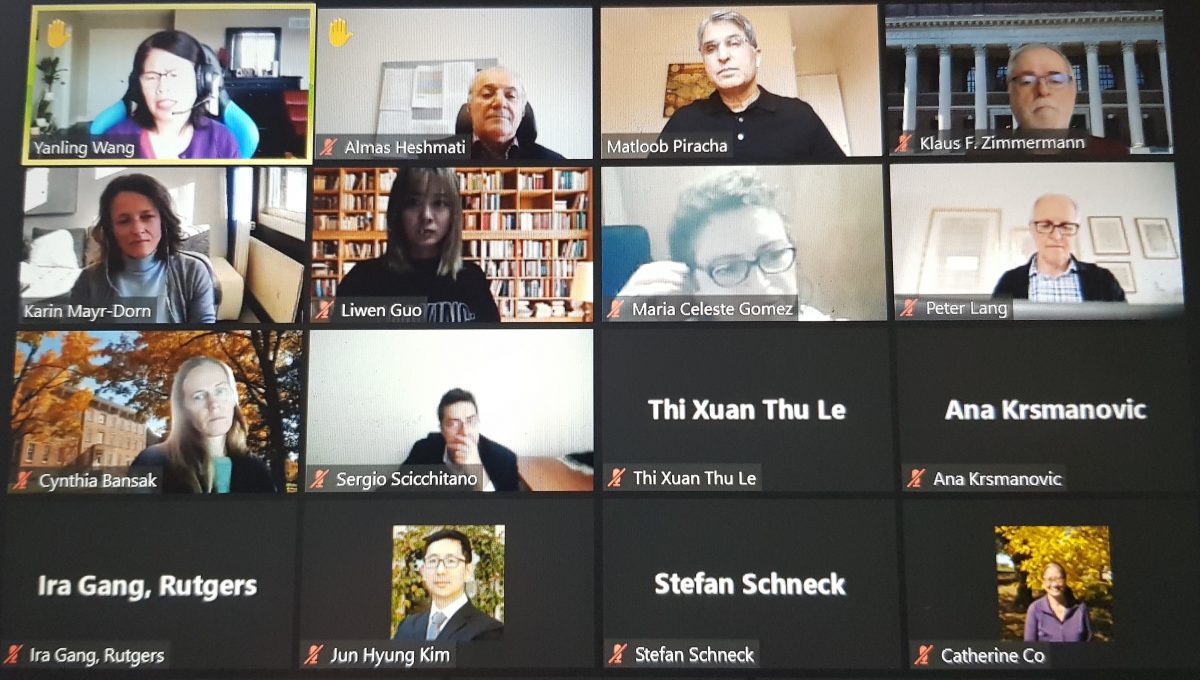
TheGLO Virtual Seminar is a monthly internal GLO research event chaired by GLO Director Matloob Piracha and hosted by the GLO partner institution University of Kent. The results are available on the GLO website and the GLO News section, where also the videos of the presentations are posted. All GLO related videos are also available in the GLO YouTube channel. (To subscribe go there.)
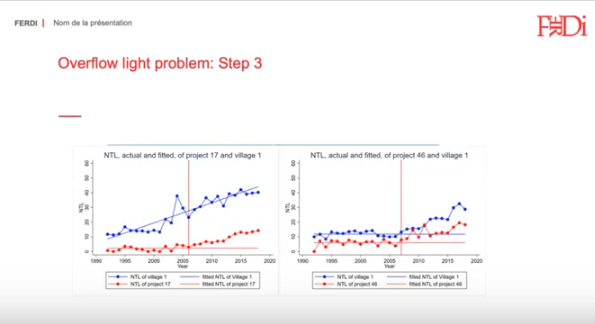
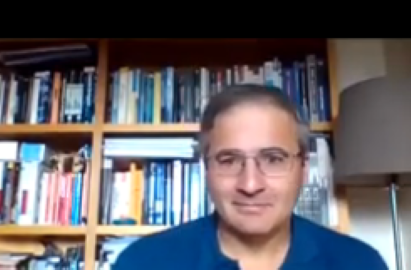
The December 2, 2021 seminar in the series was given on London/UK time at 1-2 pm, by Mathilde Maurel (CNRS, FERDI and GLO). See below for a report and the full video of the seminar.
Mathilde Maurel
Matloob Piracha
Report
A new approach for evaluation of the economic impact of decentralized electrification projects
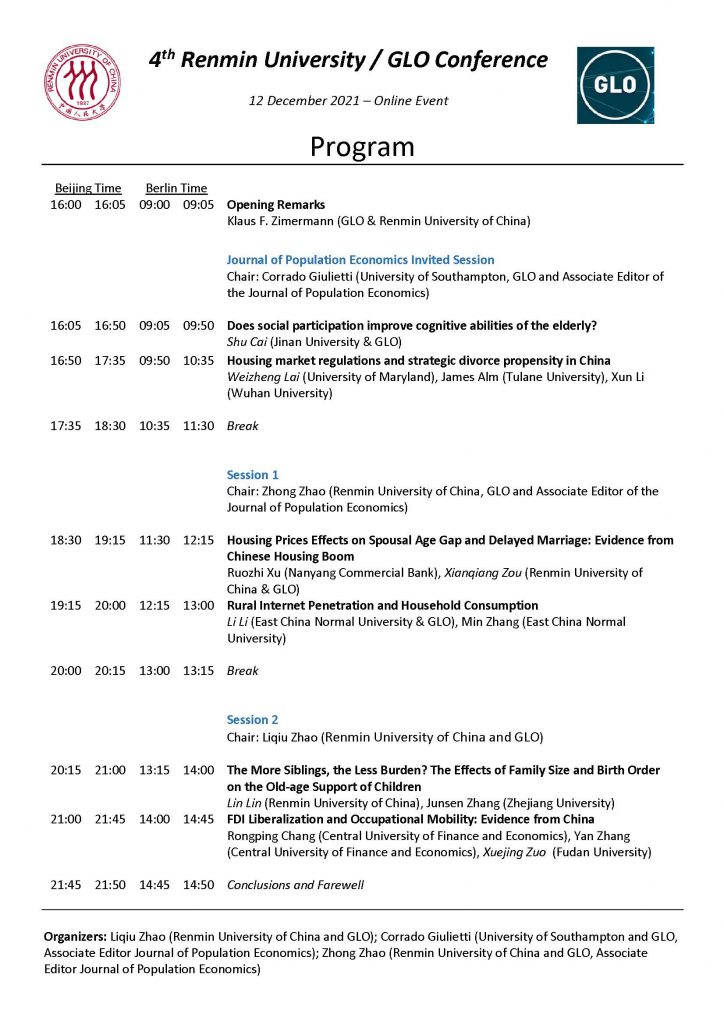
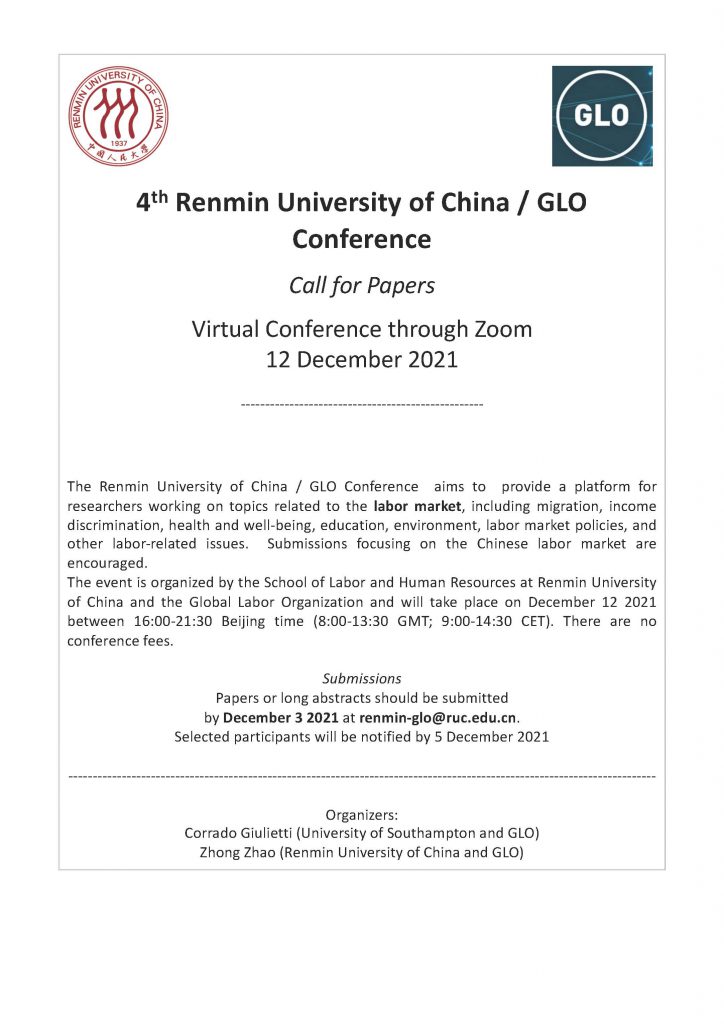
The 4th Renmin University of China, Beijing & GLO Conference 2021 takes place online on December 12, 2021 organized by the School of Labor and Human Resources together with GLO. Topics covered deal with Chinese labor market issues. The event is supported by the Journal of Population Economics.
Organizers: Liqiu Zhao (Renmin University of China and GLO); Corrado Giulietti (University of Southampton and GLO, Associate Editor Journal of Population Economics); Zhong Zhao (Renmin University of China and GLO, Associate Editor Journal of Population Economics).
A new GLO Discussion Paper documents causal effects of Chinese import competition for negative health outcomes of individuals working in the German manufacturing sector.
Author Abstract: Whether or not immigration negatively affects the labor market outcomes of natives is an ongoing debate. One of the challenges for empirical evidence is the simultaneity of supply- and demand-side effects. To isolate the demand side, we focus on recent refugees in Germany who are exogenously allocated to districts and largely excluded from the labor market. Using panel data of all German districts between 2010 and 2018 and leveraging variation in the local stock of asylum seekers, we find that 1,000 asylum seekers create 267 jobs on average in a district. This growth effect is mainly driven by a demand for additional labor in service, public administration, and social work. As a consequence, we also observe a significant reduction in the local unemployment rate when more refugees arrive. The dynamic panel data estimates are robust to various sensitivity checks and two different instrumental variable approaches. Quantifying the demand side of immigration adds to our understanding of local labor market dynamics in an increasingly mobile world.
The Global Labor Organization (GLO) is an independent, non-partisan and non-governmental organization that functions as an international network and virtual platform to stimulate global research, debate and collaboration.
Author Abstract: Using firm-level data on 11,000 companies across seven countries in South Asia, this paper explores the effects of access to finance on employment growth and performance at the firm level. The paper focuses on how the impact of financing obstacles varies across firm sizes. The results show that higher obstacles in access to finance reduces employment growth and performance for firms of all sizes, especially micro and small firms. We find significant differences between firms with less than 10 employees and small firm, which suggests that significant reforms are needed to drive micro firm growth to small and medium enterprises.
The Global Labor Organization (GLO) is an independent, non-partisan and non-governmental organization that functions as an international network and virtual platform to stimulate global research, debate and collaboration.
The 4th Renmin University of China, Beijing & GLO Conference 2021 takes place online on December 12, 2021 organized by the School of Labor and Human Resources together with GLO. Topics covered deal with Chinese labor market issues. The event is supported by the Journal of Population Economics.
Organizers: Liqiu Zhao (Renmin University of China and GLO); Corrado Giulietti (University of Southampton and GLO, Associate Editor Journal of Population Economics); Zhong Zhao (Renmin University of China and GLO, Associate Editor Journal of Population Economics).
The Journal of Population Economics(JOPE) organizes an event on December 6, 16:00-18:00 CET (Maastricht/Dutch time) to present the Kuznets Prize 2022 and a selection of the Covid-19 articles fromissue 34(4)/2021. The event is supported by GLO and hosted by UNU-MERIT via Zoom (see link below).
Managing Editor Michaella Vanore, (UNU-MERIT, Maastricht University, Netherlands, and GLO) will welcome the participants and guide through the event. Editor-in-Chief Klaus F. Zimmermann (UNU-MERIT, Maastricht University, Netherlands, and GLO) will introduce into publishing Covid-19 research with JOPE and present the prize. Editor Terra McKinnish (University of Colorado Boulder, USA, and GLO) and Associate Editor Kompal Sinha (Macquarie University, Sydney, Australia, and GLO) will also attend to chair sessions.
A highlight of the event is the presentation of the Kuznets Prize, which was awarded to
The authors, Luca Bonacini, Giovanni Gallo & Sergio Scicchitano will be all present in the online ceremony and discuss their work with a panel including Xi Chen (co-author of the Kuznets Prize winning article 2021), Terra McKinnish (JOPE Editor), Kompal Sinha (JOPE Associate Editor) and Klaus F. Zimmermann (JOPE Editor-in-Chief).
This is a unique opportunity to keep contact with fresh research and to meet the researchers behind.
The online event will also highlight a selection of the 10 articles published in issue 34(4)/2021 entirely on Covid-19 issues. All articles are published freely accessible and possible to download.
Since the first days of the pandemic, the journal has become a leading outlet for research on the disease by publishing influential articles. JOPE will continue to strengthen this reputation.
Open to the public. Mark your calendars. Detailed program below. The event will be recorded. Please click the link to join the event on December 6, 2021; 16:00-18:00 CET (Maastricht time):
16:00-16:30 Welcoming Remarks: Michaella Vanore (Managing Editor) Kuznets Prize 2022: Announcement and presentation: Klaus F. Zimmermann (Editor-in-Chief) Panel with Luca Bonacini, Giovanni Gallo & Sergio Scicchitano and Xi Chen (co-author of the Kuznets Prize winning article 2021), Terra McKinnish (Editor), Kompal Sinha (Associate Editor).
TOP 5 of Covid-19 papers in the Journal of Population Economics (as of December 5, 2021 ranked according to Google Scholar citations):
1. Qiu, Y., Chen, X. & Shi, W.: Impacts of social and economic factors on the transmission of coronavirus disease 2019 (COVID-19) in China. J Popul Econ33, 1127–1172 (2020). https://doi.org/10.1007/s00148-020-00778-2 Springer measures: 59k accesses, 148 citations; Google citations: 367
2. Bonacini, L., Gallo, G. & Scicchitano, S.: Working from home and income inequality: risks of a ‘new normal’ with COVID-19.J Popul Econ34, 303–360 (2021). https://doi.org/10.1007/s00148-020-00800-7 Springer measures: 43k accesses, 51 citations; Google citations: 149
3. Papageorge, N.W., Zahn, M.V., Belot, M. et al.: Socio-demographic factors associated with self-protecting behavior during the Covid-19 pandemic. J Popul Econ34, 691–738 (2021). https://doi.org/10.1007/s00148-020-00818-x Springer measures: 14k accesses, 32 citations; Google citations: 130
4. Brodeur, A., Grigoryeva, I. & Kattan, L.: Stay-at-home orders, social distancing, and trust. J Popul Econ34, 1321–1354 (2021). https://doi.org/10.1007/s00148-021-00848-z Springer measures: 1.8k accesses, 12 citations; Google citations: 77
5. Milani, F.: COVID-19 outbreak, social response, and early economic effects: a global VAR analysis of cross-country interdependencies. J Popul Econ34, 223–252 (2021). https://doi.org/10.1007/s00148-020-00792-4 Springer measures: 10k accesses, 33 citations; Google citations: 66
A new GLO Discussion Paper explores the impact of financial and legal obstacles utilizing the most recent and unique dataset from the World Bank Enterprise Surveys.
Author Abstract: This paper explores the impact of financial and legal obstacles that affect small and medium enterprises (SMEs) in middle-income East Asian countries by utilizing the most recent and unique dataset from the World Bank Enterprise Surveys. We particularly assess whether and at what level the effects on SMEs differ from those on large firms; We also examine how financial and institutional development levels contribute to firm performance. Our findings provide important guidance for regulators, including the authorities of middle-income nations, who seek to facilitate SMEs’ development.
The Global Labor Organization (GLO) is an independent, non-partisan and non-governmental organization that functions as an international network and virtual platform to stimulate global research, debate and collaboration.
Author Abstract: Whether or not immigration negatively affects the labor market outcomes of natives is an ongoing debate. One of the challenges for empirical evidence is the simultaneity of supply- and demand-side effects. To isolate the demand side, we focus on recent refugees in Germany who are exogenously allocated to districts and largely excluded from the labor market. Using panel data of all German districts between 2010 and 2018 and leveraging variation in the local stock of asylum seekers, we find that 1,000 asylum seekers create 267 jobs on average in a district. This growth effect is mainly driven by a demand for additional labor in service, public administration, and social work. As a consequence, we also observe a significant reduction in the local unemployment rate when more refugees arrive. The dynamic panel data estimates are robust to various sensitivity checks and two different instrumental variable approaches. Quantifying the demand side of immigration adds to our understanding of local labor market dynamics in an increasingly mobile world.
The Global Labor Organization (GLO) is an independent, non-partisan and non-governmental organization that functions as an international network and virtual platform to stimulate global research, debate and collaboration.
Author Abstract: Governments face a potential trade-off between provision for the growing population in retirement and the support of working-age households with low income. Using EUROMOD-based microdata from 28 countries, we (a) quantify the redistribution to the pensioner and non-pensioner populations, (b) study the position of net beneficiaries in the overall income distribution and (c) analyse how taxes and benefits affect the working-age population with low income. Our results provide novel insights into the distributive role of tax-benefit systems across Europe. Interestingly, a strong overall redistribution between households is associated with generous pensions for a portion of the retirees but negatively related to support for low-income households.
The Global Labor Organization (GLO) is an independent, non-partisan and non-governmental organization that functions as an international network and virtual platform to stimulate global research, debate and collaboration.
The Journal of Population Economics awards annually the Kuznets Prize for the best paper published in the Journal in a particular year. The 2022 Prize based on the articles in 2021 goes to:
The award ceremony is part of a journal workshop on December 6, 2021. 4-6 pm CEST: Presentation of Kuznets Prize 2022 & Highlights of JOPE Issue 4/2021 on Covid-19 economics. MORE information and info to participate: LINK
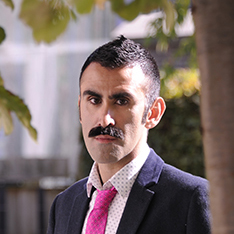
Luca Bonacini
Giovanni Gallo
Sergio Scicchitano
Luca Bonacini, University of Modena and Reggio Emilia, Modena, Italy
Giovanni Gallo, University of Modena and Reggio Emilia, Modena, Italy; National Institute for Public Policies Analysis (INAPP), Rome, Italy
Sergio Scicchitano, National Institute for Public Policies Analysis (INAPP), Rome, Italy
***
Paper abstract: In the current context of the COVID-19 pandemic, working from home (WFH) became of great importance for a large share of employees since it represents the only option to both continue working and minimize the risk of virus exposure. Uncertainty about the duration of the pandemic and future contagion waves even led companies to view WFH as a ‘new normal’ way of working. Based on influence function regression methods, this paper explores the potential consequences in the labor income distribution related to a long-lasting increase in WFH feasibility among Italian employees. Results show that a positive shift in WFH feasibility would be associated with an increase in average labor income, but this potential benefit would not be equally distributed among employees. Specifically, an increase in the opportunity to WFH would favor male, older, high-educated, and high-paid employees. However, this ‘forced innovation’ would benefit more employees living in provinces have been more affected by the novel coronavirus. WFH thus risks exacerbating pre-existing inequalities in the labor market, especially if it will not be adequately regulated. As a consequence, this study suggests that policies aimed at alleviating inequality, like income support measures (in the short run) and human capital interventions (in the long run), should play a more important compensating role in the future.
GLO andFOM University of Applied Sciences are strategic partners and institutional supporters. After years of cooperation, representatives have signed a Memorandum of Understanding (MOU) about their successful collaboration on research and educational activities. As the MOU states: “The collaboration aims to advance academic knowledge in both parties through the encouragement of academic research, the communication among scholars through meetings, conferences and seminars, the promotion of publication opportunities and by providing networking opportunities for scholars through events, projects and other joint activities.” The agreement was signed in November 2021 by FOM’s Chancellor Harald Beschorner and GLO President Klaus F. Zimmermann.
Author Abstract: This paper represents one of the first attempts at building a direct measure of occupational exposure to robotic labour-saving technologies. After identifying robotic and LS robotic patents retrieved by Montobbio et al. (2022), the underlying 4-digit CPC definitions are employed in order to detect functions and operations performed by technological artefacts which are more directed to substitute the labour input. This measure allows to obtain fine-grained information on tasks and occupations according to their similarity ranking. Occupational exposure by wage and employment dynamics in the United States is then studied, complemented by investigating industry and geographical penetration rates.
The Global Labor Organization (GLO) is an independent, non-partisan and non-governmental organization that functions as an international network and virtual platform to stimulate global research, debate and collaboration.
The Journal of Population Economics(JOPE) announces an event for December 6, 16:00-18:00 CET (Maastricht/Dutch time) to present the Kuznets Prize 2022 and a selection of the articles fromissue 34(4)/2021. The event is supported by GLO and hosted by UNU-MERIT via Zoom. Editor-in-Chief Klaus F. Zimmermann (UNU-MERIT, Maastricht University, Netherlands, and GLO) will welcome the participants and present the prize. Managing Editor Michaella Vanore, (UNU-MERIT, Maastricht University, Netherlands, and GLO) will guide through the event. Editor Terra McKinnish (University of Colorado Boulder, USA, and GLO) and Associate Editor Kompal Sinha (Macquarie University, Sydney, Australia, and GLO) will also attend to chair sessions. This is a unique opportunity to keep contact with fresh research and to meet the researchers behind.
The webinar will highlight a selection of the 10 articles published in issue 34(4)/2021 entirely on Covid-19 issues. All articles are published freely accessible and possible to download.
Since the first days of the pandemic, the journal has become a leading outlet for research on the disease by publishing influential articles. JOPE will continue to strengthen this reputation.
Open to the public. Mark your calendars. Detailed program below. The event will be recorded. Please click the link to join the event on December 6, 2021; 16:00-18:00 CEST: LINK https://us02web.zoom.us/j/83267591773?pwd=ZkpuSExTTnQ4emZMTC9QTXl3TzQ1dz09
16:00-16:30 Welcoming Remarks: Michaella Vanore (Managing Editor) Kuznets Prize 2022: Announcement and presentation: Klaus F. Zimmermann (Editor-in-Chief)
TOP 5 of Covid-19 papers in the Journal of Population Economics (as of November 29, 2021):
1. Qiu, Y., Chen, X. & Shi, W.: Impacts of social and economic factors on the transmission of coronavirus disease 2019 (COVID-19) in China. J Popul Econ33, 1127–1172 (2020). https://doi.org/10.1007/s00148-020-00778-2 Springer measures: 59k accesses, 146 citations; Google citations: 364
2. Bonacini, L., Gallo, G. & Scicchitano, S.: Working from home and income inequality: risks of a ‘new normal’ with COVID-19.J Popul Econ34, 303–360 (2021). https://doi.org/10.1007/s00148-020-00800-7 Springer measures: 42k accesses, 46 citations; Google citations: 146
3. Milani, F.: COVID-19 outbreak, social response, and early economic effects: a global VAR analysis of cross-country interdependencies. J Popul Econ34, 223–252 (2021). https://doi.org/10.1007/s00148-020-00792-4 Springer measures: 10k accesses, 33 citations; Google citations: 66
4. Papageorge, N.W., Zahn, M.V., Belot, M. et al.: Socio-demographic factors associated with self-protecting behavior during the Covid-19 pandemic. J Popul Econ34, 691–738 (2021). https://doi.org/10.1007/s00148-020-00818-x Springer measures: 13k accesses, 32 citations; Google citations: 128
5. Bonacini, L., Gallo, G. & Patriarca, F.: Identifying policy challenges of COVID-19 in hardly reliable data and judging the success of lockdown measures. J Popul Econ34, 275–301 (2021). https://doi.org/10.1007/s00148-020-00799-x Springer measures: 4.8k accesses, 27 citations; Google citations: 46
A new GLO Discussion Paper finds that initially authoritarian countries are slow in the vaccination process, while education is most relevant for scaling up the campaign and financial strength of the economies drive them to higher vaccination rates.
Author Abstract: Since vaccination is the decisive factor for controlling the COVID-19 pandemic, it is important to understand the process to vaccination success. We identify a variety of factors playing a crucial role including the availability of vaccines, pandemic pressures, economic strength (GDP), educational development and political regimes. Examining the speed of vaccinations across countries, we find that initially authoritarian countries are slow in the vaccination process, while education is most relevant for scaling up the campaign and financial strength of the economies drive them to higher vaccination rates.
Featured image: Markus-Spiske-on-Unsplash
Further research on the pandemic:
Gokhan Karabulut, Klaus F. Zimmermann, Mehmet Huseyin Bilgin and Asli Cansin Doker (2021), “Democracy and COVID-19 Outcomes”, Economics Letters, Vol. 203, June 2021, 109840 Open Access; free PDF. https://doi.org/10.1016/j.econlet.2021.109840
Klaus F. Zimmermann, Gokhan Karabulut, Mehmet Huseyin Bilgin and Asli Cansin Doker (2020), “Inter-country Distancing, Globalization and the Coronavirus Pandemic“, The World Economy, Vol. 43, pp. 1484-1498. OPEN ACCESS, doi:10.1111/twec.12969. PDF.
The Global Labor Organization (GLO) is an independent, non-partisan and non-governmental organization that functions as an international network and virtual platform to stimulate global research, debate and collaboration.
A new GLO Discussion Paper finds that a school reform in Hungary increasing the length of schooling did not decrease the probability of dropping out of secondary school at all levels.
Author Abstract: This paper examines the effects of increasing the compulsory school leaving age from 16 to 18 in Hungary using a difference-in-regression-discontinuities design identification strategy. While the reform increased the length of schooling, it did not decrease the probability of dropping out of secondary school, either on average or among the most at-risk group of Roma ethnic minority young people. Due to grade retentions, marginal students were older than their peers and couldn’t have made it to the final grade of secondary school by age 18. Neither did the reform increase the probability of employment at age 20 and 25. I show descriptive evidence that the share of disadvantaged students increased heavily in vocational training schools -that most marginal students attended- and potentially crowded out resources. This mechanism raises concerns about using school leaving age reforms as instrumental variables for education as it may violate its monotonicity assumption.
The Global Labor Organization (GLO) is an independent, non-partisan and non-governmental organization that functions as an international network and virtual platform to stimulate global research, debate and collaboration.
A new GLO Discussion Paper finds that restricting family allowance eligibility criteria decreases fertility and increases both male and female labor supply.
Author Abstract: This paper examines fertility and labor supply responses to a French policy reform that consisted in conditioning the amount of child allowances on household income. Relying on Regression Discontinuity Design and administrative income data, the paper finds that restricting family allowance eligibility criteria decreases fertility. The results also highlight that receiving half the amount of the allowances or not receiving any leads to an increase in both male and female labor supply. Auxiliary regressions show that at least part of the decline in fertility is due to timing effects, as the fertility impact declines as women’s age increases.
The Global Labor Organization (GLO) is an independent, non-partisan and non-governmental organization that functions as an international network and virtual platform to stimulate global research, debate and collaboration.
TheGLO Virtual Seminar is a monthly internal GLO research event chaired by GLO Director Matloob Piracha and hosted by the GLO partner institution University of Kent. The results are available on the GLO website and the GLO News section, where also the videos of the presentations are posted. All GLO related videos are also available in the GLO YouTube channel. (To subscribe go there.)
Forthcoming (GLO members & special invitations): December 2, 2021; 1 pm London/UK time:Mathilde Maurel (CNRS, FERDI and GLO
A new approach for evaluation of the economic impact of decentralized electrification projects (with J.C. Berthélémy)
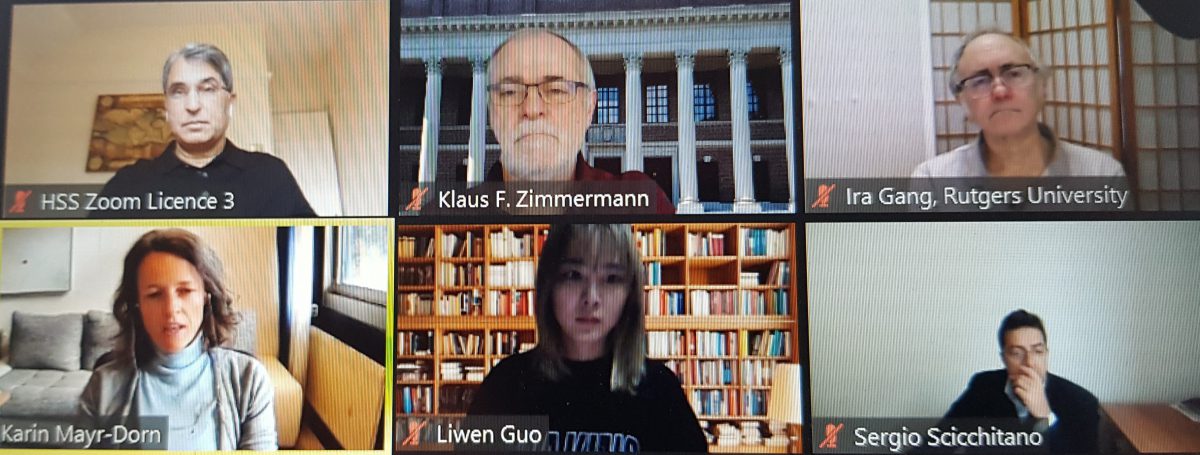
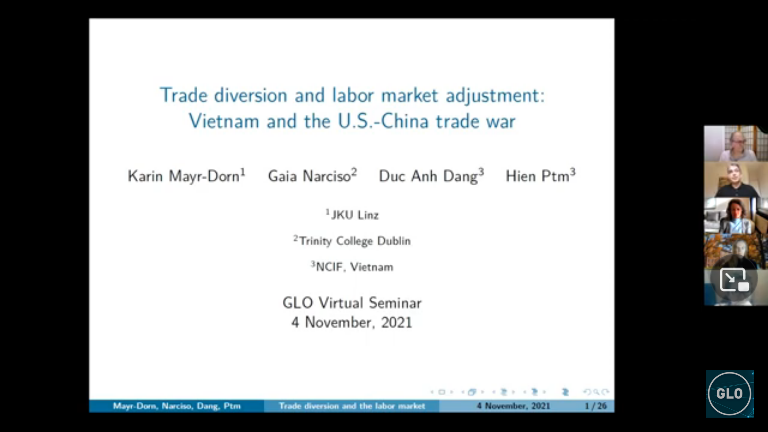
The November 2, 2021 seminar in the series was given on London/UK time at 1-2 pm, by Karin Mayr-Dorn (University of Linz and GLO). See below for a report and the full video of the seminar.
Karin Mayr-DornGLO DirectorMatloob Piracha
Report
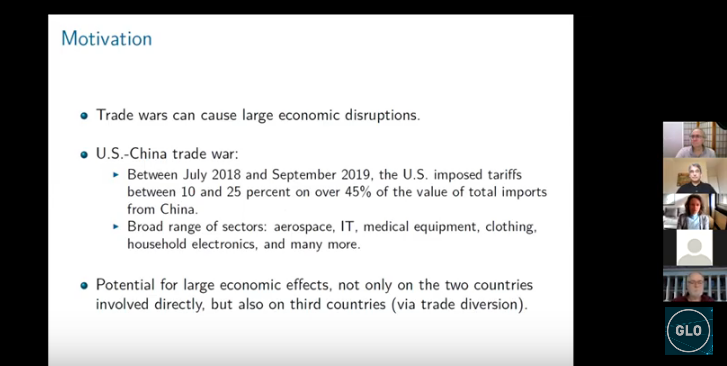
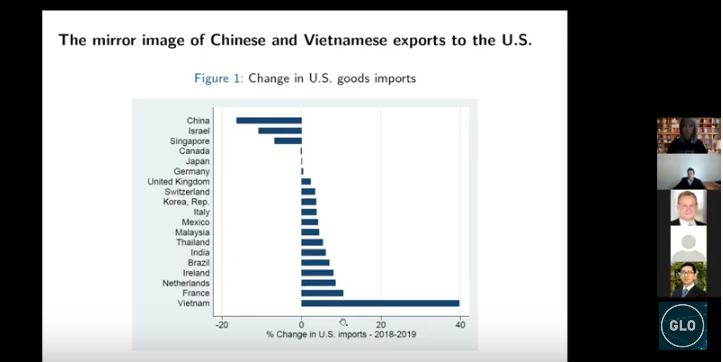
Trade diversion and labor market adjustment: Vietnam and the U.S.-China trade war
A new GLO Discussion Paper studies how institutional quality affects the size of the informal economyto find a positive and a significant association between labor productivity and the size of the shadow economy, among others.
Author Abstract: The relationship between shadow economy (or informal economy) and development has been extensively researched. But there is a lack of consensus on how institutional quality affects the size of informal economy in any country. Using the Kuznets Curve hypothesis we assess the relationship between institutional quality and the size of SE for a group of Latin American and Eurozone countries for 1991-2015. We examine the rationale of the ‘exclusion’ and ‘escape’ theories in short and long-run with the multiple indicators multiple causes (MIMIC) model. We use two techniques, namely an instrumental variable (IV) and Fully Modified OLS (FMOLS) approach. The results show positive and a significant relationship between labour productivity and the size of the shadow economy. We also find that the size of the informal sector is related to the institutional framework, and while the size of the informal sector varies across countries, both formal and informal sectors can co-exist in the long run. High corruption together with an excessive tax burden and adverse socio-economic conditions impact the size of the informal sector in an economy.
The Global Labor Organization (GLO) is an independent, non-partisan and non-governmental organization that functions as an international network and virtual platform to stimulate global research, debate and collaboration.
Author Abstract: Multitasking – alternating between two different tasks at the same time – has become a daily habit for many university students. However, this may come at a cost since the existing literature emphasises the negative association between multitasking and academic performance. Nonetheless, this literature is based on cross-sectional observational data so that that estimates cannot be given a causal interpretation. To complement these studies, we opted for a longitudinal design in this study. Specifically, for three consecutive years, students at two Belgian universities, in more than ten different study programmes, were surveyed on their multitasking preferences and academic performance. Then, these results were merged with the students’ exam scores. We exploited the longitudinal character of the data by running random and fixed effect models. Our results indicate that the positive and negative aspects of multitasking with respect to academic performance cancel each other out.
The Global Labor Organization (GLO) is an independent, non-partisan and non-governmental organization that functions as an international network and virtual platform to stimulate global research, debate and collaboration.
Author Abstract: Adopting a panel event study framework, we estimate the effect of unemployment on health outcomes by exploiting the variation in the timing of entering unemployment using longitudinal data for Greece. We find, that in the periods ahead of an unemployment event, health outcomes decline and unmet needs for medical care increase. These findings are valid only for men and are robust to alternative definitions of health outcomes, unemployment events and model specifications.
The Global Labor Organization (GLO) is an independent, non-partisan and non-governmental organization that functions as an international network and virtual platform to stimulate global research, debate and collaboration.
Author Abstract: Technological change and globalization have sparked debates on the changing demand for skills in western labour markets, especially for middle skilled workers who have seen their tasks replaced. This paper provides a new data set, which is based on text data from curricula of the entire Dutch vocational education system. We extract verbs and nouns to measure social, technical and basic skills in a novel way. This method allows us to uncover the skills middle-skilled students learn in school. Using this data, we show that skill returns vary across students specialized in STEM, economics or health, as well as across sectors of employment.
The Global Labor Organization (GLO) is an independent, non-partisan and non-governmental organization that functions as an international network and virtual platform to stimulate global research, debate and collaboration.
Author Abstract: Gender disparities in STEM fields participation are a major cause of concern for policymakers around the world. In addition to talent misallocation, low female enrollment rates in STEM careers contribute to gender-based inequalities in earnings and wealth, given the higher average level of earnings in these fields. This paper studies the effects of exposure to role models on female preferences for STEM majors. We conduct a randomized control trial where female senior students currently enrolled in engineering programs at an elite private university in Peru give talks about their experiences at randomly selected high schools. We find that exposure to this treatment increases high ability female students’ preferences for engineering programs by 14 percentage points. The effect is only statistically significant for the subgroup of female students with baseline math scores in the top 25 percentile, and who reside close to the city where the role models’ university is located. We also find positive but smaller effects on “low ability” male students. In a context where females are discouraged from enrolling in STEM fields, our results have important policy implications.
The Global Labor Organization (GLO) is an independent, non-partisan and non-governmental organization that functions as an international network and virtual platform to stimulate global research, debate and collaboration.
The 4th Renmin University of China & GLO Conference 2021 takes place online in Beijing on December 12 organized by the School of Labor and Human Resources together with GLO. Topics covered will deal with Chinese labor market issues.
Author Abstract: This paper reviews studies on LGBT workplace outcomes published between 2015 and 2020. In terms of earnings differences, in the US, Canada, Europe, and Australia, gay men were found to experience earnings penalties of 7% in comparison to heterosexual men, bisexual men experienced earnings penalties of 9% in comparison to heterosexual men, and bisexual women faced earnings penalties of 5% in comparison to heterosexual women. In the same regions, lesbian women experienced an earnings premium of 7% in comparison to heterosexual women. Trans women, in the US and Europe, faced earnings penalties ranging from 4% to 20%. In terms of job satisfaction, in the US, Canada, and Europe, gay men, and lesbian women experienced 15% and 12%, respectively lower job satisfaction than their heterosexual counterparts. Additionally, bullying against sexual minorities has persisted. In the UK, sexual minorities who experienced frequent school-age bullying faced a 32% chance of experiencing frequent workplace bullying. In relation to job exclusions, in OECD countries, gay men and lesbian women were found to experience 39% and 32%, respectively lower access to occupations than comparable heterosexual men and women. For trans men and women in Europe, comparable patterns are in evidence. Given these patterns, it is not of surprise that LGBT people in the US and the UK experience higher poverty rates than heterosexual and cis people. However, in these two regions, anti-discrimination laws and positive actions in the workplace helped reduce the earnings penalties for gay men, enhance trans people’s self-esteem, spur innovation and firms’ performance, and boost marketing capability, corporate profiles, and customer satisfaction. The evidence indicated that LGBT inclusion and positive economic outcomes mutually reinforced each other.
The Global Labor Organization (GLO) is an independent, non-partisan and non-governmental organization that functions as an international network and virtual platform to stimulate global research, debate and collaboration.
Author Abstract: This paper examines a problem of worker misallocation into jobs. A theoretical model, allowing for heterogeneous workers and firms, shows that job search frictions generate mismatch between employees and employers. In the empirical analysis, the British Household Panel Survey (BHPS), the UK household Longitudinal Study (UKHLS) and British Cohort Study 1970 (BCS70) data are used to measure the incidence of mismatch, how it changes over time and whether it can be explained by unobserved ability. Results show that (i) the incidence of mismatch increases after the Great Recession. (ii) Individual transitions to/from matching take place due to workers’ occupational mobility and over-time skills development. (iii) Employees can find better jobs or their mobility occurs earlier than the aggregate change of skills. (iv) Controlling for individual heterogeneity, measured by cognitive and non-cognitive skill test scores throughout childhood, does not decrease the incidence of mismatch. This suggests that unobserved productivity does not generate mismatch in the labour market.
The Global Labor Organization (GLO) is an independent, non-partisan and non-governmental organization that functions as an international network and virtual platform to stimulate global research, debate and collaboration.
A new GLO Discussion Paper finds that education played a protective role, significantly reducing mortality rates, during the first wave of the pandemic (between March and May 2020), but not during the second wave (between October and December 2020).
Author Abstract: We study the role of education during the COVID-19 epidemic in Italy. We compare the trends of mortality rates between municipalities with different shares of educated residents between 2012 and 2020, by means of a continuous event study model and controlling for many confounders. We find that education played a protective role, significantly reducing mortality rates, during the first wave of the pandemic (between March and May 2020), but not during the second wave (between October and December 2020). We tentatively interpret this finding as the outcome of the interplay between education and public health communication, whose coherence and consistency varied between the different stages of the epidemic.
The Global Labor Organization (GLO) is an independent, non-partisan and non-governmental organization that functions as an international network and virtual platform to stimulate global research, debate and collaboration.
A new GLO Discussion Paper shows that women appear to be more sensitive to the effect of the pandemic, and report much higher levels of anxiety and depression than males.
Author Abstract: This paper assesses the impact of the Covid-19 lockdown measures on the mental health of individuals in the UK, starting from the early restrictions in April 2020, and covering three subsequent lockdowns, up until March 2021. It also considers three aspects of mental health; that is ‘anxiety and depression’, ‘social dysfunction’, and ‘loss of confidence’, in order to identify which specific dimensions of respondents’ psychology have been adversely affected. Our findings show that women appear to be more sensitive to the effect of the pandemic, and report much higher levels of anxiety and depression than males; whilst social dysfunction appears to be a more permanent fixture. Initially, social dysfunction was higher for women and younger workers, but it remained high for women and the over 55s. Consequently, our evidence supports targeted policies aimed at reducing social isolation for women and older workers. Finally, we show that financial difficulties had a growing impact on all mental health outcomes, as the pandemic progressed.
The Global Labor Organization (GLO) is an independent, non-partisan and non-governmental organization that functions as an international network and virtual platform to stimulate global research, debate and collaboration.
A new GLO Discussion Paper finds small but statistically significant detrimental effects on labor market outcomes of Vietnam veterans residing in unauthorized Chinese enclaves in 1990.
Author Abstract: The role of ethnic immigrant networks in facilitating international trade is a well-established phenomenon in the literature. However, it is less clear whether this relationship extends to illegal trade and unauthorized immigrants. In this paper, we tackle this question by focusing on the case of the heroin trade and unauthorized Chinese immigrants in the early 1990s United States. Between mid-1980s and mid-1990s, Southeast Asia became the dominant source of heroin in the US. Heroin from this region was trafficked into the US by Chinese organized criminals, whose presence across the country can be approximated by the location of unauthorized Chinese immigrants. Instrumenting for the unauthorized Chinese immigrant enclaves in 1990 with their 1900 counterpart, we first show that Chinese presence in a community led to a sizeable increase in local opiates-related arrests, a proxy for local heroin markets. This effect is driven by arrests for sale/manufacturing of the drugs. Next, we examine the consequences of Chinese-trafficked heroin by looking at its impact on US Vietnam-era veterans – a group particularly vulnerable to heroin addiction in the early 1990s. Using a triple-difference estimation, we find mostly small but statistically significant detrimental effects on labor market outcomes of Vietnam veterans residing in unauthorized Chinese enclaves in 1990.
The Global Labor Organization (GLO) is an independent, non-partisan and non-governmental organization that functions as an international network and virtual platform to stimulate global research, debate and collaboration.
A new GLO Discussion Paper finds for Turkey that increasing the minimum wage reduces the employment probability of young males first but school enrollment increases over time and absorbs the negative employment effect.
Author Abstract: We exploit an age-specific minimum wage rule – which sets a lower minimum wage for workers of age 15 than the adult minimum wage paid to workers of age 16 and above – and its abolition to estimate the causal effect of a minimum wage increase on youth employment and education in Turkey. Using a regression discontinuity design in tandem with a difference-in-discontinuities analysis, we find that increasing the minimum wage reduces the employment probability of young males by 2.5-3.1 percentage points. We also document that, initially, the minimum wage increase does not lead to a major change in high school enrollment, while the likelihood of transitioning into “neither in employment nor in education and training” (NEET) category notably increases. However, in the medium term, the NEET effect is transitory; school enrollment increases over time and absorbs the negative employment effect. We argue that policy effects have mostly been driven by demand-side forces rather than supply side.
The Global Labor Organization (GLO) is an independent, non-partisan and non-governmental organization that functions as an international network and virtual platform to stimulate global research, debate and collaboration.
A new GLO Discussion Paper finds that hiring discrimination against candidates with disabilities, older candidates, and less physically attractive candidates is at least equally severe as the unequal treatment of candidates with salient racial or ethnic characteristics.
Author Abstract: Notwithstanding the improved integration of various minority groups in the workforce, unequal treatment in hiring still hinders many individuals’ access to the labour market. To tackle this inaccessibility, it is essential to know which and to what extent minority groups face hiring discrimination. Past meta-studies have charted parts of the discrimination literature but permit only limited comparisons across minority groups. This meta-analysis synthesises a quasi-exhaustive register of correspondence experiments on hiring discrimination published between 2005 and 2020. Using a random-effects model, we computed pooled discrimination ratios concerning a total of ten discrimination grounds upon which unequal treatment in hiring is forbidden under United States federal or state law. First, we find that hiring discrimination against candidates with disabilities, older candidates, and less physically attractive candidates is at least equally severe as the unequal treatment of candidates with salient racial or ethnic characteristics. Remarkably, hiring discrimination against older applicants is even higher in Europe than in the United States. Furthermore, unequal treatment in hiring based on sexual orientation seems to be prompted mainly by signalling activism through an affiliation with an LGB+ rights organisation rather than same-sex orientation in itself. Last, hiring discrimination remains pervasive. Aside from a decrease in hiring discrimination based on race and national origin in Europe, we find no structural evidence of temporal changes in hiring discrimination based on the various other grounds within the scope of this review.
The Global Labor Organization (GLO) is an independent, non-partisan and non-governmental organization that functions as an international network and virtual platform to stimulate global research, debate and collaboration.
Author Abstract: This study proposes and applies a new methodology to analyse firms’ and workers’ occupational preferences. We use microdata covering all 2014-2018 vacancy and jobseeker registrations from the Public Employment Services of Belgium, Morocco, and South Korea. We find that a small number of occupations are responsible for a large share of registrations and may thus deserve particular attention. We also find considerable stability in occupation preferences (especially by jobseekers) but that the correlation between firms’ and workers’ preferences weakens over time. Finally, we find different responsiveness levels of jobseeker preferences to vacancy gaps. However, young jobseekers do not appear to respond more quickly to such gaps.
The Global Labor Organization (GLO) is an independent, non-partisan and non-governmental organization that functions as an international network and virtual platform to stimulate global research, debate and collaboration.
Author Abstract: This chapter reviews the evidence on the relationship between telework and households’ time allocation, drawing heavily on the empirical evidence from time diary data, and discusses the implications of telework for workers’ productivity, wages, labor force participation, and well-being as well as its impacts on traffic congestion and greenhouse gas emissions. Telework results in significant time savings for workers, as they reduce time on commuting and grooming activities by over one hour on telework days. This time is reallocated to household and leisure activities, but differentially for men and women. Men spend most of their time windfall on leisure activities; however, fathers also increase time on primary child care. Women, on the other hand, increase their household production. Children and parents benefit because they spend more time together; however, average full-time workers spend more time alone when they telework, which leads to an increase in loneliness for some. There is also evidence that telework can increase productivity for some workers and those workers may consequently earn higher wages, except for mothers who are willing to accept lower pay for the option to work from home. Finally, the reduction in commuting due to telework leads to reduced congestion during peak travel times, especially in the morning hours.
The Global Labor Organization (GLO) is an independent, non-partisan and non-governmental organization that functions as an international network and virtual platform to stimulate global research, debate and collaboration.
Author Abstract: Adopting a largely institutional theoretical perspective, this chapter focuses on emerging and developing economies in Africa and Asia, including labor-management relations in South Africa and other jurisdictions in both Africa and Asia. The aim is to assess the effects of changes in the labor markets and regulatory institutions pertaining to employment relations. Whilst other theoretical lenses such as socio-cultural and cross-cultural management and postcolonial approaches are important, this chapter critically evaluates the institutional effects relating to changes in the nature of work and the effects of external factors on market and employment relations institutions. Providing a definitional overview, this chapter discusses empirical evidence on determinants and outcomes of institutions. Though referring to other regions such as Latin America, in order to narrow the scope of analysis, the analysis focuses on two major emerging and developing economic regions, namely Asia and Africa. It includes a discussion of the Africa-Asia nexus or Sino-Africa interface in labor-management relations. Labor market institutions, their relative strengths and weaknesses, trade unions and collective bargaining, inequality and informalization of employment practices, are discussed.
The Global Labor Organization (GLO) is an independent, non-partisan and non-governmental organization that functions as an international network and virtual platform to stimulate global research, debate and collaboration.
The GLO Virtual Young Scholars Program (GLO VirtYS) 2021/2022 has started its activity.
In the spirit of the GLO Mission, the GLO VirtYS program’s goal is to contribute to the development of the future generation of researchers, who are committed to the creation of policy-relevant research, are well equipped to work in collaboration with policy makers and other stakeholders, and adhere to the highest standards of academic integrity. This goal is achieved through the process of working on a specific research paper within the duration of the program, which is 9 months, and interact with the GLO VirtYS cohort and advisors.
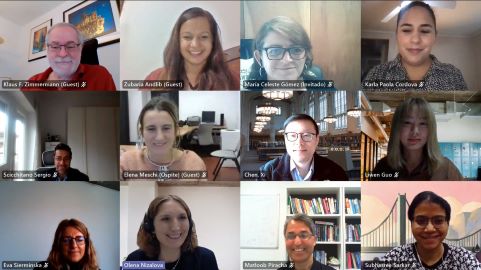
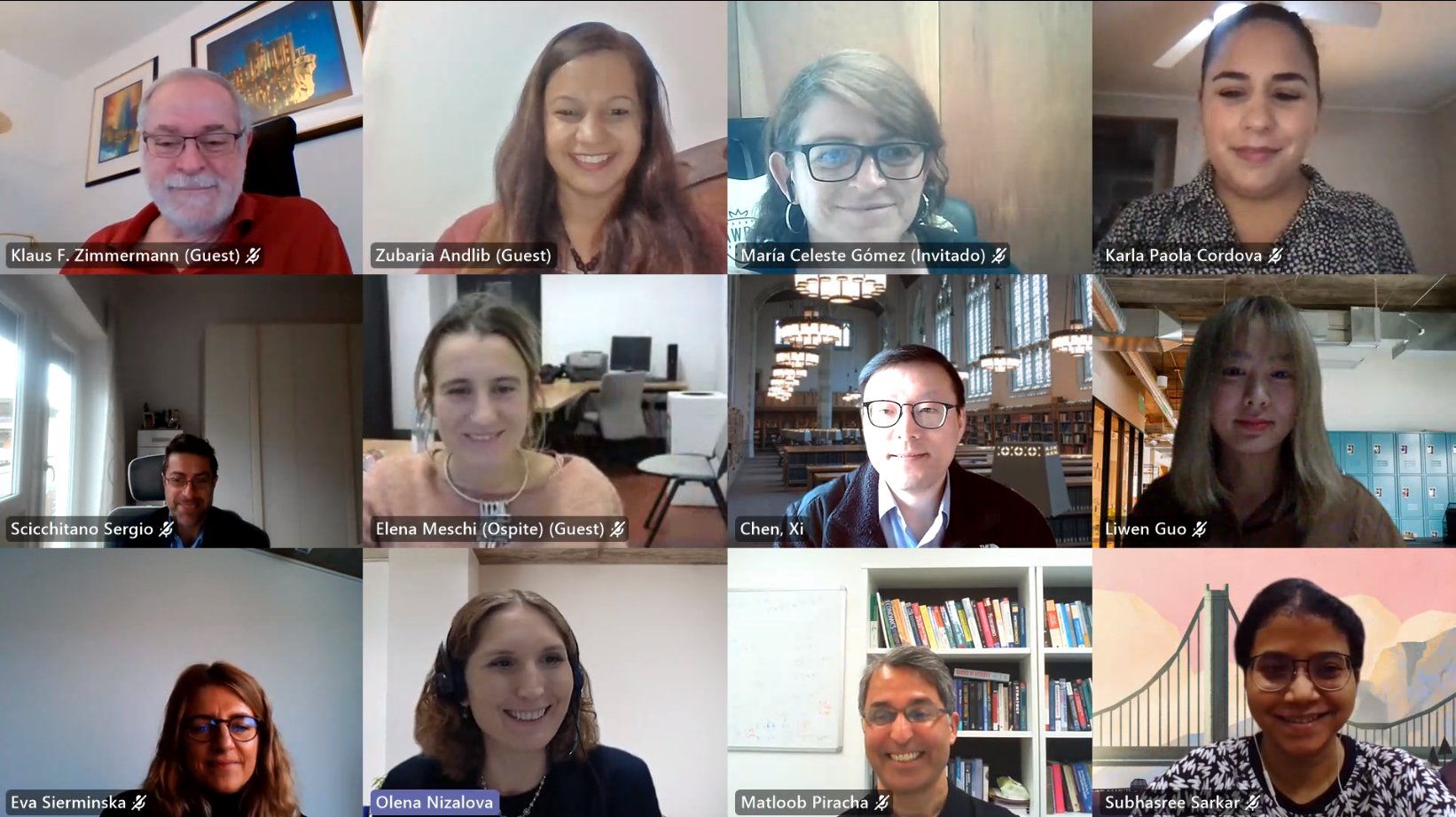
Under the leadership of GLO VirtYS Program Director Olena Nizalova, the participants have virtually met with GLO officials and advisors on November 10 2021 for a warm welcome and first interactions. GLO PresidentKlaus F. Zimmermann and GLO Director Matloob Piracha made introductory remarks. Program participants presented their research plans.
The following program participants have been appointed GLO Affiliate:
Author Abstract: This chapter describes the nature, scope and effects of various non-mandated participatory work practices in Japan, the U.S. and Europe through the lens of organizational complementarity theory. Specifically, rather than being treated in isolation, each work practice is considered an element of HIWS (High Involvement Work System), an employment system comprised of clusters of complementary work practices. In so doing, the chapter provides a complete picture of nonmandatory participatory work practices. Furthermore, by applying the common framework of viewing participatory work practices as complementary elements of HIWS to seemingly disparate forms of work practices in different parts of the world, the chapter sheds light on how participatory work practices play out in diverse institutional, cultural and regulatory environments.
The Global Labor Organization (GLO) is an independent, non-partisan and non-governmental organization that functions as an international network and virtual platform to stimulate global research, debate and collaboration.
Author Abstract: We apply the Kakwani approach to decomposing redistributive effect into average rate, progressivity, and reranking components using yearly UK data covering 1977-2018. We examine cash and in-kind benefits, and direct and indirect taxes. In addition, we highlight an empirical implementation issue – the definition of the reference (‘pre-fisc’) distribution. Drawing on an innovative counterfactual approach, our empirical analysis shows that trends in the redistributive effect of cash benefits are largely associated with cyclical changes in average benefit rates. In contrast, trends in the redistributive effects of direct and indirect taxes are mostly associated with changes in progressivity. For in-kind benefits, changes in the average benefit rate and progressivity each played the major roles at different times.
Featured image: The-new-york-public-library-on-unsplash
The Global Labor Organization (GLO) is an independent, non-partisan and non-governmental organization that functions as an international network and virtual platform to stimulate global research, debate and collaboration.
2021 Virtual Conference of the International Society for Quality-of-Life Studies ISQOLS 2021 CONFERENCE: “Quality-of-life and Adaptation in a Virulent World” VIRTUAL EVENT: 23-27, AUGUST 2021
The Global Labor Organization(GLO) and the Erasmus Happiness Research Organization(EHERO) joined forces for the third time in organizing five happiness economics sessions during the 19thInternational Society for Quality of Life Studies (ISQOLS) Virtual Conference (23-27 August, 2021).
Chaired by GLO FellowMartijn Hendriks, each session featured three or four presentations, followed by comments by a dedicated discussant, and questions from the audience. Despite the online format, the sessions had many attendees and featured lively discussions. The sessions have by now become a key part of the ISQOLS conference and a signature event of the GLO Happiness Economics cluster.
This year, the GLO/EHERO sessions also featured presentations of chapters from the section “Welfare, Well-being, Happiness” of the forthcoming Springer Nature Handbook “Labor, Human Resources and Population Economics” that is edited by GLO Fellow and Happiness Economics Cluster Lead Milena Nikolova. The Handbook’s Editor-in-Chief is GLO President Klaus F. Zimmermann.
Given the success of the sessions, the co-organizers Martijn Hendriks (GLO/EHERO), Martijn Burger (EHERO), and Milena Nikolova (GLO Fellow and Cluster Lead “Economics of Happiness”) will organize again special sessions at the 20th ISQOLS Annual Conference that will take place between 3-6 August in Burlington, Vermont, USA.
These special sessions are invitation-based to guarantee that the presentations are of high quality.
GLO – EHERO organizers
Dr. Milena Nikolova (University of Groningen and GLO), Dr. Martijn Hendriks (EHERO and GLO) and Dr. Martijn Burger (EHERO and Open Universiteit)
2021 Virtual Conference of the International Society for Quality-of-Life Studies ISQOLS 2021 CONFERENCE: “Quality-of-life and Adaptation in a Virulent World” VIRTUAL EVENT: 23-27, AUGUST 2021
Diana Tam and Arthur Grimes: The Economics of Free Speech: A Subjective Wellbeing Approach
Philip Morrison: Whose happiness in which cities? The urban wellbeing paradox revisited
Martijn Hendriks and Randall Birnberg: Happiness in the daily socio-cultural integration process: A day reconstruction study among US immigrants in Germany
Jeehoon Han and Caspar Kaiser: Changes in Time Use and Happiness
Carol Graham, Emily Dobson and James Kunhardt: When Public Health Crises Become Entwined: How Trends in COVID-19, Deaths of Despair, and Well-being Track Across the U.S.A.
Francesco Sarracino, Kelsey O’Connor, Chiara Peroni, Talita Greyling and Stephanie Rossouw: Well-being expressed through Twitter during the COVID-19 Pandemic
Julia Schmidtke, Clemens Hetschko, Gesine Stephan, Michael Eid, Ronnie Schöb and Mario Lawes: The impact of Covid-19 on mental health and well-being. An event-study based on high-frequency longitudinal survey data
Paul Fenton Villar: Is there a Mineral-Induced ‘Economic Euphoria’?: Evidence from Latin America
Mariano Rojas, Karen Watkins and Lázaro Rodríguez: The Happiness of CEOs in Family and Nonfamily Firms: Different Explanatory Structures and its Consequences
Annie Tubadji: Consumer Happiness and AI Sensitivity to Cultural and Moral Preferences
A new GLO Discussion Paper shows for Belgium that over-educated workers, regardless of their origin, suffer a wage penalty compared to their well-matched former classmates.
Author Abstract: This paper analyses the wage effects of educational mismatch by workers’ origin using a sizeable, detailed matched employer-employee dataset for Belgium. Relying on a fine-grained approach to measuring educational mismatch, the results show that over-educated workers, regardless of their origin, suffer a wage penalty compared to their well-matched former classmates. However, the magnitude of this wage penalty is found to vary considerably depending on workers’ origin. In addition, the estimates show that origin-based differences in over-education wage penalties significantly depend on both demographics (workers’ region of birth, education, and gender) and employer characteristics (firm size and collective bargaining).
The Global Labor Organization (GLO) is an independent, non-partisan and non-governmental organization that functions as an international network and virtual platform to stimulate global research, debate and collaboration.
Author Abstract: We study how income shock affect due to weather shock causally impacts the birth outcomes. We selected households depended directly on agriculture due to their extreme vulnerability to temperature and rainfall shocks. We find large efficiency loss attributed to weather shock for major food crops to the extent of 20%. However, we find that access to technology provides resilience against weather shock, therefore, causing the heterogeneity in vulnerability across farming households. Based on it, we designed the agriculture-household model, which predicts that health outcomes of child is dependent on income shock due to change in weather conditions. We tested the hypothesis by introducing weather shock in the cropping season before the conception of child to eliminate the confounding effect of direct impact due to extreme weather conditions. We find that weather shocks in cropping season, increases the likelihood of child mortality, low birth weight, and birth size. We further find that access to technology, financial tools, and economic security net reduces the impact of income loss due to weather shock. Our results suggests that access to resilient capabilities leads to heterogeneous impact across farmer households causing environmental injustice. Further, our findings provide insights into the policy design for long term shift in weather patterns due to climate change and stresses on the inequality in resilience against extreme weather events.
The Global Labor Organization (GLO) is an independent, non-partisan and non-governmental organization that functions as an international network and virtual platform to stimulate global research, debate and collaboration.
Was it important?A new GLO Discussion Paper finds that while marijuana-related hospital discharge rose, there is lack of evidence that traffic crash incidents were affected.
Author Abstract: This article examines the effect of recreational cannabis dispensary sales on traffic crashes by employing difference-in-differences model that exploits the variation in the timing of recreational marijuana dispensary entry across counties within Colorado. Using marijuana-related hospital discharge as a proxy for marijuana use, the results indicate a sizable rise in marijuana-related hospital discharges after the entry of retail cannabis stores. However, there is a lack of evidence that traffic crash incidents are affected by the entry. The preferred estimate suggests that, at 90% confidence level, a large increase in traffic crashes by more than 5% can be ruled out.
The Global Labor Organization (GLO) is an independent, non-partisan and non-governmental organization that functions as an international network and virtual platform to stimulate global research, debate and collaboration.
Author Abstract: The fundamental purpose of university geographic clustering is to gather resources through “agglomeration” to improve the performance of higher education and scientific research. However, it has been debated whether university clusters can achieve the latter goal. With the help of the “quasi-experiment” of Chinese “University Towns” project in the 1990s, this study determines the impact of university clusters on scientific research performance. Panel data of 2000 colleges and universities from 1993 to 2017 in the compilation of scientific and technical statistics of Chinese higher education and time-varying difference in differences method are used. The results show that the cluster of colleges and universities have a significant negative impact on the scientific research performance due to technological dis-proximity and rising commuting costs. And the clustering effect is related to the number of participating schools and the level of the university. Therefore, university clustering cannot effectively promote the performance of scientific research and unable to bring agglomeration economies.
The Global Labor Organization (GLO) is an independent, non-partisan and non-governmental organization that functions as an international network and virtual platform to stimulate global research, debate and collaboration.
Author Abstract: The key challenge in making distributional comparisons with ordinal data is the lack of commensurability of the distances between the ordered categories. This chapter provides a critical review of the most recent theoretical developments addressing this challenge and providing methods for ethical poverty, welfare, and inequality comparisons with univariate ordered multinomial distributions.
The Global Labor Organization (GLO) is an independent, non-partisan and non-governmental organization that functions as an international network and virtual platform to stimulate global research, debate and collaboration.
Interested researchers are cordially invited to submit their abstracts or papers for presentation consideration. The 38th EBES Conference in Warsaw will take place on January 12-14, 2022 in Hybrid Mode (online and in-person). The event is supported by the Istanbul Economic Research Association and hosted by the Faculty of Economics Sciences, University of Warsaw. GLO & EBES are collaborating organizations.
Invited Speakers
EBES is pleased to announce that distinguished colleagues Christos Kollias, M. Kabir Hassan, Christopher A. Hartwell and Klaus F. Zimmermann will participate as keynote speakers and/or invited editors.
Christos Kollias is a Professor of Applied Economics and Acting Dean at the University of Thessaly, Greece. In his career, he has published more than 100 papers and many edited volumes and books. His papers were published in many of the leading journals such as Journal of Multinational Financial Management, Applied Economics, Applied Economics Letters, Finance Research Letters, Public Choice, Southern Economic Journal, and Journal of Business Ethics. He is currently the Editor of Defence and Peace Economics (SSCI) and a member of the Editorial Boards of Peace Economics, Peace Science and Public Policy and the Economics of Peace and Security Journal and a member of the governing body of the Network of European Peace Scientists (NEPS). His research interests include defence economics, terrorism, international political economy, and applied macroeconomics.
M. Kabir Hassan is Professor of Finance in the Department of Economics and Finance in the University of New Orleans. He currently holds two endowed Chairs-Hibernia Professor of Economics and Finance, and Bank One Professor in Business- in the University of New Orleans. Professor Hassan is the winner of the 2016 Islamic Development Bank (IDB) Prize in Islamic Banking and Finance. Professor Professor Hassan has over 383 papers published/forthcoming in refereed academic journals. Professor Hassan has also been cited as one of the most prolific authors in finance literature in the last fifty years in a paper published in Journal of Finance Literature. His publication record puts him among the top 5.6% of all authors who published in the 26 leading finance journals. He is among the top 5% authors according to number of Journal Pages at RePAC/IDEAS. Professor Hassan has been included in its 2021 edition as 2% of top scholars in the world in a study published by Standford University and Elsevier Publishing Company. Professor Hassan is the 2019 recipient of University of Louisiana System Outstanding Educator, 2019 Life-long Research Achievement Award, and 2018 UNO Nick Mueller International Leadership Medallion Winner and 2019 UL System outstanding Educator Award. Professor Hassan is the Editor-in-Chief of International Journal of Islamic and Middle Eastern Finance and Management, and Journal of Economic Cooperation and Development published by SESRIC. Professor Hassan is a member of the AAOIFI Ethics and Governance Board and Education Board. He is also an advisory Board Member of Oxford University Faith-Aligned Impact Finance Project.
Christopher A. Hartwell is currently Head of the International Management Institute at the Zurich University of Applied Sciences (ZHAW) School of Management and Law, Professor of International Management at Kozminski University in Poland, Visiting Professor at the Russian Presidential Academy of National Economy and Public Administration (RANEPA), and Fellow and former President of the Center for Social and Economic Research (CASE) in Warsaw. A leading scholar on the evolution of economic institutions. Prof. Hartwell’s interests are in institutional development, especially the interplay between financial institutions and other political and economic institutions. Over his career, Professor Hartwell has published in journals such as Journal of World Business, Global Strategy Journal, Journal of Economic Behavior & Organization, Explorations in Economic History, Journal of Comparative Economics, Regional Studies, Cambridge Journal of Economics, and Journal of Institutional Economics. Prof. Hartwell holds a PhD in Economics from the Warsaw School of Economics, a Master’s in Public Policy from Harvard, and a BA in Political Science and Economics from the University of Pennsylvania. He is also the author of Two Roads Diverge: The Transition Experience of Poland and Ukraine (Cambridge University Press, 2016) and Institutional Barriers in the Transition to Market: Examining Performance and Divergence in Transition Economies (Palgrave Macmillan, 2013).
Klaus F. Zimmermann is President of EBES; President of the Global Labor Organization (GLO); Co-Director of POP at UNU-MERIT; Full Professor of Economics at Bonn University (ret.); Honorary Professor, Maastricht University, Free University of Berlin, Renmin University of China and Lixin University; Member, German Academy of Sciences Leopoldina, Regional Science Academy, and Academia Europaea (Chair of its Section for Economics, Business and Management Sciences). Among others, he has worked at Macquarie University, the Universities of Melbourne, Princeton, Harvard, Munich, Kyoto, Mannheim, Dartmouth College and the University of Pennsylvania. Research Fellow of the Centre for Economic Policy Research (CEPR) and Fellow of the European Economic Association (EEA). Editor-in-Chief of the Journal of Population Economics. Editorial Board of International Journal of Manpower, Research in Labor Economics and Comparative Economic Studies, among others. Founding Director, Institute for the Study of Labor (IZA); Past-President, German Institute for Economic Research (DIW). Distinguished John G. Diefenbaker Award 1998 of the Canada Council for the Arts; Outstanding Contribution Award 2013 of the European Investment Bank. Rockefeller Foundation Policy Fellow 2017; Eminent Research Scholar Award 2017, Australia; EBES Fellow Award 2018. He has published in many top journals including Journal of Economic Perspectives, American Economic Review, Econometrica, Journal of the European Economic Association, Journal of Human Resources, Journal of Applied Econometrics, Public Choice, Review of Economics and Statistics, Journal of Population Economics and Journal of Public Economics. His research fields are population, labor, development, and migration.
Executive Board
Prof. Klaus F. Zimmermann, UNU-MERIT, Maastricht, and Free University Berlin Prof. Jonathan Batten, University Utara Malaysia, Malaysia Prof. Iftekhar Hasan, Fordham University, U.S.A. Prof. Euston Quah, Nanyang Technological University, Singapore Prof. John Rust, Georgetown University, U.S.A. Prof. Dorothea Schäfer, German Institute for Economic Research DIW Berlin, Germany Prof. Marco Vivarelli, Università Cattolica Del Sacro Cuore, Italy
Abstract/Paper Submission
Authors are invited to submit their abstracts or papers no later than December 3, 2021
General inquiries regarding the call for papers should be directed to ebes@ebesweb.org.
Publication Opportunities
Qualified papers can be published in EBES journals (Eurasian Business Review and Eurasian Economic Review) or EBES proceedings books after a peer review process without any submission or publication fees. EBES journals (EABR and EAER) are published by Springer and both are indexed in the SCOPUS, EBSCO EconLit with Full Text, Google Scholar, ABS Academic Journal Quality Guide, CNKI, EBSCO Business Source, EBSCO Discovery Service, ProQuest International Bibliography of the Social Sciences (IBSS), OCLC WorldCat Discovery Service, ProQuest ABI/INFORM, ProQuest Business Premium Collection, ProQuest Central, ProQuest Turkey Database, ProQuest-ExLibris Primo, ProQuest-ExLibris Summon, Research Papers in Economics (RePEc), Institute of Scientific and Technical Information of China, Naver, SCImago, ABDC Journal Quality List, Cabell’s Directory, and Ulrich’s Periodicals Directory. In addition, while EAER is indexed in the Emerging Sources Citation Index (Clarivate Analytics), EABR is indexed in the Social Science Citation Index (SSCI) and Current Contents / Social & Behavioral Sciences.
Furthermore, the qualified papers from the conference will be published in the regular issues of Eastern European Economics (SSCI & Scopus) after a fast-track review.
Also, all accepted abstracts will be published electronically in the Conference Program and the Abstract Book (with an ISBN number). It will be distributed to all conference participants at the conference via USB. Although submitting full papers are not required, all the submitted full papers will also be included in the conference proceedings in a USB.
After the conference, participants will also have the opportunity to send their paper to be published (after a refereeing process managed by EBES) in the Springer’s series Eurasian Studies in Business and Economics (no submission and publication fees). This is indexed by Scopus. It will also be sent to Clarivate Analytics in order to be reviewed for coverage in the Conference Proceedings Citation Index – Social Science & Humanities (CPCI-SSH). Please note that the 10th, 11th, 12th, 13th, 14th, 15th, 16th, 17th, 18th, 19th, 20th (Vol. 2), 21st, 24th, and 25th EBES Conference Proceedings are accepted for inclusion in the Conference Proceedings Citation Index – Social Science & Humanities (CPCI-SSH). Other conference proceedings are in progress.
Important Dates
Conference Date: January 12-14, 2022 Abstract Submission Deadline: December 3, 2021 Reply-by: December 6, 2021* Registration Deadline: December 17, 2021 Submission of the Virtual Presentation: December 17, 2021 Announcement of the Program: December 24, 2021 Paper Submission Deadline (Optional): December 17, 2021** Paper Submission for the EBES journals: March 16, 2022
* The decision regarding the acceptance/rejection of each abstract/paper will be communicated with the corresponding author within a week of submission.
** Completed paper submission is optional. If you want to be considered for the Best Paper Award or your full paper to be included in the conference proceedings in the USB, after submitting your abstract before December 3, 2021, you must also submit your completed (full) paper by December 17, 2021.
Contact
Ugur Can, Director of EBES (ebes@ebesweb.org) Dr. Ender Demir, Conference Coordinator of EBES (demir@ebesweb.org)
A new GLO Discussion Paper documents that there are substantial inequalities within households in some contexts and that these often, but not always, disfavor women and children.
Author Abstract: To describe and understand the economic inequality in a given society, it is necessary to understand intra-household inequality. Households can hide important inequalities, but can also be essential units for redistribution in society. This paper gives an overview of within- household distributions in different settings, both between the adults and also between adults and children. It documents that there are substantial inequalities within households in some contexts and that these often, but not always, disfavor women and children. The paper also discusses the importance of intra-household allocations for poverty and inequality measurement. Methods that assign each household member a per-adult share of household consumption leads to underestimation of inequalities and miss-classification of poverty. In comparison, structural models seem to do better in predicting individual poverty when disaggregated data on allocation within households are not available. Main determinants of power in household decision-making are also discussed, and relatedly, so are two important policy questions: Are targeted transfers to women good for female empowerment? And, are targeted transfers to mothers good for child outcomes? The empirical evidence is clearly pointing to targeting being beneficial for female empowerment, but the evidence is less clear when it comes to child outcomes.
The Global Labor Organization (GLO) is an independent, non-partisan and non-governmental organization that functions as an international network and virtual platform to stimulate global research, debate and collaboration.
Author Abstract: This chapter comprises three main parts. The first part is about data sources, the definitions of income, and the methodologies used to estimate top income shares. Both the standard sources and methods used by the traditional top income studies are described. Further, new developments that employ new sources and estimation approaches are added, a detailed survey of the top-correction methods for surveys including reweighting and replacing top incomes is provided and approaches to align surveys, income tax data, and national accounts are contrasted. The second part of the chapter is a description of the main trends of top income shares that are the result of the previous studies. Different measures discussed in the methods section are presented and compared. The third part of the chapter surveys the literature on the determinants of top income shares. The focus of the third part is on studies that propose new methods to establish links between driving factors and top income shares.
The Global Labor Organization (GLO) is an independent, non-partisan and non-governmental organization that functions as an international network and virtual platform to stimulate global research, debate and collaboration.
A new GLO Discussion Paper finds for South Korea that working from home affected females negatively, but not when workers live with children in the household.
Author Abstract: This paper examines the effects of working from home on mental health, using unique real time survey data from South Korea collected during the COVID-19 pandemic. We find that working from home negatively affects the mental health of workers in the first half of 2020. Furthermore, we find substantial heterogeneity across gender and home environment. The negative impact of working from home is concentrated on women, and on those who are primarily responsible for housework while also maintaining market work. Surprisingly, workers who live with children in the household do not suffer from the negative effects of working from home. Our findings suggest that family-work interaction may be an important factor in the optimal design of working from home.
More research from the GLO Coronavirus Cluster:LINK
The Global Labor Organization (GLO) is an independent, non-partisan and non-governmental organization that functions as an international network and virtual platform to stimulate global research, debate and collaboration.