A new GLO Discussion Paper shows that the number of new deaths per million significantly decreases after half of the population is vaccinated, but the number of new cases witnesses an insignificant change.
Author Abstract: Voluminous vaccine campaigns are used globally since the COVID-19 pandemic owes devastating mortality and destructively unprecedented consequences on different aspects of economies. Notwithstanding different approaches to measure the effectiveness of COVID-19 vaccines in clinical medicines, this paper sheds new light on the efficacy of COVID-19 vaccines by using the difference-in-differences (DiD) design of 127 countries in the daily frequency from February 2020 till the end of August 2021. We show that the number of new deaths per million significantly decreases after half of the population is vaccinated, but the number of new cases witnesses an insignificant change. We found that the effects are more pronounced in Europe and North America by offering insights about different continents. Our results remain robust after using other proxies and testing the sensitivity of the vaccinated proportion, providing causality and evidence that expanding and expediting COVID-19 vaccination can save human lives.
Featured image: Photo-by-Adli-Wahid-on-Unsplash
More research from the GLO Coronavirus Cluster:LINK
The Global Labor Organization (GLO) is an independent, non-partisan and non-governmental organization that functions as an international network and virtual platform to stimulate global research, debate and collaboration.
A new GLO Discussion Paper finds that laissez-faire pandemic policy is associated with an increased number of deaths in nursing homes and higher state GDP growth. In terms of the death count, laissez-faire is more harmful to nursing homes than more peripheral in the networks, those located in deprived counties, and those who work for a profit.
Author Abstract: This study develops an economic model for a social planner who prioritizes health over short- term wealth accumulation during a pandemic. Agents are connected through a weighted undirected network of contacts, and the planner’s objective is to determine the policy that contains the spread of infection below a tolerable incidence level, and that maximizes the present discounted value of real income, in that order of priority. The optimal unique policy depends both on the configuration of the contact network and the tolerable infection incidence. Comparative statics analyses are conducted: (i) they reveal the tradeoff between the economic cost of the pandemic and the infection incidence allowed; and (ii) they suggest a correlation between different measures of network centrality and individual lockdown probability with the correlation increasing with the tolerable infection incidence level. Using unique data on the networks of nursing and long-term homes in the U.S., we calibrate our model at the state level and estimate the tolerable COVID-19 infection incidence level. We find that laissez-faire (more tolerance to the virus spread) pandemic policy is associated with an increased number of deaths in nursing homes and higher state GDP growth. In terms of the death count, laissez-faire is more harmful to nursing homes than more peripheral in the networks, those located in deprived counties, and those who work for a profit. We also find that U.S. states with a Republican governor have a higher level of tolerable incidence, but policies tend to converge with high death count.
More research from the GLO Coronavirus Cluster:LINK
The Global Labor Organization (GLO) is an independent, non-partisan and non-governmental organization that functions as an international network and virtual platform to stimulate global research, debate and collaboration.
TheGLO Virtual Seminar is a monthly internal GLO research event chaired by GLO Director Matloob Piracha and hosted by the GLO partner institution University of Kent. The results are available on the GLO website and the GLO News section, where also the video of the presentation is posted. All GLO related videos are also available in the GLO YouTube channel. (To subscribe go there.)
Forthcoming (GLO members & special invitations): November 4, 2021; 1 pm London/UK:Karin Mayr-Dorn (University of Linz and GLO) Trade diversion and labor market adjustment: Vietnam and the U.S.-China trade war
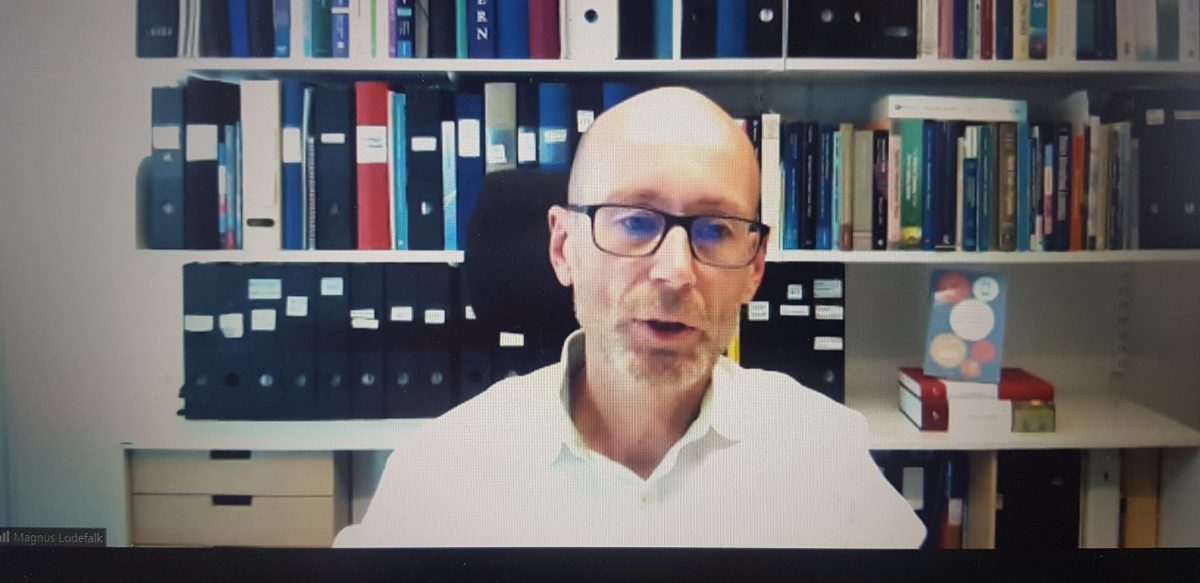
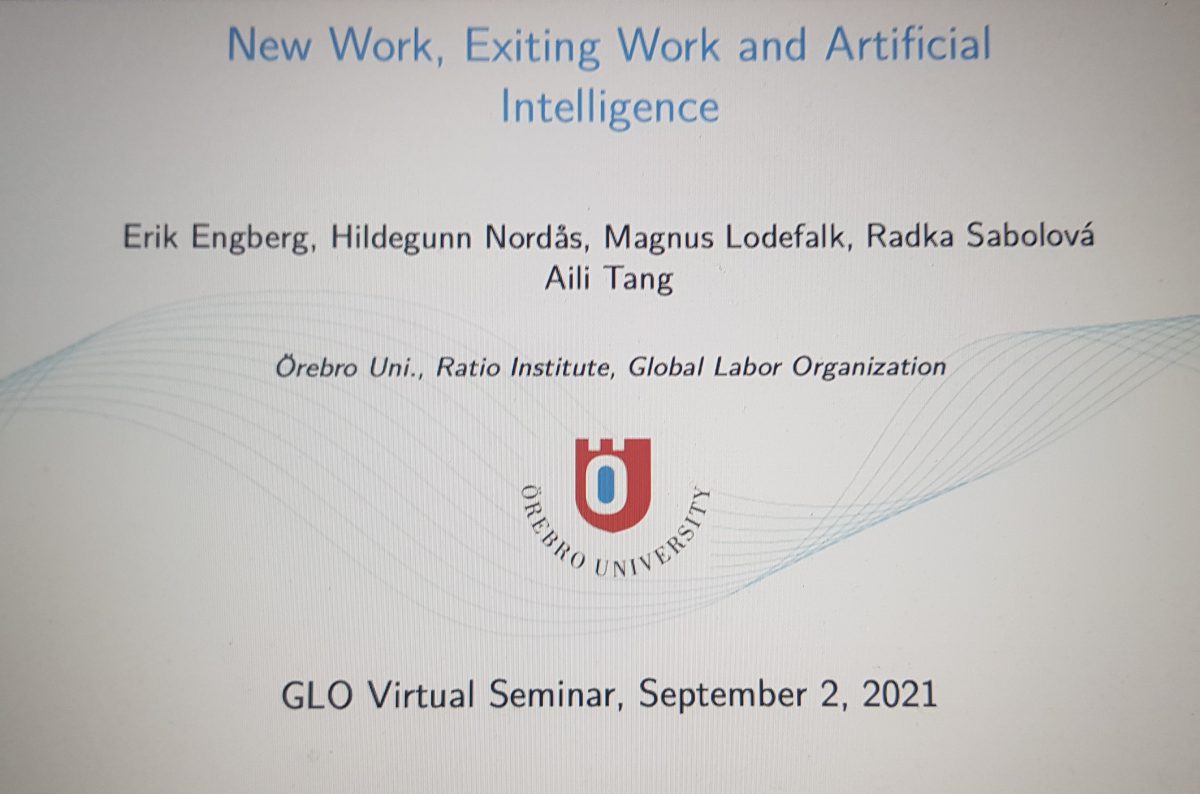
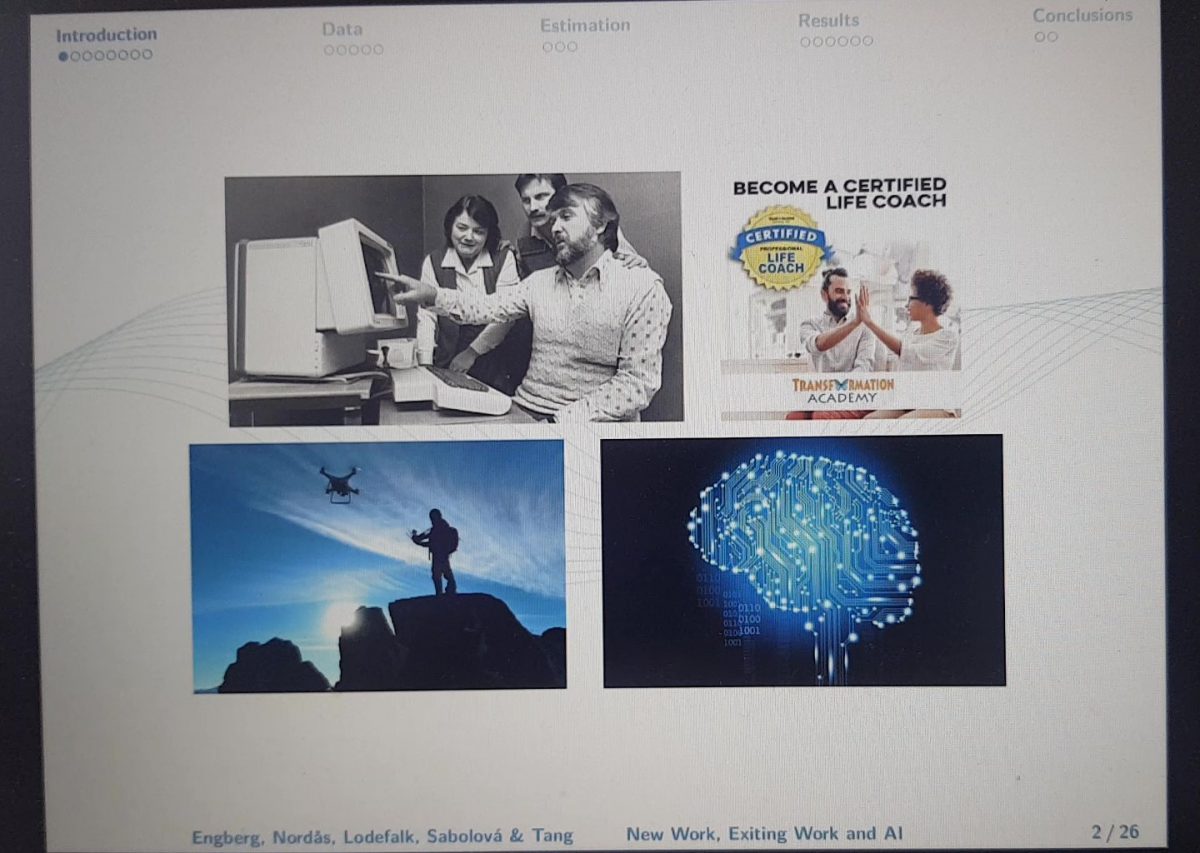
The seminar opening the Fall term was given on September 2, 2021, London/UKat 1-2 pm, by Magnus Lodefalk (Örebro University and GLO). See below a report and the full video of the seminar.
A new paper published OPEN ACCESS in the Journal of Population Economics shows that an increase in family experience of conflict has large negative long-term effects on the educational attainment of children.
by Hendrik Jürges, Luca Stella, Sameh Hallaq and Alexandra Schwarz
PublishedOPEN ACCESS: Journal of Population Economics, Vol. 35 (2022), pp. 1-43. PDF
Author Abstract: We investigate the long-term effects of households’ exposure to violent conflict on children’s educational attainment in primary school, studying cognitive and non-cognitive skills as possible causal channels. Our identification strategy exploits the locality-level variation in the intensity of the Israeli-Palestinian conflict in the West Bank during the Second Intifada (2000–2005). We show that an increase in family experience of conflict has large negative long-term effects on the educational attainment of children as measured by grade point averages. We find that non-cognitive rather than cognitive skills are the channels through which exposure affects children’s educational achievement.
The Global Labor Organization (GLO) is an independent, non-partisan and non-governmental organization that functions as an international network and virtual platform to stimulate global research, debate and collaboration.
A new GLO Discussion Paper identifies a link between mood and hiring decisions. Substantial experimental evidence suggests that discrimination based on sexual orientation and gender exists also in online labor markets.
Author Abstract: We explore whether there is a link between mood and hiring decisions. This research examines how positive mood affects the discrimination faced my homosexual job candidates compared to heterosexuals. Our experimental design allows us to track the complete hiring process and monitor employers’ behavior within and without our treatment context, in both online and offline labor market settings. Constructing pairs of curriculum vitae, distinguished, in each case, only by the sexual orientation or the gender of the applicants, led to the observation that females and gay men faced a significantly lower chance of getting hired regardless the labor market context. We also find that female employers propose higher levels of discrimination only for the case of female applicants. Our positive mood manipulation led to a depletion of discrimination levels, with the effects being more robust in the online labor context. Thus, there is substantial experimental evidence to suggest that discrimination based on sexual orientation and gender does exist also in online labor markets. Contributions to the hiring discrimination, mood research, and gig-economy literature are discussed.
The Global Labor Organization (GLO) is an independent, non-partisan and non-governmental organization that functions as an international network and virtual platform to stimulate global research, debate and collaboration.
A new GLO Discussion Paper suggests that investments in education quality are needed for better enabling green technological innovation and adaptation and reducing inequality that results from carbon pricing.
Author Abstract: Carbon pricing is increasingly used by governments to reduce emissions. The effect of carbon pricing on economic outcomes as well as mitigating factors has been studied extensively since the early 1990s. One mitigating factor that has received less attention is education quality. If technological change that reduces the reliance of production on emissions is skill-biased, then carbon pricing may increase the skill premium of earnings and subsequent wage inequality; however, a more elastic skill supply through better education quality may mitigate adverse economic outcomes, including wage inequality, and enhance the effect of carbon pricing on technological change and subsequently emissions. A general equilibrium, overlapping-generations model is proposed, with endogenous skill investment in which the average skill level of the workforce can affect the need for emissions in an aggregate production function. This study uses data on industrial emissions linked to the Organisation for Economic Co-operation and Development’s Programme for International Assessment of Adult Competencies dataset for European Union countries. The findings show that, within countries, cognitive skills are positively associated with employment in industries that rely less on emissions for production and in industries that, over time, have been able to reduce their reliance on emissions for production. In the estimated general equilibrium model, higher cognitive skills reduce their reliance on emissions for production. Having higher quality education-defined as the level of cognitive skills attained by workers per unit of cost-increases the elasticity of skill supply and, as a result, mitigates a carbon tax’s economic costs including output loss and wage inequity, and enhances its effect on emissions reduction. The implication is that investments in education quality are needed for better enabling green technological innovation and adaptation and reducing inequality that results from carbon pricing.
The Global Labor Organization (GLO) is an independent, non-partisan and non-governmental organization that functions as an international network and virtual platform to stimulate global research, debate and collaboration.
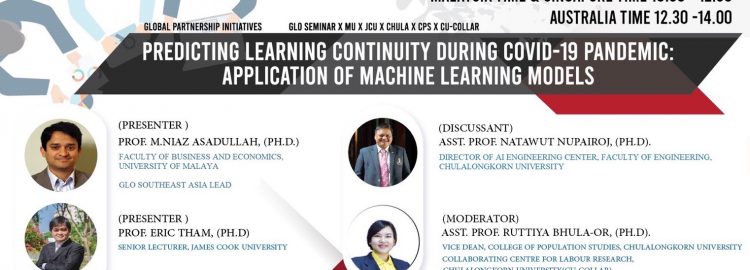
As part of GLO’s SE Asia cluster activities, the GLO webinar will discuss “Predicting learning continuity during the COVID-19 epidemic using machine learning models.”
Please see more details in the poster below. It is scheduled to take place on 29 October 2021. (Online Zoom). Online registration is available at https://forms.gle/gxsJfCegs8E14DbS7
A new GLO Discussion Paper finds that a more differentiated picture of industrial relations can be obtained by considering both membership in employers’ associations and collective bargaining coverage.
Author Abstract: While there is a strong overlap between membership in employers’ associations and collective bargaining coverage, the overlap is far from being perfect. Using unique firm-level data from Germany, this study estimates the determinants of the membership in employers’ associations and the coverage by industry-level or firm-level agreements. The analysis particularly focuses on the various constellations of membership and collective bargaining status. The results show that firm-level worker representation, foreign ownership, work organization, firm size, age and East-West differences are important determinants. Altogether, the analysis demonstrates that a more differentiated picture of industrial relations can be obtained by considering both membership in employers’ associations and collective bargaining coverage.
The Global Labor Organization (GLO) is an independent, non-partisan and non-governmental organization that functions as an international network and virtual platform to stimulate global research, debate and collaboration.
Author Abstract: We model the process of field specialization choice among beginning economists within a multivariate logit framework that accommodates single and dual primary field specializations and incorporates correlations among field specialization choices. Conditioning on personal, economic, and institutional variables reveals that women graduate students are less likely to specialize in Labor/Health, Macro/Finance, Industrial Organization, Public Economics, and Development/Growth/International and are more likely to specialize in Agricultural/Resource/Environmental Economics. Field-specific gender faculty ratios and expected relative salaries as well as economics department rankings are significant factors for gender doctoral specialization dissimilarity. Preferences and characteristics contribute about equally to field specialization dissimilarity.
The Global Labor Organization (GLO) is an independent, non-partisan and non-governmental organization that functions as an international network and virtual platform to stimulate global research, debate and collaboration.
A new GLO Discussion Paper finds that COVID-19 lockdown measures reduced children’s probability of attending school and exacerbated harmful traditional practices such as child marriage.
Featured image: fusion-medical-animation-rnr8D3FNUNY-unsplash
Author Abstract: This paper analyzes the impact of COVID-19 lockdown measures on children’s school resilience. Using an individual fixed-effect linear probability model on Nigeria data, it exploits the quasi-randomness of these measures to estimate their effect on school attendance after the lockdown was lifted. The results show that COVID-19 lockdown measures reduced children’s probability of attending school after the school system reopened. This negative impact increased with children’s age, reaching a peak among those whose education was no longer compulsory. For schoolchildren in that age group, the negative effect of COVID-19 lockdown measures is likely to be permanent, which, if not reversed, will undermine the quality of the economy-wide future labor force. The paper also finds evidence that, in the child marriageprone North-West part of Nigeria, these measures increased gender inequality in education among children aged 12 to 18. This result suggests that COVID-19 lockdown measures may exacerbate harmful traditional practices such as child marriage.
The Global Labor Organization (GLO) is an independent, non-partisan and non-governmental organization that functions as an international network and virtual platform to stimulate global research, debate and collaboration.
A new GLO Discussion Paper suggests that mass shooting incidents are associated with a rise in crimes in general, especially those carried out for monetary gains.
Author Abstract: Recent years have seen a rise in mass shooting incidents in the United States. While direct victims and their families undoubtedly suffer the most serious consequence of mass shootings, little is known on whether mass shootings have negative impacts beyond those immediately exposed to the incidents. In this paper, I examine the crime consequences of mass shootings. I hypothesize that mass shootings can increase crimes through its adverse effects on local labor market conditions. Utilizing difference-in-differences strategy that exploits geographic and temporal variation in mass shooting incidents across U.S. counties, the results of the analysis suggest that mass shooting incident is associated with a rise in crimes, especially those carried out for monetary gains. The most conservative estimate indicates that mass shooting incident increases the overall property crime rate by about 4%.
The Global Labor Organization (GLO) is an independent, non-partisan and non-governmental organization that functions as an international network and virtual platform to stimulate global research, debate and collaboration.
Author Abstract: This paper investigates the effects of shocks, predominantly climate shocks, on labor market outcomes in the West African Economic and Monetary Union (WAEMU). We focus on migration ows within the WAEMU countries to disentangle the differential effects of shocks on migrants and non-migrants. Our analysis combines survey data from Ivory Coast|as the main migrant receiving country|and from all the other 7 migrant sending countries of the WAEMU. Using an OLS fixed effects model, our results show that migration in the WAEMU is associated with a decline in female labor participation, as it is primarily motivated by marriage. However, we find an increase in female labor force participation and a narrowing of the gender gap in migrant households that are negatively affected by shocks. Our findings relate to the literature on the impact of shocks on the labor division between women and men and show that shocks may disrupt long-standing gender roles. The results are robust to accounting for the double selection into shocks and migration using a Propensity Score Matching technique that allows for a within comparison between treated and untreated units.
The Global Labor Organization (GLO) is an independent, non-partisan and non-governmental organization that functions as an international network and virtual platform to stimulate global research, debate and collaboration.
Author Abstract: Hardly any evidence currently exists on the causal effects of mental illness on refugee labor market outcomes. We offer the first study on this topic in the context of Australia, one of the host countries with the largest number of refugees per capita in the world. Analyzing the Building a New Life in Australia longitudinal survey, we exploit the variations in traumatic experiences of refugees interacted with time as an instrument for refugee mental health. We find that worse mental health, as measured by a one standard deviation increase in the Kessler mental health score, reduces the probability of employment by 14.1% and labor income by 26.8%. We also find some evidence of adverse impacts of refugees’ mental illness on their children’s mental health and education performance. These effects appear more pronounced for refugees that newly arrive or are without social networks, but they may be ameliorated with government support. Our findings suggest that policies that target refugees’ mental health may offer a new channel to improve their labor market outcomes.
The Global Labor Organization (GLO) is an independent, non-partisan and non-governmental organization that functions as an international network and virtual platform to stimulate global research, debate and collaboration.
Author Abstract: The at-risk-of-poverty rate, the relative income poverty indicator applied in the EU, can be highly sensitive to the equivalence scale used to transform household income to an equivalent for individuals. This study applies two well-established approaches to estimate the equivalence scale: an ‘objective’ one, based on consumption expenditures available in the national Household Budget Survey, and a ‘subjective’ one, based on the Minimum Income Question available in EU-Statistics on Income and Living Conditions data. The aim is to contrast the two estimated equivalence scales in the Czech Republic in the 2006-2016 period with the OECD-modified scale applied uniformly for decades across the EU countries. Our findings suggest that the adult weight in the equivalence scale is decreasing over time, while the child weight is relatively stable under both approaches. The estimated weights are lower than the officially applied ones, with the exception of the expenditure-based adult weight, which is very close to the OECD-modified weight. Applying the estimated scales affects the income poverty rate and leads to different rates than the official ones: while the trend of the rates is similar when the two estimated scales are used, the official income poverty rate deviates from those two.
The Global Labor Organization (GLO) is an independent, non-partisan and non-governmental organization that functions as an international network and virtual platform to stimulate global research, debate and collaboration.
A new GLO Discussion Paper examines the impact of U.S governor’s party allegiance (Republican vs Democrat) on the ethnic wage gap to show that the vast majority of subgroups of black workers earnings are not affected by democrat governors’ policies.
Author Abstract: Income inequality is a distributional phenomenon. This paper examines the impact of U.S governor’s party allegiance (Republican vs Democrat) on ethnic wage gap. A descriptive analysis of the distribution of yearly earnings of Whites and Blacks reveals a divergence in their respective shapes over time suggesting that aggregate analysis may mask important heterogeneous effects. This motivates a granular estimation of the comparative causal effect of governors’ party affiliation on labor market outcomes. We use a regression discontinuity design (RDD) based on marginal electoral victories and samples of quantiles groups by wage and hours worked. Overall, the distributional causal estimations show that the vast majority of subgroups of black workers earnings are not affected by democrat governors’ policies, suggesting the possible existence of structural factors in the labor markets that contribute to create and keep a wage trap and/or hour worked trap for most of the subgroups of black workers. Democrat governors increase the number of hours worked of black workers at the highest quartiles of earnings. A bivariate quantiles groups analysis shows that democrats decrease the total hours worked for black workers who have the largest number of hours worked and earn the least. Black workers earning more and working fewer hours than half of the sample see their number of hours worked increase under a democrat governor.
Related paper in the Journal of Population Economics, ONLINE FIRST 2021, FREE READ LINK: The effect of the 2016 United States presidential election on employment discrimination by Marina Mileo Gorzig & Deborah Rho
The Global Labor Organization (GLO) is an independent, non-partisan and non-governmental organization that functions as an international network and virtual platform to stimulate global research, debate and collaboration.
A new GLO Discussion Paper studies sealed-bid public procurement contract (PPC) auctions of construction works, discontinuity in bidders’ win margin and firms’ daily employment variation to provide a causal estimate of winning a PPC on firms’ employment.
Author Abstract: Public procurement contracts (PPCs) of goods, services and works is about one tenth of global gross domestic product. Much research has been conducted on government spending and its aggregate effects, but evidence is scarce at the micro-level. This study exploits sealed-bid PPC auctions of construction works, discontinuity in bidders’ win margin and firms’ daily employment variation to provide a causal estimate of winning a PPC on firms’ employment. Winning a PPC has a small positive impact on a firm’s short-run employment. The study investigates mechanisms and heterogeneity that can explain the initial small magnitudes. No compelling evidence is found in favour of political connections, an information leakage channel or PPC size as explanations for the small magnitude. A investigation of longer period shows the impact phases out in less than a year. The lack of a long-term impact is due to runners-up winning more PPCs and runners-up substituting towards more market revenue in the year after closely losing a PPC. Finally, the impacts are concentrated in construction firms that conduct the majority of contracted work in-house. The final estimation shows the effect is about four new employees per PPC with a public cost per job created at €45,200 [€34,200 – €66,200].
The Global Labor Organization (GLO) is an independent, non-partisan and non-governmental organization that functions as an international network and virtual platform to stimulate global research, debate and collaboration.
A new GLO Discussion Paper shows evidence of a large spatial heterogeneity in the electric power consumption between districts and provinces in Vietnam.
Author Abstract: Our study uses a small area estimation method to estimate the average and inequality of per capita kWh consumption for small areas in Vietnam. It shows evidence of a large spatial heterogeneity in the electric power consumption between districts and provinces in Vietnam. Households in the mountains and highlands consumed remarkably less electricity than those in the delta and coastal areas. Notably, we find a U-shaped relationship between the inequality of electricity consumption and economic levels in Vietnam. In poor districts and provinces, there is very high inequality in electricity consumption. Inequality is lower in middle-income districts and provinces.
The Global Labor Organization (GLO) is an independent, non-partisan and non-governmental organization that functions as an international network and virtual platform to stimulate global research, debate and collaboration.
A new GLO Discussion Paper finds substantial and rising gaps in the measurement of consumption and income based on household surveys and national accounts data.
Author Abstract: Estimates of average per capita consumption and income from national accounts differ substantially from corresponding measures of consumption and income from household surveys. Using a new compilation of more than 2,000 household surveys matched to national accounts data, we find that the gaps between the data sources are larger and more robust than previously established. Means of household consumption estimated from surveys are, on average, 20 percent lower than corresponding means from national accounts. The gap with GDP per capita is nearly 50 percent. The gaps have increased in recent decades and are largest in middle-income countries, where annualized growth rates for consumption surveys are systematically lower than national accounts growth rates. We show that the gaps in measures across these two sources have implications for assessments of economic growth, poverty, and inequality. We find that typical survey measures of consumption and income may exaggerate poverty reduction and underestimate inequality.
The Global Labor Organization (GLO) is an independent, non-partisan and non-governmental organization that functions as an international network and virtual platform to stimulate global research, debate and collaboration.
A new GLO Discussion Paper explores the important contributions that happiness-in-the-lab experiments can make to the debates about stylized facts by testing the causality of the relationships.
Author Abstract: The recent surge in analyses of subjective well-being (SWB) and the economics of happiness using large observational datasets has generated stylized facts about the relationship between SWB and various correlates. Because such studies are mostly concerned with the determinants of SWB, the modeling utilized assumes SWB to be the dependent variable. Often, selection effects, reverse causality, and omitted variable bias cannot adequately be controlled for, calling many of the stylized facts into question. This chapter explores the important contributions that happiness-in-the-lab experiments can make to the debates about stylized facts by testing the causality of the relationship between SWB and its correlates. A distinction is made between happiness-in-the-lab experiments in which SWB is a dependent versus independent variable, and methods for both types of experiments are discussed, along with a discussion of the limitations inherent in such experiments. The extant happiness-in-the-lab literature is reviewed and future directions for happiness-in the-lab research are proposed. The important role that happiness-inthe- lab experiments can play in the development of national SWB accounting is emphasized.
The Global Labor Organization (GLO) is an independent, non-partisan and non-governmental organization that functions as an international network and virtual platform to stimulate global research, debate and collaboration.
A new paper published ONLINE FIRST finds that, upon return, undocumented migrants experience a wage penalty compared with documented migrants, as well as relative to non-migrants.
Published ONLINE FIRST 2021: Journal of Population Economics OPEN ACCESS — PDF
Jackline Wahba
Author Abstract: This paper examines the impact of the legal status of overseas migrants on their wages upon return to the home country. Using unique data from Egypt, which allows us to distinguish between return migrants according to whether their international migration was documented or undocumented, we examine the impact of illegal status on wages upon return. Relying on a Conditional Mixed Process model, which takes into account the selection into emigration, into return, and into the legal status of temporary migration, we find that, upon return, undocumented migrants experience a wage penalty compared with documented migrants, as well as relative to non-migrants. Our results are the first to show the impact of undocumented migration on the migrant upon return to the country of origin.
The Global Labor Organization (GLO) is an independent, non-partisan and non-governmental organization that functions as an international network and virtual platform to stimulate global research, debate and collaboration.
Author Abstract: Recent evidence suggests that automation technologies entail a trade-off between productivity gains and employment losses for the economies that adopt them. This paper casts doubts on this trade-off in the context of a developing country. It shows significant productivity and employment gains from automation in Indonesian manufacturing during the years 2008-2015, a period of rapid increase in robot imports. Analysis based on manufacturing plant data provides evidence of two plausible reasons for the absence of this trade-off. First, it documents the presence of diminishing productivity returns to robot adoption. As a result, the benefits from automation could be particularly large for countries at early stages of adoption, such as Indonesia. Second, the analysis finds significant positive employment spillovers from automation in downstream plants. Such effects are likely larger in countries such as Indonesia, where the foreign content of manufacturing production is low. Suggestive evidence indicates such results could apply to developing countries more generally.
The Global Labor Organization (GLO) is an independent, non-partisan and non-governmental organization that functions as an international network and virtual platform to stimulate global research, debate and collaboration.
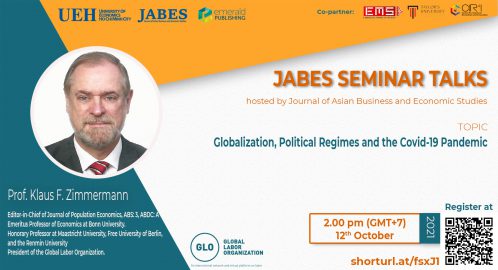
Klaus F. Zimmermann (GLO & UNU-MERIT) will speak on 12 October 2021 in an online talk at the University of Economics, Ho Chi Minh City, Hanoi, Vietnam, as part of the JABES Seminar Talks on Globalization, Political Regimes and the Covid-19 Pandemic. He will report about some of his recent studies in the field and explore the challenges for economic research studying the implications of the pandemic.
Gokhan Karabulut, Klaus F. Zimmermann, Mehmet Huseyin Bilgin and Asli Cansin Doker (2021), “Democracy and COVID-19 Outcomes”, Economics Letters (EL-Prepublication, EL-Online Appendix) Volume 203, June 2021, 109840 Open Access; free PDF. https://doi.org/10.1016/j.econlet.2021.109840
Author Abstract: What drives investment in automation technologies? This paper documents a positive relationship between labor-friendly institutions and investment in industrial robots in a sample of developing and advanced economies. Institutions explain a substantial share of cross-country variation in automation. The relationship between institutions and robots is stronger in sunk cost-intensive industries, where producers are vulnerable to holdup. The result suggests that one reason for producers to invest in automation is to thwart rent appropriation by labor. As a consequence, policies aimed at supporting workers’ welfare by increasing their bargaining power might actually reduce their employment opportunities.
The Global Labor Organization (GLO) is an independent, non-partisan and non-governmental organization that functions as an international network and virtual platform to stimulate global research, debate and collaboration.
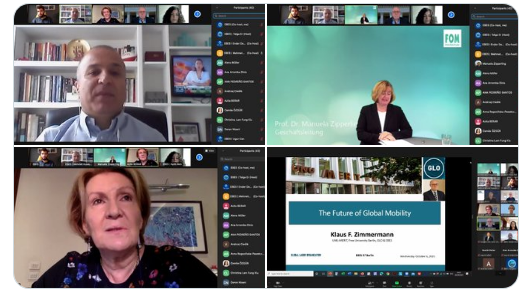
The 37th EBES Conference takes place online on October 6-8 2021. GLO is a co-organizing partner, and FOM University of Applied Sciences is the local host supporting the event from Berlin.EBES, theEurasia Business and Economics Society, and FOM University of Applied Sciencesare strategic partners and institutional supporters of GLO.
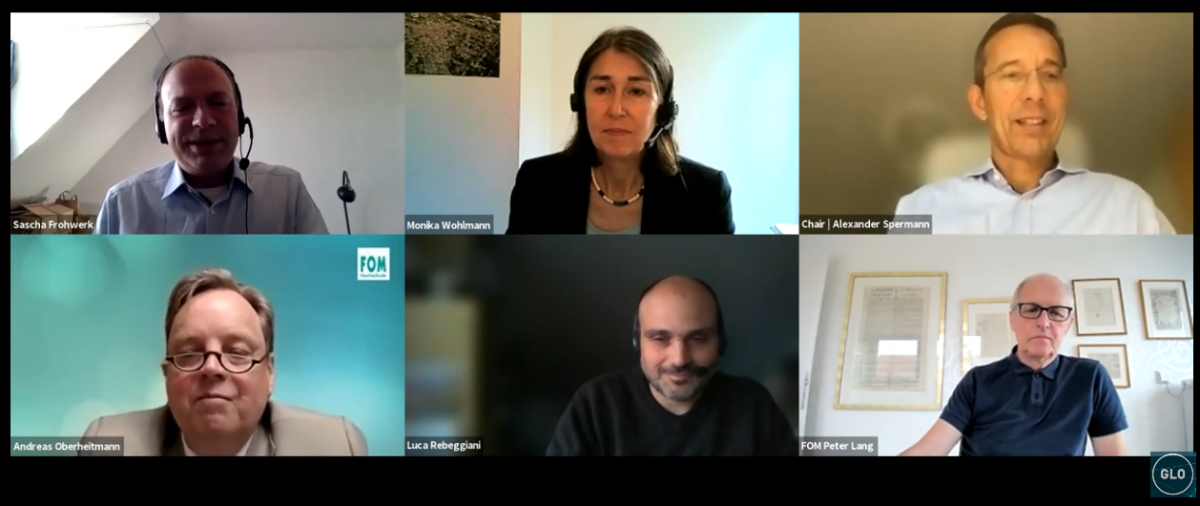
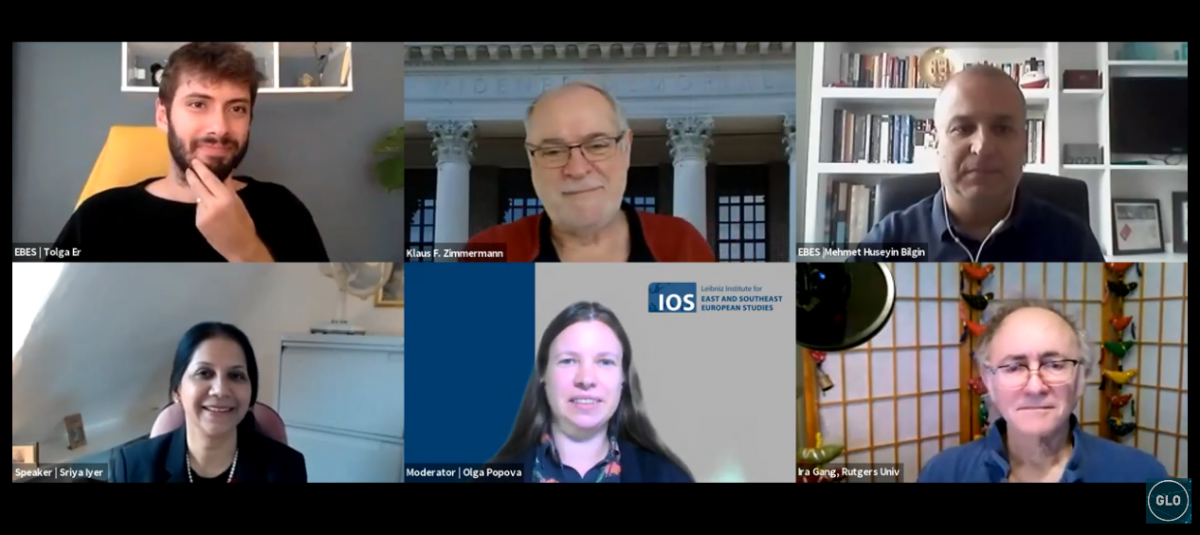
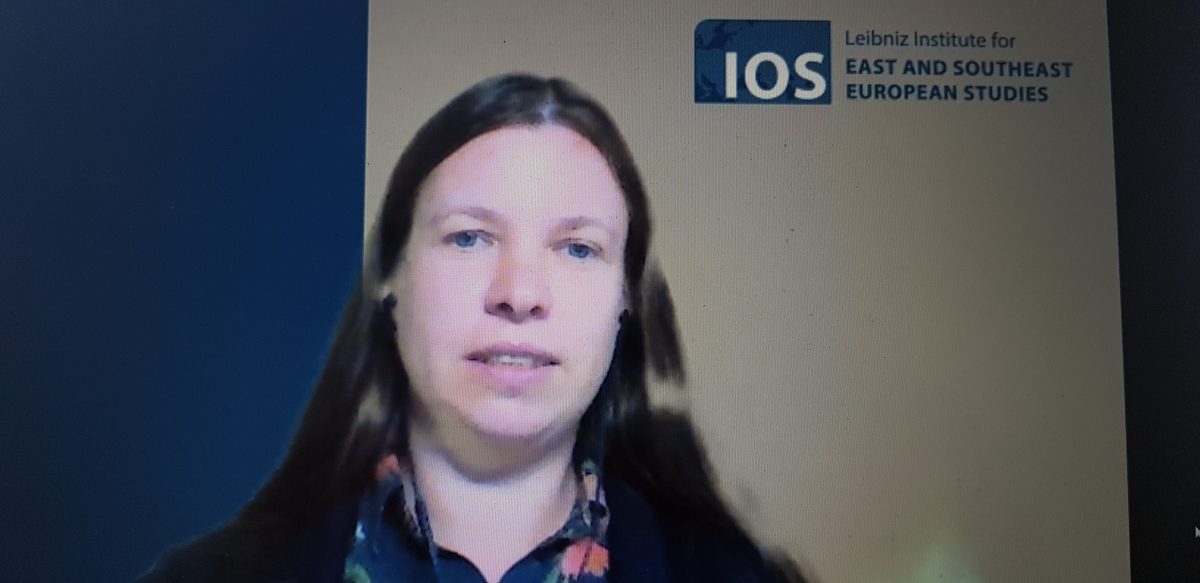
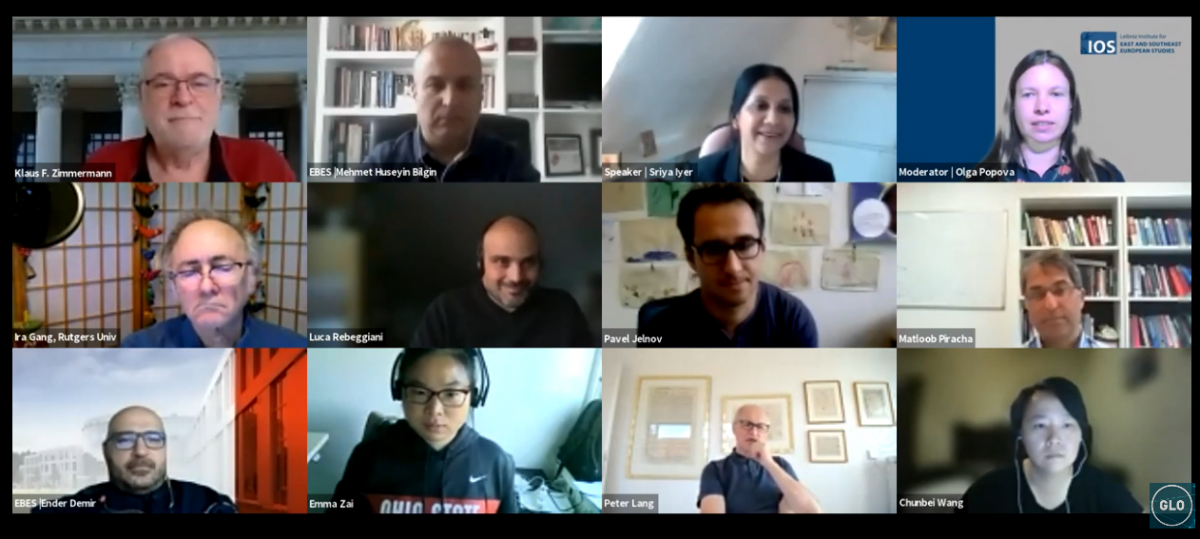
Day TWO (October 7) saw next to 9 parallel research paper sessions a Special FOM-GLO Session and the GLO Handbook Session Migration I. The highlight plenary Speech of the Day was delivered by Sriya Iyer (University of Cambridge and GLO) on Religion and Mental Health chaired by Olga Popova (Leibniz Institute for East and Southeast European Studies, CERGE-EI & GLO), who is also the GLO Research Cluster Lead “Religion”. The EBES 37 Plenary Speech was this time joint with the monthly GLO Virtual Research Seminar normally chaired by GLO Director Matloob Piracha.
CONFERENCE PROGRAM WITH PARTICIPATION DETAILS: LINK
Monika Wohlmann (FOM University of Applied Science): The European Central Bank’s Strategy Review and the Management of Inflation Expectations
Sascha Frohwerk (FOM University of Applied Sciences, Berlin, Hasso-Plattner-Institute, Potsdam and GLO): Retail Location Choice Models. A Comparison of Gravitation and Logit Model
Andreas Oberheitmann (Tsinghua University, FOM and GLO): Development of a Low Carbon Economy in Wuxi City. An Example of Climate Change Mitigation in China on the Local Level.
Michael Drewes (FOM University of Applied Sciences, Mannheim) and Luca Rebeggiani (FOM University of Applied Sciences, Bonn): Private vs. Public Financing of Sport Stadia in Germany – An Empirical Analysis.
Sascha Frohwerk (FOM University of Applied Sciences, Berlin, Hasso-Plattner-Institute, Potsdam and GLO), Carsten Kruppe and Holger Wassermann: Evolution or Revolution: The Entry of New Company Successors in Germany
Kai Klotz and Alexander Spermann (FOM University of Applied Sciences, Cologne, Freiburg University and GLO): Did the Refugee Crisis Cause the Rise of Right-wing Parties? Empirical Evidence from East Germany.
14.00-15.00. Plenary Speech joint with the monthly GLO Seminar Sriya Iyer (University of Cambridge and GLO): Religion and Mental Health Chair: Olga Popova (Leibniz Institute for East and Southeast European Studies, CERGE-EI & GLO)
Note: The session relates to the Springer Nature Handbook project“Labor, Human Resources and Population Economics”supported by the GLO network.
Massimiliano Tani (University of New South Wales & GLO) & Matloob Piracha (University of Kent & GLO): Migration and Education
Cinzia Rienzo ( University of Brighton & GLO): Performance of Economic Migrants
Cynthia A. Bansak (St. Lawrence University & GLO), Nicole Simpson (Colgate University & GLO) and Madeline Zavodny (University of North Florida & GLO): Immigrants and Their Effects on Labor Market Outcomes of Natives
The 37th EBES Conference takes place online on October 6-8 2021. GLO is a co-organizing partner, and FOM University of Applied Sciences is the local host supporting the event from Berlin.EBES, theEurasia Business and Economics Society, and FOM University of Applied Sciencesare strategic partners and institutional supporters of GLO.
Day ONE (October 6) saw opening speeches and lectures, intense parallel sessions, the conference keynote speech, and the EBES Journals session. EBES and GLO President Klaus F. Zimmermann spoke about The Future of Global Mobility. The Keynote Speech was provided by GLO Research Director David G. Blanchflower on The Economics of Walking About and Predicting Unemployment. (For the video of the Blanchflower keynote see LINK below.)
CONFERENCE PROGRAM WITH PARTICIPATION DETAILS: LINK
Some pictures from the event and an overview of the GLO-related contributions can be found below:
GLO supported program parts:
TIME STRUCTURE (All CET Berlin time)
Wednesday, October 6:
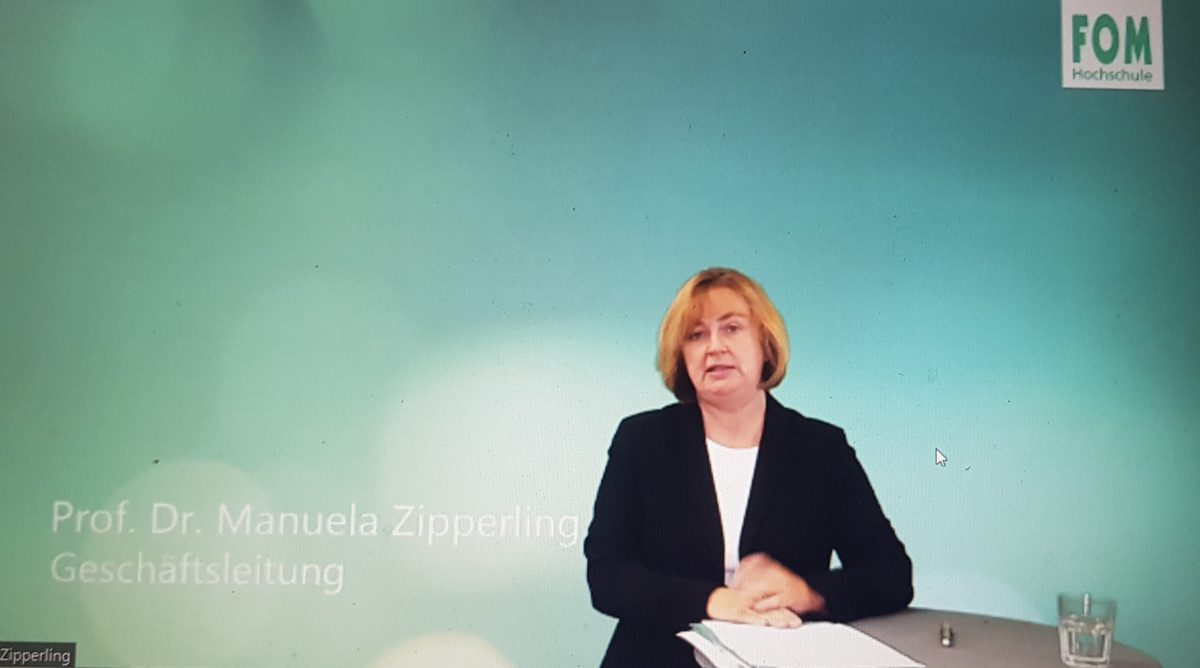
9.00 – 9.45. Welcome Speeches: Mehmet Bilgin (EBES & GLO), Manuela Zipperling (FOM & GLO), and Azita Berar Awad (Graduate Institute of International and Development Studies, Geneva, & GLO) Opening Lecture: Klaus F. Zimmermann (UNU-MERIT, Free University Berlin & GLO) The Future of Global Mobility Chair: Mehmet Bilgin (Istanbul Medeniyet University, EBES & GLO)
Head of FOM Berlin, Manuela ZipperlingGLO Policy Director Azita Berar Awad
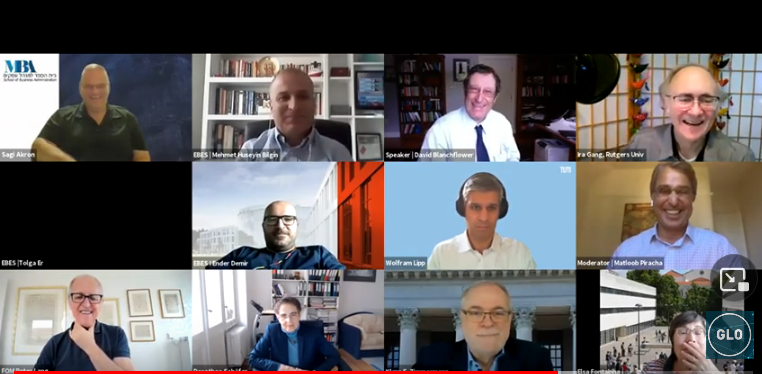
15.15-16.15. Keynote Speech David G. Blanchflower (Dartmouth College & GLO) The Economics of Walking About and Predicting Unemployment Chair: Matloob Piracha (University of Kent & GLO)
Matloob Piracha, David G. Blanchflower and Klaus F. Zimmermann (from the left)
GLO Research Director David G. Blanchflower
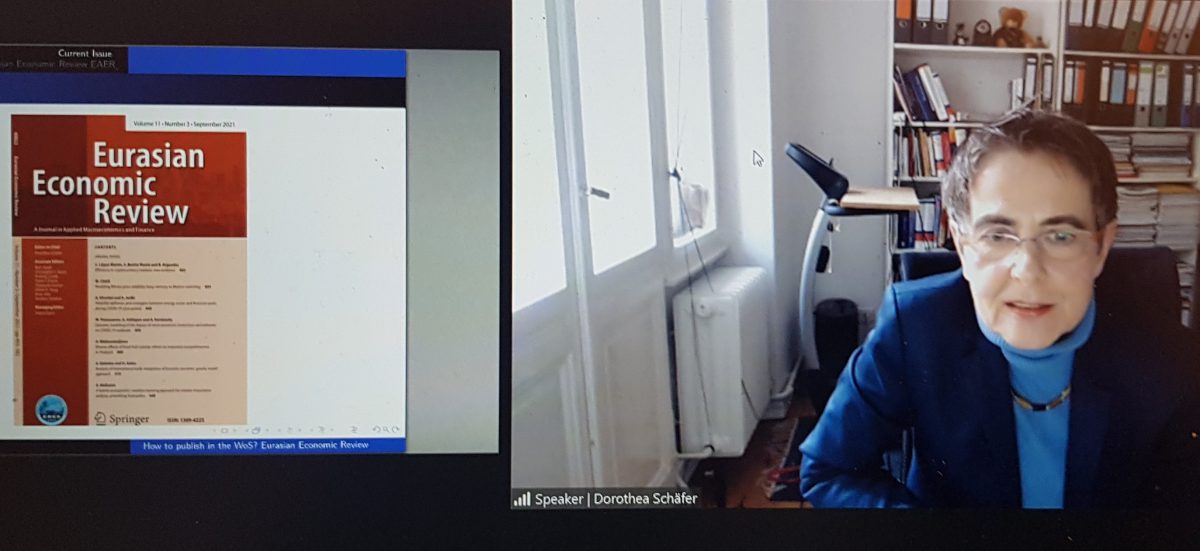
16.30-17.15. EBES Journals Session Chair: Klaus F. Zimmermann (EBES President & GLO) with Dorothea Schäfer (DIW Berlin, Jönköping University & GLO), Editor-in-Chief of Eurasian Economic Review, and Marco Vivarelli (Catholic University of Milano & GLO), Editor-in-Chief of the Eurasian Business Review.
Thursday, October 7:
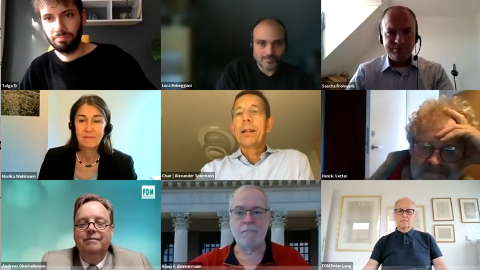
9.00-11.00. FOM-GLO Session Chair: Alexander Spermann (FOM University of Applied Sciences, Cologne, Freiburg University and GLO)
Monika Wohlmann (FOM University of Applied Science): The European Central Bank’s Strategy Review and the Management of Inflation Expectations
Sascha Frohwerk (FOM University of Applied Sciences, Berlin, Hasso-Plattner-Institute, Potsdam and GLO): Retail Location Choice Models. A Comparison of Gravitation and Logit Model
Andreas Oberheitmann (Tsinghua University, FOM and GLO): Development of a Low Carbon Economy in Wuxi City. An Example of Climate Change Mitigation in China on the Local Level.
Michael Drewes (FOM University of Applied Sciences, Mannheim) and Luca Rebeggiani (FOM University of Applied Sciences, Bonn): Private vs. Public Financing of Sport Stadia in Germany – An Empirical Analysis.
Sascha Frohwerk (FOM University of Applied Sciences, Berlin, Hasso-Plattner-Institute, Potsdam and GLO), Carsten Kruppe and Holger Wassermann: Evolution or Revolution: The Entry of New Company Successors in Germany
Kai Klotz and Alexander Spermann (FOM University of Applied Sciences, Cologne, Freiburg University and GLO): Did the Refugee Crisis Cause the Rise of Right-wing Parties? Empirical Evidence from East Germany.
14.00-15.00. Plenary Speech joint with the monthly GLO Seminar Sriya Iyer (University of Cambridge and GLO): Religion and Mental Health Chair: Olga Popova (Leibniz Institute for East and Southeast European Studies, CERGE-EI & GLO)
Note: The session relates to the Springer Nature Handbook project“Labor, Human Resources and Population Economics”supported by the GLO network.
15.15 – 17.15. GLO Session Migration I Chair: Cynthia Bansak (St. Lawrence University & GLO)
Note: The session relates to the Springer Nature Handbook project“Labor, Human Resources and Population Economics”supported by the GLO network.
Sonia Plaza (World Bank & GLO): Measuring Migration
Massimiliano Tani (University of New South Wales & GLO) & Matloob Piracha (University of Kent & GLO): Migration and Education
Cinzia Rienzo ( University of Brighton & GLO): Performance of Economic Migrants
Cynthia A. Bansak (St. Lawrence University & GLO), Nicole Simpson (Colgate University & GLO) and Madeline Zavodny (University of North Florida & GLO): Immigrants and Their Effects on Labor Market Outcomes of Natives
Chunbei Wang (University of Oklahoma & GLO) & Magnus Lofstrom (Public Policy Institute of California & GLO): Immigrant Entrepreneurs
Friday, October 8:
14.15 – 16.15. GLO SessionFamily & Household Economics Chair: Victoria Vernon (SUNY Empire State College & GLO)
Note: The session relates to the Springer Nature Handbook project“Labor, Human Resources and Population Economics”supported by the GLO network.
Effrosyni Adamopoulou (University of Mannheim & GLO): Infidelity
Juan Carlos Campaña (Antonio de Nebrija University), José Ignacio Giménez-Nadal (University of Zaragoza) & José Alberto Molina (University of Zaragoza & GLO): Time-Use Surveys
Benjamin Scharadin (Colby College): Household Food Expenditures and Diet Quality
Daniel Fernandez-Kranz (IE Business School, Madrid) & Jennifer Roff (Queens College and the Graduate Center, CUNY): Child Custody Laws and Household Outcomes
Irene Mosca (Maynooth University & GLO) and Robert E. Wright (University of Glasgow & GLO): Economics of Marriage Bars
16.30 – 18.30. GLO Session Migration II Chair: Marina Murat (University of Modena and Reggio Emilia & GLO)
Note: The session relates to the Springer Nature Handbook project“Labor, Human Resources and Population Economics”supported by the GLO network.
Jakub Lonsky (University of Liverpool & GLO) & Osea Giuntella (University of Pittsburgh & GLO): Migrant Health and Wellbeing
Kusum Mundra (Rutgers University & GLO): The Political Economy of Citizenship
Catalina Amuedo-Dorantes (University of California & GLO), Anna Marie Kietzerow (Western Michigan University) & Susan Pozo (Western Michigan University): Naturalization, Citizenship, and Identity Documents
Stefanija Veljanoska (University of Rennes) & Frederic Docquier (LISER & GLO): Brain Drain or Gain
Amelie Constant (Princeton University & GLO): Time-Space Dynamics of Return and Circular Migration
Michele Tuccio (Université Paris-Dauphine & GLO) & Jackline Wahba (University of Southampton & GLO): Social Remittances
A new GLO Discussion Paper suggests that introducing public subsidies aimed at favoring R&D disclosure represents a win-win result for firms and society.
Author Abstract: This research contributes to the theory of cost-reducing R&D investments by offering a tractable three-stage non-cooperative Cournot duopoly game in which R&D-investing firms choose whether to disclose R&D-related information to the rival. Though in a noncooperative context firms have no incentive to unilaterally disclose information on their costreducing R&D activity to prevent the rival from freely appropriate it, this work shows that there is room for the government to design an optimal policy aimed at incentivising unilaterally each owner towards R&D disclosure. Under this welfare improving policy, sharing R&D-related information becomes a Pareto efficient Nash equilibrium strategy of selfish firms. These findings suggest that introducing public subsidies aimed at favouring R&D disclosure represents a win-win result, eliminating the so far established – and unpleasant for both firms and society – non-disclosing outcome.
The Global Labor Organization (GLO) is an independent, non-partisan and non-governmental organization that functions as an international network and virtual platform to stimulate global research, debate and collaboration.
Author Abstract: We investigate the causal impact of offering telehealth services to female microfinance borrowers on their health and bargaining power in the household. Using a balanced panel of 1218 female borrowers, we observe a positive impact of offering telehealth services on self-reported physical and mental health of treated relative to control women. Treated women seek healthcare more proactively; they are more likely to consult a doctor and they do so sooner, as compared to control women. In addition, treated women report greater inclusion in household decision-making. We also find positive spillover effects of offering telehealth services within the household, where we observe a greater likelihood of the spouse and children (of treated women) to seek health care.
The Global Labor Organization (GLO) is an independent, non-partisan and non-governmental organization that functions as an international network and virtual platform to stimulate global research, debate and collaboration.
The 37th EBES Conference will take place online on October 6-8 2021. GLO is a co-organizing partner, and FOM University of Applied Sciences is the local host supporting the event from Berlin.EBES, theEurasia Business and Economics Society, and FOM University of Applied Sciencesboth are strategic partners and institutional supporters of GLO. GLO President Klaus F. Zimmermann is also President of EBES.FOM and GLO contribute own sessions as listed below.
CONFERENCE PROGRAM WITH PARTICIPATION DETAILS: LINK
An overview of the GLO-related contributions can be found below:
GLO supported program parts:
TIME STRUCTURE (All CET Berlin time)
Wednesday, October 6:
9.00 – 9.45. Welcome Speeches: Mehmet Bilgin (EBES & GLO), Manuela Zipperling (FOM & GLO), and Azita Berar Awad (Graduate Institute of International and Development Studies, Geneva, & GLO) Opening Lecture: Klaus F. Zimmermann (UNU-MERIT, Free University Berlin & GLO) The Future of Global Mobility Chair: Mehmet Bilgin (Istanbul Medeniyet University, EBES & GLO)
15.15-16.15. Keynote Speech David G. Blanchflower (Dartmouth College & GLO) The Economics of Walking About and Predicting Unemployment Chair: Matloob Piracha (University of Kent & GLO)
16.30-17.15. EBES Journals Session Chair: Klaus F. Zimmermann (EBES President & GLO) with Dorothea Schäfer (DIW Berlin, Jönköping University & GLO), Editor-in-Chief of Eurasian Economic Review, and Marco Vivarelli (Catholic University of Milano & GLO), Editor-in-Chief of the Eurasian Business Review.
Thursday, October 7:
9.00-11.00. FOM-GLO Session Chair: Alexander Spermann (FOM University of Applied Sciences, Cologne, Freiburg University and GLO)
Monika Wohlmann (FOM University of Applied Science): The European Central Bank’s Strategy Review and the Management of Inflation Expectations
Sascha Frohwerk (FOM University of Applied Sciences, Berlin, Hasso-Plattner-Institute, Potsdam and GLO): Retail Location Choice Models. A Comparison of Gravitation and Logit Model
Andreas Oberheitmann (Tsinghua University, FOM and GLO): Development of a Low Carbon Economy in Wuxi City. An Example of Climate Change Mitigation in China on the Local Level.
Michael Drewes (FOM University of Applied Sciences, Mannheim) and Luca Rebeggiani (FOM University of Applied Sciences, Bonn): Private vs. Public Financing of Sport Stadia in Germany – An Empirical Analysis.
Sascha Frohwerk (FOM University of Applied Sciences, Berlin, Hasso-Plattner-Institute, Potsdam and GLO), Carsten Kruppe and Holger Wassermann: Evolution or Revolution: The Entry of New Company Successors in Germany
Kai Klotz and Alexander Spermann (FOM University of Applied Sciences, Cologne, Freiburg University and GLO): Did the Refugee Crisis Cause the Rise of Right-wing Parties? Empirical Evidence from East Germany.
14.00-15.00. Plenary Speech joint with the monthly GLO Seminar Sriya Iyer (University of Cambridge and GLO): Religion and Mental Health Chair: Olga Popova (Leibniz Institute for East and Southeast European Studies, CERGE-EI & GLO)
Note: The session relates to the Springer Nature Handbook project“Labor, Human Resources and Population Economics”supported by the GLO network.
15.15 – 17.15. GLO Session Migration I Chair: Cynthia Bansak (St. Lawrence University & GLO)
Note: The session relates to the Springer Nature Handbook project“Labor, Human Resources and Population Economics”supported by the GLO network.
Sonia Plaza (World Bank & GLO): Measuring Migration
Massimiliano Tani (University of New South Wales & GLO) & Matloob Piracha (University of Kent & GLO): Migration and Education
Cinzia Rienzo ( University of Brighton & GLO): Performance of Economic Migrants
Cynthia A. Bansak (St. Lawrence University & GLO), Nicole Simpson (Colgate University & GLO) and Madeline Zavodny (University of North Florida & GLO): Immigrants and Their Effects on Labor Market Outcomes of Natives
Chunbei Wang (University of Oklahoma & GLO) & Magnus Lofstrom (Public Policy Institute of California & GLO): Immigrant Entrepreneurs
Friday, October 8:
14.15 – 16.15. GLO SessionFamily & Household Economics Chair: Victoria Vernon (SUNY Empire State College & GLO)
Note: The session relates to the Springer Nature Handbook project“Labor, Human Resources and Population Economics”supported by the GLO network.
Effrosyni Adamopoulou (University of Mannheim & GLO): Infidelity
Juan Carlos Campaña (Antonio de Nebrija University), José Ignacio Giménez-Nadal (University of Zaragoza) & José Alberto Molina (University of Zaragoza & GLO): Time-Use Surveys
Benjamin Scharadin (Colby College): Household Food Expenditures and Diet Quality
Daniel Fernandez-Kranz (IE Business School, Madrid) & Jennifer Roff (Queens College and the Graduate Center, CUNY): Child Custody Laws and Household Outcomes
Irene Mosca (Maynooth University & GLO) and Robert E. Wright (University of Glasgow & GLO): Economics of Marriage Bars
16.30 – 18.30. GLO Session Migration II Chair: Marina Murat (University of Modena and Reggio Emilia & GLO)
Note: The session relates to the Springer Nature Handbook project“Labor, Human Resources and Population Economics”supported by the GLO network.
Jakub Lonsky (University of Liverpool & GLO) & Osea Giuntella (University of Pittsburgh & GLO): Migrant Health and Wellbeing
Kusum Mundra (Rutgers University & GLO): The Political Economy of Citizenship
Catalina Amuedo-Dorantes (University of California & GLO), Anna Marie Kietzerow (Western Michigan University) & Susan Pozo (Western Michigan University): Naturalization, Citizenship, and Identity Documents
Stefanija Veljanoska (University of Rennes) & Frederic Docquier (LISER & GLO): Brain Drain or Gain
Amelie Constant (Princeton University & GLO): Time-Space Dynamics of Return and Circular Migration
Michele Tuccio (Université Paris-Dauphine & GLO) & Jackline Wahba (University of Southampton & GLO): Social Remittances
A new GLO Discussion Paper finds only a very small or insignificant impact of changes in the real minimum wage on unemployment entries and exits in Greece.
Author Abstract: During the last decade, unemployment in Greece climbed up to 28%, almost quadrupling due to the economic crisis that hit Greece. In the present paper, we examine the determinants of the unemployment dynamics and the impact of the minimum wage on the probability of making a transition into and out of unemployment. We use micro-level data from the Greek Labour Force Survey for the period 2004-2019 and control for several demographic factors, macro-economic conditions, regional differences and changes in statutory minimum wage. The results suggest that individual-level characteristics play an important role in making a transition into or out of unemployment. Changes in the real minimum wage are estimated to have either a statistically insignificant or a very small impact on unemployment entries and exits. Further, the impact of economy’s growth rate follows the theoretical predictions as higher growth rates increase unemployment outflows and decrease inflows, while the regional differences are also important. Our findings persist even when we split the sample in three periods (pre-crisis, crisis, recovery). The results have important policy implications. Given that the disemployment effect of the minimum wage seems to be very limited in the Greek labour market, while the socioeconomic characteristics and regional characteristics play an important role, improving the skills of individuals through the educational system and reskilling or up-skilling programs, while targeting specific regions, may facilitate labour market mobility.
The Global Labor Organization (GLO) is an independent, non-partisan and non-governmental organization that functions as an international network and virtual platform to stimulate global research, debate and collaboration.
A new GLO Discussion Paper studies determinants of self-rated physical and mental health of sexual minorities. Among other factors, increased aggregate unemployment deteriorates physical and mental wellbeing.
Author Abstract: Utilizing two panel datasets covering the periods 2013-2014 and 2018-2019, the study examines whether social rejection, family acceptance, and economic conditions bear an association with self-rated physical and mental health of sexual minorities. Social rejection bears a negative association with physical and mental health. Family acceptance shares a positive association with physical and mental health. Periods characterized by worse economic conditions (2013-2014 versus 2018-2019) correlate with a decline in sexual minorities’ physical and mental health. It is found that women, trans people, people without higher education degrees, unemployed people, and relatively poor people, experience worse physical and mental health than the corresponding reference categories. The study indicates that sexual minorities who experienced societal rejections, such as unfair treatment in educational, workplace environments, and/or services (public/health) prompted deteriorated physical and mental health. Sexual minorities who experienced acceptance from their families over their sexual orientation status, experienced better physical and mental health. Moreover, during periods of increased aggregate unemployment, the physical and mental health status of sexual minorities was deteriorated. Antidiscrimination policies help reduce homophobic incidents and positively impact sexual/gender identity minorities’ progression, self-esteem, income, and well-being. Public health services should ensure that policies are inclusive of the physical and mental health needs of sexual/gender identity minority groups. Addressing financial hardships for minority population groups should form part of the policymakers’ agenda. This is among the first international studies to examine whether, during a period of economic recession, sexual minorities experience deteriorated physical and mental health.
The Global Labor Organization (GLO) is an independent, non-partisan and non-governmental organization that functions as an international network and virtual platform to stimulate global research, debate and collaboration.
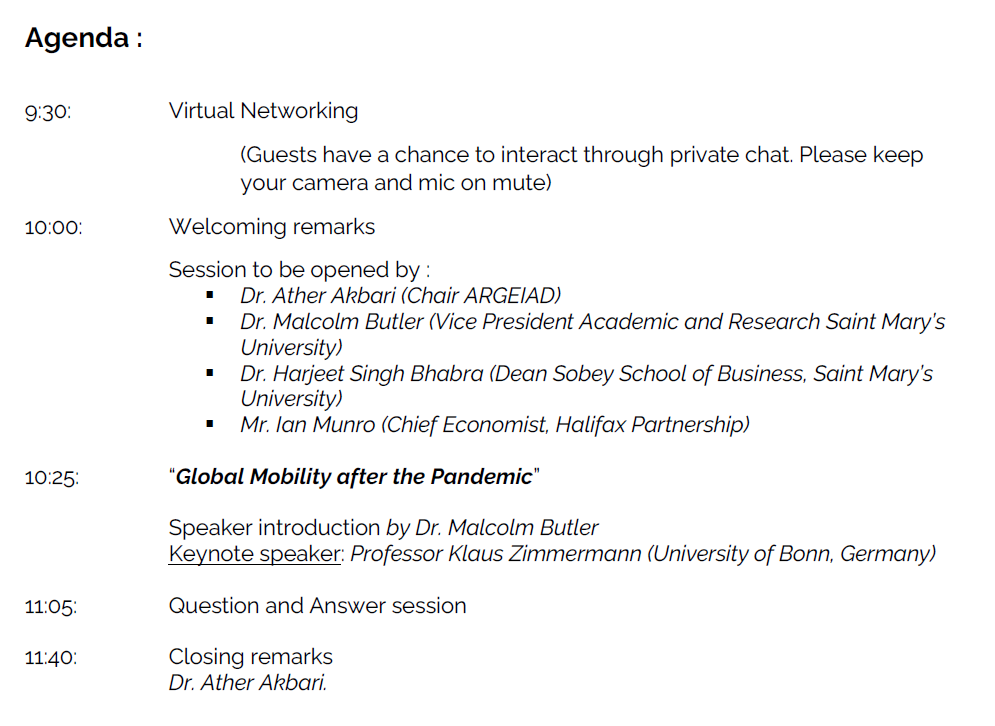
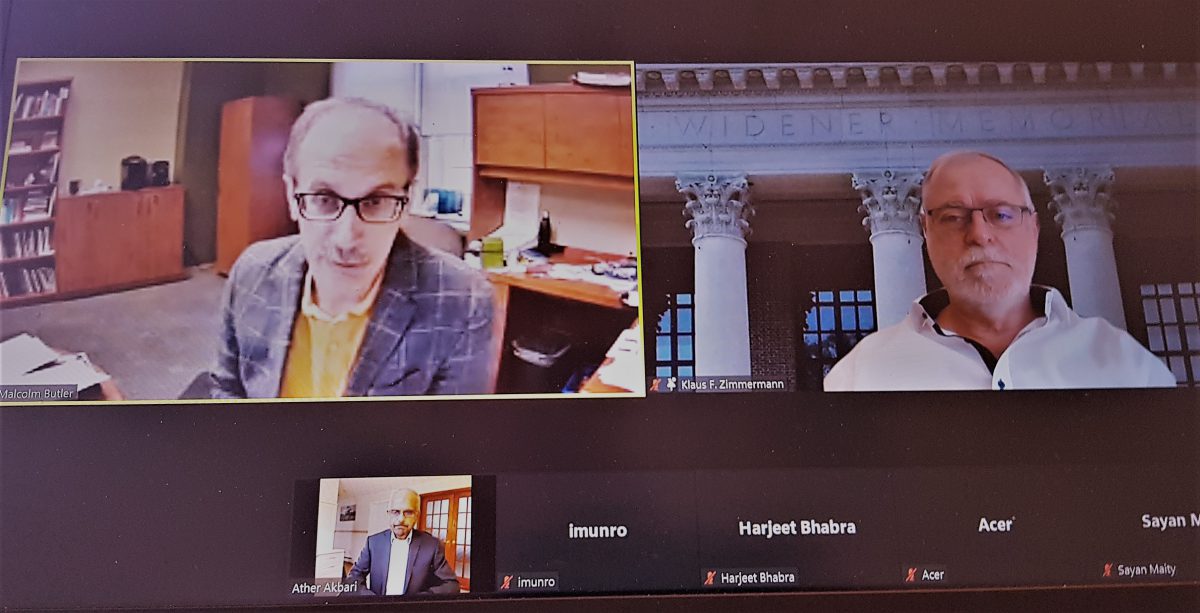
On the invitation of ARGEIAD, Sobey School of Business, Saint Mary’s University, Canada, Klaus F. Zimmermann, President of the Global Labor Organization (GLO) and UNU-MERIT, Maastricht, spoke on September 29, 2021 in a public online lecture on:
Global Mobility after the Pandemic
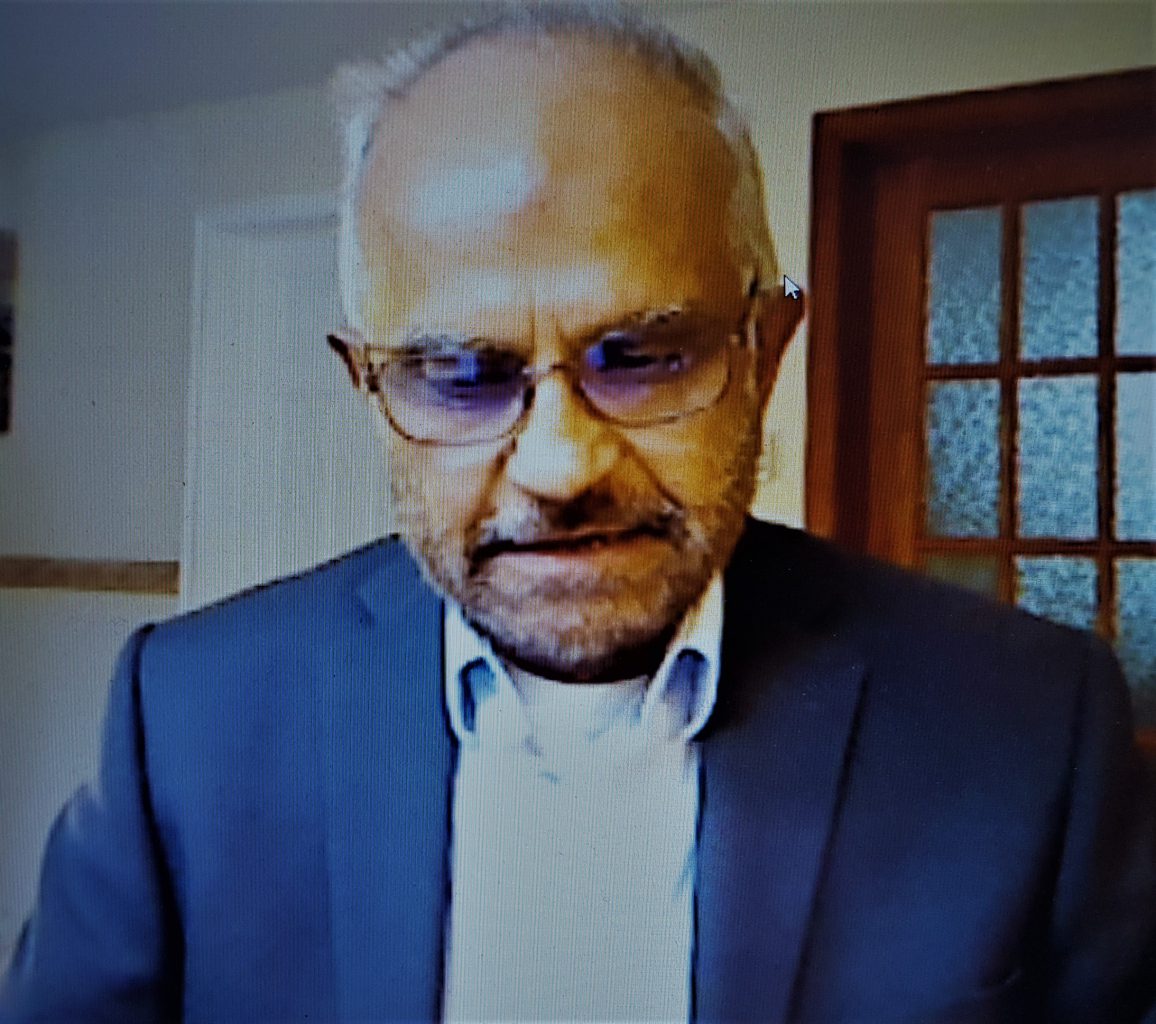
The meeting was chaired by Dr. Ather Akbari, Ph.D., Professor of Economics at the Sobey School of Business, Saint Mary’s University, and head of ARGEIAD. More details.ARGEIAD, the Atlantic Research Group on Economics of Immigration, Aging and Diversity, focuses on the economic significance of immigration, diversity and aging. The center provides a platform to researchers, policymakers, policy practitioners and business organizations to exchange ideas and conduct research on these issues in a regional, national and international context.
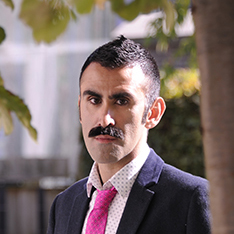
Klaus F. Zimmermann
Ather Akbari
PROGRAM
Ather Akbari
Malcom Butler
Harjeet Singh Bhabra
Ian Munro
Discussant Tony Fang, Stephen Jarislowsky Chair in Cultural and Economic Transformation, Memorial University of Newfoundland
Abstract: “Global Mobility after the Pandemic“ Covid-19 has challenged the way humanity is organizing global welfare through cooperation and the division of work. Key causes of the spread of the virus have been the conditions of human mobility and exchange. The ultimate solution had been to restrict such mobility. Among the response mechanisms were home-work and internet collaborations. What are the long term consequences after the end of the pandemic? Will this end globalization? Or cause a faster transition into the future of work? And will the pandemic ever come fully to an end? The lecture will deal with those questions. It will work out the importance of migration and mobility for the creation of human welfare and development through the law of the division of work. It will review the experiences with the “Spanish Flu”, which early in the 20th century contributed to the end of the largely globalized world existing at the time before World War I. Will history repeat? It will then study the experiences we have so far with the mobility consequences of the pandemic and which innovations are under way dealing with it. The conclusions will speculate about the consequences for the future of migration.
SelectedReferences:
Bista, Krishna, Allen, Ryan M. & Chan, Roy Y. , Eds., 2021, Impacts of COVID-19 on International Students and the Future of Student Mobility. International Perspectives and Experiences, September 29, 2021. Forthcoming by Routledge.
Newland, Kathleen. 2020. Will International Migration Governance Survive the COVID-19 Pandemic? Washington, DC: Migration Policy Institute.
Gokhan Karabulut, Klaus F. Zimmermann, Mehmet Huseyin Bilgin and Asli Cansin Doker (2021), “Democracy and COVID-19 Outcomes”, Economics Letters (EL-Prepublication, EL-Online Appendix) Volume 203, June 2021, 109840 Open Access; free PDF. https://doi.org/10.1016/j.econlet.2021.109840
ADB, OECD & ILO (2021); Labor Migration in Asia. Impacts of the COVID-19 Crisis and the post-pandemic future.
Victoria Vernon and Klaus F. Zimmermann (2021), “Walls and Fences: A Journey Through History and Economics”, in: Kourtit, K., Newbold, B., Nijkamp, P. and Partridge, M., The Economic Geography of Cross-Border Migration, Springer, Heidelberg et al., pp. 33-54; Pre-publication version.Published.
Zimmermann, Klaus F., Refugee and Migrant Labor Market Integration: Europe in Need of a New Policy Agenda. Presented at the EUI Conference on the Integration of Migrants and Refugees, 29-30 September 2016 in Florence. Published in: Bauböck, R. and Tripkovic, M., The Integration of Migrants and Refugees. An EUI Forum on Migration, Citizenship and Demography, European University Institute, Robert Schuman Centre for Advanced Studies, Florence 2017, pp. 88 – 100. Published Version of article. Published full book.
On the invitation of ARGEIAD, Sobey School of Business, Saint Mary’s University, Canada, Klaus F. Zimmermann, President of the Global Labor Organization (GLO) and UNU-MERIT, Maastricht, will speak on September 29, 2021 in a public online lecture on Global Mobility after the Pandemic. The meeting will be chaired by Dr. Ather Akbari, Ph.D., Professor of Economics at the Sobey School of Business, Saint Mary’s University, and head of ARGEIAD. More details.
ARGEIAD, the Atlantic Research Group on Economics of Immigration, Aging and Diversity, focuses on the economic significance of immigration, diversity and aging. The center provides a platform to researchers, policymakers, policy practitioners and business organizations to exchange ideas and conduct research on these issues in a regional, national and international context.
Ather Akbari
Klaus F. Zimmermann
Abstract: “Global Mobility after the Pandemic“ Covid-19 has challenged the way humanity is organizing global welfare through cooperation and the division of work. Key causes of the spread of the virus have been the conditions of human mobility and exchange. The ultimate solution had been to restrict such mobility. Among the response mechanisms were home-work and internet collaborations. What are the long term consequences after the end of the pandemic? Will this end globalization? Or cause a faster transition into the future of work? And will the pandemic ever come fully to an end? The lecture will deal with those questions. It will work out the importance of migration and mobility for the creation of human welfare and development through the law of the division of work. It will review the experiences with the “Spanish Flu”, which early in the 20th century contributed to the end of the largely globalized world existing at the time before World War I. Will history repeat? It will then study the experiences we have so far with the mobility consequences of the pandemic and which innovations are under way dealing with it. The conclusions will speculate about the consequences for the future of migration.
SelectedReferences:
Bista, Krishna, Allen, Ryan M. & Chan, Roy Y. , Eds., 2021, Impacts of COVID-19 on International Students and the Future of Student Mobility. International Perspectives and Experiences, September 29, 2021. Forthcoming by Routledge.
Newland, Kathleen. 2020. Will International Migration Governance Survive the COVID-19 Pandemic? Washington, DC: Migration Policy Institute.
Gokhan Karabulut, Klaus F. Zimmermann, Mehmet Huseyin Bilgin and Asli Cansin Doker (2021), “Democracy and COVID-19 Outcomes”, Economics Letters (EL-Prepublication, EL-Online Appendix) Volume 203, June 2021, 109840 Open Access; free PDF. https://doi.org/10.1016/j.econlet.2021.109840
ADB, OECD & ILO (2021); Labor Migration in Asia. Impacts of the COVID-19 Crisis and the post-pandemic future.
Victoria Vernon and Klaus F. Zimmermann (2021), “Walls and Fences: A Journey Through History and Economics”, in: Kourtit, K., Newbold, B., Nijkamp, P. and Partridge, M., The Economic Geography of Cross-Border Migration, Springer, Heidelberg et al., pp. 33-54; Pre-publication version.Published.
Zimmermann, Klaus F., Refugee and Migrant Labor Market Integration: Europe in Need of a New Policy Agenda. Presented at the EUI Conference on the Integration of Migrants and Refugees, 29-30 September 2016 in Florence. Published in: Bauböck, R. and Tripkovic, M., The Integration of Migrants and Refugees. An EUI Forum on Migration, Citizenship and Demography, European University Institute, Robert Schuman Centre for Advanced Studies, Florence 2017, pp. 88 – 100. Published Version of article. Published full book.
A new GLO Discussion Paper studies the role of formal institutions of contract enforcement in facilitating investments in small and medium firms in India.
Author Abstract: We study the role of formal institutions of contract enforcement in facilitating investments in small and medium firms(MSME). In a framework where established entrepreneurs can enforce contracts informally using their network ties and hierarchical advantage, we argue that an efficient formal judiciary helps entrepreneurs without any ties to informal business networks, disproportionately more. We test our theoretical prediction using a novel administrative panel-data from Indian courts and the nationally representative MSME survey data. Empirically, we treat entrepreneurs from disadvantaged castes (SC-ST) as those without traditional business-network ties. We find that improvement in court quality has a disproportionately larger impact on the investment decisions of SC-ST entrepreneurs. On average, if the time taken for a court to clear all existing cases reduces by 1 year, the initial gap in the probability of investing, between SC-ST and other entrepreneurs, gets reduced by 0.6-0.7 percentage points.
The Global Labor Organization (GLO) is an independent, non-partisan and non-governmental organization that functions as an international network and virtual platform to stimulate global research, debate and collaboration.
Author Abstract: The varieties-of-capitalism (VoC) approach distinguishes liberal market economies (LMEs) such as the USA and coordinated market economies (CMEs) such as Germany based on institutional differences in terms of corporate governance, industrial relations, company relations as well as education and training. According to the VoC approach, firms differ in the ways in which they combine market and non-market mechanisms to coordinate their activities. Firms in LMEs are considered to rely more on market or exit mechanisms than firms in CMEs, which more often complement market with non-market or voice mechanisms. This chapter summarizes what has been learned from the VoC approach on the linkages between the institutional environment and labor-management relations. Various important lessons can be drawn. Employment protection legislation is a productive element within the institutional setup of CMEs. LMEs tend to induce strong overall wage dispersion, whereas in some CMEs such as Germany the labor market performance varies markedly by skill type and gender. The recent literature also indicates that the institutional setup is more complex than the VoC approach suggests, calling for revisions to the approach. In particular, some countries are hybrid economies that combine elements of both types of capitalism. The CME-LME dichotomy does not appreciate the true variety of country-specific skill systems. Finally, multinational enterprises overcome institutional boundaries of different types of capitalism in ways that were not included in the original VoC approach.
The Global Labor Organization (GLO) is an independent, non-partisan and non-governmental organization that functions as an international network and virtual platform to stimulate global research, debate and collaboration.
A new GLO Discussion Paper studies the history and effects of marriage bars,the requirement that women working in certain jobs must leave that job when they marry.
Author Abstract: A Marriage Bar is the requirement that women working in certain jobs must leave that job when they marry. In the twentieth century, Marriage Bars were not unusual internationally. In the late 1800s to early 1900s, legislative provisions that required women to resign at marriage were introduced in several countries around the world, including Australia, Canada, Ireland, the Netherlands and the UK. Spill-overs to jobs not strictly covered by the Marriage Bar were also common. This chapter critically reviews, from an economics perspective, the background, the history and the impacts of Marriage Bars. This chapter has four aims. The first is to summarise the arguments provided by government officials and employers to justify both the introduction and the retention of Marriage Bars. The second is to provide a cross-country comparison of Marriage Bars. The third is to investigate the potential impacts of the Marriage Bar on women’s behavior with respect to employment, marriage and education. The fourth is to highlight potential avenues for future research. Although Marriage Bars do not exist anymore, they are still a serious topic of current debate. Much more can be learned about important topics, such as discrimination, from carrying out research focused on Marriage Bars.
The Global Labor Organization (GLO) is an independent, non-partisan and non-governmental organization that functions as an international network and virtual platform to stimulate global research, debate and collaboration.
A new paper published ONLINE FIRST with free readlink in the Journal of Population Economics finds that severe water contamination in the US modestly increased the rate of low birth weight, but had little effect on the length of gestation or rate of prematurity.
Published ONLINE FIRST 2021: Journal of Population Economics Free READLINK: https://rdcu.be/cytgm
Author Abstract: In 2014, the city of Flint, MI, in the USA changed its public water source, resulting in severe water contamination and a public health crisis. Using the Flint water crisis as a natural experiment, we estimate the effect of in utero exposure to polluted water on health at birth. Matching vital statistics birth records with various sources of data, we use the synthetic control method to identify the causal impact of water pollution on key birth outcomes. Our results suggest that the crisis modestly increased the rate of low birth weight (LBW) by 1.8 percentage points (or 15.5%) but had little effect on the length of gestation or rate of prematurity. However, these effects are larger among children born to black mothers, as indicated by an increase in the rate of LBW by 2.5 percentage points (or 19%). Children born to white mothers exhibit, on average, a 30.1-g decrease in birth weight. We find little evidence that the male-to-female sex ratio declines in the overall population, suggesting that the in utero scarring effect of the Flint water crisis may dominate the channel of mortality selection. However, we observe a slight decline in the sex ratio among children born to black mothers. Finally, we find no notable change in the fertility rates of either black women or white women in Flint. These results are robust to a rich set of placebo and falsification tests.
The Global Labor Organization (GLO) is an independent, non-partisan and non-governmental organization that functions as an international network and virtual platform to stimulate global research, debate and collaboration.
Author Abstract: This paper investigates whether and how China’s adoption of Soviet-aided industrialization programs in the 1950s has affected its long-run innovation. Focusing on 156 major industrial projects aided by the Soviet Union, combined with an instrumental variable approach, I find that the adoption of these programs substantially discourages local firms to innovate in the long run. A causal mediation analysis of instrumental variable settings shows that the negative effect is entirely driven by local firms’ lower intensity of incentive pay. This evidence suggests disadvantages of Soviet-aided industrialization programs for long-run innovation due to firms adopting incentive-incompatible management technology.
The Global Labor Organization (GLO) is an independent, non-partisan and non-governmental organization that functions as an international network and virtual platform to stimulate global research, debate and collaboration.
Presentations in this series are based on the projects that GLO-VirtYS program scholars completed as part of the their program participation. See for the details VirtYs program and the cohort 2021.
September 30th 2021 Program on 1 pm London/UK time.
Sydney (10pm), Beijing (8pm), Istanbul (3pm), Berlin (2pm), London (1pm), Cape Town (2pm), Washington DC (8am), Santiago de Chile (9am)
Jie Chen, Jiangsu University and GLO Affiliate Does vocational education pay better, or worse, than academic education? (GLO VirtYS program advisor Professor Francesco Pastore)
Muchin Bazan Ruiz, Virginia Tech and GLO Affiliate Women in Engineering: The Role of Role Models (GLO VirtYS program advisor Professor Kompal Sinha
Chaired by GLO VirtYS Program Director Olena Nizalova.
FOR PAST AND FUTURE EVENTS SEE THE GLO WEBSITE. Featured Image: Employee-Training-unsplash
Jie Chen is a lecturer of economics at Jiangsu University. Her research interests are in experimental economics and educational economics. She received her PhD in economics from the University of New South Wales.
GLO VirtYS project: Does vocational education pay better, or worse, than academic education?
In this paper, we use the Chinese General Social Survey data to analyze the returns to upper secondary vocational education in China. To address possible endogeneity of vocational training due to omitted heterogeneity, we construct a novel instrumental variable using the proportion of tertiary education graduates relative to the entire population by year. Our main finding is that, although returns to vocational upper secondary education appear higher than returns to academic upper secondary education according to the Mincerian equation, the results from the instrumental variable method tell the opposite story: vocational upper secondary graduates face a wage penalty compared to academic upper secondary graduates. The wage penalty is confirmed by an alternative and more recent IV method – the Lewbel method (Lewbel, 2012). Our findings highlight the importance of properly accounting for endogeneity when estimating the returns to vocational education.
Muchin Bazan Ruiz is a Ph.D. candidate in Economics at Virginia Tech. She has an MSc in Economics at the University of Warwick and a BSc. in Economics from Universidad de Piura. She has worked in the Superintendence of Banks, Insurance Companies, and Private Pension Funds (Peru) and as a Consultant at the Intern-American Development Bank. Muchin is passionate about Development and her research interests are in Development Economics, Economics of Education, and Gender Studies. She investigates the effect of role models on students’ career choices and perceptions using randomized controlled trials and administrative data.
GLO VirtYS project: Women in Engineering: The Role of Role Models
Gender disparities in STEM field participation are a major cause of concern for policymakers around the world. Given the higher average level of earnings of STEM graduates, low enrollment rates of women in these fields contribute to gender-based inequalities in earnings and wealth. This paper studies the effects of exposure to role models on female preferences for STEM fields. We conduct a randomized control trial where female senior students currently enrolled in engineering programs at an elite private university in Peru give talks about their experiences at randomly selected high schools. We find that exposure to this treatment increases high ability female students’ preferences for engineering programs by 14 percentage points. The effect is only statistically significant for the subgroup of female students with baseline math scores in the top 25 percentile, and that reside close to the city where the role models’ university is located. We also find positive but smaller effects on “low ability” male students. In a context where females are discouraged from enrolling in STEM fields, our results have important policy implications.
A new GLO Discussion Paper reveals selection in characteristics, a strong role for soft factors like social ties and sociocultural integration, and a faint role for economic factors.
Author Abstract: Aspirations provide the underlying dynamics of the behavior of individuals whether they are realized or not. Knowledge about the characteristics and motives of those who aspire to leave the host country is key for both host and home countries to formulate appropriate and effective policies in order to keep their valued immigrants or citizens and foster their (re-)integration. Based on unique individual-level Gallup World Polls data, a random utility model, and a multinomial logit we model the aspirations or stated preferences of immigrants across 138 countries worldwide. Our analysis reveals selection in characteristics, a strong role for soft factors like social ties and sociocultural integration, and a faint role for economic factors. Changes in circumstances in the home and host countries are also important determinants of aspirations. Results differ by the host countries’ level of economic development.
The Global Labor Organization (GLO) is an independent, non-partisan and non-governmental organization that functions as an international network and virtual platform to stimulate global research, debate and collaboration.
A new paper published ONLINE FIRST with free readlink in the Journal of Population Economics finds that financial hardship is associated with significantly more screen time, particularly passive screen time, and screen time at excessive levels.
by Jessica L. Arnup, Nicole Black & David W. Johnston
Published ONLINE FIRST 2021: Journal of Population Economics Free READLINK: https://rdcu.be/cyeE8
Author Abstract: This paper examines the impact of children’s migration on the well-being of left-behind parents using panel data on experienced utility measured by the Day Reconstruction Method. Exploiting exogenous variation in exposure to employment shocks at migration destinations for identification, we find that left-behind parents experience lower utility when their adult children migrate. This is partly due to increased working time and less time spent in social activities, and partly due to reduced utility within activity type. The latter effect is consistent with the finding of less physical care and psychological support from children who have migrated. These negative effects dominate the possible benefits of greater income associated with children’s migration.
The Global Labor Organization (GLO) is an independent, non-partisan and non-governmental organization that functions as an international network and virtual platform to stimulate global research, debate and collaboration.
A new paper published ONLINE FIRST with free readlink in the Journal of Population Economics finds that abortions in Mexico City reduced substantially during the period of stay-at-home orders.
Published ONLINE FIRST 2021: Journal of Population Economics Free READLINK: https://rdcu.be/cyeBt
Author Abstract: We study the effect of the COVID-19 pandemic and of government mandated mitigation policies on the number of abortions performed by Mexico City’s public abortion program. We find that the COVID-19 pandemic and stay-at-home orders (SAHO) implemented in Mexico led to unintended consequences for women’s sexual and reproductive health. Using difference-in-differences and event study analyses, we show that SAHO and the pandemic led to a fall in abortions of around 25% and find no evidence that unsafe abortions increased. We find a decrease in the share of single and teenage women getting abortions, arguably due to fewer unwanted pregnancies from decreased sexual activity, and estimate that at most 9.8% of the total fall in abortions can be attributed to this. We complement our analysis using call data from a government helpline and show that the SAHO time period led to fewer abortion- and contraception-related calls but to an increase in pregnancy-related calls.
Featured image: Fusion-medical-animation-on-unsplash
The Global Labor Organization (GLO) is an independent, non-partisan and non-governmental organization that functions as an international network and virtual platform to stimulate global research, debate and collaboration.
A new GLO Discussion Paper shows for China that a 1-day decrease in the time taken to confirm the first case in a city publicly led to 9.4% and 12.7% reductions in COVID-19 prevalence and mortality over the subsequent six months.
Author Abstract: This paper examines the causal impact of diagnostic efficiency on the COVID-19 pandemic in China. Using an instrumental variable approach, we show that a 1-day decrease in the time taken to confirm the first case in a city publicly led to 9.4% and 12.7% reductions in COVID-19 prevalence and mortality over the subsequent six months, respectively. The impact was larger for cities that are farther from the COVID-19 epicenter, are exposed to less migration, have more responsive public health systems, and have higher-capacity utilization of health systems. Social distancing and a less burdened health system are likely underlying mechanisms.
The Global Labor Organization (GLO) is an independent, non-partisan and non-governmental organization that functions as an international network and virtual platform to stimulate global research, debate and collaboration.
A new paper published ONLINE FIRST with free OPEN ACCESS in the Journal of Population Economics finds that elections indeed matter. It has implications for postal voting reforms or postponing of large-scale, in-person (electoral) events during viral outbreaks.
PublishedOPEN ACCESS ONLINE FIRST PDF 2021: Journal of Population Economics
Author Abstract: Elections define representative democracies but also produce spikes in physical mobility if voters need to travel to polling places. In this paper, we examine whether large-scale, in-person elections propagate the spread of COVID-19. We exploit a natural experiment from the Czech Republic, which biannually renews mandates in one-third of Senate constituencies that rotate according to the 1995 election law. We show that in the second and third weeks after the 2020 elections (held on October 9–10), new COVID-19 infections grew significantly faster in voting compared to non-voting constituencies. A temporarily related peak in hospital admissions and essentially no changes in test positivity rates suggest that the acceleration was not merely due to increased testing. The acceleration did not occur in the population above 65, consistently with strategic risk-avoidance by older voters. Our results have implications for postal voting reforms or postponing of large-scale, in-person (electoral) events during viral outbreaks.
Featured image: Fusion-medical-animation-on-unsplash
The Global Labor Organization (GLO) is an independent, non-partisan and non-governmental organization that functions as an international network and virtual platform to stimulate global research, debate and collaboration.
Author Abstract: We examine the relationship between wealth and health through prominent growth indicators and cognitive ability. Cognitive ability is represented by nutritional status. In this study, the proxy variable for nutritional status is BMI since there is a strong relationship between cognitive ability and nutrition. We use the reduced form equation in the cubic specification of time preference rate to estimate this relationship. We assume that the time preference rate is one of the outputs of cognitive ability. The growth indicators utilized are GDP per capita, schooling, overall and manufacturing productivities, and savings. We estimate our models using the FE, GMM estimators, and long difference OLS and IV estimation through balanced panel data for 47 countries for the 1980-2009 period, which is a representative period of the neo-liberal and globalization economic policy implications. Furthermore, by using the 1980-2009 period, we may eliminate the ripple effects of the 2007-2009 financial crisis. Although there is ample evidence that the association between GDP per capita, overall and manufacturing productivities, and BMI could be cubic, we take the results of the long-difference quadratic specification into consideration and conclude that the relationship between all prominent growth indicators and BMI is inverse U-shaped. In other words, cognitive ability has a significant potential to progress growth and economic development only in a healthy status.
The Global Labor Organization (GLO) is an independent, non-partisan and non-governmental organization that functions as an international network and virtual platform to stimulate global research, debate and collaboration.
A new GLO Discussion Paper finds that high levels of statutory employment protection is negatively associated with robot adoption, but firms also use industrial robots as potential substitutes for workers to reduce employees’ bargaining power.
Author Abstract: This work discusses and empirically investigates the relationship between labor regulation and robotization. In particular, the empirical analysis focuses on the relationship between the discipline of workers’ dismissal and the adoption of indus- trial robots in nineteen Western countries over the 2006{2016 period. We find that high levels of statutory employment protection have been negatively associated with robot adoption, suggesting that labor-friendly national legislations, by increasing adjustment costs (such as firing costs), and thus making investment riskier, provide less favorable environments for firms to invest in industrial robots. We also find, however, that the correlation is positively mediated by the sectoral levels of capital intensity, a hint that firms do resort to industrial robots as potential substitutes for workers to reduce employees’ bargaining power and to limit their hold-up opportunities, which tend to be larger in sectors characterized by high levels of operating leverage.
The Global Labor Organization (GLO) is an independent, non-partisan and non-governmental organization that functions as an international network and virtual platform to stimulate global research, debate and collaboration.
Background paper to the keynote address of Danny Blanchflower to the EBES 37 & GLO Berlin conference. More information: LINK.
Danny Blanchflower
Author Abstract: Unemployment is notoriously difficult to predict. In previous studies, once country fixed effects are added to panel estimates, few variables predict changes in unemployment rates. Using panel data for 29 European countries – Austria; Belgium; Bulgaria; Croatia; Cyprus; Czechia; Denmark; Estonia; Finland; France; Germany; Greece; Hungary; Ireland; Italy; Latvia; Lithuania; Luxembourg; Malta; Netherlands; Poland; Portugal; Romania; Slovakia; Slovenia; Spain; Sweden; Turkey and the UK – over 439 months between January 1985 and July 2021 in an unbalanced country*month panel of just over 10000 observations, we predict changes in the unemployment rate 12 months in advance based on individuals’ fears of unemployment, their perceptions of the economic situation and their own household financial situation. Fear of unemployment predicts subsequent changes in unemployment 12 months later in the presence of country fixed effects and lagged unemployment. Individuals’ perceptions of the economic situation in the country and their own household finances also predict unemployment 12 months later. Business sentiment (industry fear of unemployment) is also predictive of unemployment 12 months later. The findings underscore the importance of the “economics of walking about”. The implication is that these social survey data are informative in predicting economic downturns and should be used more extensively in forecasting. We also generate a 29 country-level annual panel on life satisfaction from 1985-2020 from the World Database of Happiness and show that the consumer level fear of unemployment variable lowers wellbeing over and above the negative impact of the unemployment rate itself. Qualitative survey metrics were able to predict the Great Recession and the economic slowdown in Europe just prior to the COVID pandemic.
The Global Labor Organization (GLO) is an independent, non-partisan and non-governmental organization that functions as an international network and virtual platform to stimulate global research, debate and collaboration.
Author Abstract: Communism was a two-edged sword for the trustees of the former regime. Communist party members and their relatives enjoyed status and privileges, while secret police informants were often coerced to work clandestinely and gather compromising materials about friends, colleagues, and neighbors. We examine the long-term consequences of such connections to the communist regime for life satisfaction in Central and Eastern Europe and the former Soviet Union. We also calculate a monetary equivalent of those effects and empirically test mechanisms. The findings underscore that past communist regime connections have a persistent but differential effect on life satisfaction.
The Global Labor Organization (GLO) is an independent, non-partisan and non-governmental organization that functions as an international network and virtual platform to stimulate global research, debate and collaboration.
A new GLO Discussion Paper finds that the higher the level of perceived income inequality is, the lower is the individual’s perception of social standing.
Author Abstract: This paper analyzes how perceived income inequality is associated with subjective well-being. Using four waves of the “Social Inequality” module of the International Social Survey Programme, I show that the higher the level of perceived income inequality is, the lower the individual’s perception of her social standing, even if objective income inequality and preferences for the legitimate level of income inequality are controlled for. The results are robust to the measure of perceived inequality and the choice of the outcome variable. The analysis also provides evidence that the estimated association is weaker for individuals with higher income, higher education, and countries without postcommunist history. Overall, the results suggest that not only do objective inequality and perception of fairness have consequences regarding subjective well-being but also the perceived level of income inequality itself.
The Global Labor Organization (GLO) is an independent, non-partisan and non-governmental organization that functions as an international network and virtual platform to stimulate global research, debate and collaboration.
Author Abstract: Kassenboehmer and DeNew (2012) claim that there is no well-being age U-shape effect for Germany, when controlling for fixed effects and respondent experience and interviewer characteristics in the German Socio-Economic Panel, 1994-2006. We re-estimate with a longer run of years and restrict the age of respondents to those under seventy and find the well-being age U-shape effect is neither flat nor trivial.
The Global Labor Organization (GLO) is an independent, non-partisan and non-governmental organization that functions as an international network and virtual platform to stimulate global research, debate and collaboration.
A new GLO Discussion Paper finds that workers with no written contract of employment, receiving hourly wages lower than the national hourly minimum wages, and experiencing insults and/or threats in their present job experience worse physical health and increased levels of depression.
Author Abstract: Τhe study examines whether adverse working conditions for immigrants in Greece bear an association with deteriorated physical health and increased levels of depression during 2018 and 2019. Findings indicate that workers with no written contract of employment, receiving hourly wages lower than the national hourly minimum wages, and experiencing insults and/or threats in their present job experience worse physical health and increased levels of depression. The study found that the inexistence of workplace contracts, underpayment, and verbal abuse in the workplace may coexist. An increased risk of underpayment and verbal abuse reveals itself when workers do not have a contract of employment and vice versa. Immigrant workers without a job contract might experience a high degree of workplace precariousness and exclusion from health benefits and insurance. Immigrant workers receiving a wage lower than the corresponding minimum potentially do not secure a living income, resulting in unmet needs and low investments in health. Workplace abuse might correspond with vulnerability related to humiliating treatment. These conditions can negatively impact workers’ physical health and foster depression. Policies should promote written employment contracts and ensure a mechanism for workers to register violations of fair practices.
The Global Labor Organization (GLO) is an independent, non-partisan and non-governmental organization that functions as an international network and virtual platform to stimulate global research, debate and collaboration.