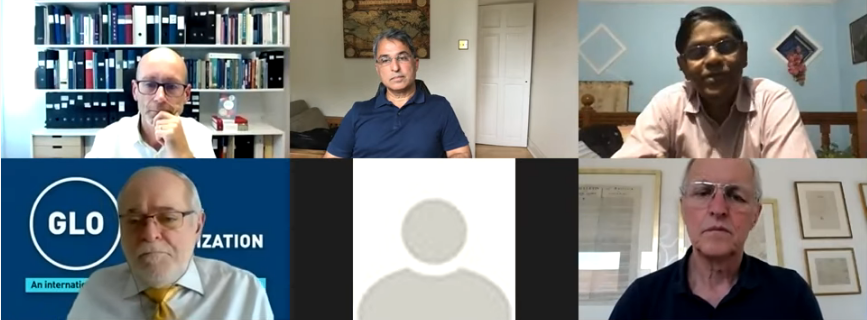
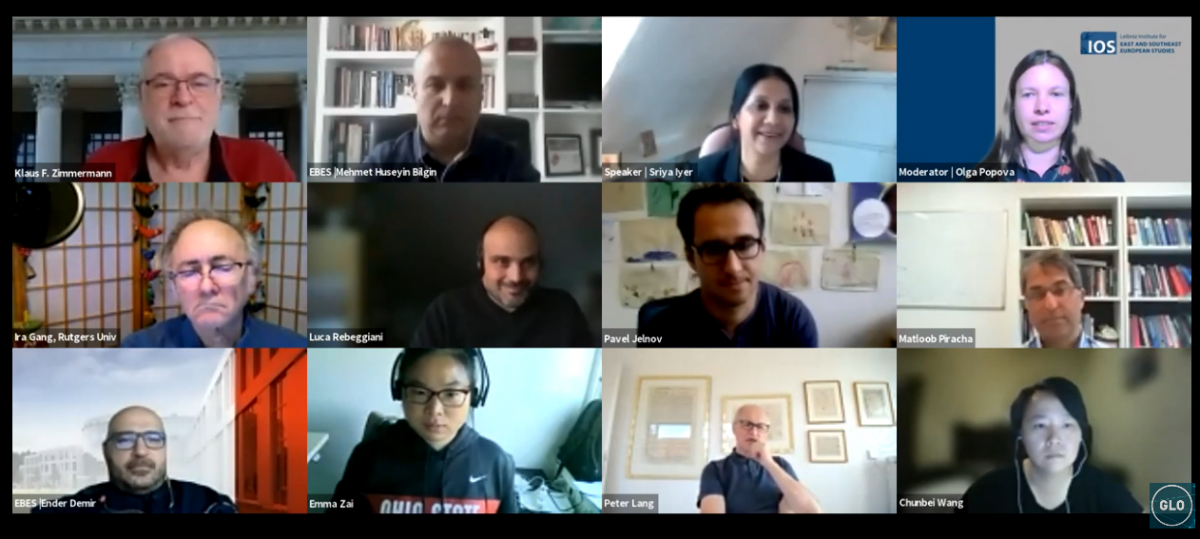
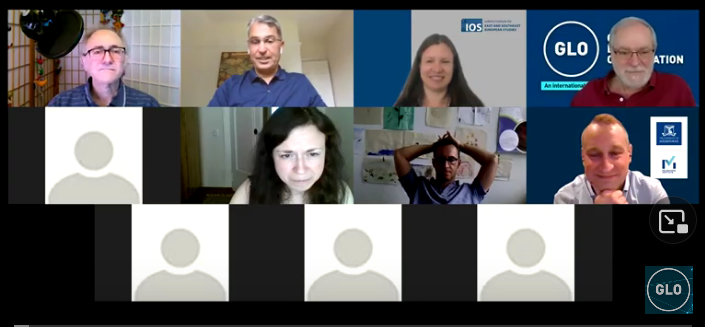
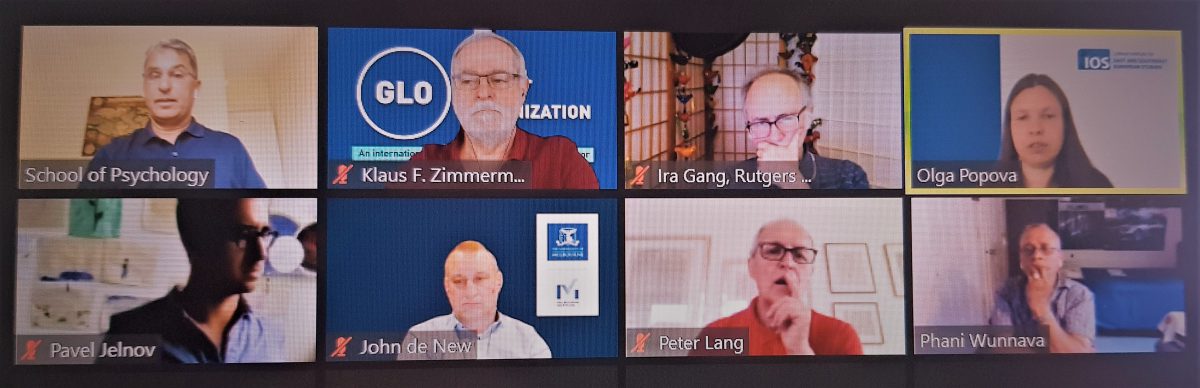
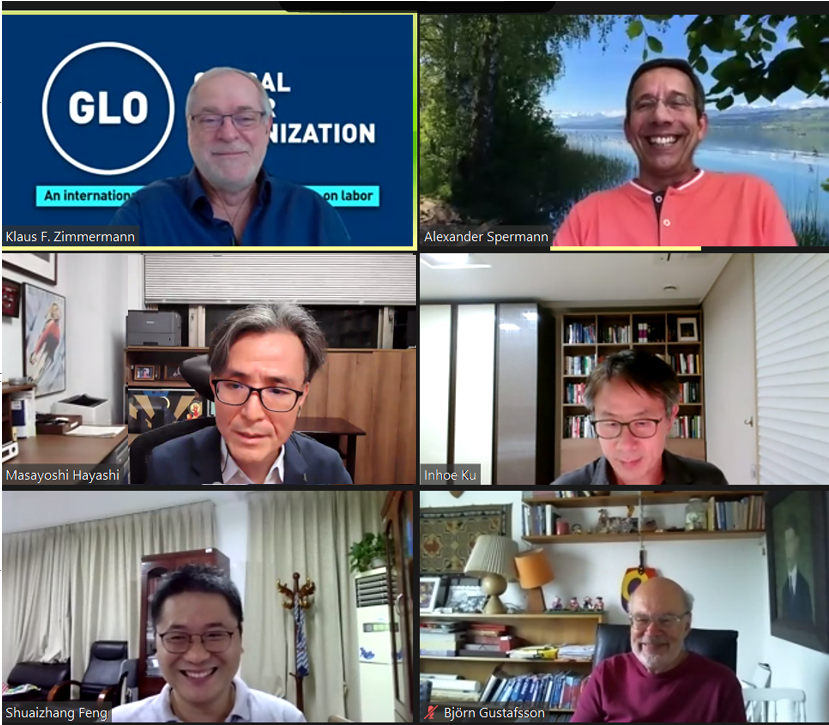
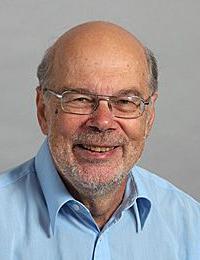
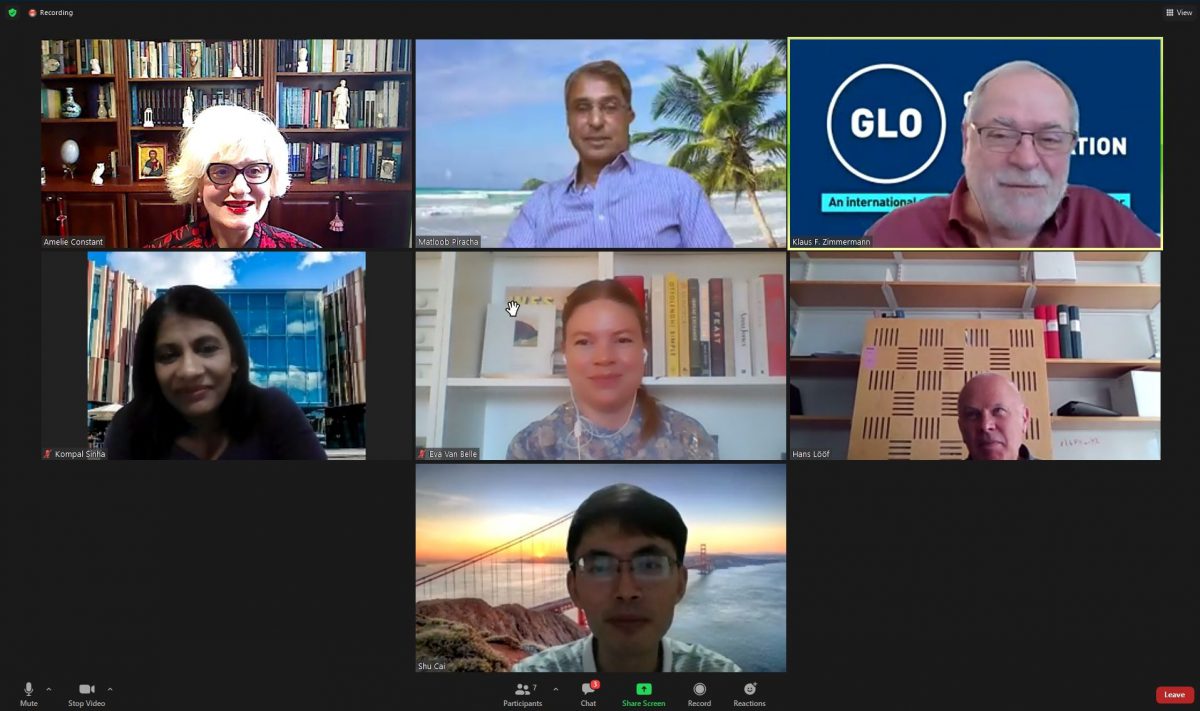
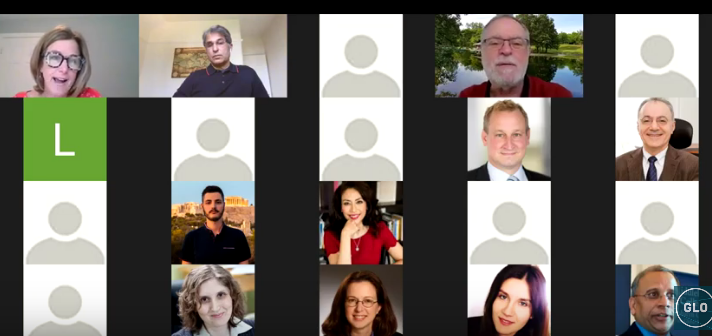
TheGLO Virtual Seminar is a monthly internal GLO research event chaired by GLO Director Matloob Piracha and hosted by the GLO partner institution University of Kent. The results are available on the GLO website and the GLO News section, where also the videos of the presentations are posted. All GLO related videos are also available in the GLO YouTube channel. (To subscribe go there.)
Forthcoming (GLO members & special invitations): December 2, 2021; 1 pm London/UK time:Mathilde Maurel (CNRS, FERDI and GLO
A new approach for evaluation of the economic impact of decentralized electrification projects (with J.C. Berthélémy)
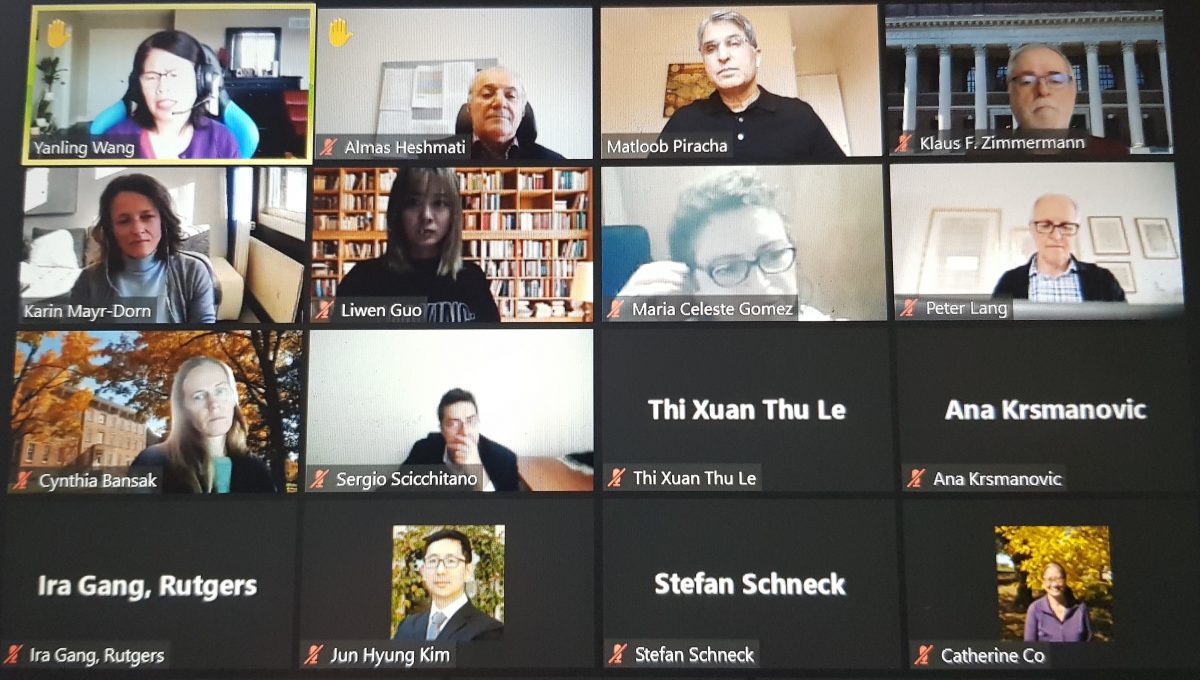
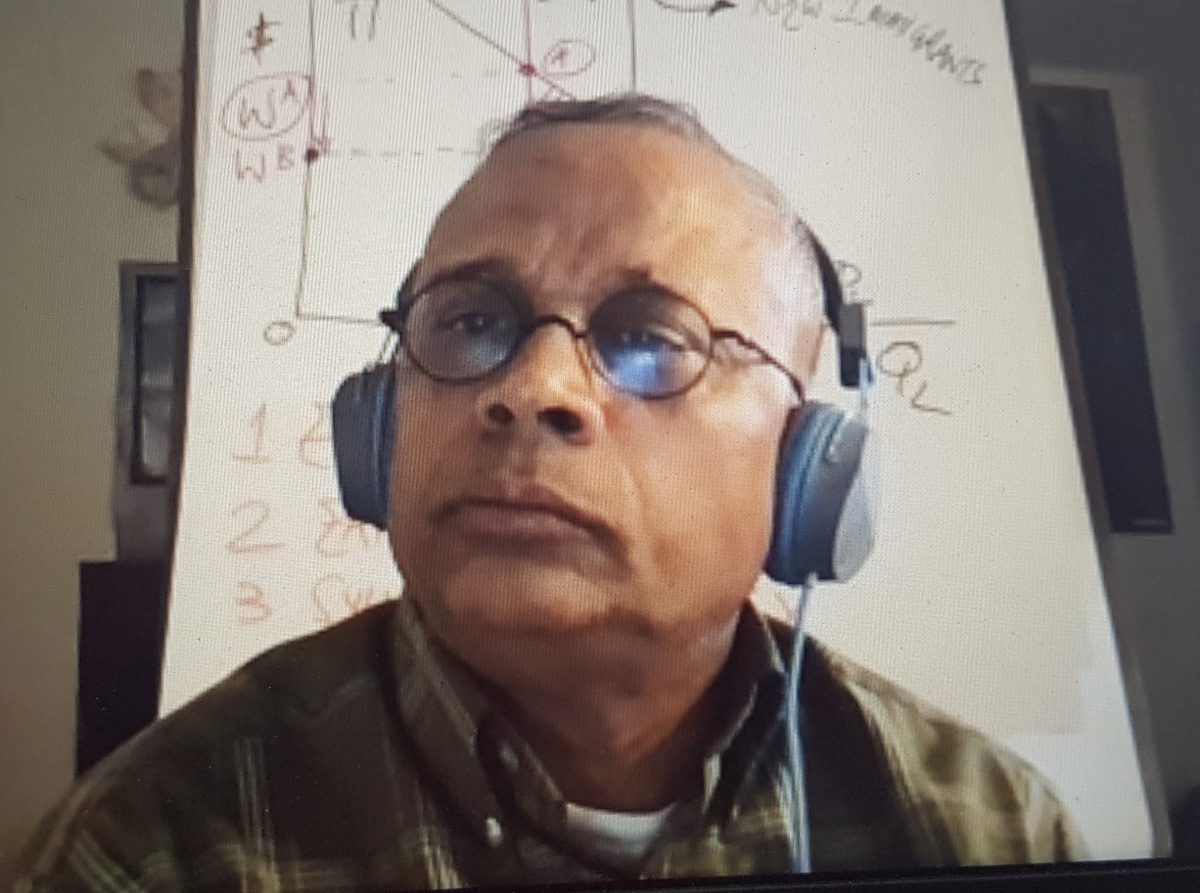
The November 2, 2021 seminar in the series was given on London/UK time at 1-2 pm, by Karin Mayr-Dorn (University of Linz and GLO). See below for a report and the full video of the seminar.
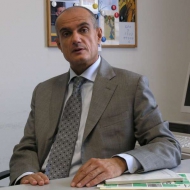
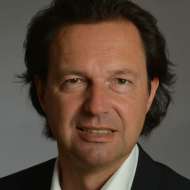
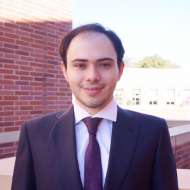
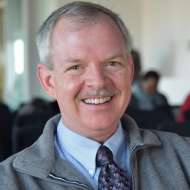
Karin Mayr-DornGLO DirectorMatloob Piracha
Report
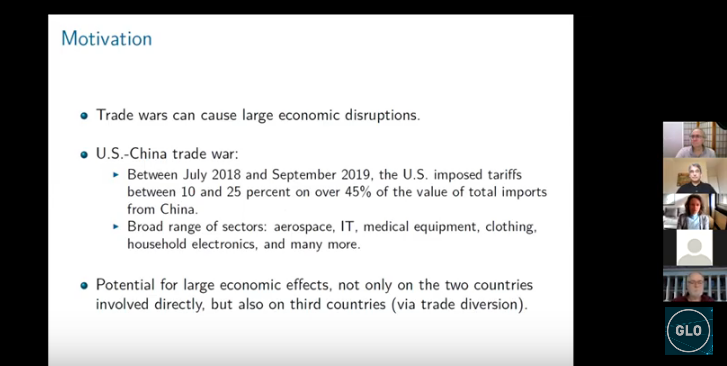
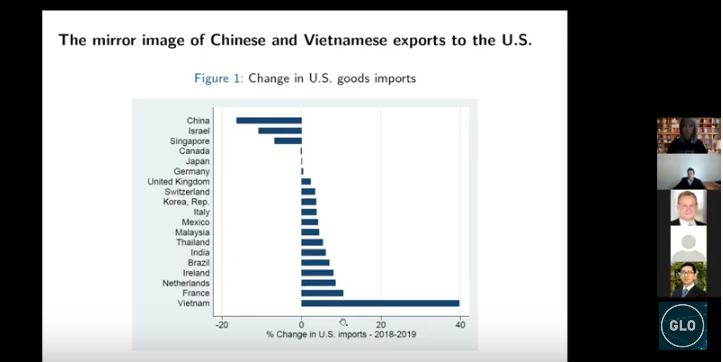
Trade diversion and labor market adjustment: Vietnam and the U.S.-China trade war
The 4th Renmin University of China & GLO Conference 2021 takes place online in Beijing on December 12 organized by the School of Labor and Human Resources together with GLO. Topics covered will deal with Chinese labor market issues.
The GLO Virtual Young Scholars Program (GLO VirtYS) 2021/2022 has started its activity.
In the spirit of the GLO Mission, the GLO VirtYS program’s goal is to contribute to the development of the future generation of researchers, who are committed to the creation of policy-relevant research, are well equipped to work in collaboration with policy makers and other stakeholders, and adhere to the highest standards of academic integrity. This goal is achieved through the process of working on a specific research paper within the duration of the program, which is 9 months, and interact with the GLO VirtYS cohort and advisors.
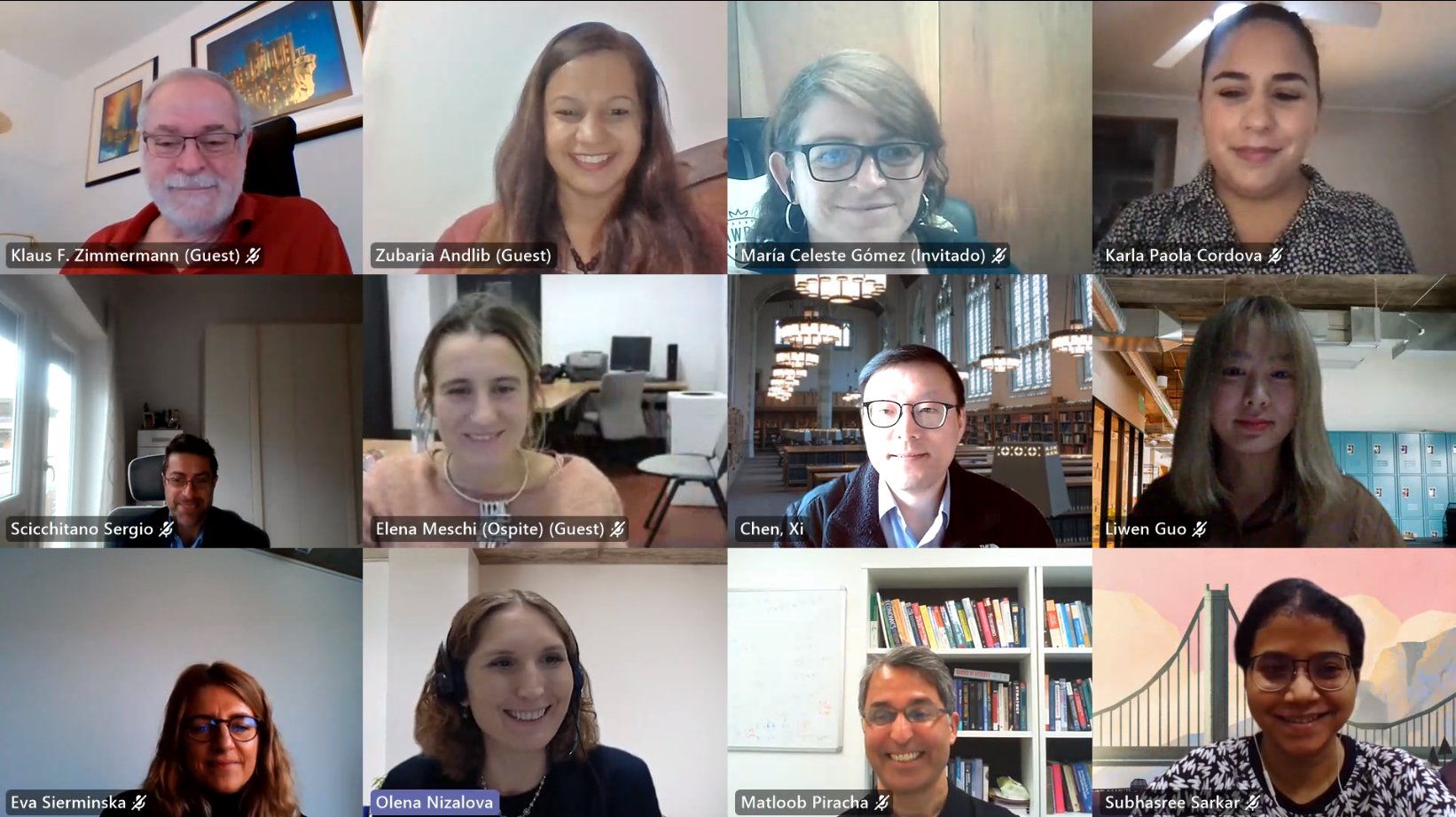
Under the leadership of GLO VirtYS Program Director Olena Nizalova, the participants have virtually met with GLO officials and advisors on November 10 2021 for a warm welcome and first interactions. GLO PresidentKlaus F. Zimmermann and GLO Director Matloob Piracha made introductory remarks. Program participants presented their research plans.
The following program participants have been appointed GLO Affiliate:
2021 Virtual Conference of the International Society for Quality-of-Life Studies ISQOLS 2021 CONFERENCE: “Quality-of-life and Adaptation in a Virulent World” VIRTUAL EVENT: 23-27, AUGUST 2021
The Global Labor Organization(GLO) and the Erasmus Happiness Research Organization(EHERO) joined forces for the third time in organizing five happiness economics sessions during the 19thInternational Society for Quality of Life Studies (ISQOLS) Virtual Conference (23-27 August, 2021).
Chaired by GLO FellowMartijn Hendriks, each session featured three or four presentations, followed by comments by a dedicated discussant, and questions from the audience. Despite the online format, the sessions had many attendees and featured lively discussions. The sessions have by now become a key part of the ISQOLS conference and a signature event of the GLO Happiness Economics cluster.
This year, the GLO/EHERO sessions also featured presentations of chapters from the section “Welfare, Well-being, Happiness” of the forthcoming Springer Nature Handbook “Labor, Human Resources and Population Economics” that is edited by GLO Fellow and Happiness Economics Cluster Lead Milena Nikolova. The Handbook’s Editor-in-Chief is GLO President Klaus F. Zimmermann.
Given the success of the sessions, the co-organizers Martijn Hendriks (GLO/EHERO), Martijn Burger (EHERO), and Milena Nikolova (GLO Fellow and Cluster Lead “Economics of Happiness”) will organize again special sessions at the 20th ISQOLS Annual Conference that will take place between 3-6 August in Burlington, Vermont, USA.
These special sessions are invitation-based to guarantee that the presentations are of high quality.
GLO – EHERO organizers
Dr. Milena Nikolova (University of Groningen and GLO), Dr. Martijn Hendriks (EHERO and GLO) and Dr. Martijn Burger (EHERO and Open Universiteit)
2021 Virtual Conference of the International Society for Quality-of-Life Studies ISQOLS 2021 CONFERENCE: “Quality-of-life and Adaptation in a Virulent World” VIRTUAL EVENT: 23-27, AUGUST 2021
Diana Tam and Arthur Grimes: The Economics of Free Speech: A Subjective Wellbeing Approach
Philip Morrison: Whose happiness in which cities? The urban wellbeing paradox revisited
Martijn Hendriks and Randall Birnberg: Happiness in the daily socio-cultural integration process: A day reconstruction study among US immigrants in Germany
Jeehoon Han and Caspar Kaiser: Changes in Time Use and Happiness
Carol Graham, Emily Dobson and James Kunhardt: When Public Health Crises Become Entwined: How Trends in COVID-19, Deaths of Despair, and Well-being Track Across the U.S.A.
Francesco Sarracino, Kelsey O’Connor, Chiara Peroni, Talita Greyling and Stephanie Rossouw: Well-being expressed through Twitter during the COVID-19 Pandemic
Julia Schmidtke, Clemens Hetschko, Gesine Stephan, Michael Eid, Ronnie Schöb and Mario Lawes: The impact of Covid-19 on mental health and well-being. An event-study based on high-frequency longitudinal survey data
Paul Fenton Villar: Is there a Mineral-Induced ‘Economic Euphoria’?: Evidence from Latin America
Mariano Rojas, Karen Watkins and Lázaro Rodríguez: The Happiness of CEOs in Family and Nonfamily Firms: Different Explanatory Structures and its Consequences
Annie Tubadji: Consumer Happiness and AI Sensitivity to Cultural and Moral Preferences
Interested researchers are cordially invited to submit their abstracts or papers for presentation consideration. The 38th EBES Conference in Warsaw will take place on January 12-14, 2022 in Hybrid Mode (online and in-person). The event is supported by the Istanbul Economic Research Association and hosted by the Faculty of Economics Sciences, University of Warsaw. GLO & EBES are collaborating organizations.
Invited Speakers
EBES is pleased to announce that distinguished colleagues Christos Kollias, M. Kabir Hassan, Christopher A. Hartwell and Klaus F. Zimmermann will participate as keynote speakers and/or invited editors.
Christos Kollias is a Professor of Applied Economics and Acting Dean at the University of Thessaly, Greece. In his career, he has published more than 100 papers and many edited volumes and books. His papers were published in many of the leading journals such as Journal of Multinational Financial Management, Applied Economics, Applied Economics Letters, Finance Research Letters, Public Choice, Southern Economic Journal, and Journal of Business Ethics. He is currently the Editor of Defence and Peace Economics (SSCI) and a member of the Editorial Boards of Peace Economics, Peace Science and Public Policy and the Economics of Peace and Security Journal and a member of the governing body of the Network of European Peace Scientists (NEPS). His research interests include defence economics, terrorism, international political economy, and applied macroeconomics.
M. Kabir Hassan is Professor of Finance in the Department of Economics and Finance in the University of New Orleans. He currently holds two endowed Chairs-Hibernia Professor of Economics and Finance, and Bank One Professor in Business- in the University of New Orleans. Professor Hassan is the winner of the 2016 Islamic Development Bank (IDB) Prize in Islamic Banking and Finance. Professor Professor Hassan has over 383 papers published/forthcoming in refereed academic journals. Professor Hassan has also been cited as one of the most prolific authors in finance literature in the last fifty years in a paper published in Journal of Finance Literature. His publication record puts him among the top 5.6% of all authors who published in the 26 leading finance journals. He is among the top 5% authors according to number of Journal Pages at RePAC/IDEAS. Professor Hassan has been included in its 2021 edition as 2% of top scholars in the world in a study published by Standford University and Elsevier Publishing Company. Professor Hassan is the 2019 recipient of University of Louisiana System Outstanding Educator, 2019 Life-long Research Achievement Award, and 2018 UNO Nick Mueller International Leadership Medallion Winner and 2019 UL System outstanding Educator Award. Professor Hassan is the Editor-in-Chief of International Journal of Islamic and Middle Eastern Finance and Management, and Journal of Economic Cooperation and Development published by SESRIC. Professor Hassan is a member of the AAOIFI Ethics and Governance Board and Education Board. He is also an advisory Board Member of Oxford University Faith-Aligned Impact Finance Project.
Christopher A. Hartwell is currently Head of the International Management Institute at the Zurich University of Applied Sciences (ZHAW) School of Management and Law, Professor of International Management at Kozminski University in Poland, Visiting Professor at the Russian Presidential Academy of National Economy and Public Administration (RANEPA), and Fellow and former President of the Center for Social and Economic Research (CASE) in Warsaw. A leading scholar on the evolution of economic institutions. Prof. Hartwell’s interests are in institutional development, especially the interplay between financial institutions and other political and economic institutions. Over his career, Professor Hartwell has published in journals such as Journal of World Business, Global Strategy Journal, Journal of Economic Behavior & Organization, Explorations in Economic History, Journal of Comparative Economics, Regional Studies, Cambridge Journal of Economics, and Journal of Institutional Economics. Prof. Hartwell holds a PhD in Economics from the Warsaw School of Economics, a Master’s in Public Policy from Harvard, and a BA in Political Science and Economics from the University of Pennsylvania. He is also the author of Two Roads Diverge: The Transition Experience of Poland and Ukraine (Cambridge University Press, 2016) and Institutional Barriers in the Transition to Market: Examining Performance and Divergence in Transition Economies (Palgrave Macmillan, 2013).
Klaus F. Zimmermann is President of EBES; President of the Global Labor Organization (GLO); Co-Director of POP at UNU-MERIT; Full Professor of Economics at Bonn University (ret.); Honorary Professor, Maastricht University, Free University of Berlin, Renmin University of China and Lixin University; Member, German Academy of Sciences Leopoldina, Regional Science Academy, and Academia Europaea (Chair of its Section for Economics, Business and Management Sciences). Among others, he has worked at Macquarie University, the Universities of Melbourne, Princeton, Harvard, Munich, Kyoto, Mannheim, Dartmouth College and the University of Pennsylvania. Research Fellow of the Centre for Economic Policy Research (CEPR) and Fellow of the European Economic Association (EEA). Editor-in-Chief of the Journal of Population Economics. Editorial Board of International Journal of Manpower, Research in Labor Economics and Comparative Economic Studies, among others. Founding Director, Institute for the Study of Labor (IZA); Past-President, German Institute for Economic Research (DIW). Distinguished John G. Diefenbaker Award 1998 of the Canada Council for the Arts; Outstanding Contribution Award 2013 of the European Investment Bank. Rockefeller Foundation Policy Fellow 2017; Eminent Research Scholar Award 2017, Australia; EBES Fellow Award 2018. He has published in many top journals including Journal of Economic Perspectives, American Economic Review, Econometrica, Journal of the European Economic Association, Journal of Human Resources, Journal of Applied Econometrics, Public Choice, Review of Economics and Statistics, Journal of Population Economics and Journal of Public Economics. His research fields are population, labor, development, and migration.
Executive Board
Prof. Klaus F. Zimmermann, UNU-MERIT, Maastricht, and Free University Berlin Prof. Jonathan Batten, University Utara Malaysia, Malaysia Prof. Iftekhar Hasan, Fordham University, U.S.A. Prof. Euston Quah, Nanyang Technological University, Singapore Prof. John Rust, Georgetown University, U.S.A. Prof. Dorothea Schäfer, German Institute for Economic Research DIW Berlin, Germany Prof. Marco Vivarelli, Università Cattolica Del Sacro Cuore, Italy
Abstract/Paper Submission
Authors are invited to submit their abstracts or papers no later than December 3, 2021
General inquiries regarding the call for papers should be directed to ebes@ebesweb.org.
Publication Opportunities
Qualified papers can be published in EBES journals (Eurasian Business Review and Eurasian Economic Review) or EBES proceedings books after a peer review process without any submission or publication fees. EBES journals (EABR and EAER) are published by Springer and both are indexed in the SCOPUS, EBSCO EconLit with Full Text, Google Scholar, ABS Academic Journal Quality Guide, CNKI, EBSCO Business Source, EBSCO Discovery Service, ProQuest International Bibliography of the Social Sciences (IBSS), OCLC WorldCat Discovery Service, ProQuest ABI/INFORM, ProQuest Business Premium Collection, ProQuest Central, ProQuest Turkey Database, ProQuest-ExLibris Primo, ProQuest-ExLibris Summon, Research Papers in Economics (RePEc), Institute of Scientific and Technical Information of China, Naver, SCImago, ABDC Journal Quality List, Cabell’s Directory, and Ulrich’s Periodicals Directory. In addition, while EAER is indexed in the Emerging Sources Citation Index (Clarivate Analytics), EABR is indexed in the Social Science Citation Index (SSCI) and Current Contents / Social & Behavioral Sciences.
Furthermore, the qualified papers from the conference will be published in the regular issues of Eastern European Economics (SSCI & Scopus) after a fast-track review.
Also, all accepted abstracts will be published electronically in the Conference Program and the Abstract Book (with an ISBN number). It will be distributed to all conference participants at the conference via USB. Although submitting full papers are not required, all the submitted full papers will also be included in the conference proceedings in a USB.
After the conference, participants will also have the opportunity to send their paper to be published (after a refereeing process managed by EBES) in the Springer’s series Eurasian Studies in Business and Economics (no submission and publication fees). This is indexed by Scopus. It will also be sent to Clarivate Analytics in order to be reviewed for coverage in the Conference Proceedings Citation Index – Social Science & Humanities (CPCI-SSH). Please note that the 10th, 11th, 12th, 13th, 14th, 15th, 16th, 17th, 18th, 19th, 20th (Vol. 2), 21st, 24th, and 25th EBES Conference Proceedings are accepted for inclusion in the Conference Proceedings Citation Index – Social Science & Humanities (CPCI-SSH). Other conference proceedings are in progress.
Important Dates
Conference Date: January 12-14, 2022 Abstract Submission Deadline: December 3, 2021 Reply-by: December 6, 2021* Registration Deadline: December 17, 2021 Submission of the Virtual Presentation: December 17, 2021 Announcement of the Program: December 24, 2021 Paper Submission Deadline (Optional): December 17, 2021** Paper Submission for the EBES journals: March 16, 2022
* The decision regarding the acceptance/rejection of each abstract/paper will be communicated with the corresponding author within a week of submission.
** Completed paper submission is optional. If you want to be considered for the Best Paper Award or your full paper to be included in the conference proceedings in the USB, after submitting your abstract before December 3, 2021, you must also submit your completed (full) paper by December 17, 2021.
Contact
Ugur Can, Director of EBES (ebes@ebesweb.org) Dr. Ender Demir, Conference Coordinator of EBES (demir@ebesweb.org)
TheGLO Virtual Seminar is a monthly internal GLO research event chaired by GLO Director Matloob Piracha and hosted by the GLO partner institution University of Kent. The results are available on the GLO website and the GLO News section, where also the video of the presentation is posted. All GLO related videos are also available in the GLO YouTube channel. (To subscribe go there.)
Forthcoming (GLO members & special invitations): November 4, 2021; 1 pm London/UK:Karin Mayr-Dorn (University of Linz and GLO) Trade diversion and labor market adjustment: Vietnam and the U.S.-China trade war
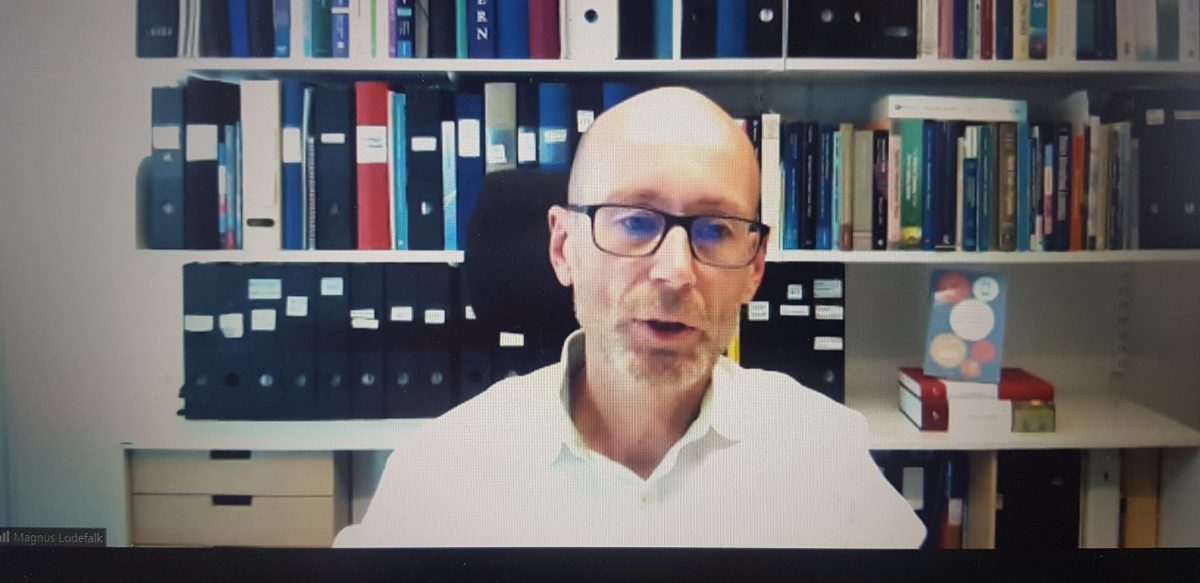
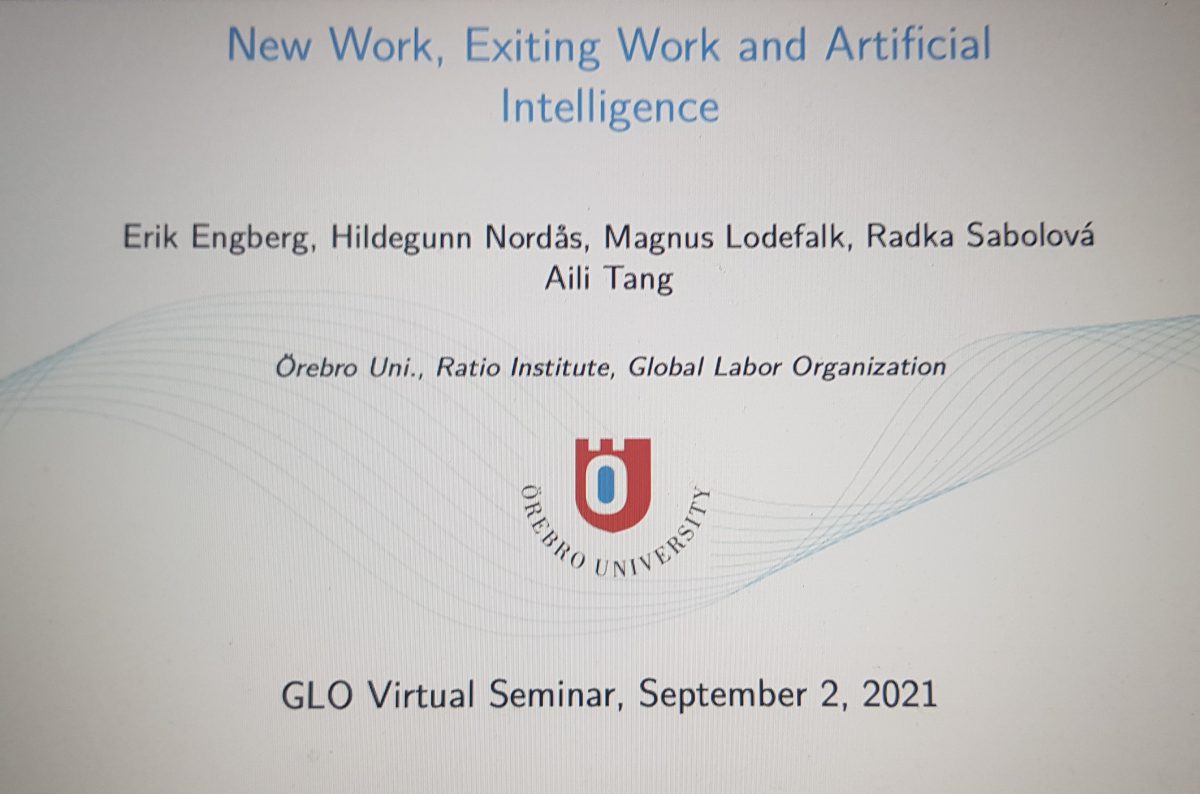
The seminar opening the Fall term was given on September 2, 2021, London/UKat 1-2 pm, by Magnus Lodefalk (Örebro University and GLO). See below a report and the full video of the seminar.
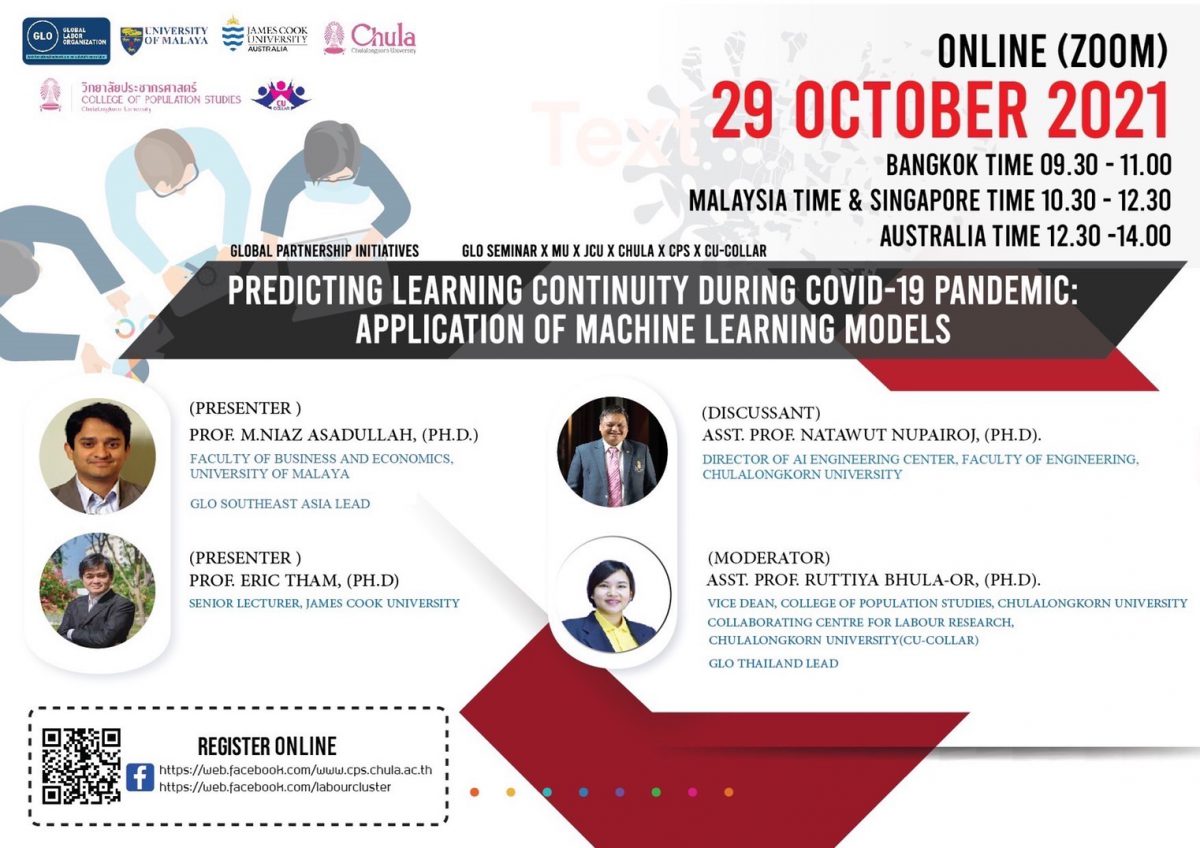
As part of GLO’s SE Asia cluster activities, the GLO webinar will discuss “Predicting learning continuity during the COVID-19 epidemic using machine learning models.”
Please see more details in the poster below. It is scheduled to take place on 29 October 2021. (Online Zoom). Online registration is available at https://forms.gle/gxsJfCegs8E14DbS7
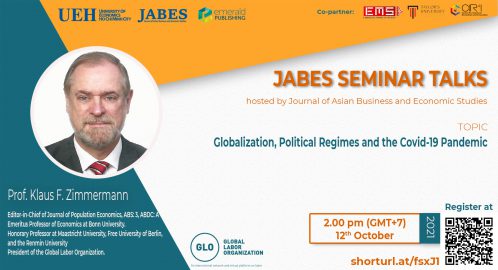
Klaus F. Zimmermann (GLO & UNU-MERIT) will speak on 12 October 2021 in an online talk at the University of Economics, Ho Chi Minh City, Hanoi, Vietnam, as part of the JABES Seminar Talks on Globalization, Political Regimes and the Covid-19 Pandemic. He will report about some of his recent studies in the field and explore the challenges for economic research studying the implications of the pandemic.
Gokhan Karabulut, Klaus F. Zimmermann, Mehmet Huseyin Bilgin and Asli Cansin Doker (2021), “Democracy and COVID-19 Outcomes”, Economics Letters (EL-Prepublication, EL-Online Appendix) Volume 203, June 2021, 109840 Open Access; free PDF. https://doi.org/10.1016/j.econlet.2021.109840
The 37th EBES Conference takes place online on October 6-8 2021. GLO is a co-organizing partner, and FOM University of Applied Sciences is the local host supporting the event from Berlin.EBES, theEurasia Business and Economics Society, and FOM University of Applied Sciencesare strategic partners and institutional supporters of GLO.
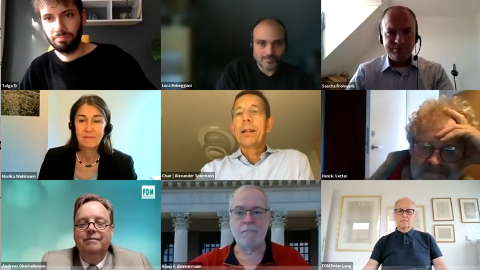
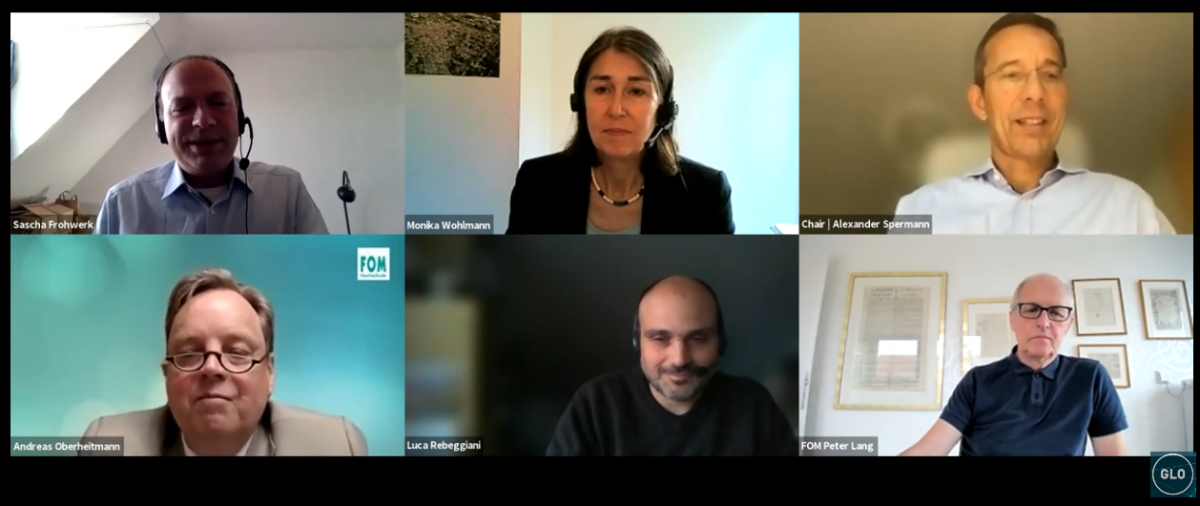
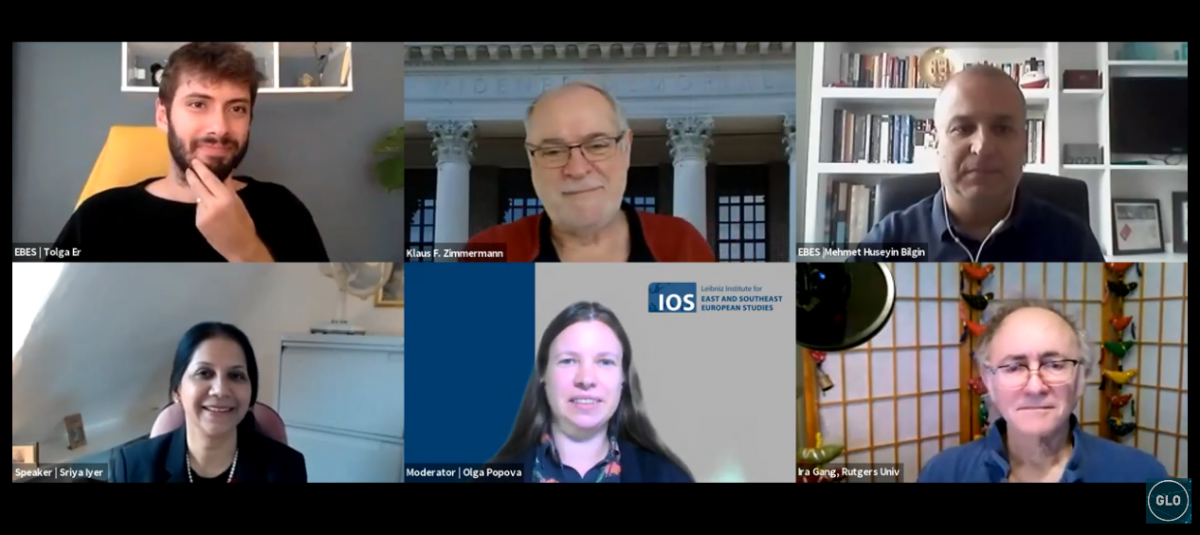
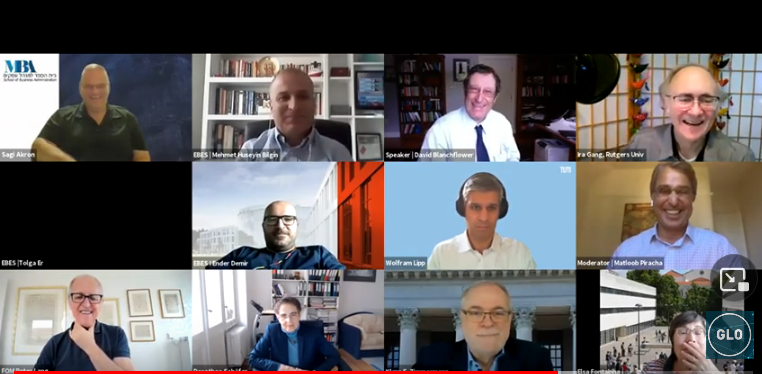
Day TWO (October 7) saw next to 9 parallel research paper sessions a Special FOM-GLO Session and the GLO Handbook Session Migration I. The highlight plenary Speech of the Day was delivered by Sriya Iyer (University of Cambridge and GLO) on Religion and Mental Health chaired by Olga Popova (Leibniz Institute for East and Southeast European Studies, CERGE-EI & GLO), who is also the GLO Research Cluster Lead “Religion”. The EBES 37 Plenary Speech was this time joint with the monthly GLO Virtual Research Seminar normally chaired by GLO Director Matloob Piracha.
CONFERENCE PROGRAM WITH PARTICIPATION DETAILS: LINK
Monika Wohlmann (FOM University of Applied Science): The European Central Bank’s Strategy Review and the Management of Inflation Expectations
Sascha Frohwerk (FOM University of Applied Sciences, Berlin, Hasso-Plattner-Institute, Potsdam and GLO): Retail Location Choice Models. A Comparison of Gravitation and Logit Model
Andreas Oberheitmann (Tsinghua University, FOM and GLO): Development of a Low Carbon Economy in Wuxi City. An Example of Climate Change Mitigation in China on the Local Level.
Michael Drewes (FOM University of Applied Sciences, Mannheim) and Luca Rebeggiani (FOM University of Applied Sciences, Bonn): Private vs. Public Financing of Sport Stadia in Germany – An Empirical Analysis.
Sascha Frohwerk (FOM University of Applied Sciences, Berlin, Hasso-Plattner-Institute, Potsdam and GLO), Carsten Kruppe and Holger Wassermann: Evolution or Revolution: The Entry of New Company Successors in Germany
Kai Klotz and Alexander Spermann (FOM University of Applied Sciences, Cologne, Freiburg University and GLO): Did the Refugee Crisis Cause the Rise of Right-wing Parties? Empirical Evidence from East Germany.
14.00-15.00. Plenary Speech joint with the monthly GLO Seminar Sriya Iyer (University of Cambridge and GLO): Religion and Mental Health Chair: Olga Popova (Leibniz Institute for East and Southeast European Studies, CERGE-EI & GLO)
Note: The session relates to the Springer Nature Handbook project“Labor, Human Resources and Population Economics”supported by the GLO network.
Massimiliano Tani (University of New South Wales & GLO) & Matloob Piracha (University of Kent & GLO): Migration and Education
Cinzia Rienzo ( University of Brighton & GLO): Performance of Economic Migrants
Cynthia A. Bansak (St. Lawrence University & GLO), Nicole Simpson (Colgate University & GLO) and Madeline Zavodny (University of North Florida & GLO): Immigrants and Their Effects on Labor Market Outcomes of Natives
The 37th EBES Conference takes place online on October 6-8 2021. GLO is a co-organizing partner, and FOM University of Applied Sciences is the local host supporting the event from Berlin.EBES, theEurasia Business and Economics Society, and FOM University of Applied Sciencesare strategic partners and institutional supporters of GLO.
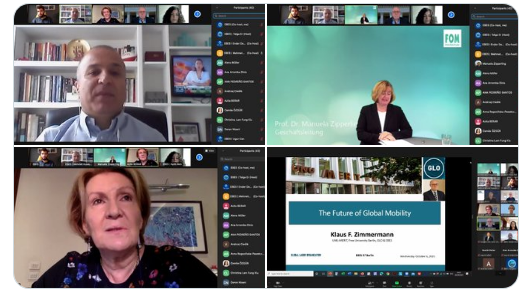
Day ONE (October 6) saw opening speeches and lectures, intense parallel sessions, the conference keynote speech, and the EBES Journals session. EBES and GLO President Klaus F. Zimmermann spoke about The Future of Global Mobility. The Keynote Speech was provided by GLO Research Director David G. Blanchflower on The Economics of Walking About and Predicting Unemployment. (For the video of the Blanchflower keynote see LINK below.)
CONFERENCE PROGRAM WITH PARTICIPATION DETAILS: LINK
Some pictures from the event and an overview of the GLO-related contributions can be found below:
GLO supported program parts:
TIME STRUCTURE (All CET Berlin time)
Wednesday, October 6:
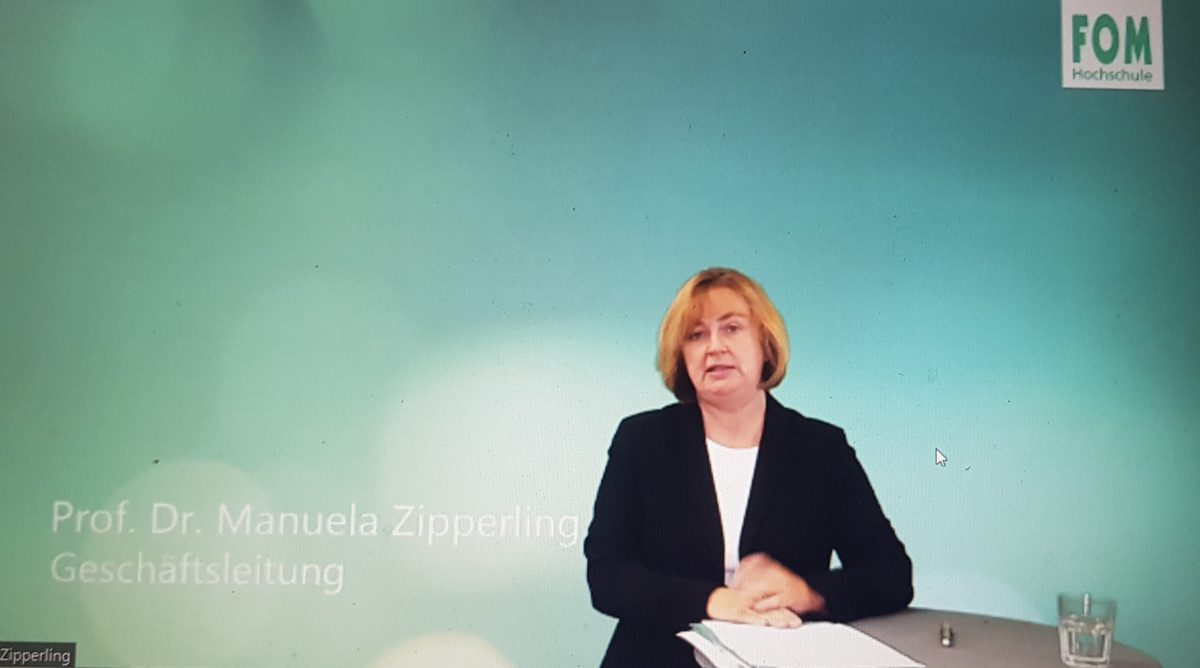
9.00 – 9.45. Welcome Speeches: Mehmet Bilgin (EBES & GLO), Manuela Zipperling (FOM & GLO), and Azita Berar Awad (Graduate Institute of International and Development Studies, Geneva, & GLO) Opening Lecture: Klaus F. Zimmermann (UNU-MERIT, Free University Berlin & GLO) The Future of Global Mobility Chair: Mehmet Bilgin (Istanbul Medeniyet University, EBES & GLO)
Head of FOM Berlin, Manuela ZipperlingGLO Policy Director Azita Berar Awad
15.15-16.15. Keynote Speech David G. Blanchflower (Dartmouth College & GLO) The Economics of Walking About and Predicting Unemployment Chair: Matloob Piracha (University of Kent & GLO)
Matloob Piracha, David G. Blanchflower and Klaus F. Zimmermann (from the left)
GLO Research Director David G. Blanchflower
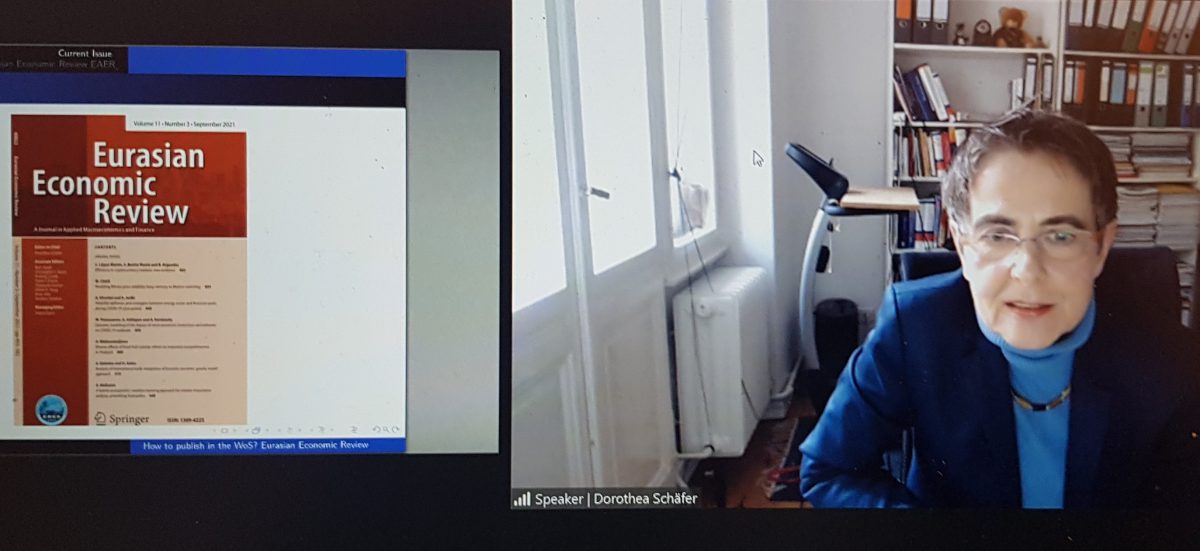
16.30-17.15. EBES Journals Session Chair: Klaus F. Zimmermann (EBES President & GLO) with Dorothea Schäfer (DIW Berlin, Jönköping University & GLO), Editor-in-Chief of Eurasian Economic Review, and Marco Vivarelli (Catholic University of Milano & GLO), Editor-in-Chief of the Eurasian Business Review.
Thursday, October 7:
9.00-11.00. FOM-GLO Session Chair: Alexander Spermann (FOM University of Applied Sciences, Cologne, Freiburg University and GLO)
Monika Wohlmann (FOM University of Applied Science): The European Central Bank’s Strategy Review and the Management of Inflation Expectations
Sascha Frohwerk (FOM University of Applied Sciences, Berlin, Hasso-Plattner-Institute, Potsdam and GLO): Retail Location Choice Models. A Comparison of Gravitation and Logit Model
Andreas Oberheitmann (Tsinghua University, FOM and GLO): Development of a Low Carbon Economy in Wuxi City. An Example of Climate Change Mitigation in China on the Local Level.
Michael Drewes (FOM University of Applied Sciences, Mannheim) and Luca Rebeggiani (FOM University of Applied Sciences, Bonn): Private vs. Public Financing of Sport Stadia in Germany – An Empirical Analysis.
Sascha Frohwerk (FOM University of Applied Sciences, Berlin, Hasso-Plattner-Institute, Potsdam and GLO), Carsten Kruppe and Holger Wassermann: Evolution or Revolution: The Entry of New Company Successors in Germany
Kai Klotz and Alexander Spermann (FOM University of Applied Sciences, Cologne, Freiburg University and GLO): Did the Refugee Crisis Cause the Rise of Right-wing Parties? Empirical Evidence from East Germany.
14.00-15.00. Plenary Speech joint with the monthly GLO Seminar Sriya Iyer (University of Cambridge and GLO): Religion and Mental Health Chair: Olga Popova (Leibniz Institute for East and Southeast European Studies, CERGE-EI & GLO)
Note: The session relates to the Springer Nature Handbook project“Labor, Human Resources and Population Economics”supported by the GLO network.
15.15 – 17.15. GLO Session Migration I Chair: Cynthia Bansak (St. Lawrence University & GLO)
Note: The session relates to the Springer Nature Handbook project“Labor, Human Resources and Population Economics”supported by the GLO network.
Sonia Plaza (World Bank & GLO): Measuring Migration
Massimiliano Tani (University of New South Wales & GLO) & Matloob Piracha (University of Kent & GLO): Migration and Education
Cinzia Rienzo ( University of Brighton & GLO): Performance of Economic Migrants
Cynthia A. Bansak (St. Lawrence University & GLO), Nicole Simpson (Colgate University & GLO) and Madeline Zavodny (University of North Florida & GLO): Immigrants and Their Effects on Labor Market Outcomes of Natives
Chunbei Wang (University of Oklahoma & GLO) & Magnus Lofstrom (Public Policy Institute of California & GLO): Immigrant Entrepreneurs
Friday, October 8:
14.15 – 16.15. GLO SessionFamily & Household Economics Chair: Victoria Vernon (SUNY Empire State College & GLO)
Note: The session relates to the Springer Nature Handbook project“Labor, Human Resources and Population Economics”supported by the GLO network.
Effrosyni Adamopoulou (University of Mannheim & GLO): Infidelity
Juan Carlos Campaña (Antonio de Nebrija University), José Ignacio Giménez-Nadal (University of Zaragoza) & José Alberto Molina (University of Zaragoza & GLO): Time-Use Surveys
Benjamin Scharadin (Colby College): Household Food Expenditures and Diet Quality
Daniel Fernandez-Kranz (IE Business School, Madrid) & Jennifer Roff (Queens College and the Graduate Center, CUNY): Child Custody Laws and Household Outcomes
Irene Mosca (Maynooth University & GLO) and Robert E. Wright (University of Glasgow & GLO): Economics of Marriage Bars
16.30 – 18.30. GLO Session Migration II Chair: Marina Murat (University of Modena and Reggio Emilia & GLO)
Note: The session relates to the Springer Nature Handbook project“Labor, Human Resources and Population Economics”supported by the GLO network.
Jakub Lonsky (University of Liverpool & GLO) & Osea Giuntella (University of Pittsburgh & GLO): Migrant Health and Wellbeing
Kusum Mundra (Rutgers University & GLO): The Political Economy of Citizenship
Catalina Amuedo-Dorantes (University of California & GLO), Anna Marie Kietzerow (Western Michigan University) & Susan Pozo (Western Michigan University): Naturalization, Citizenship, and Identity Documents
Stefanija Veljanoska (University of Rennes) & Frederic Docquier (LISER & GLO): Brain Drain or Gain
Amelie Constant (Princeton University & GLO): Time-Space Dynamics of Return and Circular Migration
Michele Tuccio (Université Paris-Dauphine & GLO) & Jackline Wahba (University of Southampton & GLO): Social Remittances
The 37th EBES Conference will take place online on October 6-8 2021. GLO is a co-organizing partner, and FOM University of Applied Sciences is the local host supporting the event from Berlin.EBES, theEurasia Business and Economics Society, and FOM University of Applied Sciencesboth are strategic partners and institutional supporters of GLO. GLO President Klaus F. Zimmermann is also President of EBES.FOM and GLO contribute own sessions as listed below.
CONFERENCE PROGRAM WITH PARTICIPATION DETAILS: LINK
An overview of the GLO-related contributions can be found below:
GLO supported program parts:
TIME STRUCTURE (All CET Berlin time)
Wednesday, October 6:
9.00 – 9.45. Welcome Speeches: Mehmet Bilgin (EBES & GLO), Manuela Zipperling (FOM & GLO), and Azita Berar Awad (Graduate Institute of International and Development Studies, Geneva, & GLO) Opening Lecture: Klaus F. Zimmermann (UNU-MERIT, Free University Berlin & GLO) The Future of Global Mobility Chair: Mehmet Bilgin (Istanbul Medeniyet University, EBES & GLO)
15.15-16.15. Keynote Speech David G. Blanchflower (Dartmouth College & GLO) The Economics of Walking About and Predicting Unemployment Chair: Matloob Piracha (University of Kent & GLO)
16.30-17.15. EBES Journals Session Chair: Klaus F. Zimmermann (EBES President & GLO) with Dorothea Schäfer (DIW Berlin, Jönköping University & GLO), Editor-in-Chief of Eurasian Economic Review, and Marco Vivarelli (Catholic University of Milano & GLO), Editor-in-Chief of the Eurasian Business Review.
Thursday, October 7:
9.00-11.00. FOM-GLO Session Chair: Alexander Spermann (FOM University of Applied Sciences, Cologne, Freiburg University and GLO)
Monika Wohlmann (FOM University of Applied Science): The European Central Bank’s Strategy Review and the Management of Inflation Expectations
Sascha Frohwerk (FOM University of Applied Sciences, Berlin, Hasso-Plattner-Institute, Potsdam and GLO): Retail Location Choice Models. A Comparison of Gravitation and Logit Model
Andreas Oberheitmann (Tsinghua University, FOM and GLO): Development of a Low Carbon Economy in Wuxi City. An Example of Climate Change Mitigation in China on the Local Level.
Michael Drewes (FOM University of Applied Sciences, Mannheim) and Luca Rebeggiani (FOM University of Applied Sciences, Bonn): Private vs. Public Financing of Sport Stadia in Germany – An Empirical Analysis.
Sascha Frohwerk (FOM University of Applied Sciences, Berlin, Hasso-Plattner-Institute, Potsdam and GLO), Carsten Kruppe and Holger Wassermann: Evolution or Revolution: The Entry of New Company Successors in Germany
Kai Klotz and Alexander Spermann (FOM University of Applied Sciences, Cologne, Freiburg University and GLO): Did the Refugee Crisis Cause the Rise of Right-wing Parties? Empirical Evidence from East Germany.
14.00-15.00. Plenary Speech joint with the monthly GLO Seminar Sriya Iyer (University of Cambridge and GLO): Religion and Mental Health Chair: Olga Popova (Leibniz Institute for East and Southeast European Studies, CERGE-EI & GLO)
Note: The session relates to the Springer Nature Handbook project“Labor, Human Resources and Population Economics”supported by the GLO network.
15.15 – 17.15. GLO Session Migration I Chair: Cynthia Bansak (St. Lawrence University & GLO)
Note: The session relates to the Springer Nature Handbook project“Labor, Human Resources and Population Economics”supported by the GLO network.
Sonia Plaza (World Bank & GLO): Measuring Migration
Massimiliano Tani (University of New South Wales & GLO) & Matloob Piracha (University of Kent & GLO): Migration and Education
Cinzia Rienzo ( University of Brighton & GLO): Performance of Economic Migrants
Cynthia A. Bansak (St. Lawrence University & GLO), Nicole Simpson (Colgate University & GLO) and Madeline Zavodny (University of North Florida & GLO): Immigrants and Their Effects on Labor Market Outcomes of Natives
Chunbei Wang (University of Oklahoma & GLO) & Magnus Lofstrom (Public Policy Institute of California & GLO): Immigrant Entrepreneurs
Friday, October 8:
14.15 – 16.15. GLO SessionFamily & Household Economics Chair: Victoria Vernon (SUNY Empire State College & GLO)
Note: The session relates to the Springer Nature Handbook project“Labor, Human Resources and Population Economics”supported by the GLO network.
Effrosyni Adamopoulou (University of Mannheim & GLO): Infidelity
Juan Carlos Campaña (Antonio de Nebrija University), José Ignacio Giménez-Nadal (University of Zaragoza) & José Alberto Molina (University of Zaragoza & GLO): Time-Use Surveys
Benjamin Scharadin (Colby College): Household Food Expenditures and Diet Quality
Daniel Fernandez-Kranz (IE Business School, Madrid) & Jennifer Roff (Queens College and the Graduate Center, CUNY): Child Custody Laws and Household Outcomes
Irene Mosca (Maynooth University & GLO) and Robert E. Wright (University of Glasgow & GLO): Economics of Marriage Bars
16.30 – 18.30. GLO Session Migration II Chair: Marina Murat (University of Modena and Reggio Emilia & GLO)
Note: The session relates to the Springer Nature Handbook project“Labor, Human Resources and Population Economics”supported by the GLO network.
Jakub Lonsky (University of Liverpool & GLO) & Osea Giuntella (University of Pittsburgh & GLO): Migrant Health and Wellbeing
Kusum Mundra (Rutgers University & GLO): The Political Economy of Citizenship
Catalina Amuedo-Dorantes (University of California & GLO), Anna Marie Kietzerow (Western Michigan University) & Susan Pozo (Western Michigan University): Naturalization, Citizenship, and Identity Documents
Stefanija Veljanoska (University of Rennes) & Frederic Docquier (LISER & GLO): Brain Drain or Gain
Amelie Constant (Princeton University & GLO): Time-Space Dynamics of Return and Circular Migration
Michele Tuccio (Université Paris-Dauphine & GLO) & Jackline Wahba (University of Southampton & GLO): Social Remittances
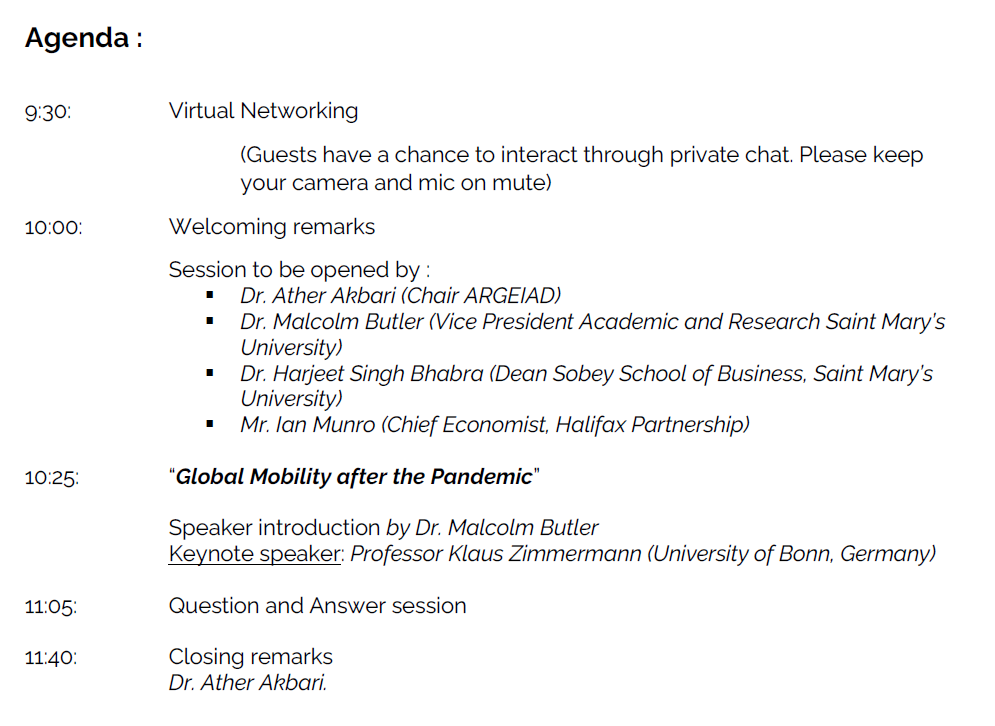
On the invitation of ARGEIAD, Sobey School of Business, Saint Mary’s University, Canada, Klaus F. Zimmermann, President of the Global Labor Organization (GLO) and UNU-MERIT, Maastricht, spoke on September 29, 2021 in a public online lecture on:
Global Mobility after the Pandemic
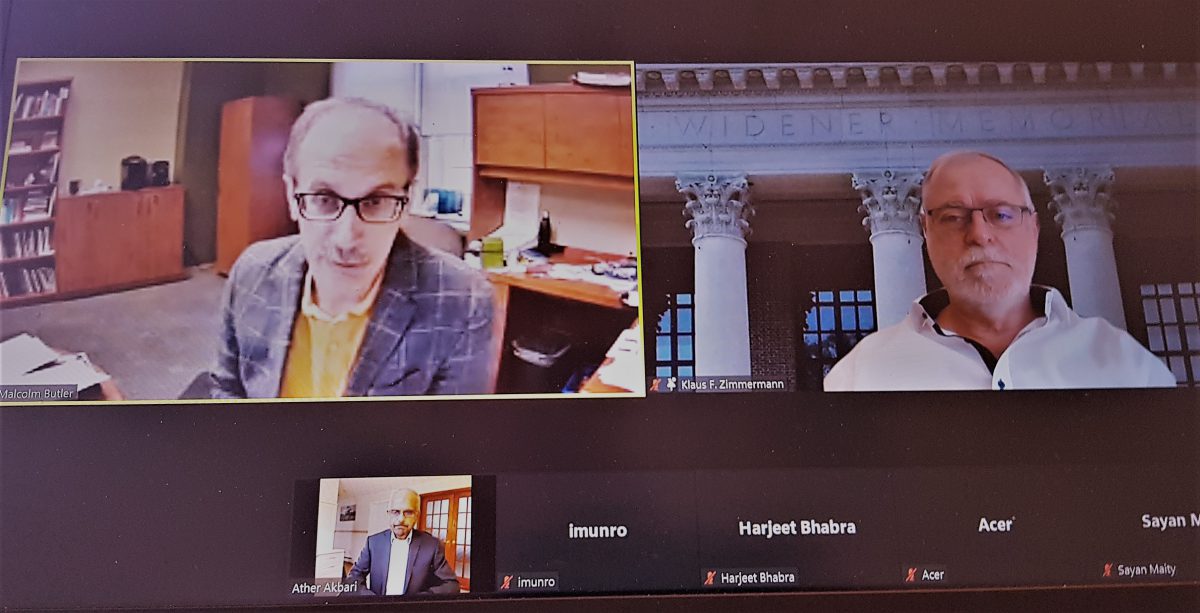
The meeting was chaired by Dr. Ather Akbari, Ph.D., Professor of Economics at the Sobey School of Business, Saint Mary’s University, and head of ARGEIAD. More details.ARGEIAD, the Atlantic Research Group on Economics of Immigration, Aging and Diversity, focuses on the economic significance of immigration, diversity and aging. The center provides a platform to researchers, policymakers, policy practitioners and business organizations to exchange ideas and conduct research on these issues in a regional, national and international context.
Klaus F. Zimmermann
Ather Akbari
PROGRAM
Ather Akbari
Malcom Butler
Harjeet Singh Bhabra
Ian Munro
Discussant Tony Fang, Stephen Jarislowsky Chair in Cultural and Economic Transformation, Memorial University of Newfoundland
Abstract: “Global Mobility after the Pandemic“ Covid-19 has challenged the way humanity is organizing global welfare through cooperation and the division of work. Key causes of the spread of the virus have been the conditions of human mobility and exchange. The ultimate solution had been to restrict such mobility. Among the response mechanisms were home-work and internet collaborations. What are the long term consequences after the end of the pandemic? Will this end globalization? Or cause a faster transition into the future of work? And will the pandemic ever come fully to an end? The lecture will deal with those questions. It will work out the importance of migration and mobility for the creation of human welfare and development through the law of the division of work. It will review the experiences with the “Spanish Flu”, which early in the 20th century contributed to the end of the largely globalized world existing at the time before World War I. Will history repeat? It will then study the experiences we have so far with the mobility consequences of the pandemic and which innovations are under way dealing with it. The conclusions will speculate about the consequences for the future of migration.
SelectedReferences:
Bista, Krishna, Allen, Ryan M. & Chan, Roy Y. , Eds., 2021, Impacts of COVID-19 on International Students and the Future of Student Mobility. International Perspectives and Experiences, September 29, 2021. Forthcoming by Routledge.
Newland, Kathleen. 2020. Will International Migration Governance Survive the COVID-19 Pandemic? Washington, DC: Migration Policy Institute.
Gokhan Karabulut, Klaus F. Zimmermann, Mehmet Huseyin Bilgin and Asli Cansin Doker (2021), “Democracy and COVID-19 Outcomes”, Economics Letters (EL-Prepublication, EL-Online Appendix) Volume 203, June 2021, 109840 Open Access; free PDF. https://doi.org/10.1016/j.econlet.2021.109840
ADB, OECD & ILO (2021); Labor Migration in Asia. Impacts of the COVID-19 Crisis and the post-pandemic future.
Victoria Vernon and Klaus F. Zimmermann (2021), “Walls and Fences: A Journey Through History and Economics”, in: Kourtit, K., Newbold, B., Nijkamp, P. and Partridge, M., The Economic Geography of Cross-Border Migration, Springer, Heidelberg et al., pp. 33-54; Pre-publication version.Published.
Zimmermann, Klaus F., Refugee and Migrant Labor Market Integration: Europe in Need of a New Policy Agenda. Presented at the EUI Conference on the Integration of Migrants and Refugees, 29-30 September 2016 in Florence. Published in: Bauböck, R. and Tripkovic, M., The Integration of Migrants and Refugees. An EUI Forum on Migration, Citizenship and Demography, European University Institute, Robert Schuman Centre for Advanced Studies, Florence 2017, pp. 88 – 100. Published Version of article. Published full book.
On the invitation of ARGEIAD, Sobey School of Business, Saint Mary’s University, Canada, Klaus F. Zimmermann, President of the Global Labor Organization (GLO) and UNU-MERIT, Maastricht, will speak on September 29, 2021 in a public online lecture on Global Mobility after the Pandemic. The meeting will be chaired by Dr. Ather Akbari, Ph.D., Professor of Economics at the Sobey School of Business, Saint Mary’s University, and head of ARGEIAD. More details.
ARGEIAD, the Atlantic Research Group on Economics of Immigration, Aging and Diversity, focuses on the economic significance of immigration, diversity and aging. The center provides a platform to researchers, policymakers, policy practitioners and business organizations to exchange ideas and conduct research on these issues in a regional, national and international context.
Ather Akbari
Klaus F. Zimmermann
Abstract: “Global Mobility after the Pandemic“ Covid-19 has challenged the way humanity is organizing global welfare through cooperation and the division of work. Key causes of the spread of the virus have been the conditions of human mobility and exchange. The ultimate solution had been to restrict such mobility. Among the response mechanisms were home-work and internet collaborations. What are the long term consequences after the end of the pandemic? Will this end globalization? Or cause a faster transition into the future of work? And will the pandemic ever come fully to an end? The lecture will deal with those questions. It will work out the importance of migration and mobility for the creation of human welfare and development through the law of the division of work. It will review the experiences with the “Spanish Flu”, which early in the 20th century contributed to the end of the largely globalized world existing at the time before World War I. Will history repeat? It will then study the experiences we have so far with the mobility consequences of the pandemic and which innovations are under way dealing with it. The conclusions will speculate about the consequences for the future of migration.
SelectedReferences:
Bista, Krishna, Allen, Ryan M. & Chan, Roy Y. , Eds., 2021, Impacts of COVID-19 on International Students and the Future of Student Mobility. International Perspectives and Experiences, September 29, 2021. Forthcoming by Routledge.
Newland, Kathleen. 2020. Will International Migration Governance Survive the COVID-19 Pandemic? Washington, DC: Migration Policy Institute.
Gokhan Karabulut, Klaus F. Zimmermann, Mehmet Huseyin Bilgin and Asli Cansin Doker (2021), “Democracy and COVID-19 Outcomes”, Economics Letters (EL-Prepublication, EL-Online Appendix) Volume 203, June 2021, 109840 Open Access; free PDF. https://doi.org/10.1016/j.econlet.2021.109840
ADB, OECD & ILO (2021); Labor Migration in Asia. Impacts of the COVID-19 Crisis and the post-pandemic future.
Victoria Vernon and Klaus F. Zimmermann (2021), “Walls and Fences: A Journey Through History and Economics”, in: Kourtit, K., Newbold, B., Nijkamp, P. and Partridge, M., The Economic Geography of Cross-Border Migration, Springer, Heidelberg et al., pp. 33-54; Pre-publication version.Published.
Zimmermann, Klaus F., Refugee and Migrant Labor Market Integration: Europe in Need of a New Policy Agenda. Presented at the EUI Conference on the Integration of Migrants and Refugees, 29-30 September 2016 in Florence. Published in: Bauböck, R. and Tripkovic, M., The Integration of Migrants and Refugees. An EUI Forum on Migration, Citizenship and Demography, European University Institute, Robert Schuman Centre for Advanced Studies, Florence 2017, pp. 88 – 100. Published Version of article. Published full book.
Presentations in this series are based on the projects that GLO-VirtYS program scholars completed as part of the their program participation. See for the details VirtYs program and the cohort 2021.
September 30th 2021 Program on 1 pm London/UK time.
Sydney (10pm), Beijing (8pm), Istanbul (3pm), Berlin (2pm), London (1pm), Cape Town (2pm), Washington DC (8am), Santiago de Chile (9am)
Jie Chen, Jiangsu University and GLO Affiliate Does vocational education pay better, or worse, than academic education? (GLO VirtYS program advisor Professor Francesco Pastore)
Muchin Bazan Ruiz, Virginia Tech and GLO Affiliate Women in Engineering: The Role of Role Models (GLO VirtYS program advisor Professor Kompal Sinha
Chaired by GLO VirtYS Program Director Olena Nizalova.
FOR PAST AND FUTURE EVENTS SEE THE GLO WEBSITE. Featured Image: Employee-Training-unsplash
Jie Chen is a lecturer of economics at Jiangsu University. Her research interests are in experimental economics and educational economics. She received her PhD in economics from the University of New South Wales.
GLO VirtYS project: Does vocational education pay better, or worse, than academic education?
In this paper, we use the Chinese General Social Survey data to analyze the returns to upper secondary vocational education in China. To address possible endogeneity of vocational training due to omitted heterogeneity, we construct a novel instrumental variable using the proportion of tertiary education graduates relative to the entire population by year. Our main finding is that, although returns to vocational upper secondary education appear higher than returns to academic upper secondary education according to the Mincerian equation, the results from the instrumental variable method tell the opposite story: vocational upper secondary graduates face a wage penalty compared to academic upper secondary graduates. The wage penalty is confirmed by an alternative and more recent IV method – the Lewbel method (Lewbel, 2012). Our findings highlight the importance of properly accounting for endogeneity when estimating the returns to vocational education.
Muchin Bazan Ruiz is a Ph.D. candidate in Economics at Virginia Tech. She has an MSc in Economics at the University of Warwick and a BSc. in Economics from Universidad de Piura. She has worked in the Superintendence of Banks, Insurance Companies, and Private Pension Funds (Peru) and as a Consultant at the Intern-American Development Bank. Muchin is passionate about Development and her research interests are in Development Economics, Economics of Education, and Gender Studies. She investigates the effect of role models on students’ career choices and perceptions using randomized controlled trials and administrative data.
GLO VirtYS project: Women in Engineering: The Role of Role Models
Gender disparities in STEM field participation are a major cause of concern for policymakers around the world. Given the higher average level of earnings of STEM graduates, low enrollment rates of women in these fields contribute to gender-based inequalities in earnings and wealth. This paper studies the effects of exposure to role models on female preferences for STEM fields. We conduct a randomized control trial where female senior students currently enrolled in engineering programs at an elite private university in Peru give talks about their experiences at randomly selected high schools. We find that exposure to this treatment increases high ability female students’ preferences for engineering programs by 14 percentage points. The effect is only statistically significant for the subgroup of female students with baseline math scores in the top 25 percentile, and that reside close to the city where the role models’ university is located. We also find positive but smaller effects on “low ability” male students. In a context where females are discouraged from enrolling in STEM fields, our results have important policy implications.
Interested researchers are cordially invited to submit their abstracts or papers for presentation consideration. The 37th EBES Conference will take place ONLINE ONLY on October 6-8 2021. GLO is a co-organizing partner, and FOM University of Applied Sciences is the local host supporting the event from Berlin.
This is aGLO supported event. EBES, theEurasia Business and Economics Society, and FOM University of Applied Sciencesboth are strategic partners and institutional supporters of GLO. GLO President Klaus F. Zimmermann is also President of EBES.FOM and GLO contribute own sessions as listed below.
Authors are invited to submit their abstracts or papers no later than September 17, 2021.
9.00 – 9.45. Welcome Speeches: Mehmet Bilgin (EBES & GLO), Manuela Zipperling (FOM & GLO), and Azita Berar Awad (Graduate Institute of International and Development Studies, Geneva, & GLO) Opening Lecture: Klaus F. Zimmermann (UNU-MERIT, Free University Berlin & GLO) The Future of Global Mobility Chair: Mehmet Bilgin (Istanbul Medeniyet University, EBES & GLO)
15.15-16.15. Keynote Speech David G. Blanchflower (Dartmouth College & GLO) The Economics of Walking About and Predicting Unemployment Chair: Matloob Piracha (University of Kent & GLO)
16.30-17.15. EBES Journals Session Chair: Klaus F. Zimmermann (EBES President & GLO) with Dorothea Schäfer (DIW Berlin, Jönköping University & GLO), Editor-in-Chief of Eurasian Economic Review, and Marco Vivarelli (Catholic University of Milano & GLO), Editor-in-Chief of the Eurasian Business Review.
Thursday, October 7:
9.00-11.00. FOM-GLO Session Chair: Alexander Spermann (FOM University of Applied Sciences, Cologne, Freiburg University and GLO)
Monika Wohlmann (FOM University of Applied Science): The European Central Bank’s Strategy Review and the Management of Inflation Expectations
Sascha Frohwerk (FOM University of Applied Sciences, Berlin, Hasso-Plattner-Institute, Potsdam and GLO): Retail Location Choice Models. A Comparison of Gravitation and Logit Model
Andreas Oberheitmann (Tsinghua University, FOM and GLO): Development of a Low Carbon Economy in Wuxi City. An Example of Climate Change Mitigation in China on the Local Level.
Michael Drewes (FOM University of Applied Sciences, Mannheim) and Luca Rebeggiani (FOM University of Applied Sciences, Bonn): Private vs. Public Financing of Sport Stadia in Germany – An Empirical Analysis.
Sascha Frohwerk (FOM University of Applied Sciences, Berlin, Hasso-Plattner-Institute, Potsdam and GLO), Carsten Kruppe and Holger Wassermann: Evolution or Revolution: The Entry of New Company Successors in Germany
Kai Klotz and Alexander Spermann (FOM University of Applied Sciences, Cologne, Freiburg University and GLO): Did the Refugee Crisis Cause the Rise of Right-wing Parties? Empirical Evidence from East Germany.
14.00-15.00. Plenary Speech joint with the monthly GLO Seminar Sriya Iyer (University of Cambridge and GLO): Religion and Mental Health Chair: Olga Popova (Leibniz Institute for East and Southeast European Studies, CERGE-EI & GLO)
Note: The session relates to the Springer Nature Handbook project“Labor, Human Resources and Population Economics”supported by the GLO network.
15.15 – 17.15. GLO Session Migration I Chair: Cynthia Bansak (St. Lawrence University & GLO)
Note: The session relates to the Springer Nature Handbook project“Labor, Human Resources and Population Economics”supported by the GLO network.
Sonia Plaza (World Bank & GLO): Measuring Migration
Massimiliano Tani (University of New South Wales & GLO) & Matloob Piracha (University of Kent & GLO): Migration and Education
Cinzia Rienzo ( University of Brighton & GLO): Performance of Economic Migrants
Cynthia A. Bansak (St. Lawrence University & GLO), Nicole Simpson (Colgate University & GLO) and Madeline Zavodny (University of North Florida & GLO): Immigrants and Their Effects on Labor Market Outcomes of Natives
Chunbei Wang (University of Oklahoma & GLO) & Magnus Lofstrom (Public Policy Institute of California & GLO): Immigrant Entrepreneurs
Friday, October 8:
14.15 – 16.15. GLO SessionFamily & Household Economics Chair: Victoria Vernon (SUNY Empire State College & GLO)
Note: The session relates to the Springer Nature Handbook project“Labor, Human Resources and Population Economics”supported by the GLO network.
Effrosyni Adamopoulou (University of Mannheim & GLO): Infidelity
Juan Carlos Campaña (Antonio de Nebrija University), José Ignacio Giménez-Nadal (University of Zaragoza) & José Alberto Molina (University of Zaragoza & GLO): Time-Use Surveys
Benjamin Scharadin (Colby College): Household Food Expenditures and Diet Quality
Daniel Fernandez-Kranz (IE Business School, Madrid) & Jennifer Roff (Queens College and the Graduate Center, CUNY): Child Custody Laws and Household Outcomes
Irene Mosca (Maynooth University & GLO) and Robert E. Wright (University of Glasgow & GLO): Economics of Marriage Bars
16.30 – 18.30. GLO Session Migration II Chair: Marina Murat (University of Modena and Reggio Emilia & GLO)
Note: The session relates to the Springer Nature Handbook project“Labor, Human Resources and Population Economics”supported by the GLO network.
Jakub Lonsky (University of Liverpool & GLO) & Osea Giuntella (University of Pittsburgh & GLO): Migrant Health and Wellbeing
Kusum Mundra (Rutgers University & GLO): The Political Economy of Citizenship
Catalina Amuedo-Dorantes (University of California & GLO), Anna Marie Kietzerow (Western Michigan University) & Susan Pozo (Western Michigan University): Naturalization, Citizenship, and Identity Documents
Stefanija Veljanoska (University of Rennes) & Frederic Docquier (LISER & GLO): Brain Drain or Gain
Amelie Constant (Princeton University & GLO): Time-Space Dynamics of Return and Circular Migration
Michele Tuccio (Université Paris-Dauphine & GLO) & Jackline Wahba (University of Southampton & GLO): Social Remittances
All the presentation in this series are based on the projects that GLO-VirtYS program scholars completed as part of their program participation.
September 9th 2021 Program on 1 pm London/UK time.
Chaired by GLO VirtYS Program Director Olena Nizalova.
Jun Hyung Kim, Jinan University and GLO Affiliate Mental Health Consequences of Working from Home during the Pandemic (GLO VirtYS program advisor Professor Jan van Ours) Watch the video of the event: Kim.
Femke Cnossen, University of Groningen and GLO Affiliate Learning the Right Skill: Revealed Local Labour Demand for Underlying Skills in STEM and Non-STEM Graduates (GLO VirtYS program advisors Dr Matloob Piracha and Dr Guy Tchuente)
Presentations in this series are based on the projects that GLO-VirtYS program scholars completed as part of the their program participation. See for the details VirtYs program and the cohort 2021.
September 16th 2021 Program on 1 pm London/UK time.
Odmaa Narantungalag, Massey University and GLO Affiliate The Local Impacts of Natural Resource Extraction: Evidence from Mongolia (GLO VirtYS program advisor Professor Kompal Sinha)
Soumya Pal, Centre for Public Policy, Indian Institute of Management Bangalore and GLO Affiliate Weather Shock, Agricultural Productivity, and Infant Health: A Tale of Environmental Justice (GLO VirtYS program advisor Professor Almas Heshmati) Video
Chaired by GLO VirtYS Program Director Olena Nizalova.
Featured Image: Employee-Training-unsplash
Odmaa Narantungalag is a Ph.D. student in economics at Massey University in New Zealand. Her research interests are in development economics, natural resource economics, and health economics. Odmaa holds a Bachelor of Arts in Economics from American University in Bulgaria and a Master of Public Administration from Tsinghua University, China. Prior to starting her doctoral studies, Odmaa worked as a national consultant at the Ministry of Economic Development and Ministry of Finance in Mongolia for various projects implemented by the World Bank and United Nations Development Programme.
GLO VirtYS project: The Local Impacts of Natural Resource Extraction: Evidence from Mongolia
This paper investigates the local economic impacts of a large-scale copper-gold mine in Mongolia. Employing household data from 2008 to 2016, I find positive economic effects of the mine. A ten percent increase in mining activities resulted in 2.2 and 2.3 percent increases in income and food consumption, respectively. Mining activities enabled households to increase their medical expenditures, while sickness did not increase significantly. In contrast, education expenditures dropped while educational attainments improved in mining areas. Both expenditure patterns indicate that large-scale extractive industries can positively benefit residents, and corporate social responsibility activities further enhance the mining sector’s traditional benefits.
Soumya Pal is PhD Candidate at the Centre for Public Policy, Indian Institute of Management Bangalore. His research interests are broadly in the domain of Climate Change, Regulations, and Environmental Justice. His doctoral thesis focuses on Economics of Climate Change and Environmental Regulations. He completed his bachelor’s in Statistics, Master’s, and M.Phil. in Demography.
GLO VirtYS project: Weather Shock, Agricultural Productivity, and Infant Health: A Tale of Environmental Justice
We study how income shock due to extreme weather fluctuations causally impacts the birth outcomes. We selected households depended directly on agriculture due to their extreme vulnerability to temperature and rainfall shocks. We find large efficiency loss attributed to weather shock for major food crops to the extent of 20%. However, we find that access to technology provides resilience against weather shock, therefore, causing the heterogeneity in vulnerability across farming households. Based on it, we designed the agriculture-household model, which predicts that health outcomes of child are dependent on income shock due to abrupt change in weather conditions. We tested the hypothesis by introducing weather shock in the cropping season before the conception of child to eliminate the confounding effect of direct impact due to extreme weather conditions. We find that weather shocks in cropping season, increases the likelihood of child mortality, low birth weight, and birth size. We further find that access to technology, financial tools, and economic security net reduces the impact of income loss due to weather shock. Our results suggests that access to resilient capabilities leads to heterogeneous impact across farmer households causing environmental injustice. Further, our findings provide insights into the policy design for long term shift in weather patterns due to climate change and stresses on the inequality in resilience against extreme weather events.
In a festive ceremony at Maastricht University on September 2, 2021, Anne-Lore Fraikin received her double PhD degree with University of Liege after proper examinations. The procedure was hybrid (online and in person) chaired by the Pro-Rector of Maastricht University Prof. Dr. Alexander Bruggen. The theme of the thesis is “The Effect of Financial Retirement Incentives Originating from the Social Security System on the Retirement Behavior of Older Belgian Workers”.
Dr. Anne-Lore Fraikin is an Affiliated Researcher in the POP @ UNU-MERIT group and a GLO Research Affiliate. The thesis work was done under the supervision of Prof. Dr. Alain Jousten (University of Liege) and Prof. Dr. Alessio Brown (UNU-MERIT & Maastricht University). The Assessment Committee consisted of Prof. Dr. Klaus F. Zimmermann (UNU-MERIT & Maastricht University) as the Chair, Prof. Dr. Sergio Perelman (University of Liege), Prof. Dr. Antoine Bozio (Paris School of Economics), Prof. Dr. Corrado Giulietti (University of Southampton), Prof. Dr. Mathieu Lefebvre (University of Strassbourg and Liege) and Dr. Zina Nimeh (UNU-MERIT). Brown and Zimmermann are Co-Directors of the POP @ UNU-MERIT group dealing with Population, Development and Labor Economics. Brown, Jousten and Giulietti are GLO Fellows and Zimmermann is GLO President.
TheGLO Virtual Seminar is a monthly internal GLO research event chaired by GLO Director Matloob Piracha and hosted by the GLO partner institution University of Kent. The results are available on the GLO website and the GLO News section, where also the video of the presentation is posted. All GLO related videos are also available in the GLO YouTube channel. (To subscribe go there.)
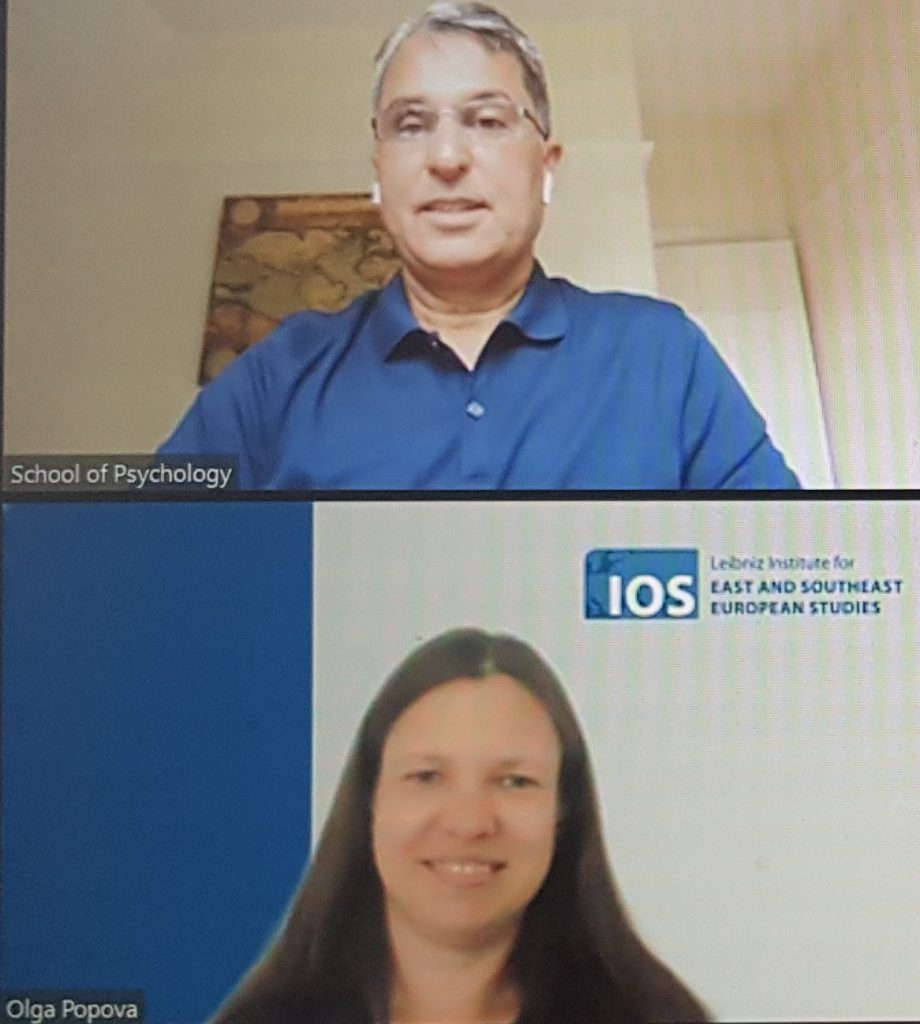
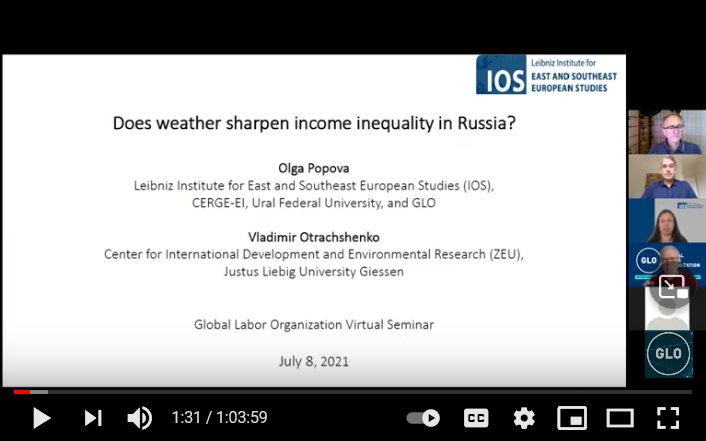
The last seminar was given on July 8, 2021, London/UKat 1-2 pm, by Olga Popova, Institute for East and Southeast European Studies (IOS) & GLO on Does weather sharpen income inequality in Russia? See below a report, the presentation slides and the full video of the seminar.
Report
Does weather sharpen income inequality in Russia?
GLO Virtual Seminar on July 8, 2021
Olga Popova, Institute for East and Southeast European Studies (IOS) & GLO
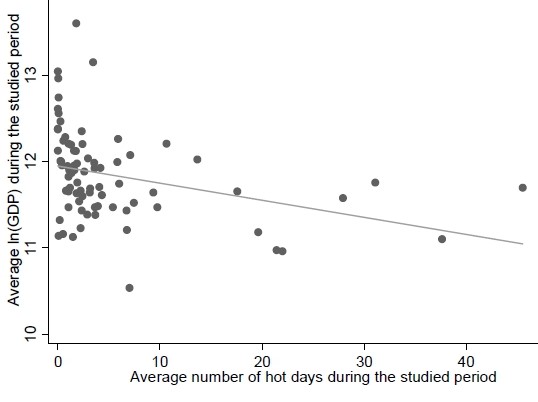
ABSTRACT Using subnational panel data, this paper analyzes how hot and cold extreme temperatures and precipitation affect economic activity and income distribution in Russia. We account for the intensity of exposure to extreme temperatures by analyzing the impacts of both single and consecutive days with extreme temperature, i.e., heat waves and cold spells, and examine several labor market channels behind those effects. We find that consecutive extremely hot days decrease regional GDP per capita but do not affect income inequality. Poor regions are affected by extreme temperatures relatively more than rich regions. These effects occur because of reallocation of labor from employment to unemployment, an increase in prices in poor regions, and to some extent because of changes in the industrial employment structure, while relative wages are not affected. Extremely cold days, both single and consecutive, as well as extreme precipitation have a limited impact on economic activity and income distribution.
Research Questions and Contribution
Examine the distributional impacts of extreme temperature and precipitation shocks, using the regional panel data from Russia
Account for the intensity of extreme temperatures exposure by simultaneously examining the impacts of both single and consecutive days with extreme temperature
Identify and test the labor market channels behind the inequality‐temperature relationship
Study if the impacts are heterogeneous • Poor vs. rich regions • Hot vs. cold regions
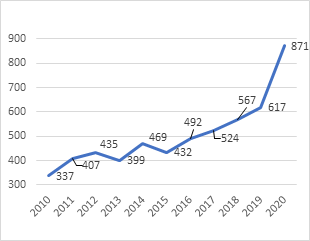
Correlation between days above 25°C and ln(GDP) in Russia
Wherever you work, pick your gig: join WageIndicator’s gig webinar on migration and telemigration on September 24.
GLO and WageIndicator Foundation are partner organizations.
Due to the digital revolution and the COVID-19 pandemic, labor mobility has increased significantly. Migrants use platforms to get a job locally, while telemigrants use platforms to perform remote work.
WageIndicator’s third event on the gig economy focuses on the experiences of these migrants and telemigrants.
Why do they choose this type of work?
And what challenges do they face?
Listen to the stories of researchers and platform representatives by joining the event on Friday 24 September!
Presentations in this series are based on the projects that GLO-VirtYS program scholars completed as part of the their program participation. See for the details VirtYs program and the cohort 2021.
September 9th 2021 Program on 1 pm London/UK time.
Jun Hyung Kim, Jinan University and GLO Affiliate Mental Health Consequences of Working from Home during the Pandemic (GLO VirtYS program advisor Professor Jan van Ours)
Femke Cnossen, University of Groningen and GLO Affiliate Learning the Right Skill: Revealed Local Labour Demand for Underlying Skills in STEM and Non-STEM Graduates (GLO VirtYS program advisors Dr Matloob Piracha and Dr Guy Tchuente)
Chaired by GLO VirtYS Program Director Olena Nizalova.
Featured Image: Employee-Training-unsplash
Jun Hyung Kim is an assistant professor of economics at the Institute of Economic and Social Research at Jinan University. His research is focused on parenting and child development, with particular attention on how life cycle decisions of parents interact with parenting decisions. He received B.A. in economics at UC Berkeley and PhD in economic at the University of Chicago.
GLO VirtYS project: Mental Health Consequences of Working from Home during the Pandemic
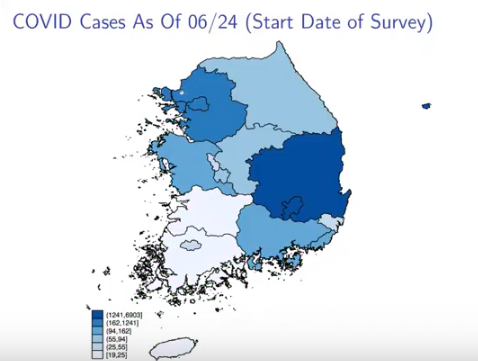
This paper examines the effects of working from home on mental health, using unique real time survey data from South Korea collected during the COVID-19 pandemic. We find that working from home negatively affects the mental health of workers in the first half of 2020. Furthermore, we find substantial heterogeneity across gender and home environment. The negative impact of working from home is concentrated on women, and on those who are primarily responsible for housework while also maintaining market work. Surprisingly, workers who live with children in the household do not suffer from the negative effects of working from home. Our findings suggest that family-work interaction may be an important factor in the optimal design of working from home.
Femke Cnossen is a PhD student at the University of Groningen. Her PhD focuses on the micro-dynamics of technological change and labour markets, by linking survey data to registerdata. She studies skill demand, (routine) task prices, and on the impact of technological progress on meaningfulness of work. From september, she is a postdoctoral researcher in regional skill analysis at the Faculty of Spatial Sciences at the University of Groningen.
GLO VirtYS project: Learning the Right Skill: Revealed Local Labour Demand for Underlying Skills in STEM and Non-STEM Graduates
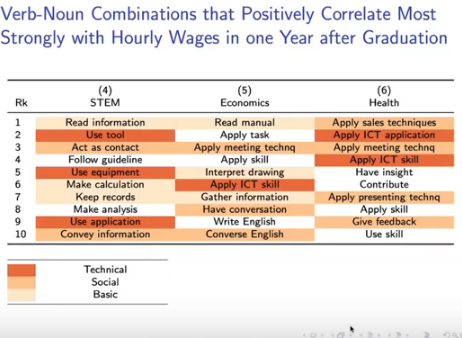
Technological change and globalization have sparked debates on the changing demand for skills in western labour markets, especially for middle skilled workers who have seen their tasks replaced. This paper provides a new data set, which is based on text data from curricula of the entire Dutch vocational education system. We extract verbs and nouns to measure social, technical and basic skills in a novel way. This method allows us to uncover the skills middle-skilled students learn in school. Using this data, we show that skill returns vary across students specialized in STEM, services or health. Furthermore, we show that social and technical skills differentially relate to the probability of being employed in either the low or high skill sector or in the goods sector. Our findings can guide future research on the complementarity between skills and production technologies.
Interested researchers are cordially invited to submit their abstracts or papers for presentation consideration. The 37th EBES Conference will take place ONLINE ONLY on October 6-8 2021. GLO is a co-organizing partner, and FOM University of Applied Sciences is the local host operating from Berlin.
This is aGLO supported event. EBES, theEurasia Business and Economics Society, and FOM University of Applied Sciencesboth are strategic partners and institutional supporters of GLO. GLO President Klaus F. Zimmermann is also President of EBES.FOM and GLO will organize own sessions for the event.
Authors are invited to submit their abstracts or papers no later than September 17, 2021.
Global Labor Organization (GLO) invites interested young scholars to apply for participation in the 2021-22GLO Virtual Young Scholars Program (GLO VirtYS). This is the third cohort of the successful GLO venture to support career developments of young researchers. It also provides a unique opportunity to interact with the large and very active GLO global network.
2021 Virtual Conference of the International Society for Quality-of-Life Studies ISQOLS 2021 CONFERENCE: “Quality-of-life and Adaptation in a Virulent World” VIRTUAL EVENT: 23-27, AUGUST 2021
The 2021 Virtual Conference of the International Society for Quality-of-Life Studies (ISQOLS 2021) on “Quality-of-life and Adaptation in a Virulent World” takes place on 23-27 August 2021 as a virtual event. The conference features five GLO/EHERO Special Sessions on Happiness Economics put together under the direction of Martijn Hendriks, Martijn Burger, and Milena Nikolova. Milena Nikolova is also the GLO Cluster Lead on Happiness Economics and a Section Editor dealing with happiness economics in the GLO-supported forthcoming Handbook “Labor, Human Resources and Population Economics” edited by GLO President Klaus F. Zimmermann. A number of review papers presented in the GLO/EHERO Special Sessions are articles from this Handbook.
Stephanie Rossouw and Talita Greyling: Big Data and Happiness
Olga Popova and Vladimir Otrachshenko: Religion and happiness
Clemens Hetschko, Andreas Knabe and Ronnie Schöb: Happiness, Work and Identity
Martin Binder and Ann-Kathrin Blankenberg: Self-Employment and Subjective Well-Being
Happiness Economics II: 10.00-11.40
Diana Tam and Arthur Grimes: The Economics of Free Speech: A Subjective Wellbeing Approach
Philip Morrison: Whose happiness in which cities? The urban wellbeing paradox revisited
Martijn Hendriks and Randall Birnberg: Happiness in the daily socio-cultural integration process: A day reconstruction study among US immigrants in Germany
Jeehoon Han and Caspar Kaiser: Changes in Time Use and Happiness
Happiness Economics III: 12.00-13.40
Richard Easterlin and Kelsey O’Connor: The Easterlin Paradox
Alberto Prati and Claudia Senik: Feeling good or feeling better?
Robin Konietzny, Milena Nikolova and Bart Los: Trade and Job (In)Security: The Two Sides of Occupational Import Exposure
Happiness Economics IV: 14.00-15.40
Carol Graham, Emily Dobson and James Kunhardt: When Public Health Crises Become Entwined: How Trends in COVID-19, Deaths of Despair, and Well-being Track Across the U.S.A.
Francesco Sarracino, Kelsey O’Connor, Chiara Peroni, Talita Greyling and Stephanie Rossouw: Well-being expressed through Twitter during the COVID-19 Pandemic
Julia Schmidtke, Clemens Hetschko, Gesine Stephan, Michael Eid, Ronnie Schöb and Mario Lawes: The impact of Covid-19 on mental health and well-being. An event-study based on high-frequency longitudinal survey data
Happiness Economics V: 19.00-20.40
Paul Fenton Villar: Is there a Mineral-Induced ‘Economic Euphoria’?: Evidence from Latin America
Mariano Rojas, Karen Watkins and Lázaro Rodríguez: The Happiness of CEOs in Family and Nonfamily Firms: Different Explanatory Structures and its Consequences
Annie Tubadji: Consumer Happiness and AI Sensitivity to Cultural and Moral Preferences
Interested researchers are cordially invited to submit their abstracts or papers for presentation consideration. The 37th EBES Conference in Berlin will take place on October 6-8 2021 in Hybrid Mode (online and in-person). GLO is a co-organizing partner, and FOM University of Applied Sciences is the local host.
This is aGLO supported event. EBESis theEurasia Business and Economics Society, a strategic partner and institutional supporter of GLO as well as FOM University of Applied Sciences. GLO President Klaus F. Zimmermann is also President of EBES.FOM and GLO will organize own sessions for the event.
Invited Speakers
EBES is pleased to announce that distinguished colleagues Dorothea Schäfer, Klaus F. Zimmermann and Marco Vivarelli will participate as keynote speakers and/or invited editors.
Dorothea Schäfer is the Research Director of Financial Markets at the German Institute for Economic Research (DIW Berlin) and Adjunct Professor of Jönköping International Business School, Jönköping University. She has also worked as an evaluator for the European Commission, the Federal Ministry of Education and Research and Chairwoman of Evaluation Committee for LOEWE (Landes-Offensive zur Entwicklung Wissenschaftlich-ökonomischer Exzellenz des Bundeslandes Hessen). She managed various research projects supported by the Deutsche Forschungsgemeinschaft (DFG), the EU Commission, the Fritz Thyssen Foundation and the Stiftung Geld und Währung. Her researches were published in various journals such as Journal of Financial Stability; German Economic Review; International Journal of Money and Finance; and Small Business Economics. She is regularly invited as an expert in parliamentary committees, including the Finance Committee of the Bundestag and gives lectures on financial market issues in Germany and abroad. She is also a member of the Editorial Board and Editor-in-Chief of the policy-oriented journal “Vierteljahrshefte zur Wirtschaftsforschung” and Editor-in-Chief of Eurasian Economic Review. Her research topics include financial crisis, financial market regulation, financing constraints, gender, and financial markets, financial transaction tax.
Klaus F. Zimmermann is President of the Global Labor Organization (GLO); Co-Director of POP at UNU-MERIT; Full Professor of Economics at Bonn University (em.); Honorary Professor, Maastricht University, Free University of Berlin and Renmin University of China; Member, German Academy of Sciences Leopoldina, Regional Science Academy, and Academia Europaea (Chair of its Section for Economics, Business and Management Sciences). Among others, he has worked at Macquarie University, the Universities of Melbourne, Princeton, Harvard, Munich, Kyoto, Mannheim, Dartmouth College and the University of Pennsylvania. Research Fellow of the Centre for Economic Policy Research (CEPR) and Fellow of the European Economic Association (EEA). Editor-in-Chief of the Journal of Population Economics. Editorial Board of International Journal of Manpower, Research in Labor Economics and Comparative Economic Studies, among others. Founding Director, Institute for the Study of Labor (IZA); Past-President, German Institute for Economic Research (DIW). Distinguished John G. Diefenbaker Award 1998 of the Canada Council for the Arts; Outstanding Contribution Award 2013 of the European Investment Bank. Rockefeller Foundation Policy Fellow 2017; Eminent Research Scholar Award 2017, Australia; EBES Fellow Award 2018. He has published in many top journals including Journal of Economic Perspectives, American Economic Review, Econometrica, Journal of the European Economic Association, Journal of Human Resources, Journal of Applied Econometrics, Public Choice, Review of Economics and Statistics, Journal of Population Economics and Journal of Public Economics. His research fields are population, labor, development, and migration.
Marco Vivarelli is a full professor at the Catholic University of Milano, where he is also Director of the Institute of Economic Policy. He is Professorial Fellow at UNU-MERIT, Maastricht; Research Fellow at IZA; Fellow of the Global Labor Organization (GLO). He is member of the Scientific Executive Board of the Eurasia Business and Economics Society (EBES); member of the Scientific Advisory Board of the Austrian Institute of Economic Research (WIFO, Vienna) and has been scientific consultant for the International Labour Office (ILO), World Bank (WB), the Inter-American Development Bank (IDB), the United Nations Industrial Development Organization (UNIDO) and the European Commission. He is Editor-in-Chief of the Eurasian Business Review, Editor of Small Business Economics, Associate Editor of Industrial and Corporate Change, Associate Editor of Economics EJournal, member of the Editorial Board of Sustainability and he has served as a referee for more than 70 international journals. He is author/editor of various books and his papers have been published in journals such as Cambridge Journal of Economics, Canadian Journal of Economics, Economics Letters, Industrial and Corporate Change, International Journal of Industrial Organization, Journal of Economics, Journal of Evolutionary Economics, Journal of Productivity Analysis, Labour Economics, Oxford Bulletin of Economics and Statistics, Regional Studies, Research Policy, Small Business Economics, Southern Economic Journal, World Bank Research Observer, and World Development. His current research interests include the relationship between innovation, employment, and skills; the labor market and income distribution impacts of globalization; the entry and post-entry performance of newborn firms.
Executive Board
Prof. Klaus F. Zimmermann, UNU-MERIT, Maastricht, and Free University Berlin Prof. Jonathan Batten, University Utara Malaysia, Malaysia Prof. Iftekhar Hasan, Fordham University, U.S.A. Prof. Euston Quah, Nanyang Technological University, Singapore Prof. John Rust, Georgetown University, U.S.A. Prof. Dorothea Schäfer, German Institute for Economic Research DIW Berlin, Germany Prof. Marco Vivarelli, Università Cattolica Del Sacro Cuore, Italy
Abstract/Paper Submission
Authors are invited to submit their abstracts or papers no later than August 20, 2021
General inquiries regarding the call for papers should be directed to ebes@ebesweb.org.
Publication Opportunities
Qualified papers can be published in EBES journals (Eurasian Business Review and Eurasian Economic Review) or EBES proceedings books after a peer review process without any submission or publication fees. EBES journals (EABR and EAER) are published by Springer and both are indexed in the SCOPUS, EBSCO EconLit with Full Text, Google Scholar, ABS Academic Journal Quality Guide, CNKI, EBSCO Business Source, EBSCO Discovery Service, ProQuest International Bibliography of the Social Sciences (IBSS), OCLC WorldCat Discovery Service, ProQuest ABI/INFORM, ProQuest Business Premium Collection, ProQuest Central, ProQuest Turkey Database, ProQuest-ExLibris Primo, ProQuest-ExLibris Summon, Research Papers in Economics (RePEc), Institute of Scientific and Technical Information of China, Naver, SCImago, ABDC Journal Quality List, Cabell’s Directory, and Ulrich’s Periodicals Directory. In addition, while EAER is indexed in the Emerging Sources Citation Index (Clarivate Analytics), EABR is indexed in the Social Science Citation Index (SSCI) and Current Contents / Social & Behavioral Sciences.
Also, all accepted abstracts will be published electronically in the Conference Program and the Abstract Book (with an ISBN number). It will be distributed to all conference participants at the conference via USB. Although submitting full papers are not required, all the submitted full papers will also be included in the conference proceedings in a USB.
After the conference, participants will also have the opportunity to send their paper to be published (after a refereeing process managed by EBES) in the Springer’s series Eurasian Studies in Business and Economics (no submission and publication fees). This is indexed by Scopus. It will also be sent to Clarivate Analytics in order to be reviewed for coverage in the Conference Proceedings Citation Index – Social Science & Humanities (CPCI-SSH). Please note that the 10th, 11th, 12th, 13th, 14th, 15th, 16th, 17th, 18th, 19th, 20th (Vol. 2), 21st, and 24th EBES Conference Proceedings are accepted for inclusion in the Conference Proceedings Citation Index – Social Science & Humanities (CPCI-SSH). Other conference proceedings are in progress.
Important Dates
Conference Date: October 6-8, 2021 Abstract Submission Deadline: August 20, 2021 Reply-by: August 23, 2021* Registration Deadline: August 31, 2021 Submission of the Virtual Presentation: August 31, 2021 Announcement of the Program: September 10, 2021 Paper Submission Deadline (Optional): August 23, 2021** Paper Submission for the EBES journals: November 16, 2021
* The decision regarding the acceptance/rejection of each abstract/paper will be communicated with the corresponding author within a week of submission.
** Completed paper submission is optional. If you want to be considered for the Best Paper Award or your full paper to be included in the conference proceedings in the USB, after submitting your abstract before August 20, 2021, you must also submit your completed (full) paper by August 31, 2021.
Contact
Ugur Can, Director of EBES (ebes@ebesweb.org) Dr. Ender Demir, Conference Coordinator of EBES (demir@ebesweb.org)
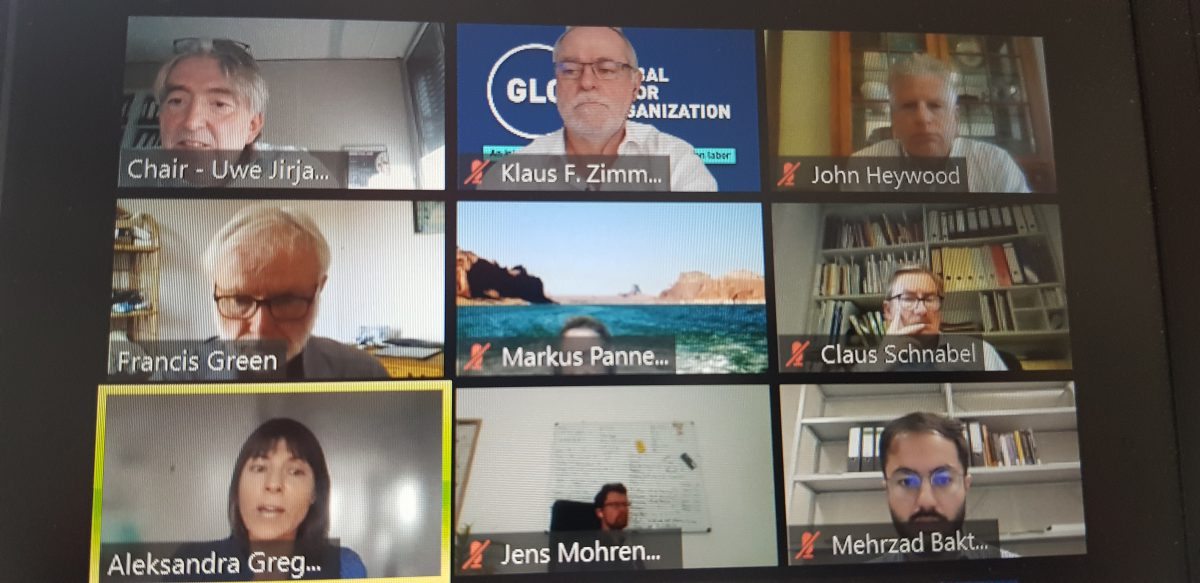
The 36th EBES Conference in Istanbul took place July 1-3, 2021 in Hybrid Mode. A highlight of the second day was the GLO Handbook Session on “Worker Representation, Labor-Management Relations and Labor Standards” chaired by GLO Fellow Uwe Jirjahn. GLO and EBES are collaborating organizations.
The conference included a GLO Handbook Session on “Worker Representation, Labor-Management Relations and Labor Standards” organized and chaired by Uwe Jirjahn (University of Trier and GLO), who is a Section Editor of the Handbook. The event took place on July 2, 3.50-5.50 pm, Istanbul time.
Decent Work and the Quality of Work and Employment Francis Green (University College London and GLO)
Union Membership and Collective Bargaining: Trends and Determinants Claus Schnabel (Universität Erlangen Nürnberg)
Unions, Worker Participation and Worker Well-Being Benjamin Artz (University of Wisconsin-Oshkosh and GLO) and John S. Heywood (University of Wisconsin-Milwaukee and GLO)
Worker Voice and Political Participation in Civil Society John Budd (University of Minnesota and GLO) and Ryan Lamare (University of Illinois and GLO)
Works Councils Jens Mohrenweiser (Bournemouth University)
Board-Level Worker Representation Aleksandra Gregoric (Copenhagen Business School)
The Covid-19 delayed IEA World Congress (“Bali”) now takes place virtually on 2-6 July 2021.
On invitation of the International Economic Association (IEA) the Global Labor Organization (GLO) has organized three sessions for the IEA World Congress, which were recorded by GLO with support of Kent University on June 10, 2021. See program details, report and video access: LINK
The 36th EBES Conference in Istanbul took place July 1-3, 2021 in Hybrid Mode. Highlights of the first day included a session of journal editors on journal publishing and the presentation of the EBES Fellow Award to Barry Eichengreen who delivered his Fellow Speech on “Financial Regulation for the Platform Economy”. The sessions were chaired by EBES & GLO President Klaus F. Zimmermann. GLO and EBES are collaborating organizations.
Just announced IF Impact Factors for 2020 by Clarivate Web of Science: Journal of Population Economics: 2.813 Finance Research Letters: 5.596 Journal of International Financial Markets Institutions and Money: 4.211 Emerging Markets Review: 4.073 Eurasian Business Review: 3.500
EBES Fellow Speech: “Financial Regulation for the Platform Economy”
Barry Eichengreen is the George C. Pardee and Helen N. Pardee Professor of Economics and Professor of Political Science at the University of California, Berkeley, where he has taught since 1987. He is a Research Associate of the National Bureau of Economic Research (NBER) and Research Fellow of the Centre for Economic Policy Research (CEPR). He worked as Senior Policy Advisor at the IMF. He is a regular monthly columnist for Project Syndicate. He has held Guggenheim and Fulbright Fellowships and has been a fellow of the Center for Advanced Study in the Behavioral Sciences (Palo Alto) and the Institute for Advanced Study (Berlin).
His larger number of books include recently • In Defense of Public Debt (with Asmaa El-Ganainy, Rui Esteves and Kris Mitchener), Oxford University Press, 2021 • How to Achieve Inclusive Growth (edited with Valerie Serra, Asmaa El-Ganainy and Martin Schindler), Oxford University Press, 2021 • The Populist Temptation: Economic Grievance and Political Reaction in the Modern Era (2018), • How Global Currencies Work: Past, Present, and Future, with Livia Chitu and Arnaud Mehl, (2017) • The Korean Economy: From a Miraculous Past to a Sustainable Future (Harvard East Asian Monographs) with Wonhyuk Lim, Yung Chul Park and Dwight H. Perkins, (2015) • Renminbi Internationalization: Achievements, Prospects, and Challenges, co-edited with Masahiro Kawai, (2015) • Hall of Mirrors: The Great Depression, The Great Recession, and the Uses-and Misuses-of History, (2015)
He was awarded the Economic History Association’s Jonathan R.T. Hughes Prize for Excellence in Teaching in 2002 and the University of California at Berkeley Social Science Division’s Distinguished Teaching Award in 2004. He is also the recipient of a doctor honoris causa from the American University in Paris. He is ranked as one of the top economists by IDEAS: 6th (number of works), 22 (average rank score) etc. •His research interests are: exchange rates and capital flows; the gold standard and the Great Depression; the European economy; European integration; the impact of China on the international economic and financial system; IMF policy. His research was published in top journals such as Journal of Economic Perspectives, American Economic Review, Economic Journal, Journal of Economic Dynamics and Control,Economic Policy, and Journal of International Economics.
The 36th EBES Conference in Istanbul will take place on July 1st, 2nd, and 3rd, 2021 in Hybrid Mode.This is aGLO supported event. EBESis theEurasia Business and Economics Society, a strategic partner and institutional supporter of GLO. GLO President Klaus F. Zimmermann is also President of EBES.(Invited speakers see below)
The conference includes a GLO Handbook Session on “Worker Representation, Labor-Management Relations and Labor Standards” organized and chaired by Uwe Jirjahn (University of Trier and GLO), who is a Section Editor of the Handbook. The event takes place on July 2, 3.50-5.50 pm, Istanbul time.
GLO Handbook Session: Worker Representation, Labor-Management Relations and Labor Standards
Decent Work and the Quality of Work and Employment Francis Green (University College London and GLO)
Union Membership and Collective Bargaining: Trends and Determinants Claus Schnabel (Universität Erlangen Nürnberg)
Unions, Worker Participation and Worker Well-Being Benjamin Artz (University of Wisconsin-Oshkosh and GLO) and John S. Heywood (University of Wisconsin-Milwaukee and GLO)
Worker Voice and Political Participation in Civil Society John Budd (University of Minnesota and GLO) and Ryan Lamare (University of Illinois and GLO)
Works Councils Jens Mohrenweiser (Bournemouth University)
Board-Level Worker Representation Aleksandra Gregoric (Copenhagen Business School)
Invited Speakersof EBES 36
EBES is pleased to announce that distinguished colleagues Barry Eichengreen, Narjess Boubakri, Klaus F. Zimmermann and Jonathan Batten will join the conference as the keynote speakers and/or invited editors.
Barry Eichengreen is the George C. Pardee and Helen N. Pardee Professor of Economics and Professor of Political Science at the University of California, Berkeley, where he has taught since 1987. He is a Research Associate of the National Bureau of Economic Research (NBER) and Research Fellow of the Centre for Economic Policy Research (CEPR). He worked as Senior Policy Advisor at the IMF. He is a regular monthly columnist for Project Syndicate. His books include The Populist Temptation: Economic Grievance and Political Reaction in the Modern Era (2018), How Global Currencies Work: Past, Present, and Future, with Livia Chitu and Arnaud Mehl, (2017), The Korean Economy: From a Miraculous Past to a Sustainable Future (Harvard East Asian Monographs) with Wonhyuk Lim, Yung Chul Park and Dwight H. Perkins, (2015), Renminbi Internationalization: Achievements, Prospects, and Challenges, co-edited with Masahiro Kawai, (2015), Hall of Mirrors: The Great Depression, The Great Recession, and the Uses-and Misuses-of History, (2015). He was awarded the Economic History Association’s Jonathan R.T. Hughes Prize for Excellence in Teaching in 2002 and the University of California at Berkeley Social Science Division’s Distinguished Teaching Award in 2004. He is also the recipient of a doctor honoris causa from the American University in Paris. He is ranked as one of the top economists by IDEAS: 6th (number of works), 22 (average rank score) etc. His research interests are: exchange rates and capital flows; the gold standard and the Great Depression; the European economy; European integration; the impact of China on the international economic and financial system; IMF policy. His research was published in top journals such as Journal of Economic Perspectives, American Economic Review, Journal of Economic Dynamics and Control, and Journal of International Economics.
Narjess Boubakri is professor of Finance at American University of Sharjah (AUS) (United Arab Emirates) where she joined in 2007. She is currently the Dean of the School of Business Administration at AUS as well. She has taught at Laval University and HEC Montreal School of Business (Canada). She has also several editorial roles at leading journals such as Editor (Finance Research Letters), Co-Editor (Quarterly Review of Economics and Finance), Associate Editor (Journal of Corporate Finance), and Subject Editor (Emerging Markets Review; Journal of International Financial Markets, Institutions, and Money; and Journal of International Business Policy). Her papers were published in well-known journals such as Journal of Finance, Journal of Financial Economics, Journal of Corporate Finance, Journal of Banking and Finance, and Journal of Accounting Research. Her research has been widely cited (Google Scholar=6,000+). Her research areas are Corporate Governance, Privatization, Corporate Finance, International Finance, Mergers and Acquisitions, Legal and Political Institutions, Lobbying, and Earnings Management.
Klaus F. Zimmermann is President of the Global Labor Organization (GLO); Co-Director of POP at UNU-MERIT; Full Professor of Economics at Bonn University (em.); Honorary Professor, Maastricht University, Free University of Berlin and Renmin University of China; Member, German Academy of Sciences Leopoldina, Regional Science Academy, and Academia Europaea (Chair of its Section for Economics, Business and Management Sciences). Among others, he has worked at Macquarie University, the Universities of Melbourne, Princeton, Harvard, Munich, Kyoto, Mannheim, Dartmouth College and the University of Pennsylvania. Research Fellow of the Centre for Economic Policy Research (CEPR) and Fellow of the European Economic Association (EEA). Editor-in-Chief of the Journal of Population Economics. Editorial Board of International Journal of Manpower, Research in Labor Economics and Comparative Economic Studies, among others. Founding Director, Institute for the Study of Labor (IZA); Past-President, German Institute for Economic Research (DIW). Distinguished John G. Diefenbaker Award 1998 of the Canada Council for the Arts; Outstanding Contribution Award 2013 of the European Investment Bank. Rockefeller Foundation Policy Fellow 2017; Eminent Research Scholar Award 2017, Australia; EBES Fellow Award 2018. He has published in many top journals including Journal of Economic Perspectives, American Economic Review, Econometrica, Journal of the European Economic Association, Journal of Human Resources, Journal of Applied Econometrics, Public Choice, Review of Economics and Statistics, Journal of Population Economics and Journal of Public Economics. His research fields are population, labor, development, and migration.
Jonathan Batten is professor of finance and CIMB-UUM Chair in Banking and Finance at the School of Economics, Finance and Banking at the University Utara Malaysia (Malaysia). Prior to this position, he worked at the Monash University (Australia), Hong Kong University of Science and Technology (Hong Kong), and Seoul National University (Korea). He is a well-known academician who has published articles in many of the leading economics and finance journals and currently serves as the Editor of Emerging Markets Review (SSCI), Journal of International Financial Markets, Institutions & Money (SSCI), and Finance Research Letters (SSCI). He was also the President of EBES from July 2014 till December 2018. His current research interests include: financial market development and risk management; spread modelling arbitrage and market integration; and the investigation of the non-linear dynamics of financial prices.
The Institute for Economic and Social Research (IESR) at Jinan University and the Global Labor Organization (GLO) are jointly organizing the Fourth IESR-GLO Virtual Conference. The conference this year is held from June 24 (Thursday) to June 26 (Saturday), 2021 through Zoom. The theme is Social Safety Net and Welfare Programs. Robert Moffitt and Timothy Smeeding are the keynote speakers. (Feng of IESR right & Zimmermann of GLO left)
Speakers on June 24 from the left: Michael Christl, Jinyuan Yang, Sen Xue Shuaizhang Feng, Robert Moffitt, Klaus F. Zimmermann Feng Chen, Laura V. Zimmermann, Xi Chen
Day 2; June 25:
Program
8.00-11.05 pm Beijing Time / 8:00-11.05 am New York / 1:00-4:05 pm London JUNE 24 (Thursday). Chair:Sen Xue(IESR, Jinan University & GLO)
8.00-8.05 pm Beijing Time / 8:00-8.05 am New York / 1:00-1:05 pm London Opening Remarks by Shuaizhang Feng (IESR, Jinan University & GLO) & Klaus F. Zimmermann (UNU-MERIT, Maastricht University & GLO)
8.05-9.05 pm Beijing Time / 8:05-9.05 am New York / 1:05-2:05 pm London Keynote Lecture:Take-up in Social Assistance Programs: Theory and Evidence Keynote Speaker: Robert Moffitt (Johns Hopkins University)
9.05-9.35 pm Beijing Time / 9:05-9.35 am New York / 2:05-2:35 pm London The Power of Lakshmi: Monetary Incentives for Raising a Girl Nabaneeta Biswas (Marshall University), Christopher Cornwell (University of Georgia) &Laura V. Zimmermann(University of Georgia & GLO). Based on GLO Discussion Paper No. 888. Download PDF.
9.35-10.05 pm Beijing Time / 9:35-10.05 am New York / 2:35-3:05 pm London Grandfathers and Grandsons: Social Security Expansion and Child Health in China Jinyuan Yang (Virginia Tech)& Xi Chen (Yale University & GLO)
10.05-10.35 pm Beijing Time / 10:05-10.35 am New York / 3:05-3:35 pm London Trapped in inactivity? Social Assistance and Labour Supply in Austria Michael Christl (European Commission & GLO) & Silvia De Poli (European Commission)
10.35-11.05 pm Beijing Time / 10:35-11.05 am New York / 3:35-4:05 pm London Does Paid Family Leave Save Infant Lives? Evidence from California Feng Chen(Tulane University & GLO)
8.00-11.00 pm Beijing Time / 8:00-11.00 am New York / 1:00-4:00 pm London June 25 (Friday). Policy Forum on Social Assistance Systems Chair: Klaus F. Zimmermann (UNU-MERIT, Maastricht University & GLO)
8.00-8.45 pm Beijing Time / 8:00-8.45 am New York / 1:00-1:45 pm London Japan. Masayoshi Hayashi (University of Tokyo) Public Assistance in Japan: Current State and Challenges
8.45-9.30 pm Beijing Time / 8:45-9.30 am New York / 1:45-2:30 pm London South Korea. Inhoe Ku(Seoul National University) Social Assistance in South Korea: Policy Developments, Impacts and Implications for Future Reform
9.30-10.15 pm Beijing Time / 9:30-10.15 am New York / 2:30-3:15 pm London Germany. Alexander Spermann (FOM/Cologne, University of Freiburg and GLO) Basic Income in Germany 1991-2021: Challenges After Reunification, Hartz Reforms and the Current Reform Debate
10.15-11.00 pm Beijing Time / 10.15-11.00 am New York / 3:15-4:00 pm London Sweden. Björn Gustafsson (University of Gothenburg and GLO) Social Assistance in Sweden – Provision, Recipients and Challenges
8.00-11.00 pm Beijing Time / 8:00-11.00 am New York / 1:00-4:00 pm London JUNE 26 (Saturday). Chair: Shuaizhang Feng (IESR, Jinan University & GLO)
8.00-9.00 pm Beijing Time / 8:00-9.00 am New York / 1:00-2:00 pm London Keynote Lecture:Poverty and Income Support Around the World: China, India and Asia in Comparative Perspective Keynote Speaker: Timothy Smeeding (University of Wisconsin–Madison)
9.00-9.30 pm Beijing Time / 9:00-9.30 am New York / 2:00-2:30 pm London The Health of Disability Insurance Enrollees: An International Comparison Enrica Croda (Ca’Foscari University of Venice & GLO),Jonathan Skinner (Dartmouth College) & Laura Yasaitis (Dartmouth College)
9.30-10.00 pm Beijing Time / 9:30-10.00 am New York / 2:30-3:00 pm London The Unintended Effect of Medicaid Aging Waivers on Informal Caregiving Xianhua (Emma) Zai(Ohio State University & GLO)
10.00-10.30 pm Beijing Time / 10:00-10.30 am New York / 3:00-3:30 pm London Housing Vouchers, Labor Supply and Household Formation: A Structural Approach Ning Zhang (University of Pittsburgh)
10.30-11.00 pm Beijing Time / 10:30-11.00 am New York / 3:30-4:00 pm London The Structure and Incentives of a COVID related Emergency Wage Subsidy Jules Linden (National University Ireland Galway & Luxembourg Institute of Socio-Economic Reesarch), Cathal O’Donoghue (National University Ireland Galway), Denisa M. Sologon (Luxembourg Institute of Socio-Economic Reesarch)
Keynote speakers
Robert Moffitt on June 24; 8.00 pm Beijing Time
Robert A. Moffitt is the Krieger-Eisenhower Professor of Economics at Johns Hopkins University and holds a joint appointment at the Johns Hopkins Bloomberg School of Public Health. He obtained his Ph.D. degree from Brown University. His research interests are in the areas of labor economics and applied microeconometrics, with a special focus on the economics of issues relating to the low-income population in the U.S.. A large portion of his research has concerned the labor supply decisions of female heads of family and its response to the U.S. welfare system. He has published on the AFDC, Food Stamp, and Medicaid programs.
Moffitt has served as Chief Editor of the American Economic Review, Coeditor of the Review of Economics and Statistics, Chief Editor of the Journal of Human Resources, and as Chair of the National Academy of Sciences Panel to Evaluate Welfare Reform. He is currently editor of Tax Policy and the Economy.
Moffitt is also a Fellow of the Econometric Society, a Fellow of the Society of Labor Economists, a member of the National Academy of Sciences, a recipient of a MERIT Award from the National Institutes of Health, a recipient of a Guggenheim Fellowship, a Fellow of the American Academy of Arts and Sciences, and Past President of the Population Association of America.
Timothy Smeeding on June 26; 8.00 pm Beijing Time
Timothy Smeeding is Lee Rainwater Distinguished Professor of Public Affairs and Economics of the University of Wisconsin–Madison. He obtained his Ph.D. in Economics from the University of Wisconsin–Madison. He was director of the Institute for Research on Poverty from 2008–2014 and was the founding director of the Luxembourg Income Study from 1983-2006. He was named the John Kenneth Galbraith Fellow, American Academy of Political and Social Science in 2017.
Professor Smeeding’s recent work has been on social and economic mobility across generations, inequality of income, consumption and wealth, and poverty in national and cross-national contexts.
His recent publications include: SNAP Matters: How Food Stamps Affect Health and Well Being (Stanford University Press, 2015); Monitoring Social Mobility in the 21st Century (Annals of the American Academy of Political and Social Science, 2015); From Parents to Children: The Intergenerational Transmission of Advantage (Russell Sage Foundation, 2012); Persistence, Privilege and Parenting: The Comparative Study of Intergenerational Mobility (Russell Sage Foundation, 2011); The Handbook of Economic Inequality (Oxford University Press, 2009); Poor Kids in a Rich Country: America’s Children in Comparative Perspective (Russell Sage Foundation, 2003); and The American Welfare State: Laggard or Leader?, (Oxford University Press, 2010).
Policy Forum on Social Assistance Systems
June 25th: 8:pm-11pm Beijing Time/ 8:00am-11am New York / 1:00pm-4:00pm London Chair: Klaus F. Zimmermann (UNU-MERIT, Maastricht University & GLO)
8:00-8:45 pm: Japan. Masayoshi Hayashi (University of Tokyo) Public Assistance in Japan: Current State and Challenges
8:45-9:30 pm: Korea. Inhoe Ku(Seoul National University) Social Assistance in South Korea: Policy Developments, Impacts and Implications for Future Reform
9:30-10:15 pm: Germany. Alexander Spermann (FOM/Cologne, University of Freiburg and GLO) Basic Income in Germany 1991-2021: Challenges After Reunification, Hartz Reforms and the Current Reform Debate
10:15-11:00 pm: Sweden. Björn Gustafsson (University of Gothenburg and GLO) Social Assistance in Sweden – Provision, Recipients and Challenges
Masayoshi Hayashi (University of Tokyo) Professor of Economics at the University of Tokyo, and the President of the Japan Institute of Public Finance. He received a Ph.D. in Economics from Queen’s University at Kingston, Canada. His research interests include redistribution, taxation and fiscal federalism.
Inhoe Ku(Seoul National University) Professor at the Department of Social Welfare, Seoul National University. He is currently working as the President of the Korean Academy of Social Welfare. His research has been focusing on poverty, inequality and social policy.
Alexander Spermann (FOM/Cologne, University of Freiburg and GLO) Has started his research on social assistance more than thirty years ago. After finishing his dissertation and habilitation at the University of Freiburg, he held leading positions at international research institutes (ZEW, IZA) and is currently Professor of Economics at FOM Cologne and University of Freiburg. He has been a regular contributor to the media for decades.
Björn Gustafsson (University of Gothenburg and GLO) Professor Emeritus, University of Gothenburg, Sweden. He has published several papers on social assistance in Sweden. Since the 1990s he has also studied various aspects on income among Chinese households.
From the left: Masayoshi Hayashi, Inhoe Ku, Alexander Spermann, and Björn Gustafsson
The Institute for Economic and Social Research (IESR) at Jinan University and the Global Labor Organization (GLO) are jointly organizing the Fourth IESR-GLO Virtual Conference. The conference this year will be held from June 24 (Thursday) to June 26 (Saturday), 2021 through Zoom. The theme is Social Safety Net and Welfare Programs. Robert Moffitt and Timothy Smeeding are the keynote speakers. To register see below.
The IESR-GLO annual conference is aimed to provide a platform for scholars and experts to exchange ideas on the current pressing economic issues through presentations of high-quality academic papers and policy discussions. Previous IESR-GLO Conferences have covered topics such as the Economics of Covid-19 in 2020 and on the Labor Markets in Belt and Road countries in 2019. (Feng of IESR right & Zimmermann of GLO left)
To participate
No participation fee. For registration, please click the link: https://www.wjx.cn/vj/mKRDcqR.aspx
8.00-11.05 pm Beijing Time / 8:00-11.05 am New York / 1:00-4:05 pm London JUNE 24 (Thursday). Chair:Sen Xue(IESR, Jinan University & GLO)
Speakers on June 24 from the left: Michael Christl, Jinyuan Yang, Sen Xue Shuaizhang Feng, Robert Moffitt, Klaus F. Zimmermann Feng Chen, Laura V. Zimmermann, Xi Chen
8.00-8.05 pm Beijing Time / 8:00-8.05 am New York / 1:00-1:05 pm London Opening Remarks by Shuaizhang Feng (IESR, Jinan University & GLO) & Klaus F. Zimmermann (UNU-MERIT, Maastricht University & GLO)
8.05-9.05 pm Beijing Time / 8:05-9.05 am New York / 1:05-2:05 pm London Keynote Lecture:Take-up in Social Assistance Programs: Theory and Evidence Keynote Speaker: Robert Moffitt (Johns Hopkins University)
9.05-9.35 pm Beijing Time / 9:05-9.35 am New York / 2:05-2:35 pm London The Power of Lakshmi: Monetary Incentives for Raising a Girl Nabaneeta Biswas (Marshall University), Christopher Cornwell (University of Georgia) &Laura V. Zimmermann(University of Georgia & GLO)
9.35-10.05 pm Beijing Time / 9:35-10.05 am New York / 2:35-3:05 pm London Grandfathers and Grandsons: Social Security Expansion and Child Health in China Jinyuan Yang (Virginia Tech)& Xi Chen (Yale University & GLO)
10.05-10.35 pm Beijing Time / 10:05-10.35 am New York / 3:05-3:35 pm London Trapped in inactivity? Social Assistance and Labour Supply in Austria Michael Christl (European Commission & GLO) & Silvia De Poli (European Commission)
10.35-11.05 pm Beijing Time / 10:35-11.05 am New York / 3:35-4:05 pm London Does Paid Family Leave Save Infant Lives? Evidence from California Feng Chen (Tulane University & GLO)
The Institute for Economic and Social Research (IESR) at Jinan University and the Global Labor Organization (GLO) are jointly organizing the Fourth IESR-GLO Virtual Conference. The conference this year will be held from June 24 (Thursday) to June 26 (Saturday), 2021 through Zoom. The theme is Social Safety Net and Welfare Programs. Robert Moffitt and Timothy Smeeding will be the keynote speakers. To register see below.
The IESR-GLO annual conference is aimed to provide a platform for scholars and experts to exchange ideas on the current pressing economic issues through presentations of high-quality academic papers and policy discussions. Previous IESR-GLO Conferences have covered topics such as the Economics of Covid-19 in 2020 and on the Labor Markets in Belt and Road countries in 2019. (Feng right & Zimmermann left)
To participate
No participation fee. For registration, please click the link: https://www.wjx.cn/vj/mKRDcqR.aspx
8.00-11.05 pm Beijing Time / 8:00-11.05 am New York / 1:00-4:05 pm London JUNE 24 (Thursday). Chair:Sen Xue(IESR, Jinan University & GLO)
8.00-8.05 pm Beijing Time / 8:00-8.05 am New York / 1:00-1:05 pm London Opening Remarks by Shuaizhang Feng (IESR, Jinan University & GLO) & Klaus F. Zimmermann (UNU-MERIT, Maastricht University & GLO)
8.05-9.05 pm Beijing Time / 8:05-9.05 am New York / 1:05-2:05 pm London Keynote Lecture:Take-up in Social Assistance Programs: Theory and Evidence Keynote Speaker: Robert Moffitt (Johns Hopkins University)
9.05-9.35 pm Beijing Time / 9:05-9.35 am New York / 2:05-2:35 pm London The Power of Lakshmi: Monetary Incentives for Raising a Girl Nabaneeta Biswas (Marshall University), Christopher Cornwell (University of Georgia) &Laura V. Zimmermann(University of Georgia & GLO)
9.35-10.05 pm Beijing Time / 9:35-10.05 am New York / 2:35-3:05 pm London Grandfathers and Grandsons: Social Security Expansion and Child Health in China Jinyuan Yang (Virginia Tech)& Xi Chen (Yale University & GLO)
10.05-10.35 pm Beijing Time / 10:05-10.35 am New York / 3:05-3:35 pm London Trapped in inactivity? Social Assistance and Labour Supply in Austria Michael Christl (European Commission & GLO) & Silvia De Poli (European Commission)
10.35-11.05 pm Beijing Time / 10:35-11.05 am New York / 3:35-4:05 pm London Does Paid Family Leave Save Infant Lives? Evidence from California Feng Chen(Tulane University & GLO)
8.00-11.00 pm Beijing Time / 8:00-11.00 am New York / 1:00-4:00 pm London June 25 (Friday). Policy Forum on Social Assistance Systems Chair: Klaus F. Zimmermann (UNU-MERIT, Maastricht University & GLO)
8.00-8.45 pm Beijing Time / 8:00-8.45 am New York / 1:00-1:45 pm London Japan. Masayoshi Hayashi (University of Tokyo) Public Assistance in Japan: Current State and Challenges
8.45-9.30 pm Beijing Time / 8:45-9.30 am New York / 1:45-2:30 pm London South Korea. Inhoe Ku(Seoul National University) Social Assistance in South Korea: Policy Developments, Impacts and Implications for Future Reform
9.30-10.15 pm Beijing Time / 9:30-10.15 am New York / 2:30-3:15 pm London Germany. Alexander Spermann (FOM/Cologne, University of Freiburg and GLO) Basic Income in Germany 1991-2021: Challenges After Reunification, Hartz Reforms and the Current Reform Debate
10.15-11.00 pm Beijing Time / 10.15-11.00 am New York / 3:15-4:00 pm London Sweden. Björn Gustafsson (University of Gothenburg and GLO) Social Assistance in Sweden – Provision, Recipients and Challenges
8.00-11.00 pm Beijing Time / 8:00-11.00 am New York / 1:00-4:00 pm London JUNE 26 (Saturday). Chair: Shuaizhang Feng (IESR, Jinan University & GLO)
8.00-9.00 pm Beijing Time / 8:00-9.00 am New York / 1:00-2:00 pm London Keynote Lecture:Poverty and Income Support Around the World: China, India and Asia in Comparative Perspective Keynote Speaker: Timothy Smeeding (University of Wisconsin–Madison)
9.00-9.30 pm Beijing Time / 9:00-9.30 am New York / 2:00-2:30 pm London The Health of Disability Insurance Enrollees: An International Comparison Enrica Croda (Ca’Foscari University of Venice & GLO),Jonathan Skinner (Dartmouth College) & Laura Yasaitis (Dartmouth College)
9.30-10.00 pm Beijing Time / 9:30-10.00 am New York / 2:30-3:00 pm London The Unintended Effect of Medicaid Aging Waivers on Informal Caregiving Xianhua (Emma) Zai(Ohio State University & GLO)
10.00-10.30 pm Beijing Time / 10:00-10.30 am New York / 3:00-3:30 pm London Housing Vouchers, Labor Supply and Household Formation: A Structural Approach Ning Zhang (University of Pittsburgh)
10.30-11.00 pm Beijing Time / 10:30-11.00 am New York / 3:30-4:00 pm London The Structure and Incentives of a COVID related Emergency Wage Subsidy Jules Linden (National University Ireland Galway & Luxembourg Institute of Socio-Economic Reesarch), Cathal O’Donoghue (National University Ireland Galway), Denisa M. Sologon (Luxembourg Institute of Socio-Economic Reesarch)
Keynote speakers
Robert Moffitt on June 24; 8.00 pm Beijing Time
Robert A. Moffitt is the Krieger-Eisenhower Professor of Economics at Johns Hopkins University and holds a joint appointment at the Johns Hopkins Bloomberg School of Public Health. He obtained his Ph.D. degree from Brown University. His research interests are in the areas of labor economics and applied microeconometrics, with a special focus on the economics of issues relating to the low-income population in the U.S.. A large portion of his research has concerned the labor supply decisions of female heads of family and its response to the U.S. welfare system. He has published on the AFDC, Food Stamp, and Medicaid programs.
Moffitt has served as Chief Editor of the American Economic Review, Coeditor of the Review of Economics and Statistics, Chief Editor of the Journal of Human Resources, and as Chair of the National Academy of Sciences Panel to Evaluate Welfare Reform. He is currently editor of Tax Policy and the Economy.
Moffitt is also a Fellow of the Econometric Society, a Fellow of the Society of Labor Economists, a member of the National Academy of Sciences, a recipient of a MERIT Award from the National Institutes of Health, a recipient of a Guggenheim Fellowship, a Fellow of the American Academy of Arts and Sciences, and Past President of the Population Association of America.
Timothy Smeeding on June 26; 8.00 pm Beijing Time
Timothy Smeeding is Lee Rainwater Distinguished Professor of Public Affairs and Economics of the University of Wisconsin–Madison. He obtained his Ph.D. in Economics from the University of Wisconsin–Madison. He was director of the Institute for Research on Poverty from 2008–2014 and was the founding director of the Luxembourg Income Study from 1983-2006. He was named the John Kenneth Galbraith Fellow, American Academy of Political and Social Science in 2017.
Professor Smeeding’s recent work has been on social and economic mobility across generations, inequality of income, consumption and wealth, and poverty in national and cross-national contexts.
His recent publications include: SNAP Matters: How Food Stamps Affect Health and Well Being (Stanford University Press, 2015); Monitoring Social Mobility in the 21st Century (Annals of the American Academy of Political and Social Science, 2015); From Parents to Children: The Intergenerational Transmission of Advantage (Russell Sage Foundation, 2012); Persistence, Privilege and Parenting: The Comparative Study of Intergenerational Mobility (Russell Sage Foundation, 2011); The Handbook of Economic Inequality (Oxford University Press, 2009); Poor Kids in a Rich Country: America’s Children in Comparative Perspective (Russell Sage Foundation, 2003); and The American Welfare State: Laggard or Leader?, (Oxford University Press, 2010).
Policy Forum on Social Assistance Systems
June 25th: 8:pm-11pm Beijing Time/ 8:00am-11am New York / 1:00pm-4:00pm London Chair: Klaus F. Zimmermann (UNU-MERIT, Maastricht University & GLO)
8:00-8:45 pm: Japan. Masayoshi Hayashi (University of Tokyo) Public Assistance in Japan: Current State and Challenges
8:45-9:30 pm: Korea. Inhoe Ku(Seoul National University) Social Assistance in South Korea: Policy Developments, Impacts and Implications for Future Reform
9:30-10:15 pm: Germany. Alexander Spermann (FOM/Cologne, University of Freiburg and GLO) Basic Income in Germany 1991-2021: Challenges After Reunification, Hartz Reforms and the Current Reform Debate
10:15-11:00 pm: Sweden. Björn Gustafsson (University of Gothenburg and GLO) Social Assistance in Sweden – Provision, Recipients and Challenges
Masayoshi Hayashi (University of Tokyo) Professor of Economics at the University of Tokyo, and the President of the Japan Institute of Public Finance. He received a Ph.D. in Economics from Queen’s University at Kingston, Canada. His research interests include redistribution, taxation and fiscal federalism.
Inhoe Ku(Seoul National University) Professor at the Department of Social Welfare, Seoul National University. He is currently working as the President of the Korean Academy of Social Welfare. His research has been focusing on poverty, inequality and social policy.
Alexander Spermann (FOM/Cologne, University of Freiburg and GLO) Has started his research on social assistance more than thirty years ago. After finishing his dissertation and habilitation at the University of Freiburg, he held leading positions at international research institutes (ZEW, IZA) and is currently Professor of Economics at FOM Cologne and University of Freiburg. He has been a regular contributor to the media for decades.
Björn Gustafsson (University of Gothenburg and GLO) Professor Emeritus, University of Gothenburg, Sweden. He has published several papers on social assistance in Sweden. Since the 1990s he has also studied various aspects on income among Chinese households.
From the left: Masayoshi Hayashi, Inhoe Ku, Alexander Spermann, and Björn Gustafsson
Klaus F. Zimmermann, GLO Shuaizhang Feng, Jinan University Sen Xue, Jinan University
Contact
For inquiries regarding the conference, please contact Sen Xue at sen.xue@jnu.edu.cn. General inquiries regarding the submissions should be directed to iesrjnu@gmail.com.
The Institute for Economic and Social Research (IESR) at Jinan University and the Global Labor Organization (GLO) are jointly organizing the Fourth IESR-GLO Virtual Conference. The conference this year will be held from June 24 (Thursday) to June 26 (Saturday), 2021 through Zoom. The theme is Social Safety Net and Welfare Programs. Robert Moffitt and Timothy Smeeding will be the keynote speakers. To register see below.
The IESR-GLO annual conference is aimed to provide a platform for scholars and experts to exchange ideas on the current pressing economic issues through presentations of high-quality academic papers and policy discussions. Previous IESR-GLO Conferences have covered topics such as the Economics of Covid-19 in 2020 and on the Labor Markets in Belt and Road countries in 2019.
To participate
No participation fee. For registration, please click the link: https://www.wjx.cn/vj/mKRDcqR.aspx
8.00-11.05 pm Beijing Time / 8:00-11.05 am New York / 1:00-4:05 pm London JUNE 24 (Thursday). Chair:Sen Xue(IESR, Jinan University & GLO)
8.00-8.05 pm Beijing Time / 8:00-8.05 am New York / 1:00-1:05 pm London Opening Remarks by Shuaizhang Feng (IESR, Jinan University & GLO) & Klaus F. Zimmermann (UNU-MERIT, Maastricht University & GLO)
8.05-9.05 pm Beijing Time / 8:05-9.05 am New York / 1:05-2:05 pm London Keynote Lecture:Take-up in Social Assistance Programs: Theory and Evidence Keynote Speaker: Robert Moffitt (Johns Hopkins University)
9.05-9.35 pm Beijing Time / 9:05-9.35 am New York / 2:05-2:35 pm London The Power of Lakshmi: Monetary Incentives for Raising a Girl Nabaneeta Biswas (Marshall University), Christopher Cornwell (University of Georgia) &Laura V. Zimmermann(University of Georgia & GLO)
9.35-10.05 pm Beijing Time / 9:35-10.05 am New York / 2:35-3:05 pm London Grandfathers and Grandsons: Social Security Expansion and Child Health in China Jinyuan Yang (Virginia Tech)& Xi Chen (Yale University & GLO)
10.05-10.35 pm Beijing Time / 10:05-10.35 am New York / 3:05-3:35 pm London Trapped in inactivity? Social Assistance and Labour Supply in Austria Michael Christl (European Commission & GLO) & Silvia De Poli (European Commission)
10.35-11.05 pm Beijing Time / 10:35-11.05 am New York / 3:35-4:05 pm London Does Paid Family Leave Save Infant Lives? Evidence from California Feng Chen (Tulane University)
8.00-11.00 pm Beijing Time / 8:00-11.00 am New York / 1:00-4:00 pm London June 25 (Friday). Policy Forum on Social Assistance Systems Chair: Klaus F. Zimmermann (UNU-MERIT, Maastricht University & GLO)
8.00-8.45 pm Beijing Time / 8:00-8.45 am New York / 1:00-1:45 pm London Japan. Masayoshi Hayashi (University of Tokyo) Public Assistance in Japan: Current State and Challenges
8.45-9.30 pm Beijing Time / 8:45-9.30 am New York / 1:45-2:30 pm London South Korea. Inhoe Ku(Seoul National University) Social Assistance in South Korea: Policy Developments, Impacts and Implications for Future Reform
9.30-10.15 pm Beijing Time / 9:30-10.15 am New York / 2:30-3:15 pm London Germany. Alexander Spermann (FOM/Cologne, University of Freiburg and GLO) Basic Income in Germany 1991-2021: Challenges After Reunification, Hartz Reforms and the Current Reform Debate
10.15-11.00 pm Beijing Time / 10.15-11.00 am New York / 3:15-4:00 pm London Sweden. Björn Gustafsson (University of Gothenburg and GLO) Social Assistance in Sweden – Provision, Recipients and Challenges
8.00-11.00 pm Beijing Time / 8:00-11.00 am New York / 1:00-4:00 pm London JUNE 26 (Saturday). Chair: Shuaizhang Feng (IESR, Jinan University & GLO)
8.00-9.00 pm Beijing Time / 8:00-9.00 am New York / 1:00-2:00 pm London Keynote Lecture:Poverty and Income Support Around the World: China, India and Asia in Comparative Perspective Keynote Speaker: Timothy Smeeding (University of Wisconsin–Madison)
9.00-9.30 pm Beijing Time / 9:00-9.30 am New York / 2:00-2:30 pm London The Health of Disability Insurance Enrollees: An International Comparison Enrica Croda (Ca’Foscari University of Venice & GLO),Jonathan Skinner (Dartmouth College) & Laura Yasaitis (Dartmouth College)
9.30-10.00 pm Beijing Time / 9:30-10.00 am New York / 2:30-3:00 pm London The Unintended Effect of Medicaid Aging Waivers on Informal Caregiving Xianhua (Emma) Zai(Ohio State University & GLO)
10.00-10.30 pm Beijing Time / 10:00-10.30 am New York / 3:00-3:30 pm London Housing Vouchers, Labor Supply and Household Formation: A Structural Approach Ning Zhang (University of Pittsburgh)
10.30-11.00 pm Beijing Time / 10:30-11.00 am New York / 3:30-4:00 pm London The Structure and Incentives of a COVID related Emergency Wage Subsidy Jules Linden (National University Ireland Galway & Luxembourg Institute of Socio-Economic Reesarch), Cathal O’Donoghue (National University Ireland Galway), Denisa M. Sologon (Luxembourg Institute of Socio-Economic Reesarch)
Keynote speakers
Robert Moffitt on June 24; 8.00 pm Beijing Time
Robert A. Moffitt is the Krieger-Eisenhower Professor of Economics at Johns Hopkins University and holds a joint appointment at the Johns Hopkins Bloomberg School of Public Health. He obtained his Ph.D. degree from Brown University. His research interests are in the areas of labor economics and applied microeconometrics, with a special focus on the economics of issues relating to the low-income population in the U.S.. A large portion of his research has concerned the labor supply decisions of female heads of family and its response to the U.S. welfare system. He has published on the AFDC, Food Stamp, and Medicaid programs.
Moffitt has served as Chief Editor of the American Economic Review, Coeditor of the Review of Economics and Statistics, Chief Editor of the Journal of Human Resources, and as Chair of the National Academy of Sciences Panel to Evaluate Welfare Reform. He is currently editor of Tax Policy and the Economy.
Moffitt is also a Fellow of the Econometric Society, a Fellow of the Society of Labor Economists, a member of the National Academy of Sciences, a recipient of a MERIT Award from the National Institutes of Health, a recipient of a Guggenheim Fellowship, a Fellow of the American Academy of Arts and Sciences, and Past President of the Population Association of America.
Timothy Smeeding on June 26; 8.00 pm Beijing Time
Timothy Smeeding is Lee Rainwater Distinguished Professor of Public Affairs and Economics of the University of Wisconsin–Madison. He obtained his Ph.D. in Economics from the University of Wisconsin–Madison. He was director of the Institute for Research on Poverty from 2008–2014 and was the founding director of the Luxembourg Income Study from 1983-2006. He was named the John Kenneth Galbraith Fellow, American Academy of Political and Social Science in 2017.
Professor Smeeding’s recent work has been on social and economic mobility across generations, inequality of income, consumption and wealth, and poverty in national and cross-national contexts.
His recent publications include: SNAP Matters: How Food Stamps Affect Health and Well Being (Stanford University Press, 2015); Monitoring Social Mobility in the 21st Century (Annals of the American Academy of Political and Social Science, 2015); From Parents to Children: The Intergenerational Transmission of Advantage (Russell Sage Foundation, 2012); Persistence, Privilege and Parenting: The Comparative Study of Intergenerational Mobility (Russell Sage Foundation, 2011); The Handbook of Economic Inequality (Oxford University Press, 2009); Poor Kids in a Rich Country: America’s Children in Comparative Perspective (Russell Sage Foundation, 2003); and The American Welfare State: Laggard or Leader?, (Oxford University Press, 2010).
Policy Forum on Social Assistance Systems
June 25th: 8:pm-11pm Beijing Time/ 8:00am-11am New York / 1:00pm-4:00pm London Chair: Klaus F. Zimmermann (UNU-MERIT, Maastricht University & GLO)
8:00-8:45 pm: Japan. Masayoshi Hayashi (University of Tokyo) Public Assistance in Japan: Current State and Challenges
8:45-9:30 pm: Korea. Inhoe Ku(Seoul National University) Social Assistance in South Korea: Policy Developments, Impacts and Implications for Future Reform
9:30-10:15 pm: Germany. Alexander Spermann (FOM/Cologne, University of Freiburg and GLO) Basic Income in Germany 1991-2021: Challenges After Reunification, Hartz Reforms and the Current Reform Debate
10:15-11:00 pm: Sweden. Björn Gustafsson (University of Gothenburg and GLO) Social Assistance in Sweden – Provision, Recipients and Challenges
Masayoshi Hayashi (University of Tokyo) Professor of Economics at the University of Tokyo, and the President of the Japan Institute of Public Finance. He received a Ph.D. in Economics from Queen’s University at Kingston, Canada. His research interests include redistribution, taxation and fiscal federalism.
Inhoe Ku(Seoul National University) Professor at the Department of Social Welfare, Seoul National University. He is currently working as the President of the Korean Academy of Social Welfare. His research has been focusing on poverty, inequality and social policy.
Alexander Spermann (FOM/Cologne, University of Freiburg and GLO) Has started his research on social assistance more than thirty years ago. After finishing his dissertation and habilitation at the University of Freiburg, he held leading positions at international research institutes (ZEW, IZA) and is currently Professor of Economics at FOM Cologne and University of Freiburg. He has been a regular contributor to the media for decades.
Björn Gustafsson (University of Gothenburg and GLO) Professor Emeritus, University of Gothenburg, Sweden. He has published several papers on social assistance in Sweden. Since the 1990s he has also studied various aspects on income among Chinese households.
From the left: Masayoshi Hayashi, Inhoe Ku, Alexander Spermann, and Björn Gustafsson
Klaus F. Zimmermann, GLO Shuaizhang Feng, Jinan University Sen Xue, Jinan University
Contact
For inquiries regarding the conference, please contact Sen Xue at sen.xue@jnu.edu.cn. General inquiries regarding the submissions should be directed to iesrjnu@gmail.com.
On invitation of the International Economic Association (IEA) the Global Labor Organization (GLO) had organized three sessions for the IEA World Congress, which were recorded by GLO with support of Kent University on June 10, 2021.
The Covid-19 delayed IEA World Congress (“Bali”) now takes place virtually on 2-6 July 2021.
Seebackground material to the papers below where available.
PROGRAM
Session I.“Socioeconomic Status and Identity”. Chair: Kompal Sinha (Macquarie University)
“Social Assimilation and Labor Market Outcomes of Internal Migrant Workers” Shu Cai (Jinan University) with Klaus F. Zimmermann (UNU-MERIT, Maastricht University & GLO) Discussion: Matloob Piracha (University of Kent)
“Ethnic Identity and Immigrants’ Labour Market Outcomes” Matloob Piracha (University of Kent) with Massimiliano Tani (University of New South Wales), Zhiming Cheng (University of New South Wales) and Ben Zhe Wang (Macquarie University) Discussion: Shu Cai (Jinan University)
“Distributional Analysis of the Role of Breadth and Persistence of Multiple Deprivation in the Health Gradient Measured by Biomarkers” Kompal Sinha (Macquarie University) with Apostolos Davillas (Norwich Business School), Andrew M. Jones (University of York) and Anurag Sharma (University of New South Wales) Discussion: Klaus F. Zimmermann (UNU-MERIT, Maastricht University & GLO)
Eva Van Belle & Martin Kahanec
Session II. “The Migration Challenge“. Chair: Klaus F. Zimmermann (UNU-MERIT, Maastricht University & GLO)
“Global Challenges and the Handbook Project” (Klaus F. Zimmermann, Ed., Labor, Human Resources and Population Economics, Springer Nature, forthcoming). Chapters presented here in this session will appear in the Handbook. Klaus F. Zimmermann (UNU-MERIT, Maastricht University & GLO)
“Welfare Migration” Martin Guzi (Masaryk University) with Martin Kahanec (Central European University)
“Climate Change and Migration” Shuaizhang Feng (Jinan University) with Xiaomeng Cui, (Jinan University)
Discussion: Martin Kahanec (Central European University)
Eskil Wadensjö
Session III. “Wage gaps”. Chair: Amelie Constant (Princeton University)
“The Native-Immigrant Wage Gap: A Meta-Analysis” Eva Van Belle (nccr and University of Neuchâtel) with Didier Ruedin (University of Neuchâtel) Discussion: Hans Lööf (Royal Institute of Technology)
“Occupational Sorting and Wage Gaps of Refugees” Hans Lööf (Royal Institute of Technology) with Christopher F. Baum (Boston College), Andreas Stephan (Jönköping University and DIW Berlin) and Klaus F. Zimmermann (UNU-MERIT, Maastricht University & GLO) Discussion: Eva Van Belle (nccr and University of Neuchâtel)
“Fifty-five Years of Wage Disparities between Hispanics and Non-Hispanic Whites in the U.S.” Amelie Constant (Princeton University) with Douglas S. Massey (Princeton University) Discussion: Klaus F. Zimmermann (UNU-MERIT, Maastricht University & GLO)
Klaus F. Zimmermann, Ed., Labor, Human Resources and Population Economics, Springer Nature, forthcoming. Further information LINK.
Martin Guzi and Martin Kahanec, Welfare Migration. Forthcoming in: Zimmermann K. (eds) Handbook of Labor, Human Resources and Population Economics. Springer, Cham.
Aycan Çelikakso and Eskil Wadensjö, Child Migration. Forthcoming in: Zimmermann K. (eds) Handbook of Labor, Human Resources and Population Economics. Springer, Cham.
Xiaomeng Cui and Shuaizhang Feng (2020), Climate Change and Migration. In: Zimmermann K. (eds) Handbook of Labor, Human Resources and Population Economics. Springer, Cham. https://doi.org/10.1007/978-3-319-57365-6_115-1
Sergio Scicchitano is Co-Lead of the GLO Coronavirus Cluster. On behalf of the Cluster he is organizing the “Panel Session CO466: The econometrics of Covid-19 pandemic” at the 15th International Conference on Computational and Financial Econometrics (CFE 2021), hosted by King’s College London on 18-20 December 2021.
Sergio Scicchitano
Abstact submission now open until 6th September 2021. How to submit: http://www.cfenetwork.org/CFE2021/submission.php
TheGLO Virtual Seminar is a monthly internal GLO research event chaired by GLO Director Matloob Piracha and hosted by the GLO partner institution University of Kent. The results are available on the GLO website and the GLO News section, where also the video of the presentation is posted. All GLO related videos are also available in the GLO YouTube channel. (To subscribe go there.)
The last seminar was given on June 3, 2021, London/UKat 1-2 pm, by Chiara Rapallini (Università degli Studi di Firenze and GLO) on Personality Traits and Earnings: A Meta-Analysis. See below a report and the full video of the seminar.
1. Provides a meta-analytical review of the empirical literature on the relationship between personal earnings and the Big Five personality traits.
2. Based on 936 partial effect sizes collected from 65 peer-reviewed articles published between 2001 and 2020.
3. Finds that personal earnings are positively associated with the traits of Openness, Conscientiousness, and Extraversion, and negatively associated with the traits of Agreeableness and Neuroticism.
4. Meta-regression estimates suggest that the results of the primary literature are at least partially driven by the characteristics of the study design and, in particular, that the inclusion of individual controls like the level of education attained or/and a proxy for cognitive abilities helps to explain study heterogeneity.
Organized by POP@UNU-MERIT, GLO & Università Cattolica del Sacro Cuore and hosted by UNU-MERIT, Maastricht, an Online Workshop on “Technological Change, Employment & Skills” will take place on June 7, 2021, 2.00 – 6.00 pm CEST/Maastricht/Dutch time. The workshop presents the core findings of 10 chapters of the 20 review articles of the section on ‘Technological Changes and the Labor Market’ in the Labor, Human Resources and Population Economics Handbook supported by the GLO and published by Springer Nature. The event is motivated by the attempt to review and discuss the general findings and the state-of-the-art in the economics and business literature.
Below you find an introduction to the Handbook Project, the detailed Workshop Program (PDF) and a listing of the 20 Handbook Chapters with links to access them on the Springer Nature website.
No advanced registration needed. Zoom Link: https://maastrichtuniversity.zoom.us/j/92175077007
The Handbook Project
The Handbook in “Labor, Human Resources and Population Economics” provides an integrated picture of knowledge about the economic and social behaviors and interactions of human beings on markets, in households, in companies and in societies. A fast evolving project by the GLO with a core basis in labor economics, human resources, demography and econometrics, it will provide a large and complete summary and evaluation of the scientific state of the art. Chapters are developed under the guidance of an engaged team of editors led by the GLO President administered in 30 sections.
to find out how to contribute to this exciting venture with an own chapter.
The Section “Technological Changes and the Labor Market” is directed by Marco Vivarelli, who is also the GLO Cluster Lead of the “Technological Change” area. The Section is just completing its set of 20 published papers now available for use, review and debate.
Workshop: Technological Change, Employment and Skills. June 7, 2021
14:00Opening Remarks Welcome: Neil Foster-McGregor (Deputy Director, UNU-MERIT) Introduction: Klaus F. Zimmermann (UNU-MERIT, Maastricht University & GLO; Editor of the “Handbook of Labor, Human Resources and Population Economics”)
14:15Aims and Scope Marco Vivarelli(Università Cattolica del Sacro Cuore & GLO; Editor of the Section “Technological Changes and the Labor Market”)
14:30Technology and Work: Key Stylized Facts for the Digital Age Mario Pianta (Scuola Normale Superiore & GLO)
14:45Innovation, Technology Adoption and Employment: Evidence Synthesis Mehmet Ugur (University of Greenwich)
15:00Innovation, Employment, and the Business Cycle Bernhard Dachs (AIT Austrian Institute of Technology)
15:15Technological Innovations and Labor Demand Using Linked Firm-Level Data Eva Hagsten (University of Iceland)
15:30General Discussion Chaired by Marco Vivarelli(Università Cattolica del Sacro Cuore & GLO)
16:00Coffee/Tea Break
16:15AI and Robotics Innovation Daniele Vertesy (Joint Research Center & GLO)
16:30Robots at Work: Automatable and Non-automatable Jobs Cecily Josten(LSE)
16:45Why do Employees Participate in Innovations? Skills and Organisational Design Issues and the Ongoing Technological Transformation Nathalie Greenan (Conservatoire National des Arts et Métiers & GLO)
17:00Skill-Sets for Prospective Careers of Highly Qualified Labor Dirk Meissner (HSE University)
17:15Quantity and Quality of Work in the Platform Economy Dario Guarascio (Sapienza University of Rome & GLO)
18:00Conclusions Marco Vivarelli and Klaus F. Zimmermann
Handbook Section “Technological Changes and the Labor Market“
The Handbook of Labor, Human Resources and Population Economics Editor: Klaus F. Zimmermann
Section – Technological Changes and the Labor Market Marco Vivarelli, Section Editor Università Cattolica del Sacro Cuore Department of Economic Policy, Milan, Italy Note: Find abstract links of the articles below the chapter titles.
Digitization and the Future of Work: Macroeconomic Consequences Melanie Arntz1,2, Terry Gregory3,1, Ulrich Zierahn5,1,4 1 Leibniz Centre for European Economic Research, 2University of Heidelberg, 3Institute of Labor Economics, IZA,4CESifo Research Network, 5Utrecht University
Innovation, Employment, and the Business Cycle Bernhard Dachs1, Martin Hud2, Bettina Peters2,3 1AIT Austrian Institute of Technology, 2Leibniz Centre for European Economic Research, 3University of Luxembourg
Why do employees participate in innovations? Skills and organisational design issues and the ongoing technological transformation, in production Nathalie Greenan, Silvia Napolitano Conservatoire National des Arts et Métiers
Quantity and Quality of Work in the Platform Economy Francesco Bogliacino1, Cristiano Codagnone2,3, Valeria Cirillo4, Dario Guarascio5 1Universidad Nacional de Colombia, 2Università degli Studi di Milano, 3Universitat Oberta de Catalunya, 4INAPP, National Institute for the Analysis of Public Policies, 5Università degli Studi di Roma
Integration in Global Value Chains and Employment Filippo Bontadini1, Rinaldo Evangelista2, Valentina Meliciani3, Maria Savona1 1University of Sussex, 2University of Camerino, 3University Luiss Guido Carli
May 17, 2021: “Human Resources Challenges” Virtual Workshop of the Academia Europaea (AE) Section “Economics, Business and Management Sciences”, all CET/Vienna. See also: Academia Europaea Website; CEU Website. The morning session presented work from the forthcoming Handbook of “Labor, Human Resources and Population Economics”published by Springer Nature reviewing and evaluating literature to human resources and technology as well as migation and aging. The afternoon session dealt with Covid-19 issues in the context of Mass Antigen Testing as well as female self-employment; presentations were based on GLO Discussion Papers referenced below forthcoming in the Journal of Population Economics. Both sessions were recorded and the videos are freely accessible below.
PROGRAM
Moderator of the event: Marton Leiszen (Central European University, Skills and Applied Learning Coordinator at the School of Public Policy)
Marton Leiszen
11.00 – 11.10 am Welcome Marton Leiszen (CEU), Martin Kahanec (MAE & CEU), Klaus F. Zimmermann (MAE, UNU-MERIT & GLO)
13.00 – 15.00 pm SESSION II:Covid-19 Research Both presentations were based on fresh and elaborated research papers, which are forthcoming in the Journal of Population Economics. The Journal has established a tradition of publishing some highly referenced research papers on Covid-19.
13.00 – 14.00 pm Martin Kahanec (MAE & CEU) with Lukas Laffers and Bernhard Schmidpeter The Impact of Mass Antigen Testing for COVID-19 on the Prevalence of the Disease GLO Discussion Paper No. 775, 2021, Journal of Population Economics.
Martin Kahanec
14.00 – 15.00 pm Alexander Kritikos (DIW Berlin & Potsdam University) with Daniel Graeber & Johannes Seebauer COVID-19: A Crisis of the Female Self-employed GLO Discussion Paper No. 788, 2021, Journal of Population Economics.
Left, Michaella Vanore (UNU-MERIT, Maastricht University and GLO), Managing Editor of the Journal of Population Economics (JoPE), and right, Alessio J. Brown (Co-Director of POP at UNU-MERIT, Maastricht University and GLO), former JoPE Managing Editor, both welcomed the participants to the JoPE Issue 2/2021 Webinar, explained the Maastricht hosting institutions and introduced into the event program.
Program of Journal Webinar for Issue 2/2021
The event took place on January 28, 2021 hosted by UNU-MERIT/Maastricht. Full video of the event. All articles are freely accessible through the links provided below; those with a READLINK are free to read online, the others are free to download.
Time
Topic
Session chair/ Presenter
16:00 CET
Welcome
Michaella Vanore, Alessio J. Brown, Klaus F. Zimmermann
16:15-17:00
Session I: Gender issues in Bangladesh, China and developing countries
The Journal of Population Economicsorganized a webinar on January 28, 16:00-18:00 CET (Maastricht/Dutch time) to present highlights from the newly published issue 34(2)/2021. The event was supported by GLO and hosted by UNU-MERIT via Zoom. Alessio J. Brown (Co-Director of POP at UNU-MERIT, Maastricht University and GLO) welcomed the participants. Managing Editor Michaella Vanore, (UNU-MERIT, Maastricht University and GLO) guided through the event. Editor Terra McKinnish (University of Colorado Boulder and GLO) and Editor-in-Chief Klaus F. Zimmermann (UNU-MERIT, Maastricht University and GLO) chaired the sessions.
The issue lead paperstudies adolescent girls’ attitudes towards intimate partner violence and child marriage using data from rural Bangladesh. It further investigates how numerous variables relate to preferences for egalitarian gender norms in rural Bangladesh.
Three highly impact blogs are based on this lead article:
Thang Dao on The education gender gap and the demographic transition in developing countries Yun Xiao on: Education and gender role attitudes
Further Workshop Presentations: Covid-19
John P. de New
Matthew Zahn
Abel Brodeur
Happiness in Issue 2/2021
Is Happiness U-shaped Everywhere? Age and Subjective Well-being in 145 Countries by Blanchflower, David G. Free Readlink. https://rdcu.be/b7kyO
Children, Unhappiness and Family Finances by Blanchflower, David G. & Clark, Andrew E. Free Readlink. https://rdcu.be/b7Z4b
Watch the GLO Virtual Seminar presentation of Danny Blanchflower on Despair, Unhappiness and Age explaining this work. Video of seminar. Report of the event.
More on Gender in Issue 2/2021
The Sex Ratio and Global Sodomy Law Reform in the Post-WWII era by Simon Chang Free Readlink. https://rdcu.be/clyvH
The Education Gender Gap and the Demographic Transition in Developing Countries Carole Bonnet, Bertrand Garbinti & Anne Solaz Free Readlink. https://rdcu.be/clyvA
Organized by POP@UNU-MERIT, GLO & Università Cattolica del Sacro Cuore and hosted by UNU-MERIT, Maastricht, an Online Workshop on “Technological Change, Employment & Skills” will take place on June 7, 2021, 2.00 – 6.00 pm CEST/Maastricht/Dutch time. The workshop presents the core findings of 10 chapters of the 20 review articles of the section on ‘Technological Changes and the Labor Market’ in the Labor, Human Resources and Population Economics Handbook supported by the GLO and published by Springer Nature. The event is motivated by the attempt to review and discuss the general findings and the state-of-the-art in the economics and business literature.
Below you find an introduction to the Handbook Project, the detailed Workshop Program (PDF) and a listing of the 20 Handbook Chapters with links to access them on the Springer Nature website.
No advanced registration needed. Zoom Link: https://maastrichtuniversity.zoom.us/j/92175077007
The Handbook Project
The Handbook in “Labor, Human Resources and Population Economics” provides an integrated picture of knowledge about the economic and social behaviors and interactions of human beings on markets, in households, in companies and in societies. A fast evolving project by the GLO with a core basis in labor economics, human resources, demography and econometrics, it will provide a large and complete summary and evaluation of the scientific state of the art. Chapters are developed under the guidance of an engaged team of editors led by the GLO President administered in 30 sections.
to find out how to contribute to this exciting venture with an own chapter.
The Section “Technological Changes and the Labor Market” is directed by Marco Vivarelli, who is also the GLO Cluster Lead of the “Technological Change” area. The Section is just completing its set of 20 published papers now available for use, review and debate.
Workshop: Technological Change, Employment and Skills. June 7, 2021
14:00Opening Remarks Welcome: Neil Foster-McGregor (Deputy Director, UNU-MERIT) Introduction: Klaus F. Zimmermann (UNU-MERIT, Maastricht University & GLO; Editor of the “Handbook of Labor, Human Resources and Population Economics”)
14:15Aims and Scope Marco Vivarelli(Università Cattolica del Sacro Cuore & GLO; Editor of the Section “Technological Changes and the Labor Market”)
14:30Technology and Work: Key Stylized Facts for the Digital Age Mario Pianta (Scuola Normale Superiore & GLO)
14:45Innovation, Technology Adoption and Employment: Evidence Synthesis Mehmet Ugur (University of Greenwich)
15:00Innovation, Employment, and the Business Cycle Bernhard Dachs (AIT Austrian Institute of Technology)
15:15Technological Innovations and Labor Demand Using Linked Firm-Level Data Eva Hagsten (University of Iceland)
15:30General Discussion Introduced by Alessio Brown (UNU-MERIT & GLO)
16:00Coffee/Tea Break
16:15AI and Robotics Innovation Daniele Vertesy (Joint Research Center & GLO)
16:30Robots at Work: Automatable and Non-automatable Jobs Grace Lordan (LSE)
16:45Why do Employees Participate in Innovations? Skills and Organisational Design Issues and the Ongoing Technological Transformation Nathalie Greenan (Conservatoire National des Arts et Métiers & GLO)
17:00Skill-Sets for Prospective Careers of Highly Qualified Labor Dirk Meissner (HSE University)
17:15Quantity and Quality of Work in the Platform Economy Dario Guarascio (Sapienza University of Rome & GLO)
18:00Conclusions Marco Vivarelli and Klaus F. Zimmermann
Handbook Section “Technological Changes and the Labor Market“
The Handbook of Labor, Human Resources and Population Economics Editor: Klaus F. Zimmermann
Section – Technological Changes and the Labor Market Marco Vivarelli, Section Editor Università Cattolica del Sacro Cuore Department of Economic Policy, Milan, Italy Note: Find abstract links of the articles below the chapter titles.
Digitization and the Future of Work: Macroeconomic Consequences Melanie Arntz1,2, Terry Gregory3,1, Ulrich Zierahn5,1,4 1 Leibniz Centre for European Economic Research, 2University of Heidelberg, 3Institute of Labor Economics, IZA,4CESifo Research Network, 5Utrecht University
Innovation, Employment, and the Business Cycle Bernhard Dachs1, Martin Hud2, Bettina Peters2,3 1AIT Austrian Institute of Technology, 2Leibniz Centre for European Economic Research, 3University of Luxembourg
Why do employees participate in innovations? Skills and organisational design issues and the ongoing technological transformation, in production Nathalie Greenan, Silvia Napolitano Conservatoire National des Arts et Métiers
Quantity and Quality of Work in the Platform Economy Francesco Bogliacino1, Cristiano Codagnone2,3, Valeria Cirillo4, Dario Guarascio5 1Universidad Nacional de Colombia, 2Università degli Studi di Milano, 3Universitat Oberta de Catalunya, 4INAPP, National Institute for the Analysis of Public Policies, 5Università degli Studi di Roma
Integration in Global Value Chains and Employment Filippo Bontadini1, Rinaldo Evangelista2, Valentina Meliciani3, Maria Savona1 1University of Sussex, 2University of Camerino, 3University Luiss Guido Carli
The Institute for Economic and Social Research (IESR) at Jinan University and the Global Labor Organization (GLO) are jointly organizing the Fourth IESR-GLO Virtual Conference. The conference this year will be held from June 24 (Thursday) to June 26 (Saturday), 2021 through Zoom. The theme is Social Safety Net and Welfare Programs. Robert Moffitt and Timothy Smeeding will be the keynote speakers.
The IESR-GLO annual conference is aimed to provide a platform for scholars and experts to exchange ideas on the current pressing economic issues through presentations of high-quality academic papers and policy discussions. Previous IESR-GLO Conferences have covered topics such as the Economics of Covid-19 in 2020 and on the Labor Markets in Belt and Road countries in 2019.
Submission
We welcome papers on topics related to Social Safety Net and Welfare Programs, especially social assistance programs.
Please submit a full paper or extended abstracts at
no later than 24:00 May 31, 2021 (Beijing Time, GMT+8).
The corresponding author will be notified of the decision by June 10, 2021.
No submission fee is required.
Time Structure on June 24 – 26, 2021
8.00-11.00 pm Beijing Time / 8:00-11.00 am New York / 1:00-4:00 pm London
Keynote speakers
Robert Moffitt on June 24; 8.00 pm Beijing Time
Robert A. Moffitt is the Krieger-Eisenhower Professor of Economics at Johns Hopkins University and holds a joint appointment at the Johns Hopkins Bloomberg School of Public Health. He obtained his Ph.D. degree from Brown University. His research interests are in the areas of labor economics and applied microeconometrics, with a special focus on the economics of issues relating to the low-income population in the U.S.. A large portion of his research has concerned the labor supply decisions of female heads of family and its response to the U.S. welfare system. He has published on the AFDC, Food Stamp, and Medicaid programs.
Moffitt has served as Chief Editor of the American Economic Review, Coeditor of the Review of Economics and Statistics, Chief Editor of the Journal of Human Resources, and as Chair of the National Academy of Sciences Panel to Evaluate Welfare Reform. He is currently editor of Tax Policy and the Economy.
Moffitt is also a Fellow of the Econometric Society, a Fellow of the Society of Labor Economists, a member of the National Academy of Sciences, a recipient of a MERIT Award from the National Institutes of Health, a recipient of a Guggenheim Fellowship, a Fellow of the American Academy of Arts and Sciences, and Past President of the Population Association of America.
Timothy Smeeding on June 26; 8.00 pm Beijing Time
Timothy Smeeding is Lee Rainwater Distinguished Professor of Public Affairs and Economics of the University of Wisconsin–Madison. He obtained his Ph.D. in Economics from the University of Wisconsin–Madison. He was director of the Institute for Research on Poverty from 2008–2014 and was the founding director of the Luxembourg Income Study from 1983-2006. He was named the John Kenneth Galbraith Fellow, American Academy of Political and Social Science in 2017.
Professor Smeeding’s recent work has been on social and economic mobility across generations, inequality of income, consumption and wealth, and poverty in national and cross-national contexts.
His recent publications include: SNAP Matters: How Food Stamps Affect Health and Well Being (Stanford University Press, 2015); Monitoring Social Mobility in the 21st Century (Annals of the American Academy of Political and Social Science, 2015); From Parents to Children: The Intergenerational Transmission of Advantage (Russell Sage Foundation, 2012); Persistence, Privilege and Parenting: The Comparative Study of Intergenerational Mobility (Russell Sage Foundation, 2011); The Handbook of Economic Inequality (Oxford University Press, 2009); Poor Kids in a Rich Country: America’s Children in Comparative Perspective (Russell Sage Foundation, 2003); and The American Welfare State: Laggard or Leader?, (Oxford University Press, 2010).
Policy Forum on Social Assistance Systems
June 25th: 8:pm-11pm Beijing Time/ 8:00am-11am New York / 1:00pm-4:00pm London Chair: Klaus F. Zimmermann (UNU-MERIT, Maastricht University & GLO)
8:00-8:45 pm: Japan. Masayoshi Hayashi (University of Tokyo) Public Assistance in Japan: Current State and Challenges
8:45-9:30 pm: Korea. Inhoe Ku(Seoul National University) Social Assistance in South Korea: Policy Developments, Impacts and Implications for Future Reform
9:30-10:15 pm: Germany. Alexander Spermann (FOM/Cologne, University of Freiburg and GLO) Basic Income in Germany 1991-2021: Challenges After Reunification, Hartz Reforms and the Current Reform Debate
10:15-11:00 pm: Sweden. Björn Gustafsson (University of Gothenburg and GLO) Social Assistance in Sweden – Provision, Recipients and Challenges
Masayoshi Hayashi (University of Tokyo) Professor of Economics at the University of Tokyo, and the President of the Japan Institute of Public Finance. He received a Ph.D. in Economics from Queen’s University at Kingston, Canada. His research interests include redistribution, taxation and fiscal federalism.
Inhoe Ku(Seoul National University) Professor at the Department of Social Welfare, Seoul National University. He is currently working as the President of the Korean Academy of Social Welfare. His research has been focusing on poverty, inequality and social policy.
Alexander Spermann (FOM/Cologne, University of Freiburg and GLO) Has started his research on social assistance more than thirty years ago. After finishing his dissertation and habilitation at the University of Freiburg, he held leading positions at international research institutes (ZEW, IZA) and is currently Professor of Economics at FOM Cologne and University of Freiburg. He has been a regular contributor to the media for decades.
Björn Gustafsson (University of Gothenburg and GLO) Professor Emeritus, University of Gothenburg, Sweden. He has published several papers on social assistance in Sweden. Since the 1990s he has also studied various aspects on income among Chinese households.
From the left: Masayoshi Hayashi, Inhoe Ku, Alexander Spermann, and Björn Gustafsson
Klaus F. Zimmermann, GLO Shuaizhang Feng, Jinan University Sen Xue, Jinan University
Contact
For inquiries regarding the conference, please contact Sen Xue at sen.xue@jnu.edu.cn. General inquiries regarding the submissions should be directed to iesrjnu@gmail.com.
The Journal of Population Economicsannounces a webinar for May 27, 16:00-18:00 CET (Maastricht/Dutch time) to present a selection from the newly published issue 34(3)/2021. The event is supported by GLO and hosted by UNU-MERIT via Zoom. Editor-in-Chief Klaus F. Zimmermann (UNU-MERIT, Maastricht University and GLO) will welcome the participants. Managing Editor Michaella Vanore, (UNU-MERIT, Maastricht University and GLO) will guide through the event. Editor Oded Galor (Brown University and GLO), Editor Alfonso Flores-Lagunes (Syracuse University and GLO), and Managing Editor Madeline Zavodny (University of North Florida and GLO) will also attend to chair sessions. This is a unique opportunity to keep contact with fresh research and to see the researchers behind the papers.
The webinar will highlight a selection of the 10 articles published in issue 34(3)/2021 on Covid-19 & the Media, the Labor Market, Health and Growth. All articles are published ONLINE FIRST and are freely accessible through the links below the titles at the end of this post; those with a provided READLINK are free to read online, the others are free to download.
Open to the public. Mark your calendars. Detailed program announced until early next week. The event will be recorded. Please click the link below to join the webinar on May 27, 2021; 16:00-18:00 CEST: https://maastrichtuniversity.zoom.us/j/97676750817
Welcoming Remarks (16:00-16:15) Michaella Vanore (Managing Editor), Klaus F. Zimmermann (Editor-in-Chief)
Session I. Chair: Oded Galor (Editor) Lead paper (16:15-16:45) Maxim Ananyev, Michael Poyker & Yuan Tian: The safest time to fly: pandemic response in the era of Fox News Growth (16:45-17:00) Maja Pedersen, Claudia Riani & Paul Sharp: Malthus in preindustrial Northern Italy?
Session II. Chair: Alfonso Flores-Lagunes (Editor) Health (17:00-17:30) Thomas Hofmarcher: The effect of paid vacation on health: evidence from Sweden Benjamin Artz, Colin P. Green & John S. Heywood: Does performance pay increase alcohol and drug use?
Session III. Chair: Madeline Zavodny (Managing Editor) Labor (17:30-18:00) Elena Del Rey, Andreas Kyriacou & José I. Silva: Maternity leave and female labor force participation: evidence from 159 countries. Rita Pető & Balázs Reizer: Gender differences in the skill content of jobs.
Note: Authors in BOLD are presenting.
The involved editors from the left: Michaella Vanore, Klaus F. Zimmermann, Oded Galor, Alfonso Flores-Lagunes, and Madeline Zavodny.
Authors presenting:
Michael Poyker
Thomas Hofmarcher
Benjamin Artz
José I. Silva
Rita Pető
FULL LIST OF PUBLISHED PAPERS OF ISSUE 34 (3) 2021 WITH FREE ACCESS
The Journal of Population Economicsannounces a webinar for May 27, 16:00-18:00 CET (Maastricht/Dutch time) to present a selection from the newly published issue 34(3)/2021. The event is supported by GLO and hosted by UNU-MERIT via Zoom. Editor-in-Chief Klaus F. Zimmermann (UNU-MERIT, Maastricht University and GLO) will welcome the participants. Managing Editor Michaella Vanore, (UNU-MERIT, Maastricht University and GLO) will guide through the event. Editor Oded Galor (Brown University and GLO), and Managing Editor Madeline Zavodny (University of North Florida) will also attend to chair sessions. This is a unique opportunity to keep contact with fresh research and see the researchers behind.
The webinar will highlight a selection of the 10 articles published in issue 34(3)/2021 on Covid-19 & the Media, the Labor Market, Health and Growth. All articles are published ONLINE FIRST and are freely accessible through the links below the titles; those with a provided READLINK are free to read online, the others are free to download.
Open to the public. Mark your calendars. Detailed program announced until early next week. The event will be recorded. Please click the link below to join the webinar on May 27, 2021; 16:00-18:00 CEST: Registration closed.
TheGLO Virtual Seminar is a monthly internal GLO research event chaired by GLO Director Matloob Piracha and hosted by the GLO partner institution University of Kent. The results are available on the GLO website and the GLO News section, where also the video of the presentation is posted. All GLO related videos are also available in the GLO YouTube channel. (To subscribe go there.)
The last seminar was given on May 6, 2021, London/UKat 1-2 pm, by Keith Bender, University of Aberdeen and GLO on Employment Contracts and Stress. See below a report and the full video of the seminar.
May 17, 2021: “Human Resources Challenges” Virtual Workshop of the Academia Europaea (AE) Section “Economics, Business and Management Sciences”, all CET/Vienna. See also: Academia Europaea Website; CEU Website.
PROGRAM
Ingy Kassem
Moderator of the event: Ingy Kassem (Central European University, Executive Assistant to the Head of the School of Public Policy)
11.00 – 11.10 am Welcome
Ingy Kassem (CEU), Martin Kahanec (MAE & CEU), Klaus F. Zimmermann (MAE, UNU-MERIT & GLO)
11.10 – 12.30 am SESSION I: Review of Knowledge Both presentations will survey relevant literature. Video of Session I.
11.10 – 11.50 am Marco Vivarelli (MAE & Università Cattolica Milano) Technology, Employment and Skills
11.50 – 12.30 am Pieter Bevelander (MAE & Malmö University) with Haodong Qi Migration and Aging
12.30 – 13.00 pm Lunch Break (Breakout room for exchange and snacks; you need to bring your own food and drinks; or just take a power nap)
13.00 – 15.00 pm SESSION II:Covid-19 Research Both presentations are based on fresh and elaborated research papers. Videoof Session II.
13.00 – 14.00 pm Martin Kahanec (MAE & CEU) with Lukas Laffers and Bernhard Schmidpeter The Impact of Mass Antigen Testing for COVID-19 on the Prevalence of the Disease
14.00 – 15.00 pm Alexander Kritikos (DIW Berlin & Potsdam University) with Daniel Graeber & Johannes Seebauer COVID-19: A Crisis of the Female Self-employed
The Institute for Economic and Social Research (IESR) at Jinan University and the Global Labor Organization (GLO) are jointly organizing the Fourth IESR-GLO Virtual Conference. The conference this year will be held from June 24 (Thursday) to June 26 (Saturday), 2021 through Zoom. The theme is Social Safety Net and Welfare Programs. Robert Moffitt and Timothy Smeeding will be the keynote speakers.
The IESR-GLO annual conference is aimed to provide a platform for scholars and experts to exchange ideas on the current pressing economic issues through presentations of high-quality academic papers and policy discussions. Previous IESR-GLO Conferences have covered topics such as the Economics of Covid-19 in 2020 and on the Labor Markets in Belt and Road countries in 2019.
Submission
We welcome papers on topics related to Social Safety Net and Welfare Programs, especially social assistance programs.
Please submit a full paper or extended abstracts at
no later than 24:00 May 31, 2021 (Beijing Time, GMT+8).
The corresponding author will be notified of the decision by June 10, 2021.
No submission fee is required.
Time Structure on June 24 – 26, 2021
8.00-11.00 pm Beijing Time / 8:00-11.00 am New York / 1:00-4:00 pm London
Keynote speakers
Robert Moffitt
Robert A. Moffitt is the Krieger-Eisenhower Professor of Economics at Johns Hopkins University and holds a joint appointment at the Johns Hopkins Bloomberg School of Public Health. He obtained his Ph.D. degree from Brown University. His research interests are in the areas of labor economics and applied microeconometrics, with a special focus on the economics of issues relating to the low-income population in the U.S.. A large portion of his research has concerned the labor supply decisions of female heads of family and its response to the U.S. welfare system. He has published on the AFDC, Food Stamp, and Medicaid programs.
Moffitt has served as Chief Editor of the American Economic Review, Coeditor of the Review of Economics and Statistics, Chief Editor of the Journal of Human Resources, and as Chair of the National Academy of Sciences Panel to Evaluate Welfare Reform. He is currently editor of Tax Policy and the Economy.
Moffitt is also a Fellow of the Econometric Society, a Fellow of the Society of Labor Economists, a member of the National Academy of Sciences, a recipient of a MERIT Award from the National Institutes of Health, a recipient of a Guggenheim Fellowship, a Fellow of the American Academy of Arts and Sciences, and Past President of the Population Association of America.
Timothy Smeeding
Timothy Smeeding is Lee Rainwater Distinguished Professor of Public Affairs and Economics of the University of Wisconsin–Madison. He obtained his Ph.D. in Economics from the University of Wisconsin–Madison. He was director of the Institute for Research on Poverty from 2008–2014 and was the founding director of the Luxembourg Income Study from 1983-2006. He was named the John Kenneth Galbraith Fellow, American Academy of Political and Social Science in 2017.
Professor Smeeding’s recent work has been on social and economic mobility across generations, inequality of income, consumption and wealth, and poverty in national and cross-national contexts.
His recent publications include: SNAP Matters: How Food Stamps Affect Health and Well Being (Stanford University Press, 2015); Monitoring Social Mobility in the 21st Century (Annals of the American Academy of Political and Social Science, 2015); From Parents to Children: The Intergenerational Transmission of Advantage (Russell Sage Foundation, 2012); Persistence, Privilege and Parenting: The Comparative Study of Intergenerational Mobility (Russell Sage Foundation, 2011); The Handbook of Economic Inequality (Oxford University Press, 2009); Poor Kids in a Rich Country: America’s Children in Comparative Perspective (Russell Sage Foundation, 2003); and The American Welfare State: Laggard or Leader?, (Oxford University Press, 2010).
Klaus F. Zimmermann, GLO Shuaizhang Feng, Jinan University Sen Xue, Jinan University
Contact
For inquiries regarding the conference, please contact Sen Xue at sen.xue@jnu.edu.cn. General inquiries regarding the submissions should be directed to iesrjnu@gmail.com.
Interested researchers are cordially invited to submit their abstracts or papers for presentation consideration. The 36th EBES Conference in Istanbul will take place on July 1st, 2nd, and 3rd, 2021 in Hybrid Mode.
This is aGLO supported event. EBESis theEurasia Business and Economics Society, a strategic partner and institutional supporter of GLO. GLO President Klaus F. Zimmermann is also President of EBES.
Invited Speakers
EBES is pleased to announce that distinguished colleagues Barry Eichengreen, Narjess Boubakri, Klaus F. Zimmermann and Jonathan Batten will join the conference as the keynote speakers and/or invited editors.
Barry Eichengreen is the George C. Pardee and Helen N. Pardee Professor of Economics and Professor of Political Science at the University of California, Berkeley, where he has taught since 1987. He is a Research Associate of the National Bureau of Economic Research (NBER) and Research Fellow of the Centre for Economic Policy Research (CEPR). He worked as Senior Policy Advisor at the IMF. He is a regular monthly columnist for Project Syndicate. His books include The Populist Temptation: Economic Grievance and Political Reaction in the Modern Era (2018), How Global Currencies Work: Past, Present, and Future, with Livia Chitu and Arnaud Mehl, (2017), The Korean Economy: From a Miraculous Past to a Sustainable Future (Harvard East Asian Monographs) with Wonhyuk Lim, Yung Chul Park and Dwight H. Perkins, (2015), Renminbi Internationalization: Achievements, Prospects, and Challenges, co-edited with Masahiro Kawai, (2015), Hall of Mirrors: The Great Depression, The Great Recession, and the Uses-and Misuses-of History, (2015). He was awarded the Economic History Association’s Jonathan R.T. Hughes Prize for Excellence in Teaching in 2002 and the University of California at Berkeley Social Science Division’s Distinguished Teaching Award in 2004. He is also the recipient of a doctor honoris causa from the American University in Paris. He is ranked as one of the top economists by IDEAS: 6th (number of works), 22 (average rank score) etc. His research interests are: exchange rates and capital flows; the gold standard and the Great Depression; the European economy; European integration; the impact of China on the international economic and financial system; IMF policy. His research was published in top journals such as Journal of Economic Perspectives, American Economic Review, Journal of Economic Dynamics and Control, and Journal of International Economics.
Narjess Boubakri is professor of Finance at American University of Sharjah (AUS) (United Arab Emirates) where she joined in 2007. She is currently the Dean of the School of Business Administration at AUS as well. She has taught at Laval University and HEC Montreal School of Business (Canada). She has also several editorial roles at leading journals such as Editor (Finance Research Letters), Co-Editor (Quarterly Review of Economics and Finance), Associate Editor (Journal of Corporate Finance), and Subject Editor (Emerging Markets Review; Journal of International Financial Markets, Institutions, and Money; and Journal of International Business Policy). Her papers were published in well-known journals such as Journal of Finance, Journal of Financial Economics, Journal of Corporate Finance, Journal of Banking and Finance, and Journal of Accounting Research. Her research has been widely cited (Google Scholar=6,000+). Her research areas are Corporate Governance, Privatization, Corporate Finance, International Finance, Mergers and Acquisitions, Legal and Political Institutions, Lobbying, and Earnings Management.
Klaus F. Zimmermann is President of the Global Labor Organization (GLO); Co-Director of POP at UNU-MERIT; Full Professor of Economics at Bonn University (em.); Honorary Professor, Maastricht University, Free University of Berlin and Renmin University of China; Member, German Academy of Sciences Leopoldina, Regional Science Academy, and Academia Europaea (Chair of its Section for Economics, Business and Management Sciences). Among others, he has worked at Macquarie University, the Universities of Melbourne, Princeton, Harvard, Munich, Kyoto, Mannheim, Dartmouth College and the University of Pennsylvania. Research Fellow of the Centre for Economic Policy Research (CEPR) and Fellow of the European Economic Association (EEA). Editor-in-Chief of the Journal of Population Economics. Editorial Board of International Journal of Manpower, Research in Labor Economics and Comparative Economic Studies, among others. Founding Director, Institute for the Study of Labor (IZA); Past-President, German Institute for Economic Research (DIW). Distinguished John G. Diefenbaker Award 1998 of the Canada Council for the Arts; Outstanding Contribution Award 2013 of the European Investment Bank. Rockefeller Foundation Policy Fellow 2017; Eminent Research Scholar Award 2017, Australia; EBES Fellow Award 2018. He has published in many top journals including Journal of Economic Perspectives, American Economic Review, Econometrica, Journal of the European Economic Association, Journal of Human Resources, Journal of Applied Econometrics, Public Choice, Review of Economics and Statistics, Journal of Population Economics and Journal of Public Economics. His research fields are population, labor, development, and migration.
Jonathan Batten is professor of finance and CIMB-UUM Chair in Banking and Finance at the School of Economics, Finance and Banking at the University Utara Malaysia (Malaysia). Prior to this position, he worked at the Monash University (Australia), Hong Kong University of Science and Technology (Hong Kong), and Seoul National University (Korea). He is a well-known academician who has published articles in many of the leading economics and finance journals and currently serves as the Editor of Emerging Markets Review (SSCI), Journal of International Financial Markets, Institutions & Money (SSCI), and Finance Research Letters (SSCI). He was also the President of EBES from July 2014 till December 2018. His current research interests include: financial market development and risk management; spread modelling arbitrage and market integration; and the investigation of the non-linear dynamics of financial prices.
Executive Board
Prof. Klaus F. Zimmermann, UNU-MERIT, Maastricht, and Free University Berlin Prof. Jonathan Batten, University Utara Malaysia, Malaysia Prof. Iftekhar Hasan, Fordham University, U.S.A. Prof. Euston Quah, Nanyang Technological University, Singapore Prof. John Rust, Georgetown University, U.S.A. Prof. Dorothea SCHAFER, German Institute for Economic Research DIW Berlin, Germany Prof. Marco Vivarelli, Università Cattolica Del Sacro Cuore, Italy
Abstract/Paper Submission
Authors are invited to submit their abstracts or papers no later than June 11, 2021
General inquiries regarding the call for papers should be directed to ebes@ebesweb.org.
Publication Opportunities
Qualified papers can be published in EBES journals (Eurasian Business Review and Eurasian Economic Review) or EBES Proceedings books after a peer review process without any submission or publication fees. EBES journals (EABR and EAER) are published by Springer and both are indexed in the SCOPUS, EBSCO EconLit with Full Text, Google Scholar, ABS Academic Journal Quality Guide, CNKI, EBSCO Business Source, EBSCO Discovery Service, ProQuest International Bibliography of the Social Sciences (IBSS), OCLC WorldCat Discovery Service, ProQuest ABI/INFORM, ProQuest Business Premium Collection, ProQuest Central, ProQuest Turkey Database, ProQuest-ExLibris Primo, ProQuest-ExLibris Summon, Research Papers in Economics (RePEc), Institute of Scientific and Technical Information of China, Naver, SCImago, ABDC Journal Quality List, Cabell’s Directory, and Ulrich’s Periodicals Directory. In addition, while EAER is indexed in the Emerging Sources Citation Index (Clarivate Analytics), EABR is indexed in the Social Science Citation Index (SSCI) and Current Contents / Social & Behavioral Sciences.
Furthermore, the qualified papers from the conference will be published in the regular issues of Singapore Economic Review (SSCI & Scopus) and International Journal of Business and Society (ESCI & Scopus) after a fast-track review.
Also, all accepted abstracts will be published electronically in the Conference Program and the Abstract Book (with an ISBN number). Although submitting full papers are not required, all the submitted full papers will also be included in the conference proceedings in a USB. Conference program/abstract book with ISBN and conference proceedings will be available on a cloud server for participants to download as well.
After the conference, participants will also have the opportunity to send their paper to be published (after a refereeing process managed by EBES) in the Springer’s series Eurasian Studies in Business and Economics (no submission and publication fees). This is indexed by Scopus. It will also be sent to Clarivate Analytics in order to be reviewed for coverage in the Conference Proceedings Citation Index – Social Science & Humanities (CPCI-SSH). Please note that the 10th, 11th, 12th, 13th, 14th, 15th, 16th, 17th, 18th, 19th, 20th (Vol. 2), 21st, and 24th EBES Conference Proceedings are accepted for inclusion in the Conference Proceedings Citation Index – Social Science & Humanities (CPCI-SSH). Other conference proceedings are in progress.
Important Dates
Conference Date: July 1-3, 2021 Abstract Submission Deadline: June 11, 2021 Reply-by: June 18, 2021* Registration Deadline: June 23, 2021 Submission of the Virtual Presentation: June 23, 2021 Announcement of the Program: June 25, 2021 Paper Submission Deadline (Optional): June 23, 2021** Paper Submission for the EBES journals: September 15, 2021
* The decision regarding the acceptance/rejection of each abstract/paper will be communicated with the corresponding author within a week of submission. ** Completed paper submission is optional. If you want to be considered for the Best Paper Award or your full paper to be included in the conference proceedings in the USB, after submitting your abstract before June 23, 2021, you must also submit your completed (full) paper by June 23, 2021.
Contact
Ugur Can, Director of EBES (ebes@ebesweb.org) Dr. Ender Demir, Conference Coordinator of EBES (demir@ebesweb.org)
TheGLO Virtual Seminar is a monthly internal GLO research event chaired by GLO Director Matloob Piracha and hosted by the GLO partner institution University of Kent. The results are available on the GLO website and the GLO News section, where also the video of the presentation is posted. All GLO related videos are also available in the GLO YouTube channel. (To subscribe go there.)
The last seminar was given on April 8, 2021, London/UKat 1-2 pm, by Nicole Simpson, Colgate University and GLO, on Single Mothers and Tax Credits: Insurance Without Disincentives? See below a report, a link to the presentation slides and the full video of the seminar.
Report
Single Mothers and Tax Credits: Insurance Without Disincentives?
Sergio Scicchitano has been appointed Co-Lead of the GLO Coronavirus Cluster. On behalf of the Cluster he is organizing the “Panel Session CO466: The econometrics of Covid-19 pandemic” at the 15th International Conference on Computational and Financial Econometrics (CFE 2021), hosted by King’s College London on 18-20 December 2021.
Sergio Scicchitano
If you have a proposal, just drop a line to: s.scicchitano@inapp.org The abstract submission will be open in May 2021.