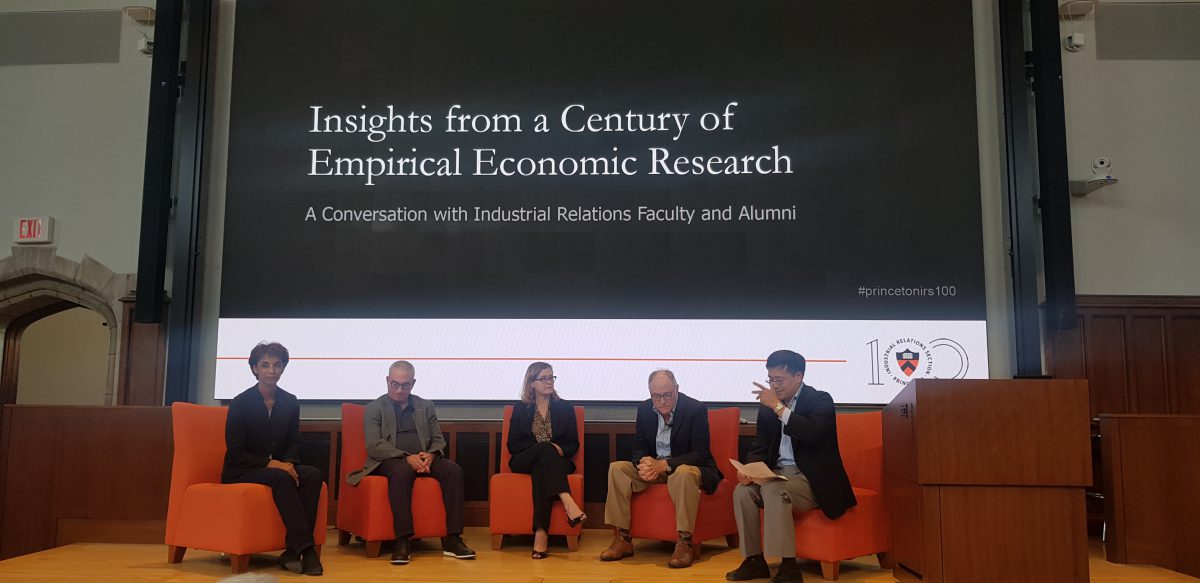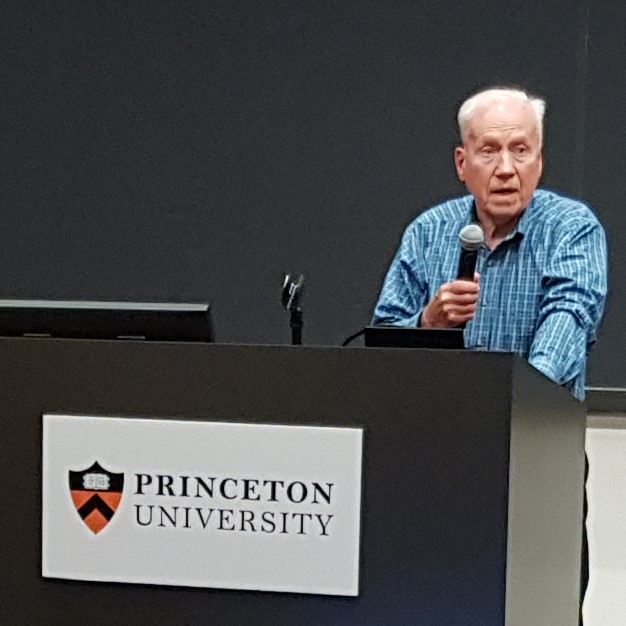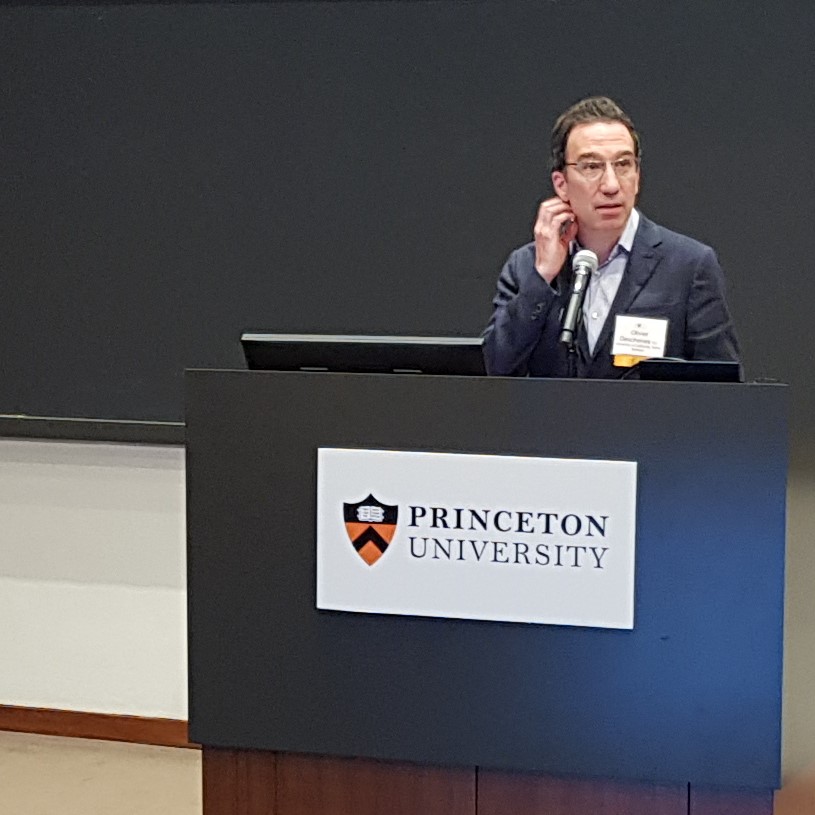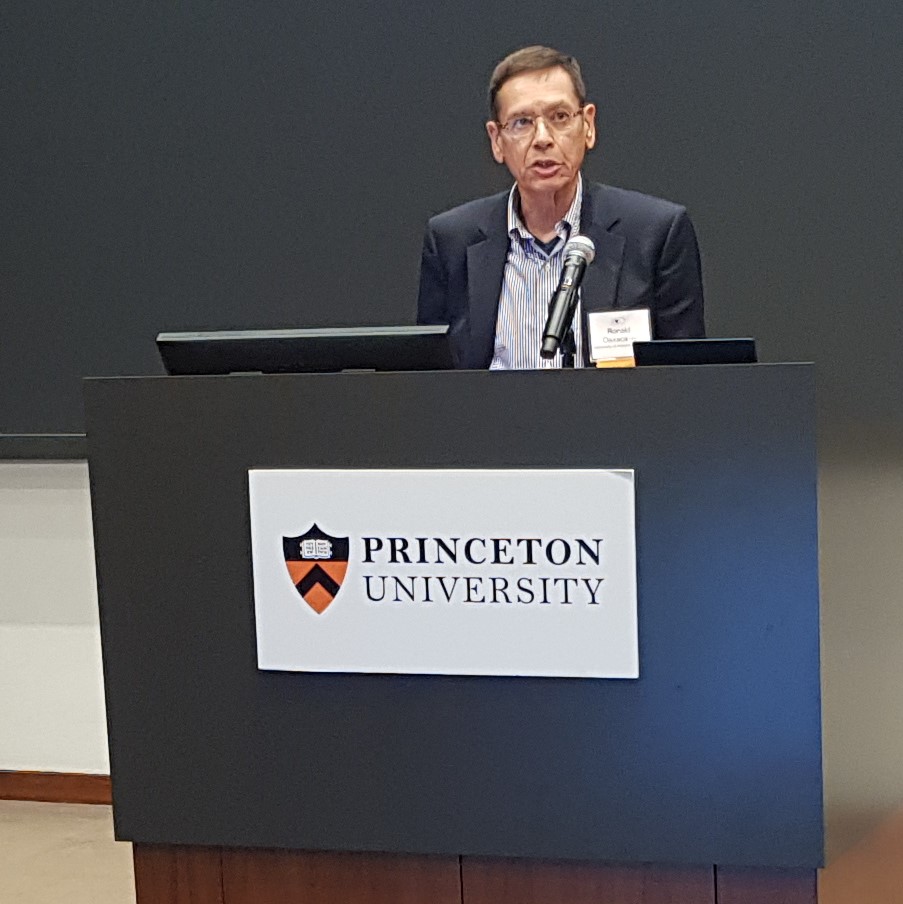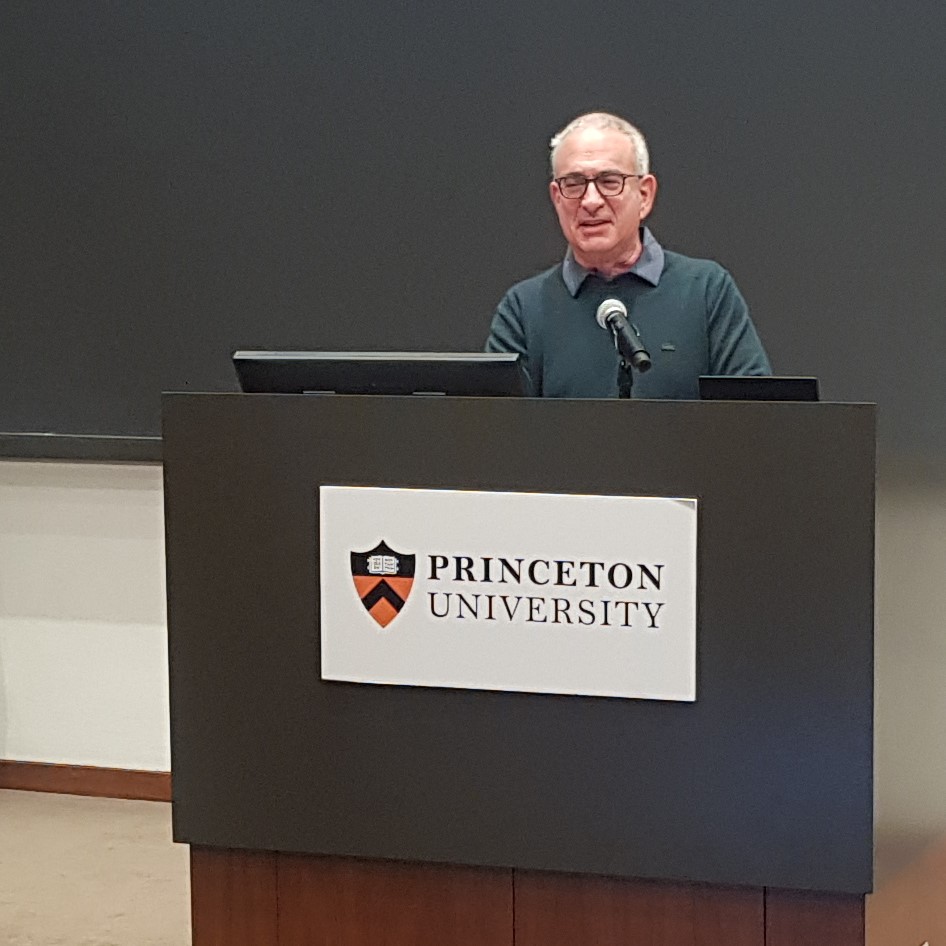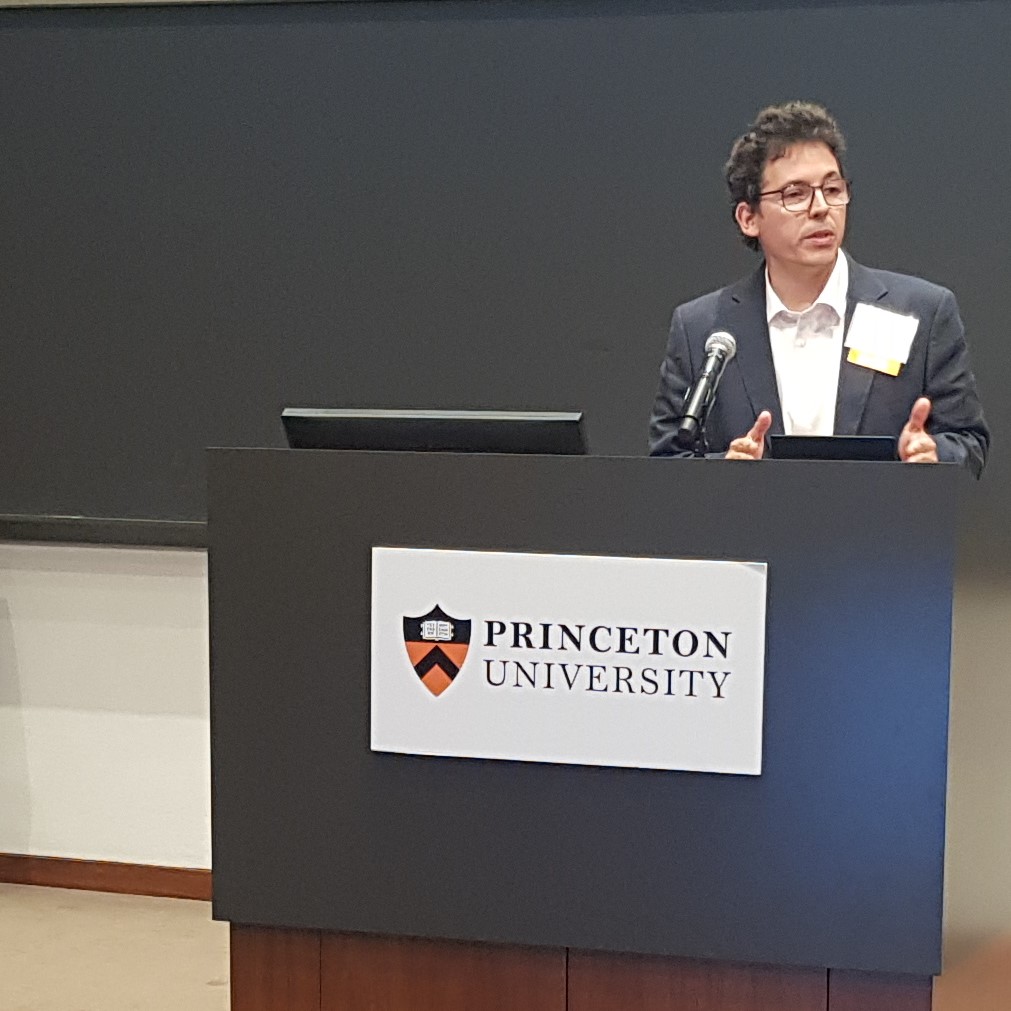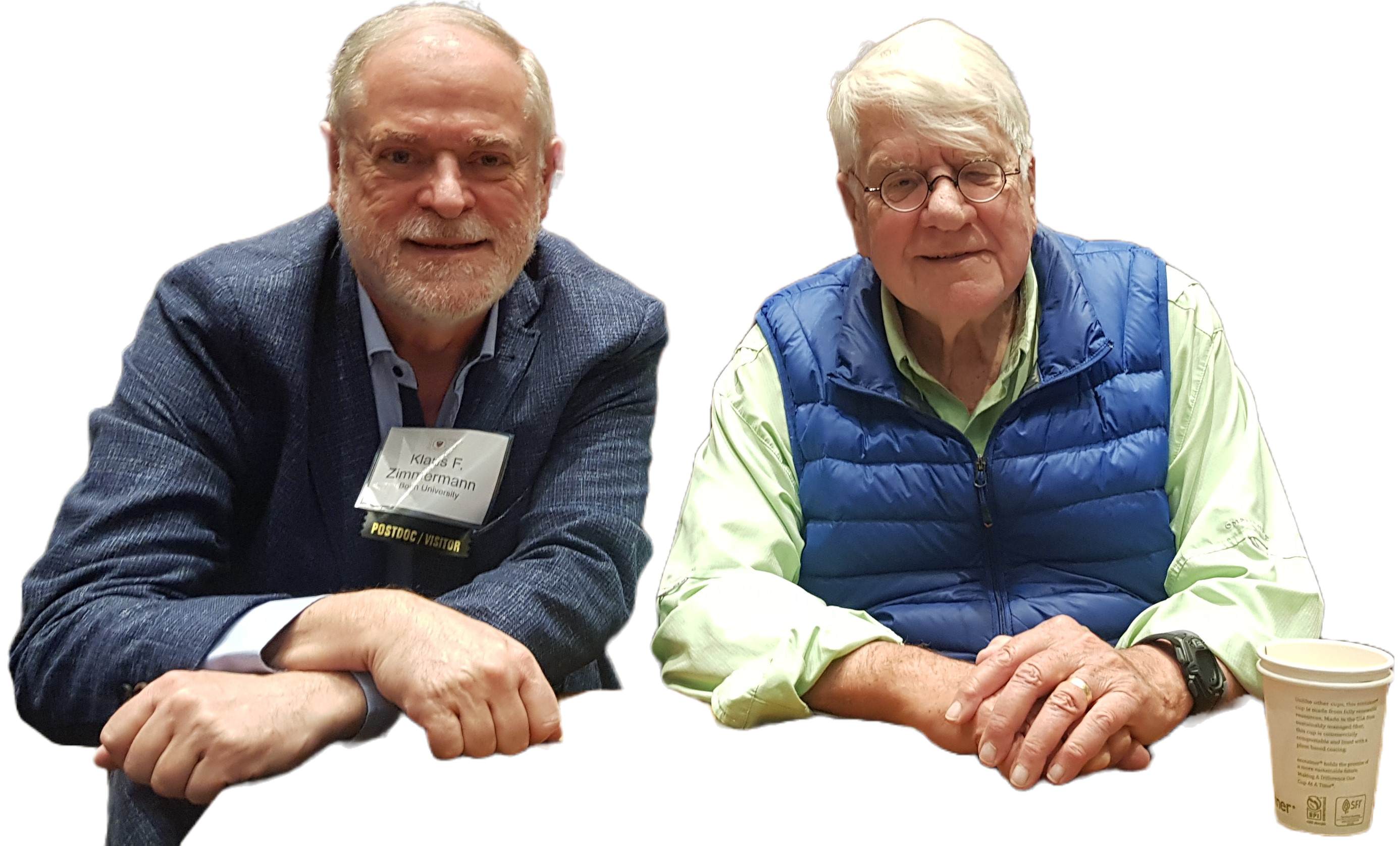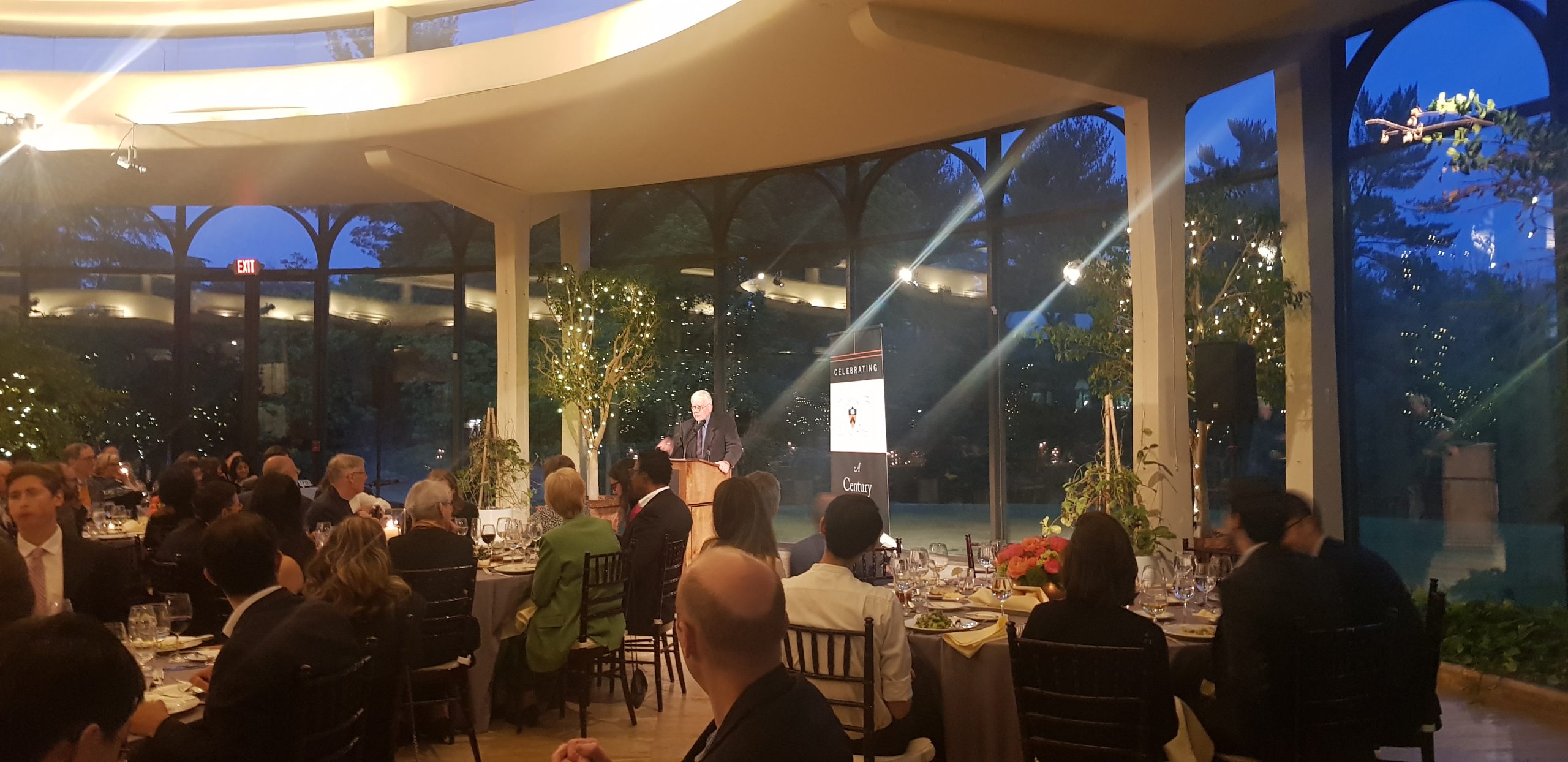

Congratulations to Princeton’s Industrial Relations Section and its leader Orley Ashenfelter celebrating 100 years of tremendous success in research and policy impact: More information.
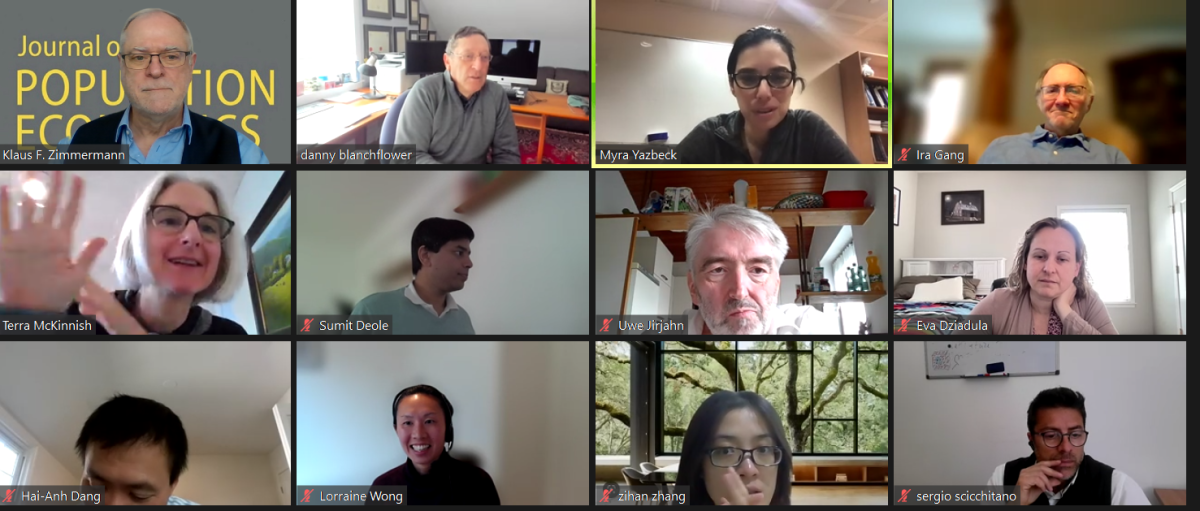
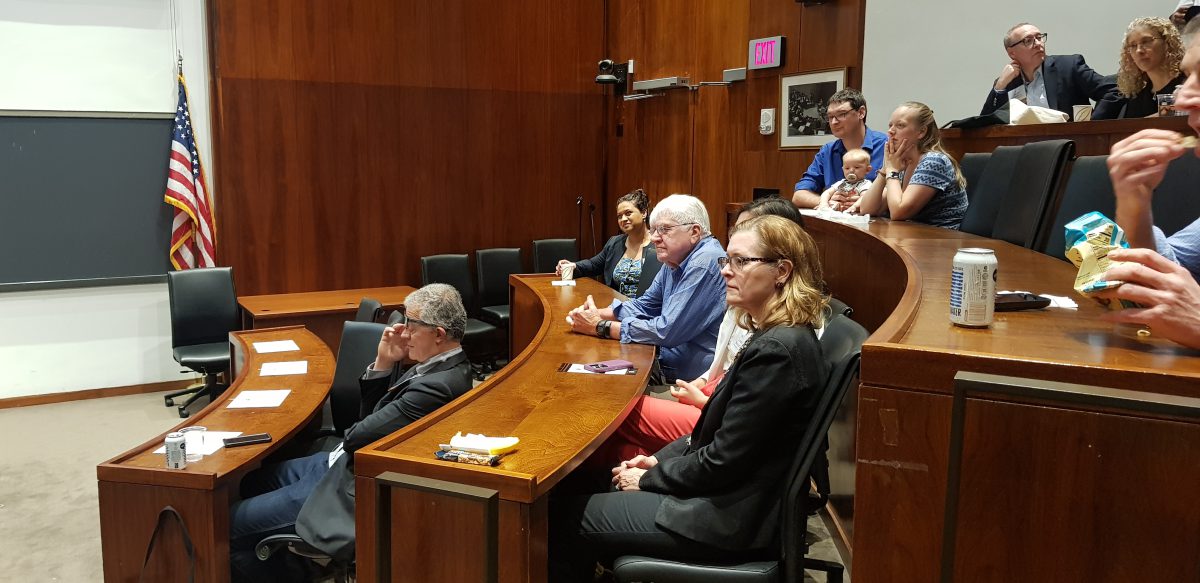
Cecilia Rose, Joshua Angrist, Janet Currie, David Card and David Lee
A new GLO Discussion Paper finds no evidence that working from home harmed mental health pre-pandemic, but may have deteriorated mental health during the pandemic.
Author Abstract: Robust evidence on working from home and mental health is lacking, with recent concerns it may blur work-home boundaries. Working from home was discretionary and less intensive in pre-pandemic years, while during the pandemic, it was often intensive and ‘mandated’. I estimate the relationship between working from home and mental health via fixed-effects and instrumental variable (IV) estimation. I find no evidence that working from home harmed mental health, on average, pre-pandemic, with IV estimates suggesting potentially improved health. Conversely, working from home may have deteriorated mental health during the pandemic, potentially due its ‘forced’, intensive nature during this time.
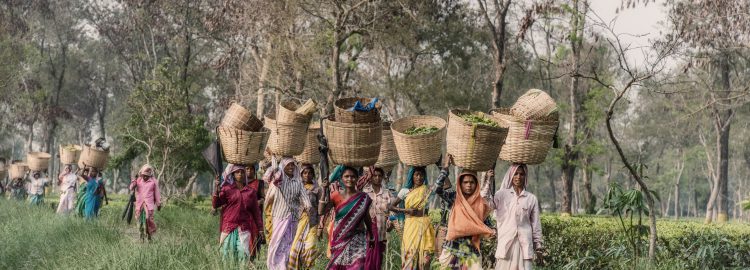
Featured image: The-Coherent-Team-on-Unsplash
JUST PUBLISHED
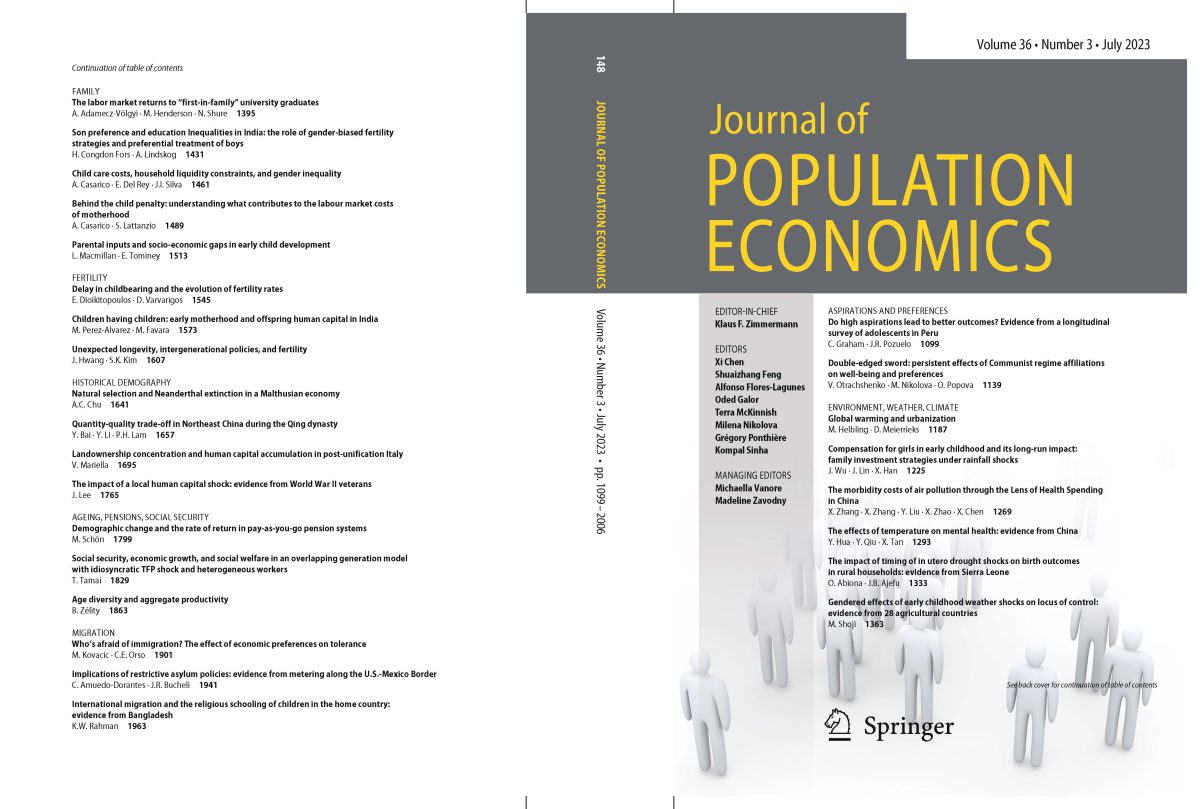
Vol. 36, Issue 3, July 2023: Journal of Population Economics (JOPE) 26 articleson:Aspirations and preferences; Environment, Weather, Climate; Family; Fertility; Historical demography; Ageing, pensions, social security; Migration https://link.springer.com/journal/148/volumes-and-issues/36-3
The Global Labor Organization (GLO) is an independent, non-partisan and non-governmental organization that functions as an international network and virtual platform to stimulate global research, debate and collaboration.
The Department of Economics at Macquarie University with support from the Department of Foreign Affairs and Trade (DFAT) and Global Labor Organization (GLO) is organizing the 18th Australasian Development Economics Workshop (ADEW) in Sydney, Australia from 8-9 June 2023.
ADEW is Australia’s leading development economics conference, often involving participants from the broader Asia-Pacific region. The workshop is an opportunity for participants to share and discuss ideas, present research, and network with colleagues with similar research interests. National and international speakers will participate in thought-provoking sessions and participation from researchers, policymakers and PhD students is welcome.
Author Abstract: This essay attempts to build a simple theoretical model of optimization to decipher the effect of digitalization of a part of the entire production structure which we call here trading or transaction or marketing. In the basic model we use traditional Cobb – Douglas production function to argue that a shift from offline to online may induce increase in profit and subsequent economic growth. However, the effects are not uniform implying that factor-input ratio or factor-intensity of the trading activity has a role to play in this context. We also find that night time utilization due to digitalization further strengthens our results. We then extend the basic model for a CES production function. And it has been observed there that in CES – case we have similar results but the channels are a little different for that both revenue and cost have similar consequences of digitalization. Nevertheless, the essence of the basic results holds true even in a more generalized case.
Featured image: Andy-Kelly-on-Unsplash
JUST PUBLISHED
Vol. 36, Issue 3, July 2023: Journal of Population Economics (JOPE) 26 articleson:Aspirations and preferences; Environment, Weather, Climate; Family; Fertility; Historical demography; Ageing, pensions, social security; Migration https://link.springer.com/journal/148/volumes-and-issues/36-3


The Global Labor Organization (GLO) is an independent, non-partisan and non-governmental organization that functions as an international network and virtual platform to stimulate global research, debate and collaboration.
A new GLO Discussion Paper investigating the optimal control of an epidemic of a Susceptible-Infective-Removed-Susceptible (SIRS) infection, where social distancing is the only control action in a first stage, whereas a combination of social distancing and vaccination is available in a second stage.
Author Abstract: Motivated by the complicated control issues of COVID-19, this article aims at investigating the optimal control of an epidemic of a Susceptible-Infective-Removed-Susceptible (SIRS) infection, where social distancing is the only control action in a first stage, whereas a combination of social distancing and vaccination is available in a second stage. The resulting two-control optimal problem is set within a parsimonious economic framework in which a social planner minimises an objective function weighting epidemiological and economic costs by choosing the strength of social distancing in the first stage and both social distancing and the extent of an income tax to finance vaccination in the second stage. The article shows (i) how to mix social distancing and vaccination depending on the planner’s degree of rationality; (ii) the importance of the planner’s expectation about the date of vaccine arrival, and how the actual effi cacy of the vaccine against the infection can affect the optimal social distancing policy in the pre-vaccination period, and (iii) the use of the social distancing instrument as the only optimal control under vaccine rationing.
Featured image: fusion-medical-animation-unsplash
JUST PUBLISHED
Vol. 36, Issue 3, July 2023: Journal of Population Economics (JOPE) 26 articleson:Aspirations and preferences; Environment, Weather, Climate; Family; Fertility; Historical demography; Ageing, pensions, social security; Migration https://link.springer.com/journal/148/volumes-and-issues/36-3
The Global Labor Organization (GLO) is an independent, non-partisan and non-governmental organization that functions as an international network and virtual platform to stimulate global research, debate and collaboration.
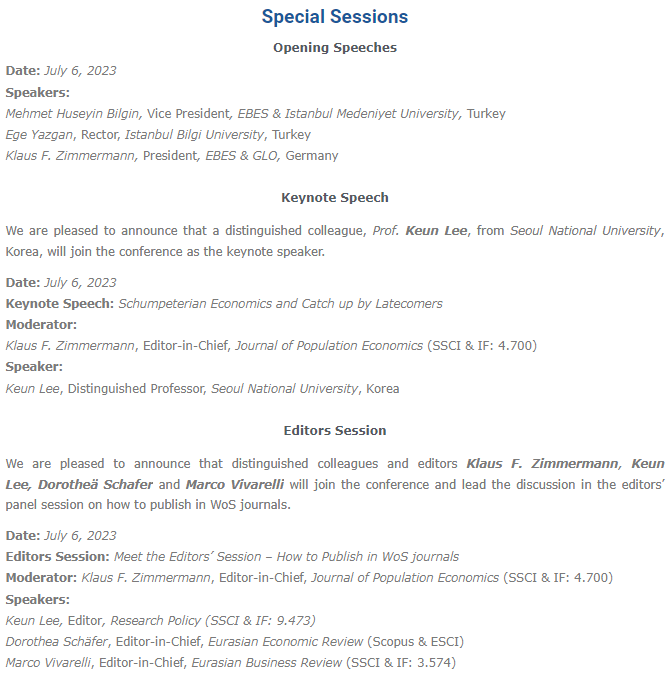
The 44th EBES Conference – Istanbul will take place on July 6th, 7th, and 8th, 2023 in Istanbul, Turkey. The conference will be hosted by Istanbul Bilgi University with the support of the Istanbul Economic Research Association and organized in Hybrid Mode (online and in-person).
Interested researchers from around the world are cordially invited to submit their abstracts or papers for presentation considerations.
Deadline for Abstract Submission is June 14, 2023.
Prof. Klaus F. Zimmermann, UNU-MERIT, Maastricht, and Free University Berlin Prof. Mehmet Huseyin Bilgin, Istanbul Medeniyet University, EBES, Turkey Prof. Jonathan Batten, University Utara Malaysia, Malaysia Prof. Iftekhar Hasan, Fordham University, U.S.A. Prof. Euston Quah, Nanyang Technological University, Singapore Prof. John Rust, Georgetown University, U.S.A. Prof. Dorothea Schäfer, German Institute for Economic Research DIW Berlin, Germany Prof. Marco Vivarelli, Università Cattolica Del Sacro Cuore, Italy
Abstract/Paper Submission
Authors are invited to submit their abstracts or papers no later than June 14, 2023. (Previous deadline of May 31 extended!)
General inquiries regarding the call for papers should be directed to ebes@ebesweb.org
Publication Opportunities
Qualified papers can be published in EBES journals (Eurasian Business Review and Eurasian Economic Review) or EBES proceedings books after a peer review process without any submission or publication fees. EBES journals (EABR and EAER) are published by Springer and both are indexed in the SCOPUS, EBSCO EconLit with Full Text, Google Scholar, ABS Academic Journal Quality Guide, CNKI, EBSCO Business Source, EBSCO Discovery Service, ProQuest International Bibliography of the Social Sciences (IBSS), OCLC WorldCat Discovery Service, ProQuest ABI/INFORM, ProQuest Business Premium Collection, ProQuest Central, ProQuest Turkey Database, ProQuest-ExLibris Primo, ProQuest-ExLibris Summon, Research Papers in Economics (RePEc), Institute of Scientific and Technical Information of China, Naver, SCImago, ABDC Journal Quality List, Cabell’s Directory, and Ulrich’s Periodicals Directory. In addition, while EAER is indexed in the Emerging Sources Citation Index (Clarivate Analytics), EABR is indexed in the Social Science Citation Index (SSCI) and Current Contents / Social & Behavioral Sciences.
Also, all accepted abstracts will be published electronically in the Conference Program and the Abstract Book (with an ISBN number). It will be distributed to all conference participants at the conference via USB. Although submitting full papers are not required, all the submitted full papers will also be included in the conference proceedings in a USB.
After the conference, participants will also have the opportunity to send their paper to be published (after a refereeing process managed by EBES) in the Springer’s series Eurasian Studies in Business and Economics (no submission and publication fees). This is indexed by Scopus. It will also be sent to Clarivate Analytics in order to be reviewed for coverage in the Conference Proceedings Citation Index – Social Science & Humanities (CPCI-SSH). Please note that the 10th, 11th, 12th, 13th, 14th, 15th, 16th, 17th, 18th, 19th, 20th, 21st, 22nd, 23rd, 24th, and 25th, 26th, 27th, 28th, 29 (Vol. 1), and 30th EBES Conference Proceedings are accepted for inclusion in the Conference Proceedings Citation Index – Social Science & Humanities (CPCI-SSH). Other conference proceedings are in progress.
Important Dates
Conference Date: July 6-8, 2023 ExtendedAbstract Submission Deadline: June 14, 2023 Reply-by: June 14, 2023* Registration Deadline: June 19, 2023 Submission of the Virtual Presentation: June 19, 2023 Announcement of the Program: June 23, 2023 Paper Submission Deadline (Optional): June 19, 2023** Paper Submission for the EBES journals: October 15, 2023
* The decision regarding the acceptance/rejection of each abstract/paper will be communicated with the corresponding author within a week of submission.
** Completed paper submission is optional. If you want to be considered for the Best Paper Award or your full paper to be included in the conference proceedings in the USB, after submitting your abstract before June 14, 2023, you must also submit your completed (full) paper by June 15, 2023.
Contact
Ugur Can, Director of EBES (ebes@ebesweb.org) Ender Demir, Conference Coordinator of EBES (demir@ebesweb.org)
A new GLO Discussion Paperidentifies a process of displacement and occupational downgrading for routine manual workers, while workers in routine cognitive occupations seem to be relatively more protected.
Author Abstract: In spite of the growing literature on polarization, relatively little is known about the individual-level patterns underlying the decline of routine occupations and its link with informal employment in a middle-income country context. To shed light on this, we examine the ows of formal and informal workers into and out of routine and non-routine occupations over the period 1980-2015 in Chile. Using rich longitudinal data from the Social Protection Survey of Chile, we first reconstruct individuals’ occupational trajectories by classifying individuals into different states at a monthly frequency. We then use a series of multilevel competing risk event history models and a decomposition ow approach to study the ows underlying the decline of routine occupations over time. Our results suggest a process of displacement and occupational downgrading for routine manual workers: workers in routine manual formal employment become increasingly unemployed or use informality as a buffer against job loss, and workers in routine manual informal employment become unemployed or transit to non-routine manual informal occupations. By contrast, workers in routine cognitive occupations seem to be relatively more protected against job displacement and occupational downgrading. Lastly, we find that the decrease in the share of routine occupations in Chile is mostly due to a decrease in the in ow transition rate from unemployment as well as an increase in the out ow transition rates to unemployment and informality.
JUST PUBLISHED
Vol. 36, Issue 3, July 2023: Journal of Population Economics (JOPE) 26 articleson:Aspirations and preferences; Environment, Weather, Climate; Family; Fertility; Historical demography; Ageing, pensions, social security; Migration https://link.springer.com/journal/148/volumes-and-issues/36-3
The Global Labor Organization (GLO) is an independent, non-partisan and non-governmental organization that functions as an international network and virtual platform to stimulate global research, debate and collaboration.
A new GLO Discussion Paperconcludes that the quality of predictions and the choice of the optimal prediction model are dependent on the distribution of observed and unobserved incomes, the poverty line, the choice of objective function and policy preferences, and various other modeling choices.
Author Abstract: Poverty prediction models are used by economists to address missing data issues in a variety of contexts such as poverty profiling, targeting with proxy-means tests, cross-survey imputations such as poverty mapping, or vulnerability analyses. Based on the models used by this literature, this paper conducts an experiment by artificially corrupting data with different patterns and shares of missing incomes. It then compares the capacity of classic econometric and machine learning models to predict poverty under these different scenarios. It finds that the quality of predictions and the choice of the optimal prediction model are dependent on the distribution of observed and unobserved incomes, the poverty line, the choice of objective function and policy preferences, and various other modeling choices. Logistic and random forest models are found to be more robust than other models to variations in these features, but no model invariably outperforms all others. The paper concludes with some reflections on the use of these models for predicting poverty.
The Global Labor Organization (GLO) is an independent, non-partisan and non-governmental organization that functions as an international network and virtual platform to stimulate global research, debate and collaboration.
Author Abstract: We study the role of proximity to historical ethnic borders in determining individual land ownership in Sub-Saharan Africa. Following an instrumental variable strategy, we document that individuals have a lower likelihood of owning land near historical ethnic borders. In particular, the likelihood of owning land decreases by 15 percentage points, i.e., about 1/3 of the mean rate of landownership, for rural migrants who move from 57km (90th percentile) to 2 km (10th percentile) from the border. This result aligns with the view that competition for land is stronger and property rights are weaker close to historical ethnic borders in Sub-Saharan Africa.
The Global Labor Organization (GLO) is an independent, non-partisan and non-governmental organization that functions as an international network and virtual platform to stimulate global research, debate and collaboration.
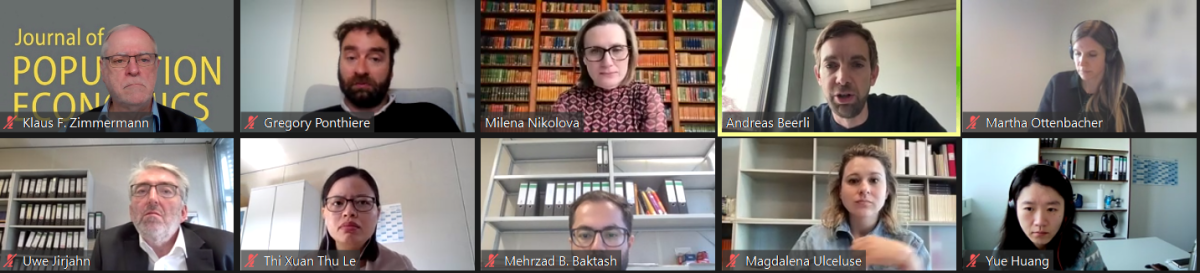
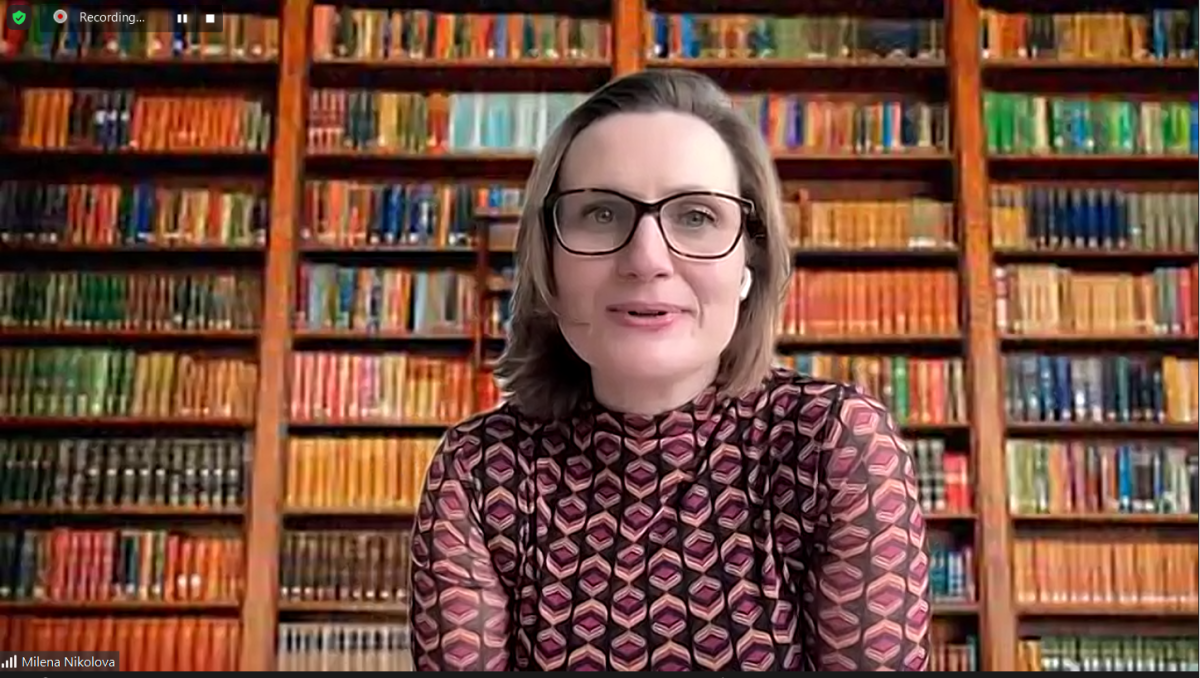
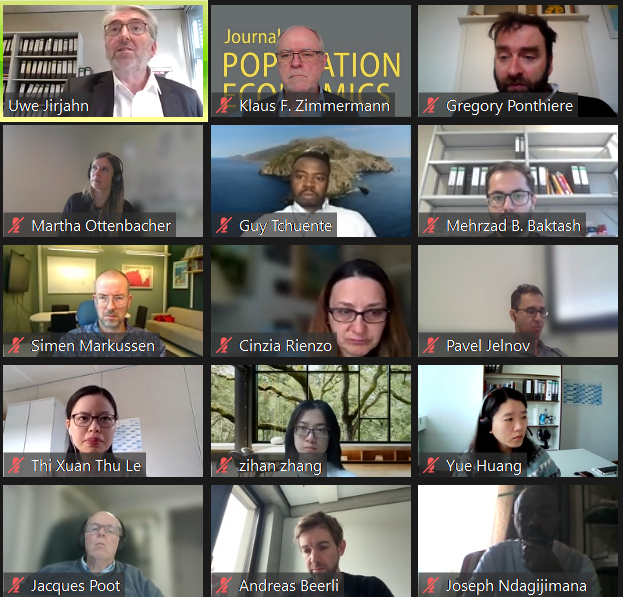
The April 2023 issue (2) of Vol. 36 of the Journal of Population Economics (JOPE) is out (LINK to issue). Highlights of the issue and of recent other related JOPE publications were presented during the April 27 Online JOPE Spring 2023 conference.
Program, access to the articles and some pictures below. You missed the event? Here is the EVENT VIDEO.
Program
April 27, 2023. 10:00 – 12:00 CEST/Berlin time (10-12 am). PART I
Andreas Beerli, Indergand, R. & Kunz, J.S.: The supply of foreign talent: how skill-biased technology drives the location choice and skills of new immigrants. https://doi.org/10.1007/s00148-022-00892-3 Open Access
Magda Ulceluse, M., Kahanec, M.: Eastward enlargements of the European Union, transitional arrangements and self-employment. https://doi.org/10.1007/s00148-022-00904-2 Open Access
Sumit Deole, S.S., Rieger, M.O.: The immigrant-native gap in risk and time preferences in Germany: levels, socio-economic determinants, and recent changes. https://doi.org/10.1007/s00148-022-00925-x Open Access
Hai-Anh H. Dang, Verme, P.: Estimating poverty for refugees in data-scarce contexts: an application of cross-survey imputation. https://doi.org/10.1007/s00148-022-00909-x Open Access
Olu Abiona, Ajefu, J.B.: The impact of timing of in utero drought shocks on birth outcomes in rural households: evidence from Sierra Leone. https://doi.org/10.1007/s00148-022-00926-w published online first. OPEN ACCESS.
A new GLO Discussion Paperfinds that inequality of opportunity is positively associated with beliefs about the unfair distribution of outcomes like a successful life and finding a job.
Author Abstract: An egalitarian society is one that incentivises individuals to use their resources in order to be improve their economic outcomes and achieve social integration. The objective of this paper is to analyse Inequality of Opportunity (IOp), a measure of deprivation which counts for differences in economic outcomes, as well as estimate its effects. The research findings show that IOp is positively associated with statements on beliefs about the unfair distribution of outcomes in the sense of a successful life and towards the most important factors of finding a job at present. On the other hand, higher levels institutional trust reverse the effect of IOp. There are additional positive impacts in terms of such beliefs for those whose access to primary goods is limited due to disfavourable initial conditions at birth (being born in a rural area and being a female),who perceive themselves as belonging to a lower social class and those who have had positive experiences from their interaction with institutions. Findings are especially important in the context of countries with weak institutions and democracy, such as the case of Western Balkans (focus of this paper) and urge for a strengthening of institutions which regulate and support the citizens’ integration into society.
The Global Labor Organization (GLO) is an independent, non-partisan and non-governmental organization that functions as an international network and virtual platform to stimulate global research, debate and collaboration.
Author Abstract: Prior studies show that taxes matter for the residential locations of high-income earners. But, states raise a significant share of revenue from nonresidents. Using variation in state tax rates, we provide causal evidence on the effect of the net-of-tax rate on the location of labor supply for professional golfers. State taxes induce high-income earners to shift employment to low-tax states without a residence change. The elasticity of working in a state is 0.34, and consistent with superstar phenomenon, increases with earnings. Our results suggest a novel margin of mobility responses for top-earners: the spatial relocation of labor supply by nonresidents.
Featured image: the-new-york-public-library-unsplash
The Global Labor Organization (GLO) is an independent, non-partisan and non-governmental organization that functions as an international network and virtual platform to stimulate global research, debate and collaboration.
Author Abstract: To determine how wives’ and husbands’ retirement options affect their spouses’ (and their own) labour supply decisions, we exploit (early) retirement cutoffs by way of a regression discontinuity design. Several German pension reforms since the early 1990s have gradually raised women’s retirement age from 60 to 65, but also increased ages for several early retirement pathways affecting both sexes. We use German Socio-Economic Panel data for a sample of couples aged 50 to 69 whose retirement eligibility occurred (i) prior to the reforms, (ii) during the transition years, and (iii) after the major set of reforms. We find that, prior to the reforms, when several retirement options were available to both husbands and wives, both react almost symmetrically to their spouse reaching an early retirement age, that is both husband and wife decrease their labour supply by about 5 percentage points when the spouse reaches age 60). This speaks in favour of leisure complementarities. However, after the set of reforms, when retiring early was much more difficult, we find no more significant labour supply reaction to the spouse reaching a retirement age, whereas reaching one’s own retirement age still triggers a significant reaction in labour supply. Our results may explain some of the diverse findings in the literature on asymmetric reactions between husbands and wives to their spouse reaching a retirement age: such reactions may in large parts depend on how flexibly workers are able to retire.
The Global Labor Organization (GLO) is an independent, non-partisan and non-governmental organization that functions as an international network and virtual platform to stimulate global research, debate and collaboration.
A new GLO Discussion Paperfinds thatJews had a higher probability of being professionals, managers, and craft workers, and were less likely to be in farm occupations or in operative jobs.
Author Abstract: This paper is concerned with analyzing the occupational status of American Jewish men compared to other free men in the mid-19th century to help fill a gap in the literature. It does this by using the 1/100 microdata sample from the 1850 Census of Population, the first census to ask occupation. Two independent lists of surnames are used to identify men with a higher probability of being Jewish. The men identified as Jews had a higher probability of being professionals, managers, and craft workers, and were less likely to be in farm occupations or in operative jobs. Using the Duncan Socioeconomic Index (SEI), the Jewish men have a higher SEI overall. In the multiple regression analysis, it is found that among Jewish and other free men occupational status increases with age (up to about age 44 for all men), literacy, being married, being native born, living in the South, and living in an urban area. Controlling for a set of these variables, Jews have a significantly higher SEI, which is the equivalent of about half the size of the effect of being literate. This higher occupational status is consistent with patterns found elsewhere for American Jews throughout the 20th century.
The Global Labor Organization (GLO) is an independent, non-partisan and non-governmental organization that functions as an international network and virtual platform to stimulate global research, debate and collaboration.
A new GLO Discussion Paperfinds that inter-personal communication may help to mitigate high intensity conflicts when the identities are common knowledge among rivals.
Author Abstract: We investigate experimentally the effects of information about native/immigrant identity, and the ability to communicate a self-chosen personal characteristic towards the rival on conflict behavior. In a two-player individual contest with British and Immigrant subjects in the UK we find that neither information about identity nor communicating self-characteristics significantly affect the average level of conflict. Both of those, however, significantly affect players’ strategies, in the sense of the extent they involve conflict over time. Overall, the results indicate that inter-personal communication may help to mitigate high intensity conflicts when the identities are common knowledge among rivals.
The Global Labor Organization (GLO) is an independent, non-partisan and non-governmental organization that functions as an international network and virtual platform to stimulate global research, debate and collaboration.
The April 2023 issue (2) of Vol. 36 of the Journal of Population Economics (JOPE) is out (LINK to issue). Highlights of the issue and of recent other related JOPE publications are presented during the April 27 Online JOPE Spring 2023 conference. Participation is free. There will be time for questions.
After registering, you will receive a confirmation email containing information about joining the event. Please join any time during 10-12 am CEST and/or 3-5 pm CEST on April 27, 2023.
We are looking forward to your online participation!
Note: JOPE’s Editor-in-Chief offers informal talks with participants about publishing with JOPE directly after the sub-meetings.
Program
April 27, 2023. 10:00 – 12:00 CEST/Berlin time (10-12 am). PART I
Andreas Beerli, Indergand, R. & Kunz, J.S.: The supply of foreign talent: how skill-biased technology drives the location choice and skills of new immigrants. https://doi.org/10.1007/s00148-022-00892-3 Open Access
Magda Ulceluse, M., Kahanec, M.: Eastward enlargements of the European Union, transitional arrangements and self-employment. https://doi.org/10.1007/s00148-022-00904-2 Open Access
Sumit Deole, S.S., Rieger, M.O.: The immigrant-native gap in risk and time preferences in Germany: levels, socio-economic determinants, and recent changes. https://doi.org/10.1007/s00148-022-00925-x Open Access
Hai-Anh H. Dang, Verme, P.: Estimating poverty for refugees in data-scarce contexts: an application of cross-survey imputation. https://doi.org/10.1007/s00148-022-00909-x Open Access
Olu Abiona, Ajefu, J.B.: The impact of timing of in utero drought shocks on birth outcomes in rural households: evidence from Sierra Leone. https://doi.org/10.1007/s00148-022-00926-w published online first. OPEN ACCESS.
A new GLO Discussion Paperfinds that the damage to the firms’ image triggered by the negative social media reactions following job destructions entail a financial cost for firms that adds to the standard adjustment costs of dismissals.
Author Abstract: We study social reactions to job destructions on Twitter. We use information on large-scale restructuring events announced in the United Kingdom over the period 2013-2018. We match it with data collected on Twitter regarding the number and sentiments of the tweets posted around the time of the announcement and involving the company name. We show that jobdestruction announcements immediately elicit numerous and strongly negative reactions. These reactions are almost five times larger than the positive reactions to job-creation announcements. We also show that the negative reactions triggered by job-destruction announcements are associated with significant losses in the market value of the downsizing firms. This suggests that the damage to the firms’ image triggered by the negative social reactions following job destructions entail a financial cost for firms that adds to the standard adjustment costs of dismissals.
JUST PUBLISHED
Vol. 36, Issue 2, April 2023: Journal of Population Economics (JOPE) 16 articles. https://link.springer.com/journal/148/volumes-and-issues/36-2 Papers will be presented at the online JOPE Spring Conference on April 27, 2023. Registration details in due course at the GLO website.
The Global Labor Organization (GLO) is an independent, non-partisan and non-governmental organization that functions as an international network and virtual platform to stimulate global research, debate and collaboration.
A new GLO Discussion Paperfinds for Vietnam no significant effects from minimum wages on employment and monthly wages, but considerable negative effects on workers’ total working hours.
Author Abstract: In this study, we examine the impact of minimum wages in Vietnam using individual-level data from the 2012-2020 annual Labor Force Surveys. During this period, the average real minimum wage increased by around 4% per year. Overall, we do not find significant effects from minimum wages on employment and monthly wages. However, we find a considerable negative effect on workers’ total working hours. Working hours per week are reduced by 0.38% for a 1% increase in the minimum wage. Since total wages remain unchanged, a reduction in working hours results in an increase in hourly income. A 1% increase in the minimum wage leads to a 0.32% increase in hourly wages. Interestingly, for workers earning below minimum wage, we find a positive effect from minimum wages on their monthly income. A 1% increase in the minimum wage increases monthly income of workers earning below minimum wage by 0.83%.
The Global Labor Organization (GLO) is an independent, non-partisan and non-governmental organization that functions as an international network and virtual platform to stimulate global research, debate and collaboration.
A new GLO Discussion Paperstudies the implications of a theoretical model where the rich being scared of the spread of an infection hire the poor to work in exposure-intensive outdoor activities, which will improve the economic position of the unskilled.
Author Abstract: We propose a model of “trade” between high income and low-income groups where the rich being scared of the spread of infection hires the poor to engage them in exposure-intensive outdoor activities as workers in the household industry. People who endure hardships and sustain exposure to unhygienic conditions may develop stronger immunity to fight the ongoing pandemic than members of the privileged class. The low-income group has greater endowment of immunity to income and for the rich it is lower. If such exchange takes place, essentially less immune people are withdrawn from exposure intensive activities and are being substituted by more immune workers. Thus, the spread and fatality will reduce with such a trade. The greater is the inequality, the more would be demand for labor for such work resulting in greater volume of such trade between low income and high-income workers. Thus, spread of the disease will be lower for countries where inequality is high. Later under a general equilibrium setting, we show that, ceteris paribus, a pandemic with a significant threat of infection and fatality would mean greater demand for poor workers; their income would rise and inequality would decline. If the pandemic increases demand for the top skilled, such as the case with virtual activities and derived demand for low skilled, relative wage for the top and bottom would increase.
The Global Labor Organization (GLO) is an independent, non-partisan and non-governmental organization that functions as an international network and virtual platform to stimulate global research, debate and collaboration.
A new GLO Discussion Paper highlights the role of trade-growth-structural factors for simulating scenarios of technology-imports contents in a global non-linear CGE model.
Author Abstract: Drawing on selective stylized facts, the paper evaluates the growth-effects for African countries and the disruptive potentials resulting from the COVD-19 pandemic, as African countries are involved in intra-regional integration processes. As AfCFTA involving 55 countries (ratified by 22 countries) is an ambitious project for industrialization for achieving SDG targets of inclusive development via trade facilitation, and regional integration, the paper argues that given the Covid-19 setback full potential depends on trade-led spillover benefits and structural factors. Our objective is to show that: given the low labor-productivity growth in the African nations-without reinventing the wheel by estimating the impact of preferential access trade agreement–the ricochet effect of the trade-induced productivity benefits via intermediates in the presence of COVID-19-led trade disruptions is crucial. The study highlights the role of trade-growth-structural factors for providing basis to simulate scenarios of technology-imports contents in a global non-linear CGE model, viz., Global Trade Analysis Project (GTAP) with 27 sectors and 51 regions. The paper shows: (i) role of trade-mediated productivity benefits for facilitating regional supply chain, (ii) factors underlying absorption of such benefits for economic transformation; (iii) how trade and technology could boost trade not just trade-liberalization per se; (iv) given the region’s weaker production basis, in the presence of Covid-19, how the risks posed by trade plus non-trade external shocks to African intra-regional integration matter. Findings also indicate that technological benefits due to trade liberalization under FTA may be hindered by non-trade factors like epidemic or pandemic resulting in skill deficiencies, and translating into productivity slowdown. The paper empirically shows that for realizing the enormous potential of AfCFTA as driver of industrialization deep policy reforms in the areas of technology, absorptive capacity, institutions, and infra- and info-structure for digitization are necessary for long-term development. Also, the result proves that: for effectiveness of AfCFTA to deliver benefits to poor countries via allocative efficiency and welfare, apart from improving the ‘behind-the-border’ factors, trade with not only emerging economies like China, but also with industrialized nations is important. Also, the research shows the necessity of formulating policies to develop targeted sectors for reaping substantial benefits via AfCFTA. Thus, AfCFTA is not a panacea for industrial development.
The Global Labor Organization (GLO) is an independent, non-partisan and non-governmental organization that functions as an international network and virtual platform to stimulate global research, debate and collaboration.
Author Abstract: Kyrgyzstan economy have undergone transition from a different economic system in the 1990s until now. For stimulating a diversified long-run growth in Kyrgyzstan, the region needs to overcome spatial fragmentation by integrating the regions for economic development translating into national growth, and wider welfare gains. For sustained basis and shared prosperity, several policies are necessary for reforming basic services, human development, connectivity via infrastructure, industrial as well as agricultural performance, and a conducive business environment. In this paper, we assess the potential impacts of selected structural reform measures using a newly developed comparative-static forecasting model tailored to suit Kyrgyzstan economy–a computable general equilibrium (CGE) model (KGZORANI)-with a detailed Input-Output table for 34 sectors, and SAM of the national economy as of 2015. Economy is disaggregated into 9 regions. The reform initiatives are designed for enhancement of productivity and efficiency in agriculture, services such as trade, tourism, and transport, logistics, some manufacturing for industrialization, as well as power and energy sector like electricity, and global integration via trade and FDI. Policy reform simulation demonstrates that regional and global integration via improvement in transport and logistics will facilitate modern E-commerce, and boost productivity with real GDP growth. Given the dependence on agriculture and tourism, this kind of diversification is conducive for becoming non-susceptible to external vulnerability. Thus, structural reform facilitates growth across the oblasts (7 regions and 2 cities) in Kyrgyzstan and moves the economy by another 1.41 percentage points annually over the baseline path to 2030.
The Global Labor Organization (GLO) is an independent, non-partisan and non-governmental organization that functions as an international network and virtual platform to stimulate global research, debate and collaboration.
Author Abstract: Informal care is a primary source of support for older adults with cognitive impairment but is less available to those who live alone. We leverage the U.S. Health and Retirement Survey 2000-2018 to examine trends in the prevalence of physical disability and social support among older adults with cognitive impairment living alone, and their gender and racial/ethnic disparities. Information on physical disability and social support was collected through measures of basic and instrumental activities of daily living (BADLs, IADLs). Logistic and Poisson regression were adopted to estimate linear trends over time for binary and integer outcomes, respectively. Among those who reported BADL/IADL disability, the proportion unsupported for BADLs decreased significantly over time, while the proportion unsupported for IADLs increased significantly over time. Among those who received IADL support, the number of unmet IADL support needs increased significantly over time. Over time, Black respondents had a relatively increasing trend of being BADL-unsupported, and Hispanic and Black respondents had a relatively increasing trend in the number of unmet BADL needs, compared to the corresponding trends in White respondents. Among US older adults with cognitive impairment living alone, fewer people received IADL support over time, and the extent of unmet IADL support needs increased. Racial/ethnic disparities were seen both in the prevalence of reported BADL/IADL disability and unmet needs for BADL/IADL support; some but not all were compatible with a reduction in disparity over time. Our findings may prompt customized interventions to reduce disparities and unmet support needs.
The Global Labor Organization (GLO) is an independent, non-partisan and non-governmental organization that functions as an international network and virtual platform to stimulate global research, debate and collaboration.
Author Abstract: Using both regression analysis and an unsupervised graphical model approach (never applied before to this issue), we confirm the rejection of the Gibrat’s law when our firm-level data are considered over the entire investigated period, while the opposite is true when we allow for market selection. Indeed, the growth behavior of the re-shaped (smaller) population of the survived most efficient firms is in line with the Law of Proportionate Effect; this evidence reconciles early and current literature testing Gibrat’s law and may have interesting implications in terms of both applied and theoretical research.
The Global Labor Organization (GLO) is an independent, non-partisan and non-governmental organization that functions as an international network and virtual platform to stimulate global research, debate and collaboration.
Global Labor Organization (GLO) invites interested young scholars to apply for participation in the 2023-24GLO Virtual Young Scholars Program (GLO VirtYS). This is the fifth cohort of the successful GLO venture to support career developments of young researchers. It also provides a unique opportunity to interact with the large and very active GLO global research network.
Application deadline: June 23, 2023, 5 pm GMT. For general information see GLO VirtYS Website.
2023-24 GLO Virtual Young Scholars Program (GLO VirtYS)
About GLO: The Global Labor Organization (GLO) is a global, independent, non-partisan and non-governmental organization that has no institutional position. The GLO functions as an international network and virtual platform for researchers, policy makers, practitioners and the general public interested in scientific research and its policy and societal implications on global labor markets, demographic challenges and human resources. These topics are defined broadly in line with its Mission to embrace the global diversity of labor markets, institutions, and policy challenges, covering advanced economies as well as transition and less developed countries.
Program’s Goal: In the spirit of the GLO Mission, the GLO VirtYS program’s goal is to contribute to the development of the future generation of researchers, who are committed to the creation of policy-relevant research, are well equipped to work in collaboration with policy makers and other stakeholders, and adhere to the highest standards of academic integrity. This goal is achieved through the process of working on a specific research paper within the duration of the program, which is 10 months starting from September 2023.
Program’s Advisory Board:
Jan van Ours, Professor of Applied Economics, Erasmus School of Economics Rotterdam, Netherlands, & Professorial Fellow, University of Melbourne, Australia
Marco Vivarelli, Professor at the Università Cattolica del Sacro Cuore in Milano and Director of the Department of Economic Policy
Le Wang, Chong K. Liew Chair and Professor & President’s Associates Presidential Professor, University of Oklahoma, USA
Klaus F. Zimmermann, Professor Emeritus, Bonn University, UNU-MERIT & President of GLO
Program’s Activities:
Virtual kick-off meeting of all the participants and Thematic Cluster advisors, who will be appointed by the participating Cluster leads to match closely participants’ research interests.
One-to-one activities with the Thematic Cluster Advisor will be agreed upon at the beginning of the scholarship period in an Individual Research Plan. These activities at a minimum shall include 2-3 virtual consultations, 1 review round of the completed research work and a discussion of the amendments (if needed) to follow up.
Provide a virtual platform for the GLO VirtYS program participants to present their findings and receive feedback from their peers and the GLO wider community.
The scholarship will conclude in June 2024 followed by the presentations by the scholars within the GLO-wide seminar series in September 2024, after which the GLO Management Board will make a decision on whether to extend an invitation to the graduate of the GLO Virtual Scholar Program to join the organization as a GLO Fellow, based on the recommendation from their Thematic Cluster Advisors and evaluation of the GLO VirtYS Advisory Board.
Research proposals are invited within one of the following GLO thematic clusters:
All GLO VirtYS program participants will become GLO Affiliates, if they are not already, and receive a GLO Bio page.
GLO VirtYS program participants will be listed with pictures on the www.glabor.org website of the program.
Feedback on their research from leading researchers in the area of their interest.
Networking opportunities with researchers from other countries within the same area and beyond
(Priority) access to GLO activities.
Interactions with the scholars of the cohort, program’s alumni, and the future cohorts.
Opportunity to promote own research via GLO channels.
Completed research paper ready for submission to the GLO Discussion Paper series.
Possibility of promotion to GLO Fellow after exceptional performance.
Eligibility criteria:
Applicant must be either currently enrolled in a doctoral program or be within 2 years after graduation as evidenced by the letter from the degree awarding institution or a degree certificate.
Applicant must be at an advanced stage of the analysis of a specific research question within the corresponding GLO Thematic Cluster to which he/she is applying as evidenced by the submitted draft.
Applicant must be supported by a letter of endorsement from either one of the GLO Fellows or from the administration of one of the GLO supporting institutions.
The GLO Virtual Young Scholars will be selected by a Scientific Selection Committee consisting of the GLO VirtYS Program Director, GLO thematic cluster leads participating in the current year, and a member of the GLO Management Board.
The results of the selection will be posted on the GLO site www.glabor.org by July 18, 2023. Scholars will be notified via email. In the 2023-24 academic year we expect to select 5-7 scholars.
The final research paper should be submitted by June 30th, 2024, by 5 pm GMT.
Upon completion of the program and based on the quality of the produced research paper, some of the GLO VirtYS programme graduates may be invited to become GLO Fellows and their paper accepted as a GLO Discussion Paper.
Evaluation criteria for applications:
Research excellence (50 points)
Policy relevance of the research question in a local and/or global context (25 points)
Potential for capacity development (25 points) (preference will be given to the applicants for which the GLO Young Scholars Program can bring the highest capacity development, compared to what the applicant would have achieved without being a GLO Young Scholar)
Application procedure:
Many applicants apply in the last days before the submission deadline. To avoid last minute problems, we ask applicants to apply in advance. Applications received after the deadline or applications that do not meet the requirements set out below will not be accepted.
To apply please complete the online application form with three attachments:
1. Research proposal (maximum 2 pages including references, single-spaced, font size 12) should include the following information:
• Formulation of the problem/ research question. • Research methodology (data and empirical approach). • (Potential) Practical/Policy implications. • Reference list.
2. 2-page CV
3. Transcript from the doctoral program or doctoral degree certificate
4. Letter of endorsement for the candidate and the research proposal from either one of the GLO fellows or from the administration of one of the GLO supporting institutions reflecting on the potential of the candidate to benefit from the Program and the merits of the research proposal.
Author Abstract: Wages and productivity represent two of the most relevant variables to consider in economic development. Given the low productivity levels that emerging countries reveal, the accumulation of productive capabilities and a narrower dispersion across sectors would enable emerging countries to overcome the middle-income trap. Yet, this positive trend in productivity should translate into higher wages. Thus, we pose the following questions applied to a middle-income trapped country: is there a link between labour productivity and wages in the Argentine manufacturing sector? Does it differ across techno-productive classes or wage levels? Which factors affect this nexus, considering premature deindustrialisation? Using a firm-level dataset from 2010 to 2016, we perform quantile regression estimates to evaluate the link between productivity and wages across the conditional wage distribution among manufacturing firms. Based on a structural analysis, we identify the differences in these elasticities at 2-ISIC code levels and across Pavitt taxonomies. Our results confirm a positive, but extremely low, pass-through between productivity and wages in the Argentinian manufacturing firms, different across sectors according to their techno-productive capabilities, robust under different empirical strategies.
The Global Labor Organization (GLO) is an independent, non-partisan and non-governmental organization that functions as an international network and virtual platform to stimulate global research, debate and collaboration.
Author Abstract: Addressing climate change requires individual behavior change and voter support for proclimate policies, yet surprisingly little is known about how to achieve these outcomes. This paper estimates causal effects of additional education on pro-climate outcomes using new compulsory schooling law data across 16 European countries. It analyzes effects on pro-climate beliefs, behaviors, policy preferences, and novel data on voting for green parties – a particularly consequential outcome to combat climate change. Results show a year of education increases pro-climate beliefs, behaviors, most policy preferences, and green voting, with voting gains equivalent to a substantial 35% increase.
The Global Labor Organization (GLO) is an independent, non-partisan and non-governmental organization that functions as an international network and virtual platform to stimulate global research, debate and collaboration.
A new GLO Discussion Paper reviews the evolution, current status, and future prospects of the poverty measurement literature on forcibly displaced populations.
Author Abstract: Poverty measurement among forcibly displaced populations, including refugees and internally displaced persons, has been, for long, neglected by the economics profession and by poverty specialists working across the social sciences. This has changed since the beginning of the Syrian conflict in 2011 and the peak of the European migration crisis in 2015. This paper reviews the evolution, current status, and future prospects of the poverty measurement literature on forcibly displaced populations; discusses the main data and measurement challenges associated with this type of population; illustrates selected empirical findings that have emerged from the recent literature; and provides an overview of the substantial effort that humanitarian and development organizations are currently undertaking to close this historical gap in poverty measurement.
The Global Labor Organization (GLO) is an independent, non-partisan and non-governmental organization that functions as an international network and virtual platform to stimulate global research, debate and collaboration.
A new GLO Discussion Paper findshigher disability rates of older people in Vietnam than identified by local authorities, while there also exists a strong and negative association between education and disability.
Author Abstract: In this study, we study disability among older people (aged 60 or older) using the 2016 Viet Nam National Disability Survey. We find that 31% and 12% of older people are living with low and high disabilities, respectively. These rates are remarkably higher than the disability rate identified by local authorities. Disability is found to be more prevalent in older people and women. There is a strong and negative association between education and disability, as well as between wealth and disability. Next, we analyze the need for care among older people with disabilities. We find that around 10% of older people need care, which is equivalent to around 1.2 million people. The proportion of people in need of care is 29% for older people with disabilities and 53.8% for older people with severe disabilities.
The Global Labor Organization (GLO) is an independent, non-partisan and non-governmental organization that functions as an international network and virtual platform to stimulate global research, debate and collaboration.
A new GLO Discussion Paper finds no evidence of a disincentive effect, and the transfer program in Vietnam causes the adults to move from self-employed non-farm work to wage-paying jobs.
Author Abstract: We study the impact of a national cash transfer program in Vietnam on labor supply using large household surveys and a regression-discontinuity design based on discontinuity in age eligibility. We do not find evidence of a disincentive effect of the cash transfer on labor supply for adults aged 15-64. More importantly, we find robust evidence that the transfer program causes the adults to move from self-employed non-farm work to wage-paying jobs. A likely mechanism is that the transfer program reduces the labor force participation of older people, and they help housework and childcare for younger adults to have wage-paying jobs.
The Global Labor Organization (GLO) is an independent, non-partisan and non-governmental organization that functions as an international network and virtual platform to stimulate global research, debate and collaboration.
On the third anniversary of the pandemic, not enough has been done to tackle learning poverty i.e. the inability of children to read at the end of primary school. Because of being out of school for an extended period during the pandemic, learning poverty became catastrophic. While school systems reopened, they have placed children back in regular classes without recognizing that cognitively the children are not the same as they might have been two years earlier.
Therefore, a joint statement released by GLO fellows and academics from China, Ethiopia, Malaysia, Taiwan, Tunisia, Israel, Switzerland and the USA has expressed deep concerns over inadequate policy response to fight post-pandemic learning loss. The authors are editors of the International Journal of Educational Development.
The paper points out that guidelines for learning recovery have already been developed. But earlier calls for action have seemed to fall on deaf ears of school systems – educational leaders have not listened. Candid admission by educational authorities to admit, calibrate and make up for the learning losses is missing.
The same ‘business as usual’ operations are evident in large and small school systems and at widely disparate levels of economic development. It appears like a tsunami has occurred. The village has been flattened. But educational authorities are allowing classes to reopen with teachers untrained to address the learning losses, with curricula unfocused on learning losses, and without the concentration on learning losses as opposed to the wide range of normal educational objectives.
Niaz Asadullah, the GLO Southeast Asia cluster Head and the lead author of the article, stresses that “cognitive repair needs to happen before the new school year opens or the losses will be permanent”. Hence this renewed call to action.
There is an urgent need for a universal and coordinated policy response at the national level to assist learners ‘catch up’ in terms of literacy and numeracy skills.
Niaz Asadullah and his co-authors call for greater state-NGO partnership, and increased collaboration between countries in the global south and the global north in terms of knowledge sharing, to accelerate progress towards learning recovery.
For media inquiries, please contact: niaz.asadullah @ monash.edu
GLO Related Research Publications on COVID-19 and School Closures
Svaleryd, H., Vlachos, J. (2022). COVID-19 and School Closures. In: Zimmermann, K.F. (eds) Handbook of Labor, Human Resources and Population Economics. Springer, Cham. https://doi.org/10.1007/978-3-319-57365-6_318-1
Yamamura, E., Tsustsui, Y. School closures and mental health during the COVID-19 pandemic in Japan. Journal of Population Economics 34, 1261–1298 (2021). https://doi.org/10.1007/s00148-021-00844-3 OPEN ACCESS
Godøy, A., Grøtting, M.W. & Hart, R.K. Reopening schools in a context of low COVID-19 contagion: consequences for teachers, students and their parents.Journal of Population Economics 35, 935–961 (2022). https://doi.org/10.1007/s00148-021-00882-x OPEN ACCESS
A new GLO Discussion Paper reveals that classical studies do not affect conscientiousness and openness, but increases neuroticism and self-reported unhappiness.
Author Abstract: We investigate whether classical studies in high school – that emphasize in Italy the study of ancient languages such as Latin and Greek – affect personality traits. Using Italian survey data, we compare individuals who did classical studies in high school with similar individuals who completed a more scientific academic curriculum. We find that having done classical studies does not affect conscientiousness and openness but increases neuroticism and self-reported unhappiness.
The Global Labor Organization (GLO) is an independent, non-partisan and non-governmental organization that functions as an international network and virtual platform to stimulate global research, debate and collaboration.
The VIII SITES conference in Economic Development, entitled “Persistence and Change: the New challenges for Economic Development”, which will be held in Naples (Italy) on 14-16 September 2023.
Keynote Speakers: FRANÇOIS BOURGUIGNON (Paris School of Economics), PAOLA GIULIANO (UCLA Anderson School of Management), SANDRA SEQUEIRA (London School of Economics) and KLAUS F. ZIMMERMANN (Bonn University).
Submission deadline for papers: May 15, 2023. Further information: LINK
A new GLO Discussion Paper reveals that although both informality and education-occupation mismatch are significant determinants of wages, the former is more crucial for a developing country like India.
Author Abstract: This article examines the intertwining relationship between informality and education-occupation mismatch (EOM) and the consequent impact on the workers’ wages. In particular, we discuss two issues – first, the relative importance of informality and education-occupation mismatch in determining the wages; and second, the relevance of EOM for formal and informal workers. The analysis reveals that although both informality and EOM are significant determinants of wages, the former is more crucial for a developing country like India. Further, we find that EOM is one of the crucial determinants of wages for formal workers, but it is not critical for informal workers. The study highlights the need for considering the bifurcation of formal-informal workers to understand the complete dynamics of EOM especially for developing countries where informality is predominant.
The Global Labor Organization (GLO) is an independent, non-partisan and non-governmental organization that functions as an international network and virtual platform to stimulate global research, debate and collaboration.
Author Abstract: In a three-country model in which export countries adopt environmental policies, this note analyses how abatement (“green”) subsidy can become a potential strategic trade policy tool. When governments set the optimal policy tool considering their local environmental damages, a rich set of equilibria arise. In contrast to the standard result, it is shown that subsidising pollution abatement can 1) emerge as a Pareto-efficient equilibrium of the game; and 2) be the only feasible environmental policy when environmental awareness is low, irrespective of the technological efficiency. Therefore, “green” subsidies can lead to a win-win situation.
The Global Labor Organization (GLO) is an independent, non-partisan and non-governmental organization that functions as an international network and virtual platform to stimulate global research, debate and collaboration.
Author Abstract: Cognitive misperception contributed to poor decision-making; yet their impact on health-related decisions is less known. We examined how self-perceived memory was associated with chronic disease awareness among older Chinese adults. Data were obtained from the China Health and Retirement Longitudinal Study. Nationally representative blood biomarkers identify participants’ dyslipidemia and diabetes status. Among participants with biomarker identified dyslipidemia or diabetes, disease awareness was defined as self-reported diagnosis of the conditions. The proportions of disease awareness were lower for individuals with better self-perceived memory and those with more impaired cognitive ability, showing opposite patterns. Controlling for cognitive ability and covariates, self-perceived memory was negatively associated with the dyslipidemia and diabetes awareness. In particular, older adults with the highest level of self-perceived memory had significantly lower disease awareness as compared to those with the lowest level of self-perceived memory. Our findings were robust to alternative cognitive measures and were stronger for less educated rural residents or those living without children. Cognitive misperception poses great challenges to chronic disease management. Targeted interventions and supports are needed, particularly for the disadvantaged.
The Global Labor Organization (GLO) is an independent, non-partisan and non-governmental organization that functions as an international network and virtual platform to stimulate global research, debate and collaboration.
GLO Fellow Olivier Bargain, on behalf of the scientific committee, announces the first edition of the Welfare & Policy Conference. The broad topic for this first conference is: “Individual and collective responses to a troubled world”, but sessions are open to various domains of research. It will take place in Bordeaux/France on May 4-5, 2023.
Deadline for submitting abstracts: 28 February 2023. The GLO-supported session is co-organized by GLO Italy Country Lead Sergio Scicchitano (INAPP, GLO, and John Cabot University).
CALL FOR PAPERS: XLIV AISRe Conference in Naples, 6-8 September 2023 ASSOCIAZIONE ITALIANA DI SCIENZE REGIONALI
Special Session: SO.11 Working from home and local labour markets
Convenors: Ilaria Mariotti (DAStU-Politecnico di Milano), Federica Rossi (DAStU-Politecnico di Milano), Sergio Scicchitano (INAPP, GLO, and John Cabot University), Giuseppe Croce (Sapienza Università di Roma).
The rapid spread of the COVID-19 pandemic has profoundly affected the way people live and work, revealing itself both as a health and a socioeconomic crisis. Specifically, we have witnessed a change in the place of work: due to the movement restrictions, working from home (WFH) has massively grown. As the emerging scientific literature is pointing out, this has had numerous impacts on the local labour markets.
This special session aims at debating this issue across different perspectives: WFH impacts on workers, employers and territories.
Specifically, we welcome submissions interested in, but not limited to, the following research questions:
Does WFH increase the workers’ productivity (both before and during the pandemic)?
How does WFH change employees’ work-life balance?
Are there different impacts of WFH on private companies and public administration in terms of business models, location choices, organization of offices and new workspaces?
Have large metropolitan cities become ghost towns?
Do peripheral areas gain remote workers?
Has WFH changed the geography of labour?
To submit an abstract, we ask for a brief description of the theme and content you would like to present (max 250 words). The abstract should also include a (working) title, up to 5 keywords, your name, and your co-authors, if applicable. Remember to indicate your interest in submitting for special session SO.11.
We appreciate a maximum of two abstract submissions per person.
Deadline for submitting abstracts: 28 February 2023 Decision notification: 31 March 2023 Registration at early bird fee: 31 May 2023 Registration at a full fee: 20 June 2023 Programme publication on the website: 20 July 2023 (based on paid registrations) XLIV AISRe Conference: 6-8 September 2023
Related research
Bonacini, L., Gallo, G. & Scicchitano, S. Working from home and income inequality: risks of a ‘new normal’ with COVID-19. Journal of Population Economics34, 303–360 (2021). https://doi.org/10.1007/s00148-020-00800-7
Caselli, M., Fracasso, A. & Scicchitano, S. From the lockdown to the new normal: individual mobility and local labor market characteristics following the COVID-19 pandemic in Italy. Journal of Population Economics35, 1517–1550 (2022). https://doi.org/10.1007/s00148-022-00891-4
Author Abstract: During the Great Recession, the increase in Greece’s unemployment rate was the highest in the European Union. However, there exists no multivariate study which has assessed the association between parental unemployment and adolescents’ grades. The study utilised panel data from the same upper high schools in the periods 2011-2013 and 2017-2019 to assess whether the grades of adolescents were associated with parental unemployment. The exogeneity of parental unemployment with respect to adolescents’ grade was confirmed. The analysis revealed that parental unemployment was associated with a decline in adolescents’ grades. Periods of economic decline, i.e. in 2011-2013, were found to be associated with deterioration in adolescents’ grades. Moreover, during periods of economic decline, parental unemployment was associated with a deterioration in adolescents’ grades. Furthermore, parental unemployment was associated with lower adolescents’ grades for those households that were not homeowners and whose schools were located in working-class areas. The outcomes were found to be robust, even after including information for government expenditure on education and social protection. The potential long-lasting effects of parental unemployment on children’s human capital should be considered by policymakers, as should educational interventions to support households experiencing adverse economic conditions.
The Global Labor Organization (GLO) is an independent, non-partisan and non-governmental organization that functions as an international network and virtual platform to stimulate global research, debate and collaboration.
Author Abstract: Resettlement is one means of assisting refugees to regain self-reliant living without constant fear. The global total of resettled refugees has remained fractional relative to the need. To contribute to the ongoing effort to increase resettlement, we consider self-enforceable sharing of full resettlement through analysis of a repeated game at the beginning of which host countries bargain over their shares. We find that cooperation opportunities are diminished, or else lost, by cutting the cost of resettlement, whereas they are expanded by heightened pureness in treating refugee protection as a humanitarian public good. Our finding thus makes us reconsider the implications of static-game analysis that both high cost and public-good nature of refugee protection are the sources of insufficient admission. We also show that a wide range of cooperation opportunities may not be conducive to the efficiency of an equilibrium outcome because it allows the bargaining outcome to deviate from the efficient one. We suggest policies for creating cooperation opportunities and improving equilibrium efficiency. Our framework is sufficiently general and is useful for examining other similar problems of public-good provision.
The Global Labor Organization (GLO) is an independent, non-partisan and non-governmental organization that functions as an international network and virtual platform to stimulate global research, debate and collaboration.
A new GLO Discussion Paper finds within-province inequality to be much larger than between-province inequality, and this inequality gap is rising over time.
Author Abstract: Vietnam is widely regarded as a success story for its impressive economic growth and poverty reduction in the last few decades. Yet, recent evidence indicates that the country’s economic growth has not been uniform. Compiling and analyzing new extensive province-level data from the Vietnam Household Living Standards Surveys (VHLSSs) for every alternate year between 2002 and 2020 and other data sources, we find within-province inequality to be much larger than between-province inequality. Furthermore, this inequality gap is rising over time. Despite the country’s fast poverty reduction, the poor were increasingly segregated in certain provinces. We find beneficial impact of economic growth on poverty reduction, but this can depend on inequality levels. We also find greater inequality to have negative impact on economic growth and poverty reduction. Our results suggest that policy makers in Vietnam should focus on reducing spatial disparities and income inequality in order to attain sustainable economic development.
The Global Labor Organization (GLO) is an independent, non-partisan and non-governmental organization that functions as an international network and virtual platform to stimulate global research, debate and collaboration.
A new GLO Discussion Paper studies the relationship between the spatial distribution of occupations with a high content of peer interactions and wages among Italian provinces.
Author Abstract: This paper investigates the relationship between the spatial distribution of occupations with a high content of peer interactions and wages among Italian provinces. At this aim, we use a unique employer-employee dataset obtained by merging administrative data on wages and labor market histories of individuals, with survey data on job tasks and contents. The spatial distribution of jobs intensive in peer-interactions is further measured according to the occupational structure of Italian provinces. The econometric analysis shows that the concentration of peer interactions leads to higher wages at the province level. These results are robust to firms and workers’ heterogeneity and endogeneity issues.
The Global Labor Organization (GLO) is an independent, non-partisan and non-governmental organization that functions as an international network and virtual platform to stimulate global research, debate and collaboration.
Author: Angus C. Chu. Department of Economics, University of Macau, Macau, China Handling JOPE Editor: Oded Galor. Author of the bestselling book Journey of Humanity.
A new GLO Discussion Paper finds that the share of Chinese immigrants who are married increased after they became automatically eligible for a green card.
Author Abstract: This study examines the impact of having a clear path to lawful permanent resident status, or a “green card,” and naturalized citizenship on marital status and spousal characteristics among Chinese immigrants in the United States. A series of U.S. policy changes in the early 1990s made all mainland Chinese immigrants already present in the country eligible for a green card. We examine the effect of those policy changes on Chinese immigrants’ marriage market outcomes relative to other East Asian immigrants. Using 1990 and 2000 U.S. Census data, we find that the share of Chinese immigrants who are married increased after they became automatically eligible for a green card. In particular, highly educated Chinese immigrants became relatively more likely to be married with a spouse living with them and relatively less likely to be married with a spouse living elsewhere. This pattern suggests that some Chinese spouses immigrated after their husband or wife received legal status, or spousal chain migration occurred. We also find that highly educated Chinese immigrants benefited in the marriage market in terms of spousal education and earnings, but less-educated Chinese immigrants did not. Meanwhile, less-educated Chinese-born women became relatively more likely to marry a U.S. native.
The Global Labor Organization (GLO) is an independent, non-partisan and non-governmental organization that functions as an international network and virtual platform to stimulate global research, debate and collaboration.
A new GLO Discussion Paper finds that achieving childcare targets would lead to significantly increased labor supply of mothers especially in countries like Hungary and Poland where the current share of formal childcare and/or female labor participation is low.
Author Abstract: This paper contributes to the debate on the revision of the Barcelona targets on childcare, as promoted by the European Commission in 2022, that aims to provide childcare for children below the age of 3. Using EUROLAB, a structural model of labour supply that also accounts for labour demand constraints, we estimate female labour market participation reactions to alternative scenarios of formal childcare policies in European countries with very low child care provision for children below 3. We quantify the potential increases in the labour supply of mothers (at the extensive and intensive margins) in the case of fulfilling potential new targets of childcare provision (40%, 50%, 60% and 65%). Achieving these targets would lead to significantly increased labour supply of mothers especially in countries like Hungary and Poland where the current share of formal childcare and/or female labour participation is low. In countries like Portugal, that are far beyond the existing childcare target, changes in labour supply incentives are instead expected to be moderate. We further show that when accounting for labour demand, the expected final employment effects will be less pronounced, but still positive.
The Global Labor Organization (GLO) is an independent, non-partisan and non-governmental organization that functions as an international network and virtual platform to stimulate global research, debate and collaboration.
A new GLO Discussion Paper finds a causal effect of Italian medieval communes on current probabilities to adopt two-tier bargaining structures and to be unionized.
Author Abstract: We explore the long run determinants of current differences in the degree of cooperative labor relations at local level. We do this by estimating the causal effect of the medieval communes -that were established in certain cities in Centre-Northern Italy towards the end of the 11th century- and that contributed to the emergence of a cooperative attitude in the population on various proxies for current cooperative labor relations. Conditional on a large set of firm and municipality level controls, as well as a full set of province fixed effects, we find that firms located in municipalities that had been a free medieval commune in the past, have higher current probabilities to adopt two-tier bargaining structures and to be unionized. We also report IV and propensity score estimates that confirm our main results.
The Global Labor Organization (GLO) is an independent, non-partisan and non-governmental organization that functions as an international network and virtual platform to stimulate global research, debate and collaboration.
A new GLO Discussion Paper finds that both perceptions matter for the willingness to take actions: how urgent the climate threat is perceived by respondents and what they think about other countries’ willingness to take ecological actions.
Author Abstract: Climate challenge can be modelled as a multiplayer prisoner’s dilemma where any ecological action – i.e., purchasing an electric car or adopting sustainable life styles – is a costly action in terms of economic resources, time, and effort for individuals. According to the well-known embedded social dilemma, even though the social benefit is maximised when everyone takes ecological actions, the Nash equilibrium of the game if all players have standard self-interested preferences is not acting. In this paper we analyse how this ecological prisoner’s dilemma is affected by people’s perception. Using the European Social Survey, we look at how urgent the climate threat is perceived by respondents and what they think about other countries’ willingness to take ecological actions. Theoretical predictions suggest that the former increases, while the latter does not affect willingness to take ecological actions. Our empirical findings on a large sample of European citizens however show that both factors positively affect willingness to take actions. We interpret the positive effect of other country action on the individual responsibility to take actions in terms of conditional cooperation and show that the effect is weaker in countries and regions with higher social capital.
The Global Labor Organization (GLO) is an independent, non-partisan and non-governmental organization that functions as an international network and virtual platform to stimulate global research, debate and collaboration.
A new GLO Discussion Paper examines the evolutionary dynamics of a population composed of Nash agents and Epictetusian agents matched randomly and interacting in the prisoner’s dilemma game.
Author Abstract: An economic interpretation of Epictetus’s precept of ‘Taking away aversion from all things not in our power’ consists of extending the domain of indifference beyond its boundaries under non-ethical preferences, so as to yield indifference between outcomes differing only on things outside one’s control. This paper examines the evolutionary dynamics of a population composed of Nash agents and Epictetusian agents matched randomly and interacting in the prisoner’s dilemma game. It is shown that, whether or not the types of players are common knowledge, neither the Nash nor the Epictetusian type is an evolutionary stable strategy under perfectly random matching. However, if the matching process exhibits a sufficiently high degree of assortativity, the Epictetusian type is an evolutionary stable strategy, and drives the Nash type to extinction.
The Global Labor Organization (GLO) is an independent, non-partisan and non-governmental organization that functions as an international network and virtual platform to stimulate global research, debate and collaboration.
The study of GLO Fellow Arie Kapteyn (University of Southern California) published in 1994 in the Journal of Population Economics demonstrated that subjective wellbeing measures fully identify household cost functions.
Happy birthday and 77 thanks to a role model in the field of population economics.
Kapteyn, A. The measurement of household cost functions. Journal of Population Economics 7:4, 333–350 (1994).