A new GLO Discussion Paper reveals the mitigating effect of different policies directed to the agricultural sector aimed at insuring against environmental disasters.
Author Abstract: While there is a growing literature on the impact of climate and weather-related events on migration, little is known about the mitigating effect of different policies directed to the agricultural sector, or aimed at insuring against environmental disasters. This paper uses state-level data on migration ows between Mexico and the U.S. from 1999 to 2012 to investigate the mitigating impact of an agricultural cashtransfer program (PROCAMPO) and a disaster fund (Fonden) on the migration response to weather shocks. We find that Fonden decreases migration in response to heavy rainfall, hurricanes and droughts. Increases in PROCAMPO amounts paid to small producers are found to play a more ambiguous role on the migration response to shocks. Changes in the distribution of PROCAMPO favoring more vulnerable producers in the non irrigated ejido sector however seem to mitigate the impact of droughts on migration.
The Global Labor Organization (GLO) is an independent, non-partisan and non-governmental organization that functions as an international network and virtual platform to stimulate global research, debate and collaboration.
Author Abstract: This paper investigates the causal impact of working conditions on mental health in the UK, combining new comprehensive longitudinal data on working conditions from the European Working Condition Survey with microdata from the UK Household Longitudinal Survey (Understanding Society). Our empirical strategy accounts for the endogenous sorting of individuals into occupations by including individual fixed effects. It addresses the potential endogeneity of occupational change over time by focusing only on individuals who remain in the same occupation (same ISCO), exploiting the variation in working conditions within each occupation over time. This variation, determined primarily by general macroeconomic conditions, is likely to be exogenous from the individual point of view. Our results indicate that improvements in working conditions have a beneficial, statistically significant, and clinically meaningful impact on depressive symptoms for women. A one standard deviation increase in the skills and discretion index reduces depression score by 2.84 points, which corresponds to approximately 20% of the GHQ score standard deviation, while a one standard deviation increase in working time quality reduces depression score by 0.97 points. The results differ by age: improvements in skills and discretion benefit younger workers (through increases in decision latitude and training) and older workers (through higher cognitive roles), as do improvements in working time quality; changes in work intensity and physical environment affect only younger and older workers, respectively. Each aspect of job quality impacts different dimensions of mental health. Specifically, skills and discretion primarily affect the loss of confidence and anxiety; working time quality impacts anxiety and social dysfunction; work intensity affects the feeling of social dysfunction among young female workers. Finally, we show that improvements in levels of job control (higher skills and discretion) and job demand (lower intensity) lead to greater health benefits, especially for occupations that are inherently characterised by higher job strain.
The Global Labor Organization (GLO) is an independent, non-partisan and non-governmental organization that functions as an international network and virtual platform to stimulate global research, debate and collaboration.
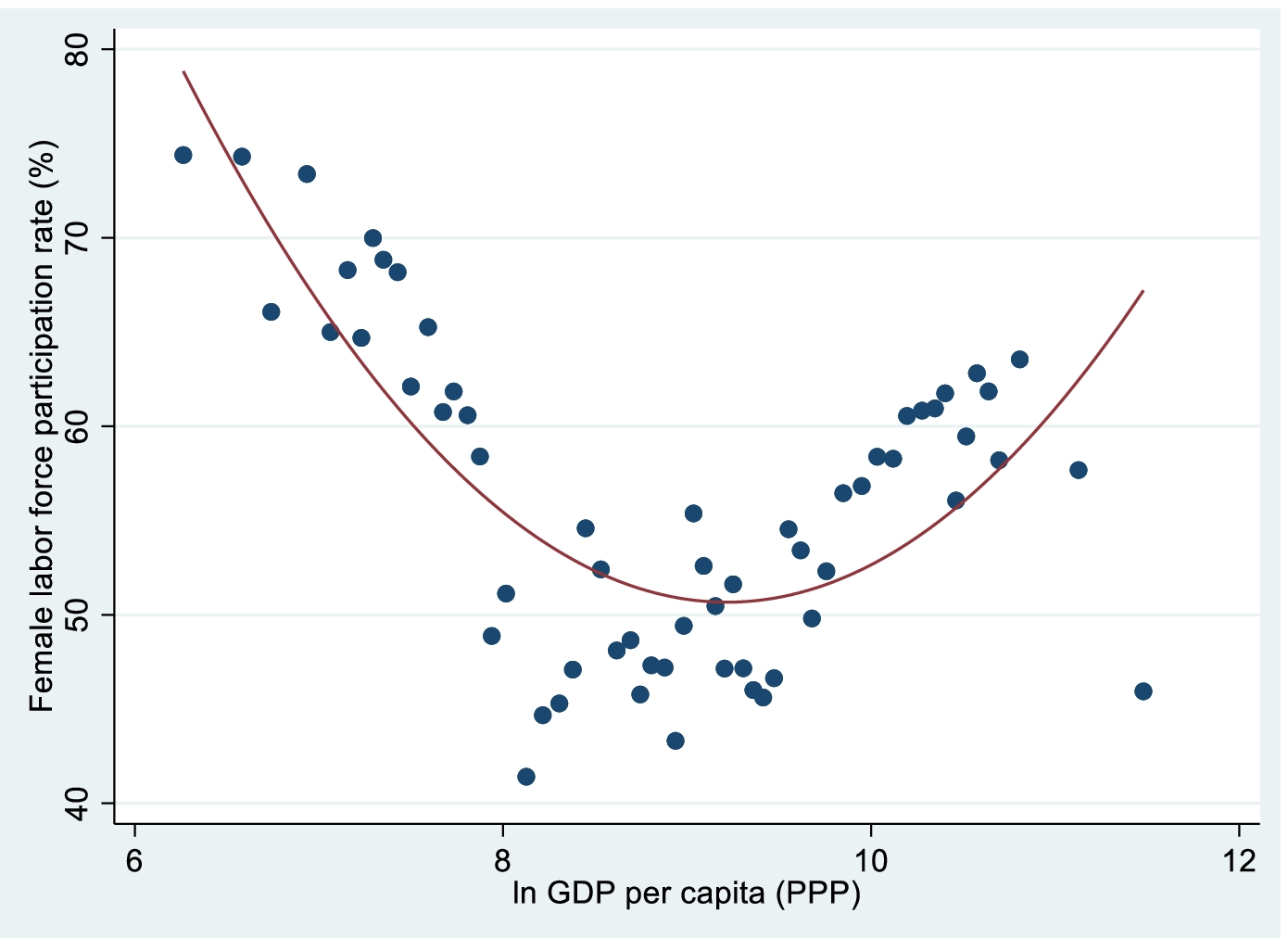
The new paperfinds that an U-shaped relationship between female labour force participation and economic development is only significant in countries whose ancestors employed a plough-based agricultural technology.
Journal of Population Economics (2022). Open Access https://link.springer.com/article/10.1007/s00148-022-00890-5
Author Abstract: The Feminisation U describes the tendency of female labour force participation (FLFP) to first decline and then rise in the process of economic development. While the Feminisation U is often presented as a ‘stylised fact’ of development, empirical support for it is mixed. Here, we show that cultural norms inherited from ancestral plough use exert a moderating influence on the shape of the Feminisation U. Specifically, we find a significantly U-shaped path of FLFP only in countries whose ancestors employed a plough-based agricultural technology. The shape of the U-curve becomes progressively more muted as the share of a country’s ancestors that practiced plough agriculture decreases. In countries with little or no legacy of historical plough use, the time path of FLFP is effectively flat. This pattern of results is robust to correcting for dynamic panel bias, instrumenting for per-capita income, and controlling for other potential effect modifiers. Our findings are compatible with a nuanced reading of the main theoretical models proposed in the literature to explain the Feminisation U.
The Global Labor Organization (GLO) is an independent, non-partisan and non-governmental organization that functions as an international network and virtual platform to stimulate global research, debate and collaboration.
Author Abstract: This paper investigates greenhouse gas emissions convergence among twenty Latin American countries, for the period 1970 to 2015. To that end, we use the Phillips-Sul methodology to examine whether these countries have followed an absolute convergence process or, whether there has been a club convergence process. Our results offer important insights into the greenhouse gas emissions catch-up exhibited by several countries, and do not support the hypothesis that all countries of the Latin American region, taken together, converge to a single equilibrium state in greenhouse gas emissions intensity. We find strong evidence of subgroups that converge to different steady states. An iterative testing procedure reveals the existence of different patterns of behavior and shows that such emissions are not uniform across these countries. We also identify the forces underlying the creation of clubs and the likelihood that any given country will be a member of any convergence club. Estimates from an ordered logit model reveal that economic structure, the unemployment rate, population density, and per-capita income play a crucial role in determining the formation of convergence clubs.
The Global Labor Organization (GLO) is an independent, non-partisan and non-governmental organization that functions as an international network and virtual platform to stimulate global research, debate and collaboration.
Author Abstract: We describe the design and implementation of a paradata based method to reduce interviewer induced measurement error in a household survey in India. Our method identifies enumerators exhibiting deviant field practices, and provides them feedback to correct potentially faulty behavior. A novel feature is the emphasis on dynamic benchmarking within a group of enumerators facing similar field conditions. This helps to correctly pin down steady state levels of multiple data generating processes that exist within our survey. We also present evidence that our method succeeded in changing actual enumerator behavior in the field. Furthermore, we provide a complete prototype of how to operationalize paradata use in a resource constrained environment. At each step, we highlight the trade-offs involved, share insights from our own shortcomings, and provide recommendations to help make more informed choices. We hope our work will encourage the use of paradata to improve survey quality, especially in low- and middle-income countries where their use is still rare.
The Global Labor Organization (GLO) is an independent, non-partisan and non-governmental organization that functions as an international network and virtual platform to stimulate global research, debate and collaboration.
A new GLO Discussion Paper documents a positive association between shop-floor employee representation and the utilization of advanced technologies.It also shows positive effects on training intensity and process innovation and no evidence of employment losses.
Author Abstract: The interplay between labor institutions and the firm-level adoption of new technologies such as robotics and other advanced digital tools remains poorly understood. Using a cross-sectional sample of more than 20000 European establishments, this paper documents a positive association between shop-floor employee representation (ER) and the utilization of these advanced technologies. We extensively dig into the potential mechanisms driving this correlation by exploiting rich information on the de facto role played by ER bodies in relation to well-defined decision areas of management, such as work organization, dismissals, training and working time. In addition, we conduct a quantitative case study using a panel of Italian firms and exploiting size-contingent policy rules governing the operation of ER bodies in the context of a local-randomization regression discontinuity design. The analysis suggests a positive effect of ER on investments in advanced technologies around the firm size cutoff, although the results are sensitive to the type of technology and specification choices. We also document positive effects on training intensity and process innovation and no evidence of employment losses or changes in the composition of employment. Taken together, our findings cast doubts on the idea that ER discourages technology adoption. On the contrary, ER seems to influence work organization and certain workplace practices in ways that may enhance the complementary between labor and new advanced technologies. Featured image: Alex-Knight-on-Unsplash
The Global Labor Organization (GLO) is an independent, non-partisan and non-governmental organization that functions as an international network and virtual platform to stimulate global research, debate and collaboration.
Author Abstract: We estimate the impact of temperature extremes on mortality in Vietnam, using daily data on temperatures and monthly data on mortality during the 2000-2018 period. We find that both cold and heat waves cause higher mortality, particularly among older people. This effect on mortality tends to be smaller in provinces with higher rates of air-conditioning and emigration, and provinces with higher public spending on health. Finally, we estimate economic cost of cold and heat waves using a framework of willingness to pay to avoid deaths, then project the cost to the year 2100 under different Representative Concentration Pathway scenarios.
The Global Labor Organization (GLO) is an independent, non-partisan and non-governmental organization that functions as an international network and virtual platform to stimulate global research, debate and collaboration.
A new GLO Discussion Paper finds that children from two-parent families have a better chance of enrolling at all levels of education than those from single-parent families. It also confirms the critical role of mothers in children’s education.
Author Abstract: This study uses a large-scale dataset from Vietnam to analyze the impacts of parental absence due to migration, death, or divorce on children’s school enrollment, for children aged from 7 to 22. We find children from two-parent families have a better chance of enrolling at all levels of education than those from single-parent families. Within single-family types, the negative effect on children of parental divorce is higher than that of parental death, while the effect of parental migration is the lowest. Comparing the effect of single-father and single-mother households, we find that children living with a single mother tend to have higher school enrollment than those living with a single father, indicating the critical role of mothers in children’s education.
The Global Labor Organization (GLO) is an independent, non-partisan and non-governmental organization that functions as an international network and virtual platform to stimulate global research, debate and collaboration.
A new GLO Discussion Paper finds that recently burned-out employees appreciate possibilities to telework, fixed feedback and work part-time, but are less attracted to opportunities for learning on the job.
Author Abstract: The existing burnout literature has predominantly focussed on the determinants of burnout, whereas its consequences for individual careers have received little attention. In this study, we investigate whether recently burned-out individuals and persons with a very high risk of clinical burnout differ in job preferences from non-burned-out workers. Moreover, we link these differences in preferences with (1) diverging perceptions of job demands and resources in a job, as well as (2) distinct weighting of such perceptions. To this end, a highquality sample of 582 employees varying in their history and current risk of burnout judged fictitious job offers with experimentally manipulated characteristics in terms of their willingness to apply as well as perceived job demands and resources. We find that recently burned-out employees appreciate possibilities to telework and fixed feedback relatively more, while being relatively less attracted to opportunities for learning on the job. Moreover, employees with a very high risk of burnout are more attracted to part-time jobs. These findings can be partially explained by differences in the perceived resources offered by jobs.
The Global Labor Organization (GLO) is an independent, non-partisan and non-governmental organization that functions as an international network and virtual platform to stimulate global research, debate and collaboration.
Author Abstract: In this study, we tested the effect of time delays on sharing behavior. We conducted a dictator game to examine whether dictators change their sharing behaviors if they have more time between receiving and sharing money. When the response time was 2 hours, the sharing behavior of dictators was similar to sharing behavior in a standard game without time delay. However, if the dictators kept their received money for a week, they were remarkably less likely to share the money. This finding provides suggestive evidence of the ownership effect in sharing behavior.
The Global Labor Organization (GLO) is an independent, non-partisan and non-governmental organization that functions as an international network and virtual platform to stimulate global research, debate and collaboration.
Author Abstract: We analyze the relationship between natives’ attitudes towards citizenship acquisition for foreigners and trust. Our hypothesis is that, in sub-Saharan Africa, the slave trade represents the deep factor behind contemporary attitudes toward citizenship, with more intense exposure to historical slave exports for an individual’s ethnic group being associated with contemporary distrust for strangers, and in turn opposition to citizenship laws that favor the inclusion of foreigners. We find that individuals who are more trusting do show more positive attitudes towards the acquisition of citizenship at birth for children of foreigners, that these attitudes are also negatively related to the intensity of the slave trade, and that the underlying link between trust and the slave trade is confirmed. Alternative factors|con ict, kinship, and witchcraft beliefs-that, through trust, may affect attitudes toward citizenship, are not generating the same distinctive pattern of linkages emerging from the slave trade.
The Global Labor Organization (GLO) is an independent, non-partisan and non-governmental organization that functions as an international network and virtual platform to stimulate global research, debate and collaboration.
A new GLO Discussion Paper suggests modeling network interactions to optimize the outcomes of the connected units. An example examines the recent spread of Covid-19 in China.
Author Abstract: We consider a model of network interactions where the outcome of a unit depends on the outcomes of the connected units. We determine the key network link, i.e., the network link whose removal results in the largest reduction in the aggregate outcomes, and provide a measure that quantifies the contribution of a network link to the aggregate outcomes, which complements the intercentrality measure of the key network node proposed by Ballester, Calv’o-Armengol, and Zenou (2006). We provide an example examining the spread of Covid-19 in China. Travel restrictions were imposed to limit the spread of infectious diseases. As uniform restrictions can be inefficient and incur unnecessarily high costs, we examine the design of restrictions that target specific travel routes. Our approach may be generalized to multiple countries to guide policies during epidemics ranging from ex ante route-specific travel restrictions to ex post health measures based on travel histories, and from the initial travel restrictions to the phased reopening.
The Global Labor Organization (GLO) is an independent, non-partisan and non-governmental organization that functions as an international network and virtual platform to stimulate global research, debate and collaboration.
A new GLO Discussion Paper finds that females spend more time on personal care, chores and educational activities and less time on physical and media related activities. These gaps appear at very young ages and widen over time.
Author Abstract: Using over 50 thousand time-use diaries from two cohorts of children, we document significant gender differences in time allocation in the first 16 years in life. Relative to males, females spend more time on personal care, chores and educational activities and less time on physical and media related activities. These gender gaps in time allocation appear at very young ages and widen overtime. We provide novel evidence that gender differentials in time investment are quantitatively important in explaining a female advantage in most cognitive and non-cognitive skills. Moreover, gender disparity in educational time outside of school is the most important factor contributing to gender test score gaps and its contribution is more pronounced for higher performing students. By contrast, gender differences in media time are the main factor explaining gender gaps in non-cognitive skills. As children age, gender differences in time allocation play an increasing role in explaining gender gaps in both cognitive and non-cognitive skills.
Featured image: dainis-graveris-lpyHSTHO7LM-unsplash
The Global Labor Organization (GLO) is an independent, non-partisan and non-governmental organization that functions as an international network and virtual platform to stimulate global research, debate and collaboration.
Author Abstract: We propose a regional inequality-based mechanism to explain the heterogeneity in the spread of Covid-19 and test it using data from India. We argue that an area characterized by coreperiphery economic structure creates regional inequality in which the periphery remains dependent on the core for the supply of jobs, goods and services. Hence, areas arranged in coreperiphery structure induce greater degree of mobility which in turn ends up at a higher infection rate than the more homogeneously developed areas at the time of pandemic. Using nightlights data to measure regional inequality in the degree of economic activity, we find evidence in support of our hypothesis. Further, we find that regions with higher nightlight inequality also experience higher spread of Covid-19 only when lockdown measures have been relaxed and movement of goods and services are near normal. Using mobility data, we provide direct evidence in support of our proposed mechanism; that the positive relationship between regional inequality and Covid-19 infection is driven by mobility. Our findings imply that policy responses to contain Covid-19 contagion needs to be heterogeneous across India where the priority areas can be chosen ex-ante based on inequality in economic activity.
The Global Labor Organization (GLO) is an independent, non-partisan and non-governmental organization that functions as an international network and virtual platform to stimulate global research, debate and collaboration.
Author Abstract: This paper investigates the issue of strategic delegation by considering the role of management centrality in contracting with different stakeholders. Specifically, a sequential negotiation unionized duopoly model is analysed, in which the management relative bargaining power visà-vis shareholders and vis-à-vis unions can differ. In such a framework, differences in the relative bargaining power among involved stakeholders play a key role in determining the endogenous choice by firms’ owners to delegate strategic decisions to the management, or, in other words, the choice of being an entrepreneurial or a managerial firm. Moreover, the distribution of stakeholders’ relative bargaining power affects firms’ profitability and overall welfare, also leading to novel results with regard to the received literature. In particular, to minimize potential conflict of interests between firms’ owners and the overall society, regulation directed to soften the managers’ bargaining strength vis-à-vis shareholders must be designed and implemented.
The Global Labor Organization (GLO) is an independent, non-partisan and non-governmental organization that functions as an international network and virtual platform to stimulate global research, debate and collaboration.
Author Abstract: The objective of the paper is to examine the retirement behaviour of Belgian workers in one-earner households who are automatically granted a more generous old-age pension benefits replacement rate, called the household replacement rate. Following a recommendation of the Belgian Pension Reform Committee, this policy is to be suppressed for new pensioners, except for those receiving the minimum pension. We provide an ex-ante impact evaluation of such reform on both pension sustainability and adequacy measures. Specifically, we test whether the household replacement rate entails a work (dis)incentive mechanism promoting (harming) pension sustainability and furthermore, we analyse the role of the household replacement rate in old-age poverty and inequality measures. To do so, we use the survey dataset SHARE and a discrete time logistic duration model to study the link between retirement and financial retirement incentives created by the social security system. We find that the household replacement rate generates slightly higher retirement incentives through an income effect and we find that the household replacement rate plays an important role in decreasing the elderly poverty rate. Since households with asymmetrical working arrangements are often at the lowest part of the equivalized income distribution, the substantial effect of the household replacement rate on poverty measures is a motive to use such mechanism as a poverty alleviation tool. Nevertheless, we advocate that income redistribution measures should not be tied to a specific household composition and policies such as pensionable earning minima, minimum pension benefits and the inclusion of replacement income periods in the pension benefits calculation effectively serve the income redistribution goal without favouring a certain type of household over another. Overall, despite the positive poverty and distributional aspects of this policy, our analysis supports the reform proposal of removing the household replacement rate.
The Global Labor Organization (GLO) is an independent, non-partisan and non-governmental organization that functions as an international network and virtual platform to stimulate global research, debate and collaboration.
Author Abstract: The stagnancy of women’s workforce participation in urban India is alarming and puzzling, considering the pace of economic development experienced in the previous decade. We investigate the extent to which the low workforce participation of women can be explained by growing instances of officially reported crimes against women. We employ a fixed-effects strategy using district-level panel data between 2004-2012. To address additional concerns of endogeneity, we exploit state-level regulations in alcohol sale and consumption and provide estimates from two different strategies – an instrumental variable approach and a border analysis. Our findings indicate that an additional sexual crime per 1000 women in a district reduces the probability that a woman is employed outside her home by roughly 1%. While we find some evidence of heterogeneity across regions and religions, overall, the deterrent effect seems to affect women equally across all economic, demographic, and social groups.
The Global Labor Organization (GLO) is an independent, non-partisan and non-governmental organization that functions as an international network and virtual platform to stimulate global research, debate and collaboration.
Author Abstract: In this paper we study whether the presence of binding liquidity constraints and the existence of fixed costs can explain the underinvestment of parents in their children’s human capital. We first incorporate these two potential mechanisms into the theoretical model of Raut & Tran (2005) and then we test their empirical relevance using data from the China Health and Retirement Longitudinal Study (CHARLS). Our results show that especially fixed costs play an important role in explaining human capital underinvestment.
The Global Labor Organization (GLO) is an independent, non-partisan and non-governmental organization that functions as an international network and virtual platform to stimulate global research, debate and collaboration.
Author Abstract: One of the potential avenues for former professional football players to pursue their career is to become a head coach of a club’s first team. An important question is how to best prepare for such a reconversion. This letter is the first in the academic literature quantifying the association between success as a professional head coach and prior experience of former professional players as a youth coach, player-coach, head coach at a lower division, assistant coach, in other staff positions and in club management positions. Our regression analyses, based on unique coach career data, show a significant positive association for the jobs of assistant or youth coach.
The Global Labor Organization (GLO) is an independent, non-partisan and non-governmental organization that functions as an international network and virtual platform to stimulate global research, debate and collaboration.
The Journal of Population Economics (JoPE) has announced the appointment of three additional editors (Xi Chen, Kompal Sinha & Milena Nikolova) and eleven new Associate Editors (Cynthia Bansak, Lisa Cameron, German Blanco,Carolina Castilla, Hugo Jales, Fabian Kindermann, Marie-Louise Leroux, Subha Mani, Astghik Mavisakalyan, Emmanuel Thibault, and Myra Yazbeck). Journal and publisher have expressed their huge gratitude to those Associate Editors who have left the team recently for their strong support over the years. Orley Ashenfelter, Kaushik Basu, David Card, Barry R. Chiswick, Janet Currie, James J. Heckman, and Giovanni Peri continue to support JoPE as members of the newly created JoPE Advisory Board.
For more details and the full Editorial Team see: LINK
Author Abstract: We study how weather shocks interact with cultural norms biased against women to affect female poverty within the household. Using expenditure on female assignable clothing per adult woman as a measure of women’s intra-household access to consumption, we document that spending on female assignable goods is lower in households with at least one widowed woman relative to households with no widows in India. However, selection into widowhood appears to be plausibly random and economic hardship on account of death of a male member is unlikely to explain why households with a widow have lower spending on female assignable goods. We then study how rainfall shocks influence the spending on female assignable goods by the presence of a widow in the household. We find that although beneficial rainfall shocks increase overall spending on female assignable goods; this increase is lower in households with a widow. We obtain opposite findings for spending on male assignable goods. We find that regions where widow persecution was widespread historically are associated with poorer outcomes for widows at present. Our analysis shows that persistence in historical norms can potentially prevent women from realizing gains in access to consumption resources within the household even in the event of beneficial environmental shocks.
The Global Labor Organization (GLO) is an independent, non-partisan and non-governmental organization that functions as an international network and virtual platform to stimulate global research, debate and collaboration.
Author Abstract: Smallholder farming dominates agriculture in poorer countries. Yet, traditional recall-based surveys on smallholder farming in these countries face challenges with seasonal variations, high survey costs, poor record-keeping, and technical capacity constraints resulting in significant recall bias. We offer the first study that employs a less-costly, imputation-based alternative using mixed modes of data collection to obtain estimates on smallholder farm labor. Using data from Tanzania, we find that parsimonious imputation models based on small samples of a benchmark weekly in-person survey can offer reasonably accurate estimates. Furthermore, we also show how less accurate, but also less resource-intensive, imputation-based measures using a weekly phone survey may provide a viable alternative for the more costly weekly in-person survey. If replicated in other contexts, including for other types of variables that suffer from similar recall bias, these results could open up a new and cost-effective way to collect more accurate data at scale.
The Global Labor Organization (GLO) is an independent, non-partisan and non-governmental organization that functions as an international network and virtual platform to stimulate global research, debate and collaboration.
Author Abstract: Using the entire population of USPTO patent applications published between 2002 and 2019, and leveraging on both patent classification and semantic analysis, this paper aims to map the current knowledge base centred on robotics and AI technologies. These technologies are investigated both as a whole and distinguishing core and related innovations, along a 4-level core-periphery architecture. Merging patent applications with the Orbis IP firm-level database allows us to put forward a twofold analysis based on industry of activity and geographic location. In a nutshell, results show that: (i) rather than representing a technological revolution, the new knowledge base is strictly linked to the previous technological paradigm; (ii) the new knowledge base is characterised by a considerable – but not impressively widespread – degree of pervasiveness; (iii) robotics and AI are strictly related, converging (particularly among the related technologies and in more recent times) and jointly shaping a new knowledge base that should be considered as a whole, rather than consisting of two separate GPTs; (iv) the US technological leadership turns out to be confirmed (although declining in relative terms in favour of Asian countries such as South Korea, China and, more recently, India).
The Global Labor Organization (GLO) is an independent, non-partisan and non-governmental organization that functions as an international network and virtual platform to stimulate global research, debate and collaboration.
Author Abstract: This paper proposes a targeting methodology focused on household’s deprivations that helps the public decision-maker in Tunisia to alleviate multidimensional poverty. In the first part of this research, we intend to decipher the relationship between official poverty measurement and anti-poverty programs currently implemented in Tunisia, with special emphasis on their targeting performance and on the divergence observed between the beneficiary selection process at the regional level and the official identification of poor households. Next, we will outline the proposed targeting methodology using the counting identification approach and we estimate three groups of potential beneficiaries reflecting three degrees of poverty. Our empirical findings show that if a household becomes deprived in one dimension, then he will automatically be considered a potential beneficiary of the anti-poverty program. In terms of budget allocation, categorizing beneficiaries by group allows the public decision-maker to prioritize the most urgent situations in the country, even in the case of an austerity policy. On the other hand, to eradicate poverty in all its forms everywhere, it would be useful to strengthen the targeting of the poor population through a forward-looking policy targeting households living in vulnerability to poverty.
The Global Labor Organization (GLO) is an independent, non-partisan and non-governmental organization that functions as an international network and virtual platform to stimulate global research, debate and collaboration.
Author Abstract: In this study, for the first time, to our knowledge, we use the propensity score matching algorithm to estimate the probability to remain ‘stuck in the status-quo ante’ across generations in Egypt. We use repeated cross-sectional data relative to a 20-year period from 1998 to 2018 to build transition matrices of intergenerational occupational mobility. The findings of the econometric analysis hint at a low degree of occupational mobility, with children of fathers in the agricultural sector or holding a blue- or white-collar job remaining linked to the profession of their fathers in most cases and experiencing only rarely upward mobility from agricultural to blue- and white-collar jobs.
The Global Labor Organization (GLO) is an independent, non-partisan and non-governmental organization that functions as an international network and virtual platform to stimulate global research, debate and collaboration.
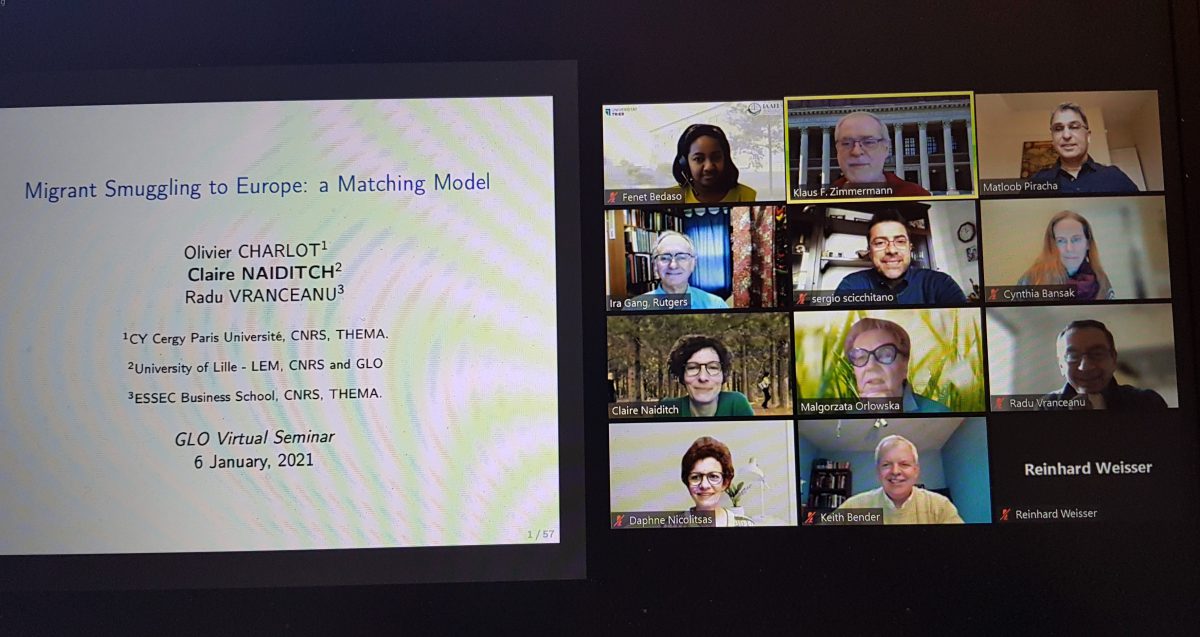
TheGLO Virtual Seminar is a monthly internal GLO research event chaired by GLO Director Matloob Piracha and hosted by the GLO partner institution University of Kent. The results are available on the GLO website and the GLO News section, where also the videos of the presentations are posted. All GLO related videos are also available in the GLO YouTube channel. (To subscribe go there.)
Forthcoming (GLO members & special invitations): February 3, 2022; 1 pm London/UK time:Michael Coon (University of Tampa and GLO)
Border Fencing, Migrant Flows, and Crossing Deaths (with Cynthia Bansak, St. Lawrence University & Abigail Blanco, Bellarmine University)
The January 6, 2022 seminar in the series was given on London/UK time at 1-2 pm, by Claire Naiditch (University of Lille and GLO). See below for a report and the full video of the seminar.
A new GLO Discussion Paper suggests that the impacts of the educational reform for primary schools supported by the World Bank have been small and were not lasting in the long run.
Author Abstract: This paper evaluates how Vietnam’s Escuela Nueva (VNEN) program, an educational reform for primary schools supported by the World Bank, affected the cognitive (mathematics and Vietnamese) and non-cognitive (socioemotional) skills of students in that country. We use propensity score matching to estimate both short-term (1-3 years) and long-term (5-7 years) average treatment effects on the treated (ATT). We find that the impacts of VNEN on students’ cognitive skills are relatively small in the short-term, and that they are larger for boys, ethnic minorities, and students in Northern Vietnam. The VNEN program modestly increased primary school students’ non-cognitive skills in the short-term; these impacts on non-cognitive skills are sizable and significant for ethnic minority students, although there seems to be little gender difference. The long-term impacts are less precisely estimated, but they appear to fade away, showing little or no impact of the VNEN program on cognitive skills. There is little variation of long-term impacts by gender or geographical region, although the imprecision of the estimates for ethnic minority students does not allow us to rule out large long-term impacts on cognitive skills for those students. The program’s impacts on non-cognitive skills also seem to have dissipated in the long-term.
The Global Labor Organization (GLO) is an independent, non-partisan and non-governmental organization that functions as an international network and virtual platform to stimulate global research, debate and collaboration.
A new GLO Discussion Paper suggests that it is important to increase primary and secondary level of education in rural areas, and the tertiary level in urban areas to equalize the life chances of some social groups.
Author Abstract: In this paper, we report returns to education in India using unit level data from the nationwide Periodic Labour Force Survey for 2018-19. OLS estimates from the classical Mincerian equation are presented. Various econometric techniques (e.g., conventional IV and heteroskedasticity-based IV models) are used to address endogeneity and sample selection issue. For regular workers, compared to those with no formal education, an additional year of literacy education increases yearly return by 2.3%, primary education by 3.4%, middle school education by 3.7%, secondary school education by 4.5%, higher secondary education by 5.8%, graduate and diploma by 9.8%, and postgraduate and above level of education by 8.2%. We also find a widening of the wage distribution, with striking differences across social groups, sectors, locations. First, returns to middle-school and above level of education are higher for women than for men; second, returns to graduate and above level of education are higher for urban than for rural workers; third, returns to workers in the public sector are higher than returns in the private or third sectors; fourth, returns to the scheduled tribe are the highest across all the castes. Over the last decade, returns to education have reduced. We provide evidence showing that this may be because more people hold higher levels of education qualifications, while the demand for skills remains quite stable. Overall, our policy suggestion is that in India, as in other lowmiddle- income countries, especially in rural areas, it is important to increase primary and secondary level of education in rural areas, and the tertiary level in urban areas and to equalize the life chances of some social groups.
The Global Labor Organization (GLO) is an independent, non-partisan and non-governmental organization that functions as an international network and virtual platform to stimulate global research, debate and collaboration.
J Popul Econ (2022). https://doi.org/10.1007/s00148-021-00883-w Open Access
Matloob Piracha
Max Tani
Zhiming Cheng
Author Abstract: We analyse how immigrants’ level of social assimilation is related to their labour market outcomes. More precisely, we estimate the association between assimilation and employment, wages, underemployment, three measures of job satisfaction, overeducation and wages. Using Australian longitudinal data, we find that assimilation is strongly associated with employment and wages as well as a number of job satisfaction measures. We then split our data and repeat the analysis for before and after the financial crisis of 2008–2009. We find important differences in the way assimilation is associated with different measures of labour market outcomes under different economic conditions. Finally, we explore mechanisms that may underlie the results.
The Global Labor Organization (GLO) is an independent, non-partisan and non-governmental organization that functions as an international network and virtual platform to stimulate global research, debate and collaboration.
Author Abstract: Although a large body of literature has argued that motherhood has a profound and long-lasting negative effect on the employment and earnings of women, there is little evidence focusing on the post-communist region. This paper exploits the latest round of the EBRD-World Bank Life in Transition Survey (LiTS) and of the Mongolian National Statistics Office Household Socio- Economic Survey (HSES) to examine the correlation between the presence of children of different age categories in a family and female employment in Mongolia in 2016. We examine the availability of childcare, social norms and attitudes towards women, as well as household decision-making as potential explanations. We find that small children decrease the probability of female employment relative to women with no small children. In particular, women with two children aged one to six years are 21.5 percentage points less likely to be employed. Our results also suggest that cultural biases against women may be – at least partially – responsible for the low female employment levels which we uncovered. These results are unlikely to be driven by omitted variable bias.
The Global Labor Organization (GLO) is an independent, non-partisan and non-governmental organization that functions as an international network and virtual platform to stimulate global research, debate and collaboration.
Because vaccinations are crucial to containing the COVID-19 pandemic, it is important to identify the key factors behind successful immunisation campaigns. This column shows that pandemic pressures, economic strength, educational advancement, and political regimes can affect vaccination uptake, given vaccine availability. While democratic regimes initially show faster vaccination uptake, this advantage fades out as countries try to get more people vaccinated. Countries with strong economies and education systems are likely to have faster uptake of vaccination campaigns.
Read the column:
Vu M. Ngo, Klaus F. Zimmermann, Phuc V. Nguyen, Toan Luu Duc Huynh and Huan H. Nguyen (2021). Understanding the setup and speed of global COVID-19 vaccination campaigns
A new paper published Online First in the Journal of Population Economics finds heritability for Norway to account for about 50–100% of intergenerational transmissions.
Author Abstract: Using a Norwegian sample of adoptees from South Korea, matched to a sample of Norwegian-born children, we study the intergenerational transmission of labour market outcomes, including earnings, disability insurance participation and sickness absence, as well as education. We find the nurture effect to be substantial for education, labour earnings, and sickness absence, but fairly small and insignificant for disability insurance participation. By carefully comparing adoptees to children living with their biological parents, we also estimate the shares of intergenerational transmission stemming from heritability and environmental factors. Across outcomes we find heritability to account for about 50–100% of intergenerational transmission.
The Global Labor Organization (GLO) is an independent, non-partisan and non-governmental organization that functions as an international network and virtual platform to stimulate global research, debate and collaboration.
A new GLO Discussion Paper studies labor-management relations in autocratic regimes for transitional peripheral economies in Central Asia (Uzbekistan and Turkmenistan) and hierarchical market economies in Latin America (Colombia and Honduras).
Author Abstract: Purpose: This chapter examines contemporary labor-management relations in autocratic regimes, drawing on two sets of countries, namely transitional peripheral economies in Central Asia (Uzbekistan and Turkmenistan) and hierarchical market economies in Latin America (Colombia and Honduras), for analysis. We discuss the political economy, work, and labor relations of these countries, highlighting the role of the state, business, and international non-government organizations. We also take into account the impact of large-scale (often in millions) migration of workers both internally within the country and cross-border. It is important to note that, just as there are different types of democratic systems, there are also different types of autocratic regimes with distinct political, economic, and social policy orientations, and this directly impacts the nature of labor relations. Under Latin American right-wing authoritarianism, a primary focus is on supporting a relatively small property-owning elite, and any countervailing worker power is seen as a direct attack on the latter. Even if workers have employment rights under the law, this zero-sum game view frequently results in extra-legal attacks on worker activists and their representatives, making union organization an extremely dangerous business. In contrast, the Central Asian autocracies, business elites are tied up within extended clan networks. Especially within Uzbekistan, a much closer emphasis has been placed on the provision of a critical mass of jobs as a means of buying political stability. Unions have been afforded a place in the system both for historical reasons and as proof of an ability to create a critical mass of decent work; at the same time, there is little room for union autonomy.
The Global Labor Organization (GLO) is an independent, non-partisan and non-governmental organization that functions as an international network and virtual platform to stimulate global research, debate and collaboration.
Interested researchers are cordially invited to submit their abstracts or papers for presentation consideration. The 39th EBES Conference in Rome will take place on April 6-8, 2022 in Hybrid Mode (online and in-person). The event is supported by the Istanbul Economic Research Association and hosted by the Faculty of Economics Sapienza, University of Rome. GLO & EBES are collaborating organizations; GLO President Klaus F. Zimmermann is also President of EBES.
Featured image: david-kohler-VFRTXGw1VjU-unsplash
Invited Speakers
EBES is pleased to announce that distinguished colleagues David B. Audretsch, Giovanni Dosi, Kevin Lang, Keun Lee, Marco Vivarelli and Klaus F. Zimmermann will participate as keynote speakers and/or invited editors.
David Bruce Audretsch is an American economist. He is a distinguished professor at the School of Public and Environmental Affairs (SPEA) at Indiana University and also serves as director of the SPEA International Office, Ameritech Chair of Economic Development, and director of SPEA’s Institute for Development Strategies (IDS). He is co-founder and co-editor of Small Business Economics: An Entrepreneurship Journal, and also works as a consultant to the United Nations, the World Bank, the OECD, the EU Commission, and the U.S. Department of State. He was the Director of the Entrepreneurship, Growth and Public Policy Group at the Max Planck Institute of Economics in Germany from 2003 to 2009.[2] Since 2020, he also serves as a Distinguished Professor in the Department of Innovation Management and Entrepreneurship at the University of Klagenfurt. Audretsch is a member of the advisory board to a number of international research and policy institutes, including chair of the German Institute for Economic Research in Berlin, chair of the Foundation for the Promotion of German Science (Stifterverband für die Deutsche Wissenschaft), New York Academy of Sciences, the Swedish Entrepreneurship Forum, and the Jackstädt Centre for Entrepreneurship in Wuppertal, Germany. He has received honorary doctorate degrees from Jonköping University in Sweden and University of Augsburg in Germany. He is an honorary professor of Industrial Economics and Entrepreneurship at the WHU – Otto Beisheim School of Management in Germany. In addition, Audretsch serves as a visiting professor at the King Saud University in Saudi Arabia, honorary professor at the University of Jena in Germany, and is a research fellow of the Centre for Economic Policy Research in London. He was awarded the 2011 Schumpeter Prize from the University of Wuppertal and the 2001 Global Award for Entrepreneurship Research by the Swedish Foundation for Small Business Research.
Giovanni Dosi is Professor of Economics and Director of the Institute of Economics at the Scuola Superiore Sant’Anna in Pisa. He is the Co-Director of the task forces “Industrial Policy” and “Intellectual Property” at the Initiative for Policy Dialogue at Columbia University. Dosi is Continental European Editor of Industrial and Corporate Change. Included in ISI Highly Cited Researchers. His major research areas, where he is author and editor of several works, include economics of innovation and technological change, industrial organization and industrial dynamics, theory of the firm and corporate governance, evolutionary theory, economic growth and development. A selection of his works has been published in two volumes: Innovation, Organization and Economic Dynamics. Selected Essays, Cheltenham, Edward Elgar, 2000; and Economic Organization, Industrial Dynamics and Development: Selected Essays, Cheltenham, Edward Elgar, 2012.
Kevin Lang is a professor of economics at Boston University. He is also an elected Fellow of the Society of Labor Economists and a research associate of the National Bureau of Economic Research (NBER). He is the author of Poverty and Discrimination and over 100 papers and articles on topics in Labor Economics. Lang received his BA in philosophy, politics and economics (PPE) from Oxford University, his MSc in economics from the University of Montreal, and his PhD in economics from the Massachusetts Institute of Technology in 1982. He went on to become an assistant professor at the University of California, Irvine, and he spent a year serving as an Olin Foundation Fellow at the NBER. In 1987, he joined the faculty at Boston University, where he served as chair of the economics department from 2005 to 2009. His recent research has focused on the economics of labor markets and education, including topics such as discrimination, unemployment, the relation between education and earnings, and the relation between housing prices, taxes and local services.
Keun Leeis a Professor of Economics at the Seoul National University, and the winner of the 2014 Schumpeter Prize for his monograph on Schumpeterian Analysis of Economic Catch-up (2013 Cambridge Univ. Press). He is an editor of Research Policy, an associate editor of Industrial and Corporate Change, and a council member of the World Economic Forum since 2016. He served as the President of the International Schumpeter Society (2016- 18), a member of the Committee for Development Policy of UN (2014-18). He obtained Ph.D. in economics from the University of California, Berkeley. One of his most cited articles is a paper on Korea’s Technological Catch-up published in Research Policy, with 1,275 citations (Google Scholar). His H-index is now 44 with 114 papers with more than 10 citations. He has a new book entitled as The Art of Economic Catch-up: barriers, detours, and leapfrogging, which will be published by the Cambridge Univ. Press, March 2019. editor of Industrial and Corporate Change, and a council member of the World Economic Forum since 2016. He served as the President of the International Schumpeter Society (2016- 18), a member of the Committee for Development Policy of UN (2014-18). He obtained Ph.D. in economics from the University of California, Berkeley. One of his most cited articles is a paper on Korea’s Technological Catch-up published in Research Policy, with 1,275 citations (Google Scholar). His H-index is now 44 with 114 papers with more than 10 citations. He has a new book entitled as The Art of Economic Catch-up: barriers, detours, and leapfrogging, which will be published by the Cambridge Univ. Press, March 2019.
Marco Vivarelliis a full professor at the Catholic University of Milano, where he is also Director of the Institute of Economic Policy. He is Professorial Fellow at UNU-MERIT, Maastricht; Research Fellow at IZA; Fellow of the Global Labor Organization (GLO). He is member of the Scientific Executive Board of the Eurasia Business and Economics Society (EBES); member of the Scientific Advisory Board of the Austrian Institute of Economic Research (WIFO, Vienna) and has been scientific consultant for the International Labour Office (ILO), World Bank (WB), the Inter-American Development Bank (IDB), the United Nations Industrial Development Organization (UNIDO) and the European Commission. He is Editor-in-Chief of the Eurasian Business Review, Editor of Small Business Economics, Associate Editor of Industrial and Corporate Change, Associate Editor of Economics EJournal, member of the Editorial Board of Sustainability and he has served as a referee for more than 70 international journals. He is author/editor of various books and his papers have been published in journals such as Cambridge Journal of Economics, Canadian Journal of Economics, Economics Letters, Industrial and Corporate Change, International Journal of Industrial Organization, Journal of Economics, Journal of Evolutionary Economics, Journal of Productivity Analysis, Labour Economics, Oxford Bulletin of Economics and Statistics, Regional Studies, Research Policy, Small Business Economics, Southern Economic Journal, World Bank Research Observer, and World Development. His current research interests include the relationship between innovation, employment, and skills; the labor market and income distribution impacts of globalization; the entry and post-entry performance of newborn firms.
Klaus F. Zimmermann is President of EBES; President of the Global Labor Organization (GLO); Co-Director of POP at UNU-MERIT; Full Professor of Economics at Bonn University (ret.); Honorary Professor, Maastricht University, Free University of Berlin, Renmin University of China and Lixin University; Member, German Academy of Sciences Leopoldina, Regional Science Academy, and Academia Europaea. Among others, he has worked at Macquarie University, the Universities of Melbourne, Princeton, Harvard, Munich, Kyoto, Mannheim, Dartmouth College and the University of Pennsylvania. Research Fellow of the Centre for Economic Policy Research (CEPR) and Fellow of the European Economic Association (EEA). Editor-in-Chief of the Journal of Population Economics. Editorial Board of International Journal of Manpower, Research in Labor Economics and Comparative Economic Studies, among others. Founding Director, Institute for the Study of Labor (IZA); Past-President, German Institute for Economic Research (DIW). Distinguished John G. Diefenbaker Award 1998 of the Canada Council for the Arts; Outstanding Contribution Award 2013 of the European Investment Bank. Rockefeller Foundation Policy Fellow 2017; Eminent Research Scholar Award 2017, Australia; EBES Fellow Award 2018. He has published in many top journals including Journal of Economic Perspectives, American Economic Review, Econometrica, Journal of the European Economic Association, Journal of Human Resources, Journal of Applied Econometrics, Public Choice, Review of Economics and Statistics, Journal of Population Economics and Journal of Public Economics. His research fields are population, labor, development, and migration.
Executive Board
Prof. Klaus F. Zimmermann, UNU-MERIT, Maastricht, and Free University Berlin Prof. Jonathan Batten, University Utara Malaysia, Malaysia Prof. Iftekhar Hasan, Fordham University, U.S.A. Prof. Euston Quah, Nanyang Technological University, Singapore Prof. John Rust, Georgetown University, U.S.A. Prof. Dorothea Schäfer, German Institute for Economic Research DIW Berlin, Germany Prof. Marco Vivarelli, Università Cattolica Del Sacro Cuore, Italy
Abstract/Paper Submission
Authors are invited to submit their abstracts or papers no later than February 14, 2022.
General inquiries regarding the call for papers should be directed to ebes@ebesweb.org.
Publication Opportunities
Qualified papers can be published in EBES journals (Eurasian Business Review and Eurasian Economic Review) or EBES proceedings books after a peer review process without any submission or publication fees. EBES journals (EABR and EAER) are published by Springer and both are indexed in the SCOPUS, EBSCO EconLit with Full Text, Google Scholar, ABS Academic Journal Quality Guide, CNKI, EBSCO Business Source, EBSCO Discovery Service, ProQuest International Bibliography of the Social Sciences (IBSS), OCLC WorldCat Discovery Service, ProQuest ABI/INFORM, ProQuest Business Premium Collection, ProQuest Central, ProQuest Turkey Database, ProQuest-ExLibris Primo, ProQuest-ExLibris Summon, Research Papers in Economics (RePEc), Institute of Scientific and Technical Information of China, Naver, SCImago, ABDC Journal Quality List, Cabell’s Directory, and Ulrich’s Periodicals Directory. In addition, while EAER is indexed in the Emerging Sources Citation Index (Clarivate Analytics), EABR is indexed in the Social Science Citation Index (SSCI) and Current Contents / Social & Behavioral Sciences.
Also, all accepted abstracts will be published electronically in the Conference Program and the Abstract Book (with an ISBN number). It will be distributed to all conference participants at the conference via USB. Although submitting full papers are not required, all the submitted full papers will also be included in the conference proceedings in a USB.
After the conference, participants will also have the opportunity to send their paper to be published (after a refereeing process managed by EBES) in the Springer’s series Eurasian Studies in Business and Economics (no submission and publication fees). This is indexed by Scopus. It will also be sent to Clarivate Analytics in order to be reviewed for coverage in the Conference Proceedings Citation Index – Social Science & Humanities (CPCI-SSH). Please note that the 10th, 11th, 12th, 13th, 14th, 15th, 16th, 17th, 18th, 19th, 20th (Vol. 2), 21st, 24th, and 25th EBES Conference Proceedings are accepted for inclusion in the Conference Proceedings Citation Index – Social Science & Humanities (CPCI-SSH). Other conference proceedings are in progress.
Important Dates
Conference Date: April 6-8, 2022 Abstract Submission Deadline: February 14, 2022 Reply-by: February 16, 2022* Registration Deadline: March 14, 2022 Submission of the Virtual Presentation: March 16, 2022 Announcement of the Program: March 19, 2022 Paper Submission Deadline (Optional): March 16, 2022** Paper Submission for the EBES journals: July 15, 2022
* The decision regarding the acceptance/rejection of each abstract/paper will be communicated with the corresponding author within a week of submission.
** Completed paper submission is optional. If you want to be considered for the Best Paper Award or your full paper to be included in the conference proceedings in the USB, after submitting your abstract before February 14, 2022, you must also submit your completed (full) paper by March 16, 2022.
Contact
Ugur Can, Director of EBES (ebes@ebesweb.org) Dr. Ender Demir, Conference Coordinator of EBES (demir@ebesweb.org)
A new GLO Discussion Paper finds that the research is more supportive of the dead-end hypothesis than the idea that a lower quality job can be a steppingstone into a better job.
Author Abstract: Purpose: This study asks whether lower quality forms of employment lead to career transitions into higher quality forms of employment acting as steppingstones, or bridges or, whether instead they lead to dead-ends, or traps, in which workers move between unstable jobs with low prospects for upward mobility and unemployment. Design/methodology/approach: This study uses a unique dataset recording retrospective monthly employment states over 3 years for 373 individuals in the Albanian city of Shkoder. The analysis uses sequence and regression analysis to investigate whether people employed in lower quality, more precarious jobs remain in these kinds of jobs or instead are able to transition into higher quality, permanent and füll-time employment. Findings: In line with previous evidence for the region and Europe, the analysis confirms the precarization of many working lives particularly for women, young people and those with lower educational attainment. This evidence is more supportive of the dead-end hypothesis than the idea that a lower quality job can be a steppingstone into a better job. Originality: This study contributes to the limited knowledge of labour market functioning in developing post-socialist Western Balkans countries. Recent flexicurity policies have generated an increased prevalence of more precarious employment arrangements in Albania. This investigation addresses previous research limitations regarding point-in-time transitions and unobserved heterogeneity using retrospective recall data and controlling for personality traits.
The Global Labor Organization (GLO) is an independent, non-partisan and non-governmental organization that functions as an international network and virtual platform to stimulate global research, debate and collaboration.
A new GLO Discussion Paper finds that an increase in relative age increases the likelihood of being employed, having a permanent contract , and having full-time employment.
Author Abstract: We are the first to estimate the impact of relative age (i.e., the difference in classmates’ ages) on both speed and quality of individuals’ transition from education to the labour market. Moreover, we are the first to explore whether and how this impact passes through characteristics of students’ educational career. We use rich data pertaining to schooling and to labour market outcomes one year after graduation to conduct instrumental variables analyses. We find that a one-year increase in relative age increases the likelihood of (i) being employed then by 3.5 percentage points, (ii) having a permanent contract by 5.1 percentage points, and (iii) having full-time employment by 6.5 percentage points. These relative age effects are partly mediated by intermediate outcomes such as having had a schooling delay at the age of sixteen or taking on student jobs. The final mediator is particularly notable as no earlier studies examined relative age effects on student employment.We are the first to estimate the impact of relative age (i.e., the difference in classmates’ ages) on both speed and quality of individuals’ transition from education to the labour market. Moreover, we are the first to explore whether and how this impact passes through characteristics of students’ educational career. We use rich data pertaining to schooling and to labour market outcomes one year after graduation to conduct instrumental variables analyses. We find that a one-year increase in relative age increases the likelihood of (i) being employed then by 3.5 percentage points, (ii) having a permanent contract by 5.1 percentage points, and (iii) having full-time employment by 6.5 percentage points. These relative age effects are partly mediated by intermediate outcomes such as having had a schooling delay at the age of sixteen or taking on student jobs. The final mediator is particularly notable as no earlier studies examined relative age effects on student employment.
The Global Labor Organization (GLO) is an independent, non-partisan and non-governmental organization that functions as an international network and virtual platform to stimulate global research, debate and collaboration.
Author Abstract: Schools are ripe for policy intervention. We demonstrate that implementing different teaching practices is effective, finding a greater prevalence of group discussion used in schools positively affects students’ life satisfaction and noncognitive skills but has no impact on test scores. The benefits do not apply to girls, however, unless they attend all-girl schools. These findings are based on a sample from the 2015 PISA which includes more than 35 thousand students from approximately 1500 schools in 14 countries or regions. We perform regressions of student life satisfaction on the prevalence of group discussion and lecturing used in their school, including a battery of individual, teacher, and school controls, as well as random intercepts by school. For robustness we use instrumental variables and methods to account for school-selection. The average impact of group discussion is not small – a one standard deviation leads to an increase in life satisfaction that is about one-half of the negative association with grade repetition. On the other hand, more or less lecturing does not affect life satisfaction, noncognitive skills, nor test scores. We conclude that teaching practices – group discussion – can be used to improve student life satisfaction, thereby likely positively affecting future economic outcomes and well-being.
The Global Labor Organization (GLO) is an independent, non-partisan and non-governmental organization that functions as an international network and virtual platform to stimulate global research, debate and collaboration.
A new GLO Discussion Paper reviews the literature to find that Covid-19 may endanger progress in gender equality but hasalso contributed to increased awareness around the globe of the importance of caring labor and care workers.
Author Abstract: The Covid-19 pandemic has triggered simultaneously a global health crisis and a global economic crisis which have further deepened existing inequalities along several dimensions, including gender. Increasing gender inequalities in paid and unpaid work has been a primary outcome of the pandemic and the associated economic crisis. Given the disproportionate gender division of labor, women were foremost in bearing the brunt of the increased demands on unpaid care work under the lockdown conditions. At the same time, women were also overrepresented in informal employment and service sectors hard-hit by the pandemic resulting in more severe job loss for female workers overall. In many labor markets, women constituted the majority of so-called essential workers, who were protected from job loss yet exposed to increased health risks and prolonged work hours under distressed work conditions. The increasing demand for household production and the unpaid work burden contributed to weakening women’s labor market attachment resulting in higher declines in female labor force participation than male. The increased prevalence of teleworking under the pandemic has the potential to provide improved work-life balance conditions, yet at the risk of widening the gender inequalities in the labor market. While these outcomes point to the threat that Covid-19 poses at rolling back the gains achieved in gender equality, the experiences under the pandemic conditions have also contributed to increased awareness around the Globe of the importance of caring labor and care workers, establishing a solid basis for advocacy of gender equal care policies.
The Global Labor Organization (GLO) is an independent, non-partisan and non-governmental organization that functions as an international network and virtual platform to stimulate global research, debate and collaboration.
Author Abstract: The COVID pandemic that took the world economy by surprise at the beginning of 2020 brought many drastic changes to the way individuals carry on their daily lives. One that will have long lasting effects, even after the spread of the virus is contained, is a shift towards flexible work arrangements, including remote work options. Initially implemented to comply with government imposed stay-at-home orders, many employers decided to allow remote work even after the orders were lifted. In this chapter we will review some of the metrics used in the literature to measure the potential that a specific occupation is suitable for telework. This is important because Working From Home was often the only option for businesses to remain open during the first part of the pandemic. We also review the results of the literature on two important dimensions of inequality: the gender wage gap and income inequality, Moreover, we review some evidence of the effect of WFH on worker’s productivity in general and during the pandemic and on physical and mental health. We conclude with a description of what WFH may look like after the pandemic, by describing the process towards a possible “new normal” in the labour market.
The Global Labor Organization (GLO) is an independent, non-partisan and non-governmental organization that functions as an international network and virtual platform to stimulate global research, debate and collaboration.
On behalf of the GLO Happiness Cluster, we are pleased to announce the call for submissions for the conference Wellbeing 2022: Knowledge for informed decisions, organized by STATEC Research. The conference organizing team includes GLO Fellows Francesco Sarracino and Kelsey O’Connor and is supported by an international Scientific Committee, including among others, GLO Fellows Milena Nikolova (GLO Cluster Lead Happiness) and Stephanie Rossouw. For complete details, see the website https://www.wellbeing2022.lu.
This international conference will bring together leading scholars to discuss the quest for better lives, including the measurement of well-being, its causes and consequences, and related questions in presentations of their work.
The program features:
Three keynote talks (Stefano Bartolini, University of Siena; GLO Fellow Carol Graham, Brookings Institution and University of Maryland, College Park; and Andrew Oswald, University of Warwick);
A roundtable discussion on how policy-makers can integrate the findings from well-being studies (GLO Fellow Andrew Clark, Paris School of Economics; Carrie Exton, OECD; Linda Laura Sabbadini (ISTAT); and three MPs from the Parliament of Luxembourg);
An opening talk given by a well-being activist (John de Graaf);
And a workshop on the recently updated World Database of Happiness, given by its creator, Ruut Veenhoven.
Paper submission and deadlines
To apply, please, submit an abstract complete with name of the author/s and a title to: submitSWB2020@statec.etat.lu.
Extended abstracts and full manuscripts are welcome. The deadline for application is the 31 January 2022. We will notify the authors of accepted papers by the end of March 2022. submitSWB2020@statec.etat.lu.
For more information, please, visit our conference website (www.wellbeing2022.lu) or send an e-mail to: infoSWB2020@statec.etat.lu
We look forward to welcoming you in Luxembourg!
The scientific committee
Serge Allegrezza, STATEC Martijn Burger, Erasmus University of Rotterdam Conchita d’Ambrosio, University of Luxembourg Johannes Hirata, Osnabruck University Milena Nikolova, University of Groningen, GLO Kelsey O’Connor, STATEC Research, GLO Chiara Peroni, STATEC Research Maurizio Pugno, University of Cassino Stephanie Rossouw, Auckland University of Technology, GLO Francesco Sarracino, STATEC Research, GLO
A new GLO Discussion Paper reviews the literature to find that initial school closurescontributed to a reduction of virus transmission, but schools could reopen safely when substantial within-school preventive measures were implemented; students learned less and learning inequalities widened when school closed.
Author Abstract: To reduce the spread of COVID-19, schools closed to an unprecedented degree in the spring of 2020. To varying extent, students have moved between in-person and remote learning up until the spring of 2021. This chapter surveys the literature on the implications of school closures of primary to upper-secondary schools for virus transmission, student learning, and mental health among children and adolescents in high-income countries. Subject to severe methodological challenges, most studies indicate that the initial school closures at least to some extent contributed to a reduction of virus transmission. However, several studies find that schools could reopen safely, especially when substantial within-school preventive measures were implemented and the general level of transmission was moderate. Student age also matters and keeping schools open for younger students contributes less to overall virus transmission. Most studies find that students learned less and that learning inequalities widened when school closed. These patterns are particularly pronounced for younger students who face more challenges adjusting to remote instruction. Essentially nothing can be said concerning the implications for vocational training. High-quality evidence on the impact on mental health is scarce and the results are mixed, but there are some indications that older students coped better with school closures also in this regard. On balance, closing schools for younger students is less well-motivated than for older students.
The Global Labor Organization (GLO) is an independent, non-partisan and non-governmental organization that functions as an international network and virtual platform to stimulate global research, debate and collaboration.
A new GLO Discussion Paper reveals a statistically significant but small impact on active commuting (i.e. cycling and walking) around the border of the charging zone. The effect is larger for lower-income households and car owners. The findings are robust against multiple specifications and validation tests.
Author Abstract: This study investigates the impact of economic incentives on travel-related physical activity, leveraging the London Congestion Charge’s disincentivising of sedentary travel modes via increasing the cost of private car use within Central London. The scheme imposes charges on most types of cars entering, exiting and operating within the Central London area, while individuals living inside the charging zone are eligible for a 90% reduction in congestion charges. Geographical location information provides the full-digit postcode data necessary to precisely identify the eligibility for the discount of participants in the London Travel Demand Survey for the period 2005-2011. Using a boundary regression-discontinuity design reveals a statistically significant but small impact on active commuting (i.e. cycling and walking) around the border of the charging zone. The effect is larger for lower-income households and car owners. The findings are robust against multiple specifications and validation tests.
The Global Labor Organization (GLO) is an independent, non-partisan and non-governmental organization that functions as an international network and virtual platform to stimulate global research, debate and collaboration.
Author Abstract: While it is well known that there are systematic birth order effects on life cycle outcomes, there is less consensus about underlying channels and mechanisms of birth order effects. We find negative birth order effects among Chinese adolescents, favoring earlier-born children within household in academic achievement and cognitive skill measures. We highlight harsh parenting as a novel channel of birth order effects, in which earlier-born children are less likely to be physically punished by their parents. Focusing on son preference as a potential mechanism generating birth order effects, our tests show limited support for the existence of son preference among Chinese siblings. These findings are in contrast to positive birth order effects and strong evidence of son preference among earlier generations of Chinese siblings reported in the literature, suggesting weakened role of son preference within families in contemporary China.
The Global Labor Organization (GLO) is an independent, non-partisan and non-governmental organization that functions as an international network and virtual platform to stimulate global research, debate and collaboration.
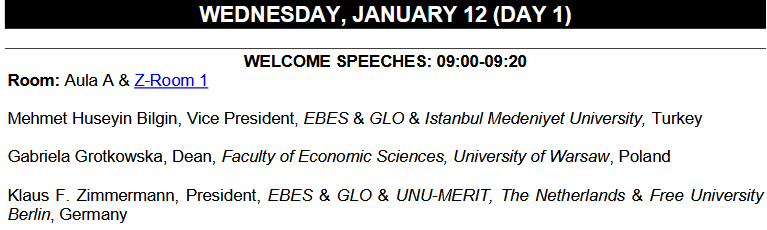
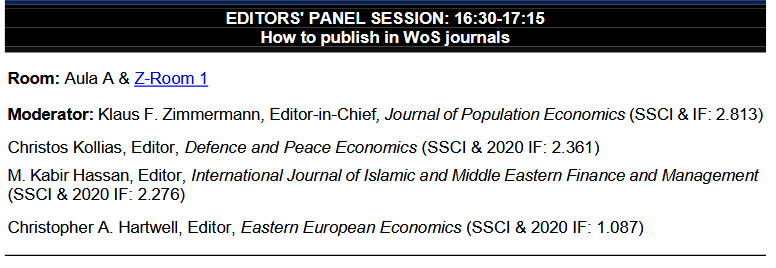
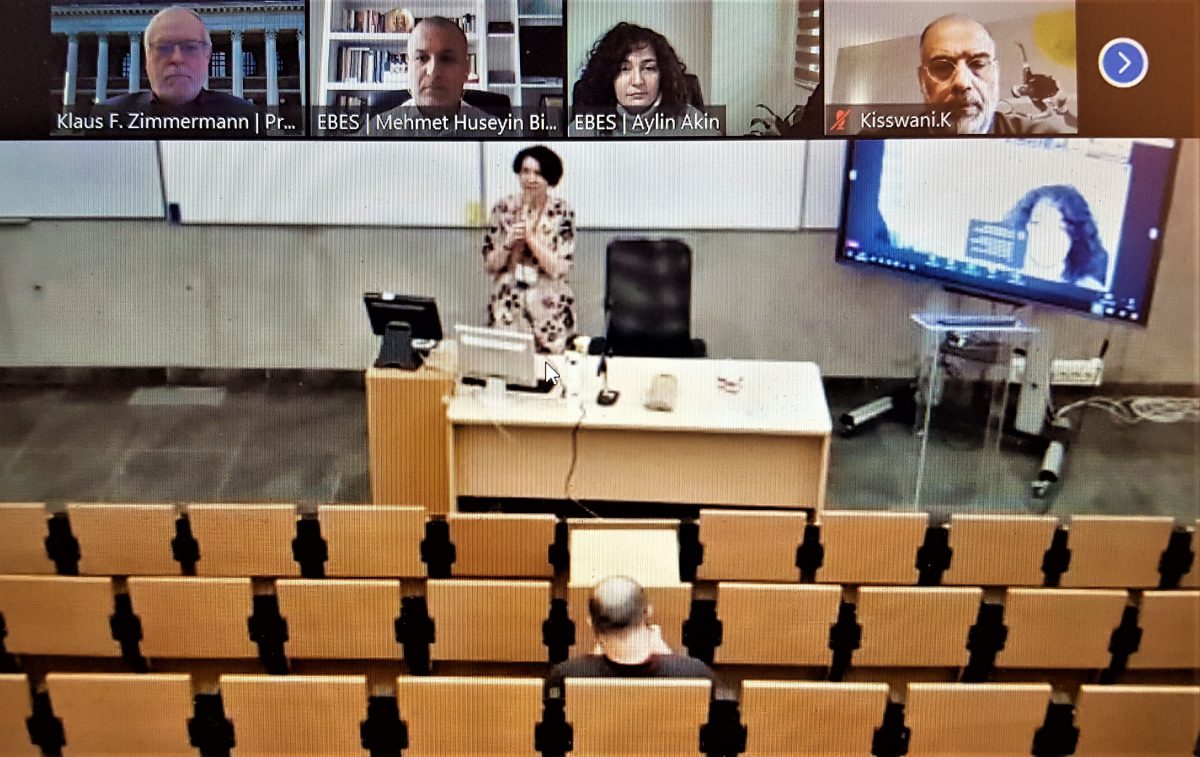
The 38th EBES Conference on January 12-14, 2022 started in Warsaw in Hybrid Mode (online and in-person). The event is supported by the Istanbul Economic Research Association and hosted by the Faculty of Economics Sciences, University of Warsaw. GLO & EBES are collaborating organizations. The conference started on January 12 with welcome speeches by EBES Vice-President Mehmet Bilgin,Gabriela Grotkowska, Dean of the Faculty of Economic Sciences, University of Warsaw, and EBES President Klaus F. Zimmermann, who is also GLO President. Zimmermann also chairs a panel in the afternoon on journal publishing.
Link to the general conference program scheduling 197 papers:LINK
Gabriela Grotkowska, Dean of the Faculty of Economic Sciences, University of Warsaw, speaking.
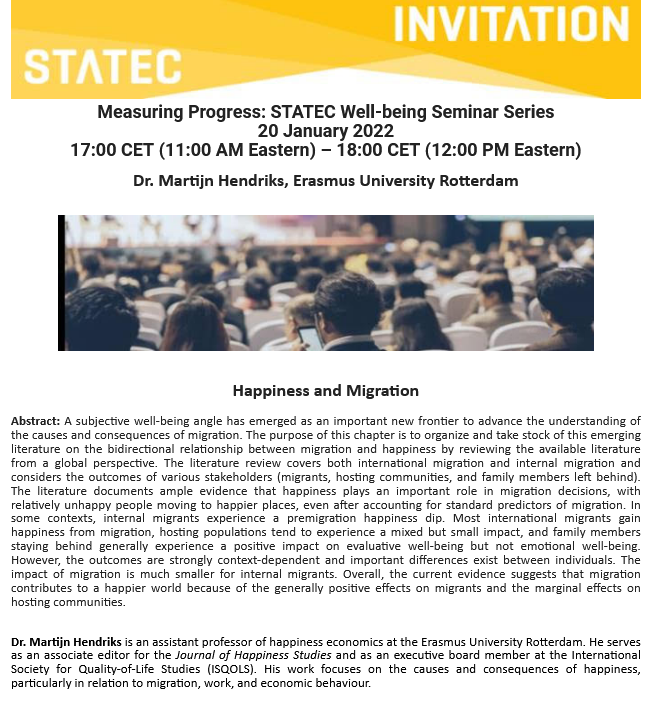
On 20 January 2022, GLO Fellow Martijn Hendriks will speak in a public seminar about Happiness and Migration. The talk is based on his Springer Handbook Chapter with Martijn Burger. The GLO Discussion Paper version of the chapter is here. For further details see below.
A new GLO Discussion Paper studies gender preferences in Pakistan across three decades to reveal that preference for boys is visible in a increasing desired sex ratio and a worsening sex ratio at last birth.
Author Abstract: Using data from two representative Demographic and Health Surveys, we examine the change in son preference over the past three decades and its effects on Pakistani women’s fertility. We analyse a number of indicators and employ different empirical methods to come up with strong and persistent evidence for both the revealed and stated preference for sons. This disproportionate preference for boys is visible in increasing desired sex ratio and worsening sex ratio at last birth. Reliance over differential birth-stopping has significantly increased over time as couples are more likely to stop childbearing once the desired number of boys is achieved.
The Global Labor Organization (GLO) is an independent, non-partisan and non-governmental organization that functions as an international network and virtual platform to stimulate global research, debate and collaboration.
A new GLO Discussion Paper finds for China that having disadvantaged peers significantly lowers conscientiousness, agreeableness, emotional stability, and social skills.
Author Abstract: Despite extensive literature on peer effects, the role of peers on personality skill development remains poorly understood. We fill this gap by investigating the effects of having disadvantaged primary school peers, generated by random classroom assignment and parental migration for employment. We find that having disadvantaged peers significantly lowers conscientiousness, agreeableness, emotional stability, and social skill. The implied effects of a 10-15 percentage point change in the classroom proportion of disadvantaged peers are comparable to the effects of popular early childhood interventions. Furthermore, we find suggestive evidence that these effects are driven by the peers’ personality skills.
The Global Labor Organization (GLO) is an independent, non-partisan and non-governmental organization that functions as an international network and virtual platform to stimulate global research, debate and collaboration.
Further on peer effects for children:
Chakraborty, Tanika & Schüller, Simone & Zimmermann, Klaus F. (2019), Beyond the Average: Ethnic Capital Heterogeneity and Intergenerational Transmission of Education, GLO Discussion Paper No. 322. Published in: Journal of Economic Behavior and Organization (JEBO), Vol. 163 (2019), pp. 551-569. Published PDF.
Author Abstract: We study the relationship between trust and vaccination. We show theoretically that vaccination rates are higher in countries with more transparent and accountable governments. The mechanism that generates this result is the lower probability of a transparent and accountable government to promote an unsafe vaccine. Empirical evidence supports this result. We find that countries perceived as less corrupt and more liberal experience higher vaccination rates. Furthermore, they are less likely to adopt a mandatory vaccination policy. One unit of the Corruption Perception Index (scaled from 0 to 10) is associated with a vaccination rate that is higher by one percentage point (pp) but with a likelihood of compulsory vaccination that is lower by 10 pp. In addition, Google Trends data show that public interest in corruption is correlated with interest in vaccination. The insight from our analysis is that corruption affects not only the supply but also the demand for public services.
The Global Labor Organization (GLO) is an independent, non-partisan and non-governmental organization that functions as an international network and virtual platform to stimulate global research, debate and collaboration.
A new GLO Discussion Paper finds for China that cities whose top officials had public health or medical backgrounds had significantly lower infection rates than cities whose top officials lacked such backgrounds.
Author Abstract: In response to the outbreak of coronavirus disease 2019 (COVID-19), there have been substantial variations in policy response and performance for disease control and prevention within and across nations. It remains unclear to what extent these variations may be explained by bureaucrats’ professionalism, as measured by their educational background or work experience in public health or medicine. To investigate the effects of officials’ professionalism on their response to and performance in fighting the COVID-19 pandemic, we collect information from the résumés of government and Party officials in 294 Chinese cities, and integrate this information with other data sources, including weather conditions, city characteristics, COVID-19-related policy measures, and health outcomes. We show that, on average, cities whose top officials had public health or medical backgrounds (PHMBG) had significantly lower infection rates than cities whose top officials lacked such backgrounds. We test the mechanisms of these effects and find that cities whose officials had PHMBG implemented community closure more rapidly than those lacked such backgrounds. Our findings highlight the importance of professionalism in combating the pandemic.
The Global Labor Organization (GLO) is an independent, non-partisan and non-governmental organization that functions as an international network and virtual platform to stimulate global research, debate and collaboration.