Author Abstract: Using data of the largest online job board in China, Zhaopin.com, we examine the impacts of the lockdown policy on the Chinese labor market demand during the coronavirus disease (COVID-19) pandemic. The analyses reveal that the lockdown policy, which was implemented in Wuhan on January 23, 2020, reduced the labor market demand drastically. Specifically, the “Number of Companies” that posted weekly job vacancies, “Number of Positions,” and “Number of Employees” to be recruited reduced rapidly by 18.5%, 21.9%, and 30.0%, respectively. Furthermore, this impact of the lockdown policy began to reduce, thus allowing the labor demand to rebound four weeks after the outbreak. The heterogeneity analyses reveal that the industries with high physical proximity and those manufacturing non-essential products/services, as well as small-size firms, were greatly impacted by the policy. No statistical difference was observed between the impacts on the cities that implemented specific control measures and those that did not. This study quantifies the dynamic impacts of China’s stringent control measures on the country’s labor demand during the pandemic. These findings indicate that the effective management of public health crises in conjunction with economic policies is critical to revitalizing labor markets.
The Global Labor Organization (GLO) is an independent, non-partisan and non-governmental organization that functions as an international network and virtual platform to stimulate global research, debate and collaboration.
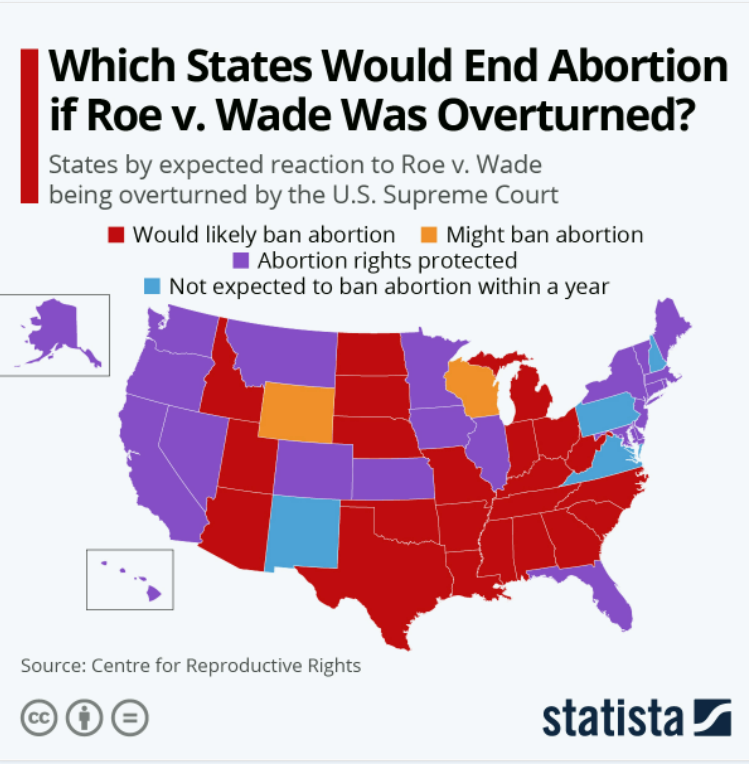
Author Abstract: An expansive empirical literature estimates the causal effects of policies governing young women’s confidential and legal access to contraception and abortion. I present a new review of changes in the historical policy environment in the United States that serve as the foundation of this work. I consult primary sources including annotated statutes, judicial rulings, attorney general opinions, and advisory articles in medical journals, as well as secondary sources including newspaper articles and snapshots of various policy environments prepared by scholars, advocates, and government organizations. Based on this review, I provide a suggested coding of the policy environment over the past 60 years. I also present and compare the legal coding schemes used in the empirical literature and where possible I resolve numerous and substantial discrepancies.
The Global Labor Organization (GLO) is an independent, non-partisan and non-governmental organization that functions as an international network and virtual platform to stimulate global research, debate and collaboration.
A new GLO Discussion Paper finds that the attractiveness of telework is particularly explained by expectations of an improved work-life balance, more work scheduling autonomy, a higher job satisfaction, and more work methods autonomy in jobs with a greater possibility to telework.
Author Abstract: This research adds to the literature on the attractiveness of telework to employees. To this end, we set up an innovative factorial survey experiment in which a high-quality sample of employees evaluates job offers with diverging characteristics, among which a wide variation in telework possibilities. We find that the relationship between the possibility to telework and job attractiveness is approximately linear: 10 percentage points more telework hours yield a rise of 2.2 percentage points in job attractiveness and, therefore, the willingness to give up an increase of 2.3 percentage points in wage in the new job. Our experimental design also allows us to investigate the underlying mechanisms of this relationship as well as its moderators. We find that the attractiveness of telework is particularly explained by expectations of an improved work-life balance, more work scheduling autonomy, a higher job satisfaction, and more work methods autonomy in jobs with a greater possibility to telework. In addition, our analyses show that less conscientious employees are on average more attracted to jobs with greater telework possibilities, so that it is important that self-selection in jobs with more telework is well-monitored.
The Global Labor Organization (GLO) is an independent, non-partisan and non-governmental organization that functions as an international network and virtual platform to stimulate global research, debate and collaboration.
Author Abstract: We examine whether having a parent who smoked during one’s childhood or adolescence increases the probability of being in energy poverty in adulthood. We find that people who had a parent who smoked when they were young are 0.8 to 1.4 percentage points more likely to be in energy poverty later in life. Various checks suggest that this relationship can be regarded as being plausibly causal. We identify health, human capital, labour market outcomes and non-cognitive traits as channels through which early life exposure to passive smoking increases the likelihood of being in energy poverty. Our results have important implications for early life interventions to address the deficits caused by exposure to passive smoking.
The Global Labor Organization (GLO) is an independent, non-partisan and non-governmental organization that functions as an international network and virtual platform to stimulate global research, debate and collaboration.
The Jurnal Ekonomi Malaysia will publish a special issue on “Inequality and Public Policy in Asia” in collaboration with GLO Southeast Asia under the direction of its GLO Cluster Lead M Niaz Asadullah. Submission deadline is June 30, 2022.
JURNAL EKONOMI MALAYSIA CALL FOR PAPERS FOR A SPECIAL ISSUE ON:Inequality and Public Policy in Asia
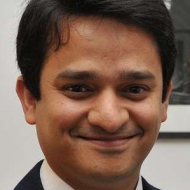
Guest Editor: Professor M Niaz Asadullah (Universiti Malaya & Global Labor Organization (GLO) Southeast Asia)
Niaz Asadullah
Overview of the Special Issue: While income inequality globally has declined significantly in many socio-economic indicators in the past decades, within country inequality is once again on the rise. Rapid economic growth and market reforms have helped reduce extreme poverty within Asian region, but this also coincided with a worsening distribution of earnings, wages and wealth. These contrasting patterns have raised questions about the progressivity of public policy and its efficacy in achieving growth with equity. To what extent have fiscal policies succeeded in reducing inequality in Asia? How important was the role of social expenditures on health and education? And what about the design of social safety nets, labor market reforms, and financial sector inclusion?
To answer some of the above questions, the editorial board of Jurnal Ekonomi Malaysia is seeking scholarly manuscripts for a special issue on inequality and public policy, which is also the first in collaboration with Global Labor Organization (GLO). The unique partnership with GLO will ensure worldwide circulation of the accepted papers.
The SI focus is on contemporary issues involving all aspects of inequality (social and economic). Social science research including a range of disciplinary perspectives and quantitative methods is welcome. Manuscripts in the following issues, but not limited to, are welcome:
Within and cross-country analysis of trends in and drivers of inequality in Asia
Policy drivers of rising or declining inequality in Asia
Political economy analysis of fiscal and tax policy
Inequality of pre-market opportunities (e.g. health, education)
Financial shock, economic crisis and redistributive policy measures
More Information about the Journal
Jurnal Ekonomi Malaysia is an internationally refereed SCOPUS-indexed journal that publishes original articles, research notes, book reviews on economics three times a year published by Penerbit UKM, Universiti Kebangsaan Malaysia. It is also one of the oldest SCOPUS-indexed economics journals published from Southeast Asia.
Submission Information
Word limit: 6,000-8,000 Total number of papers to be Accepted Paper: 8-10 Registration and Submission: https://www.ukm.my/jem/ Select article type “Special issue” in the submission process. Author guidelines: https://www.ukm.my/jem/author-guidelines/ Enquiries on Submission: jem@ukm.edu.my Informal enquiries on proposed topics and potential fit with special Issue objective: m.niaz@um.edu.my
Key Deadlines
Opening Submission Date: 1 May 2022 Closing Submission Date: 30 June 2022 Possible publication date: October 2022
Author Abstract: Culture has played a pivotal role in human evolution. Yet, the ability of social scientists to study culture is limited by the currently available measurement instruments. Scholars of culture must regularly choose between scalable but sparse survey-based methods or restricted but rich ethnographic methods. Here, we demonstrate that massive online social networks can advance the study of human culture by providing quantitative, scalable, and high-resolution measurement of behaviorally revealed cultural values and preferences. We employ publicly available data across nearly 60,000 topic dimensions drawn from two billion Facebook users across 225 countries and territories. We first validate that cultural distances calculated from this measurement instrument correspond to traditional survey-based and objective measures of cross-national cultural differences. We then demonstrate that this expanded measure enables rich insight into the cultural landscape globally at previously impossible resolution. We analyze the importance of national borders in shaping culture and compare subnational divisiveness to gender divisiveness across countries. The global collection of massive data on human behavior provides a high-dimensional complement to traditional cultural metrics. Further, the granularity of the measure presents enormous promise to advance scholars’ understanding of additional fundamental questions in the social sciences. The measure enables detailed investigation into the geopolitical stability of countries, social cleavages within both small and large-scale human groups, the integration of migrant populations, and the disaffection of certain population groups from the political process, among myriad other potential future applications.
The Global Labor Organization (GLO) is an independent, non-partisan and non-governmental organization that functions as an international network and virtual platform to stimulate global research, debate and collaboration.
A new GLO Discussion Paper establishes the presence of conflicting forces – the beneficial effects on life expectancy before the second epidemiological transition and their adverse effects thereafter.
Author Abstract: This research explores the persistent effect of the Neolithic Revolution on the evolution of life expectancy in the course of human history. It advances the hypothesis and establishes empirically that the onset of the Neolithic Revolution and the associated rise in infectious diseases triggered a process of adaptation reducing mortality from infectious diseases while increasing the propensity for autoimmune and in ammatory diseases. Exploiting an exogenous source of variation in the timing of the Neolithic Revolution across French regions, the analysis establishes the presence of these conflicting forces – the beneficial effects on life expectancy before the second epidemiological transition and their adverse effects thereafter.
The Global Labor Organization (GLO) is an independent, non-partisan and non-governmental organization that functions as an international network and virtual platform to stimulate global research, debate and collaboration.
Author Abstract: Fear of the threat of job loss is likely to elicit negative thoughts that have adverse consequences for not only job satisfaction, but also, all-round happiness and satisfaction with life. Using nationally representative cross-sectional data, this study provides evidence of the negative effect of perceived job insecurity on life satisfaction in post-communist Albania, an under-research context. This adverse effect is found to be more pronounced for women and for blue-collar workers: being in a blue-collar job is associated with lower overall life satisfaction, but if this job is perceived as insecure, the negative effect on life satisfaction is magnified. In contrast, workers in well-paying jobs are more satisfied with their lives and, relatedly, higher education also has a positive impact, more so for males. Evidence of the quality of life effects of job insecurity can be used to inform workplace policy initiatives and practices, particularly as measures of life satisfaction, well-being and happiness are increasingly considered appropriate indicators of social progress and the ultimate goal of public policy.
The Global Labor Organization (GLO) is an independent, non-partisan and non-governmental organization that functions as an international network and virtual platform to stimulate global research, debate and collaboration.
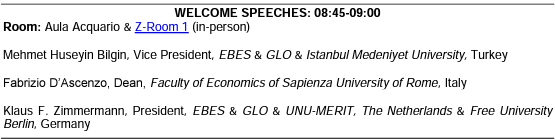
The 39th EBES Conference in Rome takes place on April 6-8, 2022 in Hybrid Mode (online and in-person). The event is supported by the Istanbul Economic Research Association and hosted by the Faculty of Economics Sapienza, University of Rome. GLO & EBES are collaborating organizations; GLO President Klaus F. Zimmermann is also President of EBES.
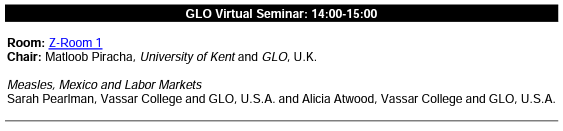
This event is joint with the monthly GLO Virtual Seminar for April. Invited Speaker is Sarah Pearlman; Chair is GLO DirectorMatloob Piracha.
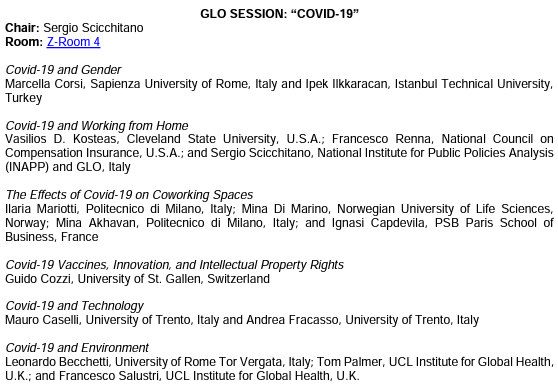
Day 3: Friday, April 8 (16:20-18:20 CEST, Rome time):
Session Chair Sergio Scicchitano, National Institute for Public Policies Analysis (INAPP), is GLO Cluster Lead COVID-19 and Section Editor COVID-19 of the Handbook “Labor, Human Resources and Population Economics” (Klaus F. Zimmermann, Editor). The presentations in this session refer to chapters in the Handbook.
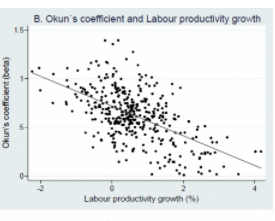
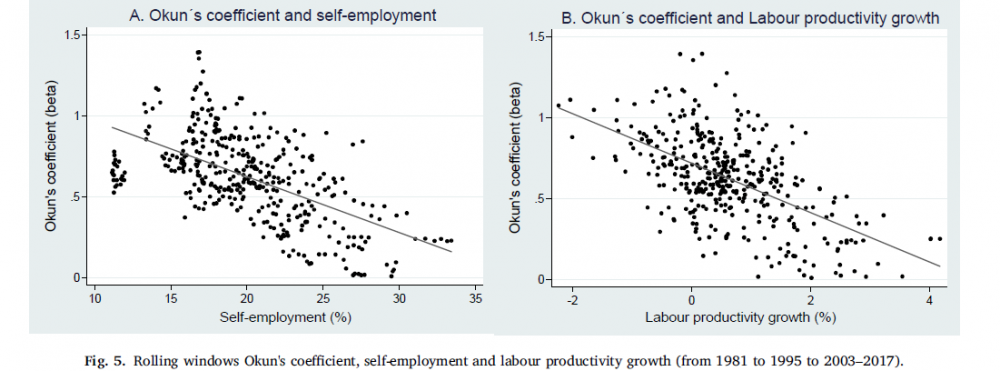
Author Abstract: Okun’s law is an extremely influential parameter in empirical research and policy analysis, based on the sizable number of estimates from this perspective. Nevertheless, it is also subject to considerable heterogeneity. We first show graphical and statistical evidence on the existence of a high level of heterogeneity among Okun’s law estimates in existing research, then analyze potential sources of heterogeneity. Using 1,213 estimates of Okun’s law for various countries, regions, and time periods, separate metaregressions are estimated; one using estimates with the unemployment rate as the dependent variable, and the other with output as the dependent variable. Our findings indicate that the specification of the underlying model of the relationship has an effect on the magnitude of Okun’s parameter. Differential labor market characteristics may also explain part of the observed heterogeneity. Finally, the results are also found to be influenced by methodological issues, such as the type of data (time series or panel data), the frequency of the data (annual or quarterly), the spatial coverage of the estimates (country, region, or group of countries), whether more variables are included in estimations, and whether a dynamic or static, symmetric or asymmetric model is estimated. This paper contributes to highlight the heterogeneity affecting the estimates of Okun’s law and that needs to be taken into account. In order to know the “true” relationship between unemployment and economic growth, researchers should bear in mind that there are a number of methodological choices that have consequences for the results.
The Global Labor Organization (GLO) is an independent, non-partisan and non-governmental organization that functions as an international network and virtual platform to stimulate global research, debate and collaboration.
Author Abstract: This study explores the impact of COVID-19 and how Vietnamese citizens perceived and experienced measures adopted by central and local governments to contain the CVODI-19 pandemic in 2021. In general, the COVID-19 pandemic had a more severe impact in 2021 than in 2020. Citizens showed great concern about their children’s education (76 percent) and their personal health (68 percent). COVID-19 negatively impacted employment and income, with 77 percent of the respondents reporting income reduction due to the pandemic. The poor, ethnic minorities, unskilled, non-farm workers, and those working in the service sector or living in provinces with longer lockdowns were the most likely to suffer. Compared with 2020, in 2021, respondents showed a high but declining positive assessment of government performance in dealing with the pandemic, with 84 percent of the respondents rating the responses from the Central Government as good or very good (97 percent in 2020), 89 percent rating the response from their provincial governments’ responses as good or very good (94 percent in 2020). Only 13 percent of the respondents received support from the Government’s package. However, ethnic minorities, female, poorer and rural respondents were less likely to receive the support. For the support recipients, delivery was regarded as timely and transparent, but administrative procedures to get access to the package were not simple. Meanwhile, support from non-governmental organizations (NGOs), social organizations, charity foundations, and individuals was distributed more efficiently, with 25 percent of the respondents receiving support from these sources.
The Global Labor Organization (GLO) is an independent, non-partisan and non-governmental organization that functions as an international network and virtual platform to stimulate global research, debate and collaboration.
Author Abstract: This study provides evidence on the trends and drivers of inequality in Vietnam using Vietnam Household Living Standard Surveys. We find that inequality, regardless of the choice of welfare indicators and inequality measurements, has been stable in Vietnam. Inequality in income or expenditure is remarkably lower than inequality in assets. In 2016, the Gini coefficient of per capita expenditure and per capita income was 0.35 and 0.39, respectively, while the Gini coefficient in electricity consumption and housing value was 0.42 and 0.62, respectively. Using the decomposition analysis, we find that inequality between provinces accounts for 22% of the total inequality, while inequality between ethnic groups accounts for 15% of the total inequality. The regression analysis shows that inequality tends to be higher in provinces with higher initial income and poverty. This implies that high-income people are more likely to benefit from economic growth, especially in better-off provinces.
The Global Labor Organization (GLO) is an independent, non-partisan and non-governmental organization that functions as an international network and virtual platform to stimulate global research, debate and collaboration.
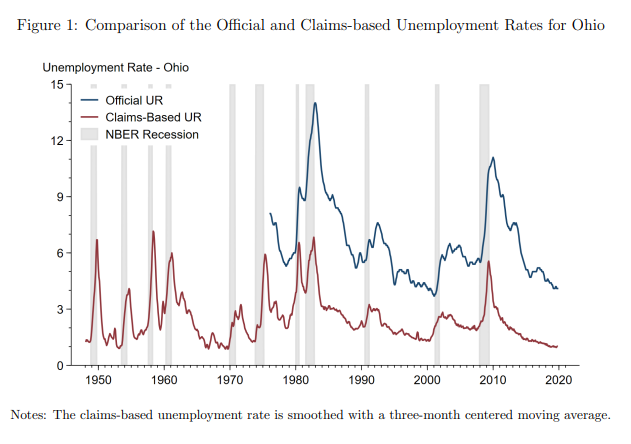
Author Abstract: Using newly digitized unemployment insurance claims data we construct a historical monthly unemployment series for U.S. states going back to January 1947. The constructed series are highly correlated with the Bureau of Labor Statics’ state-level unemployment data, which are only available from January 1976 onwards, and capture consistent patterns in the business cycle. We use our claims-based unemployment series to examine the evolving pace of post-war unemployment recoveries at the state level. We find that faster recoveries are associated with greater heterogeneity in the recovery rate of unemployment and slower recoveries tend to be more uniformly paced across states. In addition, we find that the pace of unemployment recoveries is strongly correlated with a states’ manufacturing share of output.
The Global Labor Organization (GLO) is an independent, non-partisan and non-governmental organization that functions as an international network and virtual platform to stimulate global research, debate and collaboration.
A new GLO Discussion Paper analyzes the driver of the rally effect of terrorism by disentangling voluntary solidarity from economically or politically elicited solidarity.
Author Abstract: This study examines whether the rally ’round the flag phenomenon is present in the context of terrorist attacks, and investigates the explanations for the related increase of confidence in political institutions and political approval of the incumbent’s job performance. I exploit variations in terrorist occurrences and results across sub-national regions among EU countries from 2008 to 2016. I restrict the sample to only regions where at least one attack took place during the data period, in order to mitigate concerns over selectivity of terrorism in particular areas. I empirically show that both terrorism occurrence and its results (successful or failed attacks) are plausibly exogenous to the prior political and economic climate. Conducting a difference-in-differences analysis, I compare changes in political confidence and approval among individuals who were exposed to an attack in their region to those who were not. With another more sophisticated identification, I also compare such political changes after successful attacks to those after failed attacks of the same type. I find that post-terrorism, individual political confidence and support significantly increased by more than 10 percentage points, and that this political increment was 5 percentage points after successful attacks relative to failed ones. Furthermore, I explore various potential channels suggesting patriotism and civic engagement as mechanisms while rejecting perceived economic capture and political acquisition as alternative explanations. This paper first empirically analyzes the driver of the rally effect of terrorism by disentangling voluntary solidarity from economically or politically elicited solidarity.
The Global Labor Organization (GLO) is an independent, non-partisan and non-governmental organization that functions as an international network and virtual platform to stimulate global research, debate and collaboration.
Using data from large-scale experiments with entire families for Bangladesh, the research finds that both mothers’ and fathers’ risk, time and social preferences are significantly positively correlated with their children’s economic preferences.Results differ from evidence for rich countries.
GLO Discussion Paper No. 592, 2020 now forthcoming as
Economic preferences across generations and family clusters: A large-scale experiment in a developing country by Chowdhury, Shyamal & Sutter, Matthias & Zimmermann, Klaus F.
GLO FellowsShyamal Chowdhury and Matthias Sutter & GLO President Klaus F. Zimmermann
Shyamal Chowdhury
Matthias Sutter
Klaus F. Zimmermann
Author Abstract:Our large-scale experiment with 542 families from rural Bangladesh finds substantial intergenerational persistence of economic preferences. Both mothers’ and fathers’ risk, time and social preferences are significantly (and largely to the same degree) positively correlated with their children’s economic preferences, even when controlling for personality traits and socio-economic background. We discuss possible transmission channels and are the first to classify all families into one of two clusters, with either relatively patient, risk-tolerant and pro-social members or relatively impatient, risk averse and spiteful members. Classifications correlate with socio-economic background variables. We find that our results differ from evidence for rich countries.
The Global Labor Organization (GLO) is an independent, non-partisan and non-governmental organization that functions as an international network and virtual platform to stimulate global research, debate and collaboration.
A new GLO Discussion Paper supports for Sweden the hypothesis that immigrant employees increase offshoring intensity by lowering contract enforcement costs.
Author Abstract: Offshoring continues to be an important dimension of firms’ internationalization choices. However, offshoring also increases contract enforcement costs by inhibiting the coordination and monitoring of performance. Immigrant employees may reduce such costs through their specific knowledge of the employer, their country of birth and access to foreign networks. We develop a heterogeneous firm framework with immigrants and offshoring costs, including technology leakage. In the model, immigrant employees augment the supervisory services of headquarters and limit technology leakage, thereby reducing contract enforcement costs. Then, we bring our conjectures to rich administrative Swedish microlevel data that include specific information about the characteristics of employees, manufacturing firms and their bilateral offshoring. Our results support the hypothesis that immigrant employees increase offshoring intensity by lowering contract enforcement costs. Hiring one additional immigrant employee can increase offshoring by up to three percent on average, with the strongest effects found for skilled immigrant employees.
The Global Labor Organization (GLO) is an independent, non-partisan and non-governmental organization that functions as an international network and virtual platform to stimulate global research, debate and collaboration.
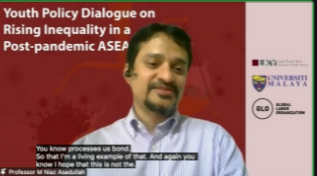
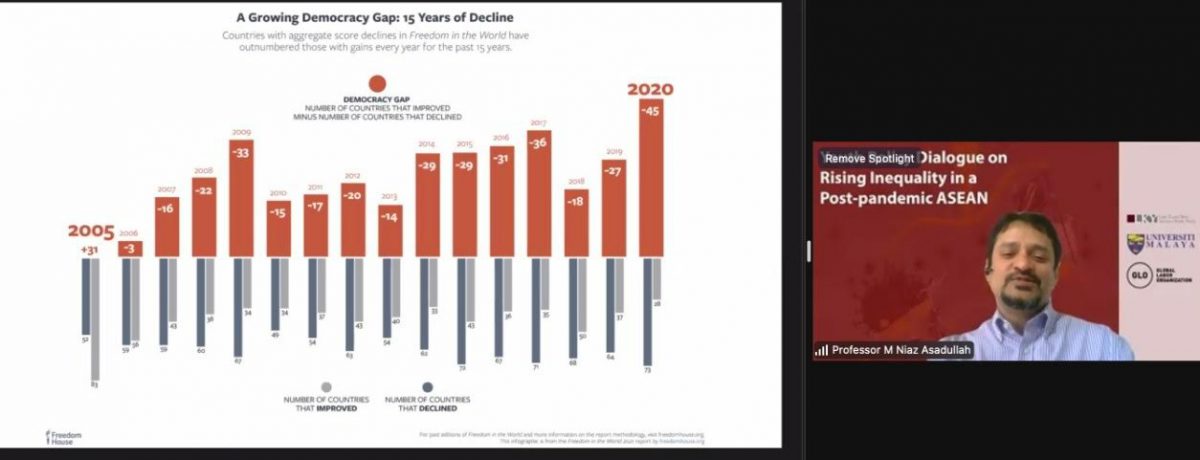
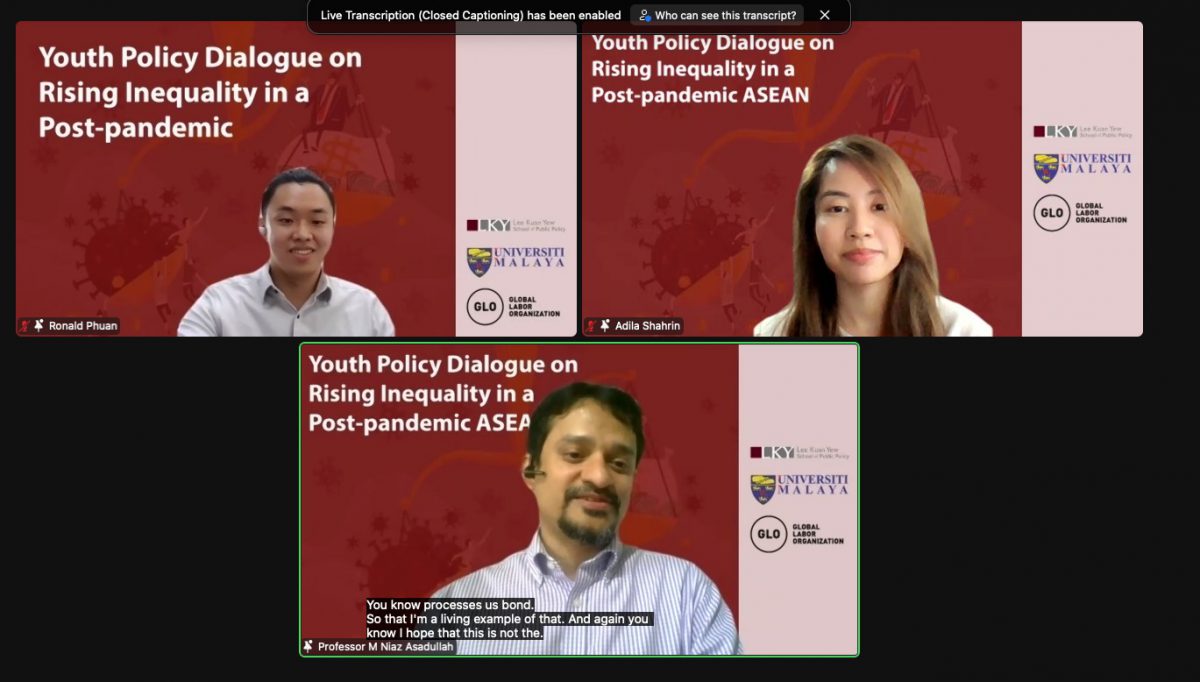
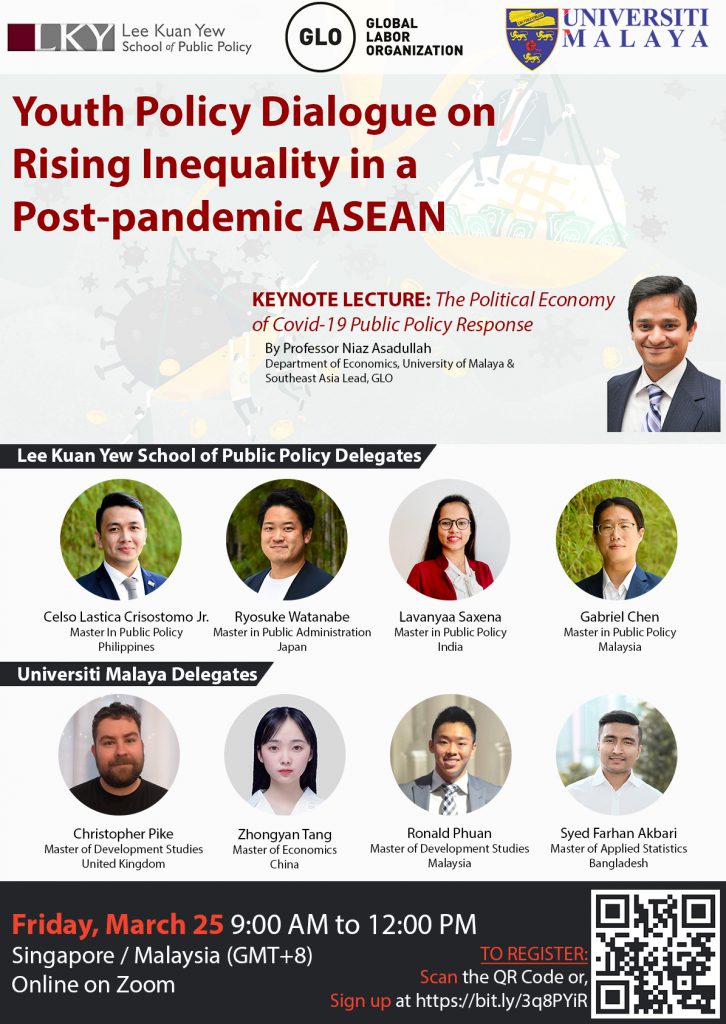
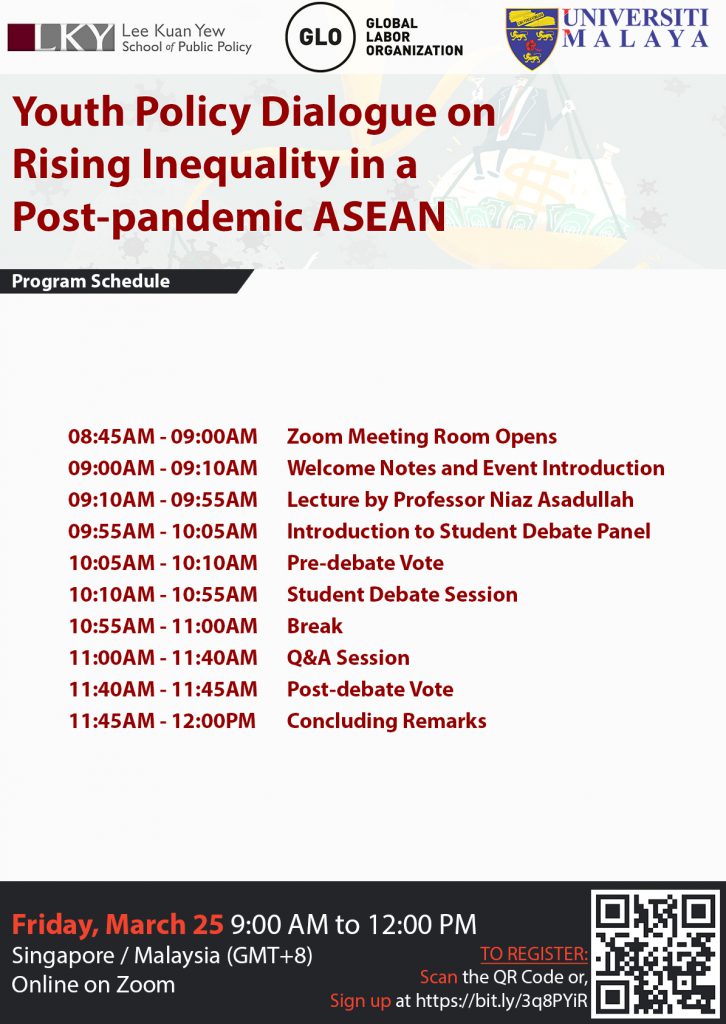
On 25 March 2022, GLO Southeast Asia Lead Niaz Asadullah successfully organized the inaugural Youth Policy Dialogue on COVID-19 pandemic in the ASEAN region. The event was jointly hosted by students from theLee Kuan Yew School of Public Policyand the University of Malaya. It is the first of its kind and coincided with the second anniversary of the pandemic.
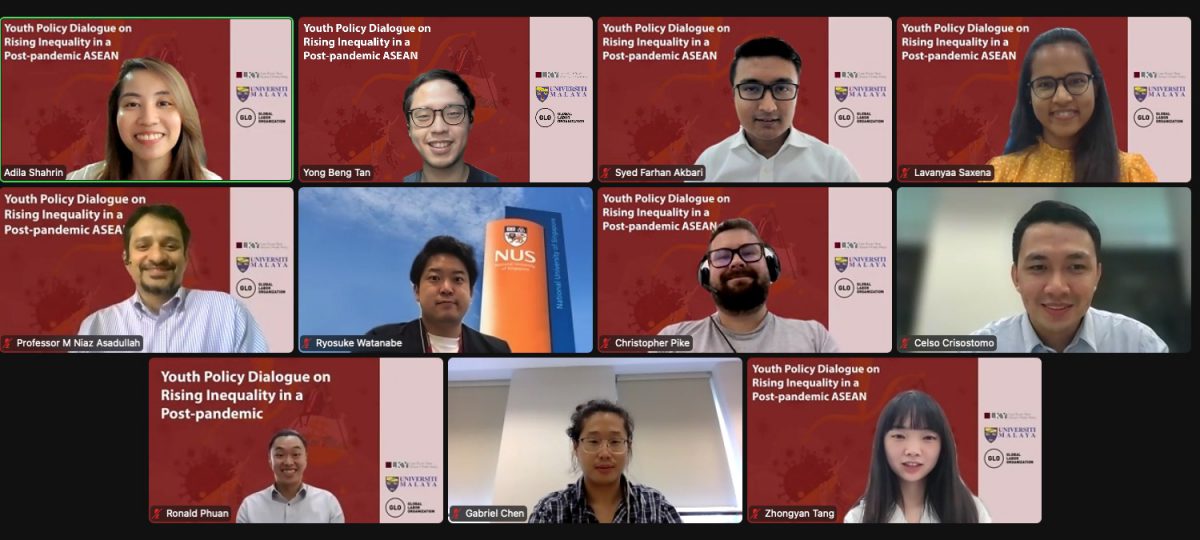
Niaz Asadullah, who is also a Professor at the University Malaya, delivered the keynote lecture on the political economy of COVID-19 policy response, offering a global overview of some of the key challenges for policymakers in tackling the “new inequality” through progressive public policy. This was followed by a lively youth panel debate where 8 speakers from 7 countries deliberated on the proposition (debate motion) that “This house believes that ASEAN’s uncoordinated response to obtaining vaccines has increased regional inequality”.
The proposition team was led by students of Lee Kuan Yew School Lavanyaa Saxena (India), Celso Lastica Crisostomo Jr. (Philippines), Ryosuke Watanabe (Japan) and Gabriel Chen (Malaysia).
The opposition team members were Christopher Pike (UK), Zhongyan Tang (China), Syed Farhan Akbari (Bangladesh) and Ronald Phuan (Malaysia) — all students of the University of Malaya.
The Lee Kuan Yew School youth delegates (proposition team) argued that ASEAN’s uncoordinated response to COVID-19 led to very high cases of infections and deaths, which combined with economic lockdowns, stunted economic growth. This in turn has increased income inequality. Therefore they concluded that a coordinated response by state authorities in member countries in obtaining vaccines early and administering the vaccination campaign effectively would have helped avoid the spike in inequality.
Youth delegates from the University of Malaya (opposition team) contested the motion pointing out that the lack of coordination in the vaccine campaign and the rise in inequality is just a coincidence and does not imply that the former is driven by the latter. Besides, inequality is multifaceted in nature as is exemplified by the rise in education inequality during the pandemic — coordinated vaccine response would not have helped much in avoiding the learning loss as it had more to do with issues of digital infrastructure provisions and quality of state-run online programs. The opposition speakers also noted ASEAN’s limited organizational capacity to coordinate a response due to its doctrine of non-interference and the geo-politics of vaccine production and supply.
Among other highlights, youth members of the audience also took part by voting on the motion before and after the youth panel session. The pre-debate audience poll produced 85% votes in favour of the proposition. After the debate, follow up votes increased support for the opposition from 15% to 36%.
(Note: Lee Kuan Yew School of Public Policy is not part of the AUA)
At the end of the event, youth speakers received a certificate signed by GLO Southeast Asia Lead, Niaz Asadullah, and the Assistant Dean of Student Affairs of LKY School, Dr Tan-Soo Jie-Sheng.
Author Abstract: We propose a measure of well-being efficiency to assess countries’ ability to transform inputs into subjective well-being (Cantril ladder). We use the six inputs (real GDP per capita, healthy life expectancy, social support, freedom of choice, absence of corruption, and generosity) identified in the World Happiness Reports and apply Data Envelopment Analysis to a sample of 126 countries. Efficiency scores reveal that high ranking subjective well-being countries, such as the Nordics, are not strictly the most efficient ones. Also, the scores are uncorrelated with economic efficiency. This means that the implicit assumption that economic efficiency promotes well-being is not supported. Well-being efficiency can be improved by changing the amount (scale) or composition of inputs and their use (technical efficiency). For instance countries with lower unemployment, and greater healthy life expectancy and optimism are more efficient.
The Global Labor Organization (GLO) is an independent, non-partisan and non-governmental organization that functions as an international network and virtual platform to stimulate global research, debate and collaboration.
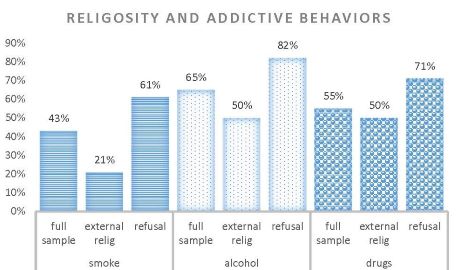
Using data for young Romanians, a GLO Discussion Paper found that it is external religiosity that interacts with weaker addictive behaviors like smoking, drinking and using drugs.
GLO Discussion Paper No. 859, 2021
Religiosity, Smoking and Other Addictive Behaviors by Roman, Monica & Zimmermann, Klaus F. & Plopeanu, Aurelian-Petruș
Now forthcoming OPEN ACCESS: Journal of Economics, Management and Religion (JEMAR), Vol. 2 (2022), 2250001.
Author Abstract: While under communism the identity-providing religion was suppressed, religiosity is strong today even among the youth in post-communist countries. This provides an appropriate background to investigate how external and internal religiosity relates to risky behaviors like smoking, drinking, and drugs among the young. This study shows that not religion as such or internal religiosity, but largely observable (external) religiosity prevents them from wallowing in those vices. While this is found strongly for both males and females, those females doubting or reflecting religion show a somewhat smaller risky activity.
The Global Labor Organization (GLO) is an independent, non-partisan and non-governmental organization that functions as an international network and virtual platform to stimulate global research, debate and collaboration.
A new GLO Discussion Paper finds sizeable glass ceiling effects in all countries considered, and persistent across all industrial sectors and years considered.
Author Abstract: In all the MENA countries considered in this study, namely Jordan Egypt and Tunisia, there has been a significant decrease in the female labor force participation rate over the last two decades. Moreover, existing analysis and the anecdotal evidence suggest that it may be problematic for women to reach a white collar high skill job, also in the more protected public sector, though there is very little empirical evidence on this. By using repeated cross sections of individuals covering periods of up to 20 years (for Egypt), we examine the evolution of the glass ceiling problem for women resorting to the matching approach, which, to our knowledge, has never been used in this field. Instead of looking at the gender gap along the wage distribution, we assess the probability to reach the top professions of manager, professional and technician or associate professional. We find a sizeable glass ceiling effect in all the countries considered. It is a persistent phenomenon across all the industrial sectors and the years considered. The present study sheds new light on the glass ceiling effect for woman in the MENA countries, which is relevant also for other countries.
The Global Labor Organization (GLO) is an independent, non-partisan and non-governmental organization that functions as an international network and virtual platform to stimulate global research, debate and collaboration.
A new GLO Discussion Paper finds thatforeign-born and illiterate women were more likely to report having an occupation compared to their native-born and literate counterparts.
Author Abstract: This paper analyzes the occupational status and distribution of free women in the antebellum United States. It considers both their reported and unreported (imputed) occupations, using the 1/100 IPUMS files from the 1860 Census of Population. After developing and testing the model based on economic and demographic variables used to explain whether a free woman has an occupation, analyses are conducted comparing their occupational distribution to free men, along with analyses among women by nativity, urbanization, and region of the country. While foreign-born and illiterate women were more likely to report having an occupation compared to their native-born and literate counterparts, they were equally likely to be working when unreported family workers are included. In the analysis limited to the slave-holding states, it is shown that the greater the slave-intensity of the county, the less likely were free women to report having an occupation, particularly as private household workers, suggesting substitution in the labor market between free women and enslaved labor.
The Global Labor Organization (GLO) is an independent, non-partisan and non-governmental organization that functions as an international network and virtual platform to stimulate global research, debate and collaboration.
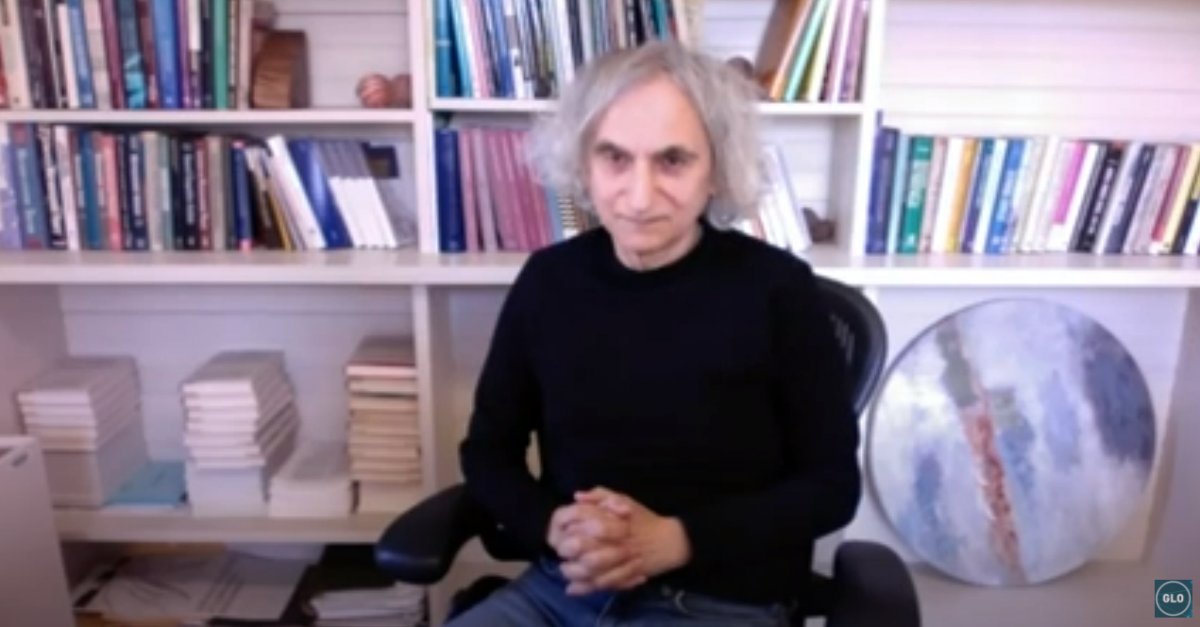
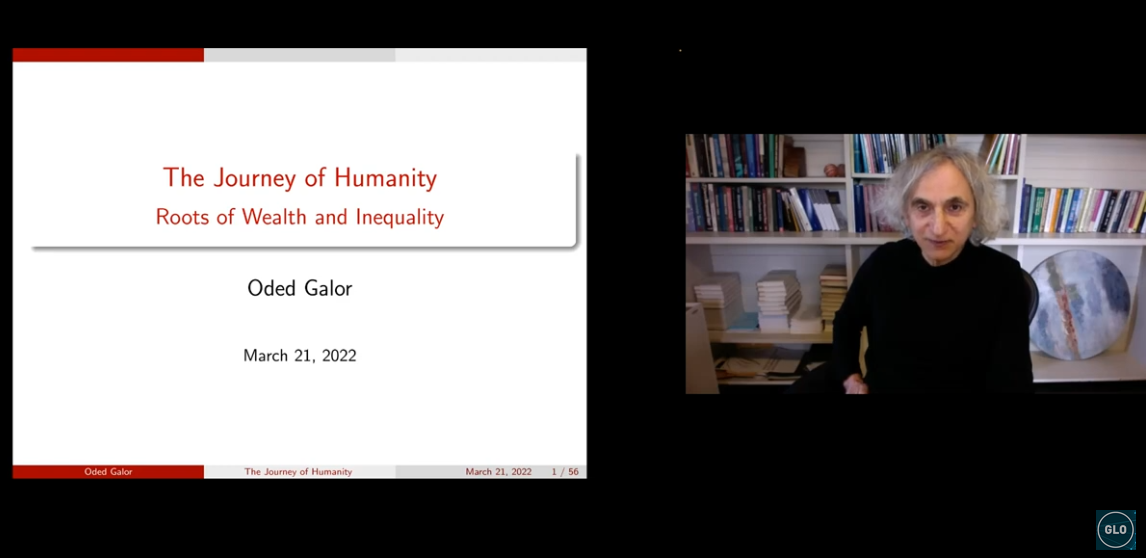
The event was jointly organized by Global Labor Organization (GLO), the Journal of Population Economics (JOPE) and POP @ UNU-MERIT and chaired by Klaus F. Zimmermann (President of GLO, Editor-in-Chief of JOPE, and Co-Director of POP). About 200 people had registered to attend.
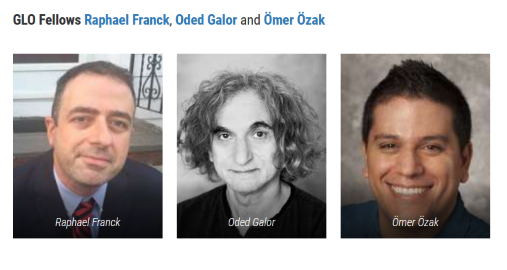
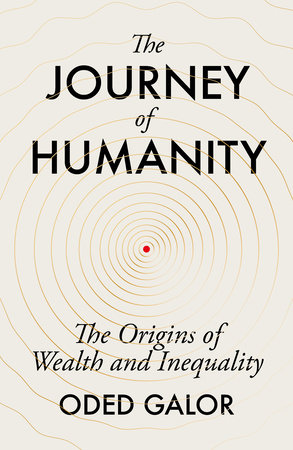
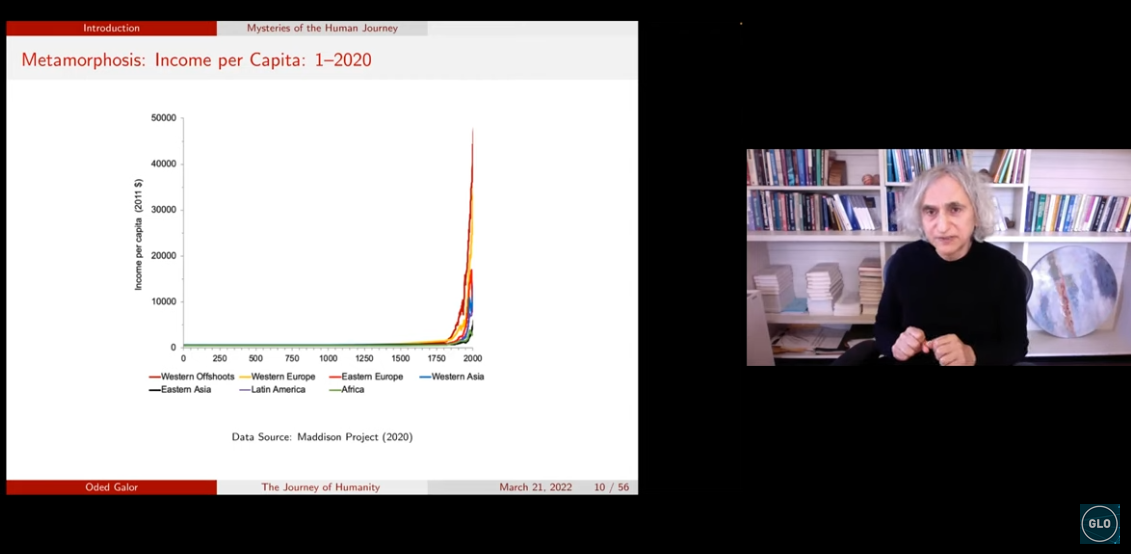
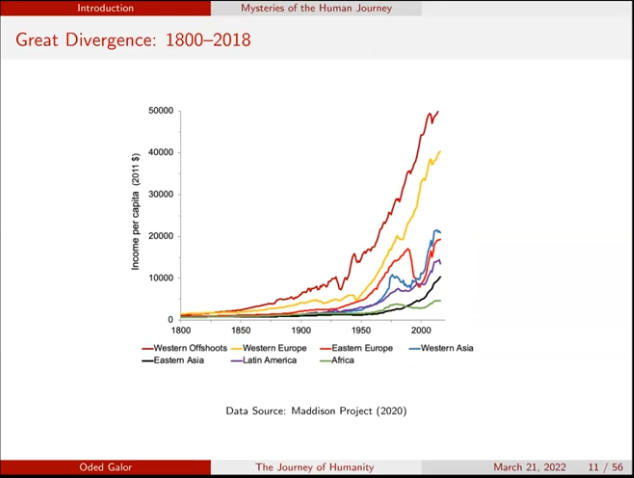
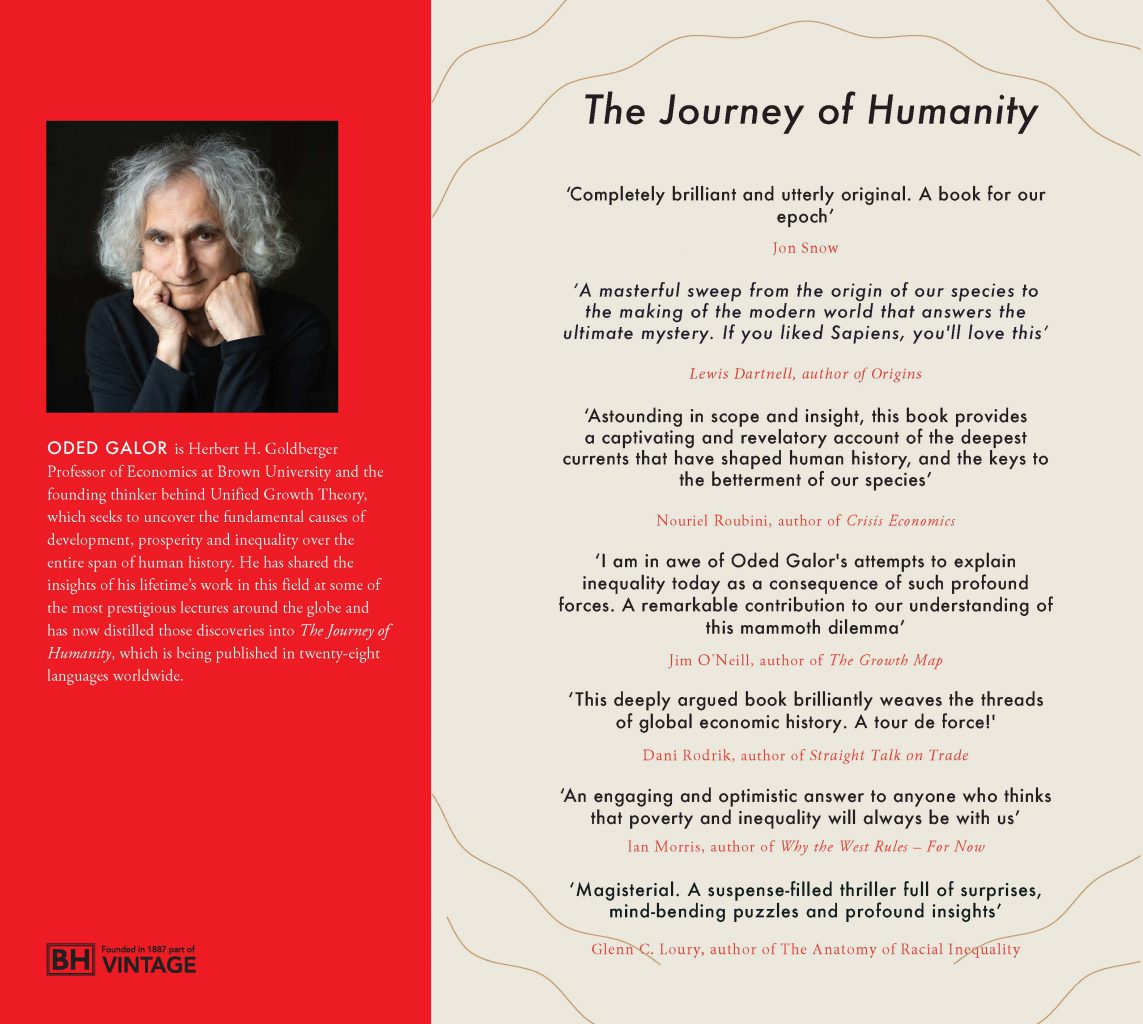
Oded Galor spoke about his new book just published with Penguin Random House in thirty languages worldwide. It is released on March 22 in the USA and on April 7 in the UK and on April 13 in Germany.
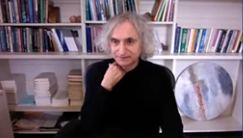
He is Herbert H. Goldberger Professor of Economics at Brown University and the founding thinker behind Unified Growth Theory, which seeks to uncover the fundamental causes of development, prosperity and inequality over the entire span of human history. He is also the Editor-in-Chief of the Journal of Economic Growth and an Editor of the Journal of Population Economics.
About the book
In a captivating journey from the dawn of human existence to the present, world-renowned economist and thinker Oded Galor offers an intriguing solution to two of humanity’s great mysteries.
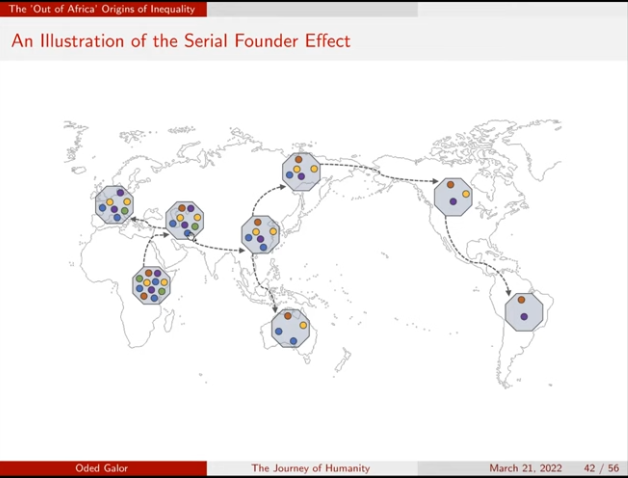
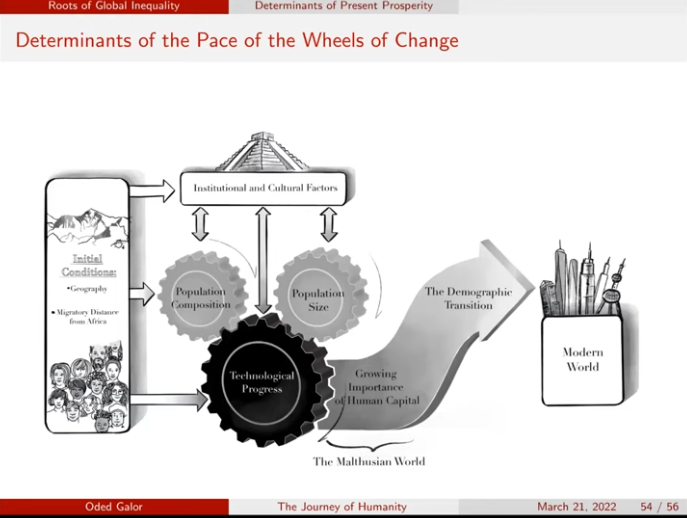
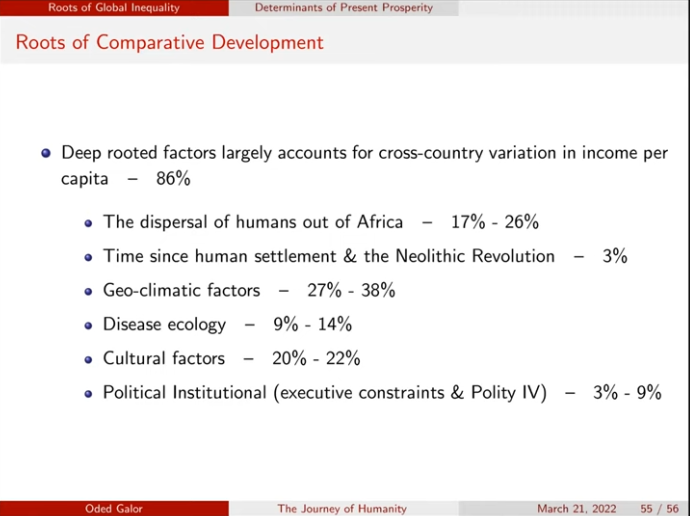
Why are humans the only species to have escaped – only very recently – the subsistence trap, allowing us to enjoy a standard of living that vastly exceeds all others? And why have we progressed so unequally around the world, resulting in the great disparities between nations that exist today? Immense in scope and packed with astounding connections, Galor’s gripping narrative explains how technology, population size, and adaptation led to a stunning “phase change” in the human story a mere two hundred years ago. But by tracing that same journey back in time and peeling away the layers of influence – colonialism, political institutions, societal structure, culture – he arrives also at an explanation of inequality’s ultimate causes: those ancestral populations that enjoyed fruitful geographical characteristics and rich diversity were set on the path to prosperity, while those that lacked it were disadvantaged in ways still echoed today.
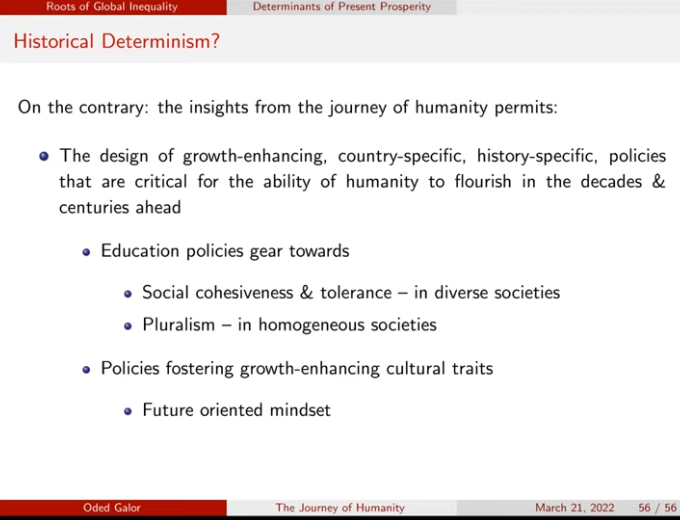
As we face ecological crisis across the globe, The Journey of Humanity is a book of urgent truths and enduring relevance, with lessons that are both hopeful and profound: gender equality, investment in education, and balancing diversity with social cohesion are the keys not only to our species’ thriving, but to its survival.
From the event
From the opening remarks of Klaus F. Zimmermann
Oded is the Herbert Goldberger Professor of Economics at Brown University and one of the profoundest economic thinkers of the world. He has published his research in the best academic outlets of the profession. His contributions focus for long around the fundamental causes of development, prosperity and inequality over the entire span of human history. As the driving force behind what he calls “Unified Growth Theory” and the role of genetic diversity for development he seeks to uncover the fundamental causes of the path of human wellbeing across time and space.
Oded Galor was awarded Doctorates Honoris Causa from UCLouvain and from Poznań University of Economics & Business. He is an elected Foreign Member of Academia Europaea and an Elected Fellow of the Econometric Society. He is affiliated with many distinguished academic networks like NBER, CEPR, GLO, IZA, among others. Furthermore, he is the Editor in Chief of the Journal of Economic Growth, Editor of the Journal of Population Economics, and Co-Editor of Macroeconomic Dynamics. He has served the profession in many unique ways.
His new book “The Journey of Humanity: The Origins of Wealth and Inequality” comes at the time of a dramatic setback in economic history, as for a few weeks now the aggressive war against the Ukraine reveals. Europe experiences some of the darkest days on the continent since WWII with unpredictable ending.
The book could not foresee this development. But it nevertheless feeds the hope for a long-term rise in humanity, of increased wealth, understanding and collaboration.
As Oded Galor writes at the beginning of his global review of history (p. 9): “…. the outlook derived from this exploration can be described as fundamentally hopeful, in terms of the overarching trajectory of societies across the globe. …. education, tolerance and greater gender equality hold the keys to our species’ flourishing in the decades and centuries to come. ”
And after discussing major global catastrophes over the last century, he writes towards the end (pp. 240-241): “But history shows that, shattering and dreadful as they are, these events have had limited long-term impact on the grand arc of human development. The relentless march of humanity has so far been unstoppable.”
The book helps us to see the mechanisms and common institutions we need to invest and struggle for to foster human development and to overpower disaster.
The GLO Cluster South-East Asia lead by Niaz Asadullah (University of Malaya & GLO) organizes the GLO South-East Asia Youth Policy Forum on 25 March 2022. For program and registration details see below. To sign up: https://bit.ly/3q8PYiR
Oded Galor speaks about his new book just published with Penguin Random House in thirty languages worldwide. It is released on March 22 in the USA and on April 7 in the UK.
Further details on the book (see also below) and how it can be purchased: USA-LINK —– UK-LINK
He is Herbert H. Goldberger Professor of Economics at Brown University and the founding thinker behind Unified Growth Theory, which seeks to uncover the fundamental causes of development, prosperity and inequality over the entire span of human history. He is also the Editor-in-Chief of the Journal of Economic Growth and an Editor of the Journal of Population Economics.
In a captivating journey from the dawn of human existence to the present, world-renowned economist and thinker Oded Galor offers an intriguing solution to two of humanity’s great mysteries.
Why are humans the only species to have escaped – only very recently – the subsistence trap, allowing us to enjoy a standard of living that vastly exceeds all others? And why have we progressed so unequally around the world, resulting in the great disparities between nations that exist today? Immense in scope and packed with astounding connections, Galor’s gripping narrative explains how technology, population size, and adaptation led to a stunning “phase change” in the human story a mere two hundred years ago. But by tracing that same journey back in time and peeling away the layers of influence – colonialism, political institutions, societal structure, culture – he arrives also at an explanation of inequality’s ultimate causes: those ancestral populations that enjoyed fruitful geographical characteristics and rich diversity were set on the path to prosperity, while those that lacked it were disadvantaged in ways still echoed today.
As we face ecological crisis across the globe, The Journey of Humanity is a book of urgent truths and enduring relevance, with lessons that are both hopeful and profound: gender equality, investment in education, and balancing diversity with social cohesion are the keys not only to our species’ thriving, but to its survival.
Biographical details
Oded Galor is the founder of Unified Growth Theory. He has contributed to the understanding of the process of development over the entire course of human history and the role of deep-rooted factors in the transition from stagnation to growth and in the emergence of the vast inequality across the globe. Moreover, he has pioneered the exploration of the impact of evolutionary processes, population diversity, and inequality on the process of development. His research has redirected research in the field of economic growth to the exploration of the long shadow of history and to the role of deep rooted forces in comparative economic development. It has spawned the influential literatures studying the impact of inequality on the process of development, the interaction between human adaptation and economic development, the transition from stagnation to growth, and the impact of human diversity on comparative economic development.
Oded Galor was awarded Doctorate Honoris Causa from UCLouvain and from Poznań University of Economics & Business. He is an elected Foreign Member of Academia Europaea and an Elected Fellow of the Econometric Society. He is a co-director of the NBER research group on Income Distribution and Macroeconomics, a Research Fellow of CEPR, GLO, and IZA, a Research Associate of the NBER and CESifo, a Sackler Fellow at Tel-Aviv University, and a Fellow of the Economics Department at the Hebrew University. Furthermore, he is the Editor in Chief of the Journal of Economic Growth, Editor of the Journal of Population Economics, and Co-Editor of Macroeconomic Dynamics.
Sergio Scicchitano (GLO Coronavirus Cluster Lead) is organizing with Minerva Lab (University La Sapienza of Rome) a session on “Covid-19 pandemic and the future of economics and economic systems” for STOREP, 26-28 May 2022, Tuscia University, Viterbo, Italy.
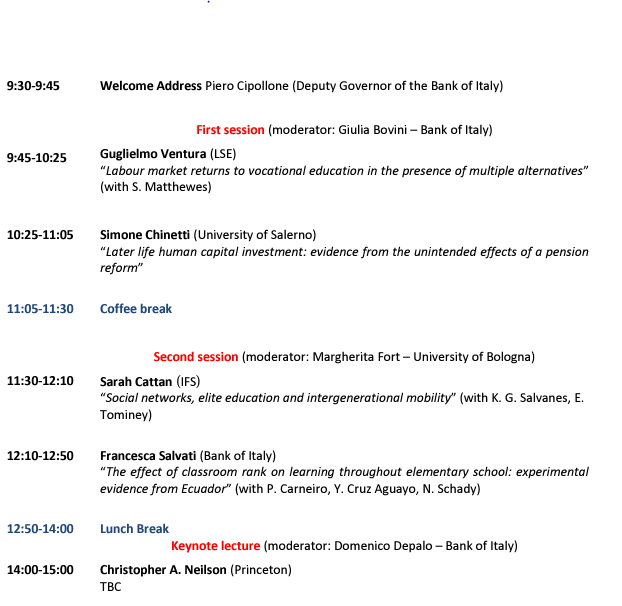
To attend, in-person or online, write before Friday 18th March to: human_capital@bancaditalia.it. Please notice that seats for in-presence attendance are limited, and they will be given out on a first come, first served basis.
The event is co-organized by GLO Fellow Domenico Depalo.
A new GLO Discussion Paper finds thatconsumption declines with greater economic insecurity, and that this decline is greater for those with high risk aversion, but smaller the more necessary the consumption items are.
Author Abstract: The prudence theory predicts that economic insecurity reduces all consumption expenditures. We question this prediction by estimating the effect of economic insecurity on various expenditure items using an Australian longitudinal data set (HILDA) and panel regressions. Our results confirm that total consumption declines in response to greater economic insecurity and that this decline is greater for those with high risk aversion. However, we observe a clear gradient related to the degree of necessity of goods and services: the more necessary the consumption items, the weaker the effect of insecurity.
The Global Labor Organization (GLO) is an independent, non-partisan and non-governmental organization that functions as an international network and virtual platform to stimulate global research, debate and collaboration.
Author Abstract: This paper is among the firsts to investigate the impact of overeducation and overskilling on workers’ wages using a unique pan-European database covering twenty-eight countries for the year 2014, namely the CEDEFOP’s European Skills and Jobs (ESJ) survey. Overall, the results suggest a wage penalty associated with overeducation. When interacting educational mismatch with skills mismatch into apparent overeducation and genuine overeducation, the results suggest that the highest wage penalty is reached for workers that are both overeducated and overskilled.
The Global Labor Organization (GLO) is an independent, non-partisan and non-governmental organization that functions as an international network and virtual platform to stimulate global research, debate and collaboration.
Author Abstract: The public sector plays a large role in many developing economies, but its effect on earnings inequality dynamics has not been widely studied. In this paper, we investigate the earnings inequality trends and their determinants in the decades before and after the Tunisian Revolution, focusing on the impact of public wage and employment policy changes. A recentered-influence function (RIF) decomposition is performed to decompose the change in earnings into wage structure and composition effects and to assess the contribution of various determinants of inequality change. We find that earnings inequality decreased significantly during the period of investigation in Tunisia, mainly due to the decrease in the public-private wage gap and in sector wage gaps on the demand side, and the decreasing education premia on the supply side. The increase in marginal returns to average routine-task intensity jobs, the falling return to experience, and the decreasing regional wage gap also contributed to declining earnings inequality, but to a lesser extent.
The Global Labor Organization (GLO) is an independent, non-partisan and non-governmental organization that functions as an international network and virtual platform to stimulate global research, debate and collaboration.
A new GLO Discussion Paper studies how those fare on the labor market whose parents do not have university degrees to find a wage penalty for females but not for males.
Author Abstract: We examine how first in family (FiF) graduates (those whose parents do not have university degrees) fare on the labor market. We find that among women, FiF graduates earn 7.4% less on average than graduate women whose parents have a university degree. For men, we do not find a FiF wage penalty. A decomposition of the wage difference between FiF and non-FiF graduates reveals two interesting findings. First, two-thirds of the female FiF penalty are explained by certain characteristics, including: having lower attainment in school, attending an elite university, selecting particular degree courses, working in smaller firms, working in jobs that do not require their degree, and motherhood. Second, FiF graduate men also differ in their endowments from non-FiF graduate men; however, FiF men earn higher returns on their endowments than non-FiF men and thus compensate for their relative social disadvantage, while FiF women do not. We also estimate the returns to graduation for potential FiF and non- FiF young people. We find that the wage returns to graduation are not lower among FiF graduates compared to those who match their parents with a degree. The effects of coming from a lower educated family are large and positive for men and large and negative for women in general, irrespective of graduation. We provide some context, offer explanations, and suggest implications of these findings.
The Global Labor Organization (GLO) is an independent, non-partisan and non-governmental organization that functions as an international network and virtual platform to stimulate global research, debate and collaboration.
GLO Research and Policy Clusters are thematic areas of research, research collaboration, evidence-based policy advice and dissemination of the GLO global network and virtual platform. Initiated and led by GLO Fellows the GLO Clusters address specific topics in research and challenges for policy, businesses and society within the GLO focus on global labor markets, demographic challenges and human resources. In line with the GLO’s philosophy the GLO clusters live through the initiative, active involvement and collaborative contributions of the GLO network.
GLO has established three new research clusters. and appointed the responsible cluster heads. For more details about research focus and the Cluster Leads see:
All three have already strongly contributed to GLO activities in the past, and will continue and extend their leadership in collaboration with the GLO network and the GLO Board.
Author Abstract: Population Economics (PopEc) covers a number of topics in Economics, as well as in Demography, Labor Studies, Sociology, etc. For example, the economic determinants of population change and demographic behavior covers topics such as household formation, marriage and divorce, fertility, gender, child bearing, schooling, access to labor markets, migration, well-being, and ageing and mortality, among others. In this paper, we analyze the production and networks of a total of 6,472 authors who have published 5,070 papers in Population Journals (indexed in SSCI of WOS) between January 1969 and January 2021 (Journal of Population Economics, Journal of Human Resources, Feminist Economics, the Review of Economics of the Household, the Journal of Demographic Economics, Demography, Population and Development Review, and the European Journal of Population). Using the Impact Factor (IF) of these journals corresponding to the year of publication, our results first identify the academic leaders among those authors, as well as other results in terms of communities. Results reveal that the largest community is led by the sociologist Trude Lappegard, with the community led by the economist Hans-Peter Kohler as a close second. The latter community includes the most prolific author, the economist Samuel H. Preston. Additionally, we note that collaborations among these authors are very rare, with only their neighborhoods collaborating.
The Global Labor Organization (GLO) is an independent, non-partisan and non-governmental organization that functions as an international network and virtual platform to stimulate global research, debate and collaboration.
A new GLO Discussion Paper finds that when partners worked onsite, mothers and fathers working from home spent more time on childcare, especially mothers, compared to those on-site; fathers spent more time on household chores. However, only mothers’ total unpaid and paid work burden was higher.
Author Abstract: In 2020, parents’ work-from-home days increased fourfold following the initial COVID-19 pandemic lockdown period compared to 2015-2019. At the same time, many daycares closed, and the majority of public schools offered virtual or hybrid classrooms, increasing the demand for household-provided childcare. Using time diaries from American Time Use Survey (ATUS) and looking at parents in dual-earner couples, we examine parents’ weekday workday time allocated to paid work, chores, and childcare in the COVID-19 era by the couple’s joint work location arrangements. We determine the work location of the ATUS respondent directly from their diary and proxy the partner’s work-from-home status using the share of workers reporting work from home in their occupation. When their partners worked onsite, mothers and fathers working from home spent more time on childcare, especially mothers, compared to those on-site; fathers spent more time on household chores. However, only mothers’ total unpaid and paid work burden was higher. In the fall, fathers working from home worked substantially fewer paid hours and spent even more time on household production. When both parents worked from home compared to both worked on-site, mothers and fathers working from home worked roughly equally fewer paid hours and did more secondary childcare, though fathers did more household production, suggesting they shared the increased work burden resulting from the pandemic more equally. However, in the fall, only mothers did more childcare when both worked from home. We also find that mothers spread their work throughout the day when working from home.
The Global Labor Organization (GLO) is an independent, non-partisan and non-governmental organization that functions as an international network and virtual platform to stimulate global research, debate and collaboration.
Interested researchers are cordially invited to submit their abstracts or papers for presentation consideration. The 39th EBES Conference in Rome will take place on April 6-8, 2022 in Hybrid Mode (online and in-person). The event is supported by the Istanbul Economic Research Association and hosted by the Faculty of Economics Sapienza, University of Rome. GLO & EBES are collaborating organizations; GLO President Klaus F. Zimmermann is also President of EBES.
Featured image: david-kohler-VFRTXGw1VjU-unsplash
Invited Speakers
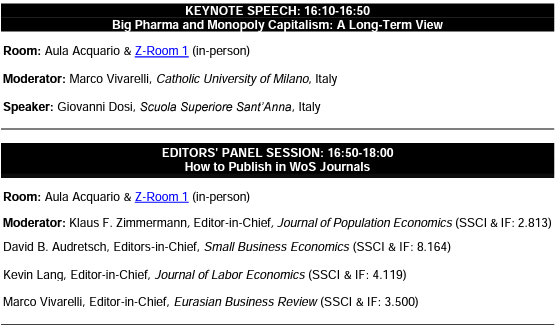
EBES is pleased to announce that distinguished colleagues David B. Audretsch, Giovanni Dosi, Kevin Lang, Keun Lee, Marco Vivarelli and Klaus F. Zimmermann will participate as keynote speakers and/or invited editors.
David Bruce Audretsch is an American economist. He is a distinguished professor at the School of Public and Environmental Affairs (SPEA) at Indiana University and also serves as director of the SPEA International Office, Ameritech Chair of Economic Development, and director of SPEA’s Institute for Development Strategies (IDS). He is co-founder and co-editor of Small Business Economics: An Entrepreneurship Journal, and also works as a consultant to the United Nations, the World Bank, the OECD, the EU Commission, and the U.S. Department of State. He was the Director of the Entrepreneurship, Growth and Public Policy Group at the Max Planck Institute of Economics in Germany from 2003 to 2009.[2] Since 2020, he also serves as a Distinguished Professor in the Department of Innovation Management and Entrepreneurship at the University of Klagenfurt. Audretsch is a member of the advisory board to a number of international research and policy institutes, including chair of the German Institute for Economic Research in Berlin, chair of the Foundation for the Promotion of German Science (Stifterverband für die Deutsche Wissenschaft), New York Academy of Sciences, the Swedish Entrepreneurship Forum, and the Jackstädt Centre for Entrepreneurship in Wuppertal, Germany. He has received honorary doctorate degrees from Jonköping University in Sweden and University of Augsburg in Germany. He is an honorary professor of Industrial Economics and Entrepreneurship at the WHU – Otto Beisheim School of Management in Germany. In addition, Audretsch serves as a visiting professor at the King Saud University in Saudi Arabia, honorary professor at the University of Jena in Germany, and is a research fellow of the Centre for Economic Policy Research in London. He was awarded the 2011 Schumpeter Prize from the University of Wuppertal and the 2001 Global Award for Entrepreneurship Research by the Swedish Foundation for Small Business Research.
Giovanni Dosi is Professor of Economics and Director of the Institute of Economics at the Scuola Superiore Sant’Anna in Pisa. He is the Co-Director of the task forces “Industrial Policy” and “Intellectual Property” at the Initiative for Policy Dialogue at Columbia University. Dosi is Continental European Editor of Industrial and Corporate Change. Included in ISI Highly Cited Researchers. His major research areas, where he is author and editor of several works, include economics of innovation and technological change, industrial organization and industrial dynamics, theory of the firm and corporate governance, evolutionary theory, economic growth and development. A selection of his works has been published in two volumes: Innovation, Organization and Economic Dynamics. Selected Essays, Cheltenham, Edward Elgar, 2000; and Economic Organization, Industrial Dynamics and Development: Selected Essays, Cheltenham, Edward Elgar, 2012.
Kevin Lang is a professor of economics at Boston University. He is also an elected Fellow of the Society of Labor Economists and a research associate of the National Bureau of Economic Research (NBER). He is the author of Poverty and Discrimination and over 100 papers and articles on topics in Labor Economics. Lang received his BA in philosophy, politics and economics (PPE) from Oxford University, his MSc in economics from the University of Montreal, and his PhD in economics from the Massachusetts Institute of Technology in 1982. He went on to become an assistant professor at the University of California, Irvine, and he spent a year serving as an Olin Foundation Fellow at the NBER. In 1987, he joined the faculty at Boston University, where he served as chair of the economics department from 2005 to 2009. His recent research has focused on the economics of labor markets and education, including topics such as discrimination, unemployment, the relation between education and earnings, and the relation between housing prices, taxes and local services.
Keun Leeis a Professor of Economics at the Seoul National University, and the winner of the 2014 Schumpeter Prize for his monograph on Schumpeterian Analysis of Economic Catch-up (2013 Cambridge Univ. Press). He is an editor of Research Policy, an associate editor of Industrial and Corporate Change, and a council member of the World Economic Forum since 2016. He served as the President of the International Schumpeter Society (2016- 18), a member of the Committee for Development Policy of UN (2014-18). He obtained Ph.D. in economics from the University of California, Berkeley. One of his most cited articles is a paper on Korea’s Technological Catch-up published in Research Policy, with 1,275 citations (Google Scholar). His H-index is now 44 with 114 papers with more than 10 citations. He has a new book entitled as The Art of Economic Catch-up: barriers, detours, and leapfrogging, which will be published by the Cambridge Univ. Press, March 2019. editor of Industrial and Corporate Change, and a council member of the World Economic Forum since 2016. He served as the President of the International Schumpeter Society (2016- 18), a member of the Committee for Development Policy of UN (2014-18). He obtained Ph.D. in economics from the University of California, Berkeley. One of his most cited articles is a paper on Korea’s Technological Catch-up published in Research Policy, with 1,275 citations (Google Scholar). His H-index is now 44 with 114 papers with more than 10 citations. He has a new book entitled as The Art of Economic Catch-up: barriers, detours, and leapfrogging, which will be published by the Cambridge Univ. Press, March 2019.
Marco Vivarelliis a full professor at the Catholic University of Milano, where he is also Director of the Institute of Economic Policy. He is Professorial Fellow at UNU-MERIT, Maastricht; Research Fellow at IZA; Fellow of the Global Labor Organization (GLO). He is member of the Scientific Executive Board of the Eurasia Business and Economics Society (EBES); member of the Scientific Advisory Board of the Austrian Institute of Economic Research (WIFO, Vienna) and has been scientific consultant for the International Labour Office (ILO), World Bank (WB), the Inter-American Development Bank (IDB), the United Nations Industrial Development Organization (UNIDO) and the European Commission. He is Editor-in-Chief of the Eurasian Business Review, Editor of Small Business Economics, Associate Editor of Industrial and Corporate Change, Associate Editor of Economics EJournal, member of the Editorial Board of Sustainability and he has served as a referee for more than 70 international journals. He is author/editor of various books and his papers have been published in journals such as Cambridge Journal of Economics, Canadian Journal of Economics, Economics Letters, Industrial and Corporate Change, International Journal of Industrial Organization, Journal of Economics, Journal of Evolutionary Economics, Journal of Productivity Analysis, Labour Economics, Oxford Bulletin of Economics and Statistics, Regional Studies, Research Policy, Small Business Economics, Southern Economic Journal, World Bank Research Observer, and World Development. His current research interests include the relationship between innovation, employment, and skills; the labor market and income distribution impacts of globalization; the entry and post-entry performance of newborn firms.
Klaus F. Zimmermann is President of EBES; President of the Global Labor Organization (GLO); Co-Director of POP at UNU-MERIT; Full Professor of Economics at Bonn University (ret.); Honorary Professor, Maastricht University, Free University of Berlin, Renmin University of China and Lixin University; Member, German Academy of Sciences Leopoldina, Regional Science Academy, and Academia Europaea. Among others, he has worked at Macquarie University, the Universities of Melbourne, Princeton, Harvard, Munich, Kyoto, Mannheim, Dartmouth College and the University of Pennsylvania. Research Fellow of the Centre for Economic Policy Research (CEPR) and Fellow of the European Economic Association (EEA). Editor-in-Chief of the Journal of Population Economics. Editorial Board of International Journal of Manpower, Research in Labor Economics and Comparative Economic Studies, among others. Founding Director, Institute for the Study of Labor (IZA); Past-President, German Institute for Economic Research (DIW). Distinguished John G. Diefenbaker Award 1998 of the Canada Council for the Arts; Outstanding Contribution Award 2013 of the European Investment Bank. Rockefeller Foundation Policy Fellow 2017; Eminent Research Scholar Award 2017, Australia; EBES Fellow Award 2018. He has published in many top journals including Journal of Economic Perspectives, American Economic Review, Econometrica, Journal of the European Economic Association, Journal of Human Resources, Journal of Applied Econometrics, Public Choice, Review of Economics and Statistics, Journal of Population Economics and Journal of Public Economics. His research fields are population, labor, development, and migration.
Executive Board
Prof. Klaus F. Zimmermann, UNU-MERIT, Maastricht, and Free University Berlin Prof. Jonathan Batten, University Utara Malaysia, Malaysia Prof. Iftekhar Hasan, Fordham University, U.S.A. Prof. Euston Quah, Nanyang Technological University, Singapore Prof. John Rust, Georgetown University, U.S.A. Prof. Dorothea Schäfer, German Institute for Economic Research DIW Berlin, Germany Prof. Marco Vivarelli, Università Cattolica Del Sacro Cuore, Italy
Abstract/Paper Submission
Authors are invited to submit their abstracts or papers no later than March 10, 2022.
General inquiries regarding the call for papers should be directed to ebes@ebesweb.org.
Publication Opportunities
Qualified papers can be published in EBES journals (Eurasian Business Review and Eurasian Economic Review) or EBES proceedings books after a peer review process without any submission or publication fees. EBES journals (EABR and EAER) are published by Springer and both are indexed in the SCOPUS, EBSCO EconLit with Full Text, Google Scholar, ABS Academic Journal Quality Guide, CNKI, EBSCO Business Source, EBSCO Discovery Service, ProQuest International Bibliography of the Social Sciences (IBSS), OCLC WorldCat Discovery Service, ProQuest ABI/INFORM, ProQuest Business Premium Collection, ProQuest Central, ProQuest Turkey Database, ProQuest-ExLibris Primo, ProQuest-ExLibris Summon, Research Papers in Economics (RePEc), Institute of Scientific and Technical Information of China, Naver, SCImago, ABDC Journal Quality List, Cabell’s Directory, and Ulrich’s Periodicals Directory. In addition, while EAER is indexed in the Emerging Sources Citation Index (Clarivate Analytics), EABR is indexed in the Social Science Citation Index (SSCI) and Current Contents / Social & Behavioral Sciences.
Also, all accepted abstracts will be published electronically in the Conference Program and the Abstract Book (with an ISBN number). It will be distributed to all conference participants at the conference via USB. Although submitting full papers are not required, all the submitted full papers will also be included in the conference proceedings in a USB.
After the conference, participants will also have the opportunity to send their paper to be published (after a refereeing process managed by EBES) in the Springer’s series Eurasian Studies in Business and Economics (no submission and publication fees). This is indexed by Scopus. It will also be sent to Clarivate Analytics in order to be reviewed for coverage in the Conference Proceedings Citation Index – Social Science & Humanities (CPCI-SSH). Please note that the 10th, 11th, 12th, 13th, 14th, 15th, 16th, 17th, 18th, 19th, 20th (Vol. 2), 21st, 24th, and 25th EBES Conference Proceedings are accepted for inclusion in the Conference Proceedings Citation Index – Social Science & Humanities (CPCI-SSH). Other conference proceedings are in progress.
Conference Date: April 6-8, 2022 Abstract Submission Deadline: March 10, 2022 Reply-by: March 11, 2022* Registration Deadline: March 14, 2022 Announcement of the Program: March 19, 2022 Paper Submission Deadline (Optional): March 16, 2022** Paper Submission for the EBES journals: July 15, 2022
* The decision regarding the acceptance/rejection of each abstract/paper will be communicated with the corresponding author within a week of submission.
** Completed paper submission is optional. If you want to be considered for the Best Paper Award or your full paper to be included in the conference proceedings in the USB, after submitting your abstract before March 10, 2022, you must also submit your completed (full) paper by March 16, 2022.
Contact
Ugur Can, Director of EBES (ebes@ebesweb.org) Dr. Ender Demir, Conference Coordinator of EBES (demir@ebesweb.org)
After registering, you will receive a confirmation email containing information about joining the meeting.
The event is jointly organized by Global Labor Organization (GLO), the Journal of Population Economics (JOPE) and POP @ UNU-MERIT.
The event is chaired by Klaus F. Zimmermann (President of GLO, Editor-in-Chief of JOPE, and Co-Director of POP)
Oded Galor speaks about his new book just published with Penguin Random House in twenty-eight languages worldwide. It is released on March 22 in the USA and on April 7 in the UK.
Further details on the book (see also below) and how it can be purchased: USA-LINK —– UK-LINK
He is Herbert H. Goldberger Professor of Economics at Brown University and the founding thinker behind Unified Growth Theory, which seeks to uncover the fundamental causes of development, prosperity and inequality over the entire span of human history. He is also the Editor-in-Chief of the Journal of Economic Growth and an Editor of the Journal of Population Economics.
In a captivating journey from the dawn of human existence to the present, world-renowned economist and thinker Oded Galor offers an intriguing solution to two of humanity’s great mysteries.
Why are humans the only species to have escaped – only very recently – the subsistence trap, allowing us to enjoy a standard of living that vastly exceeds all others? And why have we progressed so unequally around the world, resulting in the great disparities between nations that exist today? Immense in scope and packed with astounding connections, Galor’s gripping narrative explains how technology, population size, and adaptation led to a stunning “phase change” in the human story a mere two hundred years ago. But by tracing that same journey back in time and peeling away the layers of influence – colonialism, political institutions, societal structure, culture – he arrives also at an explanation of inequality’s ultimate causes: those ancestral populations that enjoyed fruitful geographical characteristics and rich diversity were set on the path to prosperity, while those that lacked it were disadvantaged in ways still echoed today.
As we face ecological crisis across the globe, The Journey of Humanity is a book of urgent truths and enduring relevance, with lessons that are both hopeful and profound: gender equality, investment in education, and balancing diversity with social cohesion are the keys not only to our species’ thriving, but to its survival.
A new GLO Discussion Paper finds that the immigrant-native gap in risk preferences has widened for recent immigration cohorts, while for time preferences the gap remains large.
Author Abstract: We present new descriptive evidence on the immigrant-native gap in risk and time preferences in Germany, one of the most preferred host countries for immigration. Using the recent waves of the Socio-Economic Panel (SOEP) dataset, we find that the immigrant-native gap in risk preferences has widened for recent immigration cohorts, especially around the 2015 European Refugee Crisis. We attribute the recent widening to decreased assimilation rates of new immigrants caused by a reduced integration due to sudden increases in immigrants flows from culturally diverse parts of the world, particularly around the year 2015. We also find that the immigrant-native gap varies across different migrant groups: “Opportunity seekers”, which we define as economic immigrants who intend to stay in Germany only temporarily, are very similar in their risk preferences to natives. Other immigrants, however, are substantially more risk-averse than natives. A smaller gap in risk preferences is also found among migrants who are female, highly educated, proficient in the host language, self-employed and working in predominantly high-skilled jobs. Concerning time preferences, although a noticeably large immigrant-native gap is evident, the gap is not found to vary across most individual-level socio-economic variables.
The Global Labor Organization (GLO) is an independent, non-partisan and non-governmental organization that functions as an international network and virtual platform to stimulate global research, debate and collaboration.
A new GLO Discussion Paper finds that it matters, and there is a more intense screening of migrants by licensing institutions than by certification and unionization.
Author Abstract: We study how licensing, certification and unionisation affect the wages of natives and migrants and their representation among licensed, certified, and unionized workers. We provide evidence of a dual role of labor market institutions, which both screen workers based on unobservable characteristics and also provide them with wage setting power. Labor market institutions confer significant wage premia to native workers (3.9, 1.6, and 2.7 log points for licensing, certification, and unionization respectively), due to screening and wage setting power. Wage premia are significantly larger for licensed and certified migrants (10.2 and 6.6 log points), reflecting a more intense screening of migrant than native workers. The representation of migrants among licensed (but not certified or unionized) workers is 14% lower than that of natives. This implies a more intense screening of migrants by licensing institutions than by certification and unionization.
The Global Labor Organization (GLO) is an independent, non-partisan and non-governmental organization that functions as an international network and virtual platform to stimulate global research, debate and collaboration.
Author Abstract:Purpose: This paper aims to contribute to understanding of the effects of active political engagement in port-of-entry jobs and employment pathways for graduate students. The data are derived from a structured survey of a small local labour market where political clientelism is pronounced due to the strong network ties. Controlling for both demand and supply factors we identify a profile for those who are more prone to engage politically in exchange for public sector jobs, which are in turn vulnerable to regime changes. Design/methodology/approach: We use data from a sample of 191 participants that records month-tomonth employment states for three consecutive years (2012-2014). The method attempts to replicate an experimental design with repeated measures before and after the June 2013 government elections. The data is analysed using sequence analysis with optimal matching and difference-in-difference methods. Findings: The analysis provides evidence of links between political engagement and selection onto different employment pathways. The pathways themselves are also shown to be differentially impacted by the 2013 election (positively or negatively). Together, these results are supportive of claims that jobs in Albania, particularly those in the public sector, are linked to the short-term presence of vote-buying and the political business cycle. This is shown to be the case even for this sample of educated members of the labour force (i.e. university graduates). The analysis also finds evidence of accumulative disadvantages over time, in relation to subjective perceptions of life satisfaction, migration intentions, employability and success in life, as a result of active political engagement. Originality: The study uses a unique data set and a novel methodology, sequence analysis. Occupational history calendars were used to capture quantitative information recording detailed work histories. To the best of our knowledge, this innovative method has not been used before to measure the temporal effects of political engagement on employment pathways.
The Global Labor Organization (GLO) is an independent, non-partisan and non-governmental organization that functions as an international network and virtual platform to stimulate global research, debate and collaboration.
Author Abstract: The COVID-19 pandemic has posed challenges to emotional well-being of individuals. With 1582 respondents from the Health and Retirement Survey (HRS), this study investigates the heterogeneity in older adults’ vulnerability and examines the relationship between vulnerability types, aging attitudes and emotional responses. International Positive and Negative Affect Schedule Short-form (I-PANAS-SF) and Attitudes toward own aging (ATOT) were used to assess the emotional experiences and aging attitudes, and 14 types of pandemic-related deprivations evaluated individuals’ vulnerability. Latent class analysis was used to explore the vulnerability types, and weighted linear regressions examined the relationship between vulnerability, aging attitudes and emotional responses. Results showed that the proportion for individuals with mild vulnerability (MV), health care use vulnerability (HV), and dual vulnerability in health care use and finances (DVs) was 67%, 22%, and 11%, respectively. Older adults aged below 65, Hispanics and non-Hispanic Blacks, and those not eligible for Medicaid were more likely to have HV or DVS. The relationship between vulnerability and positive emotions was insignificant, yet individuals with HV (beta=0.10, SE=0.16) or DVs (beta=0.09, SE=0.28) were likely to have more negative emotions than their mildly vulnerable counterparts. Furthermore, aging attitudes moderated the relationship between vulnerability and emotions. Encouraging positive aging attitudes might be helpful for older adults to have better emotional well-being, especially for those with DVs.
The Global Labor Organization (GLO) is an independent, non-partisan and non-governmental organization that functions as an international network and virtual platform to stimulate global research, debate and collaboration.
Author Abstract: This study examines how instant online video sharing affects artists’ musical streams during the pandemic. On average, the use of the TikTok app significantly increases artists’ streams, by approximately 5%. This increase is even higher for male, European and dj Mag 2020 new entry artists.
The Global Labor Organization (GLO) is an independent, non-partisan and non-governmental organization that functions as an international network and virtual platform to stimulate global research, debate and collaboration.
A new GLO Discussion Paper using the 1940 US census finds that the concentration of naturalized co-ethnics in the network positively affected individual naturalization operating mainly through information dissemination.
Author Abstract: This paper investigates the causal pathways through which ethnic social networks influence individual naturalization. Using the complete-count Census of 1930, we digitize information on the exact residence of newly arrived immigrants in New York City. This allows us to define networks with a granularity detail that was not used before for historical data – the Census block – and therefore to overcome issues of spatial sorting. By matching individual observations with the complete-count Census of 1940, we estimate the impact that the exogenous fraction of naturalized co-ethnics in the network observed in 1930 has on the probability of immigrants to acquire citizenship a decade later. Our results indicate that the concentration of naturalized co-ethnics in the network positively affects individual naturalization and that this relationship operates through one main channel: information dissemination. Indeed, immigrants who live among naturalized co-ethnics are more likely to naturalize because they have greater access to critical information about the benefits and procedures of naturalization.
The Global Labor Organization (GLO) is an independent, non-partisan and non-governmental organization that functions as an international network and virtual platform to stimulate global research, debate and collaboration.
A new GLO Discussion Paper finds that some personality traits reduce the probability of overeducation, suggesting complementarity between cognitive and non-cognitive skills.
Author Abstract: In this study, we find that the negative effect of unexploded ordnance (UXO) on the geographical density of foreign direct investment and large firms is a new channel through which the war legacy impedes local development in Vietnam. A 1% increase in the proportion of UXO-contaminated area leads to a 0.78% relative decrease in the density of FDI firms within districts. Point estimates for the elasticity of the density of joint-venture FDI firms and state-owned enterprise (SOEs) due to UXO are smaller, equal to -0.56 and -0.54. Consequently, a 1% increase in the proportion of UXO-contaminated areas leads to a 0.46% relative decrease in the intensity of nighttime light.
The Global Labor Organization (GLO) is an independent, non-partisan and non-governmental organization that functions as an international network and virtual platform to stimulate global research, debate and collaboration.
A new GLO Discussion Paper finds for Vietnam that unexploded ordnance has negative effects on the geographical density of foreign direct investment and large firms and hinders development.
Author Abstract: In this study, we find that the negative effect of unexploded ordnance (UXO) on the geographical density of foreign direct investment and large firms is a new channel through which the war legacy impedes local development in Vietnam. A 1% increase in the proportion of UXO-contaminated area leads to a 0.78% relative decrease in the density of FDI firms within districts. Point estimates for the elasticity of the density of joint-venture FDI firms and state-owned enterprise (SOEs) due to UXO are smaller, equal to -0.56 and -0.54. Consequently, a 1% increase in the proportion of UXO-contaminated areas leads to a 0.46% relative decrease in the intensity of nighttime light.
The Global Labor Organization (GLO) is an independent, non-partisan and non-governmental organization that functions as an international network and virtual platform to stimulate global research, debate and collaboration.
A new GLO Discussion Paper finds for Belgium that over-educated native workers are in fact underpaid to a greater extent than their over-educated immigrant counterparts.
Author Abstract: We provide first evidence of the impact of over-education, among natives and immigrants, on firm-level productivity and wages. We use Belgian linked panel data and rely on the methodology from Hellerstein et al. (1999) to estimate ORU (over-, required, and under-education) equations aggregated at the firm level. Our results show that the over-education wage premium is higher for natives than for immigrants. However, since the differential in productivity gains associated with over-education between natives and immigrants outweighs the corresponding wage premium differential, we conclude – based on OLS and dynamic GMM-SYS estimates – that over-educated native workers are in fact underpaid to a greater extent than their over-educated immigrant counterparts. This conclusion is refined by sensitivity analyses, when testing the role of immigrants’ background (e.g. region of birth, immigrant generation, age at arrival in the host country, tenure).
The Global Labor Organization (GLO) is an independent, non-partisan and non-governmental organization that functions as an international network and virtual platform to stimulate global research, debate and collaboration.
Peace NOW in Europe: GLO is committed to a peaceful, collaborative world. The current tragedy in Europe marks some of the darkest days on this continent since WWII. We deeply feel with the people and express the strongest solidarity. The world has changed dramatically. With the huge global long-term implications of this conflict, globalization, international understanding and collaborations remain key for the future wellbeing of the world. We need to strongly continue our efforts.
Author Abstract: The study utilises the International Labor Organization’s SMEs COVID-19 pandemic business risks scale to determine whether Artificial Intelligence (AI) applications are associated with reduced business risks for SMEs. A new 10-item scale was developed to capture the use of AI applications in core services such as marketing and sales, pricing and cash flow. Data were collected from 317 SMEs between April and June 2020, with follow-up data gathered between October and December 2020 in London, England. AI applications to target consumers online, offer cash flow forecasting and facilitate HR activities are associated with reduced business risks caused by the COVID-19 pandemic for both small and medium enterprises. The study indicates that AI enables SMEs to boost their dynamic capabilities by leveraging technology to meet new types of demand, move at speed to pivot business operations, boost efficiency and thus, reduce their business risks.
The Global Labor Organization (GLO) is an independent, non-partisan and non-governmental organization that functions as an international network and virtual platform to stimulate global research, debate and collaboration.
Author Abstract: This paper develops a model that allows for heterogenous contemporaneous peer effects among different types of agents who are endogenously selected into different peer groups. Using our framework, we characterize the reduced-form coefficient in the peer effect literature and show that it is a priori ambiguous in sign. We apply our approach to migrant and local students in Shanghai, where local students all go to public schools, but migrant students are endogenously selected into either public schools or lower-quality private schools. The results suggest large contemporaneous peer effects among all student groups. We conduct policy experiments to examine the effect of transferring migrant students from private schools to public schools. We show that peer effect can be substantially more important than the school effect in accounting for the total treatment effect of moving to better schools.
The Global Labor Organization (GLO) is an independent, non-partisan and non-governmental organization that functions as an international network and virtual platform to stimulate global research, debate and collaboration.
Author Abstract: This paper surveys the emerging economics literature on the relationship between employee training and firm performance. Most studies find very high returns to training, at least from the perspective of firms, indicating that the costs of training can be recouped in short periods of time. These results follow from different identification approaches, including randomised control trials. The training provided is typically of a general nature, which is consistent with employers’ labour market power. Several areas for future research are also proposed, including the role of labour market institutions in promoting training and the extent to which the productivity effects of training are shared with employees.
The Global Labor Organization (GLO) is an independent, non-partisan and non-governmental organization that functions as an international network and virtual platform to stimulate global research, debate and collaboration.
The new GLO Discussion Paper studies the effects of two training programs for particularly vulnerable groups including recent migrants, refugees, and women.
Author Abstract: This paper evaluates the impact on employment probabilities of two training programs funded by the European Social Fund in the province of Bolzano, Italy. The programs were addressed to particularly vulnerable groups which were much less skilled and educated than the control group from the public employment agency registers. A large share of the benefit recipients are indeed recent migrants, refugees, and women. By using different matching algorithms, this group was made as similar as possible to the control group, at least in terms of observed characteristics, including the employment status up to two years before entering the programme. We find that the short-term impact of the training programs is negative, highlighting the presence of a lock-in effect. However, from the start of the programs, up to the 13th month, this effect reduced to nihil. The effect is particularly sizeable and statistically significant for women, migrants, and the highly educated; age does not seem to matter. However, our findings suggest that the programs were especially significant in empowering women and migrants. By providing them with basic skills, including linguistic and technical professional skills, increased their integration by making them seek jobs more actively.
The Global Labor Organization (GLO) is an independent, non-partisan and non-governmental organization that functions as an international network and virtual platform to stimulate global research, debate and collaboration.
Author Abstract: We study the short-run effects of a gamified online entrepreneurship training offered to high school students in Rwanda during the COVID-19 pandemic. Using a randomized controlled trial, we estimate sizeable effects of the 6-week training on entrepreneurial activity. One month after the training, participants in schools offered the training were much more likely to own a business than participants in control schools. The training induced students to participate more actively in their school’s business club, to undertake more business-oriented actions, to improve their business practices, and to interact more with other youth and family members about their business ideas. We hypothesize that the training might have motivated treated students to sustain their business activities during the COVID-19 crisis.
The Global Labor Organization (GLO) is an independent, non-partisan and non-governmental organization that functions as an international network and virtual platform to stimulate global research, debate and collaboration.