Author Abstract: This paper evaluates if and to what extend the risk of becoming Not in Employment, Education or Training (NEET) has worsened during the Covid-19 pandemic in Italy. The analysis is based on a unique dataset from the merging of two sample surveys, the Italian Labor Force Survey and the Institutional Quality Index dataset. We find that the probability of being NEET significantly increased during the pandemic, but heterogeneously between age cohorts and geographical areas. The most affected categories have been young people (aged 25-34) and those living in North-West regions. Females are mostly affected compared to males, especially those experiencing motherhood and living in a Southern province. Investment in education reduces the NEET status, mainly for age-group 25-34 in the South. Participation in the civil society significantly reduces the probability to being NEET. Finally, active policies conducted at regional level are a further educational investment that protect from becoming NEET, although their effectiveness is not significant in the Southern regions. We provide novel evidence to inform policymakers and help building evidence-based policies, tailored on local needs.
The Global Labor Organization (GLO) is an independent, non-partisan and non-governmental organization that functions as an international network and virtual platform to stimulate global research, debate and collaboration.
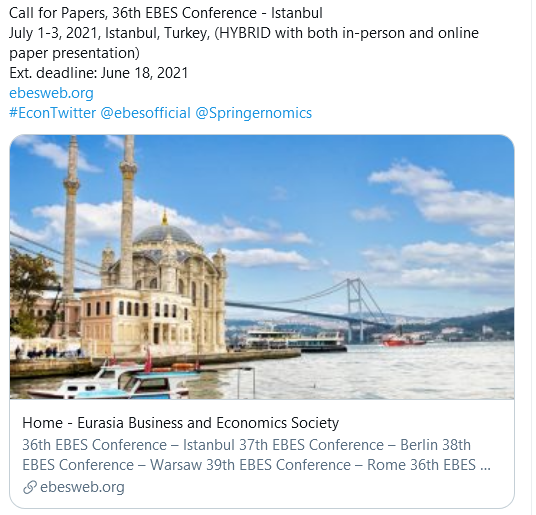
The 36th EBES Conference in Istanbul will take place on July 1st, 2nd, and 3rd, 2021 in Hybrid Mode.This is aGLO supported event. EBESis theEurasia Business and Economics Society, a strategic partner and institutional supporter of GLO. GLO President Klaus F. Zimmermann is also President of EBES.(Invited speakers see below)
The conference includes a GLO Handbook Session on “Worker Representation, Labor-Management Relations and Labor Standards” organized and chaired by Uwe Jirjahn (University of Trier and GLO), who is a Section Editor of the Handbook. The event takes place on July 2, 3.50-5.50 pm, Istanbul time.
GLO Handbook Session: Worker Representation, Labor-Management Relations and Labor Standards
Decent Work and the Quality of Work and Employment Francis Green (University College London and GLO)
Union Membership and Collective Bargaining: Trends and Determinants Claus Schnabel (Universität Erlangen Nürnberg)
Unions, Worker Participation and Worker Well-Being Benjamin Artz (University of Wisconsin-Oshkosh and GLO) and John S. Heywood (University of Wisconsin-Milwaukee and GLO)
Worker Voice and Political Participation in Civil Society John Budd (University of Minnesota and GLO) and Ryan Lamare (University of Illinois and GLO)
Works Councils Jens Mohrenweiser (Bournemouth University)
Board-Level Worker Representation Aleksandra Gregoric (Copenhagen Business School)
Invited Speakersof EBES 36
EBES is pleased to announce that distinguished colleagues Barry Eichengreen, Narjess Boubakri, Klaus F. Zimmermann and Jonathan Batten will join the conference as the keynote speakers and/or invited editors.
Barry Eichengreen is the George C. Pardee and Helen N. Pardee Professor of Economics and Professor of Political Science at the University of California, Berkeley, where he has taught since 1987. He is a Research Associate of the National Bureau of Economic Research (NBER) and Research Fellow of the Centre for Economic Policy Research (CEPR). He worked as Senior Policy Advisor at the IMF. He is a regular monthly columnist for Project Syndicate. His books include The Populist Temptation: Economic Grievance and Political Reaction in the Modern Era (2018), How Global Currencies Work: Past, Present, and Future, with Livia Chitu and Arnaud Mehl, (2017), The Korean Economy: From a Miraculous Past to a Sustainable Future (Harvard East Asian Monographs) with Wonhyuk Lim, Yung Chul Park and Dwight H. Perkins, (2015), Renminbi Internationalization: Achievements, Prospects, and Challenges, co-edited with Masahiro Kawai, (2015), Hall of Mirrors: The Great Depression, The Great Recession, and the Uses-and Misuses-of History, (2015). He was awarded the Economic History Association’s Jonathan R.T. Hughes Prize for Excellence in Teaching in 2002 and the University of California at Berkeley Social Science Division’s Distinguished Teaching Award in 2004. He is also the recipient of a doctor honoris causa from the American University in Paris. He is ranked as one of the top economists by IDEAS: 6th (number of works), 22 (average rank score) etc. His research interests are: exchange rates and capital flows; the gold standard and the Great Depression; the European economy; European integration; the impact of China on the international economic and financial system; IMF policy. His research was published in top journals such as Journal of Economic Perspectives, American Economic Review, Journal of Economic Dynamics and Control, and Journal of International Economics.
Narjess Boubakri is professor of Finance at American University of Sharjah (AUS) (United Arab Emirates) where she joined in 2007. She is currently the Dean of the School of Business Administration at AUS as well. She has taught at Laval University and HEC Montreal School of Business (Canada). She has also several editorial roles at leading journals such as Editor (Finance Research Letters), Co-Editor (Quarterly Review of Economics and Finance), Associate Editor (Journal of Corporate Finance), and Subject Editor (Emerging Markets Review; Journal of International Financial Markets, Institutions, and Money; and Journal of International Business Policy). Her papers were published in well-known journals such as Journal of Finance, Journal of Financial Economics, Journal of Corporate Finance, Journal of Banking and Finance, and Journal of Accounting Research. Her research has been widely cited (Google Scholar=6,000+). Her research areas are Corporate Governance, Privatization, Corporate Finance, International Finance, Mergers and Acquisitions, Legal and Political Institutions, Lobbying, and Earnings Management.
Klaus F. Zimmermann is President of the Global Labor Organization (GLO); Co-Director of POP at UNU-MERIT; Full Professor of Economics at Bonn University (em.); Honorary Professor, Maastricht University, Free University of Berlin and Renmin University of China; Member, German Academy of Sciences Leopoldina, Regional Science Academy, and Academia Europaea (Chair of its Section for Economics, Business and Management Sciences). Among others, he has worked at Macquarie University, the Universities of Melbourne, Princeton, Harvard, Munich, Kyoto, Mannheim, Dartmouth College and the University of Pennsylvania. Research Fellow of the Centre for Economic Policy Research (CEPR) and Fellow of the European Economic Association (EEA). Editor-in-Chief of the Journal of Population Economics. Editorial Board of International Journal of Manpower, Research in Labor Economics and Comparative Economic Studies, among others. Founding Director, Institute for the Study of Labor (IZA); Past-President, German Institute for Economic Research (DIW). Distinguished John G. Diefenbaker Award 1998 of the Canada Council for the Arts; Outstanding Contribution Award 2013 of the European Investment Bank. Rockefeller Foundation Policy Fellow 2017; Eminent Research Scholar Award 2017, Australia; EBES Fellow Award 2018. He has published in many top journals including Journal of Economic Perspectives, American Economic Review, Econometrica, Journal of the European Economic Association, Journal of Human Resources, Journal of Applied Econometrics, Public Choice, Review of Economics and Statistics, Journal of Population Economics and Journal of Public Economics. His research fields are population, labor, development, and migration.
Jonathan Batten is professor of finance and CIMB-UUM Chair in Banking and Finance at the School of Economics, Finance and Banking at the University Utara Malaysia (Malaysia). Prior to this position, he worked at the Monash University (Australia), Hong Kong University of Science and Technology (Hong Kong), and Seoul National University (Korea). He is a well-known academician who has published articles in many of the leading economics and finance journals and currently serves as the Editor of Emerging Markets Review (SSCI), Journal of International Financial Markets, Institutions & Money (SSCI), and Finance Research Letters (SSCI). He was also the President of EBES from July 2014 till December 2018. His current research interests include: financial market development and risk management; spread modelling arbitrage and market integration; and the investigation of the non-linear dynamics of financial prices.
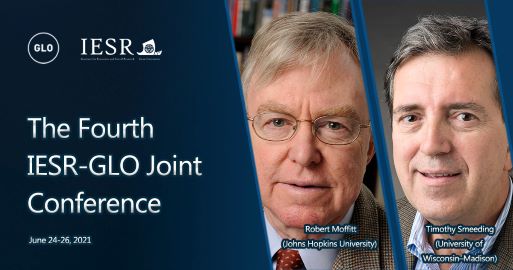
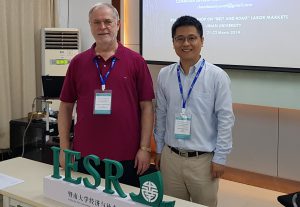
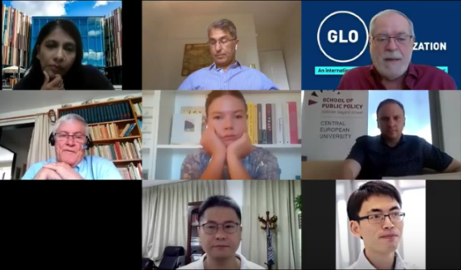
The Institute for Economic and Social Research (IESR) at Jinan University and the Global Labor Organization (GLO) are jointly organizing the Fourth IESR-GLO Virtual Conference. The conference this year is held from June 24 (Thursday) to June 26 (Saturday), 2021 through Zoom. The theme is Social Safety Net and Welfare Programs. Robert Moffitt and Timothy Smeeding are the keynote speakers. (Feng of IESR right & Zimmermann of GLO left)
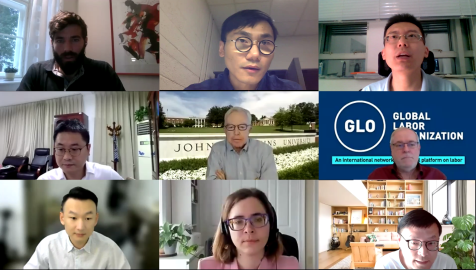
Speakers on June 24 from the left: Michael Christl, Jinyuan Yang, Sen Xue Shuaizhang Feng, Robert Moffitt, Klaus F. Zimmermann Feng Chen, Laura V. Zimmermann, Xi Chen
Day 2; June 25:
Program
8.00-11.05 pm Beijing Time / 8:00-11.05 am New York / 1:00-4:05 pm London JUNE 24 (Thursday). Chair:Sen Xue(IESR, Jinan University & GLO)
8.00-8.05 pm Beijing Time / 8:00-8.05 am New York / 1:00-1:05 pm London Opening Remarks by Shuaizhang Feng (IESR, Jinan University & GLO) & Klaus F. Zimmermann (UNU-MERIT, Maastricht University & GLO)
8.05-9.05 pm Beijing Time / 8:05-9.05 am New York / 1:05-2:05 pm London Keynote Lecture:Take-up in Social Assistance Programs: Theory and Evidence Keynote Speaker: Robert Moffitt (Johns Hopkins University)
9.05-9.35 pm Beijing Time / 9:05-9.35 am New York / 2:05-2:35 pm London The Power of Lakshmi: Monetary Incentives for Raising a Girl Nabaneeta Biswas (Marshall University), Christopher Cornwell (University of Georgia) &Laura V. Zimmermann(University of Georgia & GLO). Based on GLO Discussion Paper No. 888. Download PDF.
9.35-10.05 pm Beijing Time / 9:35-10.05 am New York / 2:35-3:05 pm London Grandfathers and Grandsons: Social Security Expansion and Child Health in China Jinyuan Yang (Virginia Tech)& Xi Chen (Yale University & GLO)
10.05-10.35 pm Beijing Time / 10:05-10.35 am New York / 3:05-3:35 pm London Trapped in inactivity? Social Assistance and Labour Supply in Austria Michael Christl (European Commission & GLO) & Silvia De Poli (European Commission)
10.35-11.05 pm Beijing Time / 10:35-11.05 am New York / 3:35-4:05 pm London Does Paid Family Leave Save Infant Lives? Evidence from California Feng Chen(Tulane University & GLO)
8.00-11.00 pm Beijing Time / 8:00-11.00 am New York / 1:00-4:00 pm London June 25 (Friday). Policy Forum on Social Assistance Systems Chair: Klaus F. Zimmermann (UNU-MERIT, Maastricht University & GLO)
8.00-8.45 pm Beijing Time / 8:00-8.45 am New York / 1:00-1:45 pm London Japan. Masayoshi Hayashi (University of Tokyo) Public Assistance in Japan: Current State and Challenges
8.45-9.30 pm Beijing Time / 8:45-9.30 am New York / 1:45-2:30 pm London South Korea. Inhoe Ku(Seoul National University) Social Assistance in South Korea: Policy Developments, Impacts and Implications for Future Reform
9.30-10.15 pm Beijing Time / 9:30-10.15 am New York / 2:30-3:15 pm London Germany. Alexander Spermann (FOM/Cologne, University of Freiburg and GLO) Basic Income in Germany 1991-2021: Challenges After Reunification, Hartz Reforms and the Current Reform Debate
10.15-11.00 pm Beijing Time / 10.15-11.00 am New York / 3:15-4:00 pm London Sweden. Björn Gustafsson (University of Gothenburg and GLO) Social Assistance in Sweden – Provision, Recipients and Challenges
8.00-11.00 pm Beijing Time / 8:00-11.00 am New York / 1:00-4:00 pm London JUNE 26 (Saturday). Chair: Shuaizhang Feng (IESR, Jinan University & GLO)
8.00-9.00 pm Beijing Time / 8:00-9.00 am New York / 1:00-2:00 pm London Keynote Lecture:Poverty and Income Support Around the World: China, India and Asia in Comparative Perspective Keynote Speaker: Timothy Smeeding (University of Wisconsin–Madison)
9.00-9.30 pm Beijing Time / 9:00-9.30 am New York / 2:00-2:30 pm London The Health of Disability Insurance Enrollees: An International Comparison Enrica Croda (Ca’Foscari University of Venice & GLO),Jonathan Skinner (Dartmouth College) & Laura Yasaitis (Dartmouth College)
9.30-10.00 pm Beijing Time / 9:30-10.00 am New York / 2:30-3:00 pm London The Unintended Effect of Medicaid Aging Waivers on Informal Caregiving Xianhua (Emma) Zai(Ohio State University & GLO)
10.00-10.30 pm Beijing Time / 10:00-10.30 am New York / 3:00-3:30 pm London Housing Vouchers, Labor Supply and Household Formation: A Structural Approach Ning Zhang (University of Pittsburgh)
10.30-11.00 pm Beijing Time / 10:30-11.00 am New York / 3:30-4:00 pm London The Structure and Incentives of a COVID related Emergency Wage Subsidy Jules Linden (National University Ireland Galway & Luxembourg Institute of Socio-Economic Reesarch), Cathal O’Donoghue (National University Ireland Galway), Denisa M. Sologon (Luxembourg Institute of Socio-Economic Reesarch)
Keynote speakers
Robert Moffitt on June 24; 8.00 pm Beijing Time
Robert A. Moffitt is the Krieger-Eisenhower Professor of Economics at Johns Hopkins University and holds a joint appointment at the Johns Hopkins Bloomberg School of Public Health. He obtained his Ph.D. degree from Brown University. His research interests are in the areas of labor economics and applied microeconometrics, with a special focus on the economics of issues relating to the low-income population in the U.S.. A large portion of his research has concerned the labor supply decisions of female heads of family and its response to the U.S. welfare system. He has published on the AFDC, Food Stamp, and Medicaid programs.
Moffitt has served as Chief Editor of the American Economic Review, Coeditor of the Review of Economics and Statistics, Chief Editor of the Journal of Human Resources, and as Chair of the National Academy of Sciences Panel to Evaluate Welfare Reform. He is currently editor of Tax Policy and the Economy.
Moffitt is also a Fellow of the Econometric Society, a Fellow of the Society of Labor Economists, a member of the National Academy of Sciences, a recipient of a MERIT Award from the National Institutes of Health, a recipient of a Guggenheim Fellowship, a Fellow of the American Academy of Arts and Sciences, and Past President of the Population Association of America.
Timothy Smeeding on June 26; 8.00 pm Beijing Time
Timothy Smeeding is Lee Rainwater Distinguished Professor of Public Affairs and Economics of the University of Wisconsin–Madison. He obtained his Ph.D. in Economics from the University of Wisconsin–Madison. He was director of the Institute for Research on Poverty from 2008–2014 and was the founding director of the Luxembourg Income Study from 1983-2006. He was named the John Kenneth Galbraith Fellow, American Academy of Political and Social Science in 2017.
Professor Smeeding’s recent work has been on social and economic mobility across generations, inequality of income, consumption and wealth, and poverty in national and cross-national contexts.
His recent publications include: SNAP Matters: How Food Stamps Affect Health and Well Being (Stanford University Press, 2015); Monitoring Social Mobility in the 21st Century (Annals of the American Academy of Political and Social Science, 2015); From Parents to Children: The Intergenerational Transmission of Advantage (Russell Sage Foundation, 2012); Persistence, Privilege and Parenting: The Comparative Study of Intergenerational Mobility (Russell Sage Foundation, 2011); The Handbook of Economic Inequality (Oxford University Press, 2009); Poor Kids in a Rich Country: America’s Children in Comparative Perspective (Russell Sage Foundation, 2003); and The American Welfare State: Laggard or Leader?, (Oxford University Press, 2010).
Policy Forum on Social Assistance Systems
June 25th: 8:pm-11pm Beijing Time/ 8:00am-11am New York / 1:00pm-4:00pm London Chair: Klaus F. Zimmermann (UNU-MERIT, Maastricht University & GLO)
8:00-8:45 pm: Japan. Masayoshi Hayashi (University of Tokyo) Public Assistance in Japan: Current State and Challenges
8:45-9:30 pm: Korea. Inhoe Ku(Seoul National University) Social Assistance in South Korea: Policy Developments, Impacts and Implications for Future Reform
9:30-10:15 pm: Germany. Alexander Spermann (FOM/Cologne, University of Freiburg and GLO) Basic Income in Germany 1991-2021: Challenges After Reunification, Hartz Reforms and the Current Reform Debate
10:15-11:00 pm: Sweden. Björn Gustafsson (University of Gothenburg and GLO) Social Assistance in Sweden – Provision, Recipients and Challenges
Masayoshi Hayashi (University of Tokyo) Professor of Economics at the University of Tokyo, and the President of the Japan Institute of Public Finance. He received a Ph.D. in Economics from Queen’s University at Kingston, Canada. His research interests include redistribution, taxation and fiscal federalism.
Inhoe Ku(Seoul National University) Professor at the Department of Social Welfare, Seoul National University. He is currently working as the President of the Korean Academy of Social Welfare. His research has been focusing on poverty, inequality and social policy.
Alexander Spermann (FOM/Cologne, University of Freiburg and GLO) Has started his research on social assistance more than thirty years ago. After finishing his dissertation and habilitation at the University of Freiburg, he held leading positions at international research institutes (ZEW, IZA) and is currently Professor of Economics at FOM Cologne and University of Freiburg. He has been a regular contributor to the media for decades.
Björn Gustafsson (University of Gothenburg and GLO) Professor Emeritus, University of Gothenburg, Sweden. He has published several papers on social assistance in Sweden. Since the 1990s he has also studied various aspects on income among Chinese households.
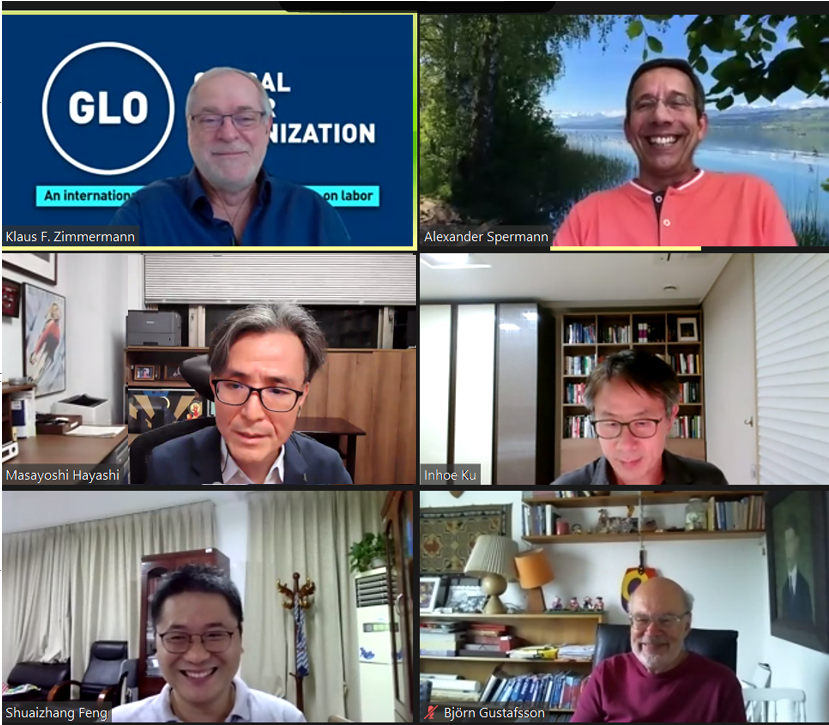
From the left: Masayoshi Hayashi, Inhoe Ku, Alexander Spermann, and Björn Gustafsson
A new paper published ONLINE FIRST freely accessible finds that commodity shocks lead to an increase in the number of births and the birth rate in Chile.
Baby commodity booms? The impact of commodity shocks on fertility decisions and outcomes
by Francisco Gallego & Jeanne Lafortune
Published ONLINE FIRST 2021: Journal of Population Economics FREE READLINK: https://rdcu.be/cnd2y
Author Abstract: This paper uses international commodity prices and local natural resource endowments as a source of plausibly exogenous variation in local Chilean economic conditions to study how these shocks impact fertility behavior of families in a small, emerging open economy where non-marital fertility is common but parental obligations are not well enforced. We find that these commodity shocks lead to an increase in the number of births and the birth rate. We argue that these results are consistent with most women experiencing an income effect and a limited substitution effect from commodity booms. This is confirmed by looking at groups that would have experienced a larger income than substitution effect: higher-order births, births within marital relationships, and those by mothers who do not experience an increase in their employment probability respond more strongly to these commodity booms.
The Global Labor Organization (GLO) is an independent, non-partisan and non-governmental organization that functions as an international network and virtual platform to stimulate global research, debate and collaboration.
A new GLO Discussion Paper finds that an increase in national teams’ performance in international cups is associated with a drop in birth rates nine months after the event.
Author Abstract: Does national team performance boost birth rates? We compiled a unique dataset combining country-level monthly birth rates for 50 European countries, along 56 years, with measures of national teams’ performance in 27 international football events. We find that an increase in national teams’ performance in international cups is associated with a drop in birth rates nine months after the event. We hypothesize that these results might be explained by individuals’ time allocation choices.
The Global Labor Organization (GLO) is an independent, non-partisan and non-governmental organization that functions as an international network and virtual platform to stimulate global research, debate and collaboration.
The Institute for Economic and Social Research (IESR) at Jinan University and the Global Labor Organization (GLO) are jointly organizing the Fourth IESR-GLO Virtual Conference. The conference this year will be held from June 24 (Thursday) to June 26 (Saturday), 2021 through Zoom. The theme is Social Safety Net and Welfare Programs. Robert Moffitt and Timothy Smeeding are the keynote speakers. To register see below.
The IESR-GLO annual conference is aimed to provide a platform for scholars and experts to exchange ideas on the current pressing economic issues through presentations of high-quality academic papers and policy discussions. Previous IESR-GLO Conferences have covered topics such as the Economics of Covid-19 in 2020 and on the Labor Markets in Belt and Road countries in 2019. (Feng of IESR right & Zimmermann of GLO left)
To participate
No participation fee. For registration, please click the link: https://www.wjx.cn/vj/mKRDcqR.aspx
8.00-11.05 pm Beijing Time / 8:00-11.05 am New York / 1:00-4:05 pm London JUNE 24 (Thursday). Chair:Sen Xue(IESR, Jinan University & GLO)
Speakers on June 24 from the left: Michael Christl, Jinyuan Yang, Sen Xue Shuaizhang Feng, Robert Moffitt, Klaus F. Zimmermann Feng Chen, Laura V. Zimmermann, Xi Chen
8.00-8.05 pm Beijing Time / 8:00-8.05 am New York / 1:00-1:05 pm London Opening Remarks by Shuaizhang Feng (IESR, Jinan University & GLO) & Klaus F. Zimmermann (UNU-MERIT, Maastricht University & GLO)
8.05-9.05 pm Beijing Time / 8:05-9.05 am New York / 1:05-2:05 pm London Keynote Lecture:Take-up in Social Assistance Programs: Theory and Evidence Keynote Speaker: Robert Moffitt (Johns Hopkins University)
9.05-9.35 pm Beijing Time / 9:05-9.35 am New York / 2:05-2:35 pm London The Power of Lakshmi: Monetary Incentives for Raising a Girl Nabaneeta Biswas (Marshall University), Christopher Cornwell (University of Georgia) &Laura V. Zimmermann(University of Georgia & GLO)
9.35-10.05 pm Beijing Time / 9:35-10.05 am New York / 2:35-3:05 pm London Grandfathers and Grandsons: Social Security Expansion and Child Health in China Jinyuan Yang (Virginia Tech)& Xi Chen (Yale University & GLO)
10.05-10.35 pm Beijing Time / 10:05-10.35 am New York / 3:05-3:35 pm London Trapped in inactivity? Social Assistance and Labour Supply in Austria Michael Christl (European Commission & GLO) & Silvia De Poli (European Commission)
10.35-11.05 pm Beijing Time / 10:35-11.05 am New York / 3:35-4:05 pm London Does Paid Family Leave Save Infant Lives? Evidence from California Feng Chen (Tulane University & GLO)
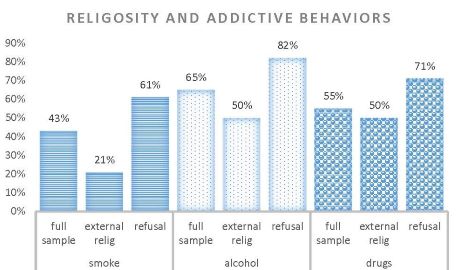
Using data for young Romanians, a new GLO Discussion Paper finds that it is external religiosity that interacts with weaker addictive behaviors like smoking, drinking and using drugs.
Author Abstract: While under communism, identity-providing religion was suppressed, religiosity is strong today even among the youth in post-communist countries. This provides an appropriate background to investigate how external and internal religiosity relates to addictive behaviors like smoking, drinking and drugs among the young. This study shows that not religion as such or internal religiosity, but largely observable (external) religiosity prevents them from wallowing those vices.
The Global Labor Organization (GLO) is an independent, non-partisan and non-governmental organization that functions as an international network and virtual platform to stimulate global research, debate and collaboration.
The Institute for Economic and Social Research (IESR) at Jinan University and the Global Labor Organization (GLO) are jointly organizing the Fourth IESR-GLO Virtual Conference. The conference this year will be held from June 24 (Thursday) to June 26 (Saturday), 2021 through Zoom. The theme is Social Safety Net and Welfare Programs. Robert Moffitt and Timothy Smeeding will be the keynote speakers. To register see below.
The IESR-GLO annual conference is aimed to provide a platform for scholars and experts to exchange ideas on the current pressing economic issues through presentations of high-quality academic papers and policy discussions. Previous IESR-GLO Conferences have covered topics such as the Economics of Covid-19 in 2020 and on the Labor Markets in Belt and Road countries in 2019. (Feng right & Zimmermann left)
To participate
No participation fee. For registration, please click the link: https://www.wjx.cn/vj/mKRDcqR.aspx
8.00-11.05 pm Beijing Time / 8:00-11.05 am New York / 1:00-4:05 pm London JUNE 24 (Thursday). Chair:Sen Xue(IESR, Jinan University & GLO)
8.00-8.05 pm Beijing Time / 8:00-8.05 am New York / 1:00-1:05 pm London Opening Remarks by Shuaizhang Feng (IESR, Jinan University & GLO) & Klaus F. Zimmermann (UNU-MERIT, Maastricht University & GLO)
8.05-9.05 pm Beijing Time / 8:05-9.05 am New York / 1:05-2:05 pm London Keynote Lecture:Take-up in Social Assistance Programs: Theory and Evidence Keynote Speaker: Robert Moffitt (Johns Hopkins University)
9.05-9.35 pm Beijing Time / 9:05-9.35 am New York / 2:05-2:35 pm London The Power of Lakshmi: Monetary Incentives for Raising a Girl Nabaneeta Biswas (Marshall University), Christopher Cornwell (University of Georgia) &Laura V. Zimmermann(University of Georgia & GLO)
9.35-10.05 pm Beijing Time / 9:35-10.05 am New York / 2:35-3:05 pm London Grandfathers and Grandsons: Social Security Expansion and Child Health in China Jinyuan Yang (Virginia Tech)& Xi Chen (Yale University & GLO)
10.05-10.35 pm Beijing Time / 10:05-10.35 am New York / 3:05-3:35 pm London Trapped in inactivity? Social Assistance and Labour Supply in Austria Michael Christl (European Commission & GLO) & Silvia De Poli (European Commission)
10.35-11.05 pm Beijing Time / 10:35-11.05 am New York / 3:35-4:05 pm London Does Paid Family Leave Save Infant Lives? Evidence from California Feng Chen(Tulane University & GLO)
8.00-11.00 pm Beijing Time / 8:00-11.00 am New York / 1:00-4:00 pm London June 25 (Friday). Policy Forum on Social Assistance Systems Chair: Klaus F. Zimmermann (UNU-MERIT, Maastricht University & GLO)
8.00-8.45 pm Beijing Time / 8:00-8.45 am New York / 1:00-1:45 pm London Japan. Masayoshi Hayashi (University of Tokyo) Public Assistance in Japan: Current State and Challenges
8.45-9.30 pm Beijing Time / 8:45-9.30 am New York / 1:45-2:30 pm London South Korea. Inhoe Ku(Seoul National University) Social Assistance in South Korea: Policy Developments, Impacts and Implications for Future Reform
9.30-10.15 pm Beijing Time / 9:30-10.15 am New York / 2:30-3:15 pm London Germany. Alexander Spermann (FOM/Cologne, University of Freiburg and GLO) Basic Income in Germany 1991-2021: Challenges After Reunification, Hartz Reforms and the Current Reform Debate
10.15-11.00 pm Beijing Time / 10.15-11.00 am New York / 3:15-4:00 pm London Sweden. Björn Gustafsson (University of Gothenburg and GLO) Social Assistance in Sweden – Provision, Recipients and Challenges
8.00-11.00 pm Beijing Time / 8:00-11.00 am New York / 1:00-4:00 pm London JUNE 26 (Saturday). Chair: Shuaizhang Feng (IESR, Jinan University & GLO)
8.00-9.00 pm Beijing Time / 8:00-9.00 am New York / 1:00-2:00 pm London Keynote Lecture:Poverty and Income Support Around the World: China, India and Asia in Comparative Perspective Keynote Speaker: Timothy Smeeding (University of Wisconsin–Madison)
9.00-9.30 pm Beijing Time / 9:00-9.30 am New York / 2:00-2:30 pm London The Health of Disability Insurance Enrollees: An International Comparison Enrica Croda (Ca’Foscari University of Venice & GLO),Jonathan Skinner (Dartmouth College) & Laura Yasaitis (Dartmouth College)
9.30-10.00 pm Beijing Time / 9:30-10.00 am New York / 2:30-3:00 pm London The Unintended Effect of Medicaid Aging Waivers on Informal Caregiving Xianhua (Emma) Zai(Ohio State University & GLO)
10.00-10.30 pm Beijing Time / 10:00-10.30 am New York / 3:00-3:30 pm London Housing Vouchers, Labor Supply and Household Formation: A Structural Approach Ning Zhang (University of Pittsburgh)
10.30-11.00 pm Beijing Time / 10:30-11.00 am New York / 3:30-4:00 pm London The Structure and Incentives of a COVID related Emergency Wage Subsidy Jules Linden (National University Ireland Galway & Luxembourg Institute of Socio-Economic Reesarch), Cathal O’Donoghue (National University Ireland Galway), Denisa M. Sologon (Luxembourg Institute of Socio-Economic Reesarch)
Keynote speakers
Robert Moffitt on June 24; 8.00 pm Beijing Time
Robert A. Moffitt is the Krieger-Eisenhower Professor of Economics at Johns Hopkins University and holds a joint appointment at the Johns Hopkins Bloomberg School of Public Health. He obtained his Ph.D. degree from Brown University. His research interests are in the areas of labor economics and applied microeconometrics, with a special focus on the economics of issues relating to the low-income population in the U.S.. A large portion of his research has concerned the labor supply decisions of female heads of family and its response to the U.S. welfare system. He has published on the AFDC, Food Stamp, and Medicaid programs.
Moffitt has served as Chief Editor of the American Economic Review, Coeditor of the Review of Economics and Statistics, Chief Editor of the Journal of Human Resources, and as Chair of the National Academy of Sciences Panel to Evaluate Welfare Reform. He is currently editor of Tax Policy and the Economy.
Moffitt is also a Fellow of the Econometric Society, a Fellow of the Society of Labor Economists, a member of the National Academy of Sciences, a recipient of a MERIT Award from the National Institutes of Health, a recipient of a Guggenheim Fellowship, a Fellow of the American Academy of Arts and Sciences, and Past President of the Population Association of America.
Timothy Smeeding on June 26; 8.00 pm Beijing Time
Timothy Smeeding is Lee Rainwater Distinguished Professor of Public Affairs and Economics of the University of Wisconsin–Madison. He obtained his Ph.D. in Economics from the University of Wisconsin–Madison. He was director of the Institute for Research on Poverty from 2008–2014 and was the founding director of the Luxembourg Income Study from 1983-2006. He was named the John Kenneth Galbraith Fellow, American Academy of Political and Social Science in 2017.
Professor Smeeding’s recent work has been on social and economic mobility across generations, inequality of income, consumption and wealth, and poverty in national and cross-national contexts.
His recent publications include: SNAP Matters: How Food Stamps Affect Health and Well Being (Stanford University Press, 2015); Monitoring Social Mobility in the 21st Century (Annals of the American Academy of Political and Social Science, 2015); From Parents to Children: The Intergenerational Transmission of Advantage (Russell Sage Foundation, 2012); Persistence, Privilege and Parenting: The Comparative Study of Intergenerational Mobility (Russell Sage Foundation, 2011); The Handbook of Economic Inequality (Oxford University Press, 2009); Poor Kids in a Rich Country: America’s Children in Comparative Perspective (Russell Sage Foundation, 2003); and The American Welfare State: Laggard or Leader?, (Oxford University Press, 2010).
Policy Forum on Social Assistance Systems
June 25th: 8:pm-11pm Beijing Time/ 8:00am-11am New York / 1:00pm-4:00pm London Chair: Klaus F. Zimmermann (UNU-MERIT, Maastricht University & GLO)
8:00-8:45 pm: Japan. Masayoshi Hayashi (University of Tokyo) Public Assistance in Japan: Current State and Challenges
8:45-9:30 pm: Korea. Inhoe Ku(Seoul National University) Social Assistance in South Korea: Policy Developments, Impacts and Implications for Future Reform
9:30-10:15 pm: Germany. Alexander Spermann (FOM/Cologne, University of Freiburg and GLO) Basic Income in Germany 1991-2021: Challenges After Reunification, Hartz Reforms and the Current Reform Debate
10:15-11:00 pm: Sweden. Björn Gustafsson (University of Gothenburg and GLO) Social Assistance in Sweden – Provision, Recipients and Challenges
Masayoshi Hayashi (University of Tokyo) Professor of Economics at the University of Tokyo, and the President of the Japan Institute of Public Finance. He received a Ph.D. in Economics from Queen’s University at Kingston, Canada. His research interests include redistribution, taxation and fiscal federalism.
Inhoe Ku(Seoul National University) Professor at the Department of Social Welfare, Seoul National University. He is currently working as the President of the Korean Academy of Social Welfare. His research has been focusing on poverty, inequality and social policy.
Alexander Spermann (FOM/Cologne, University of Freiburg and GLO) Has started his research on social assistance more than thirty years ago. After finishing his dissertation and habilitation at the University of Freiburg, he held leading positions at international research institutes (ZEW, IZA) and is currently Professor of Economics at FOM Cologne and University of Freiburg. He has been a regular contributor to the media for decades.
Björn Gustafsson (University of Gothenburg and GLO) Professor Emeritus, University of Gothenburg, Sweden. He has published several papers on social assistance in Sweden. Since the 1990s he has also studied various aspects on income among Chinese households.
From the left: Masayoshi Hayashi, Inhoe Ku, Alexander Spermann, and Björn Gustafsson
Klaus F. Zimmermann, GLO Shuaizhang Feng, Jinan University Sen Xue, Jinan University
Contact
For inquiries regarding the conference, please contact Sen Xue at sen.xue@jnu.edu.cn. General inquiries regarding the submissions should be directed to iesrjnu@gmail.com.
A new GLO Discussion Paper finds for China that vocational upper secondary graduates face a wage penalty compared to academic upper secondary graduates.
Author Abstract: In this paper, we use the Chinese General Social Survey data to analyse the returns to upper secondary vocational education in China. To address possible endogeneity of vocational training due to omitted heterogeneity, we construct a novel instrumental variable using the proportion of tertiary education graduates relative to the entire population by year. Our main finding is that, although returns to vocational upper secondary education appear higher than returns to academic upper secondary education according to the Mincerian equation, the results from the instrumental variable method tell the opposite story: vocational upper secondary graduates face a wage penalty compared to academic upper secondary graduates. The wage penalty is confirmed by an alternative and more recent IV method – the Lewbel method (Lewbel, 2012). Our findings highlight the importance of properly accounting for endogeneity when estimating the returns to vocational education.
The Global Labor Organization (GLO) is an independent, non-partisan and non-governmental organization that functions as an international network and virtual platform to stimulate global research, debate and collaboration.
Author Abstract: This paper investigates the relative importance of confidence in public institutions to explain cross-country differences in the severity of the COVID-19 pandemic. We extend the related literature by employing regression and machine learning methods to identify the most critical predictors of deaths attributed to the pandemic. We find that a one standard deviation increase (e.g., the actual difference between the US and Finland) in confidence is associated with 350.9 fewer predicted deaths per million inhabitants. Confidence in public institutions is one of the most important predictors of deaths attributed to COVID-19, compared to country-level measures of individual health risks, the health system, demographics, economic and political development, and social capital. Our results suggest that effective policy implementation requires citizens to cooperate with their governments, and willingness to cooperate relies on confidence in public institutions.
The Global Labor Organization (GLO) is an independent, non-partisan and non-governmental organization that functions as an international network and virtual platform to stimulate global research, debate and collaboration.
A new paper published ONLINE FIRST freely accessible demonstrate for Italy that supervised machine learning techniques outperform the official statistical method by substantially improving the prediction accuracy of local mortality.
by Augusto Cerqua, Roberta Di Stefano, Marco Letta & Sara Miccoli
Published ONLINE FIRST 2021: Journal of Population Economics OPEN ACCESS andPDF.
GLO Fellow Marco Letta
Author Abstract: Estimates of the real death toll of the COVID-19 pandemic have proven to be problematic in many countries, Italy being no exception. Mortality estimates at the local level are even more uncertain as they require stringent conditions, such as granularity and accuracy of the data at hand, which are rarely met. The “official” approach adopted by public institutions to estimate the “excess mortality” during the pandemic draws on a comparison between observed all-cause mortality data for 2020 and averages of mortality figures in the past years for the same period. In this paper, we apply the recently developed machine learning control method to build a more realistic counterfactual scenario of mortality in the absence of COVID-19. We demonstrate that supervised machine learning techniques outperform the official method by substantially improving the prediction accuracy of the local mortality in “ordinary” years, especially in small- and medium-sized municipalities. We then apply the best-performing algorithms to derive estimates of local excess mortality for the period between February and September 2020. Such estimates allow us to provide insights about the demographic evolution of the first wave of the pandemic throughout the country. To help improve diagnostic and monitoring efforts, our dataset is freely available to the research community.
The Global Labor Organization (GLO) is an independent, non-partisan and non-governmental organization that functions as an international network and virtual platform to stimulate global research, debate and collaboration.
The George Soros Visiting Chair or Practitioner Chair is awarded to scholars or practitioners who have demonstrated outstanding achievement or a distinguished record of participation in the academic, professional, journalistic, political, or civic world of public policy.
A new paper published ONLINE FIRST freely accessible finds for the USA that mobility decreases significantly more in high-trust counties than in low-trust counties after stay-at-home orders are implemented.
by Abel Brodeur, Idaliya Grigoryeva & Lamis Kattan
Published ONLINE FIRST 2021: Journal of Population Economics ACCESS. FREE READLINK: https://rdcu.be/cmSoY
Author Abstract: A clear understanding of community response to government decisions is crucial for policy makers and health officials during the COVID-19 pandemic. In this study, we document the determinants of implementation and compliance with stay-at-home orders in the USA, focusing on trust and social capital. Using cell phone data measuring changes in non-essential trips and average distance traveled, we find that mobility decreases significantly more in high-trust counties than in low-trust counties after the stay-at-home orders are implemented, with larger effects for more stringent orders. We also provide evidence that the estimated effect on post-order compliance is especially large for confidence in the press and governmental institutions, and relatively smaller for confidence in medicine and in science.
The Global Labor Organization (GLO) is an independent, non-partisan and non-governmental organization that functions as an international network and virtual platform to stimulate global research, debate and collaboration.
The Institute for Economic and Social Research (IESR) at Jinan University and the Global Labor Organization (GLO) are jointly organizing the Fourth IESR-GLO Virtual Conference. The conference this year will be held from June 24 (Thursday) to June 26 (Saturday), 2021 through Zoom. The theme is Social Safety Net and Welfare Programs. Robert Moffitt and Timothy Smeeding will be the keynote speakers. To register see below.
The IESR-GLO annual conference is aimed to provide a platform for scholars and experts to exchange ideas on the current pressing economic issues through presentations of high-quality academic papers and policy discussions. Previous IESR-GLO Conferences have covered topics such as the Economics of Covid-19 in 2020 and on the Labor Markets in Belt and Road countries in 2019.
To participate
No participation fee. For registration, please click the link: https://www.wjx.cn/vj/mKRDcqR.aspx
8.00-11.05 pm Beijing Time / 8:00-11.05 am New York / 1:00-4:05 pm London JUNE 24 (Thursday). Chair:Sen Xue(IESR, Jinan University & GLO)
8.00-8.05 pm Beijing Time / 8:00-8.05 am New York / 1:00-1:05 pm London Opening Remarks by Shuaizhang Feng (IESR, Jinan University & GLO) & Klaus F. Zimmermann (UNU-MERIT, Maastricht University & GLO)
8.05-9.05 pm Beijing Time / 8:05-9.05 am New York / 1:05-2:05 pm London Keynote Lecture:Take-up in Social Assistance Programs: Theory and Evidence Keynote Speaker: Robert Moffitt (Johns Hopkins University)
9.05-9.35 pm Beijing Time / 9:05-9.35 am New York / 2:05-2:35 pm London The Power of Lakshmi: Monetary Incentives for Raising a Girl Nabaneeta Biswas (Marshall University), Christopher Cornwell (University of Georgia) &Laura V. Zimmermann(University of Georgia & GLO)
9.35-10.05 pm Beijing Time / 9:35-10.05 am New York / 2:35-3:05 pm London Grandfathers and Grandsons: Social Security Expansion and Child Health in China Jinyuan Yang (Virginia Tech)& Xi Chen (Yale University & GLO)
10.05-10.35 pm Beijing Time / 10:05-10.35 am New York / 3:05-3:35 pm London Trapped in inactivity? Social Assistance and Labour Supply in Austria Michael Christl (European Commission & GLO) & Silvia De Poli (European Commission)
10.35-11.05 pm Beijing Time / 10:35-11.05 am New York / 3:35-4:05 pm London Does Paid Family Leave Save Infant Lives? Evidence from California Feng Chen (Tulane University)
8.00-11.00 pm Beijing Time / 8:00-11.00 am New York / 1:00-4:00 pm London June 25 (Friday). Policy Forum on Social Assistance Systems Chair: Klaus F. Zimmermann (UNU-MERIT, Maastricht University & GLO)
8.00-8.45 pm Beijing Time / 8:00-8.45 am New York / 1:00-1:45 pm London Japan. Masayoshi Hayashi (University of Tokyo) Public Assistance in Japan: Current State and Challenges
8.45-9.30 pm Beijing Time / 8:45-9.30 am New York / 1:45-2:30 pm London South Korea. Inhoe Ku(Seoul National University) Social Assistance in South Korea: Policy Developments, Impacts and Implications for Future Reform
9.30-10.15 pm Beijing Time / 9:30-10.15 am New York / 2:30-3:15 pm London Germany. Alexander Spermann (FOM/Cologne, University of Freiburg and GLO) Basic Income in Germany 1991-2021: Challenges After Reunification, Hartz Reforms and the Current Reform Debate
10.15-11.00 pm Beijing Time / 10.15-11.00 am New York / 3:15-4:00 pm London Sweden. Björn Gustafsson (University of Gothenburg and GLO) Social Assistance in Sweden – Provision, Recipients and Challenges
8.00-11.00 pm Beijing Time / 8:00-11.00 am New York / 1:00-4:00 pm London JUNE 26 (Saturday). Chair: Shuaizhang Feng (IESR, Jinan University & GLO)
8.00-9.00 pm Beijing Time / 8:00-9.00 am New York / 1:00-2:00 pm London Keynote Lecture:Poverty and Income Support Around the World: China, India and Asia in Comparative Perspective Keynote Speaker: Timothy Smeeding (University of Wisconsin–Madison)
9.00-9.30 pm Beijing Time / 9:00-9.30 am New York / 2:00-2:30 pm London The Health of Disability Insurance Enrollees: An International Comparison Enrica Croda (Ca’Foscari University of Venice & GLO),Jonathan Skinner (Dartmouth College) & Laura Yasaitis (Dartmouth College)
9.30-10.00 pm Beijing Time / 9:30-10.00 am New York / 2:30-3:00 pm London The Unintended Effect of Medicaid Aging Waivers on Informal Caregiving Xianhua (Emma) Zai(Ohio State University & GLO)
10.00-10.30 pm Beijing Time / 10:00-10.30 am New York / 3:00-3:30 pm London Housing Vouchers, Labor Supply and Household Formation: A Structural Approach Ning Zhang (University of Pittsburgh)
10.30-11.00 pm Beijing Time / 10:30-11.00 am New York / 3:30-4:00 pm London The Structure and Incentives of a COVID related Emergency Wage Subsidy Jules Linden (National University Ireland Galway & Luxembourg Institute of Socio-Economic Reesarch), Cathal O’Donoghue (National University Ireland Galway), Denisa M. Sologon (Luxembourg Institute of Socio-Economic Reesarch)
Keynote speakers
Robert Moffitt on June 24; 8.00 pm Beijing Time
Robert A. Moffitt is the Krieger-Eisenhower Professor of Economics at Johns Hopkins University and holds a joint appointment at the Johns Hopkins Bloomberg School of Public Health. He obtained his Ph.D. degree from Brown University. His research interests are in the areas of labor economics and applied microeconometrics, with a special focus on the economics of issues relating to the low-income population in the U.S.. A large portion of his research has concerned the labor supply decisions of female heads of family and its response to the U.S. welfare system. He has published on the AFDC, Food Stamp, and Medicaid programs.
Moffitt has served as Chief Editor of the American Economic Review, Coeditor of the Review of Economics and Statistics, Chief Editor of the Journal of Human Resources, and as Chair of the National Academy of Sciences Panel to Evaluate Welfare Reform. He is currently editor of Tax Policy and the Economy.
Moffitt is also a Fellow of the Econometric Society, a Fellow of the Society of Labor Economists, a member of the National Academy of Sciences, a recipient of a MERIT Award from the National Institutes of Health, a recipient of a Guggenheim Fellowship, a Fellow of the American Academy of Arts and Sciences, and Past President of the Population Association of America.
Timothy Smeeding on June 26; 8.00 pm Beijing Time
Timothy Smeeding is Lee Rainwater Distinguished Professor of Public Affairs and Economics of the University of Wisconsin–Madison. He obtained his Ph.D. in Economics from the University of Wisconsin–Madison. He was director of the Institute for Research on Poverty from 2008–2014 and was the founding director of the Luxembourg Income Study from 1983-2006. He was named the John Kenneth Galbraith Fellow, American Academy of Political and Social Science in 2017.
Professor Smeeding’s recent work has been on social and economic mobility across generations, inequality of income, consumption and wealth, and poverty in national and cross-national contexts.
His recent publications include: SNAP Matters: How Food Stamps Affect Health and Well Being (Stanford University Press, 2015); Monitoring Social Mobility in the 21st Century (Annals of the American Academy of Political and Social Science, 2015); From Parents to Children: The Intergenerational Transmission of Advantage (Russell Sage Foundation, 2012); Persistence, Privilege and Parenting: The Comparative Study of Intergenerational Mobility (Russell Sage Foundation, 2011); The Handbook of Economic Inequality (Oxford University Press, 2009); Poor Kids in a Rich Country: America’s Children in Comparative Perspective (Russell Sage Foundation, 2003); and The American Welfare State: Laggard or Leader?, (Oxford University Press, 2010).
Policy Forum on Social Assistance Systems
June 25th: 8:pm-11pm Beijing Time/ 8:00am-11am New York / 1:00pm-4:00pm London Chair: Klaus F. Zimmermann (UNU-MERIT, Maastricht University & GLO)
8:00-8:45 pm: Japan. Masayoshi Hayashi (University of Tokyo) Public Assistance in Japan: Current State and Challenges
8:45-9:30 pm: Korea. Inhoe Ku(Seoul National University) Social Assistance in South Korea: Policy Developments, Impacts and Implications for Future Reform
9:30-10:15 pm: Germany. Alexander Spermann (FOM/Cologne, University of Freiburg and GLO) Basic Income in Germany 1991-2021: Challenges After Reunification, Hartz Reforms and the Current Reform Debate
10:15-11:00 pm: Sweden. Björn Gustafsson (University of Gothenburg and GLO) Social Assistance in Sweden – Provision, Recipients and Challenges
Masayoshi Hayashi (University of Tokyo) Professor of Economics at the University of Tokyo, and the President of the Japan Institute of Public Finance. He received a Ph.D. in Economics from Queen’s University at Kingston, Canada. His research interests include redistribution, taxation and fiscal federalism.
Inhoe Ku(Seoul National University) Professor at the Department of Social Welfare, Seoul National University. He is currently working as the President of the Korean Academy of Social Welfare. His research has been focusing on poverty, inequality and social policy.
Alexander Spermann (FOM/Cologne, University of Freiburg and GLO) Has started his research on social assistance more than thirty years ago. After finishing his dissertation and habilitation at the University of Freiburg, he held leading positions at international research institutes (ZEW, IZA) and is currently Professor of Economics at FOM Cologne and University of Freiburg. He has been a regular contributor to the media for decades.
Björn Gustafsson (University of Gothenburg and GLO) Professor Emeritus, University of Gothenburg, Sweden. He has published several papers on social assistance in Sweden. Since the 1990s he has also studied various aspects on income among Chinese households.
From the left: Masayoshi Hayashi, Inhoe Ku, Alexander Spermann, and Björn Gustafsson
Klaus F. Zimmermann, GLO Shuaizhang Feng, Jinan University Sen Xue, Jinan University
Contact
For inquiries regarding the conference, please contact Sen Xue at sen.xue@jnu.edu.cn. General inquiries regarding the submissions should be directed to iesrjnu@gmail.com.
Author Abstract: I review trends in migration to the UK since the Brexit referendum, examining first the sharp fall in net migration from the EU that resulted, and then the recent more dramatic exodus of foreign-born residents during the covid-19 pandemic. I describe the new post-Brexit system, and review studies which attempt to estimate both the impact on future migration flows and on GDP and GDP per capita. Finally, I discuss the wider economic impact of the new system and some of the policy implications.
The Global Labor Organization (GLO) is an independent, non-partisan and non-governmental organization that functions as an international network and virtual platform to stimulate global research, debate and collaboration.
A new paper published ONLINE FIRST freely accessible finds for Japan that during Covid-19 school closures increased the inequality of mental health between genders and parents with different educational backgrounds.
The Global Labor Organization (GLO) is an independent, non-partisan and non-governmental organization that functions as an international network and virtual platform to stimulate global research, debate and collaboration.
Published ONLINE FIRST 2021: Journal of Population Economics OPEN ACCESS andPDF.
Author Abstract: The spread of the novel coronavirus disease caused schools in Japan to close to cope with the pandemic. In response to the school closures, parents of students were obliged to care for their children during the daytime, when children usually were at school. Did the increase in the burden of childcare influence parents’ mental health? Based on short panel data from mid-March to mid-April 2020, we explore how school closures influenced the mental health of parents with school-aged children. Using a fixed-effects model, we find that school closures led to mothers of students suffering from worse mental health compared to other females, while the fathers’ mental health did not differ from that of other males. This tendency is only observed for less-educated mothers who had children attending primary school, not for those with children attending junior high school nor for more-educated mothers. The contribution of this paper is showing that school closures increased the inequality of mental health between genders and parents with different educational backgrounds.
A new paper published ONLINE FIRST freely accessible finds for Portugal’s wage gap between vocational and general secondary education no support for either the human capital prediction of crossing wage profiles or the hypothesis that general graduates increasingly outperform vocational graduates in late career.
The Global Labor Organization (GLO) is an independent, non-partisan and non-governmental organization that functions as an international network and virtual platform to stimulate global research, debate and collaboration.
Author Abstract: We document and analyse the wage gap between vocational and general secondary education in Portugal between 1994 and 2013. As Portuguese workers have been educated in different school systems, we have to distinguish between birth cohorts. Analysing the wage gaps within cohorts, we find no support for either the human capital prediction of crossing wage profiles or the hypothesis that general graduates increasingly outperform vocational graduates in late career. We discover that the lifecycle wage profiles have shifted over time. We link the pattern of shifting cohort profiles to changes in the school system and in the structure of labour demand. We conclude that assessing the relative value of vocational education requires assessing how the vocational curriculum responds to changes in economic structure and technology. We show that the decline in assortative matching between workers and firms has benefited vocationally educated workers.
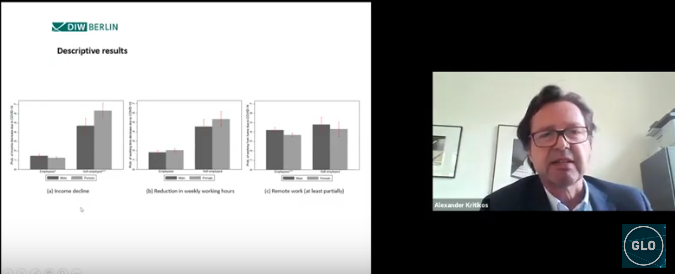
A new paper published ONLINE FIRST freely accessible finds for Germany that among the self-employed, who generally face a higher likelihood of income losses due to COVID-19 than employees, women are about one-third more likely to experience income losses than their male counterparts. No comparable gender gap among employees is found.
The Global Labor Organization (GLO) is an independent, non-partisan and non-governmental organization that functions as an international network and virtual platform to stimulate global research, debate and collaboration.
Author Abstract: We investigate how the economic consequences of the pandemic and the government-mandated measures to contain its spread affect the self-employed — particularly women — in Germany. For our analysis, we use representative, real-time survey data in which respondents were asked about their situation during the COVID-19 pandemic. Our findings indicate that among the self-employed, who generally face a higher likelihood of income losses due to COVID-19 than employees, women are about one-third more likely to experience income losses than their male counterparts. We do not find a comparable gender gap among employees. Our results further suggest that the gender gap among the self-employed is largely explained by the fact that women disproportionately work in industries that are more severely affected by the COVID-19 pandemic. Our analysis of potential mechanisms reveals that women are significantly more likely to be impacted by government-imposed restrictions, e.g., the regulation of opening hours. We conclude that future policy measures intending to mitigate the consequences of such shocks should account for this considerable variation in economic hardship.
On invitation of the International Economic Association (IEA) the Global Labor Organization (GLO) had organized three sessions for the IEA World Congress, which were recorded by GLO with support of Kent University on June 10, 2021.
The Covid-19 delayed IEA World Congress (“Bali”) now takes place virtually on 2-6 July 2021.
Seebackground material to the papers below where available.
PROGRAM
Session I.“Socioeconomic Status and Identity”. Chair: Kompal Sinha (Macquarie University)
“Social Assimilation and Labor Market Outcomes of Internal Migrant Workers” Shu Cai (Jinan University) with Klaus F. Zimmermann (UNU-MERIT, Maastricht University & GLO) Discussion: Matloob Piracha (University of Kent)
“Ethnic Identity and Immigrants’ Labour Market Outcomes” Matloob Piracha (University of Kent) with Massimiliano Tani (University of New South Wales), Zhiming Cheng (University of New South Wales) and Ben Zhe Wang (Macquarie University) Discussion: Shu Cai (Jinan University)
“Distributional Analysis of the Role of Breadth and Persistence of Multiple Deprivation in the Health Gradient Measured by Biomarkers” Kompal Sinha (Macquarie University) with Apostolos Davillas (Norwich Business School), Andrew M. Jones (University of York) and Anurag Sharma (University of New South Wales) Discussion: Klaus F. Zimmermann (UNU-MERIT, Maastricht University & GLO)
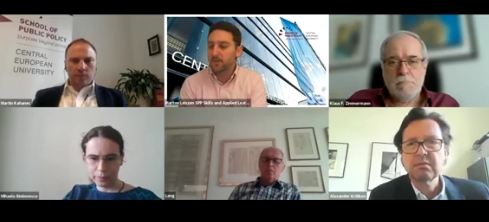
Eva Van Belle & Martin Kahanec
Session II. “The Migration Challenge“. Chair: Klaus F. Zimmermann (UNU-MERIT, Maastricht University & GLO)
“Global Challenges and the Handbook Project” (Klaus F. Zimmermann, Ed., Labor, Human Resources and Population Economics, Springer Nature, forthcoming). Chapters presented here in this session will appear in the Handbook. Klaus F. Zimmermann (UNU-MERIT, Maastricht University & GLO)
“Welfare Migration” Martin Guzi (Masaryk University) with Martin Kahanec (Central European University)
“Climate Change and Migration” Shuaizhang Feng (Jinan University) with Xiaomeng Cui, (Jinan University)
Discussion: Martin Kahanec (Central European University)
Eskil Wadensjö
Session III. “Wage gaps”. Chair: Amelie Constant (Princeton University)
“The Native-Immigrant Wage Gap: A Meta-Analysis” Eva Van Belle (nccr and University of Neuchâtel) with Didier Ruedin (University of Neuchâtel) Discussion: Hans Lööf (Royal Institute of Technology)
“Occupational Sorting and Wage Gaps of Refugees” Hans Lööf (Royal Institute of Technology) with Christopher F. Baum (Boston College), Andreas Stephan (Jönköping University and DIW Berlin) and Klaus F. Zimmermann (UNU-MERIT, Maastricht University & GLO) Discussion: Eva Van Belle (nccr and University of Neuchâtel)
“Fifty-five Years of Wage Disparities between Hispanics and Non-Hispanic Whites in the U.S.” Amelie Constant (Princeton University) with Douglas S. Massey (Princeton University) Discussion: Klaus F. Zimmermann (UNU-MERIT, Maastricht University & GLO)
Klaus F. Zimmermann, Ed., Labor, Human Resources and Population Economics, Springer Nature, forthcoming. Further information LINK.
Martin Guzi and Martin Kahanec, Welfare Migration. Forthcoming in: Zimmermann K. (eds) Handbook of Labor, Human Resources and Population Economics. Springer, Cham.
Aycan Çelikakso and Eskil Wadensjö, Child Migration. Forthcoming in: Zimmermann K. (eds) Handbook of Labor, Human Resources and Population Economics. Springer, Cham.
Xiaomeng Cui and Shuaizhang Feng (2020), Climate Change and Migration. In: Zimmermann K. (eds) Handbook of Labor, Human Resources and Population Economics. Springer, Cham. https://doi.org/10.1007/978-3-319-57365-6_115-1
A new GLO Discussion Paperindicates that introducing a hypothetical wage penalty for discriminatory choice behavior lowers discrimination and that higher penalties have a greater effect.
Author Abstract: Using a choice experiment, we test whether taste-based employee discrimination against ethnic minorities is susceptible to loss aversion. In line with empirical evidence from previous research, our results indicate that introducing a hypothetical wage penalty for discriminatory choice behaviour lowers discrimination and that higher penalties have a greater effect. Most notably, we find that the propensity to discriminate is significantly lower when this penalty is loss-framed rather than gain-framed. From a policy perspective, it could therefore be more effective to financially penalise taste-based discriminators than to incentivise them not to discriminate.
The Global Labor Organization (GLO) is an independent, non-partisan and non-governmental organization that functions as an international network and virtual platform to stimulate global research, debate and collaboration.
A new GLO Discussion Paper reviews employers’ violations of the wage contracts of workers on H-1B temporary work visas to the US; higher labor market power is associated with fewer violations, higher unemployment rates and subcontractor firms are associated with more.
Author Abstract: This study explores what determines employers’ violations of the wage contracts of workers on H-1B temporary work visas, which occur when firms pay those workers below the promised prevailing or “market” wage. A theoretical framework is proposed that predicts more violations during economic downturns, fewer violations when firms have more labor-market power, and more violations by subcontractor firms. Empirical analysis is based on a firm-level matched dataset of wage and hour violations and the firms that sponsor H-1Bs. Higher labor market power, measured by the Herfindahl-Hirschman Index, is associated with fewer violations. Higher unemployment rates and subcontractor firms are associated with more violations. The effects of the unemployment rate and labor market power are amplified in subcontractor firms.
The Global Labor Organization (GLO) is an independent, non-partisan and non-governmental organization that functions as an international network and virtual platform to stimulate global research, debate and collaboration.
Sergio Scicchitano is Co-Lead of the GLO Coronavirus Cluster. On behalf of the Cluster he is organizing the “Panel Session CO466: The econometrics of Covid-19 pandemic” at the 15th International Conference on Computational and Financial Econometrics (CFE 2021), hosted by King’s College London on 18-20 December 2021.
Sergio Scicchitano
Abstact submission now open until 6th September 2021. How to submit: http://www.cfenetwork.org/CFE2021/submission.php
A new GLO Discussion Paper finds that there is no significant difference between valuations of a private good and various versions of a public good as long as the good itself is the same.
Author Abstract: A frequent finding in the empirical literature on cost-benefit analysis of traffic safety measures is that valuations of public goods are lower than valuations of private goods, contrary to theory predictions. This study elicits the willingness to pay for publicly and privately provided safety improvement benefiting cyclists and pedestrians, a relatively neglected group in this literature. Our results suggest that there is no significant difference between valuations of a private good and three versions of a public good as long as the good itself is the same, in our case a mobile phone app. The public good versions differ in attributes such as mandatory or voluntary use and private or public provision institutions. . This finding is consistent with the simultaneous presence of both financial altruism and safety altruism, or neither. Public institutions are preferred to private ones in the provision of the public goods, and voluntary participation is preferred to mandated regulation. We also find evidence that attitudes that favor using taxes to fund traffic safety projects, and public responsibility for traffic safety are associated with a higher willingness to pay.
The Global Labor Organization (GLO) is an independent, non-partisan and non-governmental organization that functions as an international network and virtual platform to stimulate global research, debate and collaboration.
TheGLO Virtual Seminar is a monthly internal GLO research event chaired by GLO Director Matloob Piracha and hosted by the GLO partner institution University of Kent. The results are available on the GLO website and the GLO News section, where also the video of the presentation is posted. All GLO related videos are also available in the GLO YouTube channel. (To subscribe go there.)
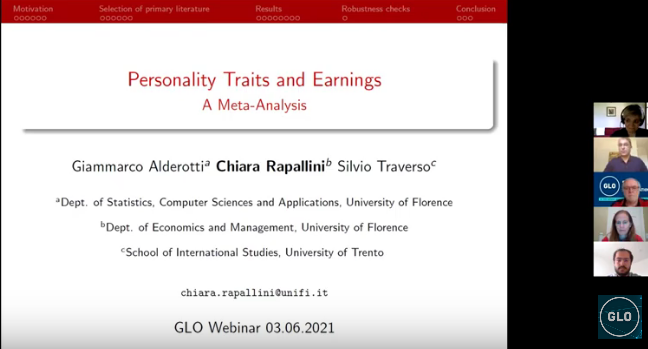
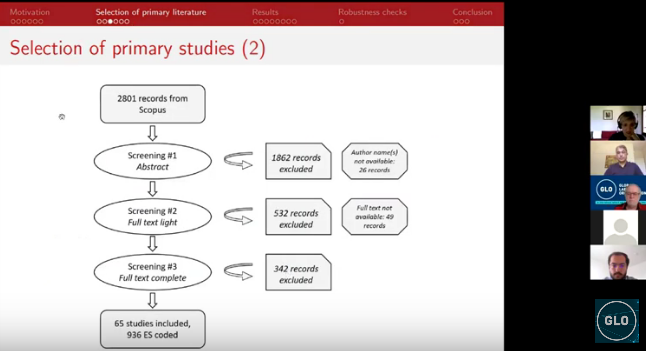
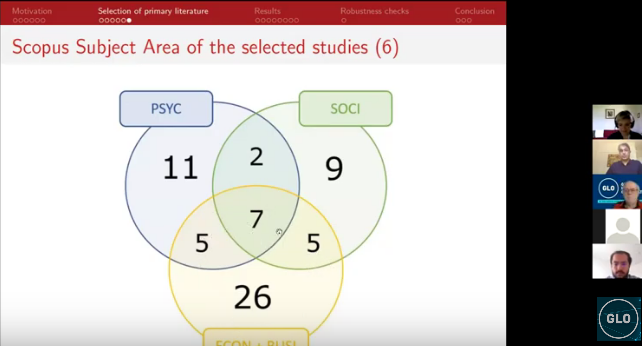
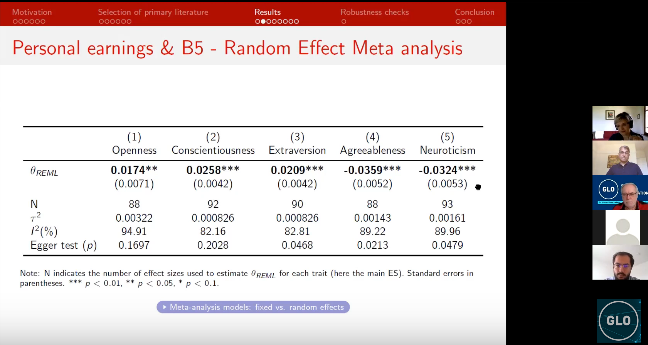
The last seminar was given on June 3, 2021, London/UKat 1-2 pm, by Chiara Rapallini (Università degli Studi di Firenze and GLO) on Personality Traits and Earnings: A Meta-Analysis. See below a report and the full video of the seminar.
1. Provides a meta-analytical review of the empirical literature on the relationship between personal earnings and the Big Five personality traits.
2. Based on 936 partial effect sizes collected from 65 peer-reviewed articles published between 2001 and 2020.
3. Finds that personal earnings are positively associated with the traits of Openness, Conscientiousness, and Extraversion, and negatively associated with the traits of Agreeableness and Neuroticism.
4. Meta-regression estimates suggest that the results of the primary literature are at least partially driven by the characteristics of the study design and, in particular, that the inclusion of individual controls like the level of education attained or/and a proxy for cognitive abilities helps to explain study heterogeneity.
A new GLO Discussion Paper finds that tenure exhibits an inverted-U-shaped relationship with respect to productivity, but its impact differs widely across workforce and firm dimensions.
Author Abstract: In this paper, we explore the impact of workers’ tenure on firm productivity, using rich longitudinal matched employer-employee data on private Belgian firms. We estimate a production function augmented with a firm-level measure of tenure. We deal with endogeneity, which arises from unobserved firm heterogeneity and reverse causality, by applying a modified version of Ackerberg et al.’s (2015) control function method, which explicitly removes firm fixed effects. Consistently with recent theoretical predictions, we find that tenure exhibits an inverted-U-shaped relationship with respect to productivity. The existence of decreasing marginal returns to tenure is corroborated in our analysis on the tenure composition of the workforce. We also find that the impact of tenure differs widely across workforce and firm dimensions. Tenure is particularly beneficial for productivity in contexts characterized by a certain degree of routineness and lower job complexity. Along the same lines, our findings indicate that tenure exerts stronger (positive) impacts in industrial and high capital-intensive firms, as well as in firms less reliant on knowledge- and ICT-intensive processes.
The Global Labor Organization (GLO) is an independent, non-partisan and non-governmental organization that functions as an international network and virtual platform to stimulate global research, debate and collaboration.
A new GLO Discussion Paper finds that a light-touch intervention can increase socioeconomic and racial diversity in undergraduate economics.
The Global Labor Organization (GLO) is an independent, non-partisan and non-governmental organization that functions as an international network and virtual platform to stimulate global research, debate and collaboration.
Author Abstract: We assess whether a light-touch intervention can increase socioeconomic and racial diversity in undergraduate Economics. We randomly assigned over 2,200 students a message with basic information about the Economics major; the basic message combined with an emphasis on the rewarding careers or financial returns associated with the major; or no message. Messages increased the proportion of first generation and underrepresented minority (URM) students majoring in Economics by five percentage points. This effect size was sufficient to reverse the gap in Economics majors between first generation/URM students and students not in these groups. Effect sizes were larger and more precise for better-performing students and first generation students. Extrapolating to the full sample, the treatment would double the proportion of first generation and underrepresented minority students majoring in Economics.
Featured image: Photo-by-Mikael-Kristenson-on-Unsplash
A new GLO Discussion Paper finds that bad economic conditions when young can significantly predict higher entrepreneurship in later life.
The Global Labor Organization (GLO) is an independent, non-partisan and non-governmental organization that functions as an international network and virtual platform to stimulate global research, debate and collaboration.
Author Abstract: We argue that past events experienced during the critical ages of 18-25 can influence an individual’s future entrepreneurship based on the “impressionable years hypothesis”. Accordingly, we empirically investigate the relationship between bad economic conditions during youth and later-life entrepreneurship using Gallup from 2009 to 2014. The identification is achieved through variations across 77 countries and age cohorts born between 1954 and 1989. Our findings indicate that bad economic conditions when young can significantly predict higher entrepreneurship in later life. For example, experiencing at least one economic contraction during youth increases future self-employment/business ownership propensities by about 6/10% at the outcome means. Graduating from college and entering the job market in a bad economy cannot explain our results. Findings are robust to numerous methods of measuring economic contractions and controlling for behavioural measures as well as economic shocks experienced before and after the impressionable years.
A new GLO Discussion Paper studies online food ordering which tops online orders and creates millions of food delivery rider jobs/gigs in mainland China.
The Global Labor Organization (GLO) is an independent, non-partisan and non-governmental organization that functions as an international network and virtual platform to stimulate global research, debate and collaboration.
Author Abstract: This article investigates the motivation of contingent workers in the gig economy of China, particularly focusing on the two Mobile Food Delivery Aggregators (MFDA) – Meituan and Ele.me that controls over 80% of the food delivery market in China. The convenience of one ‘super-app’ on phone, offered by each of these companies, allows users to order a diversified range of products and services starting from food, clothing to travel booking and ride-hailing. Online food ordering, however, tops the chart of online orders and this creates millions of food delivery rider jobs/gigs in mainland China. This paper draws key insights from the employee motivation theories by Herzberg and Taylor which underpins the findings and thematic discussion of this qualitative paper. While it is important to recognise that the usage growth of these MFDAs and consequently new gig creation is exponentially growing, the implications of this research would inform these online platform-based companies how to better design motivational factors or incentives to boost their employee satisfaction, engagement and levels of commitments in the colossal Gig economy of mainland China.
Organized by POP@UNU-MERIT, GLO & Università Cattolica del Sacro Cuore and hosted by UNU-MERIT, Maastricht, an Online Workshop on “Technological Change, Employment & Skills” will take place on June 7, 2021, 2.00 – 6.00 pm CEST/Maastricht/Dutch time. The workshop presents the core findings of 10 chapters of the 20 review articles of the section on ‘Technological Changes and the Labor Market’ in the Labor, Human Resources and Population Economics Handbook supported by the GLO and published by Springer Nature. The event is motivated by the attempt to review and discuss the general findings and the state-of-the-art in the economics and business literature.
Below you find an introduction to the Handbook Project, the detailed Workshop Program (PDF) and a listing of the 20 Handbook Chapters with links to access them on the Springer Nature website.
No advanced registration needed. Zoom Link: https://maastrichtuniversity.zoom.us/j/92175077007
The Handbook Project
The Handbook in “Labor, Human Resources and Population Economics” provides an integrated picture of knowledge about the economic and social behaviors and interactions of human beings on markets, in households, in companies and in societies. A fast evolving project by the GLO with a core basis in labor economics, human resources, demography and econometrics, it will provide a large and complete summary and evaluation of the scientific state of the art. Chapters are developed under the guidance of an engaged team of editors led by the GLO President administered in 30 sections.
to find out how to contribute to this exciting venture with an own chapter.
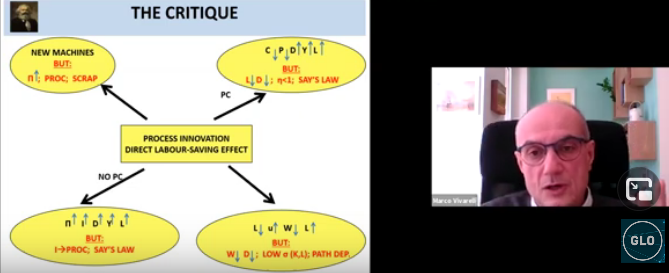
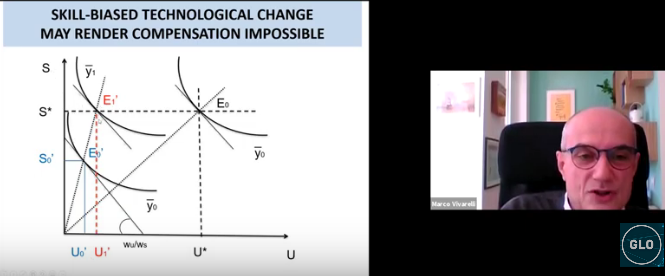
The Section “Technological Changes and the Labor Market” is directed by Marco Vivarelli, who is also the GLO Cluster Lead of the “Technological Change” area. The Section is just completing its set of 20 published papers now available for use, review and debate.
Workshop: Technological Change, Employment and Skills. June 7, 2021
14:00Opening Remarks Welcome: Neil Foster-McGregor (Deputy Director, UNU-MERIT) Introduction: Klaus F. Zimmermann (UNU-MERIT, Maastricht University & GLO; Editor of the “Handbook of Labor, Human Resources and Population Economics”)
14:15Aims and Scope Marco Vivarelli(Università Cattolica del Sacro Cuore & GLO; Editor of the Section “Technological Changes and the Labor Market”)
14:30Technology and Work: Key Stylized Facts for the Digital Age Mario Pianta (Scuola Normale Superiore & GLO)
14:45Innovation, Technology Adoption and Employment: Evidence Synthesis Mehmet Ugur (University of Greenwich)
15:00Innovation, Employment, and the Business Cycle Bernhard Dachs (AIT Austrian Institute of Technology)
15:15Technological Innovations and Labor Demand Using Linked Firm-Level Data Eva Hagsten (University of Iceland)
15:30General Discussion Chaired by Marco Vivarelli(Università Cattolica del Sacro Cuore & GLO)
16:00Coffee/Tea Break
16:15AI and Robotics Innovation Daniele Vertesy (Joint Research Center & GLO)
16:30Robots at Work: Automatable and Non-automatable Jobs Cecily Josten(LSE)
16:45Why do Employees Participate in Innovations? Skills and Organisational Design Issues and the Ongoing Technological Transformation Nathalie Greenan (Conservatoire National des Arts et Métiers & GLO)
17:00Skill-Sets for Prospective Careers of Highly Qualified Labor Dirk Meissner (HSE University)
17:15Quantity and Quality of Work in the Platform Economy Dario Guarascio (Sapienza University of Rome & GLO)
18:00Conclusions Marco Vivarelli and Klaus F. Zimmermann
Handbook Section “Technological Changes and the Labor Market“
The Handbook of Labor, Human Resources and Population Economics Editor: Klaus F. Zimmermann
Section – Technological Changes and the Labor Market Marco Vivarelli, Section Editor Università Cattolica del Sacro Cuore Department of Economic Policy, Milan, Italy Note: Find abstract links of the articles below the chapter titles.
Digitization and the Future of Work: Macroeconomic Consequences Melanie Arntz1,2, Terry Gregory3,1, Ulrich Zierahn5,1,4 1 Leibniz Centre for European Economic Research, 2University of Heidelberg, 3Institute of Labor Economics, IZA,4CESifo Research Network, 5Utrecht University
Innovation, Employment, and the Business Cycle Bernhard Dachs1, Martin Hud2, Bettina Peters2,3 1AIT Austrian Institute of Technology, 2Leibniz Centre for European Economic Research, 3University of Luxembourg
Why do employees participate in innovations? Skills and organisational design issues and the ongoing technological transformation, in production Nathalie Greenan, Silvia Napolitano Conservatoire National des Arts et Métiers
Quantity and Quality of Work in the Platform Economy Francesco Bogliacino1, Cristiano Codagnone2,3, Valeria Cirillo4, Dario Guarascio5 1Universidad Nacional de Colombia, 2Università degli Studi di Milano, 3Universitat Oberta de Catalunya, 4INAPP, National Institute for the Analysis of Public Policies, 5Università degli Studi di Roma
Integration in Global Value Chains and Employment Filippo Bontadini1, Rinaldo Evangelista2, Valentina Meliciani3, Maria Savona1 1University of Sussex, 2University of Camerino, 3University Luiss Guido Carli
After the pandemic is before the next pandemic: A new GLO Discussion Paper navigates through a long-awaited health policy transformation in areas that help to better prepare for the next pandemic.
Author Abstract: The Coronavirus Disease 2019 (COVID-19) pandemic is bringing about once-in-a-century changes to human society. Three key properties escalate the COVID-19 pandemic into a syndemic. To address this triple crisis, we discuss the importance of integrating early, targeted and coordinated public health measures with more equitable social policy, and with health care policy that realigns incentives of the major players in the health care market. Drawing on evidence from past and present epidemics as well as comparing variations in response to the current health emergency between China, the U.S. and beyond, we navigate long-awaited health policy transformation in areas that help us better prepare for the next pandemic.
The Global Labor Organization (GLO) is an independent, non-partisan and non-governmental organization that functions as an international network and virtual platform to stimulate global research, debate and collaboration.
A new GLO Discussion Paper finds that while most counties in the U.S. experienced a Baby Boom following the war, the increase in fertility was lower in high-casualty rate counties than in low-casualty rate counties which were positively related to 1950s female employment and household income.
The Global Labor Organization (GLO) is an independent, non-partisan and non-governmental organization that functions as an international network and virtual platform to stimulate global research, debate and collaboration.
Author Abstract: This paper examines the impact of male casualties due to World War II on fertility and female employment in the United States. We rely on the number of casualties at the county-level and use a difference-in-differences strategy. While most counties in the U.S. experienced a Baby Boom following the war, we find that the increase in fertility was lower in high-casualty rate counties than in low-casualty rate counties. Analyzing the channels through which male casualties could have decreased fertility, we provide evidence that county male casualties are positively related to 1950s female employment and household income.
A new paper published ONLINE FIRST freely accessible estimates the effects of an increase in free pre-school education in Englandon child development which were found to be small.
The Global Labor Organization (GLO) is an independent, non-partisan and non-governmental organization that functions as an international network and virtual platform to stimulate global research, debate and collaboration.
by Jo Blanden, Emilia Del Bono, Kirstine Hansen & Birgitta Rabe
Published ONLINE FIRST 2021: Journal of Population Economics OPEN ACCESS andPDF.
Author Abstract: Policy-makers wanting to support child development can choose to adjust the quantity or quality of publicly funded universal pre-school. To assess the impact of such changes, we estimate the effects of an increase in free pre-school education in England of about 3.5 months at age 3 on children’s school achievement at age 5. We exploit date-of-birth discontinuities that create variation in the length and starting age of free pre-school using administrative school records linked to nursery characteristics. Estimated effects are small overall, but the impact of the additional term is substantially larger in settings with the highest inspection quality rating but not in settings with highly qualified staff. Estimated effects fade out by age 7.
May 17, 2021: “Human Resources Challenges” Virtual Workshop of the Academia Europaea (AE) Section “Economics, Business and Management Sciences”, all CET/Vienna. See also: Academia Europaea Website; CEU Website. The morning session presented work from the forthcoming Handbook of “Labor, Human Resources and Population Economics”published by Springer Nature reviewing and evaluating literature to human resources and technology as well as migation and aging. The afternoon session dealt with Covid-19 issues in the context of Mass Antigen Testing as well as female self-employment; presentations were based on GLO Discussion Papers referenced below forthcoming in the Journal of Population Economics. Both sessions were recorded and the videos are freely accessible below.
PROGRAM
Moderator of the event: Marton Leiszen (Central European University, Skills and Applied Learning Coordinator at the School of Public Policy)
Marton Leiszen
11.00 – 11.10 am Welcome Marton Leiszen (CEU), Martin Kahanec (MAE & CEU), Klaus F. Zimmermann (MAE, UNU-MERIT & GLO)
13.00 – 15.00 pm SESSION II:Covid-19 Research Both presentations were based on fresh and elaborated research papers, which are forthcoming in the Journal of Population Economics. The Journal has established a tradition of publishing some highly referenced research papers on Covid-19.
13.00 – 14.00 pm Martin Kahanec (MAE & CEU) with Lukas Laffers and Bernhard Schmidpeter The Impact of Mass Antigen Testing for COVID-19 on the Prevalence of the Disease GLO Discussion Paper No. 775, 2021, Journal of Population Economics.
Martin Kahanec
14.00 – 15.00 pm Alexander Kritikos (DIW Berlin & Potsdam University) with Daniel Graeber & Johannes Seebauer COVID-19: A Crisis of the Female Self-employed GLO Discussion Paper No. 788, 2021, Journal of Population Economics.
A new paper published ONLINE FIRST freely accessible argues that, in the presence of idiosyncratic ability shocks after childbirth, irreversible fertility decisions distort the resource allocation between the quantity and quality of children.
The Global Labor Organization (GLO) is an independent, non-partisan and non-governmental organization that functions as an international network and virtual platform to stimulate global research, debate and collaboration.
Published ONLINE FIRST 2021: Journal of Population Economics OPEN ACCESS andPDF.
Author Abstract: This research argues that, in the presence of idiosyncratic ability shocks after childbirth, irreversible fertility decisions distort the resource allocation between the quantity and quality of children. In underdeveloped environments, where family size is locked into large levels, education investment places a heavy financial burden on households, which deprives some competent children of learning opportunities. In contrast, in more developed environments, family size is locked into smaller levels, which facilitates education investment even for some children with low aptitude. A redistributive policy to mitigate the distortion is proposed for each stage.
A new GLO Discussion Paper discusses reverse brain drain of white-collar migrant workers returning to live in their countries of origin while continuing to work for employers in their countries of destination as a consequence of working-from home experiences during the Covid-19 period.
The Global Labor Organization (GLO) is an independent, non-partisan and non-governmental organization that functions as an international network and virtual platform to stimulate global research, debate and collaboration.
Author Abstract: The COVID-19 pandemic has led to a substantial increase in the prevalence of working from home among white-collar occupations. This can have important implications for the future of the workplace and quality of life. We discuss an additional implication, which we label reverse brain drain: the possibility that white-collar migrant workers return to live in their countries of origin while continuing to work for employers in their countries of destination. We estimate the potential size of this reverse flow using data from the European Labor Force Survey. Our estimates suggest that the UK, France, Switzerland and Germany each have around half a million skilled migrants who could perform their jobs from their home countries. Most of them originate from the other EU member states: both old and new. We discuss the potential economic, social and political implications of such reverse brain drain.
Left, Michaella Vanore (UNU-MERIT, Maastricht University and GLO), Managing Editor of the Journal of Population Economics (JoPE), and right, Alessio J. Brown (Co-Director of POP at UNU-MERIT, Maastricht University and GLO), former JoPE Managing Editor, both welcomed the participants to the JoPE Issue 2/2021 Webinar, explained the Maastricht hosting institutions and introduced into the event program.
Program of Journal Webinar for Issue 2/2021
The event took place on January 28, 2021 hosted by UNU-MERIT/Maastricht. Full video of the event. All articles are freely accessible through the links provided below; those with a READLINK are free to read online, the others are free to download.
Time
Topic
Session chair/ Presenter
16:00 CET
Welcome
Michaella Vanore, Alessio J. Brown, Klaus F. Zimmermann
16:15-17:00
Session I: Gender issues in Bangladesh, China and developing countries
The Journal of Population Economicsorganized a webinar on January 28, 16:00-18:00 CET (Maastricht/Dutch time) to present highlights from the newly published issue 34(2)/2021. The event was supported by GLO and hosted by UNU-MERIT via Zoom. Alessio J. Brown (Co-Director of POP at UNU-MERIT, Maastricht University and GLO) welcomed the participants. Managing Editor Michaella Vanore, (UNU-MERIT, Maastricht University and GLO) guided through the event. Editor Terra McKinnish (University of Colorado Boulder and GLO) and Editor-in-Chief Klaus F. Zimmermann (UNU-MERIT, Maastricht University and GLO) chaired the sessions.
The issue lead paperstudies adolescent girls’ attitudes towards intimate partner violence and child marriage using data from rural Bangladesh. It further investigates how numerous variables relate to preferences for egalitarian gender norms in rural Bangladesh.
Three highly impact blogs are based on this lead article:
Thang Dao on The education gender gap and the demographic transition in developing countries Yun Xiao on: Education and gender role attitudes
Further Workshop Presentations: Covid-19
John P. de New
Matthew Zahn
Abel Brodeur
Happiness in Issue 2/2021
Is Happiness U-shaped Everywhere? Age and Subjective Well-being in 145 Countries by Blanchflower, David G. Free Readlink. https://rdcu.be/b7kyO
Children, Unhappiness and Family Finances by Blanchflower, David G. & Clark, Andrew E. Free Readlink. https://rdcu.be/b7Z4b
Watch the GLO Virtual Seminar presentation of Danny Blanchflower on Despair, Unhappiness and Age explaining this work. Video of seminar. Report of the event.
More on Gender in Issue 2/2021
The Sex Ratio and Global Sodomy Law Reform in the Post-WWII era by Simon Chang Free Readlink. https://rdcu.be/clyvH
The Education Gender Gap and the Demographic Transition in Developing Countries Carole Bonnet, Bertrand Garbinti & Anne Solaz Free Readlink. https://rdcu.be/clyvA
A new GLO Discussion Paper presents a novel theory that immigrants facilitate innovation and entrepreneurship by being willing and able to invest in new skills.
The Global Labor Organization (GLO) is an independent, non-partisan and non-governmental organization that functions as an international network and virtual platform to stimulate global research, debate and collaboration.
Author Abstract: We present a novel theory that immigrants facilitate innovation and entrepreneurship by being willing and able to invest in new skills. Immigrants whose human capital is not immediately transferable to the host country face lower opportunity costs of investing in new skills or methods and will be more exible in their human capital investments than observationally equivalent natives. Areas with large numbers of immigrants may therefore lead to more entrepreneurship and innovation, even among natives. We provide empirical evidence from the United States that is consistent with the theory’s predictions.
A new paper published ONLINE FIRST with free READLINK provides robust evidence for the Netherlands that policies targeted at working mothers with young children generate the largest labor supply responses but generate little additional government revenue. Introducing a flat tax, basic income or joint taxation is not effective.
The Global Labor Organization (GLO) is an independent, non-partisan and non-governmental organization that functions as an international network and virtual platform to stimulate global research, debate and collaboration.
Published ONLINE FIRST 2021: Journal of Population Economics FREE ACCESS: Readlink: https://rdcu.be/cloOs
Author Abstract: We combine the strengths of structural models and natural experiments in an analysis of tax-benefit reforms in the Netherlands. We first estimate structural discrete-choice models for labour supply. Next, we simulate key past reforms and compare the predictions of the structural model with the outcomes of quasi-experimental studies. The structural model predicts the treatment effects well. The structural model then allows us to conduct counterfactual policy analysis. Policies targeted at working mothers with young children generate the largest labour supply responses but generate little additional government revenue. Introducing a flat tax, basic income or joint taxation is not effective.
Organized by POP@UNU-MERIT, GLO & Università Cattolica del Sacro Cuore and hosted by UNU-MERIT, Maastricht, an Online Workshop on “Technological Change, Employment & Skills” will take place on June 7, 2021, 2.00 – 6.00 pm CEST/Maastricht/Dutch time. The workshop presents the core findings of 10 chapters of the 20 review articles of the section on ‘Technological Changes and the Labor Market’ in the Labor, Human Resources and Population Economics Handbook supported by the GLO and published by Springer Nature. The event is motivated by the attempt to review and discuss the general findings and the state-of-the-art in the economics and business literature.
Below you find an introduction to the Handbook Project, the detailed Workshop Program (PDF) and a listing of the 20 Handbook Chapters with links to access them on the Springer Nature website.
No advanced registration needed. Zoom Link: https://maastrichtuniversity.zoom.us/j/92175077007
The Handbook Project
The Handbook in “Labor, Human Resources and Population Economics” provides an integrated picture of knowledge about the economic and social behaviors and interactions of human beings on markets, in households, in companies and in societies. A fast evolving project by the GLO with a core basis in labor economics, human resources, demography and econometrics, it will provide a large and complete summary and evaluation of the scientific state of the art. Chapters are developed under the guidance of an engaged team of editors led by the GLO President administered in 30 sections.
to find out how to contribute to this exciting venture with an own chapter.
The Section “Technological Changes and the Labor Market” is directed by Marco Vivarelli, who is also the GLO Cluster Lead of the “Technological Change” area. The Section is just completing its set of 20 published papers now available for use, review and debate.
Workshop: Technological Change, Employment and Skills. June 7, 2021
14:00Opening Remarks Welcome: Neil Foster-McGregor (Deputy Director, UNU-MERIT) Introduction: Klaus F. Zimmermann (UNU-MERIT, Maastricht University & GLO; Editor of the “Handbook of Labor, Human Resources and Population Economics”)
14:15Aims and Scope Marco Vivarelli(Università Cattolica del Sacro Cuore & GLO; Editor of the Section “Technological Changes and the Labor Market”)
14:30Technology and Work: Key Stylized Facts for the Digital Age Mario Pianta (Scuola Normale Superiore & GLO)
14:45Innovation, Technology Adoption and Employment: Evidence Synthesis Mehmet Ugur (University of Greenwich)
15:00Innovation, Employment, and the Business Cycle Bernhard Dachs (AIT Austrian Institute of Technology)
15:15Technological Innovations and Labor Demand Using Linked Firm-Level Data Eva Hagsten (University of Iceland)
15:30General Discussion Introduced by Alessio Brown (UNU-MERIT & GLO)
16:00Coffee/Tea Break
16:15AI and Robotics Innovation Daniele Vertesy (Joint Research Center & GLO)
16:30Robots at Work: Automatable and Non-automatable Jobs Grace Lordan (LSE)
16:45Why do Employees Participate in Innovations? Skills and Organisational Design Issues and the Ongoing Technological Transformation Nathalie Greenan (Conservatoire National des Arts et Métiers & GLO)
17:00Skill-Sets for Prospective Careers of Highly Qualified Labor Dirk Meissner (HSE University)
17:15Quantity and Quality of Work in the Platform Economy Dario Guarascio (Sapienza University of Rome & GLO)
18:00Conclusions Marco Vivarelli and Klaus F. Zimmermann
Handbook Section “Technological Changes and the Labor Market“
The Handbook of Labor, Human Resources and Population Economics Editor: Klaus F. Zimmermann
Section – Technological Changes and the Labor Market Marco Vivarelli, Section Editor Università Cattolica del Sacro Cuore Department of Economic Policy, Milan, Italy Note: Find abstract links of the articles below the chapter titles.
Digitization and the Future of Work: Macroeconomic Consequences Melanie Arntz1,2, Terry Gregory3,1, Ulrich Zierahn5,1,4 1 Leibniz Centre for European Economic Research, 2University of Heidelberg, 3Institute of Labor Economics, IZA,4CESifo Research Network, 5Utrecht University
Innovation, Employment, and the Business Cycle Bernhard Dachs1, Martin Hud2, Bettina Peters2,3 1AIT Austrian Institute of Technology, 2Leibniz Centre for European Economic Research, 3University of Luxembourg
Why do employees participate in innovations? Skills and organisational design issues and the ongoing technological transformation, in production Nathalie Greenan, Silvia Napolitano Conservatoire National des Arts et Métiers
Quantity and Quality of Work in the Platform Economy Francesco Bogliacino1, Cristiano Codagnone2,3, Valeria Cirillo4, Dario Guarascio5 1Universidad Nacional de Colombia, 2Università degli Studi di Milano, 3Universitat Oberta de Catalunya, 4INAPP, National Institute for the Analysis of Public Policies, 5Università degli Studi di Roma
Integration in Global Value Chains and Employment Filippo Bontadini1, Rinaldo Evangelista2, Valentina Meliciani3, Maria Savona1 1University of Sussex, 2University of Camerino, 3University Luiss Guido Carli
A new paper published ONLINE FIRST with free READLINK provides robust evidence that housing market regulations in China significantly increase the propensity for strategic divorce of married couples.
The Global Labor Organization (GLO) is an independent, non-partisan and non-governmental organization that functions as an international network and virtual platform to stimulate global research, debate and collaboration.
Housing market regulations and strategic divorce propensity in China
by James Alm, Weizheng Lai and Xun Li
Published ONLINE FIRST 2021: Journal of Population Economics FREE ACCESS: Readlink: https://rdcu.be/cloDS
Author Abstract: In China’s regulated housing markets, a married couple may choose strategically to divorce in order to purchase more houses and/or purchase with more favorable financial conditions. Our study examines the propensity for strategic divorce induced by housing market regulations in China. To overcome the difficulty of using conventional divorce data to distinguish between a “true” divorce and a strategic (or a “fake”) divorce, we design an identification strategy using data on internet searches for divorce- and marriage-related keywords in 32 Chinese major cities from 2009 through 2016. Our difference-in-differences estimates provide robust evidence that housing market regulations significantly increase the propensity for strategic divorce. Our results also show that the increase in the propensity for strategic divorce is weaker in cities with higher male–female ratios and with stronger Confucian ideologies. These findings point to the role that housing market regulations play in distorting a family’s choices, as well as to the importance for policymakers to consider unintended impacts of regulations.
A new paper published ONLINE FIRST with free READLINK argues that the rewards and punishments that incentivize religious behavior are more effective for speakers of languages without inflectional future tense.
The Global Labor Organization (GLO) is an independent, non-partisan and non-governmental organization that functions as an international network and virtual platform to stimulate global research, debate and collaboration.
Heaven can wait: future tense and religiosity
by Astghik Mavisakalyan, Yashar Tarverdi and Clas Weber
Published ONLINE FIRST 2021: Journal of Population Economics FREE ACCESS: Readlink: https://rdcu.be/clovY
Author Abstract: This paper identifies a new source of differences in religiosity: the type of future tense marking in language. We argue that the rewards and punishments that incentivise religious behaviour are more effective for speakers of languages without inflectional future tense. Consistent with this prediction, we show that speakers of languages without inflectional future tense are more likely to be religious and to take up the short-term costs associated with religiosity. What is likely to drive this behaviour, according to our results, is the relatively greater appeal of the religious rewards to these individuals. Our analysis is based on within-country regressions comparing individuals with identical observable characteristics who speak a different language.
The Institute for Economic and Social Research (IESR) at Jinan University and the Global Labor Organization (GLO) are jointly organizing the Fourth IESR-GLO Virtual Conference. The conference this year will be held from June 24 (Thursday) to June 26 (Saturday), 2021 through Zoom. The theme is Social Safety Net and Welfare Programs. Robert Moffitt and Timothy Smeeding will be the keynote speakers.
The IESR-GLO annual conference is aimed to provide a platform for scholars and experts to exchange ideas on the current pressing economic issues through presentations of high-quality academic papers and policy discussions. Previous IESR-GLO Conferences have covered topics such as the Economics of Covid-19 in 2020 and on the Labor Markets in Belt and Road countries in 2019.
Submission
We welcome papers on topics related to Social Safety Net and Welfare Programs, especially social assistance programs.
Please submit a full paper or extended abstracts at
no later than 24:00 May 31, 2021 (Beijing Time, GMT+8).
The corresponding author will be notified of the decision by June 10, 2021.
No submission fee is required.
Time Structure on June 24 – 26, 2021
8.00-11.00 pm Beijing Time / 8:00-11.00 am New York / 1:00-4:00 pm London
Keynote speakers
Robert Moffitt on June 24; 8.00 pm Beijing Time
Robert A. Moffitt is the Krieger-Eisenhower Professor of Economics at Johns Hopkins University and holds a joint appointment at the Johns Hopkins Bloomberg School of Public Health. He obtained his Ph.D. degree from Brown University. His research interests are in the areas of labor economics and applied microeconometrics, with a special focus on the economics of issues relating to the low-income population in the U.S.. A large portion of his research has concerned the labor supply decisions of female heads of family and its response to the U.S. welfare system. He has published on the AFDC, Food Stamp, and Medicaid programs.
Moffitt has served as Chief Editor of the American Economic Review, Coeditor of the Review of Economics and Statistics, Chief Editor of the Journal of Human Resources, and as Chair of the National Academy of Sciences Panel to Evaluate Welfare Reform. He is currently editor of Tax Policy and the Economy.
Moffitt is also a Fellow of the Econometric Society, a Fellow of the Society of Labor Economists, a member of the National Academy of Sciences, a recipient of a MERIT Award from the National Institutes of Health, a recipient of a Guggenheim Fellowship, a Fellow of the American Academy of Arts and Sciences, and Past President of the Population Association of America.
Timothy Smeeding on June 26; 8.00 pm Beijing Time
Timothy Smeeding is Lee Rainwater Distinguished Professor of Public Affairs and Economics of the University of Wisconsin–Madison. He obtained his Ph.D. in Economics from the University of Wisconsin–Madison. He was director of the Institute for Research on Poverty from 2008–2014 and was the founding director of the Luxembourg Income Study from 1983-2006. He was named the John Kenneth Galbraith Fellow, American Academy of Political and Social Science in 2017.
Professor Smeeding’s recent work has been on social and economic mobility across generations, inequality of income, consumption and wealth, and poverty in national and cross-national contexts.
His recent publications include: SNAP Matters: How Food Stamps Affect Health and Well Being (Stanford University Press, 2015); Monitoring Social Mobility in the 21st Century (Annals of the American Academy of Political and Social Science, 2015); From Parents to Children: The Intergenerational Transmission of Advantage (Russell Sage Foundation, 2012); Persistence, Privilege and Parenting: The Comparative Study of Intergenerational Mobility (Russell Sage Foundation, 2011); The Handbook of Economic Inequality (Oxford University Press, 2009); Poor Kids in a Rich Country: America’s Children in Comparative Perspective (Russell Sage Foundation, 2003); and The American Welfare State: Laggard or Leader?, (Oxford University Press, 2010).
Policy Forum on Social Assistance Systems
June 25th: 8:pm-11pm Beijing Time/ 8:00am-11am New York / 1:00pm-4:00pm London Chair: Klaus F. Zimmermann (UNU-MERIT, Maastricht University & GLO)
8:00-8:45 pm: Japan. Masayoshi Hayashi (University of Tokyo) Public Assistance in Japan: Current State and Challenges
8:45-9:30 pm: Korea. Inhoe Ku(Seoul National University) Social Assistance in South Korea: Policy Developments, Impacts and Implications for Future Reform
9:30-10:15 pm: Germany. Alexander Spermann (FOM/Cologne, University of Freiburg and GLO) Basic Income in Germany 1991-2021: Challenges After Reunification, Hartz Reforms and the Current Reform Debate
10:15-11:00 pm: Sweden. Björn Gustafsson (University of Gothenburg and GLO) Social Assistance in Sweden – Provision, Recipients and Challenges
Masayoshi Hayashi (University of Tokyo) Professor of Economics at the University of Tokyo, and the President of the Japan Institute of Public Finance. He received a Ph.D. in Economics from Queen’s University at Kingston, Canada. His research interests include redistribution, taxation and fiscal federalism.
Inhoe Ku(Seoul National University) Professor at the Department of Social Welfare, Seoul National University. He is currently working as the President of the Korean Academy of Social Welfare. His research has been focusing on poverty, inequality and social policy.
Alexander Spermann (FOM/Cologne, University of Freiburg and GLO) Has started his research on social assistance more than thirty years ago. After finishing his dissertation and habilitation at the University of Freiburg, he held leading positions at international research institutes (ZEW, IZA) and is currently Professor of Economics at FOM Cologne and University of Freiburg. He has been a regular contributor to the media for decades.
Björn Gustafsson (University of Gothenburg and GLO) Professor Emeritus, University of Gothenburg, Sweden. He has published several papers on social assistance in Sweden. Since the 1990s he has also studied various aspects on income among Chinese households.
From the left: Masayoshi Hayashi, Inhoe Ku, Alexander Spermann, and Björn Gustafsson
Klaus F. Zimmermann, GLO Shuaizhang Feng, Jinan University Sen Xue, Jinan University
Contact
For inquiries regarding the conference, please contact Sen Xue at sen.xue@jnu.edu.cn. General inquiries regarding the submissions should be directed to iesrjnu@gmail.com.
The Journal of Population Economicsannounces a webinar for May 27, 16:00-18:00 CET (Maastricht/Dutch time) to present a selection from the newly published issue 34(3)/2021. The event is supported by GLO and hosted by UNU-MERIT via Zoom. Editor-in-Chief Klaus F. Zimmermann (UNU-MERIT, Maastricht University and GLO) will welcome the participants. Managing Editor Michaella Vanore, (UNU-MERIT, Maastricht University and GLO) will guide through the event. Editor Oded Galor (Brown University and GLO), Editor Alfonso Flores-Lagunes (Syracuse University and GLO), and Managing Editor Madeline Zavodny (University of North Florida and GLO) will also attend to chair sessions. This is a unique opportunity to keep contact with fresh research and to see the researchers behind the papers.
The webinar will highlight a selection of the 10 articles published in issue 34(3)/2021 on Covid-19 & the Media, the Labor Market, Health and Growth. All articles are published ONLINE FIRST and are freely accessible through the links below the titles at the end of this post; those with a provided READLINK are free to read online, the others are free to download.
Open to the public. Mark your calendars. Detailed program announced until early next week. The event will be recorded. Please click the link below to join the webinar on May 27, 2021; 16:00-18:00 CEST: https://maastrichtuniversity.zoom.us/j/97676750817
Welcoming Remarks (16:00-16:15) Michaella Vanore (Managing Editor), Klaus F. Zimmermann (Editor-in-Chief)
Session I. Chair: Oded Galor (Editor) Lead paper (16:15-16:45) Maxim Ananyev, Michael Poyker & Yuan Tian: The safest time to fly: pandemic response in the era of Fox News Growth (16:45-17:00) Maja Pedersen, Claudia Riani & Paul Sharp: Malthus in preindustrial Northern Italy?
Session II. Chair: Alfonso Flores-Lagunes (Editor) Health (17:00-17:30) Thomas Hofmarcher: The effect of paid vacation on health: evidence from Sweden Benjamin Artz, Colin P. Green & John S. Heywood: Does performance pay increase alcohol and drug use?
Session III. Chair: Madeline Zavodny (Managing Editor) Labor (17:30-18:00) Elena Del Rey, Andreas Kyriacou & José I. Silva: Maternity leave and female labor force participation: evidence from 159 countries. Rita Pető & Balázs Reizer: Gender differences in the skill content of jobs.
Note: Authors in BOLD are presenting.
The involved editors from the left: Michaella Vanore, Klaus F. Zimmermann, Oded Galor, Alfonso Flores-Lagunes, and Madeline Zavodny.
Authors presenting:
Michael Poyker
Thomas Hofmarcher
Benjamin Artz
José I. Silva
Rita Pető
FULL LIST OF PUBLISHED PAPERS OF ISSUE 34 (3) 2021 WITH FREE ACCESS
A new GLO Discussion Paper reviews the literature attempting to identify causal effects before discussing the potential mechanisms at play.
The Global Labor Organization (GLO) is an independent, non-partisan and non-governmental organization that functions as an international network and virtual platform to stimulate global research, debate and collaboration.
Author Abstract: This chapter provides a narrative review of the literature relating socioeconomic circumstances early in life to mental health and well-being later in life. It starts by highlighting the various contributions focusing on associations, then moves on to the literature attempting to identify causal effects before discussing the potential mechanisms at play. The chapter closes with a view toward research questions that may inform a future research agenda and highlights some anchors for policy.
A new GLO Discussion Paper finds differential effects by gender that favor men, by marital status and gender that favor married men over married women, and by gender, marital, and parental status that favor married fathers over married mothers.
The Global Labor Organization (GLO) is an independent, non-partisan and non-governmental organization that functions as an international network and virtual platform to stimulate global research, debate and collaboration.
Author Abstract: This study estimates random effects and difference-in-difference-in-differences models to examine the initial impacts of COVID-19 on the employment and hours of unincorporated selfemployed workers using monthly panel data from the Current Population Survey. For these workers, effects were visible in March as voluntary social distancing began, largest in April as complete shutdowns occurred, and slightly smaller in May as some restrictions were eased. We find differential effects by gender that favor men, by marital status and gender that favor married men over married women, and by gender, marital, and parental status that favor married fathers over married mothers. The evidence suggests that self-employed married mothers were forced out of the labor force to care for children as prescribed by gender norms and the division and specialization of labor within households. Remote work and working in an essential industry mitigated some of the negative effects on employment and hours.
A new GLO Discussion Paper documents the crucial role happiness plays in migration decisions.
The Global Labor Organization (GLO) is an independent, non-partisan and non-governmental organization that functions as an international network and virtual platform to stimulate global research, debate and collaboration.
Author Abstract: A subjective well-being angle has emerged as an important new frontier to advance the understanding of the causes and consequences of migration. The purpose of this chapter is to organize and take stock of this emerging literature on the bi-directional relationship between migration and happiness by reviewing the available literature from a global perspective. The literature review covers both international migration and internal migration and considers the outcomes of various stakeholders (migrants, hosting communities, and family members left behind). The literature documents ample evidence that happiness plays an important role in migration decisions, with relatively unhappy people moving to happier places, even after accounting for standard predictors of migration. In some contexts, internal migrants experience a pre-migration happiness dip. Most international migrants gain happiness from migration, hosting populations tend to experience a mixed but small impact, and family members staying behind generally experience a positive impact on evaluative well-being but not emotional well-being. However, the outcomes are strongly context-dependent and important differences exist between individuals. The impact of migration is much smaller for internal migrants. Overall, the current evidence suggests that migration contributes to a happier world because of the generally positive effects on migrants and the marginal effects on hosting communities.
The Journal of Population Economicsannounces a webinar for May 27, 16:00-18:00 CET (Maastricht/Dutch time) to present a selection from the newly published issue 34(3)/2021. The event is supported by GLO and hosted by UNU-MERIT via Zoom. Editor-in-Chief Klaus F. Zimmermann (UNU-MERIT, Maastricht University and GLO) will welcome the participants. Managing Editor Michaella Vanore, (UNU-MERIT, Maastricht University and GLO) will guide through the event. Editor Oded Galor (Brown University and GLO), and Managing Editor Madeline Zavodny (University of North Florida) will also attend to chair sessions. This is a unique opportunity to keep contact with fresh research and see the researchers behind.
The webinar will highlight a selection of the 10 articles published in issue 34(3)/2021 on Covid-19 & the Media, the Labor Market, Health and Growth. All articles are published ONLINE FIRST and are freely accessible through the links below the titles; those with a provided READLINK are free to read online, the others are free to download.
Open to the public. Mark your calendars. Detailed program announced until early next week. The event will be recorded. Please click the link below to join the webinar on May 27, 2021; 16:00-18:00 CEST: Registration closed.
A new paper published ONLINE FIRST with free OPEN ACCESS shows that past consumption of culture is associated with higher happiness levels during crises.
The Global Labor Organization (GLO) is an independent, non-partisan and non-governmental organization that functions as an international network and virtual platform to stimulate global research, debate and collaboration.
Culture and mental health resilience in times of COVID-19
by Annie Tubadji
Published ONLINE FIRST 2021: Journal of Population Economics OPEN ACCESS
Author Abstract: This paper aims to clarify the role of culture as a public good that serves to preserve mental health. It tests the evolutionary hypothesis that cultural consumption triggers a microeconomic mechanism for the self-defense of mental health from uncertainty. The COVID-19 pandemic offers a natural experiment of cultural consumption under increased uncertainty. Using primary data from a pilot survey conducted online during the pandemic and applying Probit and Heckman selection models, the study analyzes levels of happiness and propensity to help others. The results suggest that past consumption of culture is associated with higher happiness levels during crises. Moreover, spontaneous cultural practices (such as group singing) during times of uncertainty are associated with an increase in the pro-social propensity to help others. These findings highlight culture as a tool for promoting mental health at the micro level and social capital resilience at the aggregate level.
A new GLO Discussion Paper suggests that the stepping stone effect is more likely to emerge when self-selectivity issues are dealt with.
The Global Labor Organization (GLO) is an independent, non-partisan and non-governmental organization that functions as an international network and virtual platform to stimulate global research, debate and collaboration.
Author Abstract: We present a meta-analysis on the debate about the “stepping stone vs. dead end” hypothesis related to the causal effect of temporary jobs on future labour market performances. We select academic papers published on international peer-reviewed journals from 1990 until 2021. Among 78 observations from 64 articles, 32% support the hypothesis according to which temporary contracts are a port of entry into stable employment positions, 23% report ambiguous or mixed findings, and the remaining 45% provide evidence in favour of the dead end hypothesis. The results from meta-regressions suggest that the stepping stone effect is more likely to emerge when self-selectivity issues are dealt with, especially when using the timing-of-events approach. The studies focusing on temporary work agency jobs and casual/seasonal jobs detect more easily results in favour of the dead end hypothesis. Finally, in more recent years and when the unemployment rate is larger, the dead end hypothesis is more likely to prevail.