Category Archives: Events

Conference GLO-Bonn-2025. Program DAY III. (Dec 5 CET) Sessions to access online in Bonn & India, China, Asia, USA-Westcoast, Australia, New Zealand. North-America Job Market Sessions.

  • The full Program of the in-person & online Global GLO-JOPE Conference 2025, December 3-5 Bonn is available. 
  • Here we list DAY III (Dec. 5 CET) for your last minute orientation.
  • Time schedule given below is CET (Berlin). Check Time Zone Converter to orient yourself.
  • To be able to participate, you need to have registered already in the respective Zoom Rooms listed below. Registration Links and instructions to read are provided HERE.

December 5, 2025. All sessions are CET Berlin.

—- 0:30 BREAK
1:00-03:00 CET  = 11:00-13:00 AEDTSydney II“. Australia-New Zealand-US West Coast & else
— Chair: Liwen Guo (University of New South Wales & GLO)
— Zoom Moderator: Max Tani (UNSW Canberra & GLO) ——— ROOM SYDNEY

  • Maria Laura Di Tommaso (Università di Torino), Silvia Mendolia, Silvia Palmaccio, Giulia Savio (143)
    Is Physical Unattractiveness a Risk Factor for Sexual Violence Perpetration? Evidence from the U.S
  • Husame Doganay, Tony Fang, Xingfei Liu (University of Alberta), Saba Ranjbar, Arthur Sweetman. (47)
    Earnings Assimilation in Canada (2006-2021): A Seemingly Unrelated Regression Approach
  • Michael Windsor (Bankwest Curtin Economics Centre), Astghik Mavisakalyan, Loan Vu, Alan Duncan. (68)
    Breathe In The Air: Institutional Quality, Political Participation and Air Pollution in Transition Countries
  • Zhengwei YAN (Central University of Finance and Economics), Xu Zhang (Central University of Finance and Economics). (127-J)
    The Externalities of Private Tutoring on Students’ Academic and Noncognitive Outcomes: Evidence and Mechanisms

3:00 BREAK

3:30-5:30 CET = 8:00-10:00 am New Delhi “India” ——— ROOM INDIA
— Chair: Kompal Sinha (Macquarie University, JOPE Editor & GLO)

 Zoom Moderator: Leena Bhattacharya (WageIndicator Foundation & GLO)

  • Shobhit Kulshreshtha, Leena Bhattacharya (Tilburg University), Padmaja Ayyagari. Later Sunset, Better Health? GLO Discussion Paper 1648
  • Souvik Banerjee, Preeti Jaiswal (IIT Bombay), Sankar Mukhopadhyay (142-J)
    Motherhood and Labour Market Outcomes: Penalty or Premium?
  • Kompal Sinha (Macquarie University). (48)
    The relationship between socioeconomic status and life satisfaction during the COVID-19 pandemic in India: results from the IndiQol Study.

6:00 – 8:00 CET = 13:00 – 15:00 Beijing time IESR (China) Invited Session ——— ROOM CHINA
— Chair: Xue Sen (IESR & GLO)
— Zoom Moderator: Juno (Xiangyan) Qiu (IESR)

  • Hanming Fang, Jiayin Hu, Miao Yu (Peking University)
    Maternity Leave Extensions and Gender Gaps: Evidence from an Online Job Platform
  • James Kai-sing Kung, Wenbing Wu (University of Melbourne)
    The Rise of the Chinese Clan
  • Yunbo Liu, Zexuan Wang (Minzu University of China), Zesen Zhang, Jue Bai, Xiaoyang Ye
    Occupational Cognition and Employment Choices in Manufacturing: Evidence from the Information Intervention Experiment with Vocational College Students
  • Xiaogang Li, Ze Song (Nankai University), Puyang Sun, Hong Zou
    Stagnation and Differentiation in Growth: Quality Effects of Consumer Goods for Chinese Households

8:30 – 10:30 Three parallel sessions

8:30 – 10:30 FERTILITY in-person Bonn P-S1-3. ——— ROOM 1
 Chair: Gylfi Zoega (University of Iceland & GLO)
— Zoom Moderator: Liwen Guo (University of New South Wales & GLO)

  • Sua Kang (Korea University), Wookun Kim, Kanghyock Koh. (30)
    Childbirth, Baby Bonus, and Maternal Mental Health
  • Vilmundur Torfason, Gylfi Zoega (University of Iceland) (69)
    The impact of economic and social factors on fertility in Iceland, 2014-2022
  • Niko Chtouris (Senior Editor Springer Nature)
    Publishing with Springer Nature

GLO-supported book series in Population Economics:
Edumetrics. Measuring Human Capital for the 21st Century
Authors: Claude Diebolt, Nadir Altinok; forthcoming Springer 2026.

8:30 – 10:30 AFRICA I in-person Bonn P-S2-3. ——— ROOM 2
 Chair: Niels-Hugo Blunch (Washington and Lee University & GLO) 
— Zoom Moderator: Leena Bhattacharya (WageIndicator Foundation & GLO)

  • Salamatu Nanna Adam (CERGE-EI). (73)
    Statistics and Stories: Experimental Evidence on HIV Testing in Ghana
  • Adeola Oyenubi, Uma Kollamparambil, Lesego Masenya (University of the Witwatersrand). (93-J)
    Comparative Life Evaluation: A Relative Density Analysis of Native and Migrant Populations
  • Giorgio d’Agostino, Donatella Lanari, Luca Pieroni (University of Perugia) (102)
    Shifting Attitudes: The Impact of COVID-19 on Perceptions towards Immigrants in Africa

8:30 – 10:30 POPULATION ECONOMICS online-only P-S3-3. ——— ROOM 3
 Chair: Shuaizhang Feng (IESR & Jinan University & JOPE Editor, GLO) 
— Zoom Moderator: Mehrzad Baktash (University of Trier & GLO)

  • Sofya Feygenson (Korea Advanced Institute of Science and Technology), Jun Hyung Kim (Korea Advanced Institute of Science and Technology). (86)
    Unstable Jobs, Delayed Families: A Hidden Markov Model of Life-Course Transitions in South Korea
  • Wenjun Zhao (Hitotsubashi University).(45-J)
    The Role of Collateral in Marriage: How Property Division upon Divorce Affects Household Labor Supply. 
  • Bastien Bernela, Liliane Bonnal, Inès TOURE (Poitiers Economics Laboratory, University of Poitiers), and Ahmed Tritah. (148-J)
    Educational mismatch, spatial mobility, and wage inequality: Evidence from France young graduates
  • Despina Gavresi (University of Luxembourg), Andreas Irmen, Anastasia Litina (70-J)
    Population Aging and the Rise of Populism in Europe

10:30 BREAK

11:00-13:00 Three parallel sessions

11:00-13:00 WELLBEING in-person Bonn P-S1-4. ——— ROOM 1
 Chair: Mehrzad B. Baktash (University of Trier & GLO)
— Zoom Moderator: Liwen Guo (University of New South Wales & GLO)

  • Giulia Briselli (ESCP Business School), Wookun Kim (SMU, CESifo). (29)
    Unintended Consequences of Immigration Reform: Marriage Market, Intra-Household Bargaining, and Well-Being.
  • Mehrzad B. Baktash (University of Trier & GLO). (2)
    Home Alone? Work from Home and Loneliness.
  • Olena Nizalova (University of Kent, VirtYS & GLO)
    GLO’s Young Scholar Monitoring Program (VirtYS)

GLO-supported book series in Population Economics:
Loneliness in Europe. Determinants, Risks and Interventions
Editors: Sylke V. Schnepf, Béatrice d’Hombres, Caterina Mauri; Springer 2024, Open Access

11:00-13:00 AFRICA II in-person Bonn P-S2-4. ——— ROOM 2
 Chair: Kirsten Schüttler, Chief Economist Africa, GIZ & GLO
— Zoom Moderator: Leena Bhattacharya (WageIndicator Foundation and GLO)

  • Niels-Hugo Blunch (Washington and Lee University & GLO) (112-J)
    Stairway to Heaven? Human Capital and Religion in Ghana
  • Christiaan de Swardt (RWI-Leibniz Institute for Economic Research & Ruhr University Bochum), Renate Hartwig.  (17)
    The Marriage Squeeze: Measuring and Explaining Marriage Market Dynamics in Sub-Saharan Africa.
  • Luca Buzzanca, Carlo Caporali (Gran Sasso Science Institute) (50-J)
    Drought, Mafia and Slavery: The Nigeria-Italy Case Study

11:00-13:00 CIVIC ENGAGEMENT online-only P-S3-4. ——— ROOM 3
 Chair & Zoom Moderator: Matloob Piracha (University of Kent & GLO)

  • Vijetha Koppa (Zayed University Dubai) (36)
    Does easier access to Alcohol increase Domestic Violence – Evidence from Local Option Elections
  • Pawani Dasgupta (University of Groningen), Maite Laméris, Milena Nikolova. (104) Macroeconomic Conditions during the Impressionable Years and Adult Civic Engagement
  • Yaron Zelekha (Ono Academic College) (9)
    Systemic Bias in Criminal Justice: Evidence from Two Natural Experiments
  • Hai-Anh H. Dang (World Bank), Cuong Viet Nguyen (111)
    Employing data imputation to track poverty and welfare trends over extended time periods: An application to a poorer country

13:00 LUNCH BREAK

14:00 – 16:00 Two parallel sessions

14:00 – 16:00 FAMILY in-person Bonn P-S1-5. ——— ROOM 1
 Chair: Eva Dziadula (University of Notre Dame & GLO)
— Zoom Moderator: Mehrzad Baktash (University of Trier & GLO)

  • Stefan Schneck (Institut für Mittelstandsforschung)
    The origins of entrepreneurship: How parental role models and socialization shape later entrepreneurial intentions
  • Bilal Ahmad Bhat, Gargi Sarkar (IIT Kanpur), Sarani Saha, Sounak Thakur. (129) Dowries, Debts and Children’s Learning Outcomes: Evidence from India
  • Cynthia Bansak, Eva Dziadula (University of Notre Dame), Madeline Zavodny. (21)
    The Role of Coresident Grandparents in Maternal Employment among Asians in the US.

14:00 – 16:00 CARE in-person Bonn P-S2-5. ——— ROOM 2
— Chair: Olena Nizalova (University of Kent & GLO)
— Zoom Moderator: Kishan Narayan (Northeastern University & GLO)

  • Andrea Berlanda (Università di Padova), Elisabetta Lodigiani, Lorenzo Rocco (84)
    Immigration and Adult Children’s Care for Elderly Parents: Evidence from Western Europe
  • I Chun Chen (Mahidol University), Ruttiya Bhula-or (56-J)
    Economic Sustainability of Community-Based Long-Term Care for Aging Populations: A Comparative Qualitative Analysis of Labor Market and Financing Challenges in the United States and Thailand
  • Olena Nizalova (University of Kent), Julien Forder
    Revisiting the Economic Case for Social Care Spending: Informal Care

16:00 BREAK

16:30-18:30 Final session Bonn

16:30-18:30 HEALTH III in-person P-S1-6. ——— ROOM 1
— Chair: Holger Strulik (University of Goettingen)
— Zoom Moderator: Mehrzad Baktash (University of Trier & GLO)

  • Josep Amer Mestre, Manuel Serrano-Alarcon (Joint Research Centre) (99-J)
    Unpacking the Current Surge in Sick Leave: Insights from Spanish Administrative Data
  • Siew Ling Yew (Monash University), Jie Zhang. (124)
    Health externalities to labor productivity and optimal policies with endogenous fertility, labor, and longevity
  • Jakob Madsen, Zeresh Errol, Holger Strulik (University of Goettingen). (59-J)
    From Spirits to Crime: Two Centuries of Alcohol and Homicide in the West

18:30 Conference End in Bonn
Optional trips to Christmas Markets in Bonn & Bonn – Bad Godesberg

19:00 – 21:00 GLO JOBMARKET SESSIONS NORTH AMERICA I + II
( 2 parallel sessions in breakout rooms. Note that participants will be able to move between the two sessions once entered the room.)
EASTERN TIME: 13:00–15:00 ——— ROOM AMERICA

Session 5.A: Health Economics — North America
— Chair: Bingxiao Wu (Rutgers University)
— Zoom Moderator: Shobhit Kulshreshtha (Uppsala University & GLO )

1. Ami Adjoh-Baliki (Howard University, ami.adjoh@bison.howard.edu), Intimate Partner Violence Exposure and Child Mental Health in Ghana https://amiadjohbaliki.com/

2. Vikrant V Kamble (University of Delaware, vvkamble@udel.edu), The 1973 Oil Embargo and Infant Health Outcomes: Evidence from a Macroeconomic Shockhttps://vikrant-v-kamble.github.io/

3. Zincy Wei (Northwestern University (Kellogg), zixin.wei@kellogg.northwestern.edu), The Economics of Choosing Traditional Medicine: Theory and Evidence from India https://sites.google.com/view/zincy-wei/home

4. Elizabeth Krause (University of Kentucky, elizabeth.krause@uky.edu), The Effect of Immediate Postpartum Contraceptives on Teen Birth Spacing and Infant Health: Evidence from Changes in the Medicaid Payment Structurehttps://sites.google.com/view/elizabethkrause/

5. Arin Shahbazian (Virginia Tech, arin1989@vt.edu), Time to Weight Loss and Subsequent Weight Maintenance: A Survival Analysishttps://arin-shahbazian.github.io/

6. Yu Liu (Tulane University, yliu79@tulane.edu), Higher Education and Adult Health: Evidence from China’s College Entrance Exam Suspensionhttps://kellyyliu.github.io/

Discussants:

  • Tewodros G. Gutema, tewodros.gutema@bison.howard.edu
  • Jesugnon Ezechias Djima, jdjima@uh.edu
  • Md Tahmeed Hossain, tahmeedh@mail.smu.edu
  • Matthew McKetty, mcketty@wisc.edu
  • Anushka Mullick, amullic2@binghamton.edu
  • Shailee Manandhar, shailee.manandhar@rutgers.edu

Session 5.B: Human Capital, Education, and Labor Markets — North America
— Chair: Tyler Ransom (University of Oklahoma & GLO)
— Zoom Moderator: Shobhit Kulshreshtha (Uppsala University & GLO)

1. Claire Kim (University of Wisconsin-Madison, ckkim3@wisc.edu), Incentivizing Effort: Conditional Pocket Money and Adolescent Skill Formationhttps://sites.google.com/view/clairekykim

2. Ke Lyu (University of Nevada, Reno, lvke1220@gmail.com), How do minimum wages affect nonemployer businesses in the United States?https://kerrlyu.github.io/

3. Md Wahid Ferdous Ibon (Rutgers University, mfi16@economics.rutgers.edu), The Effect of Parental Job Loss on College Enrollment and Dropout in the UShttps://www.wahidferdousibon.com/

4. Taekyu Eom (University at Buffalo, SUNY, taekyueo@buffalo.edu), Cap-and-Apply: Unintended Consequences of College Application Policy in South Koreahttps://sites.google.com/view/taekyueom

5. Seungmin Yang (Kansas State University, yangsm9597@ksu.edu), More Peers, Less Support?: International Peer Effects in Doctoral Programshttps://sites.google.com/view/mikeyang/home

6. Sudong Hua (Shanghai Institute for Mathematics and Interdisciplinary Sciences, Fudan University., sudonghua.econ@gmail.com), Limits to Skill-based Countercyclical Adaptation in Business Cycleshttps://sites.google.com/view/sudonghua/

Discussants:

  • Lei Bill Wang, wang.13945@osu.edu
  • Sabarna Mukherjee, sabarnamoU@gmail.com
  • Lele Zhao, lzhao6@tulane.edu
  • Ge Sun, gsun4@nd.edu
  • Zhiyang Feng, zfeng56@wisc.edu
  • Xuchao Gao, xuchaog@smu.edu

21:00 BREAK

21:30 – 23:30 GLO JOBMARKET SESSIONS NORTH AMERICA III + IV
( 2 parallel sessions in breakout rooms. Note that participants will be able to move between the two sessions once entered the room.)
EASTERN TIME: 15:30 – 17:30 ——— ROOM AMERICA

Session 6.A: Labor and Demographic Economics — North America
— Chair:  Fan Wang (Houston & GLO)
— Zoom Moderator: Shobhit Kulshreshtha (Uppsala University & GLO)

1. Lei Bill Wang (Ohio State University, wang.13945@osu.edu), Attention vs Choice in Incomplete Welfare Take-up: What Works for WIC?https://sites.google.com/view/leibillwang/home?authuser=0

2. Sabarna Mukherjee (University at Buffalo, sabarnamoU@gmail.com), The Cyclical Behavior of a Firm’s Optimal Market and Referral Hiringhttps://sites.google.com/view/sabarnamukherjee/about

3. Lele Zhao (Tulane University, lzhao6@tulane.edu), Education as Insurance: Property Division and Women’s Educationhttps://lelezhao-econ.github.io/

4. Ge Sun (University of Notre Dame , gsun4@nd.edu ), Expected Fertility, Labor Market Contracts, and the Gender Wage Gaphttps://sybil-sun.github.io

5. Zhiyang Feng (University of Wisconsin Madison, zfeng56@wisc.edu), Where Are You From and What Will You Choose? Career Path and Intergenerational Mobilityhttps://sites.google.com/wisc.edu/zhiyangfeng/home

6. Xuchao Gao (Southern Methodist University, xuchaog@smu.edu), Single by Choice or Rejection? Evidence on Mating Preferences in Chinahttps://xuchaogao.github.io

Discussants:

  • Ami Adjoh-Baliki, ami.adjoh@bison.howard.edu
  • Vikrant V Kamble, vvkamble@udel.edu
  • Zincy Wei, zixin.wei@kellogg.northwestern.edu
  • Elizabeth Krause, elizabeth.krause@uky.edu
  • Arin Shahbazian, arin1989@vt.edu
  • Yu Liu, yliu79@tulane.edu

Session 6.B: Micro-Development Economics — North America
— Chair:  Rafiuddin Najam (University of North Carolina at Chapel Hill & GLO)
— Zoom Moderator: Shobhit Kulshreshtha (Uppsala University & GLO)

1. Tewodros G. Gutema (Howard University, tewodros.gutema@bison.howard.edu), Conflict, Climate Shocks, and Food Insecurity: Evidence from a Dynamic Event Study Analysis

2. Jesugnon Ezechias Djima (University of Houston, jdjima@uh.edu), Rethinking Intergenerational Mobility: Evidence from West Africa Beyond the Co-Residence Sample Biaswww.jesugnonezechiasdjima.com

3. Md Tahmeed Hossain (Southern Methodist University, tahmeedh@mail.smu.edu), Historical Religious Conflict and the Persistence of Communal Divisions: Evidence from Temple Destruction in Medieval Indiahttps://mdtahmeedhossain.github.io/

4. Matthew McKetty (University of Wisconsin – Madison, mcketty@wisc.edu), Sun, Sand, and Services: Tourism and Household Welfare in Jamaicamatthewmcketty.com

5. Anushka Mullick (Binghamton Univerity, amullic2@binghamton.edu), Maternal Working Hours and Children’s Cognitive Outcomes in India: Evidence from Bunching Designshttps://sites.google.com/view/anushkamullick/home

6. Shailee Manandhar (Rutgers University, shailee.manandhar@rutgers.edu), The impact of the 2015 earthquake on internal and international migration in Nepalhttps://sites.google.com/view/shaileemanandhar/home

Discussants:

  • Claire Kim, ckkim3@wisc.edu
  • Ke Lyu, lvke1220@gmail.com
  • Md Wahid Ferdous Ibon, mfi16@economics.rutgers.edu
  • Taekyu Eom, taekyueo@buffalo.edu
  • Seungmin Yang, yangsm9597@ksu.edu
  • Sudong Hua, sudonghua.econ@gmail.com

Ends;

Conference GLO-Bonn-2025. Program DAY II. (Dec 4 CET)

  • The full Program of the in-person & online Global GLO-JOPE Conference 2025, December 3-5 Bonn is available. 
  • Here we list DAY II (Dec. 4 CET) for your last minute orientation.
  • Time schedule given below is CET (Berlin). Check Time Zone Converter to orient yourself.
  • To be able to participate, you need to have registered already in the respective Zoom Rooms listed below. Registration Links and instructions to read are provided HERE.

December 4, 2025. All sessions are CET Berlin.

8:30-10:30 Three parallel sessions

8:30 – 10:30 SCHOOLING in-person P-S1-1; ———- Zoom ROOM 1
— Chair: Ingo E. Isphording (Max Planck Institute for Research on Collective Goods & GLO)
— Moderator: Liwen Guo (The University of New South Wales & GLO)

  • Antonio Di Paolo (Universitat de Barcelona & AQR-IREA). (12)
    Language of Instruction, Bilingualism, and Neighbourhood Quality: Do Local Language Skills Matter?
  • Jaroslav Groero (CERGE-EI), Alena Bicakova. (122)
    Beyond Test Scores: The Effect of School Entry Age on Specific Cognitive Processes
  • Antonia K. Entorf, Miriam Gensowski, Ingo E. Isphording (Max Planck Institute for Research on Collective Goods)
    Mental Health Challenges Among Teachers: The Role of Occupation and Workplaces

8:30 -10:30 ENVIRONMENT in-person P-S2-1; ———- Zoom ROOM 2
Chair: Shuaizhang Feng (IESR & Jinan University, JOPE Editor & GLO) 
Zoom Moderator: Leena Bhattacharya (WageIndicator Foundation and GLO)

  • Xiaoying Liu (University of Pennsylvania). (37)
    Air Pollution and Under-5 Child Mortality: Evidence from China’s Coal Power Plant Phase-out Policy
  • Luca Buzzanca (Gran Sasso Science Institute) (90)
    Labor Market Effects of Climate Extremes: Evidence from Italian Agriculture
  • Klaus F. Zimmermann (GLO)
    Networking with GLO & the Handbook “Labor, Human Resources and Population Economics” project

8:30 – 10:30 GENDER I online-only; P-S3-1: ———- Zoom ROOM 3
Chair: Matloob Piracha (University of Kent & GLO)
— Zoom Moderator: Mehrzad Baktash (University of Trier & GLO)

  • João Pereira dos Santos (Universidade Nova de Lisboa) (79)
    Perceptions of (mis)behavior by gender: Evidence from the Catholic World Youth Day
  • Nicholas A. Jolly, Nikolaos Theodoropoulos, Georgios Voucharas (Liverpool Hope University). (49)
    Business Closures, Labor Market Policies and Gender Gaps.
  • Yujia Liu (University College London) (117)
    The Intergenerational Transmission in Female Labour Force Participation (FLFP): The Role of Gender Norms in Urban China.

10:30 BREAK

11:00-13:00 Three parallel sessions

11:00-13:00 GENDER II in-person P-S1-2; ———- Zoom ROOM 1
Chair: Claudia Senik (Paris School of Economics & GLO)
— Zoom Moderator: Mehrzad Baktash (University of Trier & GLO)

  • Elghafiky Bimardhika, Daniel Halim (World Bank). (76-J)
    To have it all? Career and family choices of college-educated Indonesian women
  • Christian Grund (RWTH Aachen University) (13-J)
    Conditional Gender Pay Gaps
  • Natalia Danzer, Rachel E Kranton, Piotr Pawel Larysz, Claudia Senik (Paris School of Economics). (35)
    Gender Identity, Norms, and Happiness.

11:00 – 13:00 EARNINGS in-person P-S2-2; ———- Zoom ROOM 2
Chair: Laszlo Goerke (IAAEU, Trier University, IZA, CESifo, GLO)
— Zoom Moderator: Leena Bhattacharya (WageIndicator Foundation & GLO)

  • Emmi Wilén (University of Oulu), Sanna Huikari, Jouko Miettunen, Marko Korhonen. (105)
    Temperament traits and longitudinal earnings: increasing returns over time and at the top
  • Damilola Afolabi (University of Regina) (141)
    Is there a Motherhood Bonus for Immigrant Mothers in the Canadian Labor Market compared to Immigrant Non-Mothers?
  • Laszlo Goerke (IAAEU, Trier University, IZA, CESifo, GLO), Sven Hartmann, Yue Huang. (85-J)
    Councils of contentment: Works councils and income perceptions

13:00 BREAK

14:00-15:00 GLO Research Seminar in-person Plenary Conference Room K1;
———- Zoom ROOM 1
— Chair: Viola Angelini (University of Groningen & GLO)
— Zoom Moderator: Mehrzad Baktash (University of Trier & GLO); session will be recorded.

Olga Stoddard (Brigham Young University)
The Visible Costs of Invisible Household Labor

15:00-16:00 KEYNOTE SPEECH in-person Plenary Conference Room K1;
———- Zoom ROOM 1
— Chair: Maloob Piracha (University of Kent & GLO)
— Zoom Moderator: Mehrzad Baktash (University of Trier & GLO); session will be recorded.

Viola Angelini (University of Groningen & GLO)
Growing Older in Good Health: Tracing the Roots of Inequalities

16:00 BREAK

16:30-17:30 in-person Plenary Conference Room K1; Zoom ROOM 1
— Chair: Shuaizhang Feng (IESR & Jinan University, JOPE Editor & GLO) 
— Zoom Moderator: Mehrzad Baktash (University of Trier & GLO); session will be recorded.

Report on the Journal of Population Economics: Klaus F. Zimmermann (GLO & JOPE EiC)
Kuznets Award Ceremony: Klaus F. Zimmermann (GLO & JOPE EiC)


Claudio Costanzo (European Commission’s Joint Research Centre & ECARES) receives the 2026 Kuznets Prize. The annual prize honors the best article published in the Journal of Population Economics in the previous year. 

Claudio Costanzo: Robots, jobs, and optimal fertility timing 
FREE READ (https://rdcu.be/eKaC4) Journal of Population Economics (2025), 38, article 51

17:30-18:30 in-person Plenary Conference Room K1; ———- Zoom ROOM 1
— Zoom Moderator: Mehrzad Baktash (University of Trier & GLO):; session is recorded.

PanelCollaborating with China: Challenges and Chances
Ferdinand Dudenhöffer (Director CAR, Bochum & GLO)
Shuaizhang Feng (IESR & Jinan University, JOPE Editor & GLO) 
Xuewu Gu (International Relations/Center for Global Studies, Bonn University) 
Wenxuan Hou (University of Edinburgh & GLO) 
Klaus F. Zimmermann (GLO & Senator Leopoldina), CHAIR

18:30 BREAK

ONLINE ONLY. December 4, 2025. ———- ROOM 1
19:00-21:00 CET= 13:00-15:00 ESTPhiladelphia I” USA & Americas
Chair: Amelie Constant (University of Pennsylvania & GLO)
— Zoom Moderator: Sandipa Bhattacharjee (Ramapo College of New Jersey & GLO)

  • Harry Patrinos (University of Arkansas). (74)
    Seventy Years of Human Capital: What We Have Learned, And What We Still Have to Learn.
  • Carmel U. Chiswick  (George Washington University). (51)   
    Economic Development in the 21st Century.
  • Nancy Chau, Huiyi Chen (James Madison University), Oleg Firsin (62-J)
    Social Networks and the Spread of Strikes
  • Amelie F. Constant (University of Pennsylvania).
    Dynamic migration transitions between wealthy home and host countries by natives.

21:15-22:00 New Book Presentation in person dinner & Zoom ———- ROOM 1
— Chair: Klaus F. Zimmermann (GLO)
— Zoom Moderator: Mehrzad Baktash (University of Trier & GLO); session will be recorded.

Alison Booth (Writer & Australian National University & GLO) Death at Booroomba

The famous labor economist speaks about her new book online from Australia, available for all ONLINE participants and all dinner participants in the Casino of the Science Center Bonn.
Study also the recent GLO Interview with her (including references to the book).

ONLINE ONLY. December 4, 2025 CET Bonn.
„Sydney I“. Australia-New Zealand-US West Coast/else
22:30-00:30 CET = 8:30-10:30 AEDT (Dec. 5) ———- ROOM SYDNEY
Chair: Max Tani (UNSW Canberra & GLO)
— Moderator: Liwen Guo (University of New South Wales & GLO)

  • Yanxia Yu, Jacques Poot, W. Robert Reed, Weilun Wu (University of Canterbury), Yan. (58-J) Meta-analysis of the Impact of Population Age-Composition on Aggregate Saving Rates: A Global Perspective
  • Sholeh Maani (University of Auckland, New Zealand), Olga Sudareva (University of Auckland, New Zealand). (139-J)
    Assessing the Impact of Crime on Gender Disparities in Labour Market Outcomes.
  • Zhiming Cheng, Sarah Cook, Liwen Guo (University of New South Wales & The Kids Research Institute Australia & GLO), Massimiliano Tani. (77-J)
    Environmental Policy and Gender Health Gap
  • Jayanta Sarkar (Queensland University of Technology). (140-J)
    Breaking the Mold: Norms, Childcare, and the Dynamics of Female Labor

22:30-00:30 CET = 16:30-18:30 ESTPhiladelphia II” USA & Americas —— ROOM 1
Chair: Amelie Constant (University of Pennsylvania & GLO)
— Zoom Moderator: Kishan Narayan (Northeastern University & GLO)

  • Thomas Goldring, David C. Ribar (Georgia State University & JOPE Associate Editor). (91-J)
    How Children Combine Pre-Kindergarten and Subsidized Child Care in Georgia.
  • Paige Schoonover (Saint Mary’s College of California). (121)
    Reacting to recalls: contraceptive choice impacts of defective birth control pills in Chile
  • Jiaheng Li (Macquarie University) (63)
    Predicting dynamic vulnerability to multidimensional poverty in China
  • Hugo Jales (Syracuse University & JOPE Associate Editor), Zhengfei Yu (125)
    Minimum wage and Informality in a Roy Bargaining Economy: Evidence from a Bunching Estimator

Conference GLO-Bonn-2025. Program DAY I. (Dec 3 CET)

  • The full Program of the in-person & online Global GLO-JOPE Conference 2025, December 3-5 Bonn is now available. 
  • Here we list DAY I (Dec. 3 CET) only for your last minute orientation.
  • Time schedule given below is CET (Berlin). Check Time Zone Converter to orient yourself.
  • To be able to participate, you need to have registered already either for Zoom ROOM 1 and/or Zoom ROOM 2. Registration Links and instructions to read are provided HERE.
  • Featured Image by-The-Coherent-Team-on-Unsplash

December 3, 2025. All sessions are CET Berlin.

3:30 – 5:30 GLO JOBMARKET SESSION ASIA I ———- ROOM 1
Jobmarket Session 1: Applied Microeconomics (I) – Asia
— Chair: Shihe Fu (Wuhan University & GLO)
 Zoom Moderator: Leena Bhattacharya (WageIndicator Foundation & GLO)
CHINA: 10:30–12:30; INDIA: 8:00–10:00

1. Haobin Fan (Shanghai Academy of Social Sciences, haobin.fan@gmail.com), The Employment Landscape of Older Migrant Workers in China’s Aging Society: The Role of City‐Level and Industry Specializationhttps://iuds.sass.org.cn/_s48/2021/0622/c5601a107639/page.psp

2. Miao Yu (National School of Development, Peking University, myu2021@nsd.pku.edu.cn), Extended Maternity Leaves and Gender Gaps: Evidence from an Online Job Platformhttps://miaoyu20000702.github.io/miaoyu-pku/index.html

3. Andong Yan (University of Hong Kong, adyan@hku.hk), Redesigning Medicare Shared Savings Program: Implications for Risk-Averse and Strategic ACOshttps://andongyan.com/

4. Zipeng MA (ESSEC Business School, zipeng.ma@essec.edu), The reverse China shock on innovations and spillover: evidence from manufacturing industrieszipengmarkma.github.io

5. Yingfei Wang (Peking University, wangyf@stu.pku.edu.cn), Number One Girl: Female Top Scorers and Peer Academic Performance in Junior High Schools

6. Chen Chen (Brandeis University, chencc@brandeis.edu), Public Health Restrictions and Household Instability: Evidence from China’s COVID-19 Lockdown 
https://sites.google.com/view/chenchen-econ/research

Discussants:

  • Rikhia Bhukta, rikhiaeco@gmail.com
  • Anshika Mathur, aa708@snu.edu.in
  • Sabhya Rai, sabhya.rai21@iimb.ac.in
  • Shreemoyee Saha, la21resch11004@iith.ac.in
  • Kamalesh Pahurkar, pahurkar.kamalesh@iitb.ac.in
  • Björn Becker, becker@iaaeu.de

5:30 BREAK

6:00 – 8:00 GLO JOBMARKET SESSION ASIA II ———- ROOM 1
Jobmarket Session 2: Applied Microeconomics (II) — Asia
— Chair & Zoom Moderator: Leena Bhattacharya (WageIndicator Foundation & GLO)
CHINA: 13:00–15:00; INDIA: 10:30–12:30

1. Rikhia Bhukta (Indian Institute of Technology Kanpur, rikhiaeco@gmail.com), Does Financial Inclusion Mitigate Social Exclusion?https://rikhiabhukta.com/

2. Anshika Mathur (Shiv Nadar Institution of Eminence , aa708@snu.edu.in), Connectivity and Crime: The Impact of Broadband Availability on Sexual Assaults in India https://mathuranshika.github.io/

3. Sabhya Rai (Indian Institute of Management, Bangalore, sabhya.rai21@iimb.ac.in), Price Shocks, Job Choices, Labor Mobility and Earningshttps://sites.google.com/view/sabhya-rai/home

4. Shreemoyee Saha (Indian Institute of Technology Hyderabad, la21resch11004@iith.ac.in), The Double-Edged Sword: How Women’s Financial Inclusion Affects Intimate Partner Violence in India

5. Kamalesh Pahurkar (Indian Institute of Technology Bombay, pahurkar.kamalesh@iitb.ac.in), Removing Small-Scale Reservations and Quality Upgradation: Evidence from Indiahttps://sites.google.com/view/pahurkarkamalesh/home

6. Björn Becker (IAAEU at Trier University, becker@iaaeu.de), Higher Education, Lower Satisfaction: Hypogamy and Traditional Norms in Japanhttps://sites.google.com/view/bjorn-becker/home?authuser=0

Discussants:

  • Haobin Fan, haobin.fan@gmail.com
  • Miao Yu, myu2021@nsd.pku.edu.cn
  • Andong Yan, adyan@hku.hk
  • Zipeng Ma, zipeng.ma@essec.edu
  • Yingfei Wang, wangyf@stu.pku.edu.cn
  • Chen Chen, chencc@brandeis.edu

8:00 BREAK

8:30 – 10:30 GLO VirtYS Alumni Invited Session ———- ROOM 1
— ChairOlena Nizalova (University of Kent, Director VirtYS & GLO)
— Zoom Moderator: Leena Bhattacharya (WageIndicator Foundation & GLO)

  • Olena Nizalova (University of Kent & Director VirtYS)
    VirtYS – the GLO Junior Mentoring Program
  • Pragati (Indian Institute of Management Bangalore), Tirthatanmoy Das.
    Health Coverage and Educational Investments
  • Tista Mukherjee (Faculty of Economic Sciences, Indian Institute of Science Education and Research Bhopal (IISERB)
    Beyond the Street: Short-Run Spillover of Publicized Non-Partner Violence on Intimate Partner Abuse
  • Tarana Chauhan (Center for Philosophy, Politics, and Economics, Brown University), Berber Kramer, Patrick S. Ward, and Subhransu Pattnaik
    Agricultural credit and women’s agency: Experimental evidence from India
  • Deepthi Sara Anil (Indian Institute of Technology Kanpur)
    Dietary Diversity and Aspirations of Young Adults. Evidence from India

10:30 BREAK

11:00 – 13:00 Identity ———- ROOM 1
— Chair: Milena Nikolova (University of Groningen, JOPE Editor & GLO)
— Zoom Moderator: Leena Bhattacharya (WageIndicator Foundation & GLO)

  • Alessio Buonomo (University of Naples “Federico II”), Stefania Capecchi, Francesca Di Iorio, Salvatore Strozza. (144)
    Does cultural identity influence the probability of employment during economic crises?
     Journal of Population Economics 38, 61 (2025): OPEN ACCESS.
  • Enrica De Cian, Filippo Pavanello, Teresa Randazzo (University of Messina). (94)
    Does social identity influence households’ adaptation to hot temperatures?
  • David Fadiran & Adeola Oyenubi (University of the Witwatersrand, Johannesburg, South Africa) (52-J)
    Spatial inequality, sub-regional governance and subjective well-being: The case of South Africa
  • Milena Nikolova (University of Groningen & JOPE Editor). (18)
    Work orientations and turnover.
    GLO Discussion Paper 1645 Work orientations and economics  Download PDF

13:00 LUNCH BREAK

14:00 – 16:00 MIGRATION I ———- ROOM 1
 Chair: Milena Nikolova (University of Groningen, JOPE Editor & GLO)
— Zoom Moderator: Sandipa Bhattacharjee (Ramapo College of New Jersey & GLO)

  • Ignat Stepanok (Institute for Employment Research, IAB) (25)
    Migration and Intellectual Property Rights Protection
  • Anastasia Litina, Ioannis Patios (University of Macedonia).  (98-J)
    The Impact of Natural Disasters on Migration Attitudes. 
  • Xiangqing Liu, Elisabetta Lodigiani, Silvana Robone (University of Eastern Piedmont), Elisa Tosetti, and Giorgio Vittadini. (89-J)
    The Effect of the Great Recession on the Mental Health Care of Immigrant and Native Workers in Italy.
  • Sara Lemos (University of Leicester) and Jonathan Portes (King’s College London). (57)
    The Impact of Immigration on Wages and Employment in the UK Using Longitudinal Administrative Data.

14:00 – 16:00 GLO JOBMARKET SESSION EUROPE I ———- ROOM 2
Jobmarket Session 3: Applied Microeconomics (III) — Europe
— Chair: Brianna Felegi (Virginia Tech)
— Zoom Moderator: Kishan Narayan (Northeastern University & GLO)

1. Theodor Kouro (CERGE-EI, theodor.kouro@cerge-ei.cz), Let Me Choose What I’m Best at: A Natural Field Experiment with Volunteershttps://sites.google.com/view/theodor-kouro?usp=sharing

2. Margarita Pavlova (CERGE-EI, Charles University, Margarita.Pavlova@cerge-ei.cz), Graduates in a Cycle: The Effect of Business Cycle Trajectories on Labor Market Outcomes of College Graduateshttps://margarita-pavlova.github.io/

3. Jinci Liu (Stockholm University , jinci.liu@iies.su.se), Managing by Feedbackhttps://jinciliu.github.io/

4. Stella Papadokonstantaki (Washington University in St. Louis, p.stella@wustl.edu), Self-Presentationhttps://www.stellapapadokonstantaki.com/

5. Nathan VIEIRA (Aix-Marseille School of Economics, nathan.vieira@univ-amu.fr), The Deadweight Loss of Short-Time Worknathanvieira38.github.io

6. Yusuf Sen (University of Siena, yusufsenecon@gmail.com), Skill Obsolescence and the Consequences of Job Losshttps://sites.google.com/view/yusufziyasen

Discussants:

  • Xiaoying Liu, xiaoyliu@sas.upenn.edu
  • Ariane Gordan, ariane.gordan@gmail.com
  • Claudio Annibali, c.annibali@rug.nl
  • Dor Leventer, dorleventer@mail.tau.ac.il
  • Hyun Lim, hyunkyeong.lim@wisc.edu
  • Hoda El-Enbaby, h.elenbaby@lancaster.ac.uk

16:00 BREAK

16:30 – 18:30 HEALTH I ———- ROOM 1
 Chair: Nicolas R. Ziebarth (University of Mannheim, ZEW, GLO & JOPE Associate Editor)
— Zoom Moderator: Sandipa Bhattacharjee (Ramapo College of New Jersey & GLO)

  • Dimitris Vallis, Riikka Savolainen (Swansea University), Jonathan Portes(107)
    The impact of the pandemic on health-related inactivity and benefit claims
  • Danilo Cavapozzi, Enrico Fornasiero (Ca’ Foscari University of Venice/University of Naples Parthenope), Teresa Randazzo. (95)
    The Effects of the Indian Mid-Day Meal Scheme on Cognitive and Health Outcomes of Children in Andhra Pradesh
  • Petru Crudu, Giacomo Pasini (Ca’ Foscari University of Venice). (108-J)
    The Health Burden of Job Strain: Evidence from Europe
  • Stefan Pichler, Christopher Prinz, Stefan Thewissen, Nicolas R. Ziebarth (University of Mannheim, ZEW & JOPE Associate Editor). (39-J)
    The Economics of Paid Sick Leave

16:30 – 18:30 GLO JOBMARKET SESSION EUROPE II ———- ROOM 2
Jobmarket Session 4: Labor and Health Economics – Europe
 Chair: Nazanin Sedaghatkish (Sam Houston State)
— Zoom Moderator: Kishan Narayan (Northeastern University & GLO)

1. Xiaoying Liu (University Pennsylvania, xiaoyliu@sas.upenn.edu), Air Pollution and Under-5 Child Mortality: Evidence from China’s Coal Power Plant Phase-out Policyhttps://scholar.google.com/citations?user=mRB9MegAAAAJ&hl=en

2. Ariane Gordan (University of Luxembourg, ariane.gordan@gmail.com), Marriage Matters: Internal Migration and Marital Sorting in Indonesiahttps://arianegordan.github.io/

3. Claudio Annibali (University of Groningen, c.annibali@rug.nl), The Labour Market and Health Effects of a Diabetes Warning: Evidence of Gender and Age Differences from the Lifelines Cohort Studyhttps://sites.google.com/view/claudioannibali/about/

4. Dor Leventer (Tel Aviv University, dorleventer@mail.tau.ac.il), Identification of Child Penaltieshttps://sites.google.com/mail.tau.ac.il/dor-leventer/home

5. Hyun Lim (University of Wisconsin-Madison, hyunkyeong.lim@wisc.edu), Grading Policies and College Major Choice with Ability Learninghttps://www.hyun-lim.com

6. Hoda El-Enbaby (Lancaster University, h.elenbaby@lancaster.ac.uk), Health Insurance and Financial Protection: Evidence from Egypthttps://www.hodaelenbaby.com/

Discussants:

  • Theodor Kouro, theodor.kouro@cerge-ei.cz
  • Margarita Pavlova, Margarita.Pavlova@cerge-ei.cz
  • Jinci Liu, jinci.liu@iies.su.se
  • Stella Papadokonstantaki, p.stella@wustl.edu
  • Nathan Vieira, nathan.vieira@univ-amu.fr
  • Yusuf Sen, yusufsenecon@gmail.com

18:30 BREAK

19:00 – 21:00 MIGRATION II ———- ROOM 1
 Chair: Cynthia Bansak (St. Lawrence University, JOPE Associate Editor & GLO)
— Zoom Moderator: Kishan Narayan (Northeastern University & GLO)

  • Tomas Sarkozi (Bratislava University of Economics and Business), Martin Kahanec (97-J*)
    Do Public Employment Programs Benefit Marginalized Communities?
  • Jacek Barszczewski, Sophie Brochet, Prasanthi Ramakrishnan (Southern Methodist University). (110)
    Across-District Marriage Migration in India
  • Maye Ehab (Institute for Employment Research) and Katja Möhring (20)
    Adaptation or continuation? Refugees’ labor market participation and working hours before and after migration
  • Cynthia Bansak (St. Lawrence University & JOPE Associate Editor), Stephen Drinkwater (Roehampton University) (28)
    Differences in Schooling Attendance and Modes of Instruction Amongst Ukrainian Refugee Children: A Cross National Study

21:00 BREAK

21:30 – 23:30 HEALTH II & Labor Supply ———- ROOM 1
 Chair: Xi Chen (Yale University, JOPE Editor & GLO)
— Zoom Moderator: Kishan Narayan (Northeastern University & GLO)

  • Chen Chen (Brandeis University) (80)
    Public Health Restrictions and Household Instability: Evidence from China’s COVID-19 Lockdown
  • Hyunji Kim (University of Washington) (65)
    Maternal Health Programs and the Continuation of Unintended Pregnancies
  • Xi Chen (Yale University & JOPE Editor). (19)
    AI in Healthcare: Assessing Safety and Quality of Digital Health Implementation in China.
  • Anran Liu (University of California, Davis), Luoqi Yuan, Jianjun Tang. (150-J)
    Property Rights and Late-Life Labor Supply: Evidence from China’s Rural Land Titling Reform

RECRUITERS: Global GLO-JOPE Conference 2025, December 3-5 Bonn, Hosts Job Market Sessions for ASIA, EUROPE & NORTH AMERICA

The full Program of the in-person & online Global GLO-JOPE Conference 2025, December 3-5 Bonn is now available. The annual signature event of the Global Labor Organization (GLO) supported by the Journal of Population Economics (JOPE) also hosts a series of ONLINE JOB MARKET SESSIONS on December 3 (Asia & Europe) and December 5 (North America).

Recruiters – what to expect

  • The GLO job market sessions focus on research related to labor, demography, health, or human resources broadly defined. We have contributors from all related disciplines.
  • There are 48 candidates in 8 sessions covering Asia, Europe & North America.
  • The detailed program with time-schedule and Zoom links for the GLO job market sessions are provided HERE.

Young scholars preparing for the current & future job markets

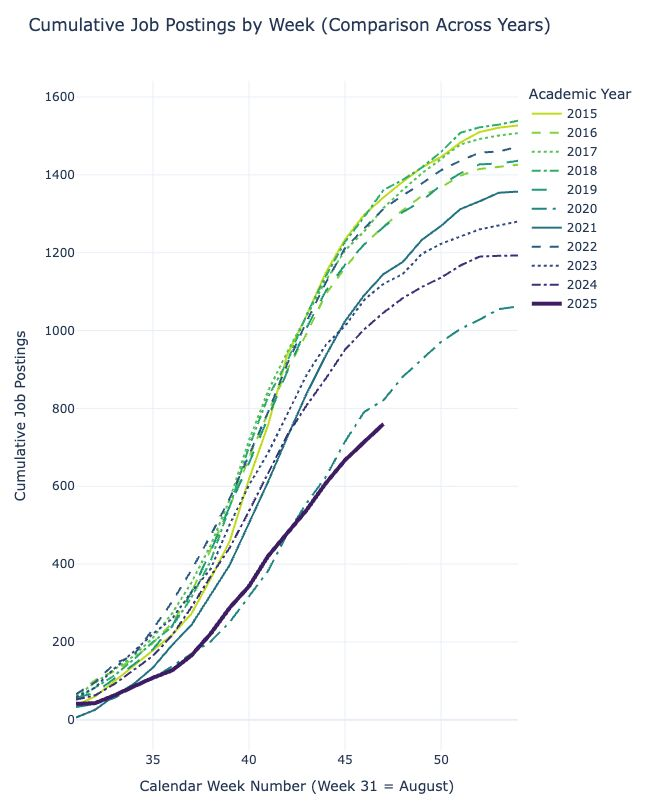
  • Study the requirements and the market conditions.
  • Prepare for long-term challenges.

Source: Paul Goldsmith-Pinkham on LinkedIn.
https://paulgp.com/2025/11/24/joe-market-update-november.html

What else to expect from the conference

  • Follow online both all in-person (Dec 4-5) & online (Dec 3-5) sessions in Bonn/Germany and around the globe.
  • Recruiters: Follow the GLO Job Market sessions for ASIA & EUROPE (Dec 3) and NORTH AMERICA (Dec 5).
  • Presentations from the GLO VirtYS Young Scholar mentoring program on Dec 3.
  • A large number of Invited & Contributed Research Paper Sessions (Dec 3-5) including some on EUROPE & AFRICA.
  • Focused research paper sessions in regional time-zones on NORTH AMERICA, INDIACHINA & OCEANIA (“Sydney”) (Dec 4-5)
  • The monthly GLO Research Seminar (Dec 4).
  • The Conference Keynote Speech (Dec 4).
  • The JOPE Kuznets Prize Ceremony & Speech (Dec 4).
  • The expert PanelCollaborating with China: Challenges and Chances
  • Presentation: Publishing with Springer Nature
  • New Book Presentation on the Death at Booroomba

Curious? Study the full program of the conference and register here: LINK

Global GLO-JOPE Conference 2025 With Book Launch of ‘Death at Booroomba’ by Alison Booth: More information & how to join online.

The full Program of the in-person & online Global GLO-JOPE Conference 2025, December 3-5 Bonn is now available. The annual signature event of the Global Labor Organization (GLO) supported by the Journal of Population Economics (JOPE) also entertains a book launch of Death at Booroomba by Alison Booth.

Alison L. Booth, a prominent Australian labor economist and celebrated novelist, has just published a new book, Death at Booroomba (Ventura Press, 2025). “Small town, big secrets.” Here you learn more about this fascinating crime story, the author and how to listen to her story.

Book Launch: On December 4, 2025, from 9:00 to 10:00 p.m. CET Berlin time (December 4, 2025, = 3:00 to 4:00 p.m. EST Philadelphia time = December 5, 2025, 7:00 to 8:00 a.m. AEDT Sydney time), she will present the book online at the Global GLO 2025 Conference.

  • See LINK for details on how to participate online in the Global GLO 2025 Conference.
  • More details about other time zones for this event see the information provided at the end of this post.
  • For background on the book and on Booth, please read her short bio and the accompanying interview here: LINK
  • More information about the book and how to order it: Website of the author.
  • Note that the “high noon” of this murder story takes place in early December 1915, just 110 years before the GLO 2025 conference.
  • To participate online in the book launch, you need to prior register here: LINK

What other to expect at the conference:

  • Follow online both all in-person (Dec 4-5) & online (Dec 3-5) sessions in Bonn/Germany and around the globe.
  • Recruiters: Follow the GLO Job Market sessions for ASIA & EUROPE (Dec 3) and NORTH AMERICA (Dec 5).
  • Presentations from the GLO VirtYS Young Scholar mentoring program on Dec 3.
  • A large number of Invited & Contributed Research Paper Sessions (Dec 3-5) including some on EUROPE & AFRICA.
  • Focused research paper sessions in regional time-zones on NORTH AMERICA, INDIA, CHINA & OCEANIA (“Sydney”) (Dec 4-5)
  • The monthly GLO Research Seminar (Dec 4).
  • The Conference Keynote Speech (Dec 4).
  • The JOPE Kuznets Prize Ceremony & Speech (Dec 4).
  • The expert PanelCollaborating with China: Challenges and Chances
  • Presentation: Publishing with Springer Nature

Curious? Study the full program of the conference and register here: LINK

Time Conversion –December 4, 2025, from 21:00 to 22:00 CET

Not your zone?  Check Time Zone Converter to orient yourself.

CityTime Zone (UTC Offset)Local Time Equivalent
Philadelphia, USAEST (UTC−5)15:00–16:00 (3–4 PM)
Los Angeles, USAPST (UTC−8)12:00–13:00 (12–1 PM)
Mexico City, MexicoCST (UTC−6)14:00–15:00 (2–3 PM)
Brasília, BrazilBRT (UTC−3)18:00–19:00 (6–7 PM)
Buenos Aires, ArgentinaART (UTC−3)18:00–19:00 (6–7 PM)
Auckland, New ZealandNZDT (UTC+13)09:00–10:00 (Dec 5)
Sydney, AustraliaAEDT (UTC+11)07:00–08:00 (Dec 5)
Seoul, KoreaKST (UTC+9)05:00–06:00 (Dec 5)
Tokyo, JapanJST (UTC+9)05:00–06:00 (Dec 5)
Beijing, ChinaCST (UTC+8)04:00–05:00 (Dec 5)
Bangkok, ThailandICT (UTC+7)03:00–04:00 (Dec 5)
Istanbul, TurkeyTRT (UTC+3)23:00–00:00 (Dec 4–5)
Cairo, EgyptEET (UTC+2)22:00–23:00 (Dec 4)
Cape Town, South AfricaSAST (UTC+2)22:00–23:00 (Dec 4)
Nairobi, KenyaEAT (UTC+3)23:00–00:00 (Dec 4–5)

Global GLO-JOPE Conference 2025, December 3-5 Bonn, is supported by IESR, Jinan University.

The full Program of the in-person & online Global GLO-JOPE Conference 2025, December 3-5 Bonn is now available. The annual signature event of the Global Labor Organization (GLO) supported by the Journal of Population Economics (JOPE) and the Institute for Economic and Social Research (IESR), Jinan University.

IESR organizes one online session of the conference, see next. Shuaizhang Feng, Dean of IESR, participates in-person in the conference in Bonn and contributes to various program parts. He is also an Editor of the Journal of Population Economics.

December 5, 2025

6:00 – 8:00 CET Berlin = 13:00 – 15:00 Beijing time IESR (China) Invited Session 
— Chair: Xue Sen (IESR & GLO)
— Zoom Moderator: Juno (Xiangyan) Qiu (IESR)

  • Hanming Fang, Jiayin Hu, Miao Yu (Peking University)
    Maternity Leave Extensions and Gender Gaps: Evidence from an Online Job Platform
  • James Kai-sing Kung, Wenbing Wu (University of Melbourne)
    The Rise of the Chinese Clan
  • Yunbo Liu, Zexuan Wang (Minzu University of China), Zesen Zhang, Jue Bai, Xiaoyang Ye
    Occupational Cognition and Employment Choices in Manufacturing: Evidence from the Information Intervention Experiment with Vocational College Students
  • Xiaogang Li, Ze Song (Nankai University), Puyang Sun, Hong Zou
    Stagnation and Differentiation in Growth: Quality Effects of Consumer Goods for Chinese Households

To participate online in this session, you need to prior register here: LINK

What other to expect at the conference:

  • Follow online both all in-person (Dec 4-5) & online (Dec 3-5) sessions in Bonn/Germany and around the globe.
  • Recruiters: Follow the GLO Job Market sessions for ASIA & EUROPE (Dec 3) and NORTH AMERICA (Dec 5).
  • Presentations from the GLO VirtYS Young Scholar mentoring program on Dec 3.
  • A large number of Invited & Contributed Research Paper Sessions (Dec 3-5) including some on EUROPE & AFRICA.
  • Focused research paper sessions in regional time-zones on NORTH AMERICA, INDIA, CHINA & OCEANIA (“Sydney”) (Dec 4-5)
  • The monthly GLO Research Seminar (Dec 4).
  • The Conference Keynote Speech (Dec 4).
  • The JOPE Kuznets Prize Ceremony & Speech (Dec 4).
  • The expert PanelCollaborating with China: Challenges and Chances
  • Presentation: Publishing with Springer Nature
  • New Book Presentation on the Death at Booroomba

Curious? Study the full program of the conference and register here: LINK

Program Available: Global GLO-JOPE Conference 2025, December 3-5 Bonn

The full Program of the in-person & online Global GLO-JOPE Conference 2025, December 3-5 Bonn is now available. The annual signature event of the Global Labor Organization (GLO) is supported by the Journal of Population Economics (JOPE).

What to expect:

  • Follow online both all in-person (Dec 4-5) & online (Dec 3-5) sessions in Bonn/Germany and around the globe.
  • Recruiters: Follow the GLO Job Market sessions for ASIA & EUROPE (Dec 3) and NORTH AMERICA (Dec 5).
  • Presentations from the GLO VirtYS Young Scholar mentoring program on Dec 3.
  • A large number of Invited & Contributed Research Paper Sessions (Dec 3-5) including some on EUROPE & AFRICA.
  • Focused research paper sessions in regional time-zones on NORTH AMERICA, INDIA, CHINA & OCEANIA (“Sydney”) (Dec 4-5)
  • The monthly GLO Research Seminar (Dec 4).
  • The Conference Keynote Speech (Dec 4).
  • The JOPE Kuznets Prize Ceremony & Speech (Dec 4).
  • The expert PanelCollaborating with China: Challenges and Chances
  • Presentation: Publishing with Springer Nature
  • New Book Presentation on the Death at Booroomba

Curious? Study the full program here:

https://glabor.org/program-details-glo-bonn-2025/

Please register to follow online all parts of the program.

2025-26 GLO Virtual Young Scholars Program (GLO VirtYS) has started

The 2025–26 GLO Virtual Young Scholars Program (GLO VirtYS) is a 10-month international research and mentoring initiative designed for early-career scholars committed to producing policy-relevant, high-quality academic work. Starting on October 1, 2025, selected participants have joined a global cohort as GLO Affiliate and will receive individual guidance from thematic cluster advisors, structured feedback on their research, and opportunities to present their findings within the GLO community. Upon successful completion by July 30, 2026, scholars will have the opportunity to submit their work to the GLO Discussion Paper Series and may be considered for appointment as a GLO Fellow. They will also have the opportunity, to present their research at the GLO-JOPE Conference 2026, the annual GLO signature event on December 2-4, 2026.

The GLO VirtYS Alumi Invited Session 2025 as part of the GLO-JOPE Conference 2025 is scheduled for December 3, 2025 and will soon be announced as part of the general conference program HERE.

The program is directed by Olena Nizalova (University of Kent & Director VirtYS).

GLO is proud to announce another strong cohort of VirtYS Scholars:

The 2025-26 GLO VirtYS Cohort Advisors are: 

GLO is grateful for the great service provided by these established researchers.

*****

Note: Featured image by Employee-Training-unsplash

Ends;
Third Call for Papers. GLO-JOPE Conference Bonn & Global – December 3-5, 2025. Submission Deadline November 5, 2025.

Second Call for Papers. The Global Labor Organization (GLO), a large international network of economists and related disciplines, invites contributed papers on all areas of applied human resources issues to its annual hybrid global GLO-JOPE 2025 conference (3-5 December 2025). Supported by the Journal of Population Economics (JOPE), it organizes online sessions for this period, and on December 4-5 a connected in-person event in the Science Center Bonn.

Contributions are invited to cover issues broadly defined about: labor, population, development, family, fertility, migration, refugees, health, crime, conflict, religion, behavioral economics and other human resources topics.
Special interests include papers related to Africa, India, Chinaglobalization or covered by the JOPE Collections.

Submissions are open, and the submission deadline is November 5, 2025. For further details (continuously updated) see 

https://glabor.org/global-glo-jope-conference-2025-december-3-5-bonn/

SUBMISSION DEADLINE EXTENDED to November 5, 2025.
Decision communication ongoing, at the latest on November 10.
Registration deadline: November 17, 2025.

WHAT HIGHLIGHTS TO EXPECT?

  • Keynote speech by Viola Angelini (University of Groningen) on
    Growing Older in Good Health: Tracing the Roots of Inequalities
  • December GLO Research Seminar provided by  Olga Stoddard (Brigham Young University): The Visible Costs of Invisible Household Labor
  • Claudio Costanzo (European Commission’s Joint Research Centre & ECARES) receives the 2026 Kuznets Prize and presents his FREE READ (https://rdcu.be/eKaC4) article Robots, jobs, and optimal fertility timing. More details.
  • Panel Discussion on Collaborating with China: Challenges and Chances with prominent speakers (see draft program).
  • Job Market Sessions for  young scholars. See separate CALL FOR PAPERS.
  • Presentation of the new book Death at Booroomba by novelist (& economist) Alison Booth. See also the interview she just gave GLO: LINK
  • A larger number of Journal of Population Economics Editors and Associate Editors present & acting, including Klaus F. Zimmermann, Xi Chen, Shuaizhang Feng, Alfonso Flores-Lagunes, Milena Nikolova, Kompal Sinha & Max Tani.
  • About 80 in-person presentations in the Science Center Bonn, all accessible online, and a larger number of online-only paper presentations from all continents.
  • Visit the Publisher Booth of Springer Nature, publisher of the Journal of Population Economics, the Handbook of Labor, Human Resources and Population Economics and the book series Population Economics.
  • Visit Bonn and other near-by German destinations during the Christmas season to enjoy the many local Christmas markets. Explore the Beethoven House, discover the city’s wide range of museums, and tour the numerous art galleries of the former capital. Visit the Drachenfels and take in the spectacular views of the Rhine Valley.

Call for Submissions: GLO Annual Online Conference Job Market Sessions

The Global Labor Organization (GLO) is pleased to announce a call for submissions for its annual conference (GLO JOPE Bonn 2025), which will be held from December 3-5, 2025 online and in-person in Bonn/Germany. Affiliated to this conference are online Job Market Sessions for young scholars, which have been very successful in previous years. The submission deadline for these sessions is November 14, 2025.

GLO Young Scholars Program invites job market candidates (PhD students or postdocs currently on the market in North America, Europe or Asia) to submit their research for presentation in dedicated job market sessions. This is a valuable opportunity to showcase your work and gain exposure in a supportive and high-profile environment. A special Q&A mentoring session for the selected presenters will take place after the presentations.

Session Focus: The job market sessions will focus on research related to labor, demography, health, or human resources broadly defined. We welcome submissions from candidates in all related disciplines.

Submission Requirements: Proposals must include:

  • A paper or extended abstract of one’s Job Market Paper
  • A CV

Submissions can be made either via link or as an attachment.

Session Regions Preferences: The job market sessions will also be organized by region based on their preferences for the timing of their presentations and the market of potential employers:

  • North America
  • Europe
  • Asia

Please indicate your session preference in your submission. Presentations will be in English.

Submission Deadline: All submissions must be received by November 14th, 2025. Notification of decision will be sent on November 20th, 2025. 

Submission Process: Please click on the link below (or scan the QR code below) to submit your information and the required documents. If you have any questions regarding the submission process, feel free to contact Dr. Le Wang, Director of GLO Young Scholars Program.

SUBMISSION LINK

Benefits of Being Selected as a Presenter:

  • Presenters are invited to provide a link to their personal websites which will be featured on the GLO website in the conference program, enhancing their portfolio’s visibility within the global research community.
  • Presenters will have access to a special Q&A mentoring session focused on the job market experience, where committee members and peers share insights and advice.
  • The online format minimizes costs, making participation accessible to candidates with limited financial resources. To further support early-career scholars, registration fees are waived for all job market candidates. This encourages a diverse set of institutions to be represented.
  • Gain valuable experience presenting your research in a highly supportive environment, helping you refine your job market pitch and assess the progress of your work.
  • Presenters will be eligible for an invitation to join the prestigious GLO network as a research affiliate, providing further opportunities for collaboration and professional growth.

We look forward to your participation and to supporting the next generation of scholars in labor and related fields. 

Organizing Committee:

Le Wang (Chair) Virginia Tech
Nazanin Sedaghatkish (Sam Houston State University), Leena Bhattacharya (Tilburg University), Tyler Ransom (University of Oklahoma), Fan Wang (University of Houston), Bingxiao Wu (Rutgers)

Ends;
Second Call for Papers. GLO-JOPE Conference Bonn & Global – December 3-5, 2025. Submission Deadline October 23, 2025.

Second Call for Papers. The Global Labor Organization (GLO), a large international network of economists and related disciplines, invites contributed papers on all areas of applied human resources issues to its annual hybrid global GLO-JOPE 2025 conference (3-5 December 2025). Supported by the Journal of Population Economics (JOPE), it organizes online sessions for this period, and on December 4-5 a connected in-person event in the Science Center Bonn.

Contributions are invited to cover issues broadly defined about: labor, population, development, family, fertility, migration, refugees, health, crime, conflict, religion, behavioral economics and other human resources topics.
Special interests include papers related to Africa, India, Chinaglobalization or covered by the JOPE Collections.

Submissions are open, and the submission deadline is October 23, 2025. For further details (continuously updated) see 

https://glabor.org/global-glo-jope-conference-2025-december-3-5-bonn/

SUBMISSION DEADLINE EXTENDED to November 5, 2025.
Decision communication ongoing, at the latest on November 10.
Registration deadline: November 17, 2025.

WHAT HIGHLIGHTS TO EXPECT?

  • Keynote speech by Viola Angelini (University of Groningen) on
    Growing Older in Good Health: Tracing the Roots of Inequalities
  • December GLO Research Seminar provided by  Olga Stoddard (Brigham Young University): The Visible Costs of Invisible Household Labor
  • Claudio Costanzo (European Commission’s Joint Research Centre & ECARES) receives the 2026 Kuznets Prize and presents his FREE READ (https://rdcu.be/eKaC4) article Robots, jobs, and optimal fertility timing. More details.
  • Panel Discussion on Collaborating with China: Challenges and Chances with prominent speakers.
  • Presentation of the new book Death at Booroomba by novelist (& economist) Alison Booth. See also the interview she just gave GLO: LINK
  • A larger number of Journal of Population Economics Editors and Associate Editors present & acting, including Klaus F. Zimmermann, Xi Chen, Shuaizhang Feng, Alfonso Flores-Lagunes, Milena Nikolova, Kompal Sinha & Max Tani.
  • About 80 in-person presentations in the Science Center Bonn, all accessible online, and a larger number of online-only paper presentations from all continents.
  • Visit the Publisher Booth of Springer Nature, publisher of the Journal of Population Economics, the Handbook of Labor, Human Resources and Population Economics and the book series Population Economics.
  • Visit Bonn and other near-by German destinations during the Christmas season to enjoy the many local Christmas markets. Explore the Beethoven House, discover the city’s wide range of museums, and tour the numerous art galleries of the former capital. Visit the Drachenfels and take in the spectacular views of the Rhine Valley.

2026 Kuznets Prize Awarded to Robots, Jobs, and Optimal Fertility Timing

Claudio Costanzo (European Commission’s Joint Research Centre & ECARES) receives the 2026 Kuznets Prize for his FREE READ (https://rdcu.be/eKaC4) article Robots, jobs, and optimal fertility timing, which was published in the Journal of Population Economics (2025), 38, article 51. The annual prize honors the best article published in the Journal of Population Economics in the previous year. 

The prize will be awarded in-person in a public online event during the hybrid Global GLO-JOPE Conference 2025, December 3-5, in Bonn, Germany, on December 4, 2025 at 4:30-5:30 pm CET Bonn time. The event will be online accessible from around the world.

CALL FOR PAPERS (Deadline: November 5, 2025) for online and in-person presentations at the conference see LINK.

More information about the Kuznets Prize & previous prize winners.


Biographical Abstract

Claudio Costanzo is a researcher at the European Commission’s Joint Research Centre (JRC) and a PhD candidate at ECARES (ULB). His research spans labor and demographic economics, and behavioral/applied microeconomics, with a focus on how technological change shapes population dynamics, household decision-making, and labour market outcomes. His work aims to connect micro-level evidence with quantitative models to inform policy design and evaluation.

Paper Abstract

The paper examines how industrial robots influence the timing of childbirth in Europe. Higher exposure to robots is associated with earlier fertility in low- and high-skilled regional labor markets and with a delay in medium-skilled ones. The underlying mechanisms are rationalized through a model of fertility, parameterized with data on individuals’ expectations about the displacement and creation of jobs due to automation. Variations in the simulated timing of childbirth are associated with corresponding changes in childlessness rates. The results establish a link between the Routine-Biased Technological Change hypothesis and demographic behavior.

Ends;
 

Call for Papers. GLO-JOPE Conference Bonn & Global – December 3-5, 2025. Submission Deadline October 23, 2025.

First Call for Papers. The Global Labor Organization (GLO), a large international network of economists and related disciplines, invites contributed papers on all areas of applied human resources issues to its annual hybrid global GLO-JOPE 2025 conference (3-5 December 2025). Supported by the Journal of Population Economics (JOPE), it organizes online sessions for this period, and on December 4-5 a connected in-person event in the Science Center Bonn. Submissions are open, and the submission deadline is October 23, 2025. For further details (continuously updated) see 

https://glabor.org/global-glo-jope-conference-2025-december-3-5-bonn/

Journal of Population Economics honored at the Springer Nature Editors Summit in Heidelberg

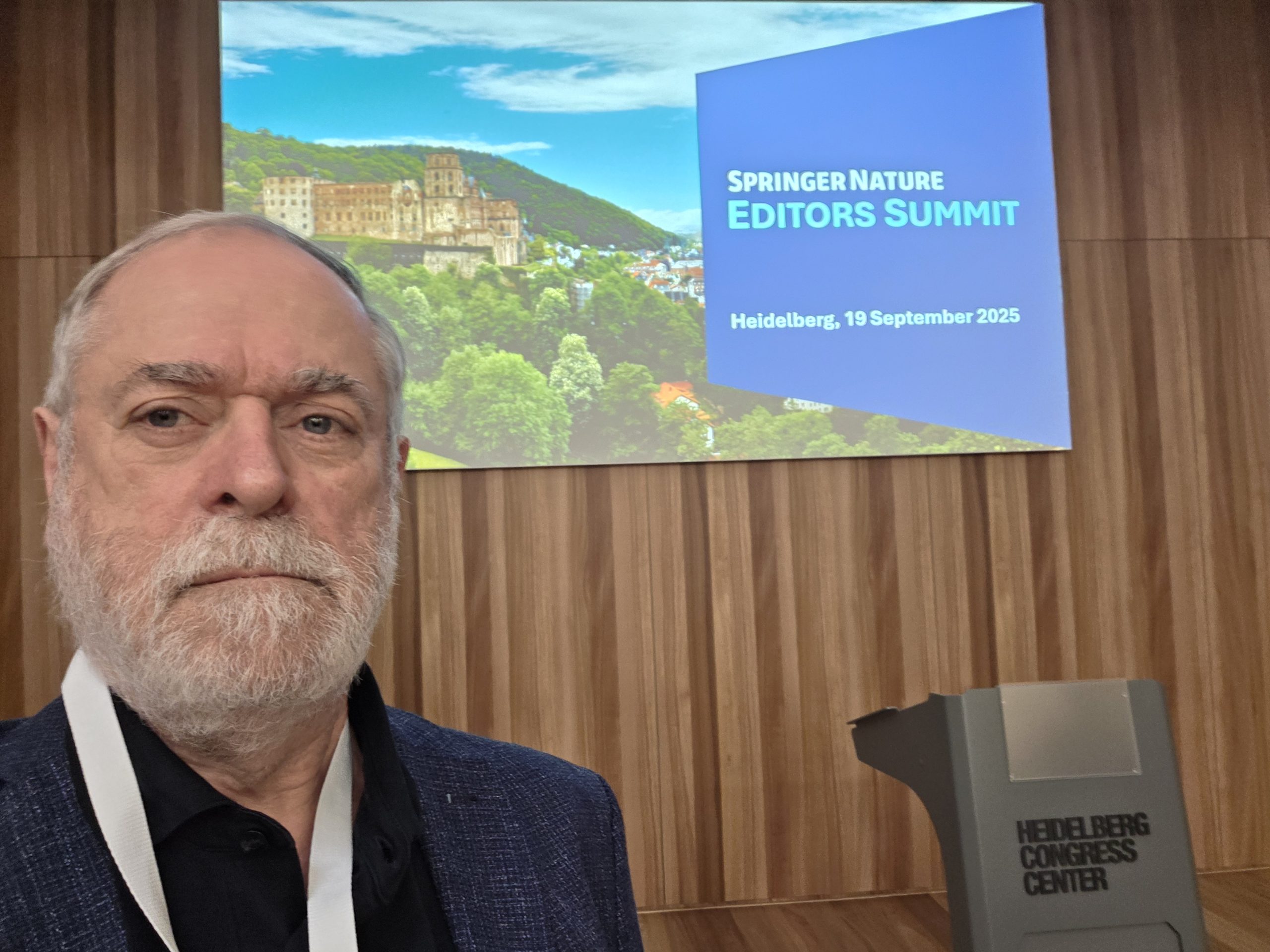
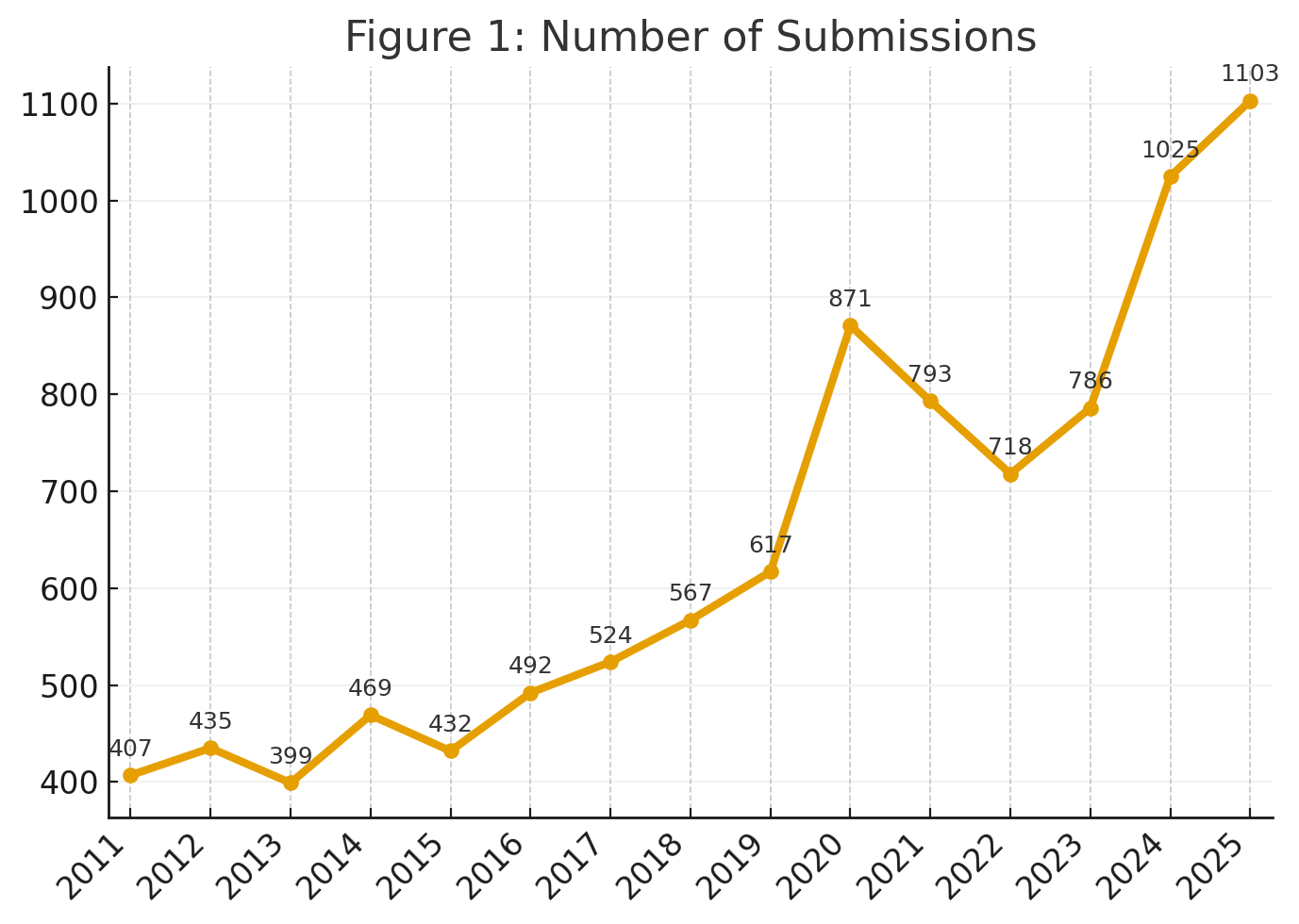
As the Editor-in-Chief of the Journal of Population Economics (JOPE), Klaus F. Zimmermann was invited to speak on September 19, 2025 at the Springer Nature Editor Summit in Heidelberg about the success story of the journal. On January 2024, JOPE introduced Continous Article Publishing (CAP) to ensure fast and efficient publication of accepted manuscripts. At the same time, it started a larger number of article Collections to signal topics of interest to generate extra high quality submissions. Recently, Zimmermann had received the Springer Nature Editor of Distinction Awards 2025. Below see number of submissions to the journal, 2011 to 2025.

Note: 2020/2021: Larger number of transfer desk submissions. 2025: Predicted based on actual numbers on September 17, 2025.

Ends;
Call for Papers: 8th Renmin University of China – GLO Annual Conference on “Micro Population Economics and Human Relations”, 1-2 November 2025, Beijing, China.

Call for Papers: The 8th Renmin University of China – GLO Conference provides a platform for researchers working on topics related to Micro Population Economics and Human Relations: Personality, Subjective Beliefs, Feelings, Norms, Preferences, Stereotypes, and AI Adaption. Submit papers or extended abstracts by September 20, 2025 at renmin-glo@ruc.edu.cn.

Final: PROGRAM PDF (Call is closed). See also: LINK

The 8th Renmin University of China – GLO Conference provides a platform for researchers working on topics related to Micro Population Economics and Human Relations: Personality, Subjective Beliefs, Feelings, Norms, Preferences, Stereotypes, and AI Adaption.

Beyond this focus, submissions on topics such as migration and other demographic issues, household and family economics, health and well-being, education and human capital, environment, labor market discrimination, and labor market policies are also considered.

The event is jointly organized by the School of Labor and Human Resources at Renmin University of China and the Global Labor Organization (GLO) and supported by the Journal of Population Economics. It will take place on November 1-2, 2025 at Renmin University of China, Beijing.

There are no conference fees. Travel and accommodation need to be covered and arranged by participants. The School of Labor and Human Resources will offer catered lunch and refreshments throughout the event and conference dinner on November 1.

Keynote speakers
Suqin Ge (Virginia Tech and GLO)
Klaus F. Zimmermann (UNU-MERIT and GLO)

Submissions
You are invited to submit papers or extended abstracts by September 20, 2025 at renmin-glo@ruc.edu.cn.
Selected participants will be notified by September 30, 2025.
To join the GLO, please visit: https://glabor.org/join-the-glo/

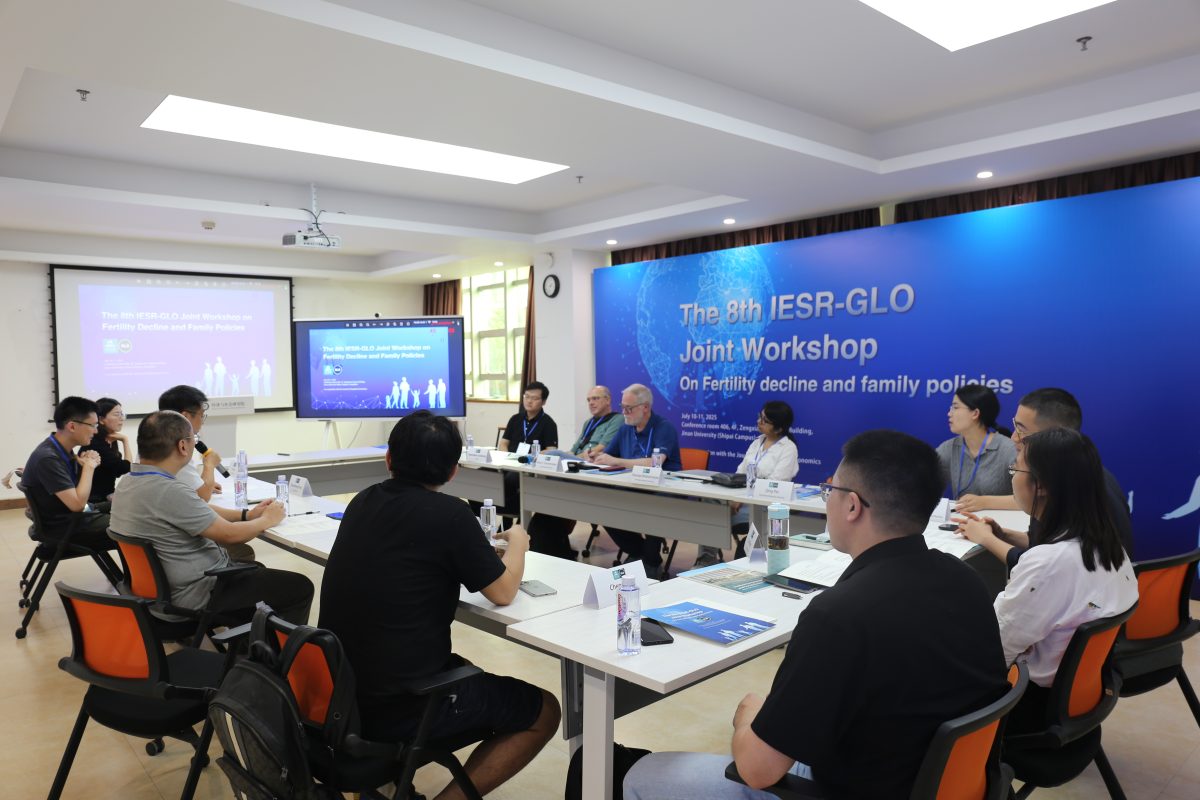
8th IESR-GLO joint workshop on “Fertility decline and family policies” at Jinan University, Guangzhou, China, organized with support of the Journal of Population Economics.

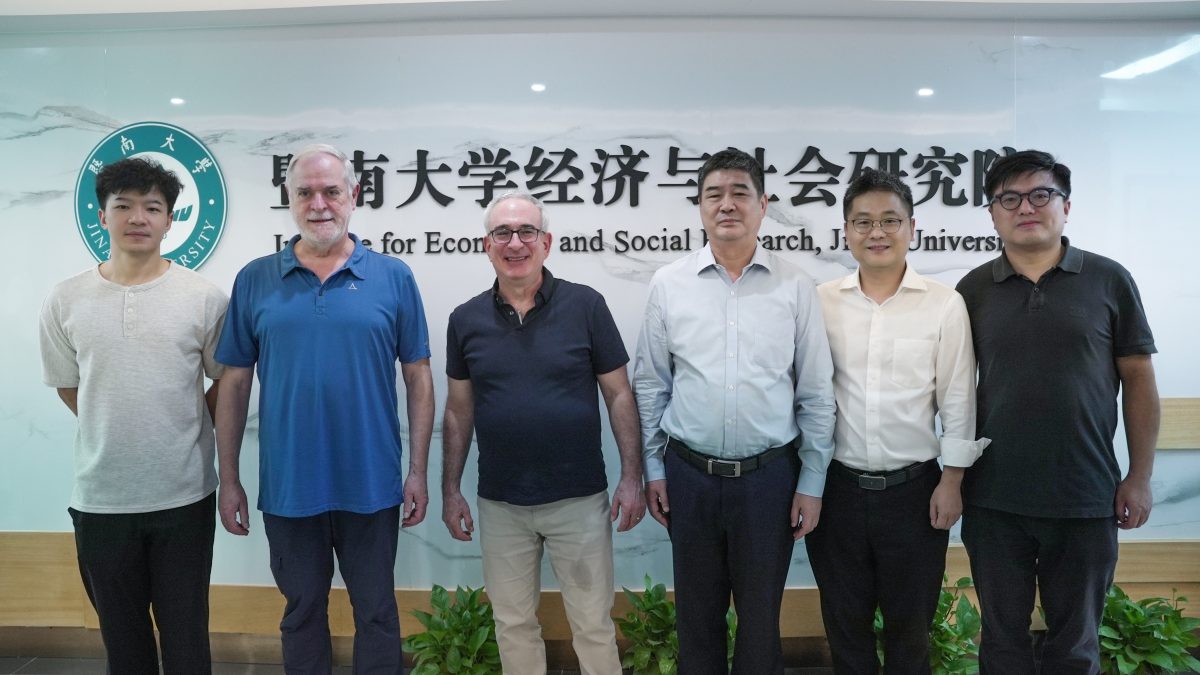
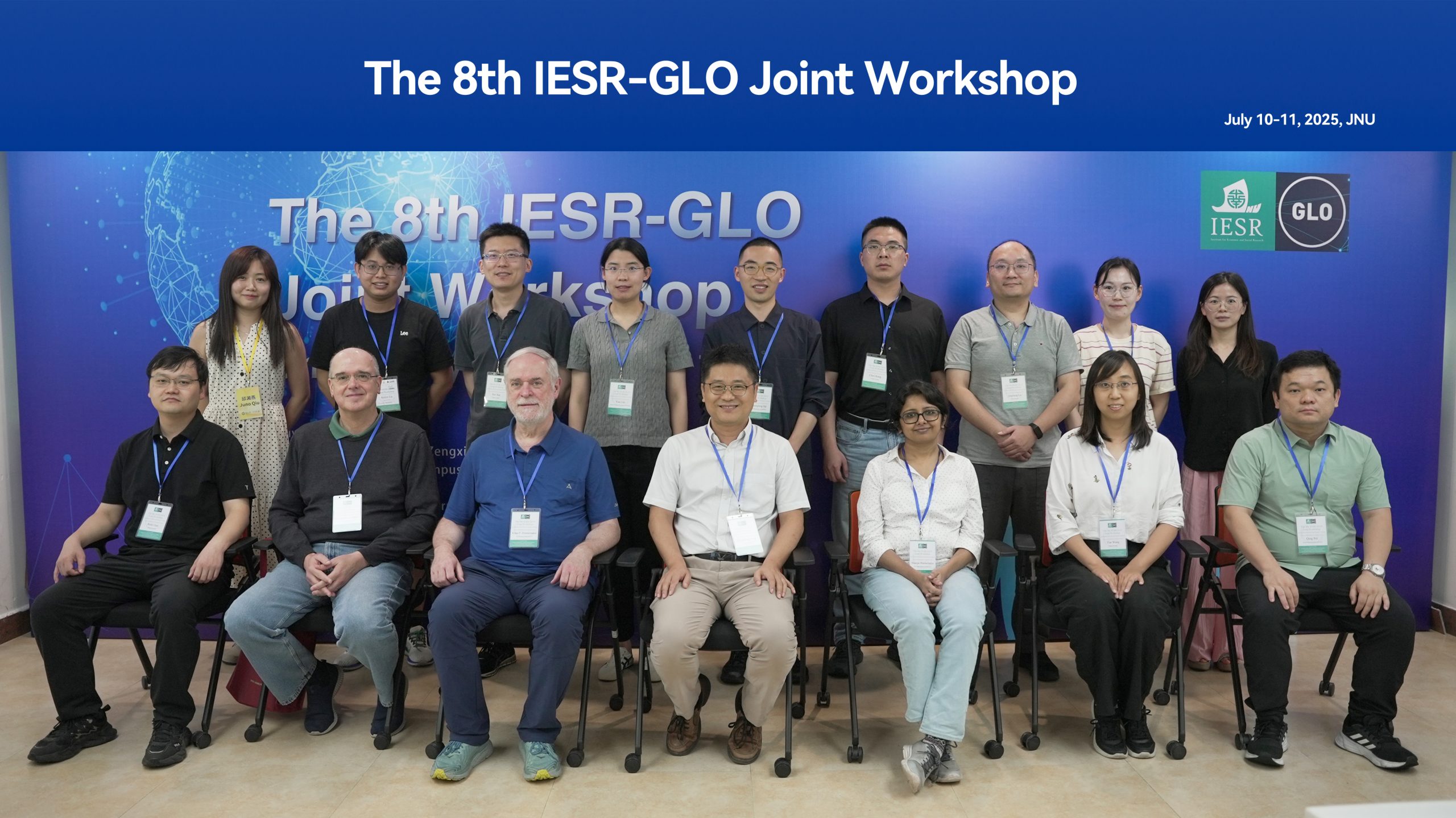
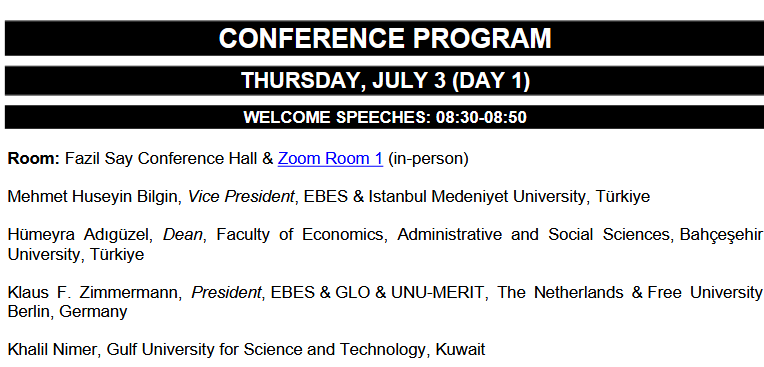
After participating in the EBES 53 conference in Istanbul, GLO President Klaus F. Zimmermann traveled to Guangzhou, China, from July 5-11, 2025. As a Honorary Professor of IESR, Jinan University, he met with a larger number of researchers for academic exchange and research and co-organized a workshop event. IESR is a GLO partner institution and hosts an annual joint research workshop. The topic this year was “Fertility decline and family policies”, a topic where the Journal of Population Economics seeks high-quality submissions.

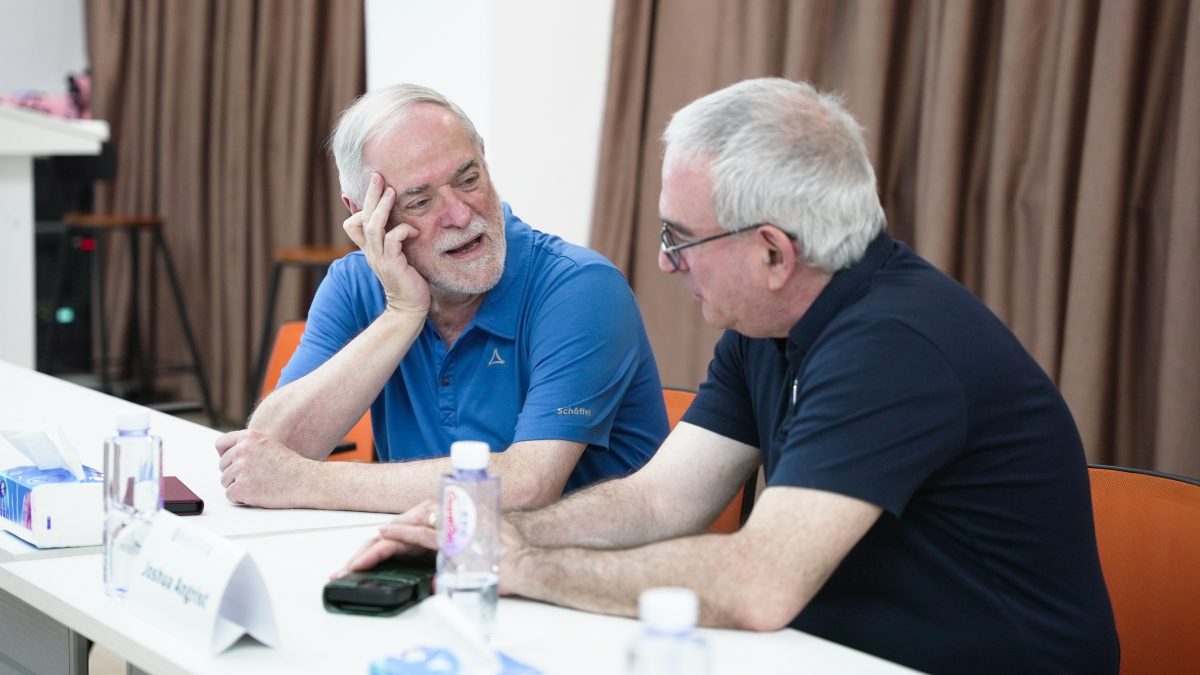
The intensive week started on July 7 with participating in a public lecture of Nobel Prize Laureate Joshua D. Angrist of MIT on “Intentions are Good but Instrumental Variables is Better: Rescuing Real-World Randomized Trials”. What an impressive and insightful talk!

Picture left (center): Klaus F. Zimmermann, Josh Angrist, Jinan University Rector Feng Xing, IESR Dean Shuaizhang Feng.
Picture right: Klaus F. Zimmermann, Josh Angrist

On July 8, Zimmermann gave a lecture to IESR junior faculty and students on “Publishing in International Research Journals” and interacted with IESR senior faculty including IESR Dean Shuaizhang Feng. On July 9 and 10 followed meetings with GLO Fellows Shu Cai, Qing Pei and Max Tani.

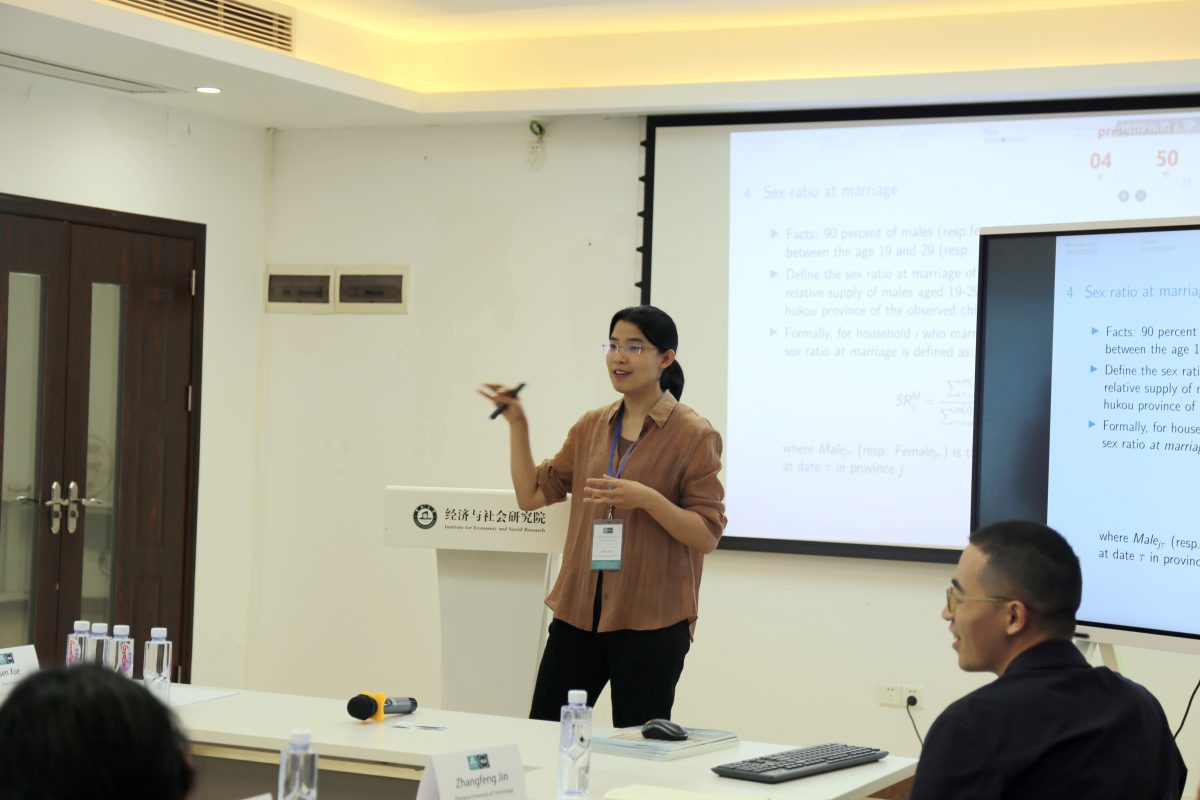
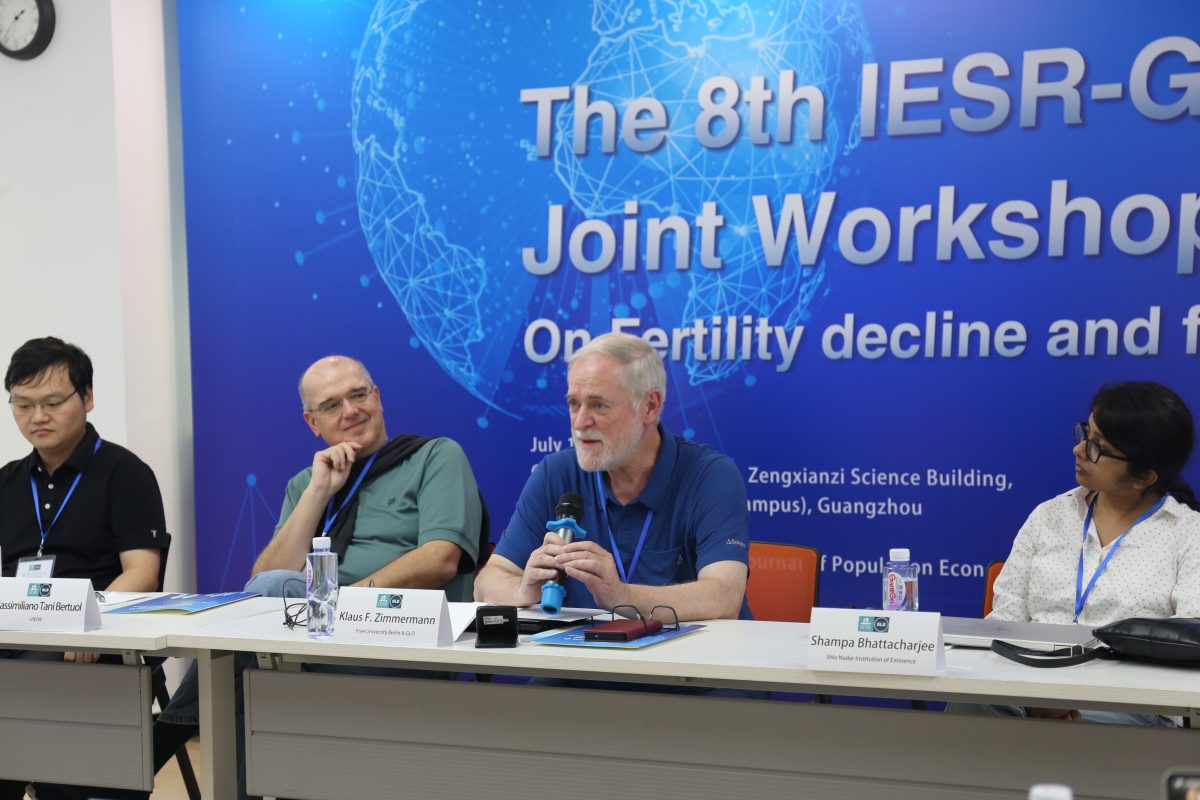
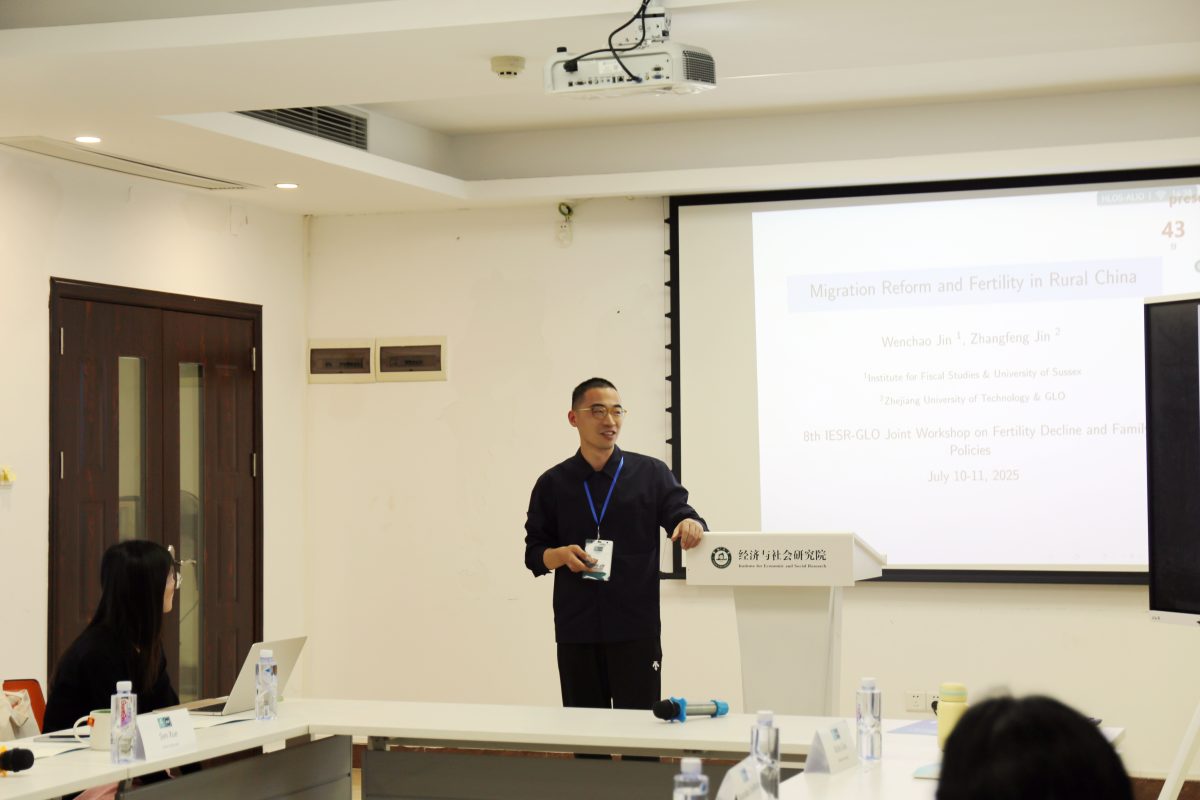
The 8th IESR-GLO joint workshop on “Fertility decline and family policies” took place on July 10-11, 2025, in Jinan University, Guangzhou, China. It was organized in co-operation with the Journal of Population Economics and collected a selection of great research papers on the topic.

Final Program

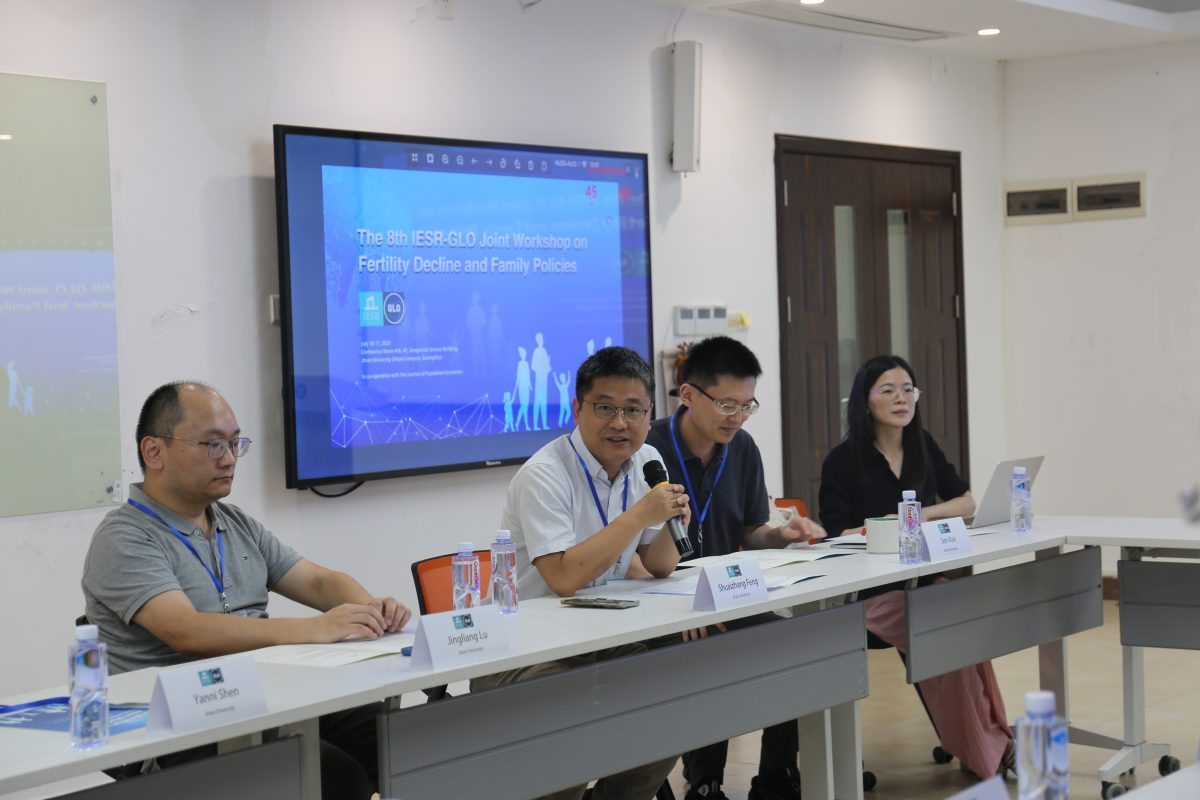
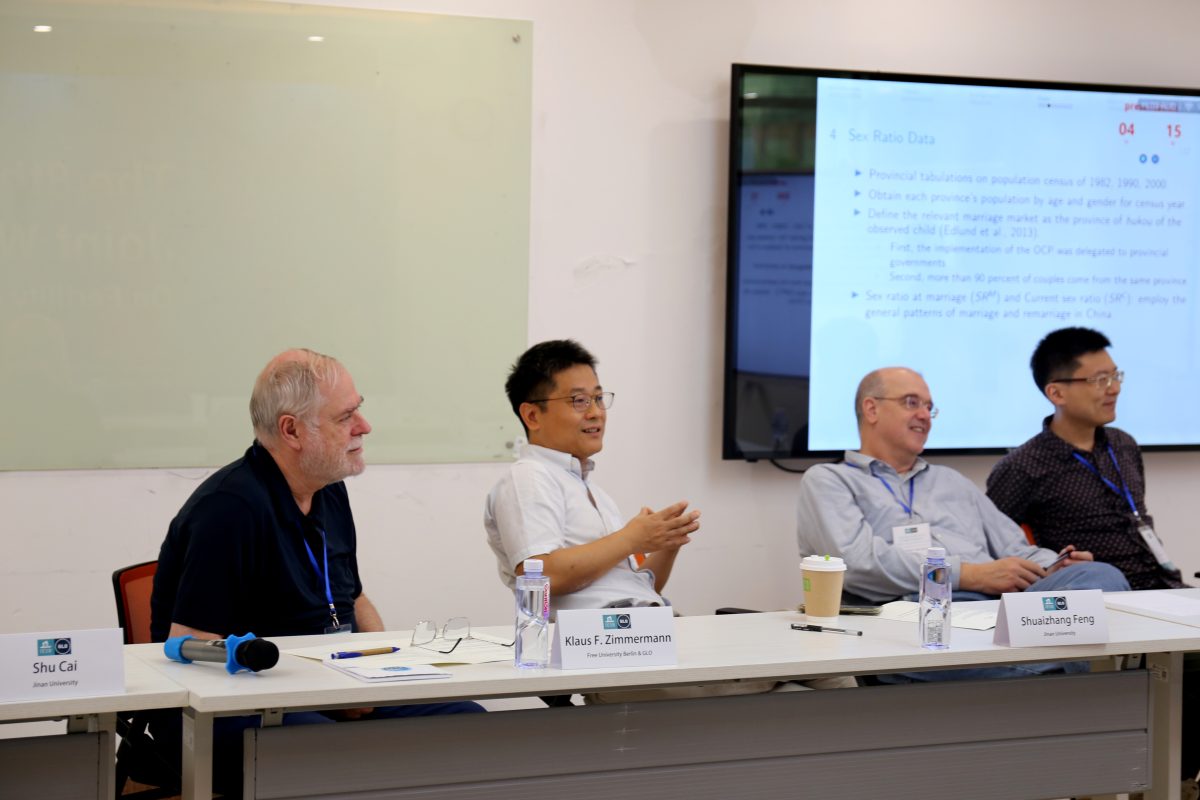
Left below: Klaus F. Zimmermann, Shuaizhang Feng, Max Tani & Sen Xue

Day 1, July 10
12:00-13:30 PM Lunch

13:30-13:45 PM Welcome
Journal of Population Economics (JOPE) & IESR-GLO Collaboration
Shuaizhang Feng, Jinan University and GLO, JOPE Editor
Klaus F. Zimmermann, UNU-MERIT and GLO, JOPE Editor-in-Chief

Session I
Chair: Shuaizhang Feng

13:45-14:30 PM
Title: The Economics of Fertility Decline
Author(s): Klaus F. Zimmermann (Free University Berlin & GLO)

14:30-15:15 PM
Title: Migration Reform and Fertility: Causal Evidence from Rural China
Author(s): Zhangfeng Jin (Zhejiang University of Technology & GLO)
         Wenchao Jin

15:15-15:45 Group Photo & Break

15:45-16:30 PM
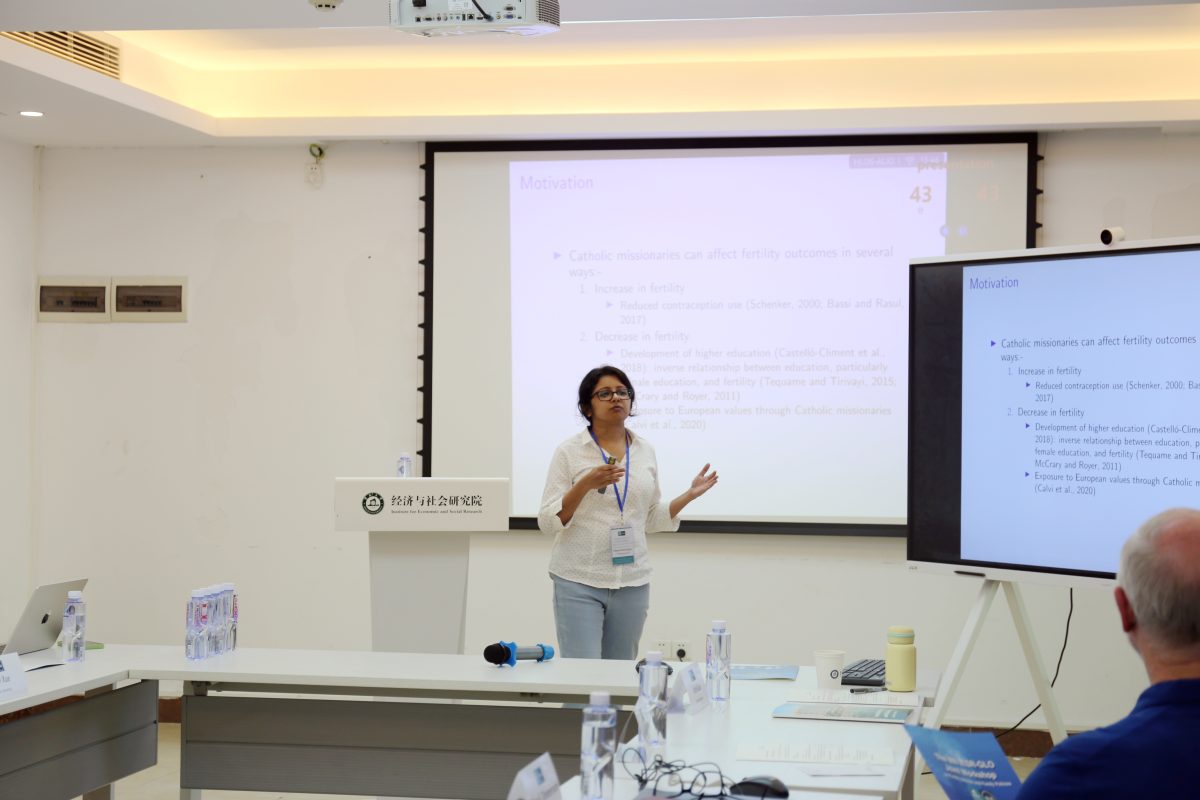
Title: Catholic Missionary Presence and Fertility in India
Author(s): Shampa Bhattacharjee (Shiv Nadar Institution of Eminence & GLO)
Roopal Jain & Priyoma Mustafi

16:30-17:15 PM
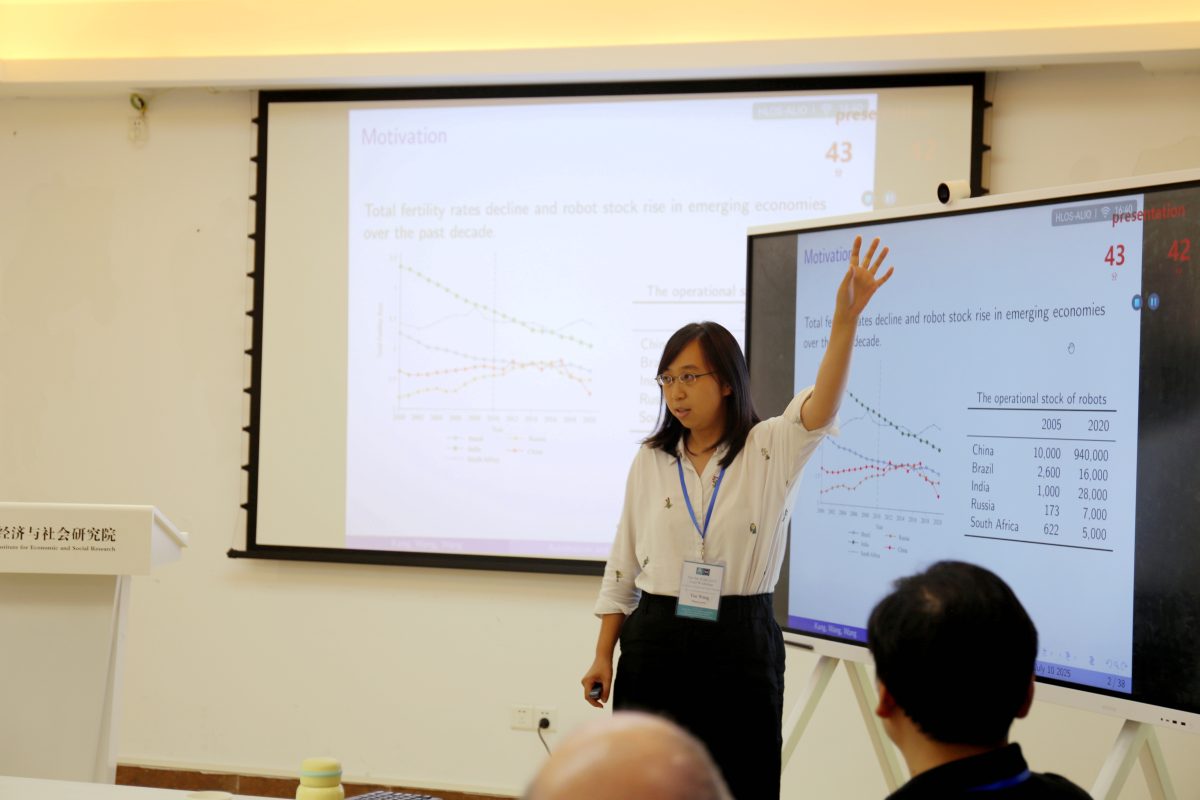
Title: Automation and Fertility Transitions in China
Author(s): Yue Wang (Peking University and GLO)
Chen Kang (Tongji University) & Xiaobing Wang (Peking University)

17:30-19:30 PM Dinner

Day 2, July 11

Session II
Chair: Klaus F. Zimmermann

9:00-9:45 AM
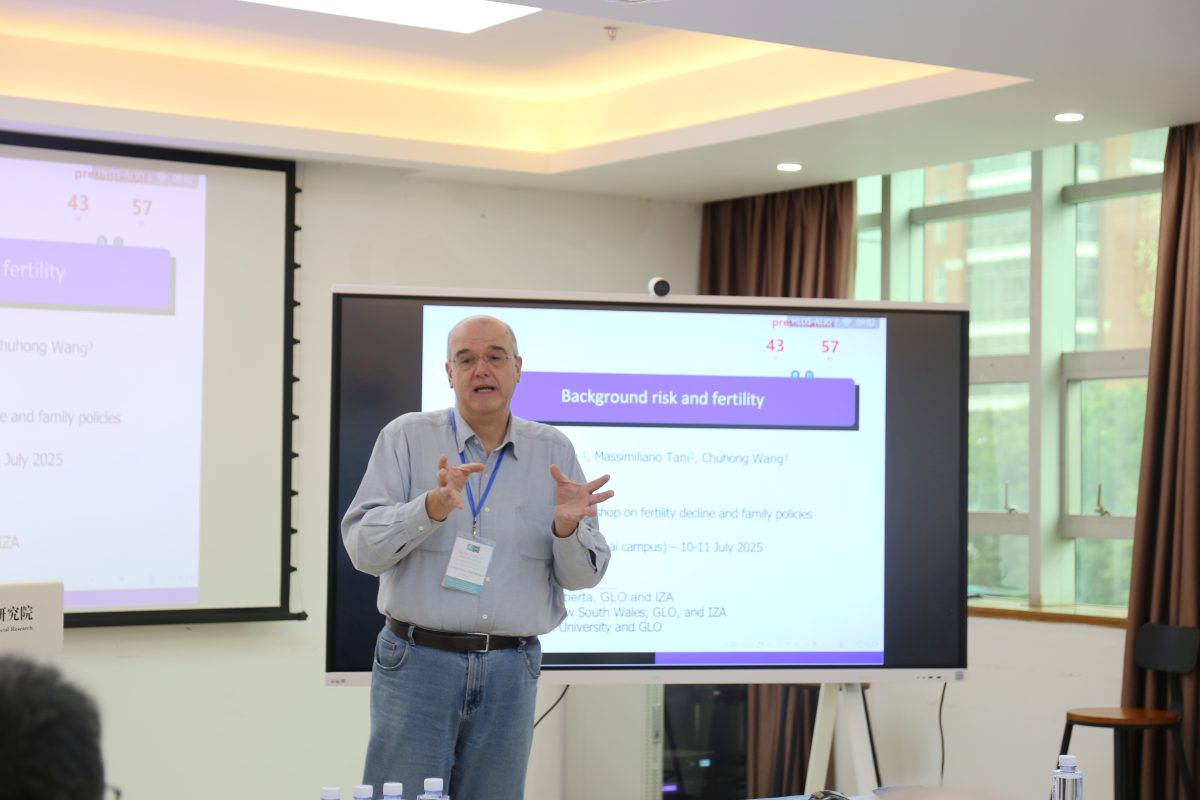
Title: Background Risk and Fertility
Author(s): Massimiliano Tani Bertuol (School of Business, UNSW & GLO)

9:45-10:30 AM
Title: Sex Ratio, Commitment and Power Distribution Within the Household: An Empirical Investigation of China’s One Child Policy
Author(s): Xiao Liu (Capital University of Economics and Business)
Pierre-André Chiappori (Columbia University) & Yaohui Zhao (Wuhan University & Peking University)

10:30-11:00 AM Break

11:00-11:45 AM
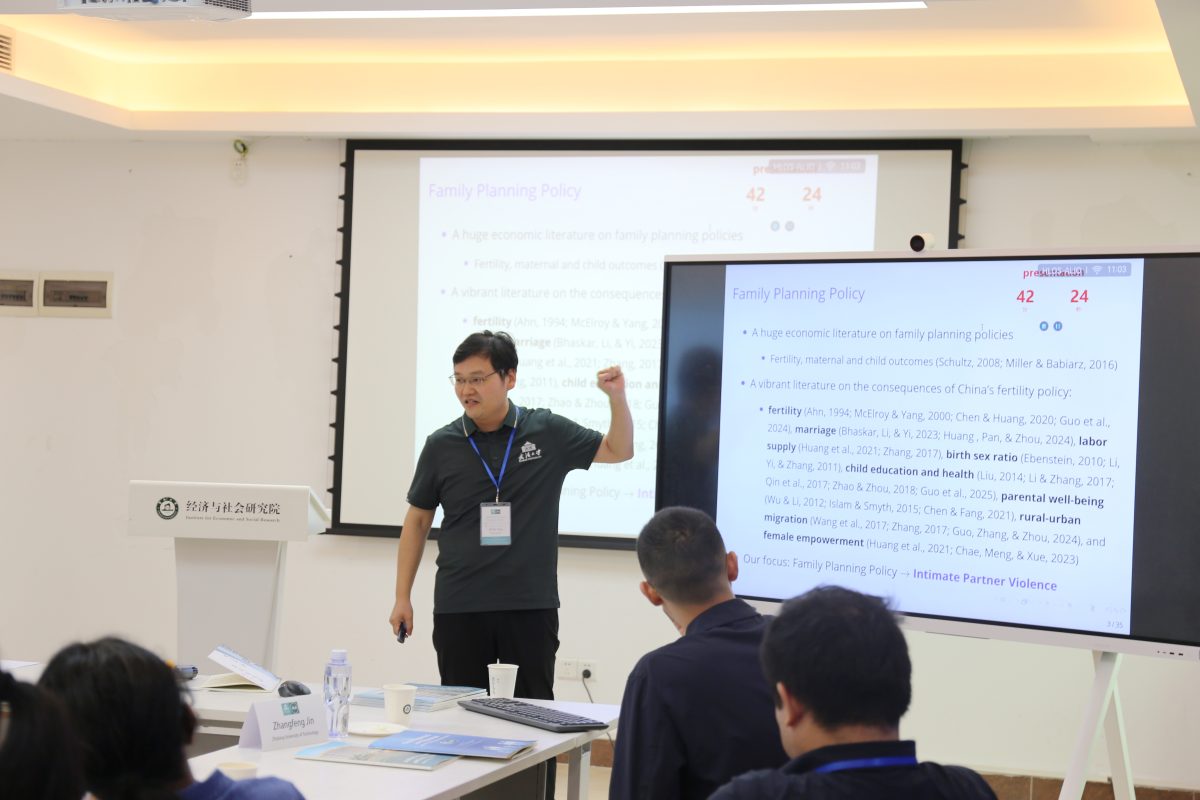
Title: Family Planning Policy and Intimate Partner Violence
Author(s): Rufei Guo (Wuhan University and GLO)
Jiawei Sheng (Wuhan University), Ying Wang (Wuhan University) & Jingyuan Yang (Hong Kong Baptist University)

11:45-12:30 PM
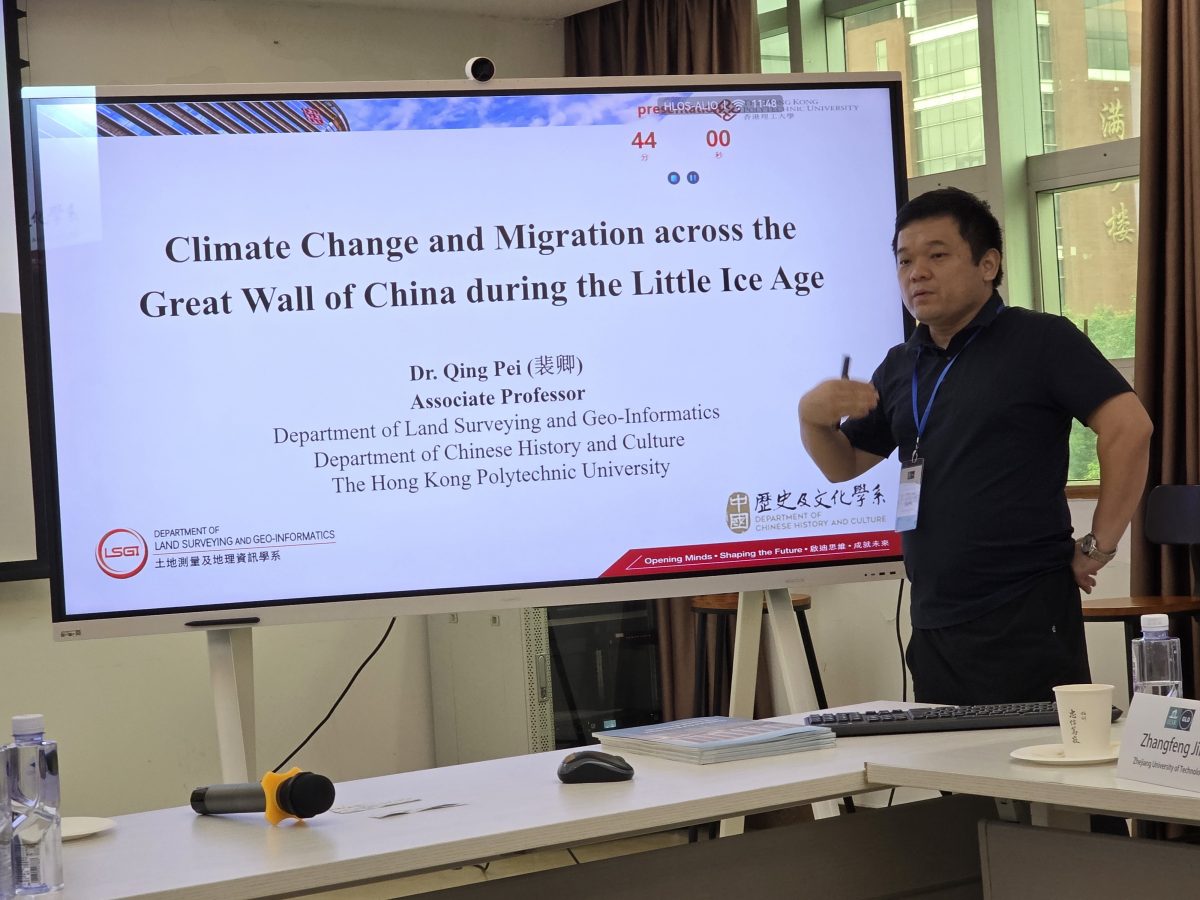
Title: Climate Change and Migration across the Great Wall of China during the Little Ice Age
Author(s): Qing Pei (Hong Kong Polytechnic University & GLO)

12:30-14:00 PM Lunch

RELATED:

– Seventh Renmin University & GLO Annual Conference 2024 on Low Fertility & Population Aging. In collaboration with the Journal of Population Economics. LINK

Hart, R.K., Bergsvik, J., Fauske, A., Kim, W. (2024). Causal Analysis of Policy Effects on Fertility. In: Zimmermann, K.F. (ed.) Handbook of Labor, Human Resources and Population Economics. Springer, Cham.
https:/doi.org/10.1007/978-3-319-57365-6_451-1

CALL FOR PAPERS: Collection Understanding Fertility Decline of the Journal of Population Economics. Details. See more related papers there.

– Costanzo, C. Robots, jobs, and optimal fertility timing. Journal of Population Economics 38, 51 (2025). https://doi.org/10.1007/s00148-025-01105-3. Free to read: https://rdcu.be/eubHU
– Huang, W., Wang, Y., Wu, H. et al. The motherhood penalty and low fertility in China: a pseudo-event study. Journal of Population Economics 38, 28 (2025). https://doi.org/10.1007/s00148-025-01078-3. Free to read: https://rdcu.be/eubJs
– Li, H., Shi, X. The effect of the one-child policy on fertility in China: identification based on difference-in-differences. Journal of Population Economics 38, 2 (2025). https://doi.org/10.1007/s00148-025-01061-y. Free to read: https://rdcu.be/eubJ4
– Luo, W., Zou, X. Demographic impacts of China’s trade liberalization: marriage, spousal quality, and fertility. Journal of Population Economics 37, 63 (2024). https://doi.org/10.1007/s00148-024-01040-9. Free to read. https://rdcu.be/eubKD

– Victoria Vernon and Klaus F. Zimmermann (2021), “Walls and Fences: A Journey Through History and Economics”, in: Kourtit, K., Newbold, B., Nijkamp, P. and Partridge, M., The Economic Geography of Cross-Border Migration, Springer, Heidelberg et al., pp. 33-54; GLO Discussion Paper No. 33o, 2019. Pre-publication version. Published. More info on book.


Call for Papers : 53rd EBES Conference in Madrid on October 16-18, 2025

The 53rd EBES Conference takes place in Madrid/Spain on October 16-18, 2025 hosted by the Faculty of Economics and Business, Universidad Complutense, with the support of the Istanbul Economic Research Association. Interested researchers from around the world are cordially invited to submit their abstracts or papers for presentation considerations.

The conference aims to bring together many distinguished researchers from all over the world. Participants will find opportunities to present new research, exchange information, and discuss current issues. Although the focus is on Europe and Asia, all papers from major economics, finance, and business fields – theoretical or empirical – are highly encouraged. The conference will be held as a hybrid event, allowing participants to present via the Zoom platform and in person.

Deadline for Abstract/Paper submission is September 16, 2025.

EBES Executive Board

Prof. Klaus F. Zimmermann, UNU-MERIT, Maastricht, and Free University Berlin, Germany
Prof. Mehmet Huseyin Bilgin, Istanbul Medeniyet University, EBES, Turkey
Prof. Jonathan Batten, University Utara Malaysia, Malaysia
Prof. Iftekhar Hasan, Fordham University, U.S.A.
Prof. Euston Quah, Nanyang Technological University, Singapore
Prof. John Rust, Georgetown University, U.S.A.
Prof. Dorothea Schäfer, German Institute for Economic Research DIW Berlin, Germany
Prof. Marco Vivarelli, Università Cattolica Del Sacro Cuore, Italy

Abstract/Paper Submission

Authors are invited to submit their abstracts or papers no later than September 16, 2025.

For submission, please visit the website at
https://ebesweb.org/53rd-ebes-conference-madrid/53rd-abstract-submission/
no submission fee is required.

General inquiries regarding the call for papers should be directed to ebes@ebesweb.org

Publication Opportunities

Qualified papers will be published in EBES journals (Eurasian Business Review and Eurasian Economic Review) after a peer review process without any submission or publication fees. EBES journals (EABR and EAER) are published by Springer and both are indexed in the SCOPUS, EBSCO EconLit with Full Text, Google Scholar, ABS Academic Journal Quality Guide, CNKI, EBSCO Business Source, EBSCO Discovery Service, ProQuest International Bibliography of the Social Sciences (IBSS), OCLC WorldCat Discovery Service, ProQuest ABI/INFORM, ProQuest Business Premium Collection, ProQuest Central, ProQuest Turkey Database, ProQuest-ExLibris Primo, ProQuest-ExLibris Summon, Research Papers in Economics (RePEc), Institute of Scientific and Technical Information of China, Naver, SCImago, ABDC Journal Quality List, Cabell’s Directory, and Ulrich’s Periodicals Directory. In addition, while EAER is indexed in the Emerging Sources Citation Index (Clarivate Analytics), EABR is indexed in the Social Science Citation Index (SSCI) and Current Contents / Social & Behavioral Sciences.

Also, all accepted abstracts will be published electronically in the Conference Program and the Abstract Book (with an ISBN number). It will be distributed to all conference participants at the conference via USB. Although submitting full papers are not required, all the submitted full papers will also be included in the conference proceedings in the USB.

After the conference, participants will also have the opportunity to send their paper to be published (after a refereeing process managed by EBES) in the Springer’s series Eurasian Studies in Business and Economics (no submission and publication fees). This is indexed by Scopus. It will also be sent to Clarivate Analytics in order to be reviewed for coverage in the Conference Proceedings Citation Index – Social Science & Humanities (CPCI-SSH). Please note that the 10th, 11th, 12th, 13th, 14th, 15th, 16th, 17th, 18th, 19th, 20th, 21st, 22nd, 23rd, 24th, 25th, 26th & 27th, 28th, 29 (Vol. 1), and 30th EBES Conference Proceedings are accepted for inclusion in the Conference Proceedings Citation Index – Social Science & Humanities (CPCI-SSH). Other conference proceedings are in progress.

Important Dates

Conference Date: October 16-18, 2025
Abstract Submission Deadline: September 16, 2025
Reply-by: September 19, 2025*
Registration Deadline: September 23, 2025
Submission of the Virtual Presentation: September 23, 2025
Announcement of the Program: September 28, 2025
Paper Submission Deadline (Optional): September 24, 2025**
Paper Submission for the EBES journals: December 15, 2025

* The decision regarding the acceptance/rejection of each abstract/paper will be communicated with the corresponding author within a week of submission.

** Completed paper submission is optional. If you want to be considered for the Best Paper Award or your full paper to be included in the conference proceedings in the USB, after submitting your abstract before September 16, 2025, you must also submit your completed (full) paper by September 24, 2025.

Contact

Ugur Can, Director of EBES (ebes@ebesweb.org)
Dr. Ender Demir, Conference Coordinator of EBES (demir@ebesweb.org)

Conference LINK

Ends;


EBES 52 in Istanbul July 3-5, 2025

The 52nd EBES Conference – Istanbul takes place on July 3rd, 4th, and 5th, 2025 in Istanbul, Türkiye. Event & Program Link. Highlights of the conference include:

Ends;
8th IESR-GLO joint workshop on Fertility Decline and Family Policies (July 10-11, 2025). In co-operation with the Journal of Population Economics.

 The 8th IESR-GLO joint workshop on “Fertility decline and family policies” takes place on July 10-11, 2025, in Jinan University, Guangzhou, China. It is organized in co-operation with the Journal of Population Economics. Attendence is on invitation only.

Program

Day 1, July 10
12:00-13:30 PM Lunch

13:30-13:45 PM Welcome
Journal of Population Economics (JOPE) & IESR-GLO Collaboration
Shuaizhang Feng, Jinan University and GLO, JOPE Editor
Klaus F. Zimmermann, UNU-MERIT and GLO, JOPE Editor-in-Chief

Session I
Chair: Shuaizhang Feng

13:45-14:30 PM
Title: The Economics of Fertility Decline
Author(s): Klaus F. Zimmermann (Free University Berlin & GLO)

14:30-15:15 PM
Title: Migration Reform and Fertility: Causal Evidence from Rural China
Author(s): Zhangfeng Jin (Zhejiang University of Technology & GLO)
         Wenchao Jin

15:15-15:45 Group Photo & Break

15:45-16:30 PM
Title: Catholic Missionary Presence and Fertility in India
Author(s): Shampa Bhattacharjee (Shiv Nadar Institution of Eminence)
Roopal Jain & Priyoma Mustafi

16:30-17:15 PM
Title: Climate Change and Migration across the Great Wall of China during the Little Ice Age
Author(s): Qing Pei (Education University of Hong Kong & GLO)

18:30-20:30 PM Dinner (By invitation)

Day 2, July 11

Session II
Chair: Klaus F. Zimmermann

9:00-9:45 AM
Title: Background Risk and Fertility
Author(s): Massimiliano Tani Bertuol (School of Business, UNSW, & GLO)

9:45-10:30 AM
Title: Sex Ratio, Commitment and Power Distribution Within the Household: An Empirical Investigation of China’s One Child Policy
Author(s): Xiao Liu (Capital University of Economics and Business)

10:30-11:00 AM Break

11:00-11:45 AM
Title: Family Planning Policy and Intimate Partner Violence
Author(s): Rufei Guo (Wuhan University and GLO)

11:45-12:30 PM
Title: Automation and Fertility Transitions in China
Author(s): Yue Wang (Peking University and GLO)
Chen Kang (Tongji University) & Xiaobing Wang (Peking University)

12:30-14:00 PM Lunch

RELATED:
– Seventh Renmin University & GLO Annual Conference 2024 on Low Fertility & Population Aging. In collaboration with the Journal of Population Economics. LINK
Hart, R.K., Bergsvik, J., Fauske, A., Kim, W. (2024). Causal Analysis of Policy Effects on Fertility. In: Zimmermann, K.F. (ed.) Handbook of Labor, Human Resources and Population Economics. Springer, Cham. https://doi.org/10.1007/978-3-319-57365-6_451-1
CALL FOR PAPERS: Collection Understanding Fertility Decline of the Journal of Population Economics. Details. See more related papers there.
– Costanzo, C. Robots, jobs, and optimal fertility timing. Journal of Population Economics 38, 51 (2025). https://doi.org/10.1007/s00148-025-01105-3. Free to read: https://rdcu.be/eubHU
– Huang, W., Wang, Y., Wu, H. et al. The motherhood penalty and low fertility in China: a pseudo-event study. Journal of Population Economics 38, 28 (2025). https://doi.org/10.1007/s00148-025-01078-3. Free to read: https://rdcu.be/eubJs
– Li, H., Shi, X. The effect of the one-child policy on fertility in China: identification based on difference-in-differences. Journal of Population Economics 38, 2 (2025). https://doi.org/10.1007/s00148-025-01061-y. Free to read: https://rdcu.be/eubJ4
– Luo, W., Zou, X. Demographic impacts of China’s trade liberalization: marriage, spousal quality, and fertility. Journal of Population Economics 37, 63 (2024). https://doi.org/10.1007/s00148-024-01040-9. Free to read. https://rdcu.be/eubKD

2025-26 GLO Virtual Young Scholars Program (GLO VirtYS). Deadline for Applications: August 15, 2025.

Global Labor Organization (GLO) invites interested young scholars to apply for participation in the 2025-26 GLO Virtual Young Scholars Program (GLO VirtYS). This is the seventh cohort of the successful GLO venture to support career developments of young researchers. It also provides a unique opportunity to interact with the large and very active GLO global research network.

The application deadline is August 15, 2025, 5 PM GMT.
For general information see GLO VirtYS Website.

DETAILS – Abstract

The 2025–26 GLO Virtual Young Scholars Program (GLO VirtYS) is a 10-month international research and mentoring initiative designed for early-career scholars committed to producing policy-relevant, high-quality academic work. Starting on October 1, 2025, selected participants will join a global cohort as GLO Affiliate and receive individual guidance from thematic cluster advisors, structured feedback on their research, and opportunities to present their findings within the GLO community. Upon successful completion by July 30, 2026, scholars will have the opportunity to submit their work to the GLO Discussion Paper Series and may be considered for appointment as a GLO Fellow.

DETAILS – Call

2025-26 GLO Virtual Young Scholars Program (GLO VirtYS)

About GLO: The Global Labor Organization (GLO) is a global, independent, non-partisan and non-governmental organization that has no institutional position. The GLO functions as an international network and virtual platform for researchers, policy makers, practitioners and the general public interested in scientific research and its policy and societal implications on global labor markets, demographic challenges and human resources. These topics are defined broadly in line with its Mission to embrace the global diversity of labor markets, institutions, and policy challenges, covering advanced economies as well as transition and less developed countries.

Program’s Goal: In the spirit of the GLO Mission, the GLO VirtYS program’s goal is to contribute to the development of the future generation of researchers, who are committed to the creation of policy-relevant research, are well equipped to work in collaboration with policy makers and other stakeholders, and adhere to the highest standards of academic integrity. This goal is achieved through the process of working on a specific research paper within the duration of the program, which is 10 months starting from October 1, 2025.

Program’s Advisory Board:

  • Jan van Ours, Professor of Applied Economics, Erasmus School of Economics Rotterdam, Netherlands, & Professorial Fellow, University of Melbourne, Australia
  • Marie Claire Villeval, Research Professor, CNRS GATE, France
  • Marco Vivarelli, Professor at the Università Cattolica del Sacro Cuore in Milano and Director of the Department of Economic Policy, Italy
  • Le Wang, David M. Kohl Chair and Professor, Director of the Kohl Centre, Virginia Tech, USA
  • Klaus F. Zimmermann, Professor Emeritus, Bonn University, Free University Berlin, UNU-MERIT & President of GLO

Program’s Activities:

  • Virtual kick-off meeting of all the participants and Thematic Cluster advisors, who will be appointed by the participating Cluster leads to match closely participants’ research interests.
  • One-to-one activities with the Thematic Cluster Advisor will be agreed upon at the beginning of the scholarship period in an Individual Research Plan. These activities at a minimum shall include 2-3 virtual consultations, 1 review round of the completed research work and a discussion of the amendments (if needed) to follow up.
  • Provide a virtual platform for the GLO VirtYS program participants to present their findings and receive feedback from their peers and the GLO wider community.
  • The scholarship will conclude in July 2026 followed by the presentations by the scholars within the GLO-wide seminar series in September 2026, after which the GLO Management Board will make a decision on whether to extend an invitation to the graduate of the GLO Virtual Scholar Program to join the organization as a GLO Fellow, based on the recommendation from their Thematic Cluster Advisors and evaluation of the GLO VirtYS Advisory Board.

Research proposals are invited related to any of the GLO Research and Policy Clusters: see Thematic Clusters I and Thematic Clusters II

Benefits to the GLO VYSP Scholars:

  • All GLO VirtYS program participants will become GLO Affiliates, if they are not already, and receive a GLO Bio page.
  • GLO VirtYS program participants will be listed on the www.glabor.org website of the program.
  • Feedback on their research from leading researchers in the area of their interest.
  • Networking opportunities with researchers from other countries within the same area and beyond
  • (Priority) access to GLO activities.
  • Interactions with the scholars of the cohort, program’s alumni, and the future cohorts.
  • Opportunity to promote own research via GLO channels.
  • Completed research paper ready for submission to the GLO Discussion Paper series.
  • Possibility of promotion to GLO Fellow after exceptional performance.

Eligibility criteria:

  • Applicant must be either currently enrolled in a doctoral program or be within 2 years after graduation as evidenced by the letter from the degree awarding institution or a degree certificate.
  • Applicant must be at an advanced stage of the analysis of a specific research question within the corresponding GLO Thematic Cluster to which he/she is applying as evidenced by the submitted draft.
  • Applicant must be supported by a letter of endorsement from either one of the GLO Fellows or from the administration of one of the GLO supporting institutions.

How to apply: all application materials have to be submitted online. If there are any questions, please write to o.nizalova@kent.ac.uk.

Selection procedure:

The GLO Virtual Young Scholars will be selected by a Scientific Selection Committee consisting of the GLO VirtYS Program Director, GLO thematic cluster leads participating in the current year, and a member of the GLO Management Board.

The results of the selection will be posted on the GLO site www.glabor.org by September 22, 2025. Scholars will be notified via email. In the 2025-26 academic year we expect to select 5-7 scholars.

The final research paper should be submitted by July 30, 2026, by 5 pm GMT.

Upon completion of the program and based on the quality of the produced research paper, some of the GLO VirtYS programme graduates may be invited to become GLO Fellows and their paper accepted as a GLO Discussion Paper.

Evaluation criteria for applications:

  1. Research excellence (50 points)
  2. Policy relevance of the research question in a local and/or global context (25 points)
  3. Potential for capacity development (25 points) (preference will be given to the applicants for which the GLO Young Scholars Program can bring the highest capacity development, compared to what the applicant would have achieved without being a GLO Young Scholar)

Application procedure:

Many applicants apply in the last days before the submission deadline. To avoid last minute problems, we ask applicants to apply in advance. Applications received after the deadline or applications that do not meet the requirements set out below will not be accepted.

To apply please complete the online application form with three attachments:

1. Research proposal (maximum 2 pages including references, single-spaced, font size 12) should include the following information:

• Formulation of the problem/ research question.
• Research methodology (data and empirical approach).
• (Potential) Practical/Policy implications.
• Reference list.

2. 2-page CV

3. Transcript from the doctoral program or doctoral degree certificate

4. Letter of endorsement for the candidate and the research proposal from either one of the GLO fellows or from the administration of one of the GLO supporting institutions reflecting on the potential of the candidate to benefit from the Program and the merits of the research proposal.

Featured image: The-Coherent-Team-on-Unsplash

Ends;


Call for contributions: 51th EBES Conference – Rome, April 11-13, 2025. Submission Deadline: March 10, 2025.

The 51st EBES Conference – Rome will take place on April 11th, 12th, and 13th, 2025 in Rome, Italy. The conference will be hosted by John Cabot University with the support of the Istanbul Economic Research Association and is organized in Hybrid Mode (online and in-person). Interested researchers from around the world are cordially invited to submit their abstracts or papers for presentation considerations.

The conference aims to bring together many distinguished researchers from all over the world. Participants will find opportunities for presenting new research, exchanging information, and discussing current issues. Although we focus on Europe and Asia, all papers from major economics, finance, and business fields – theoretical or empirical – are highly encouraged. 

Deadline for Abstract/Paper submission is March 10, 2025.

Featured image: david-kohler-VFRTXGw1VjU-unsplash

EBES Executive Board

Prof. Klaus F. Zimmermann, UNU-MERIT, Maastricht, and Free University Berlin, Germany
Prof. Mehmet Huseyin Bilgin, Istanbul Medeniyet University, EBES, Turkey
Prof. Jonathan Batten, University Utara Malaysia, Malaysia
Prof. Iftekhar Hasan, Fordham University, U.S.A.
Prof. Euston Quah, Nanyang Technological University, Singapore
Prof. John Rust, Georgetown University, U.S.A.
Prof. Dorothea Schäfer, German Institute for Economic Research DIW Berlin, Germany
Prof. Marco Vivarelli, Università Cattolica Del Sacro Cuore, Italy

Abstract/Paper Submission

Authors are invited to submit their abstracts or papers no later than March 10, 2025.

For submission, please visit our website at
at https://ebesweb.org/51st-ebes-conference-rome/51st-abstract-submission/
no submission fee is required.

General inquiries regarding the call for papers should be directed to ebes@ebesweb.org

Publication Opportunities

Qualified papers will be published in EBES journals (Eurasian Business Review and Eurasian Economic Review) after a peer review process without any submission or publication fees. EBES journals (EABR and EAER) are published by Springer and both are indexed in the SCOPUS, EBSCO EconLit with Full Text, Google Scholar, ABS Academic Journal Quality Guide, CNKI, EBSCO Business Source, EBSCO Discovery Service, ProQuest International Bibliography of the Social Sciences (IBSS), OCLC WorldCat Discovery Service, ProQuest ABI/INFORM, ProQuest Business Premium Collection, ProQuest Central, ProQuest Turkey Database, ProQuest-ExLibris Primo, ProQuest-ExLibris Summon, Research Papers in Economics (RePEc), Institute of Scientific and Technical Information of China, Naver, SCImago, ABDC Journal Quality List, Cabell’s Directory, and Ulrich’s Periodicals Directory. In addition, while EAER is indexed in the Emerging Sources Citation Index (Clarivate Analytics), EABR is indexed in the Social Science Citation Index (SSCI) and Current Contents / Social & Behavioral Sciences.

Also, all accepted abstracts will be published electronically in the Conference Program and the Abstract Book (with an ISBN number). It will be distributed to all conference participants at the conference via USB. Although submitting full papers are not required, all the submitted full papers will also be included in the conference proceedings in the USB.

After the conference, participants will also have the opportunity to send their paper to be published (after a refereeing process managed by EBES) in the Springer’s series Eurasian Studies in Business and Economics (no submission and publication fees). This is indexed by Scopus. It will also be sent to Clarivate Analytics in order to be reviewed for coverage in the Conference Proceedings Citation Index – Social Science & Humanities (CPCI-SSH). Please note that the 10th, 11th, 12th, 13th, 14th, 15th, 16th, 17th, 18th, 19th, 20th, 21st, 22nd, 23rd, 24th, 25th, 26th & 27th, 28th, 29 (Vol. 1), and 30th EBES Conference Proceedings are accepted for inclusion in the Conference Proceedings Citation Index – Social Science & Humanities (CPCI-SSH). Other conference proceedings are in progress.

Important Dates

Conference Date: April 11-13, 2025
Abstract Submission Deadline: March 10, 2025
Reply-by: March 15, 2025 *
Registration Deadline: March 20, 2025
Submission of the Virtual Presentation: March 21, 2025
Announcement of the Program: March 27, 2025
Paper Submission Deadline (Optional): March 21, 2025**
Paper Submission for the EBES journals: July 15, 2025

* The decision regarding the acceptance/rejection of each abstract/paper will be communicated with the corresponding author within a week of submission.

** Completed paper submission is optional. If you want to be considered for the Best Paper Award or your full paper to be included in the conference proceedings in the USB, after submitting your abstract before March 10, 2025, you must also submit your completed (full) paper by March 21, 2025.

Contact

Ugur Can, Director of EBES (ebes@ebesweb.org)
Dr. Ender Demir, Conference Coordinator of EBES (demir@ebesweb.org)

Conference LINK

Ends;

GLO Virtual Young Scholar (VirtYS) program session: Part II of 2023-24 Cohort final presentations on January 23, 2025, 1-2pm London time

GLO Virtual Young Scholar (VirtYS) program session: Part II of the 2023-24 Cohort final presentations on January 23, 2025, 1-2 pm London/UK time

To register asap for the Zoom meeting: https://us02web.zoom.us/meeting/register/vTP3qExMS9GlbbggasrPmw
You will receive a code for logging in after registration. 

Program

Chair: Klaus F. Zimmermann

Each paper 15 min presentation and 5 min Q&A.

  • Vincent Jerald Ramos (University of Southampton & GLO): Too Little, Too Weak? Paid Parental Leaves and Workers’ Bargaining Response
    Cluster lead & VirtYS Advisor: Prof. Uwe Jirjahn (Labor-management relations and quality of work)
  • Xinyan Liu (University of Tokyo & GLO): Institution Matters: University Establishments and Childhood Maltreatment
    Cluster lead: Prof. Niaz Assadullah (South-east Asia); VirtYS Advisor: Prof. Astghik Mavisakalyan 
  • Robina Kouser (National University of Sciences and Technology, Pakistan, & GLO): A New Insight into The Measurement of Household Well-Being for Vulnerable Economies: Evidence Using Pakistan’s Labor and Diet Data
    Cluster lead: Kompal Sinha (Development, Health, Inequality and Behavior); VirtYS Advisor: Suresh Chandra Babu

Note: Featured image Unsplash

Background information

Vincent Jerald Ramos

He is a Research Fellow at the University of Southampton, working on the demographic consequences of employment uncertainty. Concurrently, he is leading projects on concentration, representation, and bargaining in Philippine labor markets and the consequences of restrictive covenants in employment contracts. His work has been published in Work, Employment and Society, European Journal of Population, and Industrial Relations Journal, among others. He holds a PhD (summa cum laude) from the Hertie School Berlin and his current areas of interests are labor and economic demography and labor market institutions

Personal website: https://vincentrramos.github.io/

Presentation title: Too Little, Too Weak? Paid Parental Leaves and Workers’ Bargaining Response

Abstract: When statutory work and family entitlements are deemed insufficient, how do workers respond and compensate? Looking at some advanced economies points us to an idea – unionization may secure better conditions and higher benefit entitlements than what is statutorily guaranteed. However, the universality of this “success story” is far from established, particularly in contexts where unions play a less salient role and parental leave laws are perceived as weakly enforced, as is the case in many developing countries. In this paper, we construct a novel dataset of all private sector collective bargaining agreements (CBAs) in the Philippines from 2016-2021 to: (i) descriptively show the prevalence of paid parental leaves (PPLs) in CBAs; (ii) assess whether wage increase provisions crowd-out PPLs in CBAs; and (iii) analyze the causal effect of a 2019 maternity leave reform, which increased leave entitlement from 8 to 15 weeks, on the inclusion of PPLs in CBAs using two quasi-experimental identification strategies. Results suggest that around 65% of CBAs contain reinforcing provisions that merely restate statutory leave entitlements, while only 5% contain augmenting provisions that secure more leaves. Meanwhile, we find no evidence that either the inclusion of wage increase provisions or the 2019 reform has crowded out PPL provisions. On the contrary, we find a crowding-in pattern – wage increase provisions at the extensive and intensive margin are associated with a higher probability of PPL inclusion. Unpacking potential mechanisms, semi-structured interviews with union leaders and negotiators lend support to a bounded augmentation hypothesis such that where compliance and enforcement of family policy laws are perceived as weak, redundancy is as much of an objective as augmentation is in collective bargaining.

Xinyan Liu

She is a research associate at the University of Tokyo.  She is a GLO Virtual Young Scholar in the 2023-24 cohort. She obtained her Ph.D. degree from the Chinese University of Hong Kong in 2024. 

Her research interests span the fields of labor economics, education economics and crime economics. In particular, she focuses on three key areas: the influence of governmental policies on labor markets, education, and crime outcomes; the long-term effects of early childhood development; and the impact of policies on gender violence and its consequences. 

Personal website: https://sites.google.com/view/liuxinyan/home

Presentation title: Institution Matters: University Establishments and Childhood Maltreatment

Abstract: The prevalence of violence against children is a global concern, and addressing this urgent issue requires serious consideration. Based on the evidence from child trafficking, which is recognized as one of the most severe forms of childhood maltreatment, this paper proposes that the establishment of nearby educational institutions could have a substantial impact on reducing violence against children. Exploiting a quasi-experiment in China that exogenously led to the establishment of more campuses in 1999, this study investigates that the university establishments can lead to a decrease in the number of missing children. Our mechanism demonstrates that the university’s establishment leads to improved economic development, increased public safety, and changes in family behavior, resulting in a reduction in criminal activities. Our findings reveal the unintended effects on children following the implementation of social facilities, which can serve as a hidden means to combat violence against them.

Robina Kouser

She is a PhD scholar at the National University of Sciences and Technology. She is a GLO Virtual Young Scholar in the 2022-23 cohort. She is entitled to an AAEA Uma LELE mentor fellowship in 2023. Recently, she has been visiting Texas A&M University USA, as a visiting research fellow. She is working on food insecurity and the labor market in the context of households with persons with disability (PWD). Her areas of interest are the economics of inequality, labor market, and development economics.

Presentation Title: A New Insight into the Measurement of Household Well-Being for Vulnerable Economies: Evidence Using Pakistan’s Labor and Diet Data.

Abstract: Well-being is a multidimensional concept that includes various aspects of life, such as physical, emotional, and social well-being. Indexes like the Human Development Index and the Multidimensional Poverty Index are popular global measures of well-being that use indicators like education, health, and living standards. Food insecurity and lack of decent work are two key factors that significantly contribute to the deprivation of household well-being. Lack of decent work leads to low wages, long working hours, unsafe work environments, and other factors that can negatively impact the workers’ physical and mental health. Similarly, food insecurity is associated with malnutrition, poor health outcomes, and a reduced quality of life. We construct a novel index to incorporate the dimensions of labor and diets. Using the nationally representative PSLM/HIES (2018–19) data, we build a multi-dimensional well-being index (MWBI) for different occupational groups in Pakistan. We use the Alkire and Foster methodology to find the deprivation of well-being across regions, provinces, sectors, PSCO-major classes, skill levels, and industries. Our findings reveal that 26 percent of the households perform poorly on multi-dimensional well-being. Rural areas are twice as deprived as urban areas. KPK province is the most deprived, while Punjab is the least. Female-headed households are worse off than male-headed households. Household heads employed in the agriculture sector, working in PSCO-class ‘elementary occupations,’ possessing skill level 1, or in the arts, entertainment, and recreation industry are the worst performers. Household heads employed in the non-agriculture sector (0.23), PSCO major group of clerical support workers (0.08), possessing skill level 4 (0.11), or in the industry of real estate are the least deprived. Our policy recommendations are to ensure wages exceed the minimum wage and promote skilled work. Focusing on the interplay of labor and diet is pivotal to promoting well-being in vulnerable economies.

In Memoriam Richard A. Easterlin, the giant scientist of population economics

GLO Fellow Richard A. Easterlin (University of Southern California), the intellectual giant of population economics, passed away at the age of 98 on December 16, 2024. Population economists will miss his spirit, inspiration, support, and friendship.

The Easterlin hypothesis is a theory of fertility preference formation, which suggests that fertility cycles depend on the changing aspirations of young people and intergenerational relative income across cohorts. The economic and social outcomes of a cohort are inversely correlated to its size. Easterlin attributes this to material aspirations formed during adolescence using parents’ economic outcomes as a benchmark. Large cohorts growing up in prosperous times develop high income aspirations, facing poorer prospects due to crowding in family, education, and labor markets. Larger cohorts often result in more siblings, thus diluting parental time and resources. Entry of large cohorts into the labor market leads to lower relative wages and higher unemployment. Consequently, such cohorts feel deprived and may exhibit lower birth rates, leading to smaller succeeding cohorts with lower material aspirations. This cohort size effect generates long-term fertility trends and shifts in labor and goods markets.

The Easterlin paradox explains why, contrary to expectations, happiness at the national level does not necessarily increase with income over time. While cross-sectional analyses within countries show that higher income correlates with greater happiness, time-series analyses reveal that economic growth does not necessarily increase happiness. Comparatively, when basic needs, such as clothing, nutrition, and housing are met, national income has little impact on happiness. Easterlin suggested that relative income and aspiration processes explain this paradox. Once basic needs are satisfied, further increases in absolute income do not enhance well-being, unless they improve one’s relative societal position. Additionally, a higher income often raises income and consumption aspirations.

Dick Easterlin has been an author (see (9) below) and long-term Associate Editor of the Journal of Population Economics. He has been the only person in the history of the journal who was honored by an interview (see (8) below with free PDF access). Over the decades, a huge amount of research related to his work has been published in the journal (see (6) and (7) as examples below).

Research by Richard Easterlin and Gary Becker were the major sources in my population economics class in my time as Associate Professor at the University of Pennsylvania in 1987.

During my tenure as Founding Director of IZA, I was chairing the IZA award committee deciding to honor Easterlin with the IZA Prize in 2009 and was co-editing his Oxford University Press prize book (see (4) and (5) below). The official 2009 IZA Prize Ceremony took place on October 22 in Washington, DC, where I met him last time in person. I remember the moving celebrations well.

The Journal of Population Economics has established a special collection of work on Wellbeing and Happiness and the Springer Nature Handbook of Labor, Human Resources and Population Economics has an own section on Welfare, Well-Being, Happiness to publish work in his tradition (see (2) and (3) below).

In 2022, Dick Easterlin co-authored a chapter on The Easterlin Paradox in  the Handbook of Labor, Human Resources and Population Economics (see (1) below with free PDF access). This paper was GLO Discussion Paper No. 743, 2020.  

With tremendous respect, we will always remember his path-breaking work and great personality.

Klaus F. Zimmermann

References:

Source: Richard Easterlin receives IZA Prize in Labor Economics. Journal of Population Economics (2010) 23:411–414. DOI 10.1007/s00148-009-0301-4, p. 411.

GLO: Happy Holidays 2024 & Season’s Greetings!

Best wishes and many thanks for all the support we have received in 2024! GLO

Happy Holidays & Season’s Greetings!

Hotel Kempinski Corvinus Budapest Dec. 20, 2024

Global GLO-JOPE Conference 2024, December 4-7. How to register & participate online

Register for the Global GLO-JOPE Conference 2024, December 4-7. All program and registration details are here:

https://glabor.org/global-glo-jope-conference-2024-december-4-7-2024/

What to expect?

  • Dec 4: papers on robots, emerging technologies, the Gig economy, the Ukraine, migration & development. Online access to in-person meeting at UNU-MERIT, Maastricht.
  • Dec 5:
    – Term papers of the VirtYS Young Scholar Cohort 2023-2024;
    – The December GLO Virtual Seminar: Eva Sierminska on “Inequality in Economics as a Profession”.
    – The 2025 Kuznets Prize: Peter Eibich and Emma Xianhua Zai for
    Are the grandparents alright? The health consequences of grandparental childcare provision
    Journal of Population Economics JOPE (2024), 37, article 71. Peter Eibich will introduce this paper.
    – Highlights of JOPE articles 2024
    – Job Market Session
  • Dec 6:
    – Highlights of JOPE articles 2024
    – Job Market Sessions
  • Dec 7: Job Market Sessions

Looking forward to meeting you at the event.

Daylight Saving Time Policies: Diversity and Impact

Europe decided to abolish daylight saving time in 2021, since the save energy impact is debatable; but so far concrete actions remained elusive. Here is some scientific evidence.

  • Balia, S., Depalo, D., Robone, S. (2023). Daylight Saving Time Policies Around the World: Diversity and Impact. In: Zimmermann, K.F. (eds) Handbook of Labor, Human Resources and Population Economics. Springer, Cham. https://doi.org/10.1007/978-3-319-57365-6_404-1

Abstract: This chapter describes the regulations on daylight saving time (DST) in Europe and the United States, with an emphasis on their historical evolution, current policies, and possible future changes, namely the abolition of the two-phase time arrangement. The chapter also documents the highly heterogeneous perception of the policy among citizens, which is often supported more by individual beliefs than by scientific evidence. The scientific evidence on the causal impact of DST on various outcomes, such as energy consumption, human health, well-being, risky behaviors, and economic performance, is examined. The variability in results reported in the literature may be attributed to differences in the population of interest, the outcome under consideration, and the identification strategy adopted. The chapter concludes by suggesting possible extensions to the literature.

Daylight saving is under debate. What are the health and crime implications?

Based on natural experiments: Stratified demographic analyses for Indiana/USA indicate that daylight saving time had reduced mortality among males, females, and whites, but only among those aged 65 years and older. For Montevideo/Uruguay research identified a strong and statistically significant decrease in robbery. Two articles in the Journal of Population Economics, issue 3/2022, present these research findings.

  • Adam Cook
    Saving lives: the 2006 expansion of daylight saving in Indiana
    Readlink: https://rdcu.be/cQIFg

    Abstract: Using data provided by the Indiana State Department of Vital Statistics, this study examines the mortality effects of daylight saving time observance using the April 2006 expansion of daylight saving time in Indiana as a natural experiment. The expansion of daylight saving time to all Indiana counties lowered the average mortality rate in the treatment counties during the months in which daylight saving time was observed. Stratified demographic analyses indicate that daylight saving time reduced mortality among males, females, and whites, but only among those aged 65 years and older. Specific-cause analysis indicates that daylight saving time lowered mortality primarily via reduced cancer mortality. The results of this study suggest a novel solar UVB-vitamin D mechanism could be responsible for the reduction in treatment county mortality following the expansion of daylight saving time in Indiana.

  • Emiliano Tealde
    The unequal impact of natural light on crime
    Readlink: https://rdcu.be/cQIF9

    This paper studies the relationship between ambient light and criminal activity. I develop a Becker-style crime model that shows that a sudden increase in ambient light produces a larger reduction in crime in areas with less public lighting. Daylight savings time (DST), the natural experiment used, induces a sharp increase in natural light during crime-intense hours. Using geolocated data on crime and public lighting for the city of Montevideo in Uruguay, regression discontinuity estimates identify a strong and statistically significant decrease in robbery of 17%. The decrease is larger in poorly lit areas. Computing the level of public lighting at which DST has no effect on crime reduction, I identify the minimum level of public lighting that an area should target.

Ends;

Call for Submissions: GLO Annual Online Conference Job Market Sessions (December 5-7, 2024) for North America and China

Planning to enter the job markets in North America or China in this season as a PhD student or postdoc? Why not present your work to advertise for you in special sessions organized during the forthcoming GLO Annual Online Conference ? (You can be currently based anywhere.)

NOTE: Program now available and accessable ONLINE on December 5-7, 2024: 36 job market candidates present their papers in 6 sessions. Register for the event for free here: GLO Annual Online Conference

The Global Labor Organization (GLO) is pleased to announce a call for submissions for its annual online conference, which will be held from December 5-7, 2024. GLO Young Scholars Program invites job market candidates (PhD students or postdocs currently on the market in North America or China) to submit their research for presentation in dedicated job market sessions. This is a valuable opportunity to showcase your work and gain exposure in a supportive and high-profile environment. A special Q&A mentoring session for the selected presenters will take place after the presentations.

Session Focus: The job market sessions will focus on research related to labor, demography, health, or human resources broadly defined. We welcome submissions from candidates in all related disciplines.

Submission Requirements: Proposals must include:

  • A paper or extended abstract of one’s Job Market Paper
  • A CV

Submissions can be made either via link or as an attachment.

Session Regions Preferences: The job market sessions will also be organized by region based on their preferences for the timing of their presentations and the market of potential employers:

  • North America
  • China

Please indicate your session preference in your submission. Presentations will be in English.

Submission Deadline: All submissions must be received by November 15th, 2024. Notification of decision will be sent on November 25th, 2024

Submission Process: Please click on the link below (or scan the QR code below) to submit your information and the required documents. If you have any questions regarding the submission process, feel free to contact Dr. Le Wang, Director of GLO Young Scholars Program.

https://shsu.co1.qualtrics.com/jfe/form/SV_9M2nYtcv7A61t7U

Benefits of Being Selected as a Presenter:

  • Presenters are invited to provide a link to their personal websites which will be featured on the GLO website in the conference program, enhancing their portfolio’s visibility within the global research community.
  • Presenters will have access to a special Q&A mentoring session focused on the job market experience, where committee members and peers share insights and advice.
  • The online format minimizes costs, making participation accessible to candidates with limited financial resources. This encourages a diverse set of institutions to be represented.
  • Gain valuable experience presenting your research in a highly supportive environment, helping you refine your job market pitch and assess the progress of your work.
  • Presenters will be eligible for an invitation to join the prestigious GLO network as a research affiliate, providing further opportunities for collaboration and professional growth.

We look forward to your participation and to supporting the next generation of scholars in labor and related fields. Please complete the following form to submit your information and the required documents. If you have any questions regarding the submission process, feel free to contact Dr. Le Wang, Director of GLO Young Scholars Program.

Organizing Committee:

Le Wang (Chair) Virginia Tech

North America: Chanita Holmes (Virginia Tech), Nazanin Sedaghatkish (Sam Houston State), Fan Wang (Houston), Bingxiao Wu (Rugters)

China: Shihe Fu (Wuhan University), Xincheng Qiu (Peking University), LIqiu Zhao (Renmin University)

Featured image: Unsplash

Ends;

Call for contributions: 50th EBES Conference – Instituto Universitário de Lisboa, Portugal, January 8-10, 2025. Submission Deadline: November 30, 2024.

The 50th EBES Conference – Lisbon will take place on January 8th, 9th, and 10th, 2025 in Lisbon, Portugal. The conference will be hosted by ISCTE-IUL Instituto Universitário de Lisboa with the support of the Istanbul Economic Research Association and is organized in Hybrid Mode (online and in-person). Interested researchers from around the world are cordially invited to submit their abstracts or papers for presentation considerations.

The conference aims to bring together many distinguished researchers from all over the world. Participants will find opportunities for presenting new research, exchanging information, and discussing current issues. Although we focus on Europe and Asia, all papers from major economics, finance, and business fields – theoretical or empirical – are highly encouraged. 

Deadline for Abstract/Paper submission is November 30, 2024.

EBES Executive Board

Prof. Klaus F. Zimmermann, UNU-MERIT, Maastricht, and Free University Berlin, Germany
Prof. Mehmet Huseyin Bilgin, Istanbul Medeniyet University, EBES, Turkey
Prof. Jonathan Batten, University Utara Malaysia, Malaysia
Prof. Iftekhar Hasan, Fordham University, U.S.A.
Prof. Euston Quah, Nanyang Technological University, Singapore
Prof. John Rust, Georgetown University, U.S.A.
Prof. Dorothea Schäfer, German Institute for Economic Research DIW Berlin, Germany
Prof. Marco Vivarelli, Università Cattolica Del Sacro Cuore, Italy

Abstract/Paper Submission

Authors are invited to submit their abstracts or papers no later than November 30, 2024.

For submission, please visit our website at
https://ebesweb.org/50th-ebes-conference-lisbon/50th-abstract-submission/
no submission fee is required.

General inquiries regarding the call for papers should be directed to ebes@ebesweb.org

Publication Opportunities

Qualified papers will be published in EBES journals (Eurasian Business Review and Eurasian Economic Review) after a peer review process without any submission or publication fees. EBES journals (EABR and EAER) are published by Springer and both are indexed in the SCOPUS. 2023 Citescores of EAER and EABR are 6.9 (Q1) and 6.0 (Q1), respectively. In addition, while EAER is indexed in the Emerging Sources Citation Index (Clarivate Analytics), EABR is indexed in the Social Science Citation Index (SSCI) and Current Contents / Social & Behavioral Sciences. EABR’s 2023 Impact Factor is 4.0 (Q1) and EAER’s 2023 IF is 2.5 (Q2). Furthermore, the qualified papers from the conference will be published in the regular issues of Singapore Economic Review (SSCI & Scopus) after a fast-track review.

Also, all accepted abstracts will be published electronically in the Conference Program and the Abstract Book (with an ISBN number). It will be distributed to all conference participants at the conference via USB. Although submitting full papers are not required, all the submitted full papers will also be included in the conference proceedings in the USB.

After the conference, participants will also have the opportunity to send their paper to be published in the Springer’s series Eurasian Studies in Business and Economics (no submission and publication fee) after a fast peer review process. This is indexed by Scopus. This will also be sent to Clarivate Analytics in order to be reviewed for coverage in its Conference Proceedings Citation Index – Social Science & Humanities (CPCI-SSH). Please note that the 10th, 11th, 12th, 13th, 14th, 15th, 16th, 17th, 18th, 19th, 20th, 21st, 22nd, 23rd, 24th, 25th, 26th & 27th, 28th, 29th (Vol. 1), 30th, 33rd, and 34th EBES Conference Proceedings are accepted for inclusion in the Conference Proceedings Citation Index – Social Science & Humanities (CPCI-SSH). Subsequent conference proceedings are in progress.

Important Dates

Conference Date: January 8-10, 2025
Abstract Submission Deadline: November 30, 2024
Reply-by: December 10, 2024*
Registration Deadline: December 15, 2024
Submission of the Virtual Presentation: December 16, 2024
Announcement of the Program: December 22, 2024
Paper Submission Deadline (Optional): December 20, 2024**
Paper Submission for the EBES journals: March 16, 2025

* The decision regarding the acceptance/rejection of each abstract/paper will be communicated with the corresponding author within a week of submission.

** Completed paper submission is optional. If you want to be considered for the Best Paper Award or your full paper to be included in the conference proceedings in the USB, after submitting your abstract before November 30, 2024, you must also submit your completed (full) paper by December 20, 2024.

Contact

Ugur Can, Director of EBES (ebes@ebesweb.org)
Dr. Ender Demir, Conference Coordinator of EBES (demir@ebesweb.org)

Conference LINK

Ends;

Call for Papers: The Australian Gender Economics Workshop (6‒7 February 2025), Wollongong, Australia. Submission deadline is 7 October 2024!

Call for PapersAustralian Gender Economics Workshop AGEW 2025 | 6‒7 February 2025 | Wollongong, Australia.
SUBMISSION DEADLINE FOR PAPERS & ABSTRACTS IS 7 October 2024!
To register: 
https://uow.au1.qualtrics.com/jfe/form/SV_bNHfcZUBMWLVIhM

The 8th Australian Gender Economics Workshop (#AGEW2025) is hosted by the University of Wollongong in partnership with the Women in Economics Network and is organised by Alfredo Paloyo. The workshop will take place on 6‒7 February 2025 in Wollongong, New South Wales, Australia. Wollongong is in Dharawal Country.

#AGEW2025 is accepting papers for consideration. The workshop has a broad understanding of “gender economics”. Full papers or extended abstracts (about 2000 words) are acceptable.

NOTE: From 2025, AGEW will feature special sessions on the Economics of Violence Against Women in collaboration with the ARC Centre of Excellence for the Elimination of Violence Against Women (CEVAW), the Global Labor Organization (GLO) and the Journal of Population Economics (JOPE). The CEVAW-GLO-JOPE sessions are organised in the context of the “Sexual and Domestic Violence” collection of articles in the Journal of Population Economics. Please indicate in your submission if you would like your paper to be considered for presentation in these special sessions as part of the workshop, noting that submission to the “Sexual and Domestic Violence” collection of articles in the Journal of Population Economics (JOPE) post-workshop is optional and papers that are submitted to the collection will undergo a regular refereeing process of the journal. For questions on CEVAW-GLO-JOPE sessions, please email JOPE Associate Editor Astghik Mavisakalyan at astghik.mavisakalyan@curtin.edu.au.

Featured image: dainis-graveris-lpyHSTHO7LM-unsplash

Call for contributions: 49th EBES Conference – University of Piraeus Athens, Greece. October 16-18, 2024. Submission Deadline: September 16, 2024.

The 49th EBES Conference – Athens will take place on October 16th, 17th, and 18th, 2024 in Athens, Greece. The conference will be hosted by the Department of Economics, University of Piraeus with the support of the Istanbul Economic Research Association and is organized in Hybrid Mode (online and in-person). Interested researchers from around the world are cordially invited to submit their abstracts or papers for presentation considerations.

Deadline for Abstract/Paper submission is September 16, 2024.

EBES Executive Board

Prof. Klaus F. Zimmermann, UNU-MERIT, Maastricht, and Free University Berlin, Germany
Prof. Mehmet Huseyin Bilgin, Istanbul Medeniyet University, EBES, Turkey
Prof. Jonathan Batten, University Utara Malaysia, Malaysia
Prof. Iftekhar Hasan, Fordham University, U.S.A.
Prof. Euston Quah, Nanyang Technological University, Singapore
Prof. John Rust, Georgetown University, U.S.A.
Prof. Dorothea Schäfer, German Institute for Economic Research DIW Berlin, Germany
Prof. Marco Vivarelli, Università Cattolica Del Sacro Cuore, Italy

Abstract/Paper Submission

Authors are invited to submit their abstracts or papers no later than September 8, 2024.

For submission, please visit our website at
https://ebesweb.org/49th-ebes-conference-athens/49th-abstract-submission/
no submission fee is required.

General inquiries regarding the call for papers should be directed to ebes@ebesweb.org

Publication Opportunities

Qualified papers can be published in EBES journals (Eurasian Business Review and Eurasian Economic Review) or EBES proceedings books after a peer review process without any submission or publication fees. EBES journals (EABR and EAER) are published by Springer and both are indexed in the SCOPUS, EBSCO EconLit with Full Text, Google Scholar, ABS Academic Journal Quality Guide, CNKI, EBSCO Business Source, EBSCO Discovery Service, ProQuest International Bibliography of the Social Sciences (IBSS), OCLC WorldCat Discovery Service, ProQuest ABI/INFORM, ProQuest Business Premium Collection, ProQuest Central, ProQuest Turkey Database, ProQuest-ExLibris Primo, ProQuest-ExLibris Summon, Research Papers in Economics (RePEc), Institute of Scientific and Technical Information of China, Naver, SCImago, ABDC Journal Quality List, Cabell’s Directory, and Ulrich’s Periodicals Directory. In addition, while EAER is indexed in the Emerging Sources Citation Index (Clarivate Analytics), EABR is indexed in the Social Science Citation Index (SSCI) and Current Contents / Social & Behavioral Sciences.

Also, all accepted abstracts will be published electronically in the Conference Program and the Abstract Book (with an ISBN number). It will be distributed to all conference participants at the conference via USB. Although submitting full papers are not required, all the submitted full papers will also be included in the conference proceedings in a USB.

After the conference, participants will also have the opportunity to send their paper to be published (after a refereeing process managed by EBES) in the Springer’s series Eurasian Studies in Business and Economics (no submission and publication fees). This is indexed by Scopus. It will also be sent to Clarivate Analytics in order to be reviewed for coverage in the Conference Proceedings Citation Index – Social Science & Humanities (CPCI-SSH). Please note that the 10th, 11th, 12th, 13th, 14th, 15th, 16th, 17th, 18th, 19th, 20th, 21st, 22nd, 23rd, 24th, 25th, 26th, 27th, 28th, 29 (Vol. 1), and 30th EBES Conference Proceedings are accepted for inclusion in the Conference Proceedings Citation Index – Social Science & Humanities (CPCI-SSH). Other conference proceedings are in progress.

Important Dates

Conference Date: October 16-18, 2024
Abstract Submission Deadline: September 8, 2024
Reply-by: September 15, 2024*
Registration Deadline: September 19, 2024
Submission of the Virtual Presentation: September 19, 2024
Announcement of the Program: September 26, 2024
Paper Submission Deadline (Optional): December 9, 2024**
Paper Submission for the EBES journals: September 19, 2024

* The decision regarding the acceptance/rejection of each abstract/paper will be communicated with the corresponding author within a week of submission.

** Completed paper submission is optional. If you want to be considered for the Best Paper Award or your full paper to be included in the conference proceedings in the USB, after submitting your abstract before September 8, 2024, you must also submit your completed (full) paper by September 19, 2024.

Contact

Ugur Can, Director of EBES (ebes@ebesweb.org)
Dr. Ender Demir, Conference Coordinator of EBES (demir@ebesweb.org)

Conference LINK

Ends;

June is Pride Month for the LGBTQ+ Community. Economic Research on the Topic.

June is Pride Month for the LGBTQ+ community.

The Journal of Population Economics promotes a related research topic for academic studies in its “Sexuality & LGBT Issues” article collection. Zimmermann, K. (ed) Handbook of Labor, Human Resources and Population Economics. Springer, Cham, provides a number of research review chapters on the topic (see also).

Featured image: Steve-Johnson-wpw8sHoBtSY-Unsplash

Recent Journal of Population Economics articles include:

Recent Handbook articles include:

  • Marcén, M., Morales, M. (2022). Same-sex Marriage/Partnership. In: Zimmermann, K.F. (eds) Handbook of Labor, Human Resources and Population Economics. Springer, Cham. https://doi.org/10.1007/978-3-319-57365-6_267-1
  • Martell, M.E., Roncolato, L. (2022). Progress in Understanding the Economics of Same-Sex Households and the Promise of Inclusivity. In: Zimmermann, K.F. (eds) Handbook of Labor, Human Resources and Population Economics. Springer, Cham. https://doi.org/10.1007/978-3-319-57365-6_273-1
  • Weichselbaumer, D. (2022). Discrimination Due to Sexual Orientation. In: Zimmermann, K.F. (eds) Handbook of Labor, Human Resources and Population Economics. Springer, Cham. https://doi.org/10.1007/978-3-319-57365-6_301-1
  • Drydakis, N. (2020). Trans People, Transitioning, Mental Health, Life, and Job Satisfaction. In: Zimmermann, K. (eds) Handbook of Labor, Human Resources and Population Economics. Springer, Cham. https://doi.org/10.1007/978-3-319-57365-6_33-1
  • Harvey, B. (2020). Gender Identity and Sexual Orientation in Later Life. In: Zimmermann, K. (eds) Handbook of Labor, Human Resources and Population Economics. Springer, Cham. https://doi.org/10.1007/978-3-319-57365-6_38-1
  • Leppel, K. (2020). Labor Force Status of Transgender Individuals. In: Zimmermann, K. (eds) Handbook of Labor, Human Resources and Population Economics. Springer, Cham. https://doi.org/10.1007/978-3-319-57365-6_83-2
  • Meads, C. (2020). Health and Well-being Among Sexual Minority People. In: Zimmermann, K. (eds) Handbook of Labor, Human Resources and Population Economics. Springer, Cham. https://doi.org/10.1007/978-3-319-57365-6_36-1

Naples-Italy. Global SITES-GLO Conference on September 11-13, 2024. Call for Contributions. Deadline May 31.

The IX Annual SITES Conference of the Italian Association of Development Economists is organized jointly with GLO, and in collaboration with the CRISEI Institute (Department of Business and Economics, University of Naples Parthenope) in Naples, Italy. The conference is hosted by the University of Naples Parthenope on 11-13 September 2024. Submission deadline: May 31, 2024. Conference Website. Program available.

Conference topic:
Social Inclusion, Migration, and Global Inequalities

The conference aims to provide a forum for development and labor economists to identify the roots of social exclusion and discrimination and to discuss policies to sustain inclusive growth and reduce global inequalities.

The international SITES-GLO conference 2024 invites the submission of full papers, long abstracts, or complete sessions (three or four papers) related to the topics of the conference and the general themes of development and labor economics.

Submissions online (deadline May 31): https://www.conftool.net/sites-glo-2024/
More information and links: Conference Website.

brochure_SITES_GLO_2024_update

Ends;

7th IESR-GLO Joint Workshop on Aging Societies 2024 Starts Today.

The Seventh IESR-GLO Joint Workshop takes place on May 16 – May 17, 2024 in Jinan University, Guangzhou, China. Supported by the Journal of Population Economics (JOPE), the event investigates Aging Societies: Healthy Aging, Grandparenting, and Parent-Adult Offspring Relationships; topics JOPE is strongly interested to publish top research articles. The (in-person only) workshop intends to explore the research potentials.

For the full program, conference report and related literature see the GLO Website Workshop Page.

Call for contributions: 48th EBES Conference – Istanbul/Turkey July 4-6, 2024. Submission deadline: June 4, 2024

The 48th EBES Conference – Istanbul will take place on July 4th, 5th, and 6th, 2024 in Istanbul, Türkiye. The conference will be hosted by the Istanbul Ticaret University with the support of the Istanbul Economic Research Association and is organized in Hybrid Mode (online and in-person). Interested researchers from around the world are cordially invited to submit their abstracts or papers for presentation considerations.

Deadline for Abstract/Paper submission is June 4, 2024.

EBES Executive Board

Prof. Klaus F. Zimmermann, UNU-MERIT, Maastricht, and Free University Berlin, Germany
Prof. Mehmet Huseyin Bilgin, Istanbul Medeniyet University, EBES, Turkey
Prof. Jonathan Batten, University Utara Malaysia, Malaysia
Prof. Iftekhar Hasan, Fordham University, U.S.A.
Prof. Euston Quah, Nanyang Technological University, Singapore
Prof. John Rust, Georgetown University, U.S.A.
Prof. Dorothea Schäfer, German Institute for Economic Research DIW Berlin, Germany
Prof. Marco Vivarelli, Università Cattolica Del Sacro Cuore, Italy

Abstract/Paper Submission

Authors are invited to submit their abstracts or papers no later than June 4, 2024.

For submission, please visit our website at at
https://ebesweb.org/48th-ebes-conference-istanbul/48th-ebes-conference-istanbul/
no submission fee is required.

General inquiries regarding the call for papers should be directed to ebes@ebesweb.org

Publication Opportunities

Qualified papers can be published in EBES journals (Eurasian Business Review and Eurasian Economic Review) or EBES proceedings books after a peer review process without any submission or publication fees. EBES journals (EABR and EAER) are published by Springer and both are indexed in the SCOPUS, EBSCO EconLit with Full Text, Google Scholar, ABS Academic Journal Quality Guide, CNKI, EBSCO Business Source, EBSCO Discovery Service, ProQuest International Bibliography of the Social Sciences (IBSS), OCLC WorldCat Discovery Service, ProQuest ABI/INFORM, ProQuest Business Premium Collection, ProQuest Central, ProQuest Turkey Database, ProQuest-ExLibris Primo, ProQuest-ExLibris Summon, Research Papers in Economics (RePEc), Institute of Scientific and Technical Information of China, Naver, SCImago, ABDC Journal Quality List, Cabell’s Directory, and Ulrich’s Periodicals Directory. In addition, while EAER is indexed in the Emerging Sources Citation Index (Clarivate Analytics), EABR is indexed in the Social Science Citation Index (SSCI) and Current Contents / Social & Behavioral Sciences.

Also, all accepted abstracts will be published electronically in the Conference Program and the Abstract Book (with an ISBN number). It will be distributed to all conference participants at the conference via USB. Although submitting full papers are not required, all the submitted full papers will also be included in the conference proceedings in a USB.

After the conference, participants will also have the opportunity to send their paper to be published (after a refereeing process managed by EBES) in the Springer’s series Eurasian Studies in Business and Economics (no submission and publication fees). This is indexed by Scopus. It will also be sent to Clarivate Analytics in order to be reviewed for coverage in the Conference Proceedings Citation Index – Social Science & Humanities (CPCI-SSH). Please note that the 10th, 11th, 12th, 13th, 14th, 15th, 16th, 17th, 18th, 19th, 20th, 21st, 22nd, 23rd, 24th, 25th, 26th, 27th, 28th, 29 (Vol. 1), and 30th EBES Conference Proceedings are accepted for inclusion in the Conference Proceedings Citation Index – Social Science & Humanities (CPCI-SSH). Other conference proceedings are in progress.

Important Dates

Conference Date: July 4-6, 2024
Abstract Submission Deadline: June 4, 2024
Reply-by: June 6, 2024*
Registration Deadline: June 14, 2024
Submission of the Virtual Presentation: June 15, 2024
Announcement of the Program: June 23, 2024
Paper Submission Deadline (Optional): June 15, 2024**
Paper Submission for the EBES journals: October 15, 2024

* The decision regarding the acceptance/rejection of each abstract/paper will be communicated with the corresponding author within a week of submission.

** Completed paper submission is optional. If you want to be considered for the Best Paper Award or your full paper to be included in the conference proceedings in the USB, after submitting your abstract before June 4, 2024, you must also submit your completed (full) paper by June 15, 2024.

Contact

Ugur Can, Director of EBES (ebes@ebesweb.org)
Dr. Ender Demir, Conference Coordinator of EBES (demir@ebesweb.org)

Conference LINK

Ends;

Starting today: April 18-20 EBES 47 & GLO Berlin 2024 at FOM University of Applied Sciences with support of the Journal of Population Economics.

Back to Berlin for EBES 47 and GLO Berlin 2024 to organize a strong academic conference in collaboration with FOM University of Applied Sciences and the Journal of Population Economics (JOPE) on April 18-20. For the final GLO – JOPE program see GLO Berlin 2024 and the full joint program see EBES 47 Berlin.

EBES & GLO President Klaus F. Zimmermann, who is also Honorary Professor at the Free University Berlin.

Program GLO-JOPE Online Workshop February 26-27 2024

Since January 2024, the Journal of Population Economics (JOPE) follows Continuous Article Publishing: accepted articles are published immediately and included in the current issue of the journal. The journal is committed to speed and high quality. JOPE continuously organizes workshops presenting fresh publications in online workshops. This is a unique opportunity to follow exciting new research and come into contact with the authors.

The GLO-JOPE Online Workshop on February 26-27, 2024 will follow this tradition. Please find below the papers to be presented and the links to register for the meeting. The papers are all in production and you will find links to access them freely (Open Access) or to read them online as soon as they are published.

Please register in advance as soon as possible. You will receive a confirmation afterwards; and a reminder with the link close to the meeting again. The entire workshop has three parts, and you will need to register for all 3 parts separately (links below next to the parts).

Time allocation is 15 min per paper, 10 min presentation, 5 min Q&A. So use your chances to interact with the authors.

All sessions will be recorded and the videos will be made available on the GLO website here.
All articles of Vol. 37, Issue 1, 2024 are here asa online published: Issue 1, 2024.

For abstracts of all papers currently in production see: LINK

Follow the evolution & ranking of JOPE papers within the JOPE Google Scholar Citations Ranking.

JOPE Editors present next to Editor-in-Chief Klaus F. Zimmermann:

PART I: Feb 26; 3-5 pm CET. Chair: Milena Nikolova (JOPE Editor)
Time Zone Converter

VIDEO OF PART I

ZOOM REGISTRATION LINK FOR PART I: CLOSED

Happiness & Wellbeing

3:00-3:15 pm CET. David G Blanchflower, Alex Bryson
The Female Happiness Paradox
OPEN ACCESS: https://doi.org/10.1007/s00148-024-00981-5

3:15-3:30 pm CET. Enghin Atalay
A Twenty-First Century of Solitude? Time Alone and Together in the United States
https://rdcu.be/dxVs6

3:30-3:45 pm CET. Claudia Senik, Andrew E. Clark, Conchita D’Ambrosio, Anthony Lepinteur, Carsten Schröder
Teleworking and Life Satisfaction in Germany during COVID-19: The Importance of Family Structure
https://rdcu.be/dxMle

3:45-4:00 pm CET. Jeehoon Han, Caspar Kaiser
Time use and happiness: US evidence across three decades
https://rdcu.be/dyoiv

4:15-4:30 pm CET. Philippe Sterkens, Stijn Baert, Eline Moens, Joey Wuyts, Eva Derous
I Won’t Make the Same Mistake Again: Burnout History and Job Preferences
https://rdcu.be/dw5Kg

Labor & Family

4:30-4:45 pm CET. Jiyoon Kim     
The Effects of Paid Family Leave – Does It Help Fathers’ Health, Too?

OPEN ACCESS: https://doi.org/10.1007/s00148-024-00994-0

4:45-5:00 pm CET. Joanna Lahey, Roberto Mosquera
Age and Hiring for High School Graduate Hispanics in the United States
https://rdcu.be/dyMpO

5:00-5:15 pm CET. Stanislao Maldonado
Empowering women through multifaceted interventions: Long-term evidence from a double matching design

https://rdcu.be/dxMkH

PART II: Feb 27; 9:00-10:30 am CET. Chair: Kompal Sinha (JOPE Editor)
Time Zone Converter

VIDEO OF PART II

ZOOM REGISTRATION LINK FOR PART II: CLOSED

Migration (9:00-10:00 am CET)

9:00-9:15 am CET. Guanchun Liu, Yuanyuan Liu,Jinyu Yang, Yanren Zhang
Labor Contract Law and Inventor Mobility: Evidence from China

https://rdcu.be/dxMlp

9:15-9:30 am CET. Olivier Charlot, Claire Naiditch, Radu Vranceanu
Smuggling of Forced Migrants to Europe: A Matching Model
https://rdcu.be/dyMok

9:30-9:45 am CET. Federico Maggio, Carlo Caporali
The Impact of Police Violence on Migration: Evidence from Venezuela
https://rdcu.be/dzlzD

9:45 BREAK

Historical Demography (10:00-10:30 am CET)

10:00-10:15 am CET. Xuechao Qian 
Revolutionized Life: Long-term Effects of Childhood Exposure to Persecution on Human Capital and Marital Sorting

10:15-10:30 am CET. Nikos Benos, Stelios Karagiannis, Sofia Tsitou
Geography, Landownership Inequality and Literacy: Historical Evidence from Greek Regions
OPEN ACCESS.
https://link.springer.com/article/10.1007/s00148-024-01002-1

PART III: Feb 27; 3-5 pm CET  Chair: Terra McKinnish (JOPE Editor)
Time Zone Converter

VIDEO OF PART III

ZOOM REGISTRATION LINK FOR PART III: CLOSED

Elderly Care

3:00-3:15 pm CET. Julien Bergeot
Care for Elderly Parents: Do Children Cooperate?

https://rdcu.be/dxMls

Violence

3:15-3:30 pm CET. Veronica Grembi, Anna Rosso, Emilia Barili
Domestic Violence Perception and Gender Stereotypes
OPEN ACCESS: https://link.springer.com/article/10.1007/s00148-024-00986-0

3:30-3:45 pm CET. Riccardo Ciacci
Banning the purchase of sex increases cases of rape: evidence from Sweden

Health

3:45-4:00 pm CET. Li Zhou; Zongzhi Liu; Xi Tian 
Threat Beyond the Border: Kim Jong-un’s Nuclear Tests and China’s Rural Migration
https://rdcu.be/dw5J6

4:00-4:15 pm CET. Fabian Duarte, Valentina Paredes, Cristobal Bennett, Isabel Poblete
Impact of an extension of maternity leave on infant health
https://rdcu.be/dxVts

4:15-4:30 pm CET. Davide Furceri, Pietro Pizzuto, Khatereh Yarveisi
The Effect of Pandemic Crises on Fertility

https://rdcu.be/dw5Kf

4:30-4:45 pm CET. Jose Ignacio García-Pérez, Manuel Serrano-Alarcon, Judit Vall-Castello
Long-term unemployment subsidies and middle-aged disadvantaged workers’ health
OPEN ACCESS: https://doi.org/10.1007/s00148-024-01000-3

Ends;

Visit lovely Berlin for a productive research conference: GLO Berlin 2024, April 18-20. Submission deadline: February 29.

GLO Berlin 2024 Conference – Call for Papers 

Call for contributed papers or sessions for the GLO Berlin 2024 Conference on April 18-20. Contributions are invited to broadly defined labor, population, family, health, crime, conflict and other human resources issues.

The event is jointly organized with EBES 47 at FOM University of Applied Sciences, Berlin. GLO organizes a separate program with separate registration and paper call. Participants of EBES 47 Berlin and GLO Berlin 2024 will have access to all program parts of both conferences. All program parts can be followed either in-person or online.

The event is HYBRID: Presentations on the first two days will be in-person only, and on the last day only online. Online attendees can follow all the program parts of the conference on all three days.

I invite you to visit lovely Berlin for a productive research conference! The city is a vibrant place offering many surprising features. For instance, it is known for its extensive waterways, including rivers, canals, and lakes.

Submissions can be (i) individual contributions with abstract only or full papers with abstract, or (ii) full sessions with six contributions consisting of six abstracts and possibly papers. Providing full papers increases the chance of acceptance.

Individual contributions submitter have to decide whether they want to be considered for (i) a regular contributed session or (ii) a Journal of Population Economics Express Evaluation Session (JOPE-EES).

JOPE-EES: Submissions for this category require a full paper and abstract. Those rejected for this session will still be considered for regular contributed sessions. If accepted for JOPE-EES, authors have to register for the conference either for the in-person or online version of the conference; they also have to submit their paper to JOPE while registering to the conference after the acceptance decision. These submissions will pass the desk rejection phase of the journal and receive an express evaluation within six weeks after the conference. Topics related to JOPE’s collections are particularly welcome, see https://link.springer.com/journal/148/collections

Sergio Scicchitano

Program Committee: Sergio Scicchitano (John Cabot University, Rome, Italy; Chair )
Guido Cozzi (University of St. Gallen, Switzerland); Shuaizhang Feng (Jinan University, Guangzhou, China) Alfonso Flores-Lagunes (Syracuse University, USA); Andrea Fracasso (Trento University, Italy); Oded Galor (Brown University, USA); Hilary Ingham (Lancaster University, UK); Jungmin Lee (Seoul National University, South-Korea); Ilaria Mariotti (Polytechnic of Milan); Terra McKinnish (University of Colorado); Valentina Meliciani (Luiss University); Silvia Mendolia (Turin University, Italy); Milena Nikolova (University of Groningen, The Netherlands); Matloob Piracha (University of Kent, UK); Vicente Royuela (University of Barcelona, Spain); Kompal Sinha (Macquarie University, Sydney, Australia); Cristina Tealdi (Heriot-Watt University, Edinburgh, UK); Chiara Mussida (Università Cattolica del Sacro Cuore– Piacenza, Italy); Klaus F. Zimmermann (GLO, UNU-MERIT & FU Berlin, The Netherlands, Germany)

The Program (joint with EBES) will include an evening event, speeches and contributions by Mehmet Huseyin Bilgin (Vice President, EBES & Istanbul Medeniyet University), Alessio Brown (UNU-MERIT, Maastricht), Martin Kahanec (Central European University), Christos Kollias (University of Thessaly), Alexander Kritikos (DIW Berlin & Potsdam University), Lucie Merkle (Berlin, Free State of Bavaria), Dorothea Schäfer (DIW Berlin and Jönköping University), Sergio Scicchitano (John Cabot University, Rome, Chair GLO Program), Klaus F. Zimmermann (Free University Berlin, UNU-MERIT & GLO/EBES), Manuela Zipperling, (FOM University of Applied Sciences, Berlin)

Keynote speech: Martin Kahanec Rebuilding Ukraine in Higher Education

Submissions through:  https://editorialexpress.com/conference/GLOBerlin2024/
Submission open since January 24, 2024 – no submission fee
Deadline: March 6, 2024. CLOSED.
Open until midnight on US east coast time = midnight CET Berlin + 6 hours.

Decisions were communicated.
Conference registration see ORGANIZATIONAL DETAILS below.

Participation fees: To be paid upon conference registration (see Organizational Details).

Regular: in-person € 500, online € 350
JOPE-EES: in-person € 600, online € 450
Fees for in-person participants include coffee breaks and lunch during the conference as well as the conference reception on April 18, 2024.

To participate with no paper please pay the regular fee (in-person € 500, online € 350) as explained in “Organizational Details” and send a registration email to Office@glabor.org with the subject “GLO-Berlin-2024-No-Paper”.

Fees for all participants provide access to the full joint program of EBES 47 & GLO Berlin 2024 either online or in person. JOPE-EES authors will receive the express journal service.

ORGANIZATIONAL DETAILS

PRELIMINARY PROGRAM

Conference venue: FOM University of Applied Sciences Berlin, Bismarckstraße 107, 10625 Berlin

Questions to Office@glabor.org

Ends;

Call for contributions: 47th EBES Conference – Berlin/Germany April 18-20, 2024. Submission deadline: February 29, 2024.

The 47th EBES Conference – Berlin will take place on April 18th, 19th, and 20th, 2024 in Berlin, Germany. EBES 47 is supported by the Istanbul Economic Research Association and jointly organized with the GLO 2024 Berlin conference of the Glabor Labor Organization. Both collaborative conferences will be hosted by the FOM University of Applied Sciences Berlin branch and are organized in Hybrid Mode (online and in-person). Participants of EBES 47 Berlin and GLO 2024 Berlin will have access to all program parts of both conferences.

Interested researchers from around the world are cordially invited to submit their abstracts or papers for presentation considerations.

Deadline for Abstract/Paper Submission is February 29, 2024.

EBES Executive Board

Prof. Klaus F. Zimmermann, UNU-MERIT, Maastricht, and Free University Berlin
Prof. Mehmet Huseyin Bilgin, Istanbul Medeniyet University, EBES, Turkey
Prof. Jonathan Batten, University Utara Malaysia, Malaysia
Prof. Iftekhar Hasan, Fordham University, U.S.A.
Prof. Euston Quah, Nanyang Technological University, Singapore
Prof. John Rust, Georgetown University, U.S.A.
Prof. Dorothea Schäfer, German Institute for Economic Research DIW Berlin, Germany
Prof. Marco Vivarelli, Università Cattolica Del Sacro Cuore, Italy

Abstract/Paper Submission

Authors are invited to submit their abstracts or papers no later than February 29, 2024.

For submission, please visit our website at at
https://ebesweb.org/47th-ebes-onference/berlin-abstract-submission/
no submission fee is required.

General inquiries regarding the call for papers should be directed to ebes@ebesweb.org

Publication Opportunities

Qualified papers can be published in EBES journals (Eurasian Business Review and Eurasian Economic Review) or EBES proceedings books after a peer review process without any submission or publication fees. EBES journals (EABR and EAER) are published by Springer and both are indexed in the SCOPUS, EBSCO EconLit with Full Text, Google Scholar, ABS Academic Journal Quality Guide, CNKI, EBSCO Business Source, EBSCO Discovery Service, ProQuest International Bibliography of the Social Sciences (IBSS), OCLC WorldCat Discovery Service, ProQuest ABI/INFORM, ProQuest Business Premium Collection, ProQuest Central, ProQuest Turkey Database, ProQuest-ExLibris Primo, ProQuest-ExLibris Summon, Research Papers in Economics (RePEc), Institute of Scientific and Technical Information of China, Naver, SCImago, ABDC Journal Quality List, Cabell’s Directory, and Ulrich’s Periodicals Directory. In addition, while EAER is indexed in the Emerging Sources Citation Index (Clarivate Analytics), EABR is indexed in the Social Science Citation Index (SSCI) and Current Contents / Social & Behavioral Sciences.

Also, all accepted abstracts will be published electronically in the Conference Program and the Abstract Book (with an ISBN number). It will be distributed to all conference participants at the conference via USB. Although submitting full papers are not required, all the submitted full papers will also be included in the conference proceedings in a USB.

After the conference, participants will also have the opportunity to send their paper to be published (after a refereeing process managed by EBES) in the Springer’s series Eurasian Studies in Business and Economics (no submission and publication fees). This is indexed by Scopus. It will also be sent to Clarivate Analytics in order to be reviewed for coverage in the Conference Proceedings Citation Index – Social Science & Humanities (CPCI-SSH). Please note that the 10th, 11th, 12th, 13th, 14th, 15th, 16th, 17th, 18th, 19th, 20th, 21st, 22nd, 23rd, 24th, 25th, 26th, 27th, 28th, 29 (Vol. 1), and 30th EBES Conference Proceedings are accepted for inclusion in the Conference Proceedings Citation Index – Social Science & Humanities (CPCI-SSH). Other conference proceedings are in progress.

Important Dates

Conference Date: April 18-20, 2024
Abstract Submission Deadline: February 29, 2024
Reply-by: March 4, 2024*
Registration Deadline: March 15, 2024
Submission of the Virtual Presentation: March 16, 2024
Announcement of the Program: March 29, 2024
Paper Submission Deadline (Optional): March 16, 2024**
Paper Submission for the EBES journals: July 15, 2024

* The decision regarding the acceptance/rejection of each abstract/paper will be communicated with the corresponding author within a week of submission.

** Completed paper submission is optional. If you want to be considered for the Best Paper Award or your full paper to be included in the conference proceedings in the USB, after submitting your abstract before February 29, 2024, you must also submit your completed (full) paper by March 16, 2024.

Contact

Ugur Can, Director of EBES (ebes@ebesweb.org)
Dr. Ender Demir, Conference Coordinator of EBES (demir@ebesweb.org)

Conference LINK

Ends;

Operating from Medellin and the World Congress of the International Economic Association (IEA).

Medellin, EAFIT December 11-15, 2023. World Congress of the International Economic Association (IEA) with over 1,000 participants from all parts of the world. Fantastic organization, up to the highest standards both form the local setting as well as from the quality of the academic program. Congratulations to EAFIT & IEA for an outstanding conference.

GLO President Klaus F. Zimmermann is participating to represent GLO at the Executive Board and Council Meeting of IEA, speak with authors and potential contributors of the Journal of Population Economics as its Editor-in-Chief and presenting some of his research on “Parental Gender Stereotypes and Student Wellbeing in China”.

The GLO President was just recently elected Senator of Leopoldina and Chair (“Obmann”) of its Section 25 “Economics and Empirical Social Sciences” starting on December 13, 2023 for a period of 4 years. Leopoldina originated in 1652 as a classical scholarly society and is the German National Academy of Sciences. It complements his earlier work as Section Chair of the Section “Economics, Business and Management Sciences”, Academia Europaea, the European Academy of Sciences, over 2014 – 2021.

Below: left Andreu Mas-Colell; middle Ashwini Deshpande; right: Steven Durlauf, John Earle, Kaushik Basu, Martin Kahanec

Ends;

2024 Kuznets Prize Awarded to Yinjunjie Zhang & Robert Breunig of the Australian National University for their research on female breadwinning and domestic abuse in Australia.

Yinjunjie Jacquelyn Zhang and Robert Breunig of the Australian National University receive the 2024 Kuznets Prize for their OPEN ACCESS article Female breadwinning and domestic abuse: evidence from Australia, which was published in the Journal of Population Economics (2023), 36, pp. 2925–2965. The annual prize honors the best article published in the Journal of Population Economics in the previous year. 

The prize will be awarded in a public online event during the 2023 GLO – JOPE Global Conference on December 4, 2023 on 10:00 pm – 12.00 am CET Berlin = December 4, 2023 on 16:00 pm – 18.00 pm EST Philadelphia = December 5, 2023 on 8:00 am – 10:00 am AEDT Sydney. For the program and to register for the event see LINK.

December 6, 2023: Missed the event? Here is the video of the session.
VIDEO of GLO-JOPE Global Conference 2023 Sessions A6-A7 (Kuznets Prize Session)


Biographical Abstracts

Yinjunjie Zhang (Jacquelyn) is a research fellow affiliated at Arndt-Corden Department of Economics and Tax and Transfer Policy Institute in Crawford School of Public Policy at Australian National University. Dr Zhang obtained her PhD at Texas A&M University in 2018. She has her research interest spanning the areas of labor economics, public economics, and experimental economics. A common thread is in understanding the impact of public policy on people’s behavior, choice, and welfare. She has published research articles in peer-reviewed economic journals and worked on a range of research projects aimed at providing insights on social policies and labor market outcomes.

Robert Breunig is the director of the Tax and Transfer Policy Institute at the Crawford School of Public Policy. He is one of Australia’s leading Public Policy Economists. He has published in over 50 international academic journals in economics and public policy. Professor Breunig has made significant policy impact through a number of his research projects: the relationship between child care and women’s labor supply; the effect of immigration to Australia on the labor market prospects of Australians; the effect of switching to cash from food stamps in the U.S. food stamp program and the inter-generational transmission of disadvantage. Professor Breunig’s research is motivated by important social policy issues and debates. His work is characterized by careful empirical study and appropriate use of statistical technique.

Paper Abstract

We explore the relationship between heterosexual partners’ relative income and the incidence of both domestic violence and emotional abuse. Using Australian data drawn from society-wide surveys, we find women who earn more than their male partners are subject to a 33% increase in partner violence and a 20% increase in emotional abuse compared to mean levels. We show the relationship between relative spouse income and female partner abuse is best modelled by a binary variable that captures “female breadwinning.” This finding differs from those of some earlier studies that considered only serious abuse and found a continuous negative relationship between female partners’ relative income and abuse. Instead, our findings suggest a mechanism related to gender norms generating domestic violence. We find no link between relative income and abuse of male partners.

More about the Kuznets Prize & previous prize winners.

Further research & video presentations on domestic violence in the Journal of Population Economics:

JOPE Collections and calls for papers: One focus (collection) is Sexual and Domestic Violence. JOPE Associate Editors Astghik Mavisakalyan and Dave Ribar are important advisors in the JOPE Editorial Board for this focus.

Recommended reading:
Prettyman, A., Ribar, D.C. (2022). Child Abuse and Neglect. In: Zimmermann, K.F. (eds) Handbook of Labor, Human Resources and Population Economics. Springer, Cham. https://doi.org/10.1007/978-3-319-57365-6_234-1
Hsu, L., Henke, A. (2022). Intimate Partner Violence. In: Zimmermann, K.F. (eds) Handbook of Labor, Human Resources and Population Economics. Springer, Cham. https://doi.org/10.1007/978-3-319-57365-6_309-2

*****

The Sixth IESR-GLO Joint Workshop at Jinan University, October 26-27, 2023, had covered papers on “Gender Issues and Domestic Violence”: REPORT

Ends;

Announcement: GLO-JOPE Global Conference 2023 will take place online December 4-6. Paper highlights, strategy & 2024 Kuznets Prize

A 3-days online event on December 4-6 celebrates recent successes and informs about publication highlights from 2023 issues 3 and 4 of the Journal of Population Economics (JOPE). New JOPE publication directions are explained. The 2024 JOPE Kuznets Prize for the best paper published in 2023 is presented.

  • Event presents highlights of JOPE articles of issues 3 + 4 of 2023
    https://link.springer.com/journal/148/volumes-and-issues/36-3
    https://link.springer.com/journal/148/volumes-and-issues/36-4
  • Kuznets Prize Ceremony
  • Journal Success Report (IF: 6.1; CiteScore: 9.2)
  • JOPE 2023 report and announcements
    Exciting news: JOPE has now moved to a zero-backlog policy implying immediate publication of all newly published papers into the running quarterly issue of the journal. JOPE will start in 2024 with about two dozens of high quality research papers.
  • General time-frame all CET (Dec 4: 3pm-12am; Dec 5: 2pm-5pm; Dec 6: 2pm-4:15pm)
    CET – Central European Time: Time Zone Converter
    You need to register for all three days separately, see below.
  • NOTE: The event is video-taped.

Full Program below: Current draft December 6, 2023, 7:00 am CET Berlin

GLO – JOPE 2023 Global Conference, Dec 4-6

ALL CET – Central European Time: Time Zone Converter

DAY I – MONDAY, DEC 4: 3 pm – 12 am CET

ZOOM REGISTRATION LINK FOR DAY I: terminated.
ALL CET – Central European Time: Time Zone Converter

VIDEO of GLO-JOPE Global Conference 2023 Sessions A1-A5
VIDEO of GLO-JOPE Global Conference 2023 Sessions A6-A7
(Kuznets Prize Session)

A1 – Environment, Weather, Climate – Chair: JOPE Editor Shuaizhang Feng

3:00 pm. Jia Wu, Lin, J. & Han, X. Compensation for girls in early childhood and its long-run impact: family investment strategies under rainfall shockshttps://doi.org/10.1007/s00148-022-00901-5  Readlink: https://rdcu.be/dbILc

3:15 pm. Xin Zhang, Zhang, X., Liu, Y. et al. The morbidity costs of air pollution through the Lens of Health Spending in China.  https://doi.org/10.1007/s00148-023-00948-y 
Readlink: https://rdcu.be/dbIPy

3:30 pm. Yue Hua, Qiu, Y. & Tan, X. The effects of temperature on mental health: evidence from Chinahttps://doi.org/10.1007/s00148-022-00932-y  Readlink: https://rdcu.be/dbKwT

3:45 pm. Masahiro Shoji  Gendered effects of early childhood weather shocks on locus of control: evidence from 28 agricultural countrieshttps://doi.org/10.1007/s00148-022-00923-z  Readlink: https://rdcu.be/dbKyE

4:00 pm. BREAK

A2 – Health, Vaccinations, Risky Behaviors – Chair: JOPE Editor Xi Chen

4:30 pm. Yarine Fawaz, Mira, P. Social isolation, health dynamics, and mortality: evidence across 21 European countries. https://doi.org/10.1007/s00148-023-00956-y  Readlink: https://rdcu.be/diCU8

4:50 pm. Beghelli, S., Augustin De Coulon & O’Mahony, M. Health benefits of reducing aircraft pollution: evidence from changes in flight paths. https://doi.org/10.1007/s00148-023-00964-y OPEN ACCESS.

5:10 pm. Elodie Djemai, Renard, Y. & Samson, AL. Mothers and fathers: education, co-residence, and child healthhttps://doi.org/10.1007/s00148-023-00966-w  Readlink: https://rdcu.be/dlAFr

5:30 pm. BREAK

A3 – Education – Chair: JOPE Editor Alfonso Flores-Lagunes

6:00 pm. Kendall Kennedy Hidden schooling: endogenous measurement error and bias in education and labor market experience. https://doi.org/10.1007/s00148-022-00918-w  Readlink: https://rdcu.be/dbKxP

6:15 pm. Ruzica Savcic, Theodoropoulos, N. & Xefteris, D. Conscription and educational outcomeshttps://doi.org/10.1007/s00148-023-00944-2 Readlink: https://rdcu.be/diC0V

6:30 pm. BREAK

A4 + A5 – Migration and Refugee Issues – Chair: JOPE Editor Alfonso Flores-Lagunes

7:00 pm. Yuanyuan Chen, Fu, W. Migration control policy and parent–child separation among migrant families: evidence from Chinahttps://doi.org/10.1007/s00148-023-00971-z Readlink: https://rdcu.be/diCUx

7:15 pm. El-Bialy, N., Aranda, E.F., Andreas Nicklisch, A. Voigt, S. et al. No man is an island: trust, trustworthiness, and social networks among refugees in Germany
https://doi.org/10.1007/s00148-023-00969-7 OPEN ACCESS.

7:30 pm. Robert Bernhardt., Wunnava, P.V. Does asking about citizenship increase labor survey non-response?  https://doi.org/10.1007/s00148-023-00945-1 
Readlink: https://rdcu.be/diCZ4

7:45pm. Kovacic, M., Cristina Elisa Orso Who’s afraid of immigration? The effect of economic preferences on tolerance. https://doi.org/10.1007/s00148-023-00947-z  OPEN ACCESS

8:00 pm. BREAK

A6 – Gender Issues and Preferences – Chair: JOPE Editor Kompal Sinha.

Note that December 4, 2023, 10:00 pm – 12.00 am CET Berlin = December 4, 2023 on 16:00 pm – 18.00 pm EST Philadelphia = December 5, 2023, 8:00 am – 10:00 am AEDT Sydney.  
Time Zone Converter

10:00 pm. Jones, T.R., Matthew Millington & Price, J. Changes in parental gender preference in the USA: evidence from 1850 to 2019https://doi.org/10.1007/s00148-023-00957-x Readlink: https://rdcu.be/diCXe

10:20 pm. Yinjunjie Zhang & Robert Breunig (Australian National University)
Female breadwinning and domestic abuse: evidence from Australia https://doi.org/10.1007/s00148-023-00975-9 OPEN ACCESS.
Kuznets Prize 2024 winning paper for the best JOPE article published in 2023. MORE INFO.
Questions & remarks: GLO VirtYS Scholars 2023/2024
Tarana Chauhan (Cornell University) & Xinyan Liu (Chinese University of Hong Kong)

11:00 pm.

A7 – JOPE Annual Report & JOPE Kuznets Prize Ceremony. Chair: JOPE Editor Kompal Sinha.

  • JOPE Annual Report:  Klaus F. Zimmermann (JOPE & GLO)   
  • The Kuznets Prize Ceremony: Kompal Sinha (Macquarie University)
  • Kuznets Prize LaudatioAstghik Mavisakalyan (Curtin University)
  • Response: Kuznets Prize Winner

12:00 am. END OF DAY I

DAY II – TUESDAY, DEC 5: 2 pm – 5 pm CET

ZOOM REGISTRATION LINK FOR DAY II: terminated
ALL CET – Central European Time: Time Zone Converter

VIDEO of GLO-JOPE Global Conference 2023 Sessions B1-B3

B1 & B2 – Family & Fertility: Chair: JOPE Editor Milena Nikolova

2:00 pm. Jisoo Hwang, Kim, S.K. Unexpected longevity, intergenerational policies, and fertilityhttps://doi.org/10.1007/s00148-023-00943-3 OPEN ACCESS

2:15 pm. Anna Adamecz-Völgyi, A., Henderson, M. & Shure, N. The labor market returns to “first-in-family” university graduateshttps://doi.org/10.1007/s00148-022-00908-y OPEN ACCESS

2:30 pm. Congdon Fors, H., Annika Lindskog Son preference and education Inequalities in India: the role of gender-biased fertility strategies and preferential treatment of boys. https://doi.org/10.1007/s00148-023-00941-5 OPEN ACCESS

2:45 pm. Casarico, A., Elena del Rey Canteli, E. & Silva, J.I. Child care costs, household liquidity constraints, and gender inequality. https://doi.org/10.1007/s00148-023-00936-2  OPEN ACCESS

3:00 pm. Casarico, A., Salvatore Lattanzio Behind the child penalty: understanding what contributes to the labour market costs of motherhood. https://doi.org/10.1007/s00148-023-00937-1 Readlink: https://rdcu.be/dbIRU

3:15 pm. BREAK

B3 – Fertility and Marriage – Chair: JOPE Editor Terra McKinnish

4:00 pm. Jie Zhang, Liu, H. Differential fertility, school enrollment, and development. https://doi.org/10.1007/s00148-023-00954-0 OPEN ACCESS.

4:15 pm. Madhulika Khanna, Kochhar, N.: Do marriage markets respond to a natural disaster? The impact of flooding of the Kosi river in India. https://doi.org/10.1007/s00148-023-00955-z Readlink: https://rdcu.be/diCVT

4:30 pm. Bastian Schulz, Siuda, F. Marriage and divorce: the role of unemployment insurancehttps://doi.org/10.1007/s00148-023-00961-1 OPEN ACCESS.

B4 – Aspirations and Preferences – Chair: JOPE Editor Terra McKinnish

VIDEO of GLO-JOPE Global Conference 2023 Session B4

4:45 pm. Otrachshenko, V., Nikolova, M. & Olga Popova Double-edged sword: persistent effects of Communist regime affiliations on well-being and preferences. https://doi.org/10.1007/s00148-022-00930-0  OPEN ACCESS.

5:00 pm. END OF DAY II

DAY III – WEDNESDAY, DEC 6: 2 pm – 4:15 pm CET

ZOOM REGISTRATION LINK FOR DAY III: terminated
ALL CET – Central European Time: Time Zone Converter

VIDEO of GLO-JOPE Global Conference 2023 Sessions C1-C3

C1 & C2 – Historical Demography – Chair: JOPE Editor Oded Galor

2:00 pm. Raphael Franck The impact of industrialization on secondary schooling during the industrial revolution: evidence from nineteenth-century France.
https://doi.org/10.1007/s00148-023-00962-0 Readlink: https://rdcu.be/diCUM

2:15 pm. Angus Chu Natural selection and Neanderthal extinction in a Malthusian economyhttps://doi.org/10.1007/s00148-023-00939-z  Readlink: https://rdcu.be/dbJ00

2:30 pm. Bai, Y., Yanjun Li & Lam, P.H. Quantity-quality trade-off in Northeast China during the Qing dynasty. https://doi.org/10.1007/s00148-022-00933-x  
Readlink: https://rdcu.be/dbJ1F

2:45 pm. BREAK

3:15 pm. Kwan Lee The impact of a local human capital shock: evidence from World War II veterans. https://doi.org/10.1007/s00148-022-00919-9 Readlink: https://rdcu.be/dbKzA

3:30 pm. Sijie Hu Survival of the literati: Social status and reproduction in Ming–Qing China. https://doi.org/10.1007/s00148-023-00960-2 Readlink: https://rdcu.be/diCX5

C3 – Retirement – Chair: JOPE Editor Gregory Ponthiere

3:45 pm. Enrique Pardo Reinoso Mandatory retirement savings in the presence of an informal labor market. https://doi.org/10.1007/s00148-023-00967-9 OPEN ACCESS.

Final Remarks – Season’s Greetings – Chair: JOPE Managing Editor Madeline Zavodny

4:00 pm – 4:15 pm. Remarks and conference ending.

Congratulations, Professor Galor!

Oded Galor

Today, we celebrate the 70th birthday of Professor Oded Galor, a North Star in the field of economics. His groundbreaking work has illuminated our understanding of humanity’s economic journey. His dedication to research has inspired countless individuals around the world. The Journal of Population Economics and the GLO global network is grateful for his endless support and great inspirations. On this special day, we honor his remarkable contributions and wish him a very happy birthday. May his path continue to be marked by curiosity, discovery, and success.

Ends;

Sixth IESR-GLO Joint Workshop at Jinan University, October 26-27, 2023: REPORT.

The 6th IESR-GLO joint workshop on “Gender Issues and Domestic Violence” took place in Guangzhou, Jinan University, China, on October 26-27, 2023. The event was jointly organized by the Institute for Economic and Social Research (IESR) of Jinan University and the Global Labor Organization (GLO) with the support of the Journal of Population Economics (JOPE).

The two-days workshop discussed family, gender and child issues including gender equality and sexual & domestic violence. These issues are and remain of particular interest for future publications of JOPE. The event also reviewed and celebrated the recent success JOPE has achieved with impact factor IF = 6.1 and CiteScore 9.2.

On the invitation of IESR Director Shuaizhang Feng, GLO President Klaus F. Zimmermann had already given a public lecture at Jinan University on “Economic Preferences Across Generations” on October 25.

Day 1 October 26
12:00-2:00 PM Lunch

2:00-2:45 PM

  • Welcome Shuaizhang Feng, Jinan University and GLO
  • Journal of Population Economics (JOPE) & IESR-GLO Collaboration
    Klaus F. Zimmermann, UNU-MERIT and GLO, JOPE Editor-in-Chief


Impact Factor 2022 IF = 6.1
CiteScore 2022 = 9.2


Among the top 12 best cited articles for the 2022 Impact Factor are two papers with IESR authors:

Rank 1: Qiu, Y., Chen, X. & Shi, W. Impacts of social and economic factors on the transmission of coronavirus disease 2019 (COVID-19) in China. JOPE 33, 1127–1172 (2020). https://doi.org/10.1007/s00148-020-00778-2 OPEN ACCESS.
Rank 11: Meng, X., Xue, S. Social networks and mental health outcomes: Chinese rural–urban migrant experience. JOPE 33, 155–195 (2020). https://doi.org/10.1007/s00148-019-00748-3 Free to read: https://rdcu.be/dpLbO

From the left: Wei Shi, Yun Qiu, JOPE Editor-in-Chief Klaus F. Zimmermann, JOPE Editor Shuaizhang Feng & Sen Xue. The handling editor of both articles was the Editor-in-Chief.

JOPE Collections and calls for papers: One focus (collection) is Sexual and Domestic Violence. JOPE Associate Editors Astghik Mavisakalyan and Dave Ribar are important advisors in the JOPE Editorial Board for this focus.

Recommended reading:
Prettyman, A., Ribar, D.C. (2022). Child Abuse and Neglect. In: Zimmermann, K.F. (eds) Handbook of Labor, Human Resources and Population Economics. Springer, Cham. https://doi.org/10.1007/978-3-319-57365-6_234-1
Hsu, L., Henke, A. (2022). Intimate Partner Violence. In: Zimmermann, K.F. (eds) Handbook of Labor, Human Resources and Population Economics. Springer, Cham. https://doi.org/10.1007/978-3-319-57365-6_309-2

Session I – Chair: Klaus F. Zimmermann

2:45-3:30 PM

  • Intimate Partner Violence and Child Health

Tushar Bharati (University of Western Australia), Michael Dockery (Curtin University),
Astghik Mavisakalyan (Curtin University and GLO) and Loan Vu (Curtin University)

3:30-4:00 PM Break

4:00-4:45 PM 

  • No Pain, More Gain: Anti-domestic Violence Law and Female Wages in Rural China

Liu Xinyan, CUHK and GLO
The author is a 2023-24 VirtYS scholar, Astghik Mavisakalyan her mentor in this program.

4:45-5:30 PM

  • Women, Violence and Work: Threat of Sexual Violence and Women’s Decision to Work

Tanika Chakraborty, Indian Institute of Management and GLO; Nafisa Lohawala,
University of Michigan

5:30 PM: JOPE internal meeting

Discussion of Editor-in-Chief Klaus F. Zimmermann & Editor Shuaizhang Feng with JOPE Associate Editors Astghik Mavisakalyan & Dave Ribar (online) as well as Tanika Chakraborty & Xiao Zhang about the focus Sexual and Domestic Violence.

Shuaizhang Feng, Tanika Chakraborty, Astghik Mavisakalyan & Klaus F. Zimmermann

Day 2 October 27

Sen Xue (left) & Shuaizhang Feng

Session II – Chair: Sen Xue

9:00-:9:45 AM

  • The Impact of Ozone Pollution on Mortality: Evidence from China

Yunning Liu, Chinese Center for Disease Prevention and Control; Yun Qiu, Jinan University and GLO; Wei Shi, Jinan University and GLO; Maigeng Zhou, Chinese Center for Disease Prevention and Control

9:45-10:30 AM

  • Parental Migration, Parenting and Children’s Skill Development

Shuaizhang Feng, Jinan University and GLO; James J. Heckman, University of Chicago and GLO; Jun Hyung Kim, Korea Advanced Institute of Science and Technology and GLO; Yuejie Han, Jinan University; Sen Xue, Jinan University and GLO

10:30-11:00 AM Break

Session III – Chair: Shuaizhang Feng

11:00-11:45 AM

  • Shaping Gender Role Attitudes: Intergenerational Impacts of Parental Occupational Differences during Adolescence

Shu Cai, Jinan University and GLO; Wei Luo, Jinan University and GLO; Zheng Zhong, Jinan University

11:45-12:30 AM 

  • Parental Gender Stereotypes and Student Wellbeing in China

Shuai Chu, Renmin University and GLO, Xiangquan Zeng, Renmin University and GLO & Klaus
F. Zimmermann
, UNU-MERIT and GLO

Summary
Shuaizhang Feng
, Jinan University & GLO

Lunch

Ends;

Sixth Renmin University of China & GLO Conference 2023. Program & Report.

The 6th Renmin University of China, Beijing & GLO Conference 2023 on Chinese labor market issues took place in person October 7-8 at Renmin University of China organized by the School of Labor and Human Resources together with GLO. The event was supported by the Journal of Population Economics.

Organizers: Liqiu Zhao (Renmin University of China and GLO); Corrado Giulietti (University of Southampton and GLO, Associate Editor Journal of Population Economics); Zhong Zhao (Renmin University of China and GLO, Associate Editor Journal of Population Economics), and GLO President & Editor-in-Chief Journal of Population Economics Klaus F. Zimmermann (Renmin University of China & Free University of Berlin).

The full academic program is provided below; conference photo at the end.
See also: Conference program.

The conference was opened by Zhong Zhao, who is also the Dean of the School of Labor and Human Resources at Renmin University, and Klaus F. Zimmermann for GLO.

The first keynote speaker was Junsen Zhang (Zhejiang University and GLO), who spoke about “Aging in a Dual Economy: Urban Aging, Massive Migration, and Agricultural Development”.

In his keynote (“Publishing in Research Journals at the Time of AI”), Zimmermann mentioned that the Journal of Population Economics (JOPE) has published important Chinese studies and will continue to do so. Among the top 12 best cited articles for the 2022 Impact Factor (with a top value for JOPE of IF = 6.1) are four articles from Chinese authors with contributors of three articles present at the conference.

From the left: Sen Xue, Junsen Zhang, Klaus F. Zimmermann, Zhong Zhao, Liqiu Zhao

Among the top 12 best cited articles for the 2022 JOPE Impact Factor are four papers with authors based in China:

Rank 1: Qiu, Y., Chen, X. & Shi, W. Impacts of social and economic factors on the transmission of coronavirus disease 2019 (COVID-19) in China. JOPE 33, 1127–1172 (2020). https://doi.org/10.1007/s00148-020-00778-2 OPEN ACCESS.
Handling Editor: Klaus F. Zimmermann
Rank 8: Du, H., Xiao, Y. & Zhao, Liqiu Education and gender role attitudes. JOPE 34, 475–513 (2021). https://doi.org/10.1007/s00148-020-00793-3 Free to read: https://rdcu.be/dpTur
Handling Editor: Shuaizhang Feng
Rank 11: Meng, X., Xue, Sen Social networks and mental health outcomes: Chinese rural–urban migrant experience. JOPE 33, 155–195 (2020). https://doi.org/10.1007/s00148-019-00748-3 Free to read: https://rdcu.be/dpLbO
Handling Editor: Klaus F. Zimmermann
Rank 12: Tang, C., Zhao, Liqiu & Zhao, Zhong Does free education help combat child labor? The effect of a free compulsory education reform in rural China. JOPE 33, 601–631 (2020). https://doi.org/10.1007/s00148-019-00741-w Free to read: https://rdcu.be/dpU9i
Handling Editor: Junsen Zhang

Day 1: Saturday. October 7, 2023

Day 2: Sunday. October 8, 2023

Ends;

Report on Scientific Collaborations with Renmin University of China

Reflections and debate on the 40th Anniversary of the School of Labor and Human Resources of Renmin University of China. A large day-long event took place on October 4, 2023 at Renmin University, Beijing, China. Since its creation, GLO had annual research conferences with the School, the 6th RUC-GLO conference took place on October 7-8, 2023. However, GLO President Klaus F. Zimmermann had organized international collaborations and exchange with the School already over a period of three decades before in his previous roles as Founding Director of IZA Bonn (for two decades) and his tenure as Professor and Director of SELPO at the University of Munich (in the decade before).

Consequently, the GLO President was one of the main (and the only foreign) speakers among a long list of distinguished authorities during the morning (19 speeches) congratulating the School for its rise to excellence, success and international recognition. Zimmermann said: “I extend my heartfelt congratulations on your decades of escalating success! The success reflects your commitment to advancing science, particularly in the field of economics through research and policy advice. Your contributions through international visibility and collaborations are commendable. Since its establishment in 1983, the School has grown into a leading institution in labor research and education in China with global recognition. One of its notable achievements includes the creation of China’s first research program for a PhD degree in labor economics in 1994, among many others. The School has made significant strides in areas such as employment, income distribution, labor relations, human resource development and management, social security, and more.”

The presentations in the afternoon discussed the evolution of the discipline and the contributions the School was engaged with. In this context, Klaus F. Zimmermann gave a speech on “Family Economics: From Constraints to Preferences and Stereotypes” reviewing also the collaborative work he has done and is still doing with Chinese researchers. He further detailed the long-term contacts he has been involved with and thanked in particular former Dean Xiangquan Zeng and current Dean Zhong Zhao for the many years of successful collaborations.

In a special speech, Dean Zhong Zhao honored Xiangquan Zeng and Klaus F. Zimmermann in the name of the School for their long-term strong efforts to foster scientific collaborations with a certificate (see below).

On Friday October 6, 2023 Xiangquan Zeng gave an opening speech at the 2023 Annual Meeting of the Chinese Labor Society which also took place at Renmin University of China. Klaus F. Zimmermann was invited to deliver a keynote lecture on “Migrant Local Identity and Labor Market Success”.

October 4, 2023; Morning Session.

40th Anniversary of the School of Labor and Human Resources of Renmin University of China: Building a Discipline of Labor Economics and Management with Chinese Characteristics

First row GLO Fellows Yang Du & Desheng Lai; second row, right Zhong Zhao, Dean of the School (and GLO Fellow) on his way to provide his speech at the end of the morning celebrations.

October 4, 2023; Afternoon Session.

40th Anniversary of the School of Labor and Human Resources of Renmin University of China: Global Forum of Labor Economics and Management Disciplines

GLO Fellow Xiangquan Zeng and Klaus F. Zimmermann receiving the certificates of the School of Labor and Human Resources of Renmin University.

Dean Zhong Zhao and Klaus F. Zimmermann with respect for the achievements.

October 6, 2023

2023 Annual Meeting of the Chinese Labor Society


Renmin University of China Professor Xiangquan Zeng during his opening speech at the 2023 Annual Meeting of the Chinese Labor Society.

GLO President Klaus F. Zimmermann delivered a keynote lecture on “Migrant Local Identity and Labor Market Success”.

Ends;

Sixth IESR-GLO Joint Workshop at Jinan University, October 26-27, 2023.

The 6th IESR-GLO joint workshop on “Gender Issues and Domestic Violence” takes place in Guangzhou, Jinan University, China, on October 26-27, 2023. The event is jointly organized by the Institute for Economic and Social Research (IESR) of Jinan University and the Global Labor Organization (GLO) with the support of the Journal of Population Economics (JOPE).

Day 1 October 26
12:00-2:00 PM Lunch

2:00-2:45 PM

  • Welcome Shuaizhang Feng, Jinan University and GLO
  • Journal of Population Economics (JOPE) & IESR-GLO Collaboration
    Klaus F. Zimmermann, UNU-MERIT and GLO, JOPE Editor-in-Chief

    Recommended reading: Prettyman, A., Ribar, D.C. (2022). Child Abuse and Neglect. In: Zimmermann, K.F. (eds) Handbook of Labor, Human Resources and Population Economics. Springer, Cham. https://doi.org/10.1007/978-3-319-57365-6_234-1

Session I – Chair: Klaus F. Zimmermann

2:45-3:30 PM

  • Intimate Partner Violence and Child Health

Tushar Bharati (University of Western Australia), Michael Dockery (Curtin University),
Astghik Mavisakalyan (Curtin University and GLO) and Loan Vu (Curtin University)

3:30-4:00 PM Break

4:00-4:45 PM 

  • No Pain, More Gain: Anti-domestic Violence Law and Female Wages in Rural China

Liu Xinyan, CUHK and GLO

4:45-5:30 PM

  • Women, Violence and Work: Threat of Sexual Violence and Women’s Decision to Work

Tanika Chakraborty, Indian Institute of Management and GLO; Nafisa Lohawala,
University of Michigan

5:30 PM: JOPE internal meeting

Day 2 October 27

Session II – Chair: Sen Xue

9:00-:9:45 AM

  • The Impact of Ozone Pollution on Mortality: Evidence from China

Yunning Liu, Chinese Center for Disease Prevention and Control; Yun Qiu, Jinan University and GLO; Wei Shi, Jinan University and GLO; Maigeng Zhou, Chinese Center for Disease Prevention and Control

9:45-10:30 AM

  • Parental Migration, Parenting and Children’s Skill Development

Shuaizhang Feng, Jinan University and GLO; James J. Heckman, University of Chicago and GLO; Jun Hyung Kim, Korea Advanced Institute of Science and Technology and GLO; Yuejie Han, Jinan University; Sen Xue, Jinan University and GLO

10:30-11:00 AM Break

Session III – Chair: Shuaizhang Feng

11:00-11:45 AM

  • Shaping Gender Role Attitudes: Intergenerational Impacts of Parental Occupational Differences during Adolescence

Shu Cai, Jinan University and GLO; Wei Luo, Jinan University and GLO; Zheng Zhong, Jinan University

11:45-12:30 AM 

  • Parental Gender Stereotypes and Student Wellbeing in China

Shuai Chu, Renmin University and GLO, Xiangquan Zeng, Renmin University and GLO & Klaus
F. Zimmermann
, UNU-MERIT and GLO

Summary
Shuaizhang Feng
, Jinan University & GLO

Lunch

Ends;

Human Capital Workshop Call for Papers by Bank of Italy.

The Bank of Italy is pleased to announce a one-day workshop on “Human Capital” to be held on March 22, 2024.

The workshop brings together leading researchers in the field of education and human capital to present their theoretical and empirical research.

The deadline to submit a paper is January 8, 2024.

The keynote lecture will be given by Lance Lochner (University of Western Ontario).

The scientific committee is composed by: Giulia Bovini, Antonio Dalla Zuanna, Domenico Depalo, Annalisa Loviglio (University of Bologna), Monica Langella (University of Naples Federico II).

We kindly ask you to circulate the call and submit your research.

More information:
https://www.bancaditalia.it/media/notizia/4th-bank-of-italy-human-capital-workshop/?com.dotmarketing.htmlpage.language

The post was suggested by GLO Fellow Domenico Depalo.

Featured image: david-kohler-unsplash

Ends;

Call for contributions: 46th EBES Conference – Rome/Italy January 10-12, 2024. Abstract deadline: November 30, 2023.

The 46th EBES Conference – Rome will take place on January 10th,11th, and 12th, 2024 in Rome, Italy. The conference will be hosted by the Faculty of Economics, Sapienza University of Rome with the support of the Istanbul Economic Research Association and organized in Hybrid Mode (online and in-person).

Interested researchers from around the world are cordially invited to submit their abstracts or papers for presentation considerations.

Deadline for Abstract/Paper Submission is November 30, 2023.

EBES Executive Board

Prof. Klaus F. Zimmermann, UNU-MERIT, Maastricht, and Free University Berlin
Prof. Mehmet Huseyin Bilgin, Istanbul Medeniyet University, EBES, Turkey
Prof. Jonathan Batten, University Utara Malaysia, Malaysia
Prof. Iftekhar Hasan, Fordham University, U.S.A.
Prof. Euston Quah, Nanyang Technological University, Singapore
Prof. John Rust, Georgetown University, U.S.A.
Prof. Dorothea Schäfer, German Institute for Economic Research DIW Berlin, Germany
Prof. Marco Vivarelli, Università Cattolica Del Sacro Cuore, Italy

Abstract/Paper Submission

Authors are invited to submit their abstracts or papers no later than November 30, 2023.

For submission, please visit our website at https://ebesweb.org/46th-ebes-conference-rome/46th-abstract-submission/ no submission fee is required.

General inquiries regarding the call for papers should be directed to ebes@ebesweb.org

Publication Opportunities

Qualified papers can be published in EBES journals (Eurasian Business Review and Eurasian Economic Review) or EBES proceedings books after a peer review process without any submission or publication fees. EBES journals (EABR and EAER) are published by Springer and both are indexed in the SCOPUS, EBSCO EconLit with Full Text, Google Scholar, ABS Academic Journal Quality Guide, CNKI, EBSCO Business Source, EBSCO Discovery Service, ProQuest International Bibliography of the Social Sciences (IBSS), OCLC WorldCat Discovery Service, ProQuest ABI/INFORM, ProQuest Business Premium Collection, ProQuest Central, ProQuest Turkey Database, ProQuest-ExLibris Primo, ProQuest-ExLibris Summon, Research Papers in Economics (RePEc), Institute of Scientific and Technical Information of China, Naver, SCImago, ABDC Journal Quality List, Cabell’s Directory, and Ulrich’s Periodicals Directory. In addition, while EAER is indexed in the Emerging Sources Citation Index (Clarivate Analytics), EABR is indexed in the Social Science Citation Index (SSCI) and Current Contents / Social & Behavioral Sciences.

Also, all accepted abstracts will be published electronically in the Conference Program and the Abstract Book (with an ISBN number). It will be distributed to all conference participants at the conference via USB. Although submitting full papers are not required, all the submitted full papers will also be included in the conference proceedings in a USB.

After the conference, participants will also have the opportunity to send their paper to be published (after a refereeing process managed by EBES) in the Springer’s series Eurasian Studies in Business and Economics (no submission and publication fees). This is indexed by Scopus. It will also be sent to Clarivate Analytics in order to be reviewed for coverage in the Conference Proceedings Citation Index – Social Science & Humanities (CPCI-SSH). Please note that the 10th, 11th, 12th, 13th, 14th, 15th, 16th, 17th, 18th, 19th, 20th, 21st, 22nd, 23rd, 24th, and 25th, 26th, 27th, 28th, 29 (Vol. 1), and 30th EBES Conference Proceedings are accepted for inclusion in the Conference Proceedings Citation Index – Social Science & Humanities (CPCI-SSH). Other conference proceedings are in progress.

Important Dates

Conference Date: January 10-12, 2024
Abstract Submission Deadline: November 30, 2023
Reply-by: December 10, 2023*
Registration Deadline: December 19, 2023
Submission of the Virtual Presentation: December 20, 2023
Announcement of the Program: December 25, 2023
Paper Submission Deadline (Optional): December 20, 2023**
Paper Submission for the EBES journals: March 16, 2024

* The decision regarding the acceptance/rejection of each abstract/paper will be communicated with the corresponding author within a week of submission.

** Completed paper submission is optional. If you want to be considered for the Best Paper Award or your full paper to be included in the conference proceedings in the USB, after submitting your abstract before November 30, 2023, you must also submit your completed (full) paper by December 20, 2023.

Contact

Ugur Can, Director of EBES (ebes@ebesweb.org)
Dr. Ender Demir, Conference Coordinator of EBES (demir@ebesweb.org)

Conference LINK

Ends;

Ten Years of China’s Belt and Road Initiative.

China’s Belt and Road Initiative “has now been active for ten years and has led to China engaging in $1.01 trillion worth of investment and construction in 148 countries around the world.” (statista) The initiative has been under debate ever since the beginning.

  • Lauren A. Johnston (2023). China’s Belt and Road Initiative: Human Capital Implications. In: Zimmermann, K.F. (eds) Handbook of Labor, Human Resources and Population Economics. Springer, Cham. https://doi.org/10.1007/978-3-319-57365-6_412-1

    In 2013 China launched a flagship global development and geoeconomics initiative, the Belt and Road Initiative (BRI). From the lens of the contents of the two launch speeches the BRI can be understood as having five policy-related objectives which should be achieved via and alongside five delivery-related principles. These include direct human resources–related objectives, including fostering people-to-people ties, and goals that have vast implicit human resources–related implications, including those calling for fostering greater trade and investment. This chapter outlines those launch speeches, and China’s economic circumstances at the time of their delivery. This sets the context for onward elaboration of the BRI’s human resources–related policy announcements and goals, and the mechanisms for their delivery, including educational scholarships and in-country technical and vocational training, alongside language training, mainly via Confucius Institutes. Since none of China’s BRI activities happen in a controlled vacuum, and the BRI’s implementation context typically varies across time, country, and sector, it is difficult to draw specific human resource–related conclusions as to the BRI’s related implications. Case studies around the use of Chinese labor, and Chinese management, are, however, explored, and emphasis is placed on capacity to co-shape the human resources–related evolution of the BRI going forward.

  • Michele Bruni (2022). China, the Belt and Road Initiative, and the Century of Great Migration. Cambridge Scholars Publishing.
    GLO Interview with the author.

  • 2019 IESR-GLO Workshop on ‘Belt and Road’ – Labor Markets.

Source: statista

Ends;

EBES – GLO Conference Collaborations: Budapest, Rome, Berlin

The 45th EBES Conference took place on October 11-13, 2023 in Budapest, Hungary. The conference was hosted by Mathias Corvinus Collegium and organized in Hybrid Mode (online and in-person). GLO & EBES President Klaus F. Zimmermann gave a welcome speech together with Ender Demir (EBES) and Zoltan Csefalvay (Mathias Corvinus Collegium). Zimmermann also chaired the Editors’ Panel Session presenting the two EBES journals Eurasian Economic Review and the Eurasian Business Review next to his own Journal of Population Economics.

EBES 45 Budapest Conference Program

The next conferences were discussed and announced (mark your calendars):

  • January 10-12, 2024: Rome, Italy.  46th EBES HYBRID conference. Submission deadline November 30, 2023.  Call for contributions.
  • April 18-20, 2024: Berlin, Germany47th EBES HYBRID conference. (The first two days will be in person only.) Jointly Organized with GLO and FOM University of Applied SciencesBerlin. GLO will organize a separate program part with separate registration and paper call. Participants will have access to all program parts of both conferences.

Ends;