A new paper published online in the Journal of Population Economics shows that exposure to hot temperatures reduces the conception rate in the first few weeks and projects that climate change may increase seasonal differences in conception rates and cause a decline in fertility.
The Global Labor Organization (GLO) is an independent, non-partisan and non-governmental organization that functions as an international network and virtual platform to stimulate global research, debate and collaboration.
Temperature, climate change, and human conception rates: evidence from Hungary by Tamás Hajdu and Gábor Hajdu
Published ONLINE FIRST 2021: Journal of Population EconomicsOPEN ACCESS.
Author Abstract: In this paper, we examine the relationship between temperature and human conception rates and project the impacts of climate change by the mid-twenty-first century. Using complete administrative data on 6.8 million pregnancies between 1980 and 2015 in Hungary, we show that exposure to hot temperatures reduces the conception rate in the first few weeks following exposure, but a partial rebound is observed after that. We project that with absent adaptation, climate change will increase seasonal differences in conception rates and annual conception rates will decline. A change in the number of induced abortions and spontaneous fetal losses drives the decline in conception rates. The number of live births is unaffected. However, some newborns will experience a shift in the timing of conception that leads to changes in in utero temperature exposure and therefore might have further consequences.
In the forthcoming week (25-28 February 2021), the 47th Annual Conference of the Eastern Economic Association takes place at the New York Sheraton, New York, NY, and virtually. The event schedules three GLO Sessions organized by GLO Fellow Amelie Constant (Princeton University). A further EEA session schedules a talk of GLO President Klaus F. Zimmermann.
February 26, 2021: Room G; 8:00 AM–9:20 PM, NY time Skilled Migration, Education, and Environmental Stress Session Chair: Amelie Constant (afconstant299@gmail.com), Princeton University Organizer: Amelie Constant (afconstant299@gmail.com), Princeton University Sponsor: Global Labor Organization (GLO)
International Student Applications in the UK After Brexit Catalina Amuedo-Dorantes (camuedo-dorantes@ucmerced.edu), University of California Merced; Agnese Romiti (agnese.romiti@strath.ac.uk), University of Strathclyde
The Impact of Approaches to Learning on Early Academic Performance Bixi Zhang (bixiz@msu.edu), Michigan State University; Spyros Konstantopoulos (spyros@msu.edu), Michigan State University
Sixty Years of Wage Disparities among Whites, Blacks, and Hispanics in the U.S. Amelie Constant (afconstant299@gmail.com), Princeton University; Douglas S. Massey (dmassey@princeton.edu), Princeton University
Domestic and International Migration Intentions in Response to Environmental Stress: A Global Cross-Country Analysis Els Bekaert (Els.Bekaert@UGent.be), Ghent University; Ilse Ruyssen (Ilse.Ruyssen@UGent.be), University of Ghent; Sara Salomone (Sara.Salomone@UGent.be), Ghent University
Discussants: Caterina Alacevich (caterina.alacevich@phc.ox.ac.uk), University of Oxford; Timothy N. Bond (tnbond@purdue.edu), Purdue University; Killian Foubert (Killian.Foubert@UGent.be), University of Ghent
February 26, 2021: Room B; 13:00 PM–14:20 PM, NY time Disparities, Testing, Mobility, and Economic Stimulus in the Era of COVID-19 Session Chair: Thesia Garner (Garner.Thesia@bls.gov), Bureau of Labor Statistics Organizer: Amelie Constant (afconstant299@gmail.com), Princeton University Sponsor: Global Labor Organization (GLO)
Measuring Geographical Disparities in England at the Time of COVID-19: Results Using a Composite Indicator of Population Vulnerability Catia Nicodemo (catia.nicodemo@gmail.com), University of Oxford; Samira Barzin (s.barzin@rug.nl), University of Oxford; Daniel S. Lasserson (d.s.lasserson@bham.ac.uk), University of Birmingham; Francesco Moscone (francesco.moscone@brunel.ac.uk), Brunel University London; Stuart Redding (stuart.redding@phc.ox.ac.uk), University of Oxford; Muhaheed Shaikh (shaikh@hertie-school.org), Hertie School; Nicolo Cavalli (nicolo.cavalli@nuffield.ox.ac.uk), University of Oxford
The Causal Impact of Antibody Testing for COVID-19 on the Prevalence of the Disease Martin Kahanec (Martin.Kahanec@celsi.sk), Central European University; Lukáš Lafférs (lukas.laffers@gmail.com), Matej Bel University
Consumer Response to Stimulus Payment and Life in the Time of COVID-19 Thesia Garner (Garner.Thesia@bls.gov), Bureau of Labor Statistics; Adam Safir (Safir.Adam@bls.gov), Bureau of Labor Statistics; Jake Schild (Schild.Jake@bls.gov), Bureau of Labor Statistics
Global Mobility and the Threat of Pandemics: Evidence from Three Centuries Michael A. Clemens (mclemens@cgdev.org), Center for Global Development; Thomas Ginn (tginn@cgdev.org), Center for Global Development
February 26, 2021: Room F; 16:00 PM–17:20 PM, NY time Poverty, Wages, and the Labor Markets for Immigrants and Refugees Session Chair: Silvio Rendon (rensilvio@gmail.com), Federal Reserve Bank of Philadelphia Organizer: Amelie Constant (afconstant299@gmail.com), Princeton University
Updating Poverty Thresholds Over Time: Considerations and Options Jake Schild (Schild.Jake@bls.gov), Bureau of Labor Statistics; Thesia Garner (Garner.Thesia@bls.gov), Bureau of Labor Statistics; Rob Cage (Cage.Rob@bls.gov), Bureau of Labor Statistics
Wage-specific Search Intensity Silvio Rendon (rensilvio@gmail.com), Federal Reserve Bank of Philadelphia
Social Assimilation and Labor Market Outcomes of Migrants in China Shu Cai (shucai.ccer@gmail.com), Jinan University; Klaus F. Zimmermann (klaus.f.zimmermann@gmail.com), UNU-MERIT and GLO
First Time Around: Local Conditions and Multi-dimensional Integration of Refugees Cevat Giray Aksoy (aksoyc@ebrd.com), European Bank for Reconstruction and Development; Panu Poutvaara (poutvaara@ifo.de), University of Munich; Felicitas Schikora (fschikora@diw.de), Freie Universität Berlin
February 27, 2021: Room C; 13:00 PM–14:20 PM, NY time Immigration, Impact on Natives, and Terrorism Session Chair: Killian Foubert (Killian.Foubert@UGent.be), University of Ghent Organizer: Amelie Constant (afconstant299@gmail.com), Princeton University Sponsor: Global Labor Organization (GLO)
Up and Down the Legal Immigration Escalator: The Case of U.S. Conditional Legal Permanent Residents Guillermina Jasso (gj1@nyu.edu), New York University; Mark Rosenzweig (mark.rosenzweig@yale.edu), Yale University
The effect of immigration on occupational injuries. Evidence from administrative data Caterina Alacevich (caterina.alacevich@phc.ox.ac.uk), University of Oxford; Catia Nicodemo (catia.nicodemo@gmail.com), University of Oxford
Immigration and Work Schedules: Theory and Evidence Timothy N. Bond (tnbond@purdue.edu), Purdue University; Osea Giuntella (osea.giuntella@pitt.edu), University of Pittsburgh; Jakub Lonsky (jakub.lonsky@compas.ox.ac.uk), University of Oxford
Leaving Terrorism Behind? Impact of Terrorist Attacks on Migration Intentions around the World Killian Foubert (Killian.Foubert@UGent.be), University of Ghent; Ilse Ruyssen (Ilse.Ruyssen@UGent.be), University of Ghent
A new GLO Discussion Paper studies whether the different types of lockdown measures imposed at different periods and areas in the Philippines were effective in mitigating the pernicious effects of COVID-19.
The Global Labor Organization (GLO) is an independent, non-partisan and non-governmental organization that functions as an international network and virtual platform to stimulate global research, debate and collaboration.
Author Abstract: As the world races to develop a COVID-19 vaccine, non-pharmaceutical interventions such as voluntary social distancing and community quarantine (CQ) have been the first line of defense in breaking the chains of transmission in most countries. The efficacy of a public health measure, however, depends on a myriad of factors including its timing and optimal implementation, the proclivity of individuals in following protocols and information dissemination. We examine whether the different types of CQ imposed at different periods and areas in the Philippines are effective in mitigating the pernicious effects of COVID-19 while controlling for other confounding factors. Our natural experiment (difference-in-differences fixed effects) using panel data that we constructed results in the following. First, a lockdown is effective only in reducing COVID-19 incidence and mortality when combined with health capacity and sociodemographic characteristics that could potentially capture preferences to comply. Second, the efficacy of a CQ persists over time but it is somewhat reduced. Third, heterogeneity in the effectiveness of a quarantine exists across the different types of CQ, with a stricter CQ apparently more effective. Fourth, the number of nurses and other health care workers, urbanity and population matter in improving the health outcomes of areas under quarantine.
A new GLO Discussion Paper finds that the non-response rise in the important US CPS data set is caused largely by partially-responding households. The rising refusals artificially suppressed the measured labor force participation rate, among other effects.
The Global Labor Organization (GLO) is an independent, non-partisan and non-governmental organization that functions as an international network and virtual platform to stimulate global research, debate and collaboration.
Author Abstract: Since 2010 and before the pandemic hit, the share of households refusing to participate in the Current Population Survey (CPS) tripled. We show that partially-responding households – households that respond to some but not all of the survey’s eight panels – account for most of the rise. Leveraging the labor force status of partially-responding households in the months surrounding their non-response, we find that rising refusals artificially suppressed the labor force participation rate and employment-population ratio but had little discernible effect on the unemployment rate. Factors robustly correlated with state-level refusal rates include a larger urban population, a smaller Democratic vote share (our proxy for sentiment towards government), and the economic and social changes brought about by manufacturing decline.
A new GLO Discussion Paper finds that employees who are under a dual condition of stress, the coronavirus pandemic and the risk of job loss, respond with training efforts.
The Global Labor Organization (GLO) is an independent, non-partisan and non-governmental organization that functions as an international network and virtual platform to stimulate global research, debate and collaboration.
Author Abstract: The recent SARS-Cov-2 pandemic has contributed to several corporate crises. As a result, many Small- and Medium-Sized Enterprises (SMEs) in Italy have filed for bankruptcy in the first quarter of 2020. In addition to a gigantic macroeconomic effect, the lockdown has impacted individuals to a large extent. In this article, we investigate the behavioral response of employees who are under a dual condition of stress; namely, the pandemic and the risk of job loss. The hypothesis of employment hysteresis is challenged by looking at the tendency of individuals who are employed in firms facing a crisis, or in difficulty, to participate in training measures for: a similar job, remote working, and self-employment. Findings from a seemingly unrelated regressions (SUR) model show a significant increase in the likelihood to participate in standard or high-commitment training measures for similar jobs and remote working for employees who: i) positively value their professional social capital, i.e. their membership in a trade union (+24.4 and +25.2 percentage points, respectively); ii) have some displaced colleagues (+29.6 and +40.7 percentage points, respectively). Finally, we find that employees with a lower educational background are less likely to consider the possibility of switching between occupations.
A new GLO Discussion Paper finds for China that the SARS epidemic in 2003 significantly increased the intergenerational transmission of education, and hence inequality.
The Global Labor Organization (GLO) is an independent, non-partisan and non-governmental organization that functions as an international network and virtual platform to stimulate global research, debate and collaboration.
Author Abstract: This paper examines the impact of the SARS epidemic in 2003 on intergenerational mobility in China. Using large cross-city variation in SARS cases, our triple difference-in-differences estimates suggest that the SARS epidemic significantly increases the intergenerational transmission of education. Our results show that a one percent increase in the number of SARS cases leads to a 9.3 percent increase in the maternal intergeneration transmission coefficient. The effect of the SARS epidemic is stronger for admission to 4-year bachelor programmes and more concentrated in female students and students in large cities. This paper also investigates the potential mechanisms and finds that more highly educated mothers tend to be more engaged in children’s studies during the epidemic period when teachers are absent. These results convey the warning message that pandemics may reduce intergenerational mobility of education.
A new GLO Discussion Paperlinks the African banking system development to the colonial and legal history of the respectivecountries.
The Global Labor Organization (GLO) is an independent, non-partisan and non-governmental organization that functions as an international network and virtual platform to stimulate global research, debate and collaboration.
Author Abstract: This paper links banking system development to the colonial and legal history of African countries. Based on a sample of 40 African countries from 2000 to 2018, our empirical findings show a significant dependence of current financial institutions on the inherited legal origin and the colonization type. Findings also reveal that current financial legal institutions are not major determinants of banking system development, and that institutional development and governance quality are more important. A high share of government spending relative to GDP also positively affects banking system development in African countries.
A new GLO Discussion Paper examines the relationship between incident cognitive impairment and receipt of diagnosis among American older adults. It calls for targeted interventions to improve the rate of early diagnosis, especially among vulnerable populations.
The Global Labor Organization (GLO) is an independent, non-partisan and non-governmental organization that functions as an international network and virtual platform to stimulate global research, debate and collaboration.
Author Abstract: Cognitive impairment creates significant challenges to health and well-being of the fast-growing aging population. Early recognition of cognitive impairment may confer important advantages, allowing for diagnosis and appropriate treatment, education, psychosocial support, and improved decision-making regarding life planning, health care, and financial matters. Yet the prevalence of memory-related diagnoses among older adults with early symptoms of cognitive impairment is unknown. Using 2000-2014 Health and Retirement Survey – Medicare linked data, we leveraged within-individual variation in a longitudinal cohort design to examine the relationship between incident cognitive impairment and receipt of diagnosis among American older adults. Receipt of a memory-related diagnosis was determined by ICD-9-CM codes. Incident cognitive impairment was assessed using the modified Telephone Interview of Cognitive Status (TICS). We found overall low prevalence of early memory-related diagnosis, or high rate of underdiagnosis, among older adults showing symptoms of cognitive impairment, especially among non-whites and socioeconomically disadvantaged subgroups. Our findings call for targeted interventions to improve the rate of early diagnosis, especially among vulnerable populations.
A new GLO Discussion Paper finds that harmonization reduced the probability of receiving workers compensation in treated states by 0.9 percentage points.
The Global Labor Organization (GLO) is an independent, non-partisan and non-governmental organization that functions as an international network and virtual platform to stimulate global research, debate and collaboration.
Author Abstract: We analyse the impact of harmonising workplace health and safety laws in Australia on workplace injury and disease by estimating effects on the probability of receiving workers compensation in the past year. The introduction of the reform in all but two Australian states created a unique, region-based natural experiment. We exploit this regional variation to perform difference-in-difference estimation on a panel data sample of workers from the Household, Income and Labour Dynamics in Australia survey, accounting for a diverse range of individuallevel covariates associated with workers compensation claiming. We find harmonisation reduced the probability of receiving workers compensation in treated states by 0.9 percentage points (p=0.047). This is likely to have resulted from increased enforcement activity by state governments and increased managerial focus on improving workplace health and safety. Subgroup analysis suggests the high-risk construction industry had a larger and more significant reduction of 2.9-3.6 percentage points (p=0.030). We suggest the construction industry had a greater potential for achieving reductions in workplace injury and disease due to a higher level of underlying workplace risk and the introduction of construction specific legislative requirements imposed by harmonisation.
A new GLO Discussion Paper provides findings of a population survey in Vietnam confirming an overall positive feedback from citizens with the government’s response and support package in spite of drastic economic damages.
The Global Labor Organization (GLO) is an independent, non-partisan and non-governmental organization that functions as an international network and virtual platform to stimulate global research, debate and collaboration.
Author Abstract: The study aims to understand the impact of COVID-19 on citizens’ livelihoods, the accessibility and effectiveness of the Government’s relief packages, and public confidence and trust in the government responses to the pandemic. The study reveals several important findings as follows. First, the government responses to contain the COVID-19 outbreak have proved to be swift and effective, according to citizens surveyed. This is evident in the respondents’ high consensus of strong support for government policy and actions to contain the pandemic. Importantly, people who have positive experiences with their provincial performance in governance and public administration were more supportive of the government’s responses during the pandemic. Second, despite such government and citizen responses, the COVID-19 pandemic has generated negative impacts on the Vietnamese citizens and the national economy as a whole. The survey findings reveal that 24 percent of the respondents reported job losses because of the pandemic. These are also 65 percent of the respondents reporting income loss. Third, the findings of the survey reaffirm an overall positive feedback from citizens of and experience with the government’s support package. People who received supports from the package were more likely to support the government’s responses to the COVID-19 pandemic.
As the first country in the world, Slovakia implemented and repeated mass rapid antigen testing. A new GLO Discussion Paper has shown that this had reduced infections substantially.
The Global Labor Organization (GLO) is an independent, non-partisan and non-governmental organization that functions as an international network and virtual platform to stimulate global research, debate and collaboration.
Author Abstract: More than a year since the first outbreak in China in December 2019, most countries are still struggling to contain the COVID-19 pandemic. Mass antigen testing has been proposed as an instrument to mitigate the spread of the disease and allow the economy to re-open. We investigate the potential benefits of mass antigen testing for the mitigation of the pandemic, using data from a uniquely designed testing that took place in Slovakia in autumn 2020. As the first country in the world, Slovakia implemented and repeated mass rapid antigen testing. After the first round of nation-wide testing, only districts above an ex-ante unknown prevalence threshold were re-tested. Comparing districts in the neighborhood above and below the threshold using a quasi-experimental design, we find that repeated mass antigen testing reduces infections by about 25-30% and results in a decrease in R0 of 0.3 two weeks after the testing. These effects peaked about 15 days after the second round of testing and gradually dissipated afterward. These results suggest that mass testing could be an effective tool in curbing the spread of COVID-19, but for lasting effects it would need to be conducted regularly in relatively short intervals.
A new GLO Discussion Paperstudies the impacts of COVID-19 safer-at-home polices on collisions and pollution to find that both are substantially reduced.
The Global Labor Organization (GLO) is an independent, non-partisan and non-governmental organization that functions as an international network and virtual platform to stimulate global research, debate and collaboration.
Author Abstract: This paper investigates the impacts of COVID-19 safer-at-home polices on collisions and pollution. We find that statewide safer-at-home policies lead to a 20% reduction in vehicular collisions and that the effect is entirely driven by less severe collisions. For pollution, we find particulate matter concentration levels approximately 1.5µg/m3 lower during the period of a safer-at-home order, representing a 25% reduction. We document a similar reduction in air pollution following the implementation of similar policies in Europe. We calculate that as of the end of June 2020, the benefits from avoided car collisions in the U.S. were approximately $16 billion while the benefits from reduced air pollution could be as high as $13 billion.
A new GLO Discussion Paperinvestigates the influence of the working from home attitude of occupations on the gender wage gap in Italy to find that the gap is greater among females working in an occupation with a high level of the home attitude.
The Global Labor Organization (GLO) is an independent, non-partisan and non-governmental organization that functions as an international network and virtual platform to stimulate global research, debate and collaboration.
Author Abstract: Working from home (WFH) has become a key factor during the COVID-19 pandemic, especially in countries that have implemented severe social distancing measures. This paper investigates the potential influence of the working from home attitude of occupations on the gender wage gap (GWG) reported by Italian employees, on average and along the distribution. Based on Oaxaca-Blinder decompositions and unconditional quantile regressions, our results show that the GWG is greater among females working in an occupation with a high level of WFH attitude, thus among those more likely to be affected by a (probably) persistent spread of WFH procedures after the COVID-19 pandemic. In addition, we find evidence of both sticky floor and glass ceiling effects for employees with a high WFH attitude and only a sticky floor effect for the group with a low WFH attitude. The positive association revealed between the level of WFH attitude and the GWG appears particularly strong among older and married female employees, as well as among those working in the private sector. Finally, this study confirms that allocating adequate resources to programmes and instruments that aim to achieve genderrelated goals is strongly recommended.
Featured image: Photo-by-Charles-Deluvio-on-Unsplash
A new GLO Discussion Paperfinds that while the infection rates of Covid-19 do indeed appear to be higher for more democratic countries so far, their observed case fatality rates are lower.
The Global Labor Organization (GLO) is an independent, non-partisan and non-governmental organization that functions as an international network and virtual platform to stimulate global research, debate and collaboration.
Author Abstract: More democratic countries are often expected to fail at providing a fast, strong, and effective response when facing a crisis such as COVID-19. This could result in higher infections and more negative health effects, but hard evidence to prove this claim is missing for the new disease. Studying the association with five different democracy measures, this study shows that while the infection rates of the disease do indeed appear to be higher for more democratic countries so far, their observed case fatality rates are lower. There is also a negative association between case fatality rates and government attempts to censormedia. However, such censorship relates positively to the infection rate.
A new GLO Discussion Paper finds for Italy that placing microchips on the bags for the curbside collection to reduce the unsorted urban solid waste and increase the fraction recycled is indeed effective.
The Global Labor Organization (GLO) is an independent, non-partisan and non-governmental organization that functions as an international network and virtual platform to stimulate global research, debate and collaboration.
Author Abstract: We evaluate the effectiveness of placing microchips on the bags for the curbside collection in reducing the unsorted urban solid waste and increasing the fraction recycled. The microchip allows the waste collection company to identify the users that left the bags on the curb and check whether they properly sorted the waste. Our study is carried out in the Italian province of Macerata (Marche, Italy), where the bag microchips were introduced only in some municipalities in 2013. Exploiting monthly information on waste collection and natural experiment methods, we find that, two years after the programme start, the bag microchip increased the fraction recycled by 3-4:5 percentage points and decreased the monthly unsorted waste by 1-2 kilograms per capita.
A new GLO Discussion Paper studies the wage gap between vocational and general secondary education in Portugal to find no support for the human capital prediction of crossing wage profiles and no support either for the hypothesis that general graduates increasingly outperform vocational graduates in late career.
The Global Labor Organization (GLO) is an independent, non-partisan and non-governmental organization that functions as an international network and virtual platform to stimulate global research, debate and collaboration.
Author Abstract: We document and analyze the wage gap between vocational and general secondary education in Portugal between 1994 and 2013. As Portuguese workers have been educated in different school systems, we have to distinguish birth cohorts. Analyzing the wage gaps within cohorts, we find no support for the human capital prediction of crossing wage profiles and no support either for the hypothesis that general graduates increasingly outperform vocational graduates in late career. We discover that the lifecycle wage profiles have shifted over time. We link the pattern of shifting cohort profiles to changes in the school system and in the structure of labor demand. We conclude that assessing the relative value of vocational education requires to assess how the vocational curriculum responds to changes in economic structure and technology. We show that the decline in assortative matching between workers and firms has benefited vocationally educated workers.
Featured image: Photo-by-Mikael-Kristenson-on-Unsplash
A new GLO Discussion Paper finds for Australia that ethnic identity is strongly associated with employment and wages as well as with a number of job satisfaction measures.
The Global Labor Organization (GLO) is an independent, non-partisan and non-governmental organization that functions as an international network and virtual platform to stimulate global research, debate and collaboration.
Author Abstract: The objective of this paper is to analyse how immigrants’ ethnic identity correlates with their labour market outcomes. More precisely, we estimate the role of ethnic identity in employment, wages, under-employment (i.e., they would prefer to work more hours but are not given the opportunity), three measures of job satisfaction, overeducation and wages. We further explore whether economic downturn has a differentiated impact on our measures. Using Australian longitudinal data, we find that ethnic identity strongly is associated with employment and wages as well a number of job satisfaction measures. We then split our data and repeat the estimations for before and after the Great Financial Crisis of 2008-09. We find important differences in the way ethnic identity is associated with different measures of labour market outcomes under different economic conditions. Finally, we explore the mechanisms through which some of results could be explained.
A new GLO Discussion Paper finds for Italy that young people and especially foreigners have suffered the most from the Great Recession.
The Global Labor Organization (GLO) is an independent, non-partisan and non-governmental organization that functions as an international network and virtual platform to stimulate global research, debate and collaboration.
Author Abstract: In this paper we use two different non-parametric methods to disentangle the role of Great Recession on income polarization in Italy by population groups (gender, occupational status, education, age, residential area and state of birth). By using data from the Survey on Household Income and Wealth of the Bank of Italy, first, we decompose the Duclos, Esteban and Ray polarization index by population groups. Second, we employ the Relative Distribution Approach by groups. Our results show a general downgrading, particularly of lower incomes, where low-educated, young, southern and foreign head of household are located out of the crisis. Young people and especially foreigners have suffered the most from the crisis. The lowest (highest) homogeneity within groups and the lowest (highest) heterogeneity between groups is observed when groups are formed on the basis of the state of birth (residential area).Thus, the decomposition of the polarization indices by population groups is able to provide specific useful policy indications, tailored to groups’ needs.
Featured image: Photo-by-Jose-Antonio-Gallego-Vázquez-on-Unsplash
A new GLO Discussion Paper analyzes the effects of the U.S. Vietnam-era military service on veterans’ health outcomes and finds for volunteers statistically significant detrimental health effects that appeared 20 years after the end of the conflict.
The Global Labor Organization (GLO) is an independent, non-partisan and non-governmental organization that functions as an international network and virtual platform to stimulate global research, debate and collaboration.
Author Abstract: We analyze the short- and long-term effects of the U.S. Vietnam-era military service on veterans’ health outcomes using a restricted version of the National Health Interview Survey 1974-2013 and employing the draft lotteries as an instrumental variable (IV). We start by assessing whether the draft lotteries, which have been used as an IV in prior literature, satisfy the exclusion restriction by placing bounds on its net or direct effect on the health outcomes of individuals who are nonveterans regardless of their draft eligibility (the “never takers”). Since we do not find evidence against the validity of the IV, we assume its validity in conducting inference on the health effects of military service for individuals who comply with the draft-lotteries assignment (the “compliers”), as well as for those who volunteer for enlistment (the “always takers”). The causal analysis for volunteers, who represent over 75% of veterans, is novel in this literature that typically focuses on the compliers. Since the effect for volunteers is not point-identified, we employ bounds that rely on a mild mean weak monotonicity assumption. We examine a large array of health outcomes and behaviors, including mortality, up to 40 years after the end of the Vietnam War. We do not find consistent evidence of detrimental health effects on compliers, in line with prior literature. For volunteers, however, we document that their estimated bounds show statistically significant detrimental health effects that appear 20 years after the end of the conflict. As a group, veterans experience similar statistically significant detrimental health effects from military service. These findings have implications for policies regarding compensation and health care of veterans after service.
Featured image: Photo-by-Stijn-Swinnen-on-Unsplash
A new GLO Discussion Paper shows for Italy that non-routine workers earn always significantly more than routine workers.
The Global Labor Organization (GLO) is an independent, non-partisan and non-governmental organization that functions as an international network and virtual platform to stimulate global research, debate and collaboration.
Author Abstract: The Routine-Biased Technological Change (RBTC) has been called as a relatively novel technology-based explanation of social changes like job and wage polarization. In this paper we investigate the wage inequality between routine and non-routine workers along the wage distribution in Italy. Thanks to unique survey data, we can estimate the wage differential using both actual and perceived level of routine intensity of jobs to classify workers. We adopt semi-parametric decomposition techniques to quantify the importance of characteristics of workers in explaining the gaps. We also employ non-parametric techniques to account for self-selection bias. We find evidence of a significant U-shaped pattern of the wage gap, according to both definitions, with non-routine workers earning always significantly more than routine workers. Results show that workers’ characteristics fully explain the gap in the case of perceived routine, while they account for no more than 50% of the gap across the distribution in the case of actual routine. Thus, results highlight the importance of taking into account workers’ perceptions when analyzing determinants of wage inequality. Overall, we confirm that, after leading to job polarization, RBTC induced a similar polarizing effects on wages in Italy.
A new GLO Discussion Paper shows for Italy that immigrant children face a double disadvantagereducing school performance in Italian and Math substantially.
The Global Labor Organization (GLO) is an independent, non-partisan and non-governmental organization that functions as an international network and virtual platform to stimulate global research, debate and collaboration.
Author Abstract: A double disadvantage occurs when the interaction of two disadvantages generates an additional disadvantage. We show that second-generation immigrant children in the Italian primary school experience a double disadvantage that, relative to the average native, reduces scores in Italian by 17% and in Math by 20%. The double disadvantage stems from the interaction of the immigration background with age effects (namely, Absolute Age Effect and Relative Age Effect). In a policy perspective, we show that controlling for age effects in class composition criteria pursues integration because it delivers extra benefits to second-generation immigrant children. Besides, we point out the possibility of exploiting the larger impact of the relative age on second-generation children in order to support their performance and reduce the large penalization associated to the immigration background.
Featured image: Photo-by-Element5-Digital-on-Unsplash-
A new GLO Discussion Paper relates the rising share of older workers in advanced countries to gains in educational attainment, changes in labor market policies (such as the tax benefit system, and pension reforms), as well as (although moderated by automation) to urbanization and the increasing role of services.
The Global Labor Organization (GLO) is an independent, non-partisan and non-governmental organization that functions as an international network and virtual platform to stimulate global research, debate and collaboration.
Author Abstract: Population aging in advanced economies could have significant macroeconomic implications, unless more individuals choose to participate in labor markets. In this context, the steep increase in the share of older workers who remain economically active since the mid- 1990s is an overlooked yet encouraging trend. We identify the drivers of the rise in participation of the elderly relying on cross-country and individual-level data from advanced economies over the past three decades. Our findings suggest that the bulk of the increase in their participation is driven by gains in educational attainment and changes in labor market policies, such as the tax benefit system, and pension reforms. Urbanization and the increasing role of services also contributed, while automation weighed on their participation.
A new GLO Discussion Paper summarizes the latest state of the art in economic research on unemployment and subjective well-being.
The Global Labor Organization (GLO) is an independent, non-partisan and non-governmental organization that functions as an international network and virtual platform to stimulate global research, debate and collaboration.
Author Abstract: This chapter summarizes the latest state of the art in economic research on unemployment and subjective well-being. Outcomes covered are general life satisfaction, affective well-being, and mental health. Special attention is paid to empirical evidence as obtained from popular panel data sets. Both prominent methodological issues and substantive themes are introduced. Topics covered include the estimation of non-pecuniary costs of unemployment, unemployment over time, the role of others’ unemployment, spill-over effects, and re-employment, among others.
Featured image: Photo-by-Jose-Antonio-Gallego-Vázquez-on-Unsplash
A new GLO Discussion Paper finds that international migration of households in Kyrgyzstan increases with a drought shock but declines with winter and earthquake shocks.
The Global Labor Organization (GLO) is an independent, non-partisan and non-governmental organization that functions as an international network and virtual platform to stimulate global research, debate and collaboration.
Author Abstract: We use panel data for rural Kyrgyzstan to examine households’ international migration response when faced with shocks. Using a household fixed effects regression model, we find that while a drought shock increases the likelihood of migration, winter and earthquake shocks reduce the likelihood of migration. We use a simple theoretical framework to illustrate the trade-off between two effects of a shock for a household: loss of income and increase in the need of labor services. We show that migration increases when the former effect of a shock dominates, it reduces when the latter effect dominates. We explore these mechanisms by examining how the migration-response to shocks changes in the presence of alternate coping mechanisms and by evaluating the effect of shocks on a household’s decision to send and recall a migrant member. We find that when households have easier access to informal finance the migration-response is muted only for shocks for which the adverse income effect dominates. Our findings also suggest that while shocks for which the loss of income effect dominates have a greater effect on the decision to send a migrant, shocks for which the need of labor services effect dominates only affect the decision to recall a migrant. These findings provide evidence in favor of the proposed mechanisms through which shocks affect temporary migration.
Featured image: Photo-by-Wesley-Tingey-on-Unsplash
A new GLO Discussion Paper finds that European and non-European migrants have a different fiscal position from natives only on the extreme tails of the net fiscal positiondistribution.
The Global Labor Organization (GLO) is an independent, non-partisan and non-governmental organization that functions as an international network and virtual platform to stimulate global research, debate and collaboration.
Author Abstract: This paper compares the net fiscal position (NFP) of immigrants versus natives using data from the European Survey on Living Conditions (EU-SILC) for the period 2007-2015. By employing a quantile regression approach, we find that European and non-European migrants have a different fiscal position from natives only on the extreme tails of the NFP distribution. Non-EU migrants contribute more than natives in the top quantile of the NFP, whereas they are more fiscally depend in the bottom quantile. We also examine the relationship between our calculated migrants’ fiscal position and the fiscal perception of European citizens versus migrants as measured in European Social Survey (ESS) data. The negative perception in some European countries may be entirely driven by the fiscal position of migrants in the lowest quantile. Our results highlight the critical need to better understand the fiscal contribution of migrants in the destination countries for a fair and constructive migration policy.
Featured image: Photo-by-Mika-Baumeister-on-Unsplash
The Journal of Population Economicsis organizing a webinar on January 28, 16:00-18:00 CET (Maastricht/Dutch time) to present highlights from the newly published issue 34(2)/2021. The event is supported by GLO and hosted by UNU-MERIT via Zoom. Alessio J. Brown (Co-Director of POP at UNU-MERIT, Maastricht University and GLO) will welcome participants. Managing Editor Michaella Vanore, (UNU-MERIT, Maastricht University and GLO) will guide through the event. Editor Terra McKinnish (University of Colorado Boulder and GLO) and Editor-in-Chief Klaus F. Zimmermann (UNU-MERIT, Maastricht University and GLO) will chair the sessions.
Alessio J. G. Brown
Terra McKinnish
Michalella Vanore
Klaus F. Zimmermann
The webinar highlights 6 of the 10 articles published in issue 34(2)/2021, three on GENDER (covering Bangladesh, China and developing countries in general) and three on COVID-19 (covering the USA and Australia). All articles are freely accessible through the links provided below; those with a READLINK are free to read online, the others are free to download.
Open to the public. Post event info: Full video of the event. The webinar link to the event is outdated.
Program (January 28, 2021)
Time
Topic
Session chair/ Presenter
16:00 CET
Welcome
Michaella Vanore, Alessio J. Brown, Klaus F. Zimmermann
16:15-17:00
Session I: Gender issues in Bangladesh, China and developing countries
Using Italian data combining information on advancements of AI at the occupational level with measures of the required proximity in the job-place and administrative employer-employee data on job flows, a new GLO Discussion Paperfinds thatAI and proximity exhibit an inverse U-shape relationship at the sectoral level, with high advancements in AI that are negatively associated with proximity.
The Global Labor Organization (GLO) is an independent, non-partisan and non-governmental organization that functions as an international network and virtual platform to stimulate global research, debate and collaboration.
Author Abstract: Social distancing has become worldwide the key public policy to be implemented during the COVID-19 epidemic and reducing the degree of proximity among workers turned out to be an important dimension. An emerging literature looks at the role of automation in supporting the work of humans but the potential of Artificial Intelligence (AI) to influence the need for physical proximity on the workplace has been left largely unexplored. By using a unique and innovative dataset that combines data on advancements of AI at the occupational level with information on the required proximity in the job-place and administrative employer-employee data on job flows, our results show that AI and proximity stand in an inverse U-shape relationship at the sectoral level, with high advancements in AI that are negatively associated with proximity. We detect this pattern among sectors that were closed due to the lockdown measures as well as among sectors that remained open. We argue that, apart from the expected gains in productivity and competitiveness, preserving jobs and economic activities in a situation of high contagion may be the additional benefits of a policy favouring digitization.
A new GLO Discussion Paperfinds that the pandemic makes people unhappy in general, but more disadvantaged people including those poor, rural, female and older are more likely to suffer.
The Global Labor Organization (GLO) is an independent, non-partisan and non-governmental organization that functions as an international network and virtual platform to stimulate global research, debate and collaboration.
Author Abstract: Does the COVID-19 pandemic cause people unhappy? In this study, we use a recent survey from China, Japan, South Korea, Italy, the United Kingdom and the United States to explore this question. We find a relatively large effect: a one per-mille point increase in the incidence of the COVID-19 cases increases the probability of unhappiness by 0.002. Possibly channels through which the COVID-19 pandemic causes unhappiness are negative effects on economic outcomes and social interactions of people. We also find that more disadvantaged people including poor, rural, female and older people are more likely to be affected by the pandemic.
A new article published in the Journal of Population Economicsstudies the occupational selection among generations of immigrants in the United States and shows how their choices are linked to the occupational wage distribution in their country of origin.
The Global Labor Organization (GLO) is an independent, non-partisan and non-governmental organization that functions as an international network and virtual platform to stimulate global research, debate and collaboration.
Author Abstract: This paper studies the occupational selection among generations of immigrants in the United States and links their choices to the occupational wage distribution in their country of origin. The empirical results suggest that individuals are more likely to take up an occupation in the US that was more lucrative in the origin country, conditional on individual demographics, parental human capital, and ethnic networks. However, the importance of the origin wage declines with the length of time that immigrants spend in the US and over generations. Information friction may be an explanation.
A new GLO Discussion Paper finds that immigration has contributed to reducing inequality within the 25 EU countries over the 2003-2017 period.
The Global Labor Organization (GLO) is an independent, non-partisan and non-governmental organization that functions as an international network and virtual platform to stimulate global research, debate and collaboration.
Author Abstract: This chapter provides the historical context for the past half-century in Europe focusing specifically on the link between migration and economic development and inequality. The literature review suggests that there are several channels through which migration affects economic inequality between countries in one or the other direction. The net effects are an open empirical question and are likely to depend on the economic, demographic and institutional and policy contexts; sources, types and selectivity of migration, as well as responses of the receiving societies as well as migrants themselves. We undertake an empirical analysis and find that immigration has contributed to reducing inequality within the 25 EU countries over the 2003-2017 period. As the EU attracted relatively highly qualified immigrants throughout this period, our results are consistent with the ameliorating effect of skilled migration on within-country inequality, as predicted by theory.
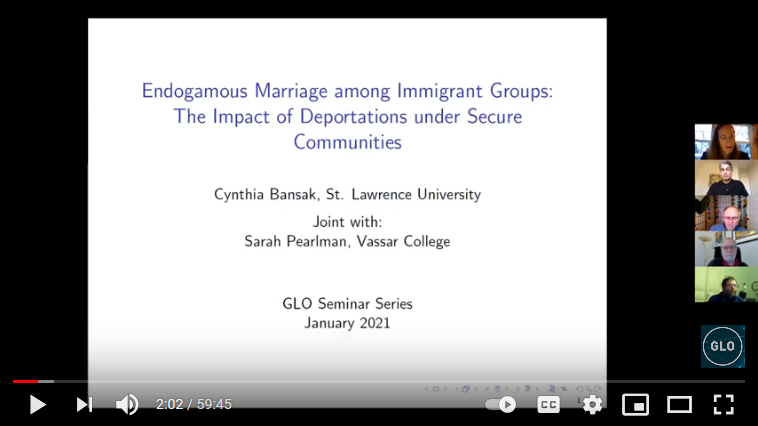
A new GLO Discussion Paper finds for the USA that deportations increase overall marriage rates and increase the likelihood of endogamous marriages.
The Global Labor Organization (GLO) is an independent, non-partisan and non-governmental organization that functions as an international network and virtual platform to stimulate global research, debate and collaboration.
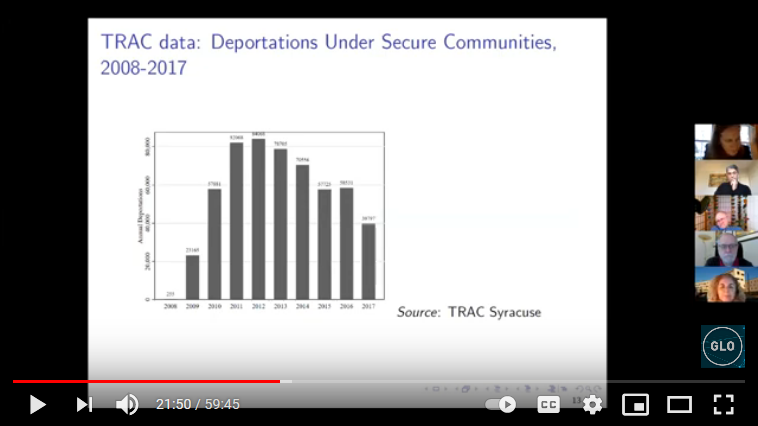
Author Abstract: We investigate the impact of removals under the Secure Communities (SC) program on the marriage patterns of immigrant women living in the U.S. where endogamous marriage is the dominant form of partnership. We focus on enforcement by MSA and country of origin and find evidence that deportations increase overall marriage rates, increase the likelihood of endogamous marriage, decrease rates of exogamous marriage to immigrants from other countries and have indeterminate effects on marriage to natives. When examining channels for behavioral responses, we find evidence pointing towards the desire to mitigate the risk of deportation through the increased importance of networks.
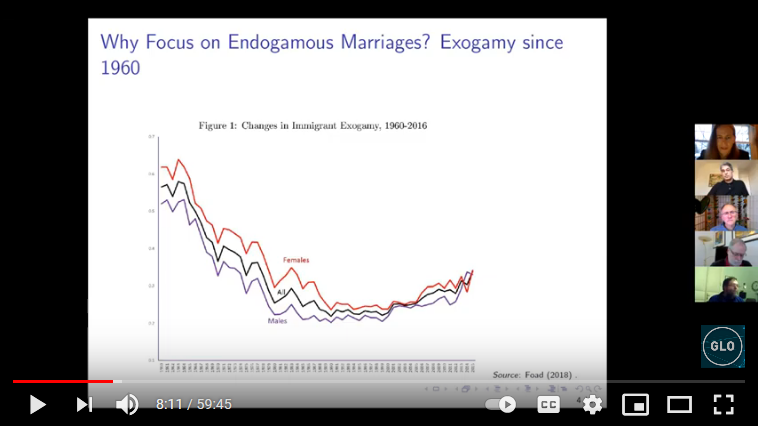
REPORT & VIDEO OF A PAPER PRESENTATION IN THE GLO VIRTUAL SEMINAR SERIES.
A new GLO Discussion Paper finds that terrorism had less of an influence on voters than is usually thought.
The Global Labor Organization (GLO) is an independent, non-partisan and non-governmental organization that functions as an international network and virtual platform to stimulate global research, debate and collaboration.
Author Abstract: This paper examines the impact of terrorism on voting behavior in the United States. We rely on an exhaustive list of terror attacks over the period 1970-2016 and exploit the inherent randomness of the success or failure of terror attacks to identify the political impacts of terrorism. We first confirm that the success of terror attacks is plausibly random by showing that it is orthogonal to potential confounders. We then show that on average successful attacks have no effect on presidential and non-presidential elections. As a benchmark, we also rely on a more naïve identification strategy using all the counties not targeted by terrorists as a comparison group. We show that using this naïve identification strategy leads to strikingly different results overestimating the effect of terror attacks on voting behavior. Overall, our results indicate that terrorism has less of an influence on voters than is usually thought.
A new GLO Discussion Paper finds ethnicity not to be the crucial factor behind both the civil and ethnic conflict in Syria in 2011.
The Global Labor Organization (GLO) is an independent, non-partisan and non-governmental organization that functions as an international network and virtual platform to stimulate global research, debate and collaboration.
Author Abstract: While most civil wars seem to have an economic basis, they are generally pushed by political, ethnic, and religious differences. This paper attempts to identify the drivers of the Syrian civil war of 2011 by investigating the role of ethnic divisions in starting a conflict. We integrate a variety of variables such as excluded population, power-sharing, anocracy, ethnic groups in addition to a number of economic factors. The main results indicate that ethnicity does not seem to be a very important factor in starting both the civil and ethnic conflict in Syria, but it shows that the lack of power-sharing to be the most significant factor. Therefore, where power in Syria was not inclusive and shared among different demographic segments, such as religious or urban groups, it created upheavals between different groups, as some groups dis-identify with the state, paving the way to causing the conflict. Economic factors also provide an explanation of the onset of conflicts in Syria. The paper offers detailed policy suggestions that could serve as a recovery mechanism for the Syrian crisis and a preventive measurement for its re-occurrence.
The Journal of Population Economicsis happy to announce a webinar for January 28, 16:00-18:00 CET (Maastricht/Dutch time) to present highlights from the newly published issue 34(2)/2021. The event is supported by GLO and hosted by UNU-MERIT via Zoom. Alessio J. Brown (Co-Director of POP at UNU-MERIT, Maastricht University and GLO) will welcome participants. Managing Editor Michaella Vanore, (UNU-MERIT, Maastricht University and GLO) will guide through the event. Editor Terra McKinnish (University of Colorado Boulder and GLO) and Editor-in-Chief Klaus F. Zimmermann (UNU-MERIT, Maastricht University and GLO) will chair the sessions.
The webinar highlights 6 of the 10 articles published in issue 34(2)/2021, three on GENDER (covering Bangladesh, China and developing countries in general) and three on COVID-19 (covering the USA and Australia). All articles are published ONLINE FIRST and are freely accessible already now through the links below the titles; those with a provided READLINK are free to read online, the others are free to download.
Open to the public. Post event info: Full video of the event.
Program (January 28, 2021)
Time
Topic
Session chair/ Presenter
16:00 CET
Welcome
Michaella Vanore, Alessio J. Brown, Klaus F. Zimmermann
16:15-17:00
Session I: Gender issues in Bangladesh, China and developing countries
A new GLO Discussion Paper examines the effect of USA military service in Vietnamon incarceration outcomes, with effects among white volunteers and veterans in certain birth cohorts.
The Global Labor Organization (GLO) is an independent, non-partisan and non-governmental organization that functions as an international network and virtual platform to stimulate global research, debate and collaboration.
Author Abstract: Employing nonparametric bounds, we examine the effect of military service on incarceration outcomes using the Vietnam draft lotteries as a possibly invalid instrumental variable for military service. The draft is allowed to have a direct effect on the outcomes independently of military service, disposing of the exclusion restriction. We find: (i) suggestive but not strong statistical evidence that the direct effect of the draft increases the incarceration rate for violent offenses for a particular cohort of draft avoiders, and (ii) military service increases the incarceration rate for violent and nonviolent crimes of white volunteers and veterans in certain birth cohorts.
A new GLO Discussion Paperfinds that lockdowns had a larger impact on the mobility of women and younger cohorts.
The Global Labor Organization (GLO) is an independent, non-partisan and non-governmental organization that functions as an international network and virtual platform to stimulate global research, debate and collaboration.
Author Abstract: Overall mobility declined during the COVID-19 pandemic because of government lockdowns and voluntary social distancing. Yet, aggregate data mask important heterogeneous effects across segments of the population. Using unique mobility indicators based on anonymized and aggregate data provided by Vodafone for Italy, Portugal, and Spain, we find that lockdowns had a larger impact on the mobility of women and younger cohorts. Younger people also experienced a sharper drop in mobility in response to rising COVID-19 infections. Our findings, which are consistent across estimation methods and robust to a variety of tests, warn about a possible widening of gender and inter-generational inequality.
A new GLO Discussion Paper provides an assessment of the targeted approach to COVID-19 containment.Under a targeted policy, the optimal containment reaches a larger portion of the population than under a blanket policy. Compared to a blanket policy, a targeted approach results in a smaller death count.
The Global Labor Organization (GLO) is an independent, non-partisan and non-governmental organization that functions as an international network and virtual platform to stimulate global research, debate and collaboration.
Author Abstract: The large economic costs of full-blown lockdowns in response to COVID-19 outbreaks, coupled with heterogeneous mortality rates across age groups, led to question non-discriminatory containment measures. In this paper we provide an assessment of the targeted approach to containment. We propose a SIR-macro model that allows for heterogeneous agents in terms of mortality rates and contact rates, and in which the government optimally bans people from working. We find that under a targeted policy, the optimal containment reaches a larger portion of the population than under a blanket policy and is held in place for longer. Compared to a blanket policy, a targeted approach results in a smaller death count. Yet, it is not a panacea: the recession is larger under such approach as the containment policy applies to a larger fraction of people, remains in place for longer, and herd immunity is achieved later. Moreover, we find that increased interactions between low- and high-risk individuals effectively reduce the benefits of a targeted approach to containment.
A new article published in the Journal of Population Economicssuggests that Donald Trump would likely have won re-election if COVID-19 cases in the United States had been 5 percent lower.
COVID-19 brought the change Photo by Charles Deluvio on Unsplash
The Global Labor Organization (GLO) is an independent, non-partisan and non-governmental organization that functions as an international network and virtual platform to stimulate global research, debate and collaboration.
Abel Brodeur
The COVID-19 Pandemic and the 2020 U.S. Presidential Election by Baccini, Leonardo & Brodeur, Abel & Weymouth, Stephen Pre-publication revisedGLODP710[pre.].
Author Abstract: What is the effect of the COVID-19 pandemic on the 2020 US presidential election? Guided by a pre-analysis plan, we estimate the effect of COVID-19 cases and deaths on the change in county-level voting for Donald Trump between 2016 and 2020. To account for potential confounders, we include a large number of COVID-19-related controls as well as demographic and socioeconomic variables. Moreover, we instrument the numbers of cases and deaths with the share of workers employed in meat-processing factories to sharpen our identification strategy. We find that COVID-19 cases negatively affected Trump’s vote share. The estimated effect appears strongest in urban counties, in states without stay-at-home orders, in swing states, and in states that Trump won in 2016. A simple counterfactual analysis suggests that Trump would likely have won re-election if COVID-19 cases had been 5 percent lower. We also find some evidence that COVID-19 incidence had a positive effect on voters’ mobilization, helping Biden win the presidency.
A new paper published online in the Journal of Population Economics discusses why it is so vital to understand what drives people to engage in or refrain from health-related behaviors during a pandemic and reveal the role of socioeconomic differences in explaining behavior in the USA.
The Global Labor Organization (GLO) is an independent, non-partisan and non-governmental organization that functions as an international network and virtual platform to stimulate global research, debate and collaboration.
Socio-demographic factors associated with self-protecting behavior during the Covid-19 pandemic
by Papageorge, Nicholas W.; Zahn, Matthew V.; Belot, Michèle; van den Broek-Altenburg, Eline; Choi, Syngjoo; Jamison, Julian C. & Tripodi, Egon
Published ONLINE FIRST 2021: Journal of Population Economics, scheduled for Issue 2/2021. FREE READLINK: https://rdcu.be/cdCjh OPEN ACCESS.
Author Abstract: Given the role of human behavior in the spread of disease, it is vital to understand what drives people to engage in or refrain from health-related behaviors during a pandemic. This paper examines factors associated with the adoption of self-protective health behaviors, such as social distancing and mask wearing, at the start of the Covid-19 pandemic in the USA. These behaviors not only reduce an individual’s own risk of infection but also limit the spread of disease to others. Despite these dual benefits, universal adoption of these behaviors is not assured. We focus on the role of socioeconomic differences in explaining behavior, relying on data collected in April 2020 during the early stages of the Covid-19 pandemic. The data include information on income, gender and race along with unique variables relevant to the current pandemic, such as work arrangements and housing quality. We find that higher income is associated with larger changes in self-protective behaviors. These gradients are partially explained by the fact that people with less income are more likely to report circumstances that make adopting self-protective behaviors more difficult, such as an inability to tele-work. Both in the USA and elsewhere, policies that assume universal compliance with self-protective measures—or that otherwise do not account for socioeconomic differences in the costs of doing so—are unlikely to be effective or sustainable.
A new paper published online in the Journal of Population Economicsindicates that the negative COVID-19 labour market effects are felt the most by people in the lowest percentiles of the financial wellbeing distributionsuggesting significant increases in financial wellbeing disadvantage and inequality.
The Global Labor Organization (GLO) is an independent, non-partisan and non-governmental organization that functions as an international network and virtual platform to stimulate global research, debate and collaboration.
Implications of COVID-19 labour market shocks for inequality in financial wellbeing
by Botha, Ferdi; de New, John P.; de New, Sonja C.; Ribar, David C. & Salamanca, Nicolás
Published ONLINE FIRST 2021: Journal of Population Economics, scheduled for Issue2/2021. FREE READLINK: https://rdcu.be/cdBX6 FREE ACCESS to PDF. Previous version GLO DP 661.
Author Abstract: Australia’s economy abruptly entered into a recession due to the COVID-19 pandemic of 2020. Related labour market shocks on Australian residents have been substantial due to business closures and social distancing restrictions. Government measures are in place to reduce flow-on effects to people’s financial situations, but the extent to which Australian residents suffering these shocks experience lower levels of financial wellbeing, including associated implications for inequality, is unknown. Using novel data we collected from 2078 Australian residents during April to July 2020, we show that experiencing a labour market shock during the pandemic is associated with a 29% lower level of perceived financial wellbeing, on average. Unconditional quantile regressions indicate that lower levels of financial wellbeing are present across the entire distribution, except at the very top. Distribution analyses indicate that the labour market shocks are also associated with higher levels of inequality in financial wellbeing. Financial counselling and support targeted at people who experience labour market shocks could help them to manage financial commitments and regain financial control during periods of economic uncertainty.
A new GLO Discussion Paper finds that the decrease in the male to female sex ratio in World War II contributed to a lower decline in fertility and child mortality rates in postwar Japan.
The Global Labor Organization (GLO) is an independent, non-partisan and non-governmental organization that functions as an international network and virtual platform to stimulate global research, debate and collaboration.
Author Abstract: This study explores the effects of imbalances in the sex ratio, and their impact on intra-household bargaining, on both the quantity and the quality of children. We first present the theoretical model of intra-household bargaining in the presence of conflicting family goals within a couple, and show that male scarcity (a decrease in the male to female sex ratio) induces an increase in the number of children, but a decrease in the quality of children. Second, using the impact of World War II on the sex ratio, as a quasi-natural experiment, we establish empirically that the decrease in the male to female sex ratio in World War II contributed to a lower decline in fertility and child mortality rates in postwar Japan. In particular, the fertility rate would have fallen by an additional 12% and the child mortality rate by an additional 13% between 1948 and 1970, in the absence of the decrease in the sex ratio.
A new GLO Discussion Paper finds for Italy that immigrants with stronger feelings of belonging to the societies of both the host and home country have higher employment rates, while those who exclusively identify with the host country culture do not have a net occupational advantage.
The Global Labor Organization (GLO) is an independent, non-partisan and non-governmental organization that functions as an international network and virtual platform to stimulate global research, debate and collaboration.
Author Abstract: This paper explores the relationship between social identity and labor market outcomes of immigrants. Using survey data from Italy, we provide robust evidence that immigrants with stronger feelings of belonging to the societies of both the host and home country have higher employment rates, while those who exclusively identify with the host country culture do not have a net occupational advantage. Analysis of the potential mechanisms suggests that, although simultaneous identification with host and home country groups can be costly, the positive effect of multiple social identities is especially triggered by the enlarged information transmission and in-group favoritism that identification with, and membership of, extended communities ensure.
A new paper published online in the Journal of Population Economics finds that participating in social activities has significantly positive impacts on cognitive function among the elderly in China.
The Global Labor Organization (GLO) is an independent, non-partisan and non-governmental organization that functions as an international network and virtual platform to stimulate global research, debate and collaboration.
Does social participation improve cognitive abilities of the elderly?
by Cai, Shu
Published ONLINE FIRST 2021: Journal of Population Economics, scheduled for 2021. FREE READLINK: https://rdcu.be/cdjPu
Author Abstract: This paper examines the effect of social participation on cognitive performance using data from a longitudinal survey of the elderly in China. It addresses the problem of endogenous participation by exploiting the variation in changes in social participation that are driven by changes in community service for social activities. The results show that participating in social activities has significantly positive impacts on cognitive function among the elderly. The point estimates indicate that engaging in social activity raises cognitive scores by 29% of a standard deviation.
A new GLO Discussion Paper finds for China that research universities can have negative effects on local economic development.
The Global Labor Organization (GLO) is an independent, non-partisan and non-governmental organization that functions as an international network and virtual platform to stimulate global research, debate and collaboration.
Author Abstract: This paper studies whether research universities can boost regional economic development through an exogenous shock of a forced relocation of a research university in China. We analyze the development in the treated regions compared with a set of control regions that are created using the synthetic control method and find that research universities can have negative effects on local economic development. We then perform a series of robustness checks. Our main results carry through. By employing a more exogenous shock and more reliable identification strategies, our study provides evidence that research universities do not necessarily promote regional economic development.
A new GLO Discussion Paper finds that policies supporting development in low-income countries are associated with less emigration to all destinations, including the rich economies.
The Global Labor Organization (GLO) is an independent, non-partisan and non-governmental organization that functions as an international network and virtual platform to stimulate global research, debate and collaboration.
Author Abstract: The ‘mobility transition’ hypothesis – with emigration first increasing and then decreasing as a country develops – (Zelinsky, 1971) is often interpreted as a stylised fact, which bears the implication that immigration into rich countries will grow as low-income countries develop. This paper tests the relationships between development and emigration from 130 developing countries during 25 years. Results, robust to different semiparametric and parametric specifications, show that emigration from low to middle-income countries declines as income increases, education improves or population growth slows down. The stage of development at home also affects the main destinations of emigration. Immigration into rich economies increases from countries at intermediate levels of development. Hence, policies supporting development in low-income countries are associated with less emigration to all destinations, including that to rich economies.
Featured image: Photo-by-joshua-hoehne-on-unsplash
With immediate effect, Grégory Ponthière (UCLouvain) joins the group of Editors of the Journal of Population Economics. He will work with Editors Shuaizhang Feng (Jinan University), Oded Galor (Brown University), Terra McKinnish (University of Colorado Boulder), Editor-in-Chief Klaus F. Zimmermann (UNU-MERIT) and with Managing Editors Michaella Vanore (UNU-MERIT) and Madeline Zavodny (University of North Florida).
Interview with Grégory Ponthière
GLO: What brought you to population economics?
Grégory Ponthière: As a Ph.D. student in Economics in Cambridge in the early 2000s, I became interested in the measurement of human welfare across long periods of time. From that perspective, variations in survival conditions play a fundamental role, since the finiteness of life is a major cause of scarcity and deprivation for humans. This definitely oriented my research at the intersection of economic theory and demography.
GLO: Why can micro theory help us to understand demographic processes?
Grégory Ponthière: Demographic outcomes (fertility, mortality, migration) are influenced by economic factors, in particular individual endowments in terms of physical or human capital, and also by prices faced by individuals (e.g. the wage rate, housing prices). Thus demographic processes cannot be understood without considering the economic conditions under which they take place. This makes the microeconomic analysis of demographic trends fundamental: focusing on microeconomic foundations allows us to identify conditions under which existing population trends can be rationalized or explained. But I would go even further, and defend the view that most economic processes – in particular accumulation mechanisms and dynamics – cannot be understood without considering demography. Economic and demographic outcomes are joint products, and this makes population economics a central field of economic analysis.
GLO: Explain us your field of specialization!
Grégory Ponthière: My research lies at the intersection of economic theory and demography. It focuses, from a theoretical perspective, on multidirectional relations between economic variables and demographic outcomes. I published several papers on the economic rationalization of mortality variations (within a population at a given period and across long periods of time), and also on the microeconomic study of the timing of births (in particular the advancement of births in the early 20th century, followed by a postponement of births starting in the 1970s). Besides those positive studies, my research also examined the design of optimal public policies when demographic outcomes are endogenously determined within the economy, and depend on material living conditions faced by individuals. Those normative studies involved the design of prevention policies, pensions, long term care social insurance, family policies (in particular family allowances) and fiscal policies (the taxation of savings and bequests).
GLO: What excites you most in your current research?
Grégory Ponthière: My current research focuses on the construction of a fair Welfare State, and on the normative foundations behind public policies. Since the pioneer works of Bentham and Mill, there is a long tradition, in Economics, which adopts utilitarianism as an ethical benchmark (the principle of “the largest happiness for the largest number”). My current research aims at identifying the unattractive implications of utilitarianism in the context where the population is heterogeneous on important dimensions (e.g. the genetic background determining longevity outcomes or the natural fecundity of individuals), and proposes to rethink the design of the Welfare State while adopting alternative normative foundations, which lay a stronger emphasis on equalizing welfare across individuals (either in ex ante terms or in ex post terms). Taking unequal demographic outcomes into account – beyond the mere “representative agent” – does not leave the design of the Welfare State unchanged.
GLO: Why have you accepted to take the Editor position?
Grégory Ponthière: I have been doing research in population economics since the beginning of my Ph.D. thesis, almost 20 years ago. Thus I have a long-lasting interest in that field of economic research. During that period, my research has greatly benefited from the (indirect) supervision of editors of journals, and also from the work of a large number of anonymous reviewers. It is time for me to contribute to the public good, by participating more actively to the life of scientific journals, not only as an author or as a reviewer, but also as an editor. Joining the Editorial team of the Journal of Population Economics is a unique opportunity to contribute actively to the flourishing of that exciting area of research.
GLO: Where do you see promising fields for population theory the Journal could explore?
Grégory Ponthière: At the micro level, I can see two promising areas of research, which are quite complementary. The first one concerns the modelling of the human life cycle, which faces serious limitations when considering basic decisions (e.g. the long term care insurance puzzle). In particular, the inclusion, within the lifecycle model, of the risk about the duration of life is challenging. A second – related – field concerns the modelling of the interests of economic agents at the two extremities of life: childhood and old-age dependency. Public policies should take the interests of the very young and of the very old into account, but the problem is that those individuals may not have well-defined preferences in the same way as adults can have. The microeconomic analysis of the family thus still faces major challenges, and those challenges are also relevant for the macroeconomic study of demographic trends. Finally, another fundamental challenge for population economics concerns the design of the Welfare State when demographic variables react to public policies, i.e. abstracting from the usual “ceteris paribus” assumption. This last point is most relevant in the context of the corona crisis.
GLO: Will the coronavirus change the world of academic publishing?
Grégory Ponthière: It is too early to know what will be the long-run consequences of coronavirus on the society, and on the world of science in particular. But one thing is certain: the corona crisis does not only affect health and mortality outcomes around the world, but it also deteriorates teaching and learning conditions in all universities. As such, this deteriorates the foundations of science in the future.
*************************** With Editor and GLO FellowGrégory Ponthière spoke Klaus F. Zimmermann, GLO President & Editor-in-Chief of the Journal of Population Economics.
Grégory Ponthière
GLO FellowGregory Ponthiereis a Professor of Economics and Philosophy at the Hoover Chair in Economic and Social Ethics, UCLouvain, and an Editor of the Journal of Population Economics. Before joining UCLouvain, he held permanent positions at the Ecole Normale Superieure and at the University Paris XII, and was an Associate Researcher at the Paris School of Economics. His research focuses on relations between economic and demographic outcomes, from a positive perspective (rationalization of stylized facts) and a normative perspective (design of a fair Welfare State). His publications include three books and articles in journals such as the Journal of Economic Theory, the International Economic Review, Social Choice and Welfare and the Journal of Public Economics. He is an Honorary Fellow of the Institut Universitaire de France.
A new GLO Discussion Paper documents unambiguous evidence of a negative spillover of the welfare reforms of UK Welfare Reform Act 2012 at the heart of the government’s austerity program on social welfare, which reinforced the direct inequality-worsening effect of this program.
The Global Labor Organization (GLO) is an independent, non-partisan and non-governmental organization that functions as an international network and virtual platform to stimulate global research, debate and collaboration.
Author Abstract: The UK Welfare Reform Act 2012 imposed a series of welfare cuts, which disproportionately impacted ex-ante poorer areas. In this paper, we consider the impact of these austerity measures on two different but complementary elements of crime – the crime rate and the less-studied concentration of crime – over the period 2011-2015 in England and Wales, and document four new facts. First, areas more exposed to the welfare reforms experience increased levels of crime, an effect driven by a rise in violent crime. Second, both violent and property crime become more concentrated within an area due to the welfare reforms. Third, it is ex-ante more deprived neighborhoods that bear the brunt of the crime increases over this period. Fourth, we find no evidence that the welfare reforms increased recidivism, suggesting that the changes in crime we find are likely driven by new criminals. Combining these results, we document unambiguous evidence of a negative spillover of the welfare reforms at the heart of the UK government’s austerity program on social welfare, which reinforced the direct inequality-worsening effect of this program. More deprived districts are more exposed to the welfare reforms, and it is these districts that then experience the further negative consequences of the reforms via increased crime. Our findings underscore the importance of considering both multiple dimensions of crime as well as considering different levels of spatial aggregation of crime data. Given that it is violent crime that responds to the (economicallybased) welfare cuts, our work also highlights the need to develop better economic models of non-rational crime.
Featured image: Photo-by-Jose-Antonio-Gallego-Vázquez-on-Unsplash
TheGLO Virtual Seminar is a monthly internal GLO research event chaired by GLO Director Matloob Piracha and hosted by the GLO partner institution University of Kent. The results are available on the GLO website and the GLO News section, where also the video of the presentation is posted. All GLO related videos are also available in the GLO YouTube channel. (To subscribe go there.)
The last seminar was given on January 7, 2021, London/UKat 1-2 pm, by Cynthia Bansak, St. Lawrence University and GLO on Endogamous Marriage among Immigrant Groups: The Impact of Deportations under Secure Communities. Below find a report and the video of the seminar.
Report
Endogamous Marriage among Immigrant Groups: The Impact of Deportations under Secure Communities
A new GLO Discussion Paper finds that the recent increase in the supply of child-care services by immigrants has positively affected native fertility in Italy.
The Global Labor Organization (GLO) is an independent, non-partisan and non-governmental organization that functions as an international network and virtual platform to stimulate global research, debate and collaboration.
Author Abstract: The availability of child-care services has often been advocated as one of the instruments to counter the fertility decline observed in many high-income countries. In the recent past large inflows of low-skilled migrants have substantially increased the supply of child-care services. In this paper we examine if the flow of immigrants as actually affected fertility exploiting the natural experiment occurred in Italy in 2007, when a large inflow of migrants – many of them specialized in the supply of child care – arrived unexpectedly. With a difference-in-differences method, we show that newly arrived immigrant female workers have increased the number of native births by roughly 2 per cent. We validate our result by the implementation of an instrumental variable approach and several robustness tests, all concluding that the increase in the supply of child-care services by immigrants has positively affected native fertility choice.
A new GLO Discussion Paper discusses evidence and explanations why self-employment is positively associated with job satisfaction.
The Global Labor Organization (GLO) is an independent, non-partisan and non-governmental organization that functions as an international network and virtual platform to stimulate global research, debate and collaboration.
Author Abstract: Self-employment contributes to employment growth and innovativeness and many individuals want to become self-employed due to the autonomy and exibility it brings. Using “subjective well-being” as a broad summary measure that evaluates an individual’s experience of being self-employed, the chapter discusses evidence and explanations why self-employment is positively associated with job satisfaction, even though the self-employed often earn less than their employed peers, work longer hours and experience more stress and higher job demands. Despite being more satisfied with their jobs, the self-employed do not necessarily enjoy higher overall life satisfaction, which is due to heterogeneity of types of self-employment, as well as motivational factors, work characteristics and institutional setups across countries.