School-to-Work Transition: An International Comparative Perspective
for: International Journal of Manpower. Guest Editor: Francesco Pastore. Professor Pastore is Head of the GLO Cluster on School-to-Work Transition and GLO Country Lead Italy.
Francesco Pastore
The school-to-work transition is at the centre of several academic and public debates. It is behind the debate on persistent youth unemployment in many countries. It is also at the centre of the debate on the future of work and the need to adapt educational and training institutions to the needs of the fourth industrial revolution which is ongoing at a pace which has been clearly accelerated by the COVID-19 emergency.
A new GLO Discussion Paper assesses how the UK health care system performed against the norm of horizontal equity in health care access during the first wave of COVID-19 wave.There is no evidence that horizontal equity, with respect to income, was violated for NHS hospital outpatient and inpatient care during the first wave of the pandemic.
The Global Labor Organization (GLO) is an independent, non-partisan and non-governmental organization that functions as an international network and virtual platform to stimulate global research, debate and collaboration.
Author Abstract: Using monthly data from the Understanding Society (UKHLS) COVID-19 Survey we analyse the evolution of unmet need and assess how the UK health care system performed against the norm of horizontal equity in health care access during the first wave of COVID-19 wave. Unmet need was most evident for hospital care, and less pronounced for primary health services (medical helplines, GP consultations, local pharmacist advice, over the counter medications and prescriptions). Despite this, there is no evidence that horizontal equity, with respect to income, was violated for NHS hospital outpatient and inpatient care during the first wave of the pandemic. There is evidence of pro-rich inequities in access to GP consultations, prescriptions and medical helplines at the peak of the first wave, but these were eliminated as the pandemic progressed. There are persistent pro-rich inequities for services that relate to individuals’ ability to pay (over the counter medications and advice from the local pharmacist).
A new GLO Discussion Paper reviews the literature on the wellbeing of union members. Union members can be expected to exhibit higher job satisfaction than comparable non-members, but this is not consistent with empirical findings.
The Global Labor Organization (GLO) is an independent, non-partisan and non-governmental organization that functions as an international network and virtual platform to stimulate global research, debate and collaboration.
Author Abstract: If individuals join a trade union their utility should increase. Therefore, union members can be expected to exhibit higher job satisfaction than comparable non-members. This expectation is not consistent with empirical findings. The evidence sometimes indicates that union members have lower job satisfaction, but overall suggests the absence of a robust correlation. This survey discusses empirically relevant determinants of the relationship between trade union membership and job satisfaction. It distinguishes settings in which a trade union provides public goods from those in which it restricts the provision of benefits to its members. Furthermore, the survey summarizes the empirical evidence and indicates possible future research issues.
A new GLO Discussion Paper outlines the key theoretical channels by which worker voice can affect political and civic participation, highlights important methodological challenges in identifying causal relationships and mechanisms, and summarizes the major research findings pertaining to nonunion and union voice.
The Global Labor Organization (GLO) is an independent, non-partisan and non-governmental organization that functions as an international network and virtual platform to stimulate global research, debate and collaboration.
Author Abstract: Worker voice can relate to political and civic participation in numerous ways. Individual and collective voice can equip individuals with skills and attitudes that increase political engagement, and unions also explicitly encourage members to be politically aware, vote, and run for office. Labor unions and union federations are also often direct participants in the political and policy-making process. This chapter outlines the key theoretical channels by which worker voice can affect political and civic participation, highlights important methodological challenges in identifying causal relationships and mechanisms, and summarizes the major research findings pertaining to nonunion and union voice. In summarizing the major theoretical alternatives, a distinction is made between (a) experiential spillovers in which political and civic participation is facilitated by workers’ experience with voice, and (b) intentional efforts by voice institutions, especially labor unions, to increase political and civic participation. In practice, however, the experiential versus intentional transmission mechanisms can be hard to distinguish, so the review of the empirical record is structured around individual-level voice versus collective voice, especially labor unions. Attention is also devoted to the aggregate effects of and participation in the political arena by labor unions. Overall, a broad approach is taken which includes not only classic issues such higher voting rates among union members, but also emerging issues such as whether union members are less likely to vote for extremist parties and the conditions under which labor unions are likely to be influential in the political sphere.
A new paper published online in the Journal of Population Economicsfinds for European countries that parents who are firstborns are better educated and have more educated children compared with later born parents.
The Global Labor Organization (GLO) is an independent, non-partisan and non-governmental organization that functions as an international network and virtual platform to stimulate global research, debate and collaboration.
The intergenerational effects of birth order on education by Enkelejda Havari and Marco Savegnago
Published ONLINE: Journal of Population Economics, scheduled for 2021. OPEN ACCESS!!
Author Abstract: We study the intergenerational effect of birth order on educational attainment using rich data from different European countries included in the Survey of Health, Ageing and Retirement in Europe (SHARE). The survey allows us to link two or more generations in different countries. We use reduced-form models linking children’s education to parents’ education, controlling for a large number of characteristics measured at different points in time. We find that not only are parents who are themselves firstborns better educated, on average, but they also have more-educated children compared with laterborn parents (intergenerational effect). Results are stronger for mothers than for fathers, and for daughters than for sons. In terms of heterogeneous effects, we find that girls born to firstborn mothers have higher educational attainment than girls born to laterborn mothers. We do not find evidence for potential channels other than parental education that could explain the intergenerational effect of parental birth order.
A new GLO Discussion Paper finds that social identityreflected by caste and gender affect future aspirations negatively.
The Global Labor Organization (GLO) is an independent, non-partisan and non-governmental organization that functions as an international network and virtual platform to stimulate global research, debate and collaboration.
Author Abstract: This study investigates the relationship between individuals’ social identity and their future aspirations in a developing country. We analyse primary survey data from participants of a large-scale skill-training programme that targets rural poor youths in India, focusing on two dimensions of individuals’ identity: caste and gender. Our empirical findings suggest that training participants from the most socially disadvantaged groups – Scheduled Tribe (ST) and Scheduled Caste (SC) – have significantly lower income aspiration when compared to Other Backward Class (OBC) and Other Caste (OC) participants. Female participants also have significantly lower aspiration than their male counterparts. The aspiration gaps exist even after controlling for various background characteristics, including participants’ pre-training personality traits and soft skills. Individual-level and household-level factors mediate some of the aspiration gaps based on caste and gender. We find evidence that for SC/ST female participants, the disadvantages on both caste and gender dimensions add up; this is reflected in their lower income aspiration levels, in comparison with all other groups. Thus, our results support the hypothesis of “double jeopardy” instead of “intersectionality” in this context.
A new GLO Discussion Paper studies the distributional properties of VAT to reveal who bears higher payments, natives or migrants. There are no gaps in Germany, but in France and Spain.
The Global Labor Organization (GLO) is an independent, non-partisan and non-governmental organization that functions as an international network and virtual platform to stimulate global research, debate and collaboration.
Author Abstract: This paper contributes to the literature on the distributional properties of VAT analysing who bears higher VAT payments between native and migrant household in France, Germany and Spain. The question is of interest both from a distributional and fiscal perspective, fitting the ongoing debate of the net fiscal impact of immigration. Using data from the 2010 EU HBS and a simple VAT calculator we show the existence of gaps in effective VAT rates between native and migrant households in France and in Spain, while no significant gap is observed in Germany. Our results also confirm the existing evidence on the regressivity of VAT with respect to income. These findings suggest that the fairness consequences of VAT reforms should be carefully assessed and advocate for the importance of considering indirect taxation when assessing the fiscal cost of migration.
Featured image: Photo-by-Mika-Baumeister-on-Unsplash
A new GLO Discussion Paper studies the influence of ozone pollution on labor productivity in China.
The Global Labor Organization (GLO) is an independent, non-partisan and non-governmental organization that functions as an international network and virtual platform to stimulate global research, debate and collaboration.
Author Abstract: Ground-level ozone is a continuing problem worldwide, but research on the influences of ozone pollution on labour productivity in developing countries is insufficient. We investigate the effect of ozone pollution on outdoor worker productivity in the service sector using a unique panel dataset of courier productivities from a top five express company in China. Using an instrumental variable constructed from ozone pollution of upwind nearby cities, we find that a one-standard-deviation increase in daily ozone pollution decreases courier productivity by 8.91%. The same increase in ozone in the previous 30 days decreases worker productivity by 37.9%.
TheGLO Virtual Seminar is a monthly internal GLO research event chaired by GLO Director Matloob Piracha and hosted by the GLO partner institution University of Kent. The results are available on the GLO website and the GLO News section, where also the video of the presentation is posted. All GLO related videos are also available in the GLO YouTube channel. (To subscribe go there.)
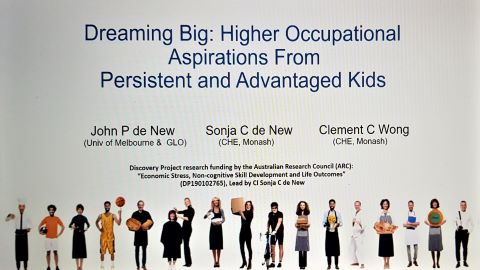
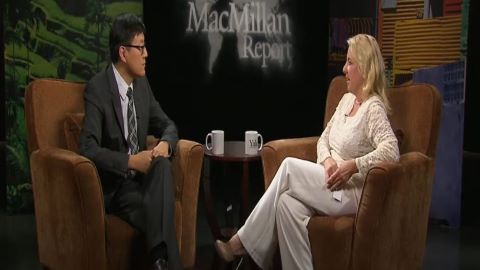
The last seminar was given on November 5, 2020 by John P. de New on Dreaming Big: Higher Occupational Aspirations From Persistent and Advantaged Kids. Below find a report and the video of the seminar.
Cynthia Bansak
Announcement/forthcoming seminar: January 7, 2021:London/UKat 1-2 pm Cynthia Bansak, St. Lawrence University and GLO
Topic: Endogamous Marriage among Immigrant Groups: The Impact of Deportations under Secure Communities
Report
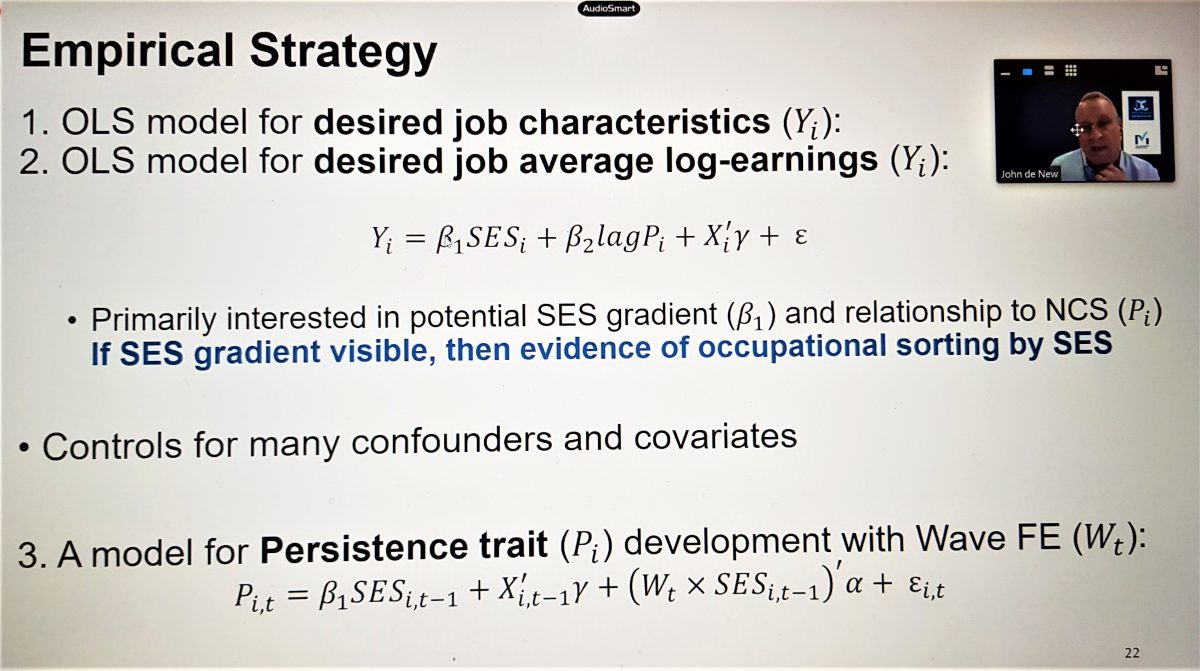
Dreaming Big: Higher Occupational Aspirations From Persistent and Advantaged Kids
John P. de New
GLO Virtual Seminar on December 3, 2020 John P. de New,Melbourne Institute of Applied Economic and Social Research, University of Melbourne, and GLO Video of Seminar.
Based on joint work with Sonja C de New and Clement C Wong.
A new GLO Discussion Paper studies U.S. patenting activity to provide evidence on the history of labour-saving innovations back to the early 19th century.
The Global Labor Organization (GLO) is an independent, non-partisan and non-governmental organization that functions as an international network and virtual platform to stimulate global research, debate and collaboration.
Author Abstract: This paper, relying on a still relatively unexplored long-term dataset on U.S. patenting activity, provides empirical evidence on the history of labour-saving innovations back to early 19th century. The identification of mechanisation/automation heuristics, retrieved via textual content analysis on current robotic technologies by Montobbio et al. (2020), allows to focus on a limited set of CPC codes where mechanisation and automation technologies are more prevalent. We track their time evolution, clustering, eventual emergence of wavy behaviour, and their comovements with long-term GDP growth. Our results challenge both the general-purpose technology approach and the strict 50-year Kondratiev cycle, while provide evidence of the emergence of erratic constellations of heterogeneous technological artefacts, in line with the developmentblock approach enabled by autocatalytic systems.
A new GLO Discussion Paper confirms that personality traits play a role for sexual feelings and behavior.
The Global Labor Organization (GLO) is an independent, non-partisan and non-governmental organization that functions as an international network and virtual platform to stimulate global research, debate and collaboration.
Author Abstract: Sexual well-being plays an important role in the quality of life. Against this background, we provide an economics-based approach to the relationship between the Big Five personality traits and various dimensions of sexuality. From a theoretical viewpoint, personality influences sexual well-being not only by how a person feels about sex, but also by how the person behaves in a sexual relationship. Personality shapes information sharing about sexual preferences, the way dissonant sexual preferences of the partners are handled, and the extent to which the person is committed to promises made to the partner. Using a large representative dataset from Germany, we find that personality traits play a role in a person’s own sexual satisfaction, in (the self-assessment of) fulfilling the partner’s sexual needs and desires, in sexual communication, in actual and desired frequency of sex, and in extradyadic affairs.
A new GLO Discussion Paper argues that, when examining social partners’ representativeness, it is important to consider both affiliation and dissimilarity measures.
The Global Labor Organization (GLO) is an independent, non-partisan and non-governmental organization that functions as an international network and virtual platform to stimulate global research, debate and collaboration.
Author Abstract: Social partners (trade unions and employers’ associations) shape labour institutions and economic and social outcomes in many countries. In this paper, we argue that, when examining social partners’ representativeness, it is important to consider both affiliation and dissimilarity measures. The latter concerns the extent to which affiliated and non- affiliated firms or workers are distributed similarly across relevant dimensions, including firm size. In our analysis of European Company Survey data, we find that affiliation and dissimilarity measures correlate positively across countries, particularly in the case of employers’ associations. This result also holds across employers’ associations when we use firm population data for Portugal. Overall, we conclude that higher affiliation rates do not necessarily equate to more representative social partners as they can involve greater dissimilarity between affiliated and non-affiliated firms.
A new GLO Discussion Paper finds that the fall in prices of information and communication technologies is associated with a significant increase in the share of employees who work from home.
The Global Labor Organization (GLO) is an independent, non-partisan and non-governmental organization that functions as an international network and virtual platform to stimulate global research, debate and collaboration.
Author Abstract: We use data from 14 European countries and provide evidence that the fall in prices of information and communication technologies (ICT) is associated with a significant increase in the share of employees who work from home. Similar results hold within age, gender, and occupation groups. There are notable differences across age groups, however. The effect of the fall in ICT prices on working from home increases with age. A rationale for such a result is that the preference for working from home increases with age.
Featured image: Photo-by-Charles-Deluvio-on-Unsplash
Ilhom Abdulloev, Executive Director Open Society Institute Assistance Foundation – Tajikistan, GLO Fellow and GLO Country Lead for Tajikistan, reflects in an interview the challenging situation in the economy and on the labor market. He touches long-run trends, deals with the implications of the coronavirus pandemic and the Chinese “Belt and Road Initiative”, and reveals his mission and vision as researcher.
Some core messages of the interview:
The coronavirus pandemic has decreased families’ wellbeing substantially also in Tajikistan.
The size of remittances has reached 28% of GDP in 2019.
Despite its positive contribution to economic activities, China’s “Belt and Road Initiative” impact on external debt is raising alarms.
The mission of the Open Society Foundation in Tajikistan is the promotion, popularization, and protection of the principles of the foundation in the Republic of Tajikistan through humanitarian assistance and charity.
In his research, he is currently studying the effect of migration on labor supply and job satisfaction of members of migrants’ families.
Ilhom Abdulloev
GLO Fellow Ilhom Abdulloev is Executive Director Open Society Institute Assistance Foundation – Tajikistan and GLO Country Lead for Tajikistan.
GLO: How is the Tajik labor market doing in the Covid-19 crisis?
Ilhom Abdulloev: Even before the pandemic, the economy of the Republic of Tajikistan could not create enough jobs for the growing working-age population. About half of the working-age population in Tajikistan is not economically active. Women’s participation in the labor force is very low, and many young people (15%) have become discouraged and have given up searching for domestic employment. Informal employment is also high (55%) and mainly concentrated in agriculture and rural areas, where most of the population lives. Under such conditions, emigration becomes a primary employment option for many young people in Tajikistan.
During the coronavirus outbreak, although Tajikistan did not declare a lockdown, it closed country’s borders and education facilities sending pupils and students to early vacation. Seventy four percent of families had to take care of children more than usual during the pandemic and that translates to an additional investment of time, money and resources towards caregiving. As a result, many unemployed people did not look for jobs as they were more engaged in housework and schooling activities. Many families (64%) spent their savings to stock up on food and other necessities during the pandemic, and many others experienced lower earnings because of reduced business revenue, temporary furloughs and layoffs due to the pandemic.
Additionally, some people have looked for paid work during the pandemic, which implies that families’ experienced budget constraints (due to increased prices) and job losses. This also indicates that the pandemic has contributed to increased unemployment. Compared to urban areas, families in rural areas are engaged in farming on their own land or animal husbandry, which reduces the negative impact of employment and creates alternative sources of livelihood. Overall, the pandemic has decreased families’ wellbeing.
With reduced business revenues because of the pandemic, many employers decided to keep businesses open and running as long as possible which necessitated the implementation of safety measures including protective equipment for staff, all of which increases operational costs. This resulted in employers cutting operational costs by any means available including the dismissal of workers without fair compensation, or offering lower paid informal jobs. Such workers require legal support and the government’s attention.
GLO: Tajikistan has been one of the world’s most remittance-dependent countries of the world, largely affiliated with Russia. What were the implications and how will this change in the pandemic?
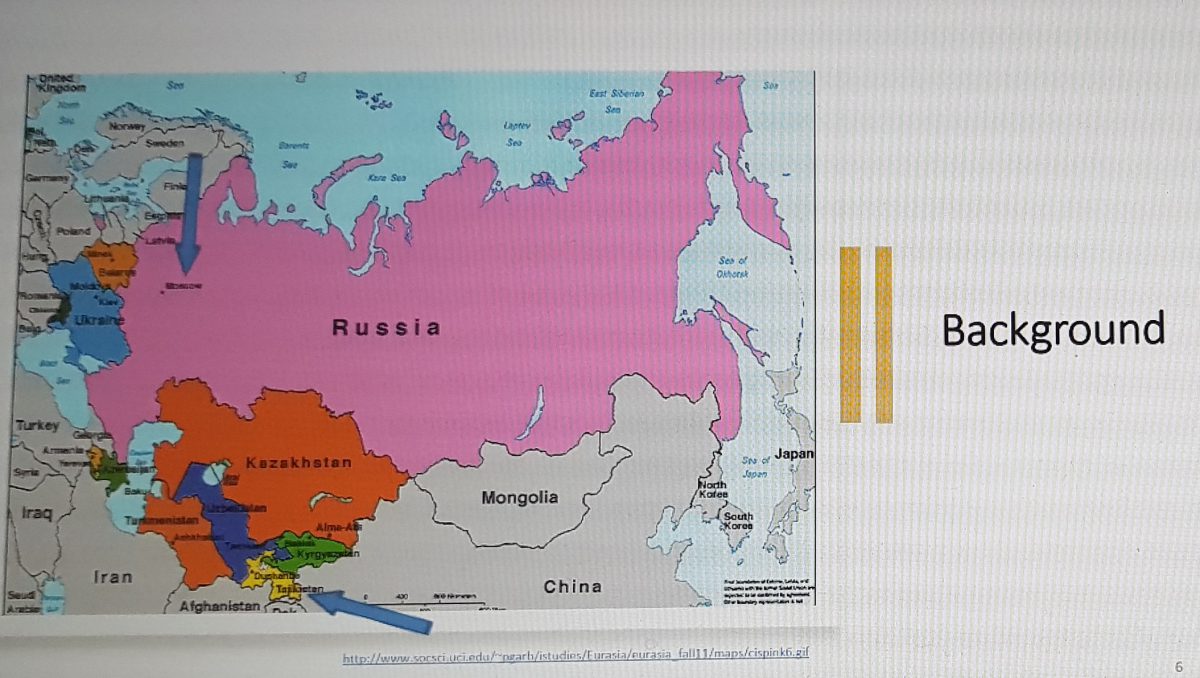
Ilhom Abdulloev: Migration was playing an augmenting role for Tajikistan’s economy before the pandemic. It helped lift the budget constraint and supported families’ food consumption. Almost every other household in Tajikistan has had a family member migrate. The majority of migrants work in low-skill occupations in construction, retail trade and care services in the Russian Federation. The size of remittances reached 28% of GDP in 2019.
All labor migrants have been affected by travel restrictions that were imposed because of the pandemic. Since the migration from Tajikistan is seasonal, many migrants who were at home during the winter were expecting to migrate during the spring. They were not able to migrate because of the border closures. Some of these returned migrants were able to find some form of paid work in Tajikistan, but their current earnings do not compensate for the income they would have earned abroad. Most returnees are waiting for travel restrictions to be lifted so they can emigrate to Russia.
At the same time, the current migrants in destination countries were not able to return home to Tajikistan. They face financial difficulties due to loss of jobs and the inability to pay for their lodging and meals in their destination country or for charter fights tickets to return to Tajikistan. The decline in economic activities in Russia and the reduced demand for migrant labor may lead to an increase in unemployment among international migrants, forcing them to return to their home countries.
Remittance income fell dramatically from April-August pushing the poverty rate higher. The unknown period of borders closure and the lack of employment opportunities in both Russia and Tajikistan would further decrease incomes and consumption of migrants’ families in Tajikistan.
GLO: How is the country involved in the Chinese “Belt and Road Initiative”?
Ilhom Abdulloev: Chinese financing plays an important role in Tajikistan, making a significant contribution to improving the economic infrastructure and the influx of new technologies. Chinese investment has increased significantly over the past decade reaching the total of 2.6 billion US$ in 2019, but at the cost of slowing down some other reforms. China’s Belt and Road initiative aims to strengthen ties with Central Asian countries through investment in economic infrastructure, technical assistance, and trade expansion. It became attractive for Central Asian governments because it does not impose any conditionality on human rights and good governance as does aid coming from other international financial institutions.
Despite its positive contribution to economic activities, China’s impact on external debt is raising alarms. Tajikistan has the largest debt to the China Eximbank which was over 1.1 billion US$ in 2020. A further increase in the debt to GDP ratio could make servicing the external debt unsustainable. The large debt repayments may reduce the amount available for investment in public services in the future. After starting to repay the Chinese debt, the country may attempt to borrow from other international financial institutions, causing the problem to spiral and amplify. With any inability of foreign debt repayment, China may request debt-for-assets or debt-for-nature swaps.
Tajikistan should consider positive reforms aiming at the business investment to other foreign investors and good governance, fighting against corruption and building the skilled labor force. The government can work closely with civil society organizations in promoting the transparency and accountability of state institutions and businesses.
GLO: What role has the Open Society in Tajikistan?
Ilhom Abdulloev: The Foundation in Tajikistan is a part of an international network of the Open Society Foundations, which work to build vibrant and tolerant democracies whose governments are accountable to their citizens. To achieve this mission, the Open Society Foundations seek to shape public policies that assure greater fairness in political, legal, and economic systems and safeguard fundamental rights. On a local level, the Open Society Foundations seek to implement a range of initiatives to advance justice, education, public health, and independent media. The Foundations places a high priority on protecting and improving the lives of people in marginalized communities.
The mission of the Foundation in Tajikistan is the promotion, popularization, and protection of the principles of open and civil society in the Republic of Tajikistan through humanitarian assistance and charity. The Foundation prioritizes the following open society and civil society principles in its activities:
– Promotion and protection of rights and freedom, including freedom of thought, freedom of conscience and belief, protection of rights to freedom of opinion and expression. – Protection of equality, including protection from all forms of discrimination as well as ensuring gender equity. – Building solidarity, including access to social welfare, ensuring dignified standard of living, health, and affordable education.
The Foundation’s current strategy is based on the following four priorities:
1. Focusing economic advancement on those most in need. 2. Strengthening social resilience in critical dimensions of education and public health. 3. Defending fundamental rights and the civic space in which they are expressed. 4. Enhancing independent oversight over public and private sectors.
GLO: What are your recent research interests?
Ilhom Abdulloev: My main research area is the impact of labor migration on the migrants’ families and their members who remained in the home country. I am currently studying the effect of migration on labor supply and job satisfaction of members of migrants’ families, as well as their decisions on schooling, particularly on forsaken professional schooling. I also study the labor market tendencies in transitional economies, informal employment, and female and youth participation in the labor force.
************* With Ilhom Abdulloev spoke Klaus F. Zimmermann, GLO President.
A new GLO Discussion Paper finds that parental gender stereotypes strongly decrease student wellbeing in China.
The Global Labor Organization (GLO) is an independent, non-partisan and non-governmental organization that functions as an international network and virtual platform to stimulate global research, debate and collaboration.
GLO Fellow Xiangquan Zeng, GLO Affiliate Shuai Chu& GLO President Klaus F. Zimmermann
Author Abstract: Non-cognitive abilities are supposed to affect student’s educational performance, who are challenged by parental expectations and norms. Parental gender stereotypes are shown to strongly decrease student wellbeing in China. Students are strongly more depressed, feeling blue, unhappy, not enjoying life and sad with no male-female differences while parental education does not matter.
A new GLO Discussion Paper finds that identifying as local residents significantly increase migrants’ hourly wages and reduce hours worked, although their monthly earnings remained barely changed. Further findings suggest that migrants with strong local identity are more likely to use local networks in job search, and to obtain jobs with higher average wages and lower average hours worked per day.
The Global Labor Organization (GLO) is an independent, non-partisan and non-governmental organization that functions as an international network and virtual platform to stimulate global research, debate and collaboration.
GLO Fellow Shu Cai & GLO President Klaus F. Zimmermann
Author Abstract: Previous research has found identity to be relevant for international migration, but has neglected internal mobility as in the case of the Great Chinese Migration. However, the context of the identities of migrants and their adaption in the migration process is likely to be quite different. The gap is closed by examining social assimilation and the effect on the labor market outcomes of migrants in China, the country with the largest record of internal mobility. Using instrumental variable estimation, the study finds that identifying as local residents significantly increase migrants’ hourly wages and reduce hours worked, although their monthly earnings remained barely changed. Further findings suggest that migrants with strong local identity are more likely to use local networks in job search, and to obtain jobs with higher average wages and lower average hours worked per day.
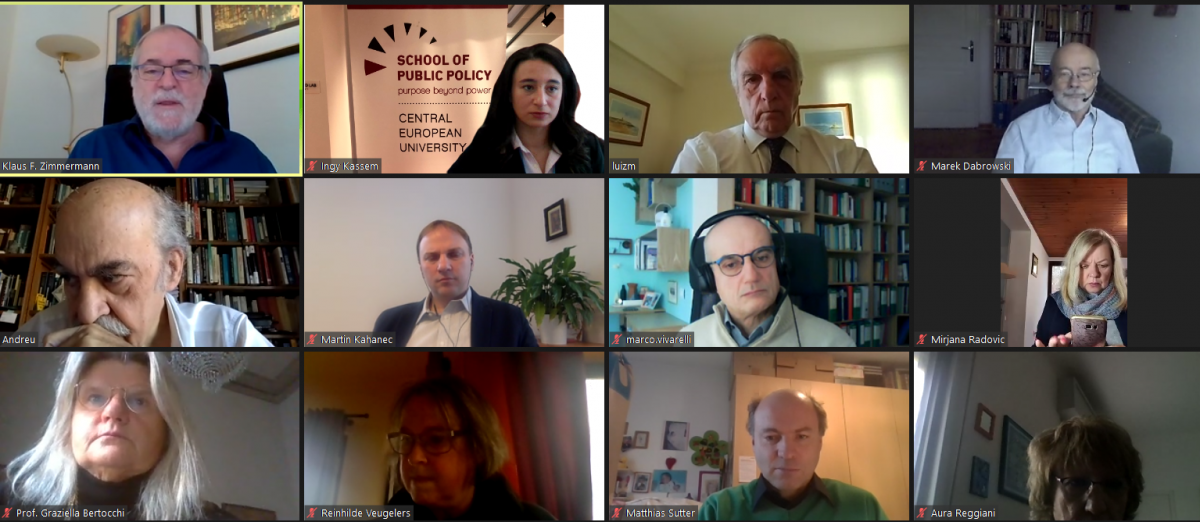
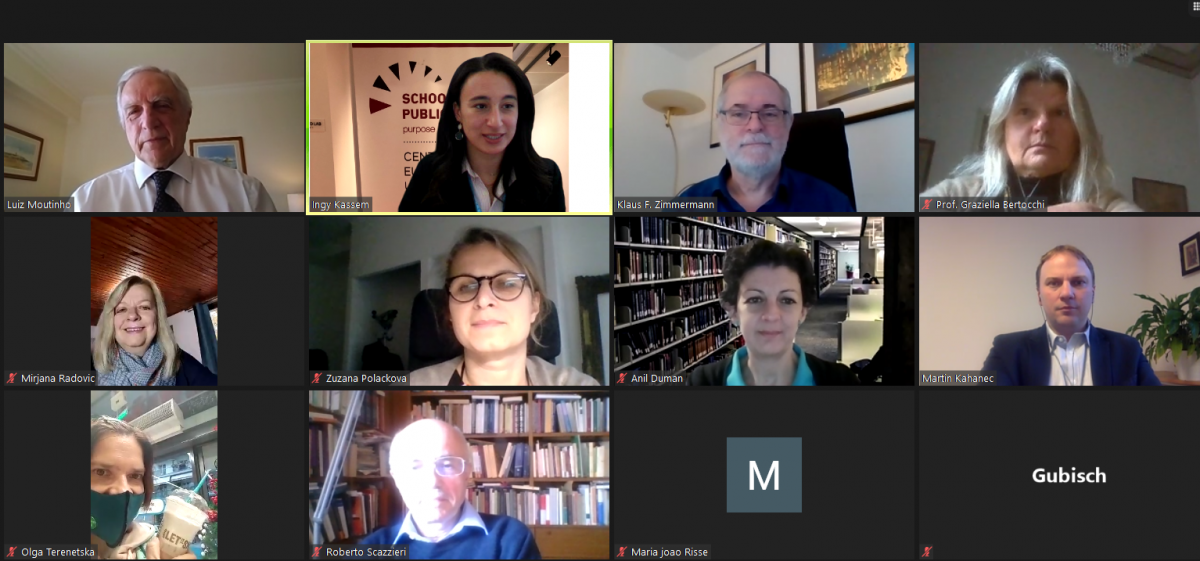
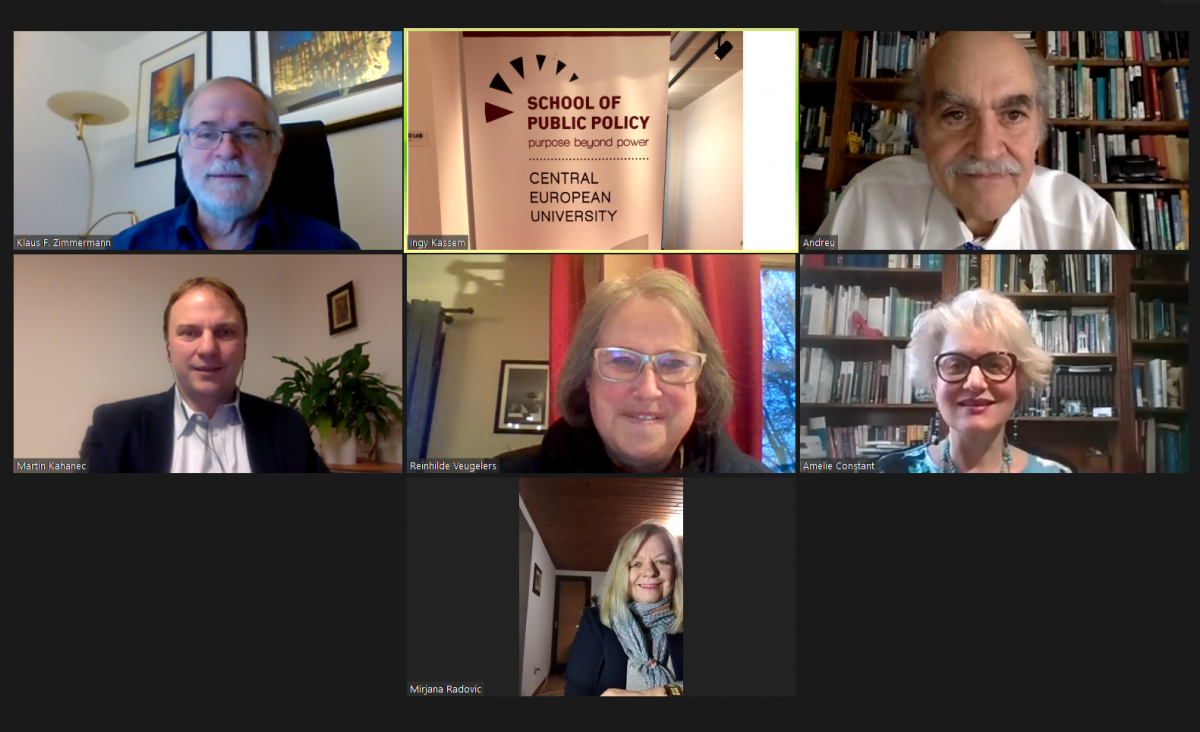
This was an internal meeting of the AE section on special invitation only; a larger number of section members joined during the day as did a larger number of guests from CEU & GLO placed in various parts of the world.
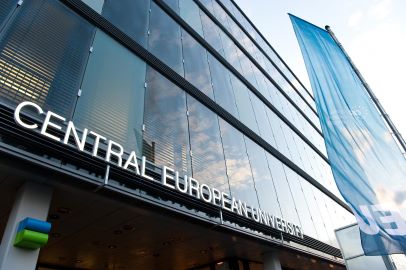
Central European University (CEU), Vienna
November 23, 2020: “COVID-19” Virtual Workshop of the Academia Europaea (AE) Section “Economics, Business and Management Sciences”, all CET/Vienna.
PROGRAM
Ingy Kassem
Starting at 9.00 am; Informal get together, flexible entry….
Moderator of the event: Ingy Kassem (Central European University, Executive Assistant to the Head of the School of Public Policy)
NOTE: Ingy Kassem announced the program parts. The session chairs briefly announced the speakers. The speakers took 20 minutes for presentation. 10 minutes discussion. Luxurious breaks were used for intense communication. Participants brought their own food and drinks…. The meeting was not recorded.
9.30 am; Klaus F. Zimmermann (MAE, UNU-MERIT, Maastricht University & GLO): Welcome of the Section Chair
9.35 – 9.50 am; Martin Kahanec (MAE, Central European University, Acting Dean of CEU School of Public Policy): Welcome of the Host & and CEU Business
9.50 – 10.40 am; Graziella Bertocchi (MAE, Università di Modena e Reggio Emilia): COVID-19, Race, and Redlining Chair: Andreu Mas-Colell (MAE, Universitat Pompeu Fabra)
10.50 – 11.40 am; Matthias Sutter (MAE, University of Cologne & Max-Planck Bonn): Nudging or Paying? Evaluating the effectiveness of measures to contain COVID-19 in rural Bangladesh in a randomized controlled trial. Chair:Reinhilde Veugelers(MAE, University of Leuven)
11.50am – 12.40 pm;Anil Duman (Guest, Central European University): Wage Losses and Inequality in Developing Countries: labor market and distributional consequences of COVID-19 lockdowns in Turkey Chair: Klaus F. Zimmermann(MAE, UNU-MERIT, Maastricht University & GLO)
12.40 – 13.50 pm; Lunch with 3 random “seat” allocations…. (virtual, participants brought food and drinks and exchanged views in three changing group rounds)
13.50 – 14.40 pm; Peter Nijkamp (MAE, Vrije Universiteit Amsterdam): Corona Impacts on the Hospitality Market. A Space-time Economic Roller-Coaster Analysis Chair:Martin Kahanec (MAE, Central European University)
14.50 – 15.40 pm; Luiz Moutinho (MAE, University of Suffolk): Artificial Intelligence and Control of COVID-19 Chair: Mirjana Radovic-Markovic (MAE, Institute of Economic Sciences)
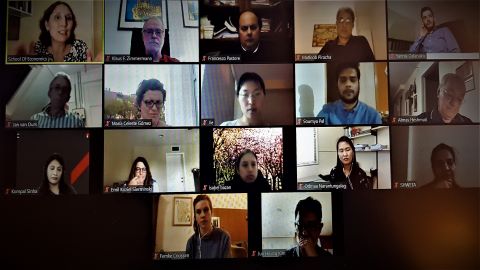
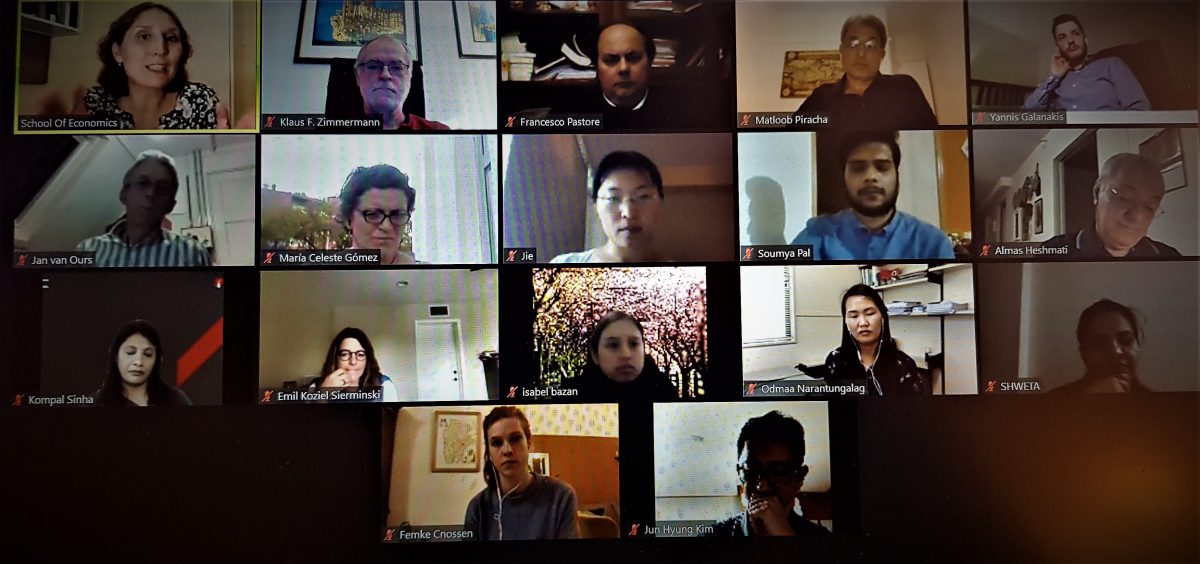
15.40 – 15.50 pm; “Conference picture – group photo”.
Some visible participants:
15.50 – 16.40 pm; Marcella Alsan(Guest, Harvard University): Civil Liberties in Times of Crises Chair: Amelie Constant (MAE, Princeton University)
16.40 – 16.50 pm; Final remarks: Martin Kahanec& Klaus F. Zimmermann 16.50 – 17.00 pm; “After the hour”: Section Committee only. Group photo.
The end.
AE Section Committee“Economics, Business and Management Sciences”
A new GLO Discussion Paper evaluates the effects of pensions on older adults’ health service utilization, and estimates the size of pension required to influence such utilization.
The Global Labor Organization (GLO) is an independent, non-partisan and non-governmental organization that functions as an international network and virtual platform to stimulate global research, debate and collaboration.
Author Abstract: The proportion of people aged 60 years or over is growing faster than other age groups. The well-being older adults depend heavily on their state of health. This study evaluates the effects of pensions on older adults’ health service utilization, and estimates the size of pension required to influence such utilization. Using a nationally representative survey, the China Health and Retirement Longitudinal Study (CHARLS), we adopted a fuzzy regression discontinuity design and undertook segmented regression analysis. Pension demonstrated heterogeneous effects on health service utilization by income. We show that pension encouraged low-income individuals to use both outpatient (OR = 1.219, 95% 1.018-1.460) and inpatient services (OR = 1.269, 95% 1.020-1.579). In the meantime, it promoted self-treatment, specifically over-the-counter (OR = 1.208, 95% 1.037-1.407; OR = 1.206, 95% 1.024-1.419; respectively) and traditional Chinese medicines (OR = 1.452, 95% 1.094-1.932; OR = 1.456, 95% 1.079-1.955; respectively) among all income groups. However, receiving a pension had no effect on the frequency of outpatient or inpatient service use. Breakpoints for pension to promote health service utilization were mainly located in the range 55-95 CNY (7.1-12.3 EUR or 8.0-13.8 USD). Our study enriches the literature on pension and healthcare-seeking behaviour, and can be helpful in policy design and model formulation.
A new GLO Discussion Paper finds that import competition affects fertility through reduced earnings, though differently for male and female workers.
The Global Labor Organization (GLO) is an independent, non-partisan and non-governmental organization that functions as an international network and virtual platform to stimulate global research, debate and collaboration.
Author Abstract: This paper studies the effects of import competition from China and Eastern Europe (EE) on the fertility decisions of individuals in German manufacturing. Through the lens of gender, the paper uniquely contributes to the literature by linking import competition to longitudinal individual data to examine individual fertility. Two separate measures of import exposure are computed for competition from China and EE (amassing five countries), whose trade volumes with Germany have increased remarkably during the panel years. Fixed-effects instrumental variable (FEIV) estimation results show that individual fertility decreases by 1.6 p.p. and by 2.0 p.p. with rising competition from China and EE, respectively. The effects are robust and consistent across different subgroups of individuals. Effects of import competition are then inspected by gender, alongside potential mechanisms underlying fertility decisions. Both male and female workers’ fertility is affected via reduced earnings, though differently. The effect on male fertility is negative, with shortened employment duration. Conversely, the effect on female workers’ fertility is positive, with worsened working conditions. Furthermore, in line with family economics theory, these results suggest that there is a substitution effect in the labour supply of women, here prevalently concentrated in low-technology sectors: as female earnings fall and their opportunity cost of work is lower, the prospect of having children possibly becomes a more rewarding alternative.
Klaus F. Zimmermann, GLO President, UNU-MERIT & Maastricht University, has been appointed 2019 Honorary Professor of the Shanghai Lixin University of Accounting and Finance. As part of this relationship, he provides on November 26, 2020 a lecture in the Distinguished Speaker Series on “The Role of Identity in Economic Life”. Zimmermann was visiting Lixin last time in October 2019 for talks and collaborations. Report 1 and report 2 from 2019.
A new GLO Discussion Paper analyzes the economic impact of Covid-19 by focusing on the implications for migrant remittances in Tunisia and Morocco.
The Global Labor Organization (GLO) is an independent, non-partisan and non-governmental organization that functions as an international network and virtual platform to stimulate global research, debate and collaboration.
Author Abstract: The spread of the novel coronavirus and ‘stay at home’ measures in response to this global health crisis is profoundly changing societies and economies around the world. The objective of this work is to analyze the economic impact of Covid-19 by focusing on their implications on migrant remittances flows in Tunisia and Morocco. Indeed, we analyze in which countries, where individuals depend on remittances and where this dependence intersects with economic vulnerability and inadequate financial infrastructure. We use micro-data from the Afrobarometer survey, wave 2016-2018. Based on Principal Component Analysis (PCA), the results show that the decline in remittances will exacerbate economic difficulties during the crisis for individuals who depend on remittances. In Tunisia, 60% of individuals who say they are dependent on remittances are unemployed and 46% of those who say they are dependent on remittances face a lack of liquidity. In Morocco, 63% and 43%, respectively the share of individuals who say they are dependent on remittances are unemployed and the share with liquidity problems. Also, “stay at home” measures are likely to limit the ability of individuals to receive funds from abroad. Both countries have similar access to infrastructure, more than 46% of people who depend on remittances do not have a bank account and 37% do not have access to the internet. They would therefore be less able to adapt to a restriction on in-person remittance services during a lockdown to contain the Covid-19 virus. For this reason, the paradigm shift from cash to digital money is necessary.
A new GLO Discussion Paper finds that exposure to violent conflict significantly reduces the total number of hours worked in Nigerian farm households.
The Global Labor Organization (GLO) is an independent, non-partisan and non-governmental organization that functions as an international network and virtual platform to stimulate global research, debate and collaboration.
Author Abstract: Nigeria has experienced bouts of violent conflict in different regions over the last few decades leading to significant loss of life. In this paper, we explore the potential short and accumulated long term effects of such conflict on labor supply of agricultural households. Using a nationally representative panel dataset for Nigeria in combination with armed conflict data, we estimate the effect of violent conflict on a farm household members labor supply. Our findings suggest that exposure to violent conflict significantly reduces the total number of hours the farm household head works and also deceases total family labor supply for agricultural households.
The GLO Virtual Young Scholars Program (GLO VirtYS) 2020/2021 has started its activity.
In the spirit of the GLO Mission, the GLO VirtYS program’s goal is to contribute to the development of the future generation of researchers, who are committed to the creation of policy-relevant research, are well equipped to work in collaboration with policy makers and other stakeholders, and adhere to the highest standards of academic integrity. This goal is achieved through the process of working on a specific research paper within the duration of the program, which is 9 months, and interact with the GLO VirtYS cohort and advisors.
Under the leadership of GLO VirtYS Program Director Olena Nizalova, the participants have virtually met with GLO officials and advisors on November 12 for a warm welcome and first interactions. GLO PresidentKlaus F. Zimmermann and GLO Director Matloob Piracha made introductory remarks. GLO VirtYS Program Assistant Yannis Galanakis reported from his experience as a member of the GLO VirtYS 2010/2020 cohort.
The following program participants have been appointed GLO Affiliate:
TheGLO Virtual Seminar is a monthly internal GLO research event chaired by GLO Director Matloob Piracha and hosted by the GLO partner institution University of Kent. The results are available on the GLO website and the GLO News section, where also the video of the presentation is posted. All GLO related videos are also available in the GLO YouTube channel. (To subscribe go there.)
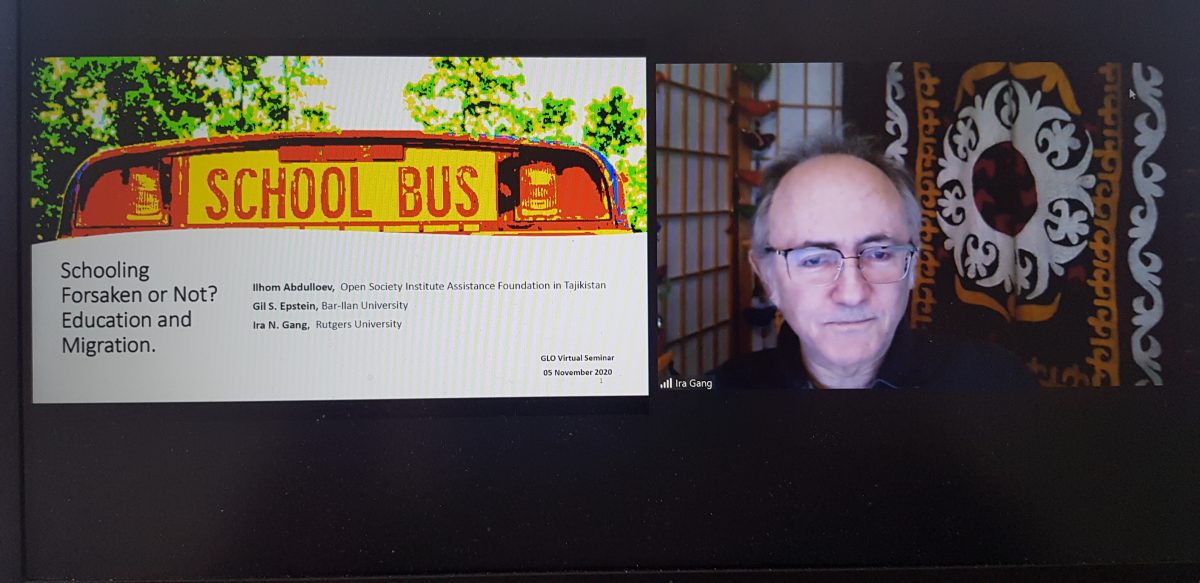
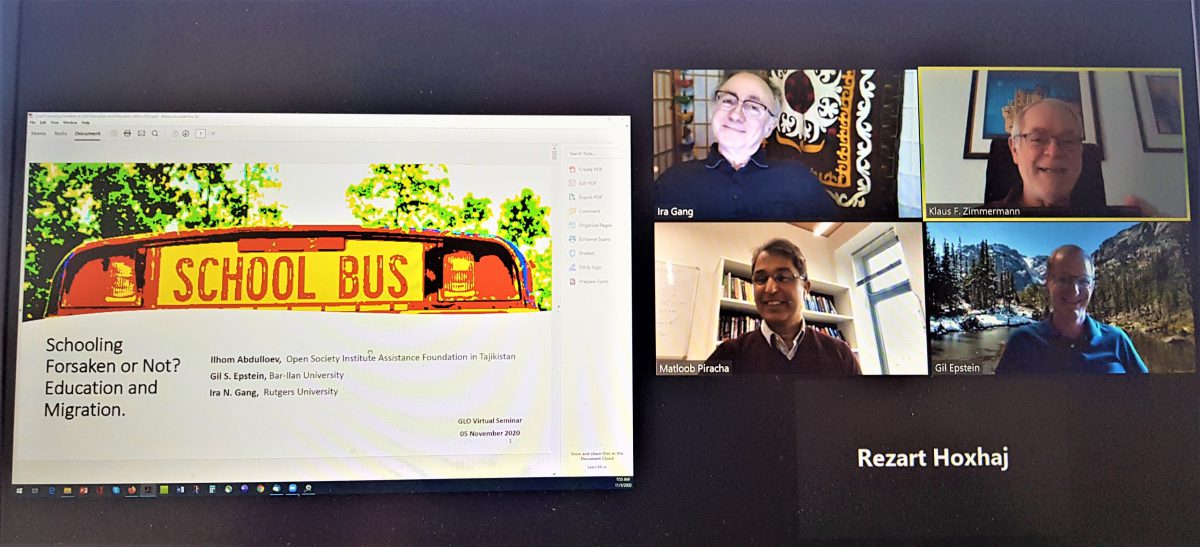
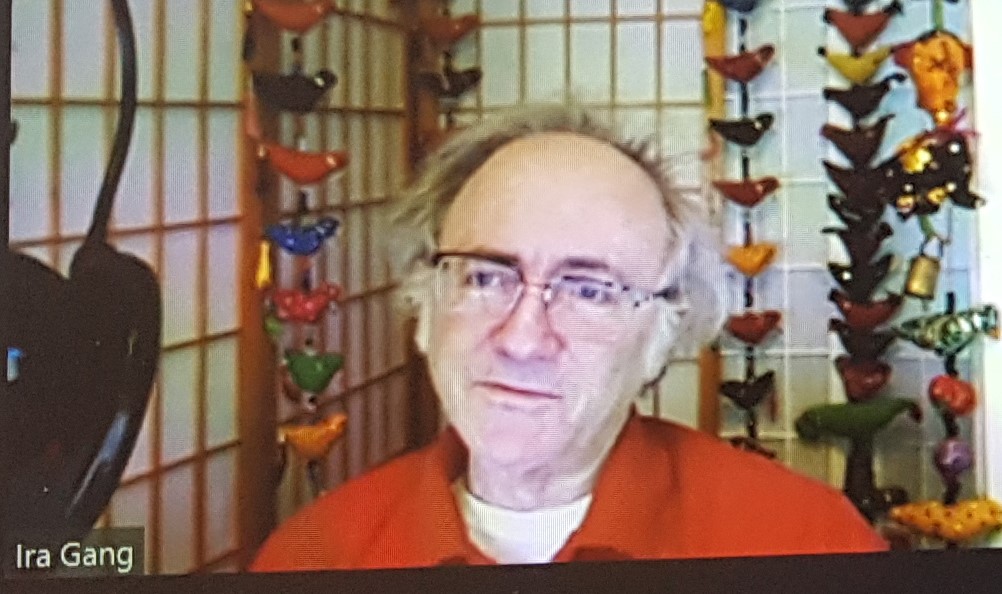
The last seminar was given on November 5, 2020 by Ira Gang on Schooling Forsaken or Not? Education and Migration. Below find a report and the video of the seminar.
Announcement/forthcoming seminar: December 3, 2020:London/UKat 1-2 pm John P. de New, Melbourne Institute of Applied Economic and Social Research, University of Melbourne, and GLO
Report
Schooling Forsaken or Not? Education and Migration.
GLO Virtual Seminar on November 5, 2020 Ira Gang, Rutgers University and GLO Video of the seminar.
Based on joint work with Gil Epstein and Ilhom Abdulloev:
A new GLO Discussion Paper studies the origins and consequences of the Russian mafia.
The Global Labor Organization (GLO) is an independent, non-partisan and non-governmental organization that functions as an international network and virtual platform to stimulate global research, debate and collaboration.
Author Abstract: This paper studies the origins and consequences of the Russian mafia (vory-v-zakone). Using a unique web scraped dataset containing detailed biographies of more than 5,000 mafia leaders, I first show that the Russian mafia originated in the Soviet Gulag archipelago, and could be found near the gulags’ initial locations in mid-1990s Russia, some three decades after the camps were officially closed down. Then, using an instrumental variable approach that exploits the proximity of the Russian mafia to the gulags, I show that Russian communities with mafia presence in the mid-1990s experienced a dramatic rise in crime driven by elite violence which erupted shortly after the collapse of the Soviet Union in 1991. The violence – initially confined to the criminal underworld – eventually spilled over, leading to indiscriminate attacks against local businessmen, managers of state-owned enterprises, judges, and members of the state security apparatus. However, there was no increase in politically-motivated violence, suggesting a widespread collusion between the mafia and local politicians in the early post-Soviet Russia.
A new GLO Discussion Paper finds that people who consider migrating abroad will have either lower years of schooling, or generally have not completed professional schools.
The Global Labor Organization (GLO) is an independent, non-partisan and non-governmental organization that functions as an international network and virtual platform to stimulate global research, debate and collaboration.
Author Abstract: We consider how the possibility of international migration affects an individual’s educational choices in their home country. Without the opportunity to emigrate abroad people choose their educational investment (and hence their skill level) as we might expect, taking into account the utility they derive from the status their attainment bestows. A result of this paper is that if there are low chances of obtaining professional (requires tertiary schooling) jobs in the host country, individuals may well choose an educational track leading to a less-skilled lower status occupational profession in order to increase their chances of obtaining a job in the host country after migration. Thus, all home country students may choose the non-professional education track. Those who might have otherwise pursued higher, professional education may forgo that schooling. The theory developed here explains the forsaken schooling phenomenon, which shows that low-skilled and skilled home country workers are willing to accept low-skilled positions in host countries. This leads to the forgoing of professional schooling in the home country since it is not optimal for the worker in the home country to choose a high skilled education since, they will be overqualified in the host country. This will have a long run affect. As time goes on, therefore, people who consider migrating abroad will have either lower years of schooling, or generally have not completed professional schools (technical-vocational or tertiary).
Featured image: Photo-by-Mikael-Kristenson-on-Unsplash
A new GLO Discussion Paper finds strong empirical evidence supporting the crucial role of financial access in promoting entrepreneurship among informal sector firms in India.
The Global Labor Organization (GLO) is an independent, non-partisan and non-governmental organization that functions as an international network and virtual platform to stimulate global research, debate and collaboration.
Author Abstract: How does informal economic activity respond to increased financial inclusion? Does it become more entrepreneurial? Does access to new financing options change the gender configuration of informal economic activity and, if so, in what ways and what directions? We take advantage of nationwide data collected in 2010/11 and 2015/16 by India’s National Sample Survey Office on unorganized (informal) enterprises. This period was one of rapid expansion of banking availability aimed particularly at the unbanked, under-banked, and women. We find strong empirical evidence supporting the crucial role of financial access in promoting entrepreneurship among informal sector firms in India. Our results are robust to alternative specifications and alternative measures of financial constraints using an approach combining propensity score matching and difference-in-differences. However, we do not find conclusive evidence that increased financial inclusion leads to a higher likelihood of women becoming entrepreneurs than men in the informal sector.
A new GLO Discussion Paper identifies and analyses a new effect related to the cyclical behavior of labor supply: the Entitled-Worker Effect (EWE) and provides evidence for the effect in Spain.
The Global Labor Organization (GLO) is an independent, non-partisan and non-governmental organization that functions as an international network and virtual platform to stimulate global research, debate and collaboration.
Author Abstract: This paper identifies and analyses a new effect related to the cyclical behavior of labor supply: the Entitled-Worker Effect (EWE). This effect is different from the well-known Added-Worker Effect (AWE) and Discouraged-Worker Effect (DWE). The EWE is a consequence of one of the most important labor institutions: the unemployment benefit (UB). We develop a model with uncertainty about the results of the job seeking and transactions costs linked to such a search process in which a kind of moral hazard appears. This creates new incentives for workers and produces an additional counter-cyclical pressure on aggregate labor supply, but with a different foundation from that of the AWE. Finally, we show some empirical evidence supporting the EWE for the Spanish case.
A new GLO Discussion Paper documents that education can generate important externalities that contribute towards economic growth and convergence.
The Global Labor Organization (GLO) is an independent, non-partisan and non-governmental organization that functions as an international network and virtual platform to stimulate global research, debate and collaboration.
Author Abstract: Education can generate important externalities that contribute towards economic growth and convergence. In this paper, we study the drivers of such externalities by conducting the first meta-analysis of the social returns to education literature. We analyse over 1,000 estimates from 31 articles published since 1993 that cover 15 countries. Our results indicate that: 1) spillovers slow down with economic development; 2) tertiary schooling and schooling dispersion increase spillovers; 3) spillovers are smaller under fixed-effects and IV estimators but larger when measured at the firm level; and 4) there is publication bias (but not citation bias).
Featured image: Photo-by-Mikael-Kristenson-on-Unsplash
A new GLO Discussion Paper reviews the long-term evidence about the relationship between unions and job satisfaction.
The Global Labor Organization (GLO) is an independent, non-partisan and non-governmental organization that functions as an international network and virtual platform to stimulate global research, debate and collaboration.
Author Abstract: This chapter focuses on the lessons learned from four decades of studying the relationship between unions and job satisfaction. We discuss the original paradox that started the literature and trace the on-going debate over results that differ by sample and by estimation technique. We emphasize the cross-national evidence suggesting that the paradox of dissatisfied union members may be largely associated with Anglophone countries. Within Anglophone countries we explore exactly what is typically being measured and how unionization may influence both job characteristics and perceptions of given job characteristics. We explore differences in the influence of union membership on job satisfaction and on broader life satisfaction. We also review the literature on alternative forms of employee representation. We conclude by summarizing and suggesting avenues for future research.
Featured image: Photo-by-Jose-Antonio-Gallego-Vázquez-on-Unsplash
This is an internal meeting on special invitation only. If you wish to attend, please contact office@glabor.org.
Central European University (CEU), Vienna
November 23, 2020: “COVID-19” Virtual Workshop of the Academia Europaea (AE) Section “Economics, Business and Management Sciences”, all CET/Vienna.
PROGRAM
Ingy Kassem
Starting at 9.00 am; Informal get together, flexible entry….
Moderator of the event: Ingy Kassem (Central European University, Executive Assistant to the Head of the School of Public Policy)
NOTE: Ingy Kassem will announce the program parts. The session chairs will briefly announce the speakers. The speakers will upload their presentations and share screens. 20 minutes presentation. 10 minutes discussion. Ingy will help with communicating the questions. Breaks are for intense communication. You need to bring your food and drinks…. The meeting is internal on invitation only. It will be not recorded.
9.30 am; Klaus F. Zimmermann (MAE, UNU-MERIT, Maastricht University & GLO): Welcome of the Section Chair
9.35 – 9.50 am; Martin Kahanec (MAE, Central European University, Acting Dean of CEU School of Public Policy): Welcome of the Host & and CEU Business
9.50 – 10.40 am; Graziella Bertocchi (MAE, Università di Modena e Reggio Emilia): COVID-19, Race, and Redlining Chair: Andreu Mas-Colell (MAE, Universitat Pompeu Fabra)
10.50 – 11.40 am; Matthias Sutter (MAE, University of Cologne & Max-Planck Bonn): Nudging or Paying? Evaluating the effectiveness of measures to contain COVID-19 in rural Bangladesh in a randomized controlled trial. Chair:Reinhilde Veugelers(MAE, University of Leuven)
11.50am – 12.40 pm;Anil Duman (Guest, Central European University): Wage Losses and Inequality in Developing Countries: labor market and distributional consequences of COVID-19 lockdowns in Turkey Chair: Klaus F. Zimmermann(MAE, UNU-MERIT, Maastricht University & GLO)
12.40 – 13.50 pm; Lunch with 3 random “seat” allocations…. (virtual, bring your food and drinks)
13.50 – 14.40 pm; Peter Nijkamp (MAE, Vrije Universiteit Amsterdam): Corona Impacts on the Hospitality Market. A Space-time Economic Roller-Coaster Analysis Chair:Martin Kahanec (MAE, Central European University)
14.50 – 15.40 pm; Luiz Moutinho (MAE, University of Suffolk): Artificial Intelligence and Control of COVID-19 Chair: Mirjana Radovic-Markovic (MAE, Institute of Economic Sciences)
15.40 – 15.50 pm; “Conference picture – group photo”.
15.50 – 16.40 pm; Marcella Alsan(Guest, Harvard University): Civil Liberties in Times of Crises Chair: Amelie Constant (MAE, Princeton University)
16.40 – 16.50 pm; Final remarks: Martin Kahanec& Klaus F. Zimmermann 16.50 – 17.00 pm; “After the hour”: Section Committee only. Group photo.
A new GLO Discussion Paperfinds that employment discrimination increased after the 2016 presidential election in the United States.
The Global Labor Organization (GLO) is an independent, non-partisan and non-governmental organization that functions as an international network and virtual platform to stimulate global research, debate and collaboration.
Author Abstract: We examine whether employment discrimination increased after the 2016 presidential election in the United States. We submitted fictitious applications to publicly advertised positions using resumes that are manipulated on perceived race and ethnicity (Somali American, African American, and white American). Prior to the 2016 election, employers contacted Somali American applicants slightly less than white applicants but more than African American applicants. After the election, the difference between white and Somali American applicants increased by 8 percentage points. The increased discrimination predominantly occurred in occupations involving interaction with customers. We continued data collection from July 2017 to March 2018 to test for seasonality in discrimination; there was no substantial increase in discrimination after the 2017 election.
A new GLO Discussion Paperdevelops a dynamic version of the competitive search model with adverse selection. Numerical results show that firm learning does not increase labor market efficiency.
The Global Labor Organization (GLO) is an independent, non-partisan and non-governmental organization that functions as an international network and virtual platform to stimulate global research, debate and collaboration.
Author Abstract: I develop a dynamic version of the competitive search model with adverse selection in Guerrieri, Shimer and Wright (2010). My model allows for an analysis of the effects of firm learning on labor market efficiency in the presence of search frictions. I find that firm learning increases relative expected earnings in high-ability jobs and, thereby, enhances imitation incentives of low-ability workers. The net effect on the aggregate expected match surplus and unemployment is indeterminate a priori. Numerical results show that firm learning does not increase labor market efficiency.
Featured image: Photo-by-Alex-Kotliarskyi-on-Unsplash
A new GLO Discussion Paperfinds on experimental basis with students from middle- and high-school classes in the city of Rome that obtaining information about migrants shape open attitudes more effectively than meeting one, but neither treatment affects feelings associated to immigrants.
The Global Labor Organization (GLO) is an independent, non-partisan and non-governmental organization that functions as an international network and virtual platform to stimulate global research, debate and collaboration.
Author Abstract: We analyze whether (correct) information provision on immigration is more effective than contact in shaping attitudes towards immigration. We collect data from a randomized experiment in 18 middle- and high-school classes in the city of Rome. Half of the classes meet a refugee from Mauritania, whereas the rest of them attend a lecture on figures and numbers on immigration in Italy and the world. On average, students develop better attitudes towards immigration (especially in the case of policy preferences and the perceived number of immigrants in their country) after the information treatment more than they do after the contact treatment, whereas neither treatment affects feelings associated to immigrants. Also, students having received the information treatment strongly adjust their knowledge on immigration. However, students’ individual characteristics and school type (i.e. middle vs. high school) affect treatments’ effectiveness.
Featured image: Photo-by-Joshua Hoehne-on-Unsplash
A new GLO Discussion Paperfinds that removing the criminal ties makes it challenging for the firm to maintain profitability and efficiency.
The Global Labor Organization (GLO) is an independent, non-partisan and non-governmental organization that functions as an international network and virtual platform to stimulate global research, debate and collaboration.
Author Abstract: In this paper, I assess the causal effects of judicial administration on a sample of Italian criminal firms in the period 2004-2016, to shed light on the dynamic path of the firm’s performance from pre-seizure to the post-entry judicial administration phase. By using exogenous enforcement law decisions imposed by authorities for each case, I estimate their impact, highlighting the economic consequences of having new legal governance aiming to establish legality and the perpetuation of activities. The results show that there are adverse effects on profitability and efficiency with an increase in the leverage level. The empirical evidence shows how organised crime firms are intrinsically managed by their dark criminal side; removing the criminal ties makes it challenging to maintain profitability and efficiency. Overall, the negative results are due to difficulty in establishing a new economic framework for (ex-criminal) firms in which they are able to operate efficiently and according to market rules.
A new GLO Discussion Paper suggests that Donald Trump would likely have won re-election if COVID-19 cases in the United States had been 5 percent lower.
The Global Labor Organization (GLO) is an independent, non-partisan and non-governmental organization that functions as an international network and virtual platform to stimulate global research, debate and collaboration.
Author Abstract: What is the effect of the COVID-19 pandemic on the 2020 U.S. presidential election? Guided by a pre-analysis plan, we estimate the effect of COVID- 19 cases and deaths on the change in county-level voting for Donald Trump between 2016 and 2020. To account for potential confounders, we include a large number of COVID-19-related controls as well as demographic and socioeconomic variables. Moreover, we instrument the numbers of cases and deaths with the share of workers employed in meat-processing factories to sharpen our identification strategy. We find that COVID-19 cases negatively affected Trump’s vote share. The estimated effect appears strongest in urban counties, in swing states, and in states that Trump won in 2016. A simple counterfactual analysis suggests that Trump would likely have won re-election if COVID-19 cases had been 5 percent lower. Our paper contributes to the literature of retrospective voting and demonstrates that voters hold leaders accountable for their (mis-)handling of negative shocks.
A new GLO Discussion Paperdocuments that poorer households bear disproportionate costs of water quality violations in the United States.
The Global Labor Organization (GLO) is an independent, non-partisan and non-governmental organization that functions as an international network and virtual platform to stimulate global research, debate and collaboration.
Author Abstract: Up to 45 million Americans in a given year are potentially exposed to contaminated drinking water, increasing their risk of adverse health outcomes. Existing literature has demonstrated that individuals respond to drinking water quality violations by increasing their purchases of bottled water and filtration avoidance, thereby avoiding exposure to contaminants. This paper demonstrates that poorer households, for whom the costs of avoidance comprise a greater share of disposable income, bear disproportionate costs of water quality violations in the United States. Following a health-based water quality violation, poor households’ expenditure on nutritious grocery products in a nationally representative panel differentially decreases by approximately $7 per month. This is associated with a decrease of about 1,500 calories per household member per day, placing these individuals at a higher risk of food insecurity. This finding suggests that the indirect costs of drinking water contamination through economic channels exacerbate health disparities associated with poverty.
Volume 34, issue 1, 2021 of the Journal of Population Economics is published online. See below the list of articles and access links to read or download the contributions.
PARTICIPATE in the November 19, 2020 (Thursday); (2-5 pm CET) Journal of Population Economics Online Workshop (Webinar). Hosted by UNU-MERIT. Maastricht . Open to the general public. The detailed agenda is below presenting highlights on “Covid-19” and “societal conflict” from the new issue.
Journal of Population Economics: Report Klaus F. Zimmermann (Editor-in-Chief; UNU-MERIT & Maastricht University)
2.15 – 2.45 pm CET Maastricht
Lead paper Issue 1/2021: Session Chair Terra McKinnish (Editor; University of Colorado Boulder)
“Names and behavior in a war” presented by Štěpán Jurajda (CERGE-EI, Prague) Co-author: Dejan Kovač (Princeton University and Zagreb)
Discussion
Michaella Vanore
Klaus F. Zimmermann
Terra McKinnish
Štěpán Jurajda
Dejan Kovač
2.45 – 3.15 pm CET Maastricht
Kuznets Prize 2021: “Impacts of social and economic factors on the transmission of coronavirus disease 2019 (COVID-19) in China”, published in the Journal of Population Economics (2020), 33(4), pp. 1127–1172.
Klaus F. Zimmermann (Editor-in-Chief; UNU-MERIT & Maastricht University) Bartel Van de Walle (Director, UNU-MERIT)
Panel with the authors: Yun Qiu (Jinan University), Xi Chen (Yale University), and Wei Shi (Jinan University)
Bartel Van de Walle
Klaus F. Zimmermann
Yun Qiu
Xi Chen
Wei Shi
3.15 – 4.00 pm CET Maastricht
Panel: Publishing in Population Economics Alessandro Cigno (Editor; University of Florence), Shuaizhang Feng (Editor; Jinan University), Oded Galor (Editor; Brown University), Pierre Pestieau (Editor; Université de Liège), Erdal Tekin (Editor; American University), Katharina Wetzel-Vandai (Springer Nature), Junsen Zhang (Editor; Chinese University of Hong Kong), Klaus F. Zimmermann (Editor-in-Chief; UNU-MERIT & Maastricht University)
Sandro Cigno, Klaus F. Zimmermann, Katharina Wetzel-Vandai, Erdal Tekin
Shuaizhang Feng
Oded Galor
Pierre Pestieau
Junsen Zhang
Alessandro Cigno (Editor, Journal of Population Economics, 1988 – 2020)
Shuaizhang Feng (Editor; Journal of Population Economics, 2020 – )
Oded Galor (Editor; Journal of Population Economics, 2019 – ; Editor-in-Chief, Journal of Economic Growth)
Pierre Pestieau (Editor; Journal of Population Economics, 1988 – 1995; previously: Co-Editor Journal of Public Economics)
Erdal Tekin (Editor; Journal of Population Economics, 2010 – 2018; Editor-in-Chief Journal of Policy Analysis and Management)
Junsen Zhang (Editor; Journal of Population Economics, 2001 – 2019; Coeditor, Journal of Human Resources)
Klaus F. Zimmermann (Editor-in-Chief; Managing Editor; Journal of Population Economics, 1988 – ; previously: Managing Editor, Economic Policy)
4.00 – 5.00 pm CET Maastricht
Covid-19 in Issue 1/2021: Session Chair Madeline Zavodny (Managing Editor; University of North Florida)
Fabio Milani (University of California, Irvine): “COVID-19 outbreak, social response, and early economic effects: a global VAR analysis of cross-country interdependencies”
Discussion
Domenico Depalo (Bank of Italy): “True COVID-19 mortality rates from administrative data”
Discussion
Fabrizio Patriarca (University of Modena and Reggio Emilia): “Identifying policy challenges of COVID-19 in hardly reliable data and judging the success of lockdown measures” Co-authors: Luca Bonacini (University of Modena and Reggio Emilia); Giovanni Gallo (National Institute for Public Policies Analysis)
Discussion
Sergio Scicchitano (National Institute for Public Policies Analysis): “Working from home and income inequality: risks of a ‘new normal’ with COVID-19” Co-authors: Luca Bonacini (University of Modena and Reggio Emilia); Giovanni Gallo (National Institute for Public Policies Analysis)
A new GLO Discussion Paper makes the case that the COVID-19 pandemic may cause a permanent reduction in innovation and entrepreneurship and may even bring the 4th industrial revolution to a premature end.
The Global Labor Organization (GLO) is an independent, non-partisan and non-governmental organization that functions as an international network and virtual platform to stimulate global research, debate and collaboration.
Author Abstract: Industrialization is vital for inclusive and sustainable global development. The two engines of industrialization – innovation and trade – are in danger of being compromised by the COVID-19 pandemic, under conditions increasingly reminiscent of the medieval world. It comes at a time when innovation had already been stagnating under guild-like corporate concentration and dominance, and the multilateral trade system had been buckling under pressure from a return to mercantilist ideas. The COVID-19 pandemic may cause a permanent reduction in innovation and entrepreneurship and may even bring the 4th industrial revolution (4IR) to a premature end. Hence the post-COVID-19 world may be left with trade as the only engine for industrialization for the foreseeable future. If the global community fails to fix the multilateral trade system, the world may start to resemble the Middle Ages in other, even worse, aspects.
A new GLO Discussion Paperdocuments that in Africa both the intensive and extensive margins of contemporary conflict are higher close to historical ethnic borders.
The Global Labor Organization (GLO) is an independent, non-partisan and non-governmental organization that functions as an international network and virtual platform to stimulate global research, debate and collaboration.
Author Abstract: We explore the effect of historical ethnic borders on contemporary conflict in Africa. We document that both the intensive and extensive margins of contemporary conflict are higher close to historical ethnic borders. Exploiting variations across artificial regions within an ethnicity’s historical homeland and a theory-based instrumental variable approach, we find that regions crossed by historical ethnic borders have 27 percentage points higher probability of conflict and 7.9 percentage points higher probability of being the initial location of a conflict. We uncover several key underlying mechanisms: competition for agricultural land, population pressure, cultural similarity and weak property rights.
A new GLO Discussion Paperdemonstrates that massive online social networks can advance the study of human culture by providing quantitative, scalable, and high-resolution measurement of behaviorally revealed cultural values and preferences.
The Global Labor Organization (GLO) is an independent, non-partisan and non-governmental organization that functions as an international network and virtual platform to stimulate global research, debate and collaboration.
Author Abstract: Culture has played a pivotal role in human evolution. Yet, the ability of social scientists to study culture is limited by the currently available measurement instruments. Scholars of culture must regularly choose between scalable but sparse survey-based methods or restricted but rich ethnographic methods. Here, we demonstrate that massive online social networks can advance the study of human culture by providing quantitative, scalable, and high-resolution measurement of behaviorally revealed cultural values and preferences. We employ publicly available data across nearly 60,000 topic dimensions drawn from two billion Facebook users across 225 countries and territories. We first validate that cultural distances calculated from this measurement instrument correspond to traditional survey-based and objective measures of cross-national cultural differences. We then demonstrate that this expanded measure enables rich insight into the cultural landscape globally at previously impossible resolution. We analyze the importance of national borders in shaping culture, explore unique cultural markers that identify subnational population groups, and compare subnational divisiveness to gender divisiveness across countries. The global collection of massive data on human behavior provides a high-dimensional complement to traditional cultural metrics. Further, the granularity of the measure presents enormous promise to advance scholars’ understanding of additional fundamental questions in the social sciences. The measure enables detailed investigation into the geopolitical stability of countries, social cleavages within both small and large-scale human groups, the integration of migrant populations, and the disaffection of certain population groups from the political process, among myriad other potential future applications.
A new GLO Discussion Paperfinds for European countries that school friendship networks arise according to homophily along many characteristics (gender, school achievement and ethnic and cultural backgrounds).
The Global Labor Organization (GLO) is an independent, non-partisan and non-governmental organization that functions as an international network and virtual platform to stimulate global research, debate and collaboration.
Author Abstract: This paper investigates the determinants of school friendship networks among adolescents, proposing a model of network formation and estimating it using a sample (CILS4EU) of about 10,000 secondary school students in four countries: England, Germany, the Netherlands and Sweden. We test the idea that networks arise according to homophily along many characteristics (gender, school achievement and ethnic and cultural backgrounds), and assess the relative importance of each factor. In addition to gender, we find that country of origin, generational status and religion predict friendship for foreign-born students. For country-born individuals, ties depend on a broader set of factors, including socioeconomic status and school achievement. In sum, homophilic preferences go considerably beyond ethnicity. Multiculturalism, which gives prominence to ethnic backgrounds, risks emphasising the differences in that dimension at the expense of affinity in others.
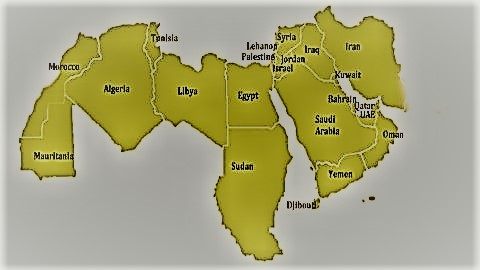
A new GLO Discussion Papercarefully analyzes the components of the low female work participation in MENA countries and draws policy conclusions.
The Global Labor Organization (GLO) is an independent, non-partisan and non-governmental organization that functions as an international network and virtual platform to stimulate global research, debate and collaboration.
Author Abstract: This paper considers the female labor force participation (FLFP) behavior over the past decade in five MENA countries namely, Algeria, Egypt, Jordan, Palestine and Tunisia. Low FLFP rates in these countries, as it is in other MENA countries, are well documented. We conduct synthetic panel analysis using age-period-cohort (APC) methodology and decompose FLFP rates into age, period and cohort effects. We present our results with Hanoch-Honig/Deaton-Paxson normalization and maximum entropy estimation approaches to the APC methodology in order to observe robustness of our results. We first study the aggregate FLFP and note the differentials in age, period and cohort effects across the countries we consider. The analysis is carried also out by rural/urban regional differentiation, marital status and educational attainment. Implications of our results for possible government policies to increase FLFP rates are discussed.
A new GLO Discussion Paper studies the short-term labor market effects of the Great Lockdown in the United States. It shows that jobs with a high non-routine content are especially well-protected, even if they are not teleworkable, and underlines the importance of their task content.
The Global Labor Organization (GLO) is an independent, non-partisan and non-governmental organization that functions as an international network and virtual platform to stimulate global research, debate and collaboration.
Author Abstract: I examine the short-term labor market effects of the Great Lockdown in the United States. I analyze job losses by task content (Acemoglu & Autor 2011), and show that they follow underlying trends; jobs with a high non-routine content are especially well-protected, even if they are not teleworkable. The importance of the task content, particularly for non-routine cognitive analytical tasks, is strong even after controlling for age, gender, race, education, sector and location (and hence for differential demand and supply shocks). Jobs subject to higher structural turnover rates are much more likely to be terminated, suggesting that easier-to-replace employees were at a particular disadvantage, even within sectors; at the same time, there is evidence of labor hoarding for more valuable matches. Individuals in low-skilled jobs fared comparatively better in industries with a high share of highskilled workers.
A new GLO Discussion Paperprovides evidence for the existence of social barriers to female migration.
The Global Labor Organization (GLO) is an independent, non-partisan and non-governmental organization that functions as an international network and virtual platform to stimulate global research, debate and collaboration.
Author Abstract: Traditional gender norms can restrict independent migration by women, thus preventing them from taking advantage of economic opportunities in urban non-agricultural industries. However, women may be able to circumvent such restrictions by using marriage to engage in long-distance migration – if they are able to match with migrating grooms. Guided by a theoretical model in which women make marriage and migration decisions jointly, we hypothesize that marriage and labor markets will be inextricably linked by the possibility of marital migration. To test our hypotheses, we use the event of the construction of a major bridge in Bangladesh – which dramatically reduced travel time between the economically deprived north-western region and the manufacturing belt located around the capital city Dhaka – as a source of plausibly exogenous variation in migration costs. Our empirical findings support our model’s main predictions and provide strong evidence for the existence of social barriers to female migration.
Interested researchers are cordially invited to submit their abstracts or papers for presentation consideration. The 34th EBES Conference – Athens/Greece will take place on January 6-8, 2021 co-organized with Department of Economics, School of Economics, Business and International Studies, University of Piraeus. (Online/Virtual Presentation Only)
This is aGLO supported event. EBESis theEurasia Business and Economics Society, a strategic partner and institutional supporter of GLO. GLO President Klaus F. Zimmermann is also President of EBES.
Invited Speakers
EBES is pleased to announce that distinguished colleagues Jonathan Batten, Douglas Cumming, Kevin Lang, Narjess Boubakri, Keun Lee, Wolfgang Kürsten, Christos Kollias, and Michael Chletsos will join the conference as the invited editors and/or the keynote speakers.
Jonathan Batten is professor of finance and CIMB-UUM Chair in Banking and Finance at the School of Economics, Finance and Banking at the University Utara Malaysia (Malaysia). Prior to this position, he worked at the Monash University (Australia), Hong Kong University of Science and Technology (Hong Kong), and Seoul National University (Korea). He is a well-known academician who has published articles in many of the leading economics and finance journals and currently serves as the Editor of Emerging Markets Review (SSCI), Journal of International Financial Markets, Institutions & Money (SSCI), and Finance Research Letters (SSCI). He was also the President of EBES from July 2014 till December 2018. His current research interests include: financial market development and risk management; spread modelling arbitrage and market integration; and the investigation of the non-linear dynamics of financial prices.
Douglas Cumming, J.D., Ph.D., CFA, is the DeSantis Distinguished Professor of Finance and Entrepreneurship at the Florida Atlantic University (USA). In his prior position, he was a Professor and the Ontario Research Chair at York University (Canada) and has also held visiting appointments at Essex Business School, Kobe University, and EMLyon, among others. He has published over 18 academic books and 150 articles in leading refereed academic journals in finance, management, and law and economics, such as the Academy of Management Journal, Journal of Financial Economics, Review of Financial Studies, Journal of Corporate Finance, Journal of Banking &Finance, Journal of Financial and Quantitative Analysis, Journal of International Business Studies and the Journal of Empirical Legal Studies. His papers were cited more than 17K (Google Scholar). He is currently serving in numerous academic journals: Review of Corporate Finance (Founding Editor-in-Chief), British Journal of Management (Managing Editor-in-Chief), Corporate Governance: An International Review (Co-Editor), European Journal of Finance (Assoc. Editor), Studies in Economics and Finance (Assoc. Editor), and Journal of Banking and Finance (Assoc. Editor). Previously, he was the Managing Editor-in-Chief of the Journal of Corporate Finance and Finance Research Letters and Co-Editor of Entrepreneurship Theory and Practice. His areas of expertise are crowdfunding, venture capital, private equity, hedge funds and law & finance. He earned both a law degree and a doctoral degree in Economics and Finance at the University of Toronto.
Kevin Lang is a professor in the Department of Economics at Boston University (USA), elected Fellow of the Society of Labor Economists, Research Associate of the National Bureau of Economic Research (NBER) and the Center for Research and Analysis of Migration (University College, London), a Research Fellow of the Institute for the Study of Labor (Bonn) and a Fellow of the Center for the Study of Poverty and Inequality (Stanford University), and a member of the Advisory Board of the Canadian Employment Research Forum. He served as a co-editor of Labour Economics, the Journal of the European Association of Labor Economists and remains as an associate editor. He is currently the Editor-in-Chief of Journal of Labor Economics. Prior to BU, he spent a year at the NBER as an Olin Foundation Fellow and before that was an assistant professor at the University of California, Irvine. He has also visited MIT as a visiting scholar and professor and spent his sabbatical at the Collegio Carlo Alberto (Italy), the School of Economics at the University of New South Wales (Australia) and the Center for Research and Analysis of Migration. He has published many articles in top journals such as Journal of Political Economy, Journal of Economic Literature, American Economic Review, Journal of Economic Perspectives, Review of Economics and Statistics, and Quarterly Journal of Economics. His research interests are economics of labor markets and education, including such topics as discrimination, unemployment, the relation between education and earnings and the relation between housing prices, taxes and local services. He earned his Ph.D. in economics from the Massachusetts Institute of Technology (USA).
Narjess Boubakri is professor of Finance at American University of Sharjah (AUS) (United Arab Emirates) where she joined in 2007. She is currently the Dean of the School of Business Administration at AUS as well. She has taught at Laval University and HEC Montreal School of Business (Canada). She has also several editorial roles at leading journals such as Editor (Finance Research Letters), Co-Editor (Quarterly Review of Economics and Finance), Associate Editor (Journal of Corporate Finance), and Subject Editor (Emerging Markets Review; Journal of International Financial Markets, Institutions, and Money; and Journal of International Business Policy). Her papers were published in well-known journals such as Journal of Finance, Journal of Financial Economics, Journal of Corporate Finance, Journal of Banking and Finance, and Journal of Accounting Research. Her research has been widely cited (Google Scholar=6,000+). Her research areas are corporate governance, privatization, corporate finance, international finance, mergers and acquisitions, legal and political institutions, lobbying, and earnings management.
Keun Lee is a Professor of Economics at the Seoul National University (South Korea). He had also short-term positions at University of California, Davis (USA) and University of Aberdeen (UK). He was the winner of the 2014 Schumpeter Prize for his monograph on Schumpeterian Analysis of Economic Catch-up (2013 Cambridge Univ. Press). He is currently Editor of Research Policy, an associate editor of Industrial and Corporate Change, and a council member of the World Economic Forum since 2016. He served as the President of the International Schumpeter Society (2016-18), a member of the Committee for Development Policy of UN (2014-18). One of his most cited articles is a paper on Korea’s Technological Catch-up published in Research Policy, with 1.3K citations (Google Scholar). His research areas are economics of development, transition, and catch-up, economics of innovation, and corporate organization and growth, among others. He obtained Ph.D. in economics from the University of California, Berkeley (USA).
Wolfgang Kürsten is a Full Professor at the Friedrich-Schiller-University of Jena, Germany. Prior to his current role, he worked in many leading institutions such as the Catholic University of Eichst, Germany, the University of Zürich, Switzerland, and University of Hannover, Germany, among others. He is a member of the Advisory Board of Operations Research Spectrum – Quantitative Approaches in Management and the Managing Editor of Review of Managerial Science (SSCI). He also served as Co-Editor in Zeitschrift für Betriebswirtschaft and Operations Research Spectrum-Quantitative Approaches in Management. He has published many articles in journals such as Journal of Institutional and Theoretical Economics and Zeitschrift für Betriebswirtschaft. His research interests include investments, capital structure, and asymmetric information, optimal credit contracts under moral hazard, credit rationing, asset-liability-management of banks, hedging with derivatives, stock options, and management incentives, corporate finance and governance, risk measures and stochastic dominance, decisions under uncertainty, mergers and acquisitions and firm valuation.
Christos Kollias is a Professor of Applied Economics and Acting Dean at the University of Thessaly, Greece. In his career, he has published more than 100 papers and many edited volumes and books. His papers were published in many of the leading journals such as Journal of Multinational Financial Management, Applied Economics, Applied Economics Letters, Finance Research Letters, Public Choice, Southern Economic Journal, and Journal of Business Ethics. He is currently the Editor of Defence and Peace Economics (SSCI) and a member of the Editorial Boards of Peace Economics, Peace Science and Public Policy and the Economics of Peace and Security Journal and a member of the governing body of the Network of European Peace Scientists (NEPS). His research interests include defence economics, terrorism, international political economy, and applied macroeconomics.
Michael Chletsos is a Professor of Economic Analysis at the Department of Economics at the University of Piraeus where he is currently the Director of the Postgraduate Program. Prior to his current position, he taught at the University of Thessaly, the University of Crete, and the University of Ioannina. He was the head of the Dept. of Economics at the University of Ioannina and a senior researcher at the National Labour Institute and the Centre of Planning and Economic Research and Director of the Research Department of the Employment Observatory Research and Informatics S.A. He has been elected by Cedefop to serve as National Expert in skills forecasting and labor market developments. His research interests are labor economics, public economics, health economics and economics of social protection, poverty, and income inequalities, and economics of education. He holds a Ph.D. in economics degree from the University of Picardie, France.
Board Prof. Klaus F. Zimmermann, UNU-MERIT, Maastricht University, The Netherlands, & GLO. Prof. Jonathan Batten, University Utara Malaysia, Malaysia & GLO Prof. Iftekhar Hasan, Fordham University, U.S.A. Prof. Euston Quah, Nanyang Technological University, Singapore Prof. John Rust, Georgetown University, U.S.A., & GLO Prof. Dorothea Schäfer, German Institute for Economic Research (DIW Berlin), Germany, and GLO Prof. Marco Vivarelli, Università Cattolica Del Sacro Cuore, Italy, & GLO
Abstract/Paper Submission
Authors are invited to submit their abstracts or papers no later than December 10, 2020.
Qualified papers can be published in EBES journals (Eurasian Business Review and Eurasian Economic Review) or EBES Proceedings books after a peer review process without any submission or publication fees. EBES journals (EABR and EAER) are published by Springer and both are indexed in the SCOPUS, EBSCO EconLit with Full Text, Google Scholar, ABS Academic Journal Quality Guide, CNKI, EBSCO Business Source, EBSCO Discovery Service, ProQuest International Bibliography of the Social Sciences (IBSS), OCLC WorldCat Discovery Service, ProQuest ABI/INFORM, ProQuest Business Premium Collection, ProQuest Central, ProQuest Turkey Database, ProQuest-ExLibris Primo, ProQuest-ExLibris Summon, Research Papers in Economics (RePEc), Institute of Scientific and Technical Information of China, Naver, SCImago, ABDC Journal Quality List, Cabell’s Directory, and Ulrich’s Periodicals Directory. In addition, while EAER is indexed in the Emerging Sources Citation Index (Clarivate Analytics), EABR is indexed in the Social Science Citation Index (SSCI) and Current Contents / Social & Behavioral Sciences.
Also, all accepted abstracts will be published electronically in the Conference Program and the Abstract Book (with an ISBN number). Although submitting full papers are not required, all the submitted full papers will also be included in the conference proceedings in a USB. Conference program/abstract book with ISBN and conference proceedings will be available on a cloud server for participants to download as well.
After the conference, participants will also have the opportunity to send their paper to be published (after a refereeing process managed by EBES) in the Springer’s series Eurasian Studies in Business and Economics (no submission and publication fees). This is indexed by Scopus. It will also be sent to Clarivate Analytics in order to be reviewed for coverage in the Conference Proceedings Citation Index – Social Science & Humanities (CPCI-SSH). Please note that the 10th, 11th, 12th, 13th, 14th, 15th, 16th, 17th, 18th, 19th, 20th (Vol. 2), 21st, and 24th EBES Conference Proceedings are accepted for inclusion in the Conference Proceedings Citation Index – Social Science & Humanities (CPCI-SSH). Other conference proceedings are in progress. it is also indexed by Scopus.
Important Dates
Conference Date: January 6-7-8, 2021 Abstract Submission Deadline: December 10, 2020 Reply-by: December 14, 2020* Registration Deadline: December 20, 2020 Submission of the Virtual Presentation: December 21, 2020 Announcement of the Program: December 25, 2020 Paper Submission Deadline (Optional): December 20, 2020** Paper Submission for the EBES journals: March 15, 2021
* The decision regarding the acceptance/rejection of each abstract/paper will be communicated with the corresponding author within a week of submission.
** Completed paper submission is optional. If you want to be considered for the Best Paper Award or your full paper to be included in the conference proceedings in the USB, after submitting your abstract before December 10, 2020, you must also submit your completed (full) paper by December 20, 2020.
Contact Ugur Can, Director of EBES (ebes@ebesweb.org); EBES & GLO Dr. Ender Demir, Conferene Coordinator of EBES (demir@ebesweb.org); EBES & GLO
A new GLO Discussion Paperstudies how firms in Brazil respond to predictable, but uncertain, worker absences that arise from maternity and non-work-related sickness leave.
The Global Labor Organization (GLO) is an independent, non-partisan and non-governmental organization that functions as an international network and virtual platform to stimulate global research, debate and collaboration.
Author Abstract: The costs to a firm of employee absence depend on how easy it is to find a replacement. We study how firms respond to predictable, but uncertain, worker absences that arise from maternity and non-work-related sickness leave. Using administrative data on over two million spells of leave in Brazil, we identify the short-run effects of a leave spell starting on a firm’s employment, hiring, and separations. We find that firms respond immediately to the start of leave by hiring new workers, and to a lesser extent, by limiting job separations. However, firms replace leave-takers at far less than the one – for- one rate implied by a frictionless labor market model. Hiring responses are more pronounced for absences arising in occupations with more transferable skills and in firms operating in thicker labor markets. Altogether, our results suggest that replacing workers using external markets is costly and firms manage predictable worker absences through other channels.
A new GLO Discussion Paperfinds that the Bologna reform decreased the number of new highly educated apprentices and aggravated the skills shortage in the German economy.
The Global Labor Organization (GLO) is an independent, non-partisan and non-governmental organization that functions as an international network and virtual platform to stimulate global research, debate and collaboration.
Author Abstract: Starting in 1999, the Bologna Process reformed the German five-year study system for a first degree into the three-year bachelor’s (BA) system to harmonize study lengths in Europe and improve competitiveness. This reform unintentionally challenged the German apprenticeship system that offers three-year professional training for the majority of school leavers. Approximately 29% of new apprentices are university-eligible graduates from academic-track schools. We evaluate the effects of the Bologna reform on new highly educated apprentices using a generalized difference-in-differences design based on detailed administrative student and labor market data. Our estimates show that the average regional expansion in first-year BA students decreased the number of new highly educated apprentices by 3%-5%; average treatment effects on those indecisive at school graduation range between -18% and -29%. We reveal substantial gender and occupational heterogeneity: males in STEM apprenticeships experienced the strongest negative effects. The reform aggravated the skills shortage in the economy.