A new GLO Discussion Paper tries to understand the Chinese gig economy by studying how employee motivation and retention are managed by the mobile app-based, multiple payment platform enabled, car-pooling Chinese giant DiDi.
The Global Labor Organization (GLO) is an independent, non-partisan and non-governmental organization that functions as an international network and virtual platform to stimulate global research, debate and collaboration.
Author Abstract: In recognition of the importance and expansion of the gig economy, largely in developed and BRICs economies, along with the growing literature surrounding it, this research contributes towards an empirical and conceptual understanding of how employee motivation and retention are managed by the mobile app-based, multiple payment platform enabled, car-pooling Chinese giant DiDi. Both the exponential usage and evidently a diversified range of services offered by Didi has not only transformed the Chinese perception of using cabs, over their personal vehicle, in the 1.4 billion demographics but also invites emerging research in learning the tools for employee retention of a company that has a high regional scale of operations across all provinces in China. While the company employs over a million people at various contractual levels, the objective of this paper is to evaluate how levels of employee motivation, in a gig economy setting, largely affects employee effort and performance of DiDi drivers working long hours in major Chinese cities. The objective of this research is to qualitatively investigate the nature and effectiveness of Didi as a customer customiser using a thematic analysis and a conceptual framework, while also adding contextual knowledge on how a relatively new transport company retain employees in a leading BRICS economy, that is embedded with many faces of the gig economy.
A new GLO Discussion Paperidentifies the two-tier structure of the informal labor market in Poland.
The Global Labor Organization (GLO) is an independent, non-partisan and non-governmental organization that functions as an international network and virtual platform to stimulate global research, debate and collaboration.
Author Abstract: This paper tries to identify the wage gap between informal and formal workers and tests for the two-tier structure of the informal labour market in Poland. Design/methodology/approach: I employ the propensity score matching (PSM) technique and use data from the Polish Labour Force Survey (LFS) for the period 2009-2017 to estimate the wage gap between informal and formal workers, both at the means and along the wage distribution. I use two definitions of informal employment: a) employment without a written agreement and b) employment while officially registered as unemployed at a labour office. In order to reduce the bias resulting from the non-random selection of individuals into informal employment, I use a rich set of control variables representing several individual characteristics. After controlling for observed heterogeneity, I find that on average informal workers earn less than formal workers, both in terms of monthly earnings and hourly wage. This result is not sensitive to the definition of informal employment used and is stable over the analysed time period (2009-2017). However, the wage penalty to informal employment is substantially higher for individuals at the bottom of the wage distribution, which supports the hypothesis of the two-tier structure of the informal labour market in Poland. The main contribution of this study is that it identifies the two-tier structure of the informal labour market in Poland: informal workers in the first quartile of the wage distribution and those above the first quartile appear to be in two partially different segments of the labour market.
Featured image: Photo-by-Jose-Antonio-Gallego-Vázquez-on-Unsplash
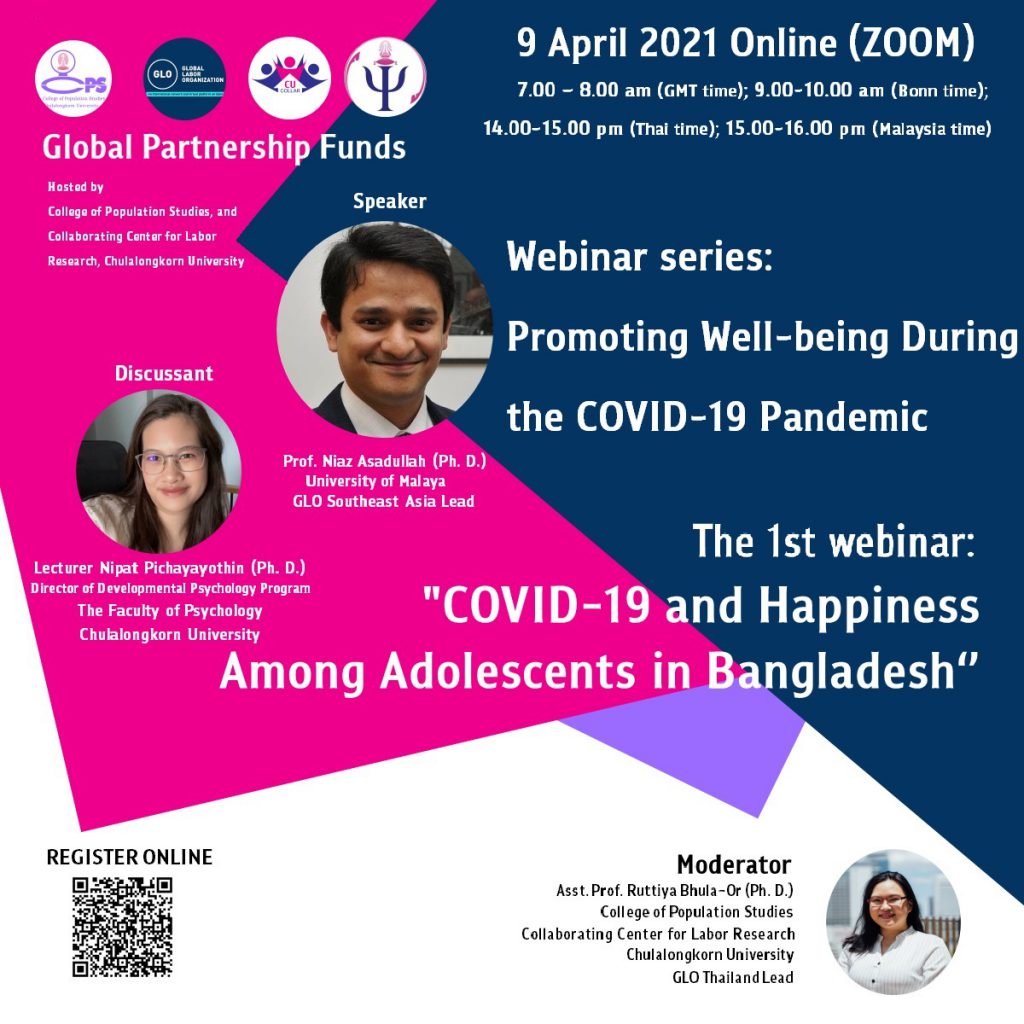
Hosted by the College of Population Studies, Chulalongkorn University, Thailand, the GLO East Asia Cluster organizes an Online Webinar Seminar Series on Promoting Well-being During the COVID-19 Pandemic starting with a first Seminar on 9 April 2021.
A new GLO Discussion Paperestimates the degree of retirement age differentiation needed to compensate individuals for their career-related health handicap/advantage and get closer to “real” actuarial fairness.
The Global Labor Organization (GLO) is an independent, non-partisan and non-governmental organization that functions as an international network and virtual platform to stimulate global research, debate and collaboration.
Author Abstract: Population ageing in Europe calls for an overall rise in the age of retirement. However, many argue that this age should be differentiated to account for individuals’ career arduousness. This paper explores the relevance of this idea. It combines the 7th wave of the SHARE panel data on health at an older age and US occupational O*NET data. With these unique data it first quantifies the impact of entire career arduousness on health at typical retirement age, relative to other key determinants (gender, childhood health, parental longevity). It then estimates the degree of retirement age differentiation that would be needed to compensate individuals for their career-related health handicap/advantage and get closer to “real” actuarial fairness. Using the age of 65 as a reference, results point at the need for differentiation ranging from 60 to 71. But the paper also shows that systematic retirement age differentiation would fail to match a significant portion of the full distribution of health at an older age. In a world where retirement policy compensates for career-related arduousness there would still be a lot of unaccounted health differences; in particular those related to health endowment. Using variance decomposition methods, we estimate that career-arduousness represents at most 5.83% of the model-explained variance of health at an older age.
A new GLO Discussion Paperprovides directions for strategies targeting at improving the performance of firms in MENA countries.
The Global Labor Organization (GLO) is an independent, non-partisan and non-governmental organization that functions as an international network and virtual platform to stimulate global research, debate and collaboration.
Author Abstract: This paper attempts to study the relationship between firm legal form and firm performance in the Middle East and North Africa Region (MENA) using the World Bank Enterprise Survey (WBES) database. Our analysis shows that open shareholding, closed shareholding, partnership, and limited partnership companies demonstrate an advantage in terms of annual sales and annual productivity growth rates over sole proprietorship firms, and that medium-sized and large-sized firms also demonstrate an advantage over small ones. Our analysis also shows that foreign ownership, exporting activities, the usage of the web in communication with clients and suppliers, and the presence of full-time workers positively affect firm performance. These findings are robust when running the analysis for firms with female participation in ownership. This paper provides directions for strategists targeting at improving the performance of firms.
A new GLO Discussion Paper finds for Germany that the likelihood of consuming each of four types of alcohol (beer, wine, spirits, and mixed drinks) is higher for those receiving performance pay, and their total number of types of alcohol consumed is larger. This confirms previous results published in the Journal of Population Economics for the USA.
The Global Labor Organization (GLO) is an independent, non-partisan and non-governmental organization that functions as an international network and virtual platform to stimulate global research, debate and collaboration.
Author Abstract: We study the link between performance pay and alcohol use in Germany, a country with mandated health insurance. Previous research from the US argues that alcohol use as a form of “self-medication” may be a natural response to the stress and uncertainty of performance pay when many workers do not have access to health insurance. We find that the likelihood of consuming each of four types of alcohol (beer, wine, spirits, and mixed drinks) is higher for those receiving performance pay even controlling for a long list of economic, social and personality characteristics and in sensible IV estimates. We also show that the total number of types of alcohol consumed is larger for those receiving performance pay. We conclude that even in the face of mandated health insurance, the link found in the US persists in Germany.
Related paper published ONLINE FIRST 2020 in the Journal of Population Economics:
Does performance pay increase alcohol and drug use?
by Benjamin Artz, Colin P. Green and GLO Fellow John S. Heywood
Forthcoming in a regular issue 2021: Read for free — READLINK: https://rdcu.be/chTbM
A new GLO Discussion Paper finds for Belgiuma negative effect of households’ indebtedness on their consumption.
The Global Labor Organization (GLO) is an independent, non-partisan and non-governmental organization that functions as an international network and virtual platform to stimulate global research, debate and collaboration.
Author Abstract: This paper investigates the potentially non-linear relation between households’ indebtedness and their consumption between 2010 and 2014 in Belgium, using panel data from the two waves of the Household Finance and Consumption Survey. Unlike previous studies, we find a negative effect of households’ indebtedness on their consumption, even in the absence of negative shock on their assets. Our findings suggest that, without such a shock, it is the day-to-day sustainability of the debt, rather than its overall sustainability, that leads households to reduce their consumption. We perform as well a threshold analysis, whose results suggest that households should not have a debt-service-to-income ratio greater than 30%. The effect appears to be robust to various specifications, to result from a trade-off between housing and consumption, and to be more prevalent among more fragile households.
A new GLO Discussion Paper studies for Italy the impact of robotization on the shares of workers employed as robot operators and in occupations deemed exposed to robots to reveal for the first time reinstatement effects among robot operators and heterogeneous results among exposed occupations.
The Global Labor Organization (GLO) is an independent, non-partisan and non-governmental organization that functions as an international network and virtual platform to stimulate global research, debate and collaboration.
Author Abstract: This work investigates the impact that the change in the exposure to robots had on the Italian local employment dynamics over the period 2011-2018. A novel empirical strategy focusing on a match between occupations’ activities and robots’ applications at a high level of disaggregation makes it possible to assess the impact of robotization on the shares of workers employed as robot operators and in occupations deemed exposed to robots. In a framework consistently centered on workers’ and robots’ activities, rather than on their industries of employment, the analysis reveals for the first time reinstatement effects among robot operators and heterogeneous results among exposed occupations.
Blanchflower provides global evidence that the U-shaped happiness-age curveis everywhere.
Blanchflowerand Clarkfind thatchildren may cause unhappiness because of challenging family finances.
Watch the GLO Virtual Seminar presentation of Danny Blanchflower on Despair, Unhappiness and Age explaining this work. Video of seminar. Report of the event.
The Global Labor Organization (GLO) is an independent, non-partisan and non-governmental organization that functions as an international network and virtual platform to stimulate global research, debate and collaboration supporting the Journal of Population Economics.
Featured image: Photo-by-Elijah-Hail-on-Unsplash
Danny Blanchflower
Happiness U-shaped Everywhere? Age and Subjective Well-being in 145 Countries
by Blanchflower, David G.
Published April 2021: Journal of Population Economics. Free Readlink. https://rdcu.be/b7kyO
GLO Fellow David G. Blanchflower & Research Director GLO
Author Abstract: A large empirical literature has debated the existence of a U-shaped happiness-age curve. This paper re-examines the relationship between various measures of well-being and age in 145 countries, including 109 developing countries, controlling for education and marital and labor force status, among others, on samples of individuals under the age of 70. The U-shape of the curve is forcefully confirmed, with an age minimum, or nadir, in midlife around age 50 in separate analyses for developing and advanced countries as well as for the continent of Africa. The happiness curve seems to be everywhere. While panel data are largely unavailable for this issue, and the findings using such data largely confirm the cross-section results, the paper discusses insights on why cohort effects do not drive the findings. I find the age of the minima has risen over time in Europe and the USA.
Andrew Clark
Children, Unhappiness and Family Finances by Blanchflower, David G. & Clark, Andrew E.
Published April 2021: Journal of Population Economics. Free Readlink. https://rdcu.be/b7Z4b GLO Fellow Andrew E. Clark, Associate Editor of the Journal of Population Economics
Author Abstract: The common finding of a zero or negative correlation between the presence of children and parental well-being continues to generate research interest. We consider international data, including well over one million observations on Europeans from 11 years of Eurobarometer surveys. We first replicate this negative finding, both in the overall data and then for most different marital statuses. Children are expensive: controlling for financial difficulties turns our estimated child coefficients positive. We argue that difficulties paying the bills explain the pattern of existing results by parental education and income and by country income and social support. Last, we underline that not all children are the same, with stepchildren commonly having a more negative correlation with well-being than children from the current relationship.
Europe decided to abolish daylight saving time in 2021, since the save energy impact is debatable; but so far concrete actions remained elusive. Some evidence should not be overlooked. Based on natural experiments: Stratified demographic analyses for Indiana/USA indicate that daylight saving time had reduced mortality among males, females, and whites, but only among those aged 65 years and older. For Montevideo/Uruguay research identified a strong and statistically significant decrease in robbery. Two articles in the Journal of Population Economics take up these issues.
The Global Labor Organization (GLO) is an independent, non-partisan and non-governmental organization that functions as an international network and virtual platform to stimulate global research, debate and collaboration.
Saving lives: the 2006 expansion of daylight saving in Indiana
by Adam Cook
Published ONLINE FIRST 2021: Journal of Population EconomicsFREE READ LINK.
Author Abstract: Using data provided by the Indiana State Department of Vital Statistics, this study examines the mortality effects of daylight saving time observance using the April 2006 expansion of daylight saving time in Indiana as a natural experiment. The expansion of daylight saving time to all Indiana counties lowered the average mortality rate in the treatment counties during the months in which daylight saving time was observed. Stratified demographic analyses indicate that daylight saving time reduced mortality among males, females, and whites, but only among those aged 65 years and older. Specific-cause analysis indicates that daylight saving time lowered mortality primarily via reduced cancer mortality. The results of this study suggest a novel solar UVB-vitamin D mechanism could be responsible for the reduction in treatment county mortality following the expansion of daylight saving time in Indiana.
Author Abstract: This paper studies the relationship between ambient light and criminal activity. A Becker-style crime model is developed where it is shown that in areas with less public lighting a sudden increase in ambient light produces a higher reduction in crime. The Daylight Saving Time, the natural experiment used, induces a sharp increase in natural light during crime-intense hours. Using geolocated data on crime and public lighting for the city of Montevideo in Uruguay, regression discontinuity estimates identify a strong and statistically significant decrease in robbery of 17-percent. The decrease is larger in poorly lit areas. Computing the level of public lighting at which DST has no effect on crime reduction, we identify the minimum level of public lighting that an area should target.
Hyperbolic utility discounting has emerged as a leading alternative to exponential discounting because it can explain time-inconsistent behaviors. A new paper published in the Journal of Population Economics uses hyperbolic discounting in an intergenerational model with altruistic parents to find that in the steady state it decreases fertility, increases human capital investment, and shifts consumption towards younger ages.
The Global Labor Organization (GLO) is an independent, non-partisan and non-governmental organization that functions as an international network and virtual platform to stimulate global research, debate and collaboration.
Hyperbolic discounting in an intergenerational model with altruistic parents
by Jia Cao & Minghao Li
Published ONLINE FIRST 2021: Journal of Population EconomicsFREE READ LINK.
Author Abstract: Hyperbolic utility discounting has emerged as a leading alternative to exponential discounting because it can explain time-inconsistent behaviors. Intuitively, hyperbolic discounting should play a crucial role in intergenerational models characterized by intertemporal trade-offs. In this paper, we incorporate hyperbolic discounting into a dynamic model in which parents are altruistic towards their children. Agents live for four periods and choose levels of consumption, fertility, investment in their children’s human capital, and bequests to maximize discounted utility. In the steady state, hyperbolic discounting decreases fertility, increases human capital investment, and shifts consumption towards younger ages. These effects are more pronounced in the time-consistent problem (in which agents cannot commit to a course of action) than in the commitment problem, which can be interpreted as realized and intended actions, respectively. The preference-based discrepancy between intended fertility and realized fertility has important implications for the empirical literature that compares the two.
A new paper published in the Journal of Population Economics investigates the impact of the 2008 recession on the health of immigrants’ newborns in Italy. It finds that the negative effects are driven by the main economic activity of the ethnic group and its related network at the municipal level.
The Global Labor Organization (GLO) is an independent, non-partisan and non-governmental organization that functions as an international network and virtual platform to stimulate global research, debate and collaboration.
Birth outcomes in hard times among minority ethnic groups by Paola Bertoli, Veronica Grembi & The Linh Bao Nguyen
Published ONLINE FIRST 2021: Journal of Population EconomicsOPEN ACCESS.
Author Abstract: Combining a unique dataset of birth records with municipal-level real estate information, we assess the impact of the 2008 recession on the health of immigrants’ newborns in Italy. Health at birth (e.g., low birth weight) of children born to immigrants deteriorated more than health at birth of children born to Italian natives. The negative effects on immigrants are not equally distributed across ethnicities, but rather are driven by the main economic activity of the ethnic group and its related network at the municipal level. Immigrants whose ethnic group is mainly employed in the sectors most affected during the recession suffered the most. Living in a municipality where their ethnic network is organized through more registered immigrant associations mitigates the recession hardship for immigrants. The characteristics of ethnic groups and their organization at the municipal level do not explain the heterogeneous effects on Italian newborns, which confirms the presence of network effects rather than neighborhood effects
A new GLO Discussion Paper shows that government-led urbanization in China has a positive impact on natural gas demand conditional on total energy use.
The Global Labor Organization (GLO) is an independent, non-partisan and non-governmental organization that functions as an international network and virtual platform to stimulate global research, debate and collaboration.
Author Abstract: The Chinese government is actively promoting urbanization to stimulate its economic growth while facing increasingly prominent environmental concerns. The main objective of this research is to assess whether the Chinese government is making efforts to promote cleaner energy demand while pushing for urbanization. This study employs system GMM models to empirically investigate the causal relationship between urbanization and natural gas demand by using a sample of 30 provinces in China over the period 2005–2018. The estimates of the preferred specifications show that government-led urbanization has a positive impact on natural gas demand conditional on total energy use. By attaching natural gas facilities to new structures through the use of administrative power, the government induces natural gas demand while promoting urbanization. Robustness checks indicate that adding more potentially influential factors will not qualitatively change the results from the baseline. A constrained two-step static panel data estimation is used to estimate the depreciation rates of natural gas and of all fuel appliances, suggesting that the promotion of natural gas demand provides a relatively economical way to balance the trade-off between economic growth and the reduction of emissions. The empirical results also show that the dynamic model outperforms its static counterpart in predictions. Based on the results, policy recommendations are made towards the goals of the Fourteenth Five-Year Plan for the National Economic and Social Development of China.
Assistant Professor Dr Ruttiya Bhula-or is a Vice Dean at the College of Population Studies, Chulalongkorn University, a director/ key coordinator of Collaborating Centre for Labour Research at Chulalongkorn University, a GLO Fellow and GLO Country Lead for Thailand. In her interview, she reflects the challenging situation in the economy and on the labor market both in the short-run and the long-run. She reveals her mission and vision as a researcher and describes her role in the upcoming collaboration between her university and GLO.
Some core messages of the interview:
Chulalongkorn University collaborates with the Ministry of Labor to establish the National Labor Research Center and Collaborating Center for Labor Research at Chulalongkorn University (CU-COLLAR).
The developing collaboration is to help facilitate the national-global platform in advancing labor research and policies into practice.
Her upcoming publication deals with the socioeconomic disparities in Thailand under the impact of COVID-19.
In the long-term, universal protection of vulnerable groups is the policy priority.
The private sector is urging the Thai government to adopt a vaccine passport scheme to support tourism.
Strong public health interventions, among other factors, had successfully flattened the epidemic Covid-19 curve by mid-2020.
A large share of Thais were reported to be willing to be vaccinated.
Assistant Professor Dr Ruttiya Bhula-or is a Vice Dean at College of Population Studies, Chulalongkorn University, a director/ key coordinator of Collaborating Centre for Labour Research at Chulalongkorn University, Secretariat to National Labour Research Centre at the Ministry of Labour, and a committee member on Labour Reform, Thai Senate of Thailand. She has hand-on experience at the national and international level with UN organizations, and contributes to academic areas and promotes linkages of labour researches into policies and practices using an interdisciplinary approach. She has been actively working in the area of labour market analysis, skills, gender, migration, and labour policy linkages. As a GLO Fellow she is the GLO Country Lead Thailand.
GLO: CU-Collar and Chulalongkorn University have joined the GLO network. What is the institutional background?
Ruttiya Bhula-or: Chulalongkorn University collaborates with the Ministry of Labor to establish the National Labor Research Center and Collaborating Center for Labor Research at Chulalongkorn University (CU-COLLAR). The center aims at extending a network among educational institutions, private sectors in Thailand, as well as an international level and advancing labor, human resource research for the Thai and global community. The objective of CU-COLLAR is to leverage, to fully integrate and to manage labor-related knowledge and database of labor and human resources, along with (1) becoming a center for research studies on labor issues and enabling the planning of a labor development which is in line with the Thailand 4.0 heading toward sustainability and sustainable development goals; (2) promoting studies and usage of research in policy decision making; (3) developing a database that all interested parties can use for research purposes; (4) extending labor research network at the national and international level to increase competitiveness of the country and to promote a better quality of life for the Thai and global community.
GLO:What is your role in this new collaboration?
Ruttiya Bhula-or: As CU-COLLAR has a strong commitment to contributing to evidence-informed policy-making and promoting dialogue on labor, social and human development, our key roles are to promote linkages of knowledge and enable a platform as well as knowledge production and dissemination and for cooperation between stakeholders within the local and global community. My role in this collaboration is to help facilitate this national-global platform in advancing labor research and policies into practice. The working mechanism includes existing and expanding public, private, and academic partnerships at the national and international level in building structures and systems that embed research use and drive evidence use in a sustainable development manner.
GLO: Beyond the COVID-19 crisis: What are the long-term challenges the Thai’s labor market has to solve?
Ruttiya Bhula-or: According to my article with Prof. Niaz, before the COVID-19, the COVID-19 outbreak will hammer existing income and wealth inequalities. The COVID-19 will have a disproportionately negative impact on the poorer households, who are informal workers, workers in small-to-mid enterprises and family businesses. On the other hand, many employers have reorganized businesses allowing employees the option to work from home, but the country’s digital divide remains wide. These challenges thus will be a short-term and long-term effect and need extensive and universal protection of vulnerable group as the policy priority. M Niaz Asadullah and Ruttiya Bhula-or (2020) Why COVID-19 Will Worsen Inequality in Thailand. The Diplomat, 28 April 2020.
GLO:In particular: Will tourism recover and what can the options be for the country?
Ruttiya Bhula-or: It is clear that tourism-related sectors were the most severely affected due to the declaration of an emergency, a temporary ban on the majority of international flights, and measures restricting dining in restaurants and visiting entertainment venues. Thai stimulus packages include a domestic tourism stimulus initiative, known as Rao Tiew Duay Kan (We Travel Together). However, Thailand is one of the most popular tourist destinations in the world that attracted a large number of international tourists. Domestic tourism cannot compensate for the net loss. It is clear that the private sector is urging the Thai government to adopt a vaccine passport scheme and a travel bubble arrangement with countries where the prevalence rate of COVID-19 is low to moderate. Maya Taylor (2021) The Thaiger Thai industry representatives push government on vaccine passport policy.
GLO:So far, Thailand was quite successful in fighting the pandemic: What is the explanation?
Ruttiya Bhula-or: Actually, Thailand reported an imported case of COVID-19; the first case detected outside China. Thanks to strong public health interventions, community engagement, effective governance, a high degree of public cooperation, and good community-based networks, Thailand had successfully flattened the epidemic curve by the mid-2020 (WHO & MOPH, 2020). Nevertheless, the second wave of outbreaks has started in December 2020 in a migrant-intensive province, highlighting the vulnerability of low-paid migrant workers to the pandemic. World Health Organization & Ministry of Public Health (2020) Joint Intra-Action Review of the Public Health Response to COVID-19 in Thailand, 20-24 July 2020.
GLO:Why is Thailand not joining the international COVID-19 vaccine alliance?
Ruttiya Bhula-or: The Thai government claimed that Thailand, as a middle-income country, is ineligible for cheap vaccines under the WHO’s Covax scheme. The government also added that the country had to make an advance payment without knowing the source of vaccines and delivery dates. With this, Thailand becomes the last ASEAN nation to roll out vaccines. In the meantime, health workers have begun receiving vaccination from imported Chinese Sinovac shots, but mass vaccinations for the general population will be locally produced in June [1]. The additional reason goes to the efficacy of AstraZeneca’s vaccine, which is upward of 70.4%, compared with over 50% for Sinovac’s product [2]. No doubt, this policy draws attention to the public interest. According to the survey by YouGov, a large share of Thais reported that they are willing to be vaccinated. (The survey was taken between Nov. 17 and Jan. 10, covering 2,088 participants in Thailand.) [3] In addition, the private sector, for example, the tourism industry, also further push pressure on the government for alternative stimulus and vaccine passport policies. We are looking forward to this June for vaccination and, with uttermost hope, a gradually socioeconomic recovering. [1] REUTERS (2021) Govt defends decision not to join Covax vaccine alliance, 14 FEB 2021. [2] Dominic Faulder and Apornrath Phoonphongphiphat (2021)Thailand finally kicks off COVID vaccinations: 25 things to know [3] Khaosod English (2020) Thais most willing to take vaccine, out of 24 surveyed countries, 18 January 2021 ************* With Ruttiya Bhula-or spoke Klaus F. Zimmermann, GLO President.
Ruttiya Bhula-or reporting to the Thai Senate in 2021
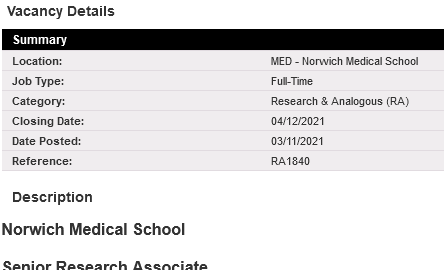
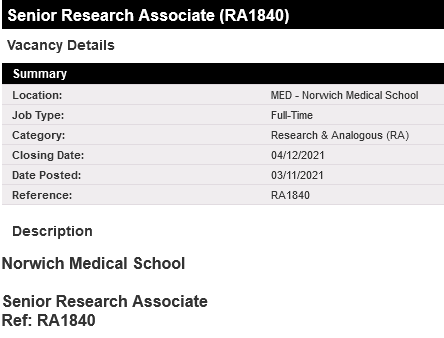
GLO Fellows Prof. Andrew Jones and Dr. Apostolos Davillas seek to fill a position for a highly skilled postdoctoral researcher with closing date 12 April 2021. See for details below.
“We are seeking a highly skilled postdoctoral researcher at Senior Research Associate level to deliver the research objectives defined by the “(In)Consistency of responses to self-assessed health measures and implications for biosocial research” ESRC grant and research project. You will work with Prof. Andrew Jones and Dr. Apostolos Davillas on econometric analysis of longitudinal data.
As a Senior Research Associate, you will be actively involved in all aspects of the project. You will help to build and analyse data from Understanding Society: the UK Household Longitudinal Survey. Ideally, on the conceptualisation side, you will be able also to provide support on appropriate econometric analysis and techniques to be employed, as well as on the interpretation of our findings given the existing literature.
You will have a postgraduate degree in a relevant discipline, such as economics, statistics or relevant quantitative discipline and experience in econometric analysis and techniques. You will also be required to have experience in managing and working with large, multi-purpose social science datasets.
This full-time post is offered on a fixed term basis to 31 October 2022.
A new paper published in the Journal of Population Economics finds that employment discrimination in the US increased after the 2016 Presidential elections, but predominantly occurred in occupations involving interaction with customers.
The Global Labor Organization (GLO) is an independent, non-partisan and non-governmental organization that functions as an international network and virtual platform to stimulate global research, debate and collaboration.
The effect of the 2016 United States presidential election on employment discrimination
by GLO Fellows Marina Mileo Gorzig & Deborah Rho
Published ONLINE FIRST 2021: Journal of Population Economics FREE READ LINK.
Author Abstract: We examine whether employment discrimination increased after the 2016 presidential election in the United States. We submitted fictitious applications to publicly advertised positions using resumes that are manipulated on perceived race and ethnicity (Somali American, African American, and white American). Prior to the 2016 election, employers contacted Somali American applicants slightly less than white applicants but more than African American applicants. After the election, the difference between white and Somali American applicants increased by 8 percentage points. The increased discrimination predominantly occurred in occupations involving interaction with customers. We continued data collection from July 2017 to March 2018 to test for seasonality in discrimination; there was no substantial increase in discrimination after the 2017 local election.
A new paper published in the Journal of Population Economics finds for German data that the employment probability of unemployed immigrants increases strongly with language training.
The Global Labor Organization (GLO) is an independent, non-partisan and non-governmental organization that functions as an international network and virtual platform to stimulate global research, debate and collaboration.
Employment effects of language training for unemployed immigrants by Julia Lang
Published ONLINE FIRST 2021: Journal of Population EconomicsOPEN ACCESS.
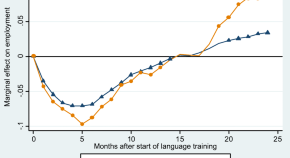
Author Abstract: Proficiency in the host country’s language is an important factor for the successful labor market integration of immigrants. In this study, I analyze the effects of a language training program for professional purposes on the employment opportunities of participants in Germany. I apply an instrumental variable approach and exploit differences in lagged local training intensities. Bivariate probit estimates show that 2 years after the program started, the employment probability of immigrants who were unemployed in 2014 and participated in the program had increased by more than nine percentage points as a result of language training.
A new GLO Discussion Paper finds for Italy that “places that don’t recover” after events like an earthquake can become populist hotbeds.
The Global Labor Organization (GLO) is an independent, non-partisan and non-governmental organization that functions as an international network and virtual platform to stimulate global research, debate and collaboration.
Author Abstract: The recent literature on the determinants of populism has highlighted the role of long-term trends of progressive isolation and prolonged economic stagnation in engendering discontent and, in turn, demand for political change. We investigate, instead, the potential of unanticipated local shocks in shaping the ‘geography of discontent’. Using comprehensive data at a fine spatial scale and a comparative natural experiment approach, we document that the occurrence of two destructive earthquakes in Italy resulted in sharply diverging electoral outcomes: while the 2012 Emilia quake did not alter voting behaviour, the 2009 L’Aquila earthquake paved the way for an impressive and persistent surge in right-wing populism in the most affected areas. Such heterogeneous patterns mainly originate from a stark contrast in post-disaster reconstruction processes and shifts in institutional trust. Our findings are consistent with the idea that not only “places that don’t matter”, but also “places that don’t recover”, can become populist hotbeds.
A new paper published in the Journal of Population Economics finds by comparing twins and close siblings in Swedish register data that the negative association between human capital and fertility mostly reflects family background factors.
The Global Labor Organization (GLO) is an independent, non-partisan and non-governmental organization that functions as an international network and virtual platform to stimulate global research, debate and collaboration.
How family background shapes the relationship between human capital and fertility by Francis Kramarz, Olof Rosenqvist & Oskar Nordström Skans
Published ONLINE FIRST 2021: Journal of Population EconomicsOPEN ACCESS.
Author Abstract: Many previous studies have shown that skilled and educated women have fewer children. By comparing twins and close siblings in Swedish register data, we show that the negative association between human capital and fertility mostly reflects family background factors. For males, human capital measures are unrelated to fertility in the overall population, but this again masks the influence of family background factors as high-skilled males tend to have more children than their less-skilled twins or siblings. Hence, family background factors have a strong negative impact on the overall association between human capital measures and fertility for both women and men. Non-cognitive abilities deviate from these patterns—these abilities remain strongly complementary to fertility both within and across families. Our results can be reconciled with a stylized model where family-specific preferences for fertility are shared across generations and shape investments in skills and traits when children are young.
The Journal of Population of Economicsis an international quarterly that publishes original theoretical and applied research in all areas of population economics, household economics, and human resources. This report contains information about the Journal and its editorial process in the past year and some earlier years.
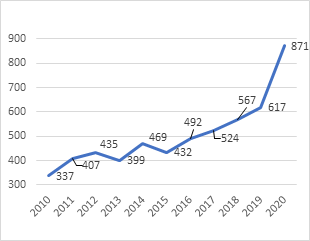
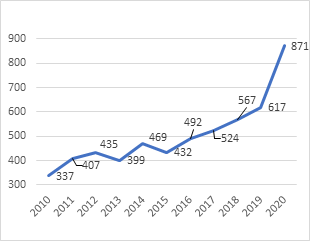
Figure 1: Number of Submissions
The number of submissions has substantially increased over recent years (Figure 1). Between 2011 and 2013, the Journal received about 400 submissions per year; by 2016 the number of submissions neared 500, and in 2020, 871 manuscripts were received. This marks an annual increase of submissions of 41%. Over the decade 2010-2020, the manuscript inflow rose from 337 to a level 2.6 times higher. The additional workload was managed through an efficient desk rejection policy for initial screening.
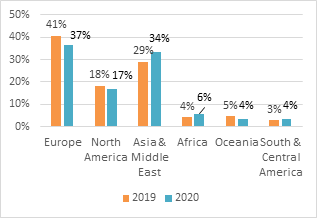
Figure 2: Origin of Submissions
In line with past years, the largest single share of submissions made in 2020 were from corresponding authors based in Europe (Figure 2). Nearly 40% of all submissions originated from Europe, and over one-third (34%) of submissions came from authors based in Asia and the Middle East. Under one-fifth (17%) of submissions came from authors based in North America. The remaining submissions came from contributors from Africa (6%), Oceania (Australia and New Zealand; 4%), and South and Central America (4%).
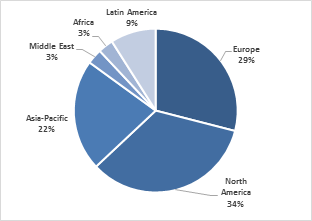
Figure 3: Visits by World Region 2019
Figure 3 contains the internet visits to the Journal on the Springer website from the world regions. With over a third of visits coming from North America and 29% from Europe, followed by the Asia-pacific region (22%), the Journal is globally accessed and read.
Figure 4: Days to First Decision
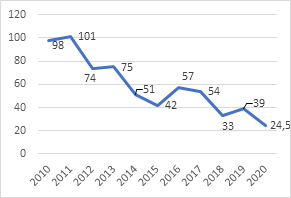
Figure 4 shows that the average number of days between submission and first decision has generally declined over time. Despite a slight uptick in the turnaround time for first decisions between 2015 and 2016, which may be partially attributed to the increased volume of submissions, there was a substantial reduction in turnaround time in following years. In 2020, the average time for first decisions was 24 days. The Journal is committed to keep the time between submission and decisions low, including eventual publication. Since 2013 the Journal has executed a desk rejection policy to provide authors with an early signal for better targeting of their work. The large number of submissions combined with an annual quota of 40 manuscripts keeps the acceptance rates of the Journal very low.
Table 1 shows three acceptance rate measures: 1) the number of manuscripts accepted in a given year as a share of all final decisions made in that year; 2) the number of published articles in a given year as a share of all submissions in that year; and; 3) the number of articles published in a given year divided by the number of the previous year’s submissions.
The number of accepted papers (submitted at any point in time) in a given year as a share of all decisions made in that year has shifted over time. The acceptance rate has declined from 7% in 2018 to 4.9% in 2019, slightly increasing in 2020 to 5.4%. If acceptance rate is measured as the number of published manuscripts as a share of total submissions received in that year, the acceptance rate was slightly higher, at 4.6% in 2020 (at 40 manuscripts from among 871 submissions), falling from 7.1% in 2018 and 6.5% in 2019. Measuring the acceptance rate as the number of publications as a share of the number of submissions received in the previous year (2019) would yield a 2020 rate of 6.5%, which is lower than the previous years (7.6% in 2018 and 7.1% in 2019).
Table 1: Acceptance Rates
Index Year
2018
2019
2020
No. accepted / Total No. decisions
7.0%
4.9%
5.4%
No. articles publ. / No. submissions
7.1%
6.5%
4.6%
No. articles publ. / No. subm. prev. year
7.6%
7.1%
6.5%
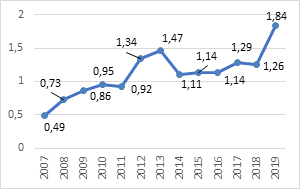
Table 2 reports the status of papers submitted in the given year for years 2018 – 2020. The Journal’s Impact Factor has increased substantially over time (Figure 5). In 2019, the 2020 published simple Impact Factor was 1.840, and the 5-year Impact Factor was 2.353. The Journal ranked 120/371 in economics and 11/29 in demography in 2019. As of July 2020, the Journal’s IDEAS/RePEc ranking was 77/2,485 (based on the Simple Impact Factor 15.682, for Journals and all years).
Table 2: Status of Papers Submitted in Particular Year
Outcome/Year
2018
2019
2020
Accept
39
35
47
Revise
68
125
81
Reject
522
551
737
Figure 5: Impact Factor
The Journal is ranked in: Social Science Citation Index, Journal Citation Reports/Social Sciences, SCOPUS, EconLit, Google Scholar, EBSCO Discovery Service, ProQuest, CAB International, ABS Academic Journal Quality Guide, Academic OneFile, Academic Search, Bibliography of Asian Studies, CAB Abstracts, CSA Environmental Sciences, Current Contents/Social & Behavioral Sciences, ECONIS, ERIH PLUS, Gale, Global Health, International Bibliography of the Social Sciences (IBSS), JSTOR, OCLC, Research Papers in Economics (RePEc), Review of Population Reviews, SCImago, and Summon by ProQuest.
Klaus F. Zimmermann, Editor-in-Chief Journal of Population Economics
A new GLO Discussion Paper finds that within the studied period 1991-2015the earnings of overeducated workers eroded at the lower and upper segments of the wage distribution.
The Global Labor Organization (GLO) is an independent, non-partisan and non-governmental organization that functions as an international network and virtual platform to stimulate global research, debate and collaboration.
Author Abstract: The main aim of this study is to analyse the wage returns of Overeducated workers employed in Trinidad and Tobago. To undertake such a study, data from the Continuous Sample Survey of Population (CSSP) for the period 1991-2015 is used to estimate an initial OLS and Quantile regression version of the Mincerian Earnings equations, which is commonly used in the education mismatch literature. To observe the unconditional partial effects of small changes in wage returns of overeducated workers at the mean, the Recentred Influence Function is estimated. The results reveal that if the earnings of overeducated workers who receive low wages, was replaced with that of high wages, then this would lead to a rise, or shift in the returns of overeducated workers, if only their biographical information is considered. The inclusion of their skill and geographic location would cause their earnings to shift further. The shift in the earnings of overeducated workers, when examined across the wage distribution, would tend to favor those who were married, younger, i.e., in the 25-35 age group, who were highly skilled at their jobs. These groups of overeducated workers would experience the lowest wage penalties in comparison to their single, mature, and semi-skilled colleagues.
A new GLO Discussion Paper finds a rather limited role of mental health in comparison to physical health for older individuals’ work.
The Global Labor Organization (GLO) is an independent, non-partisan and non-governmental organization that functions as an international network and virtual platform to stimulate global research, debate and collaboration.
Author Abstract: This paper contributes to the literature on old employment barriers by exploring empirically the relative importance of mental v.s. physical health in determining work. It combines regression and variance decomposition analyses to quantify the respective role of mental v.s. physical health. The data used are from SHARE and inform in great detail on the health but also work status (i.e. employment and hours) of individuals aged 50+, interviewed between 2004 and 2017 in 21 European countries. The main result of the paper is that of the rather limited role of mental health – in comparison to physical health – in accounting for older individuals’ work. The paper also shows that health (physical or mental) is much better at predicting old people’s propensity to be in employment than the number of hours they work. Finally, the paper reveals that, in comparison to women, men’s work is more driven by their health status.
A new GLO Discussion Paper finds that in less affluent transition economies, more workers use involuntary non-standard jobs as a means to escape unemployment, while in affluent economies, interventionist policies are associated with high levels of voluntary non-standard work and low unemployment.
The Global Labor Organization (GLO) is an independent, non-partisan and non-governmental organization that functions as an international network and virtual platform to stimulate global research, debate and collaboration.
Author Abstract: This paper is dedicated to the cross-national comparison of the labour markets of the EU member countries and Albania. The aim is to establish whether or not cross-national variations in propensities of being hired in a non-standard job are the result of differences in national institutional regimes and labour market regulations. An adapted version of the Fraser Index is used to explain cross-country differences in relation to the application of rigid labour market regulation. The econometric analyses indicate that the net effect of more stringent labour market regulation, increase job quality in different senses: in less affluent transition economies, more workers use involuntary non-standard jobs as a means to escape unemployment. On the other hand, in affluent economies, interventionist policies are associated with high levels of voluntary non-standard work and low unemployment.
A new GLO Discussion Paper suggests that exposure to disadvantaged childhood circumstances can exacerbate cognitive deficits as well as cognitive decline over time.
The Global Labor Organization (GLO) is an independent, non-partisan and non-governmental organization that functions as an international network and virtual platform to stimulate global research, debate and collaboration.
Author Abstract: We examine the long-term relationship between childhood circumstances and cognitive aging. In particular, we differentiate the level of cognitive deficit from the rate of cognitive decline. Applying a linear mixed-effect model to three waves of China Health and Retirement Longitudinal Surveys (CHARLS 2011, 2013, 2015) and matching cognitive outcomes to CHARLS Life History Survey (2014), we find that key domains of childhood circumstances, including family socioeconomic status (SES), neighborhood cohesion, friendship and health conditions, are significantly associated with both the level of cognitive deficit and the rate of decline. In contrast, childhood neighborhood safety only affects the level of cognitive deficit. Childhood relationship with mother only affects the rate of cognitive decline. The effects of adverse childhood circumstances are generally larger on level of cognitive deficit than on rate of cognitive decline. Moreover, education plays a more important role in mediating the relationships compared to other later-life factors. These findings suggest that exposure to disadvantaged childhood circumstances can exacerbate cognitive deficit as well as cognitive decline over time, which may be partially ameliorated by educational attainment.
Azita Berar is Director Policy of the Global Labor Organization (GLO), and Senior Fellow, Graduate Institute of International and Development Studies, Geneva.
GLO Policy Brief No. 5 Theme 2: Inequalities and labor markets Theme 4: Youth employment and participation
Appraising the youth uprisings in the Middle East and North Africa
“Ten years on, too early to say ?!“
by Azita Berar
It is ten years since several countries in the Middle East and North Africa (MENA), were swept by waves of peaceful youth-led protests, longing for economic and social justice and political freedoms. These uprisings, also called the “Arab Spring”, eventually led to the fall of long established leaders in some countries (Tunisia, Egypt, Libya), ushered attempts of reform in others (Morocco, Algeria, Jordan), and stalled in protracted and violent civil strife in others (Libya, Syria, Iraq and Yemen) where competing external interventions have compounded internal polarizations.
In this Policy Brief, I argue that the transformational impact of the “Arab Spring” process is more complex, global and open-ended than is generally acknowledged. ____________________
Ten years on: reflecting on root causes and policy outcomes of the “Arab Spring”
It has become a common practice, especially on anniversaries such as this one, to revisit the original demands that drove the Arab uprisings at the end of 2010 and throughout 2011 and to measure the progress achieved. But could we or should we assess the outcomes of revolutions, social movements and uprisings by establishing a balance sheet to score successes and failures? To identify winners and losers? Could we attribute responsibilities for these diverging and complex outcomes in different settings?
Ten years on,- notwithstanding the specific circumstances and dynamics in each country-, the impressions of an unfinished agenda, of an aborted revolution, of stagnation or even backpedaling predominate. These sentiments have replaced the worldwide jubilation, admiration and support that poured then into the symbolic seeds of these youthful uprisings: Sidi Bouzid in Tunisia, the town of M. Bouazizi’s tragic self-immolation and the Tahrir Square in Cairo, Egypt.
There are many outstanding questions regarding the “Arab Spring”. There is still an unsettled debate for example as how to qualify these uprisings: social movement, political revolt, revolution or any other denomination?
Regarding the substance of claims that filled the placards carried by young protestors across the region, the twin themes of “Freedom and Equity” predominated, revealing a mix of deeply rooted political, economic and social grievances.
Chief amongst the socio-economic grievances voiced by young women and men throughout the region, was the demand for “jobs”, more precisely, for “decent work”. The desperate self-immolation of Abu Azizi, a young street vendor in the small town of Sidi Bouzid, which sparked the waves of protests in Tunisia, was symbolic on more than one count. It epitomized the plight of the informal economy, the only source of jobs and livelihoods for a majority of the workforce, in all the dimensions of precarity and insecurity associated with it. The eldest son of a family of disenfranchised small land-owner, he had to abandon his early efforts of farming and after multiple attempts to find decent formal jobs in the town he had come to settle in, he resorted to selling vegetable and fruits on a cart, with funds borrowed, to cater for himself and the family of six. He also had to struggle all along to finish his own schooling and have his siblings go to school. As a street vendor, he was subject to continuous harassment by local authorities on various grounds including for presenting a permit that later was confirmed that he did not need. The situation of informal economy workers is not much different today. Informality is on the rise with the continued youth employment crisis in the region. The COVID-19 induced economic slowdown has increased poverty including working poverty. The various relief and compensation packages, seldom take into account work and income losses and access to health and social protection of those who live and work in conditions of informality.
The tragic event also gave a human face to the millions of young women and men in the region, who each year, upon finishing school, struggle to find a decent job and a meaningful place in the society. Ten years on, youth unemployment rates remain as stubbornly high, in all of the MENA region, as a decade ago; sadly, the highest in the world[1]. Difficulties in school to work transitions affect all strokes of youth including the university graduates. The “decent work” deficits are also manifest in more significant indicators, such as high incidence of inactivity and discouraged labour and low pay jobs amongst youth. Across all these indicators, youth are affected disproportionately, compared to their relative weight in the population and young women consistently, at a higher disadvantage. The gender gap is significant signaling pervasive segregation and discrimination in numerous sectors. In addition, women shoulder a disproportionate share of unpaid care labour, in view of the limited availability of affordable and accessible social infrastructure for child and elderly care.
While the demographics in the region, in particular the youth bulge, explain the pressure on labour markets, they do not excuse the poor performance in youth transitions. There is a collective political responsibility of policy actors in public and private spheres in the region for, gradually but surely, missing out on the short and irreversible window of opportunity that the “youth dividend” represents. The same dividend that many analysts consider, as a key success factor in promoting the “East Asian Tigers”’ economic miracle[2].
Despite all the soul-searching that was undertaken in the wake of youth protests a decade ago, internally, as well as by international institutions and development partners, the main course of economic and social strategies, have not changed fundamentally.
Scholars of the region had pointed then to the gaps and needed direction of change to deliver on more and better job-friendly and inclusive outcomes. The kinds of structural changes in economic strategies that were advocated, such as supporting an endogenous Research and Innovation (R&I) capacity and a genuine industrial policy redressing the exclusionary nature of current privatization policies, as well as better negotiating terms of integration in the global economy, have not been followed suit.
The discursive mea culpa of international financial institutions for the neglect of the social and human side of the equation[3] , was not followed through either with action or support for the adoption of alternative macro-economic frameworks.[4]
Whilst in the first few years after the uprisings, the region saw a flurry of projects and increased development cooperation dedicated to youth employment, gender equality and in support of reform and inclusion agendas, these did not amount to a significant change in policy priorities and approaches. Investments in access to health, in quality education, in inclusive skills’ training opportunities and for extending capacities for implementation and institutional development have not matched the needs. Even in Tunisia which, by all accounts, has had a most peaceful and successful transition to date , thanks to the strength of its social institutions[5], policy reform and implementation have become captive of protracted consultations, political balancing and frequent changes in ministerial assignments.
On the objective of democratization, the score may seem even weaker, and the space that was created and occupied seem to have closed or significantly shrunk. Aside from the Tunisian exception, elsewhere coercive measures and repression, and sometimes, serious breaches of human rights, seem to have won over. The no-choice policy narrative of “radical Islamism” or “autocracy” prior to the Arab uprisings is gradually replaced by another no-choice, that of either “chaos” or “autocracy”.
However, it will be wrong to limit the legacy of the Arab Spring to these considerations, as fundamental as they are. The unmet aspirations have not de-legitimized the original drive. The acquired experience of new citizenship rights, of holding the rulers accountable and the claims of “dignity”, “justice” and other non-quantifiable transformational values, awakened by the 2010-2011 protests, are vivid. The more recent rounds of protests in Sudan, Algeria, Lebanon, show that these demands and expectations, resurface recurrently and occupy the space that can be occupied. Each time, the agenda of demands is pushed into new spaces and in more creative ways.
Shouldn’t we look at “Arab Spring”, its triggers and outcomes, by situating it more globally ?
Most people analyze the “Arab Spring” through an “essentialist” lens, explaining its rise and demise from the specific historical and geopolitical conditions in Middle East and North Africa. There is another perspective to consider: that of the chain of protests against inequalities and backlashes of globalization that have sparked indifferent geographies and succeeded each other throughout the last decade.
We should recall that the youth uprisings in MENA followed shortly the 2008 global economic financial crisis that caused global recession and slowdown, with massive impacts on jobs. The global crisis was revelatory of another, that of an unprecedented youth employment crisis. The “Arab spring” was preceded by the 2009 “Green Uprising” in Iran, and followed by numerous bouts of similar protests on the other shores of the Mediterranean and beyond. Such as those by the “Indignados” starting in Spain, or “Occupy Wall Street” for example, that developed in the following months and years and spread worldwide. The reference by the “Occupy” movement to the “Tahrir moment”[6], clearly shows the catalytic role that the “Arab Spring” played in the string of social protests movements in the early years of the decade.
While the local dynamics and demands differed, there were several common denominators amongst these youth-led leaderless movements. First, was a loud outcry against inequalities and neo-liberal policies that shaped the globalization, in particular for failing to deliver on the goals of full and decent employment and on social inclusion and mobility agendas. Another common demand was the quest for new forms of participatory democracy and for creating new forms of local empowerment as a means to rebuild trust in the institutions. Unsurprisingly, in the midst of another global crisis, that of COVID-19, these demands have re-emerged creating a new momentum for paradigm shifts.
The Arab Spring also acted as a catalyst to the emergence of yet another phenomenon, that of “youth agency” in global governance. Several international resolutions and calls for actions spearheaded by the United Nations System were adopted in direct response to the youth employment crisis[7] revealed by the 2008 financial crisis and echoed through the 2010-2011 “Arab Spring”. Ever since, inviting youth as a distinct stakeholder in the policy conversation and promoting youth voice and engagement in consultative and advisory formats, in various forums related to sustainable development or to peace building agendas has become a new standard pattern. The organization and institutionalization of numerous youth fora along global, regional and national policy making conferences, the growth of new youth-led or youth-centered organizations in all regions and their engagement by multiple stakeholders, governments, private sector, civil society and academia, show the road traveled in less than a decade.
Ten years is a short period in a historical perspective.But what is an adequate time frame to appraise the impact of the “Arab Spring” ? There is a famous quote attributed to the Chinese premier Zhou Enlai. When asked in early 1970’s about the influence of the French Revolution, he is reputed to have said: ‘Too early to say!’
The 2010-2020 decade joins two major global crises. The 2008 global financial crisis followed by the austerity policies adopted since 2010, and the COVID-19 pandemic in 2020. These crises triggered massive social and economic meltdowns, waves of social and political protests and alternative ideas looking into the future. In this broader perspective, how to appraise the impact of the “Arab Spring”, in the region and globally ? Certainly in more complex terms and it is “Too early to say”. __________________
[1] In 2020, the youth unemployment rate in North Africa stood at 30 percent compared to the world average of 13,6 percent. For all indicators, see various editions of ILO, Global Employment Trends for Youth. [2] There is a growing body of empirical evidence on the subject since the original work by D.E. Bloom & J.G. Williamson, Demographic Transitions and Economic Miracles in Emerging Asia, was published in 1997. [3] Momani, B and Lanz, D (2014) Shifting IMF Policies Since the Arab Uprisings, Centre for International Governance Innovation, Policy Brief no. 34. [4] Mohammed Mossallam, The IMF in the Arab world: Lessons unlearnt, SOAS, University of London, December 2015. [5] The Tunisian National Dialogue Quartet composed of the UGTT (the Tunisian General Labour Union), UTICA (the Tunisian Confederation of Industry, Trade and Handicrafts), Tunisian Human Rights League and the Tunisian Order of Lawyers, was awarded the 2015 Noble Peace Prize for its decisive contribution to consolidate democratic gains and a peaceful constitutional settlement. [6] The organizers of the Occupy Wall Street posted in their July 2011 web-post: Are you ready for a “Tahrir moment”? The expression has been used multiple times since. [7] See ILO, 2012 The youth employment crisis: A call for action.Adopted by tripartite constituents from ILO’s 189 members. ILO subsequently led the for formulation and launch in 2016 of a Global Initiative on Decent Jobs for Youth, a joint UN system wide initiative and multi-stakeholder partnership.
Note: The opinions expressed here are those of the author and not of the GLO, which has no institutional position. Featured image: Mohamed Bouazizi
A new GLO Discussion Paper finds that education indeed affects gender role attitudes.
The Global Labor Organization (GLO) is an independent, non-partisan and non-governmental organization that functions as an international network and virtual platform to stimulate global research, debate and collaboration.
Author Abstract: This paper presents the first empirical evidence of the causal impact of individuals’ education on their attitudes towards traditional gender roles. We employ two national panel datasets from the UK and Switzerland and a repeated cross-sectional dataset with information from 13 Western European countries for the analysis. The causal impact of education on gender role attitudes is estimated by exploiting the exogenous variation in individuals’ education induced by the compulsory school reforms undertaken in European countries in the second half of the 20th century. We find evidence that an additional year of education instigates egalitarian gender role attitudes equivalent of 0.1-0.3 of a standard deviation. While education’s moderating effect is particularly prominent among women, no evidence of effect heterogeneity is found concerning the individuals’ religiosity. Our findings are robust to numerous checks performed and are briefly discussed for their policy relevance.
A new GLO Discussion Paper finds systemic discrimination in a procedurally fair hiring process using culture as hiring criterion.
The Global Labor Organization (GLO) is an independent, non-partisan and non-governmental organization that functions as an international network and virtual platform to stimulate global research, debate and collaboration.
Author Abstract: Criteria used in hiring workers often do not reflect the skills required on the job. By comparing trainee performance for newly hired workers conditional on competitive civil service examination scores for hiring French public sector workers, we test whether women and men with the same civil service examination score exhibit similar performance in a job-related trainee programme. Both the civil service examination and trainee scores contain anonymous and non-anonymous components that we observe separately. We find that by the end of the trainee programme (first year of employment), women are outperforming men on both anonymous written and non-anonymous oral evaluations, a finding that holds both conditionally and unconditionally for the civil service examination results. According to further analysis, however, it is the anonymously graded “essay on common culture” civil service examination that, unlike the other CSE components, disadvantages women in this particular context.
A new GLO Discussion Paper shows that the enforced increase in work from home in the pandemic in the United Kingdom is associated with a higher self-perceived productivity per hour, and an increase in weekly working hours among the employed.
The Global Labor Organization (GLO) is an independent, non-partisan and non-governmental organization that functions as an international network and virtual platform to stimulate global research, debate and collaboration.
Author Abstract: In 2020, the COVID-19 pandemic forced governments in many countries to ask employees to work from home (WFH) where possible. Using representative data from the UK, we show that increases in WFH frequency are associated with a higher self-perceived productivity per hour and an increase in weekly working hours among the employed. The WFH-productivity relationship is stronger for employees residing in regions worse affected by the pandemic and those who previously commuted longer distances, while it is weaker for mothers with childcare responsibilities. Also, we find that employees with higher autonomy over job tasks and work hours and those with childcare responsibilities worked longer hours when working from home. With prospects that WFH possibility may remain permanently open for some employees, we discuss our results’ labor market policy implications.
A new GLO Discussion Paper finds that payments to works councilors in Germany are broadly in line with legal regulations.
The Global Labor Organization (GLO) is an independent, non-partisan and non-governmental organization that functions as an international network and virtual platform to stimulate global research, debate and collaboration.
Author Abstract: The German law on co-determination at the plant level (Betriebsverfassungsgesetz) stipulates that works councilors are neither to be financially rewarded nor penalized for their activities. This regulation contrasts with publicized instances of excessive payments. The divergence has sparked a debate about the need to reform the law. This paper provides representative evidence on wage payments to works councilors for the period 2001 to 2015. We find wage premia of 2% to 6% in OLS-specifications, which are more pronounced for long-term works councilors. Moreover, we observe no wage premia in linear fixed-effects panel data specifications, suggesting that the OLS-results capture the effect of selection into works councillorship. We obtain no evidence for a delayed compensation or a special treatment of works councilors released from work. Hence, our results indicate that payments to works councilors are broadly in line with legal regulations.
TheGLO Virtual Seminar is a monthly internal GLO research event chaired by GLO Director Matloob Piracha and hosted by the GLO partner institution University of Kent. The results are available on the GLO website and the GLO News section, where also the video of the presentation is posted. All GLO related videos are also available in the GLO YouTube channel. (To subscribe go there.)
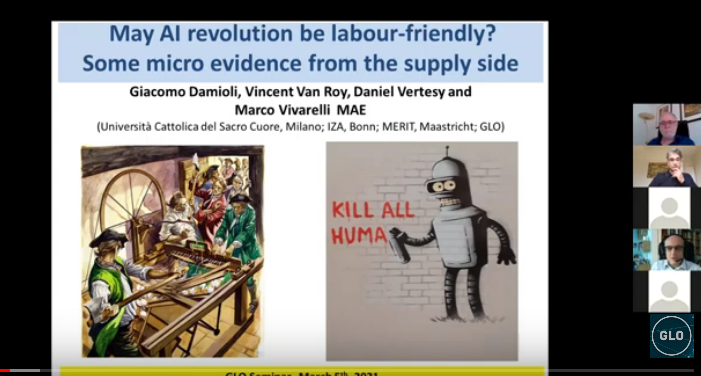
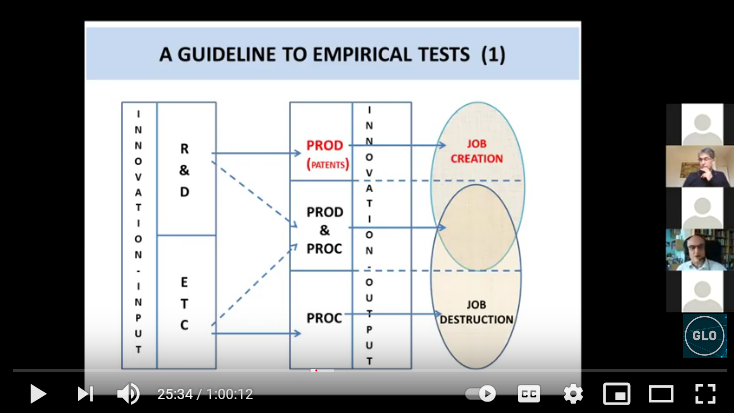
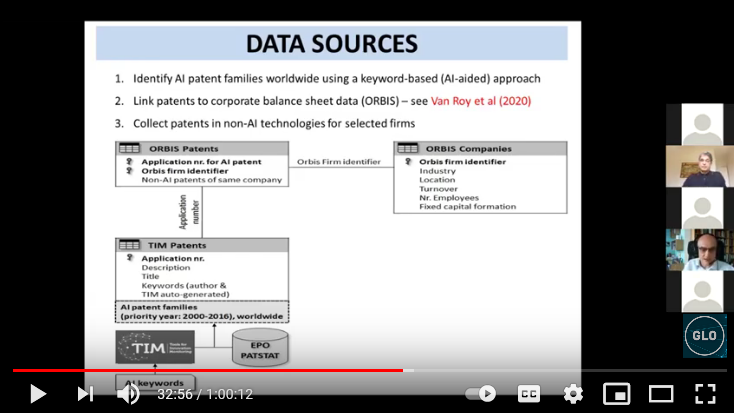
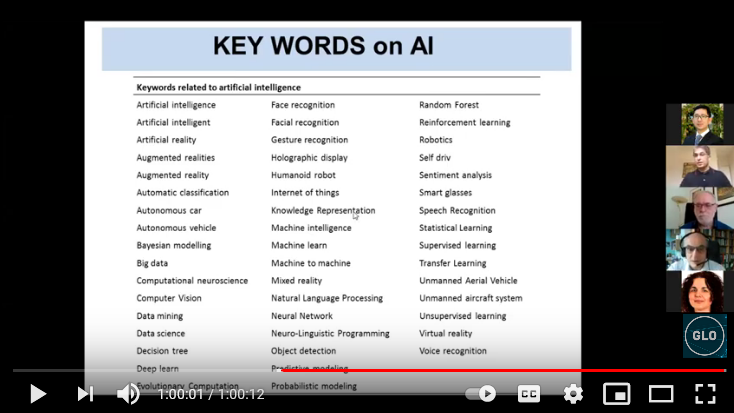
The last seminar was given on March 5, 2021, London/UKat 1-2 pm, by Marco Vivarelli, Università Cattolica del Sacro Cuore and GLO, on May AI revolution be labour-friendly? Some micro evidence from the supply side. See below a report, a link to the presentation slides and the full video of the seminar.
Report
May AI revolution be labour-friendly? Some micro evidence from the supply side.
GLO Virtual Seminar on March 5, 2021
Marco Vivarelli, Università Cattolica del Sacro Cuore and GLO
A new GLO Discussion Paper finds that due to COVID-19 female self-employed are 35% more likely to experience income losses than their male counterparts, whereas no comparable gender gap is observed among employees. Self-employed women are significantly more likely to be impacted by government-imposed restrictions.
The Global Labor Organization (GLO) is an independent, non-partisan and non-governmental organization that functions as an international network and virtual platform to stimulate global research, debate and collaboration.
Author Abstract: We investigate how the economic consequences of the pandemic, and of the government mandated measures to contain its spread, affect the self-employed – particularly women – in Germany. For our analysis, we use representative, real-time survey data in which respondents were asked about their situation during the COVID-19 pandemic. Our findings indicate that among the self-employed, who generally face a higher likelihood of income losses due to COVID-19 than employees, women are 35% more likely to experience income losses than their male counterparts. Conversely, we do not find a comparable gender gap among employees. Our results further suggest that the gender gap among the self-employed is largely explained by the fact that women disproportionately work in industries that are more severely affected by the COVID-19 pandemic. Our analysis of potential mechanisms reveals that women are significantly more likely to be impacted by government-imposed restrictions, i.e. the regulation of opening hours. We conclude that future policy measures intending to mitigate the consequences of such shocks should account for this considerable variation in economic hardship.
Using various estimation techniques, a new GLO Discussion Paper finds that returns to education in China experienced a slight decrease in 2010-2015, but reverted back in 2017. University education remained to have higher returns than those to secondary or compulsory education.
The Global Labor Organization (GLO) is an independent, non-partisan and non-governmental organization that functions as an international network and virtual platform to stimulate global research, debate and collaboration.
Author Abstract: In this paper, we apply Generalized Propensity Score matching (GPSM) method, which deals with a continuous treatment variable, to estimate the returns to education in China from 2010 to 2017. Results are compared with OLS estimates from the classical Mincerian equation, as well as estimates from two instrumental variable methods (i.e., 2SLS and Lewbel). We use the Chinese General Social Survey data, including a subset newly released in 2020. We find that returns to education in China experienced a slight decrease in 2010-2015, but reverted back in 2017. With the more flexible GPSM method, we also find that returns to university education remain higher than returns to secondary or compulsory education. The GPSM estimates are also closer to OLS estimates, compared to both instrumental variable methods.
Interested researchers are cordially invited to submit their abstracts or papers for presentation consideration. The 35th EBES Conference – Rom/Italy will take place on April 7-9, 2021 co-organized with the Faculty of Economics Sapienza, University of Rome. (Online/Virtual Presentation Only)
This is aGLO supported event. EBESis theEurasia Business and Economics Society, a strategic partner and institutional supporter of GLO. GLO President Klaus F. Zimmermann is also President of EBES.
Invited Speakers
EBES is pleased to announce that distinguished colleagues Euston Quah, Dorothea Schäfer, and M. Kabir Hassan will join the conference as the invited editors and/or the keynote speakers.
Euston Quah is the Albert Winsemius Chair Professor and head of the Department of Economics at the Nanyang Technological University (Singapore). He is a prolific writer with publications in well-known international journals such as World Development, Applied Economics, Environment and Planning, Journal of Environmental Management, International Review of Law and Economics, Journal of Economics, Journal of Public Economic Theory, American Journal of Economics and Sociology, among others, and 6 books. He is the editor of the Singapore Economic Review (SSCI). He is also the President of Economic Society of Singapore and Adjunct Principal Research Fellow at IPS (National University of Singapore). His areas of expertise are environmental economics, resource allocation and cost-benefit analysis, law and economics and household economics.
Dorothea Schäfer is the Research Director of Financial Markets at the German Institute for Economic Research (DIW Berlin) and Adjunct Professor of Jönköping International Business School, Jönköping University. She has also worked as an evaluator for the European Commission, the Federal Ministry of Education and Research and Chairwoman of Evaluation Committee for LOEWE (Landes-Offensive zur Entwicklung Wissenschaftlich-ökonomischer Exzellenz des Bundeslandes Hessen). She managed various research projects supported by the Deutsche Forschungsgemeinschaft (DFG), the EU Commission, the Fritz Thyssen Foundation and the Stiftung Geld und Währung. Her researches were published in various journals such as Journal of Financial Stability; German Economic Review; International Journal of Money and Finance; and Small Business Economics. She is regularly invited as an expert in parliamentary committees, including the Finance Committee of the Bundestag and gives lectures on financial market issues in Germany and abroad. She is also a member of the Editorial Board and Editor-in-Chief of the policy-oriented journal “Vierteljahrshefte zur Wirtschaftsforschung” and Editor-in-Chief of Eurasian Economic Review. Her research topics include financial crisis, financial market regulation, financing constraints, gender, and financial markets, financial transaction tax.
M. Kabir Hassan is Professor of Finance and Hibernia Professor of Economics and Finance at University of New Orleans (USA), where he holds three endowed Chairs. He has consulting, research and teaching experiences in development finance, money and capital markets, Islamic finance, corporate finance, investments, monetary economics, macroeconomics, Islamic banking and finance, and international trade and finance. Prof. Hassan has been recognized with Lifetime Achievement Award by UNO Research Council in 2019. Prof. Hassan is the Editor-in-Chief of International Journal of Islamic and Middle Eastern Finance and Management, Senior Editor of International Journal of Emerging Markets and Associate Editor of Review of International Business and Finance, International Review of Economics and Finance, and Pacific-Basin Finance Journal. He has guest edited special issues of many journals as well.
ExecutiveBoard Prof. Klaus F. Zimmermann, UNU-MERIT, Maastricht University, The Netherlands, & GLO. Prof. Jonathan Batten, University Utara Malaysia, Malaysia & GLO Prof. Iftekhar Hasan, Fordham University, U.S.A. Prof. Euston Quah, Nanyang Technological University, Singapore Prof. John Rust, Georgetown University, U.S.A., & GLO Prof. Dorothea Schäfer, German Institute for Economic Research (DIW Berlin), Germany, and GLO Prof. Marco Vivarelli, Università Cattolica Del Sacro Cuore, Italy, & GLO
Abstract/Paper Submission
Authors are invited to submit their abstracts or papers no later than March 12, 2021.
Qualified papers can be published in EBES journals (Eurasian Business Review and Eurasian Economic Review) or EBES Proceedings books after a peer review process without any submission or publication fees. EBES journals (EABR and EAER) are published by Springer and both are indexed in the SCOPUS, EBSCO EconLit with Full Text, Google Scholar, ABS Academic Journal Quality Guide, CNKI, EBSCO Business Source, EBSCO Discovery Service, ProQuest International Bibliography of the Social Sciences (IBSS), OCLC WorldCat Discovery Service, ProQuest ABI/INFORM, ProQuest Business Premium Collection, ProQuest Central, ProQuest Turkey Database, ProQuest-ExLibris Primo, ProQuest-ExLibris Summon, Research Papers in Economics (RePEc), Institute of Scientific and Technical Information of China, Naver, SCImago, ABDC Journal Quality List, Cabell’s Directory, and Ulrich’s Periodicals Directory. In addition, while EAER is indexed in the Emerging Sources Citation Index (Clarivate Analytics), EABR is indexed in the Social Science Citation Index (SSCI) and Current Contents / Social & Behavioral Sciences.
Furthermore, the qualified papers from the conference will be published in the regular issues of Singapore Economic Review (SSCI & Scopus) and International Journal of Business and Society (ESCI & Scopus) after a fast-track review.
Also, all accepted abstracts will be published electronically in the Conference Program and the Abstract Book (with an ISBN number). Although submitting full papers are not required, all the submitted full papers will also be included in the conference proceedings in a USB. Conference program/abstract book with ISBN and conference proceedings will be available on a cloud server for participants to download as well.
After the conference, participants will also have the opportunity to send their paper to be published (after a refereeing process managed by EBES) in the Springer’s series Eurasian Studies in Business and Economics (no submission and publication fees). This is indexed by Scopus. It will also be sent to Clarivate Analytics in order to be reviewed for coverage in the Conference Proceedings Citation Index – Social Science & Humanities (CPCI-SSH). Please note that the 10th, 11th, 12th, 13th, 14th, 15th, 16th, 17th, 18th, 19th, 20th (Vol. 2), 21st, and 24th EBES Conference Proceedings are accepted for inclusion in the Conference Proceedings Citation Index – Social Science & Humanities (CPCI-SSH). Other conference proceedings are in progress.
Important Dates
Conference Date: April 7-9, 2021 Abstract Submission Deadline: March 12, 2021 Reply-by: March 15, 2021* Registration Deadline: March 26, 2021 Submission of the Virtual Presentation: March 26, 2021 Announcement of the Program: March 29, 2021 Paper Submission Deadline (Optional): March 26, 2021** Paper Submission for the EBES journals: July 15, 2021
* The decision regarding the acceptance/rejection of each abstract/paper will be communicated with the corresponding author within a week of submission.
** Completed paper submission is optional. If you want to be considered for the Best Paper Award or your full paper to be included in the conference proceedings in the USB, after submitting your abstract before March 26, 2021, you must also submit your completed (full) paper by March 26, 2021.
Contact Ugur Can, Director of EBES (ebes@ebesweb.org) Dr. Ender Demir, Conferene Coordinator of EBES (demir@ebesweb.org)
TheGLO Virtual Seminar is a monthly internal GLO research event chaired by GLO Director Matloob Piracha and hosted by the GLO partner institution University of Kent. The results are available on the GLO website and the GLO News section, where also the video of the presentation is posted. All GLO related videos are also available in the GLO YouTube channel. (To subscribe go there.)
Open to GLO members and invited guests, the next seminar is: March 5, 2021 (Friday);1-2 pm London/UK time: Marco Vivarelli (Università Cattolica del Sacro Cuore and GLO) on: “May AI revolution be labour-friendly? Some micro evidence from the supply side” Invitations with online links will be mailed in time.
The last seminar was given on February 5, 2021, London/UKat 1-2 pm, by Pedro Martins, Queen Mary University of London and GLO on Employer collusion and employee training. Below find a report and the video of the seminar.
Report
Employer Collusion and Employee Training
GLO Virtual Seminar on February 5, 2021
Pedro Martins, Queen Mary University of London and GLO
A new paper published online in the Journal of Population Economics finds that women use their cognitive skills less than men even within the same occupation; but there is no evidence of workplace discrimination against women.
The Global Labor Organization (GLO) is an independent, non-partisan and non-governmental organization that functions as an international network and virtual platform to stimulate global research, debate and collaboration.
Gender differences in the skill content of jobs by Rita Pető & Balázs Reizer
Published ONLINE FIRST 2021: Journal of Population EconomicsOPEN ACCESS.
Author Abstract: There is significant heterogeneity in actual skill use within occupations even though occupations are differentiated by the task workers should perform during work. Using data on 12 countries which are available both in the Programme for the International Assessment of Adult Competencies survey and International Social Survey Program, we show that women use their cognitive skills less than men even within the same occupation. The gap in skill intensity cannot be explained by differences in worker characteristics or in cognitive skills. Instead, we show that living in a partnership significantly increases the skill use of men compared with women. We argue that having a partner affects skill use through time allocation as the gender penalty of partnered women is halved once we control for working hours and hours spent on housework. Finally, we do not find evidence of workplace discrimination against women.
The 47th Annual Conference of the Eastern Economic Association took place on 25-28 February 2021 at the New York Sheraton, New York, NY, and online. The event included three GLO Sessions organized by GLO Fellow Amelie Constant (Princeton University). A further EEA session also organized by her had scheduled a talk of GLO President Klaus F. Zimmermann. A member of the EEA Program Committee, she also organized a few AIRLEAP sessions. Some impressions of the sessions below:
February 26, 2021: Room G; 8:00 AM–9:20 PM, NY time Skilled Migration, Education, and Environmental Stress Session Chair: Amelie Constant (afconstant299@gmail.com), Princeton University Organizer: Amelie Constant (afconstant299@gmail.com), Princeton University Sponsor: Global Labor Organization (GLO)
International Student Applications in the UK After Brexit Catalina Amuedo-Dorantes (camuedo-dorantes@ucmerced.edu), University of California Merced; Agnese Romiti (agnese.romiti@strath.ac.uk), University of Strathclyde
The Impact of Approaches to Learning on Early Academic Performance Bixi Zhang (bixiz@msu.edu), Michigan State University; Spyros Konstantopoulos (spyros@msu.edu), Michigan State University
Sixty Years of Wage Disparities among Whites, Blacks, and Hispanics in the U.S. Amelie Constant (afconstant299@gmail.com), Princeton University; Douglas S. Massey (dmassey@princeton.edu), Princeton University
Domestic and International Migration Intentions in Response to Environmental Stress: A Global Cross-Country Analysis Els Bekaert (Els.Bekaert@UGent.be), Ghent University; Ilse Ruyssen (Ilse.Ruyssen@UGent.be), University of Ghent; Sara Salomone (Sara.Salomone@UGent.be), Ghent University
Discussants: Caterina Alacevich (caterina.alacevich@phc.ox.ac.uk), University of Oxford; Timothy N. Bond (tnbond@purdue.edu), Purdue University; Killian Foubert (Killian.Foubert@UGent.be), University of Ghent
February 26, 2021: Room B; 13:00 PM–14:20 PM, NY time Disparities, Testing, Mobility, and Economic Stimulus in the Era of COVID-19 Session Chair: Thesia Garner (Garner.Thesia@bls.gov), Bureau of Labor Statistics Organizer: Amelie Constant (afconstant299@gmail.com), Princeton University Sponsor: Global Labor Organization (GLO)
Measuring Geographical Disparities in England at the Time of COVID-19: Results Using a Composite Indicator of Population Vulnerability Catia Nicodemo (catia.nicodemo@gmail.com), University of Oxford; Samira Barzin (s.barzin@rug.nl), University of Oxford; Daniel S. Lasserson (d.s.lasserson@bham.ac.uk), University of Birmingham; Francesco Moscone (francesco.moscone@brunel.ac.uk), Brunel University London; Stuart Redding (stuart.redding@phc.ox.ac.uk), University of Oxford; Muhaheed Shaikh (shaikh@hertie-school.org), Hertie School; Nicolo Cavalli (nicolo.cavalli@nuffield.ox.ac.uk), University of Oxford
The Causal Impact of Antibody Testing for COVID-19 on the Prevalence of the Disease Martin Kahanec (Martin.Kahanec@celsi.sk), Central European University; Lukáš Lafférs (lukas.laffers@gmail.com), Matej Bel University
Consumer Response to Stimulus Payment and Life in the Time of COVID-19 Thesia Garner (Garner.Thesia@bls.gov), Bureau of Labor Statistics; Adam Safir (Safir.Adam@bls.gov), Bureau of Labor Statistics; Jake Schild (Schild.Jake@bls.gov), Bureau of Labor Statistics
Global Mobility and the Threat of Pandemics: Evidence from Three Centuries Michael A. Clemens (mclemens@cgdev.org), Center for Global Development; Thomas Ginn (tginn@cgdev.org), Center for Global Development
February 26, 2021: Room F; 16:00 PM–17:20 PM, NY time Poverty, Wages, and the Labor Markets for Immigrants and Refugees Session Chair: Silvio Rendon (rensilvio@gmail.com), Federal Reserve Bank of Philadelphia Organizer: Amelie Constant (afconstant299@gmail.com), Princeton University
Updating Poverty Thresholds Over Time: Considerations and Options Jake Schild (Schild.Jake@bls.gov), Bureau of Labor Statistics; Thesia Garner (Garner.Thesia@bls.gov), Bureau of Labor Statistics; Rob Cage (Cage.Rob@bls.gov), Bureau of Labor Statistics
Wage-specific Search Intensity Silvio Rendon (rensilvio@gmail.com), Federal Reserve Bank of Philadelphia
Social Assimilation and Labor Market Outcomes of Migrants in China Shu Cai (shucai.ccer@gmail.com), Jinan University; Klaus F. Zimmermann (klaus.f.zimmermann@gmail.com), UNU-MERIT and GLO
First Time Around: Local Conditions and Multi-dimensional Integration of Refugees Cevat Giray Aksoy (aksoyc@ebrd.com), European Bank for Reconstruction and Development; Panu Poutvaara (poutvaara@ifo.de), University of Munich; Felicitas Schikora (fschikora@diw.de), Freie Universität Berlin
February 27, 2021: Room C; 13:00 PM–14:20 PM, NY time Immigration, Impact on Natives, and Terrorism Session Chair: Killian Foubert (Killian.Foubert@UGent.be), University of Ghent Organizer: Amelie Constant (afconstant299@gmail.com), Princeton University Sponsor: Global Labor Organization (GLO)
Up and Down the Legal Immigration Escalator: The Case of U.S. Conditional Legal Permanent Residents Guillermina Jasso (gj1@nyu.edu), New York University; Mark Rosenzweig (mark.rosenzweig@yale.edu), Yale University
The effect of immigration on occupational injuries. Evidence from administrative data Caterina Alacevich (caterina.alacevich@phc.ox.ac.uk), University of Oxford; Catia Nicodemo (catia.nicodemo@gmail.com), University of Oxford
Immigration and Work Schedules: Theory and Evidence Timothy N. Bond (tnbond@purdue.edu), Purdue University; Osea Giuntella (osea.giuntella@pitt.edu), University of Pittsburgh; Jakub Lonsky (jakub.lonsky@compas.ox.ac.uk), University of Oxford
Leaving Terrorism Behind? Impact of Terrorist Attacks on Migration Intentions around the World Killian Foubert (Killian.Foubert@UGent.be), University of Ghent; Ilse Ruyssen (Ilse.Ruyssen@UGent.be), University of Ghent
A new GLO Discussion Paper extends the literature on the political economy of labour market institutions by developing a framework in which owners of capital can benefit from both greater labour market flexibility and better rule of law.
The Global Labor Organization (GLO) is an independent, non-partisan and non-governmental organization that functions as an international network and virtual platform to stimulate global research, debate and collaboration.
Author Abstract: The paper extends the literature on the political economy of labour market institutions by developing a framework in which owners of capital can benefit from both greater labour market flexibility and better rule of law. Their choice of location of manufacturing centres can, therefore, by influenced both by reduction in expropriation that is associated with better rule of law and greater bargaining power vis-à-vis workers by way of greater labour market flexibility. It follows that where owners of capital are better placed to influence government choices of these institutions, labour market flexibility is influenced by both labour market institutions intensity of exports and as well as rule of law intensity of exports. These predictions are borne out by a cross-country empirical analysis.
Israel is the front-runner in the global race for jabs. Its success story is a mixture of a competitive government move and efficient local management. Teva Pharmaceutical Industries has been the company responsible for the rollout of Covid-19 vaccines in Israel. It is the world’s largest generic drug manufacturer and the largest provider of healthcare products and services in the Israeli market. Placed in the middle of the small country, it has the capacity to store and hold the BionNTech – Pfizer vaccine developed in Mainz/Germany at a temperature of -70 C°. Their cars can leave in the morning and be at any point in Israel at a maximum of 4 hours. And there are forthcoming important elections….. While Europe remains slow, Israel’s public life starts again and the pandemic is expected to be soon under control. GLO Fellow Gil S. Epstein of Bar-Ilan University shares some background information and insights in the interview provided below.
Cars are back & the lights are on
Gil S. Epstein in the streets of Tel Aviv on February 25
Some core messages of the interview below:
Israel is a small country with very efficient medical organizations that can execute the vaccinations fast all over the country.
The older population has seen the large benefits of vaccinations, and there was an effective and strong public campaign introducing the mission.
There is a lot of pressure to open stores and go back to work.
The groups left to be vaccinated are the young assuming a low risk of mortality and those fearing negative side effects.
A green passport for all with a second vaccination was established. This enables going to concerts and shopping; going to work might be limited to those with such a document.
The role of scientists is crucial.
Incentives play a very important role.
GLO Fellow Gil S. Epstein is a Professor of Economics and Dean of Social Science at Bar-Ilan University, GLO Country Lead Israel, and an Associate Editor of the Journal of Population Economics. He was already vaccinated against COVID-19 twice some time ago and carries a green passport. His fields of interest are labor economics, migration and political economy.
Interview
GLO:Why is Israel now by far the global front-runner in the vaccination race?
Gil S. Epstein: The main reason seems to be twofold: Obtaining a large number of vaccines and efficient distribution. Israel is a relatively small country with just over a population of nine million people. Israel obtained a large number of vaccinations in a short period of time. Israel signed a contract with Pfizer to provide them with data regarding the vaccinated population and this seems to be the reason why we were able to obtain so many vaccinations and so fast. Israel is a small country with very efficient medical organizations that can execute the vaccinations fast all over the country. Pfizer couldn’t ask for better conditions to test their vaccination. This gave them the incentive to provide Israel with the number of vaccinations needed.
GLO:What explains the initial dramatic speed of the vaccine campaign, luck or special Israeli factors?
Gil S. Epstein: The first vaccinations were given to the elderly. Those in the high-risk groups. Those that know that the probability of catching the virus with a high mortality rate is high. Elderly people that want to meet their kids and grand-kids want to be vaccinated. They understood that even if there are long run risks from taking the vaccination, the expected quality of life will increase by being vaccinated. Add to this a strong public campaign where the Prime Minister, the President and many other important people had their vaccination live on TV. The media talked about the benefits, and how this will change the life of those getting vaccinated.
GLO:It seems that the corona crisis is over: Shops are opening, strategy or just caused by pressure from the public?
Gil S. Epstein: The crisis is not over. There is a lot of pressure to open stores and go back to work. The data show that those who have received two vaccinations have a very low probability of becoming sick. We have had three lockdowns and small businesses are not doing well. The government issued a green passport for all those who have had two vaccinations. Most of the shops and businesses will, by law, only serve those that have the green passport and this decreases the probability of being sick and increases the incentive to get vaccinated. This week we had for the first time in a long-time live shows and concerts for those having the green passport with a limited number of attendants. In addition, the upcoming elections (in one-month) provide incentives to move forward.
GLO:Israel has seen a drop in immunization rates since making the vaccine available to everyone recently. Who are the anti-vaxxers and will this endanger reaching herd immunity soon?
Gil S. Epstein: We have seen a drop in the immunization rate. The reason for this is that those in the high risk group have been vaccinated, and the groups left is the younger population that do not see themselves at high risk of mortality. The side effects of the vaccine are not yet clear and there are those thinking it may affect fertility or create other health issues, and those issues discourage them from getting vaccinated. In response, the medical institutes seeing that the public is not willing to be vaccinated decided to go to the public. For example, over the weekends when they saw that many people are vacationing in the parks, they went to the parks and offered to vaccinate those that hadn’t been vaccinated. The idea was to decrease the inconvenience of going to get vaccinated. This seems helping to increase the rate. If we will not be able to increase the rate of vaccination, this may well decrease the chances of reaching herd immunity.
GLO:Israel has introduced a coronavirus vaccination certificate: A model for the world?
Gil S. Epstein: Israel has introduced a green passport for all those where at least one week has passed since the second vaccination. This will enable them to go to concerts, shopping and there are even talks about limiting the right to work to only those who have the green passport. This creates a strong incentive for people to get vaccinated. The idea is twofold: To create a safe environment for vaccinated people and to provide an incentive to get vaccinated. This seems to work quite well.
GLO:What role have scientists played in the success?
Gil S. Epstein: The role of scientists is very important. Both by passing the information to the public and by helping the decision makers to make the right decisions.
GLO:What are major scientific insights so far we can learn about?
Gil S. Epstein: Incentives play a very important role. Scientists have an important and major part in the decision making. Economics, biology, chemistry, etc., all have a strong impact in getting us out of this crisis. This crisis has brought scientists to the stage.
************* With Gil S. Epstein spoke Klaus F. Zimmermann, GLO President.
A new GLO Discussion Paper studies important public health costs of lockdown restrictions for mental health and physical activity in the UK.
The Global Labor Organization (GLO) is an independent, non-partisan and non-governmental organization that functions as an international network and virtual platform to stimulate global research, debate and collaboration.
Author Abstract: To reduce infection rates during the first UK wave of the COVID-19 outbreak, a first lockdown was announced on March 23, 2020, with a final easing of the restrictions on July 4, 2020. Among the most important public health costs of lockdown restrictions are the potential adverse effects on mental health and physical activity. Using data from the UK Household Longitudinal Study (UKHLS) and Google COVID-19 Mobility Reports we find evidence of reduced park mobility during the initial period of the first UK lockdown and confirm existing evidence of worsening psychological wellbeing. Linkage with weather data shows that contrary to popular belief, weather conditions do not exacerbate the mental health consequences of the pandemic, while we find systematic links between park mobility and weather over the same period. Our results highlight the importance of promoting the existing guidelines on regular exercise during winter lockdowns.
A new GLO Discussion Paper finds that pro-activity during unemployment increases subjective well-being and the likelihood of finding a new job.
The Global Labor Organization (GLO) is an independent, non-partisan and non-governmental organization that functions as an international network and virtual platform to stimulate global research, debate and collaboration.
Author Abstract: Using longitudinal data from the German Socio-Economic Panel (GSOEP), this paper investigates how pro-active time-use (e.g., in sports/arts/socializing) relates to subjective well-being of the unemployed and their probability of finding a new job. Allowing for a variety of socio-demographic and -economic observed characteristics, we find that pro-activity is negatively associated with the well-being loss upon unemployment. That is, the negative unemployment shock on their well-being is mitigated through various stress-reducing activities including, in particular, art participation, socializing, going on trips, and visiting a church. We also find that the probability of returning to the labor market later is positively associated with pro-activity during the unemployment period. The results are robust to various checks including estimators, measures, and individual personality characteristics which can correlate with time-use activities.
You want to enjoy economics and learn crispy lessons about everyday challenges, and how to deal with them? Then try this new book by GLO Fellow Sudipta Sarangi:
By “using a range of everyday objects and common experiences like bringing about lasting societal change through Facebook to historically momentous episodes like the shutting down of telegram services in India offers crisp, easy-to-understand lessons in economics. The book studies the development of familiar cultural practices from India and around the world and links the regular to the esoteric and explains everything from Game Theory to the Cobra Effect without depending on graphs or equations-a modern-day miracle! Through disarmingly simple prose, the book demystifies economic theories, offers delightful insights, and provides nuance without jargon.”
The ultimate goal of any theorist is to explain phenomena around us.
Economic theory is all around us, and simple everyday actions can be explained using the lens of economics.
Takeaways of the book are: incentives matter, heterogeneity matters, complementarities matter, information matters, cognitive costs matter, and strategic behavior matters.
Even grandmas in India are obsessed with cricket!
The anecdotes used are true and about actual people and their lives.
Being closeted at home due to the pandemic has created curiosities that may not have happened otherwise.
GLO Fellow Sudipta Sarangi is a Professor and Department Head at Virginia Tech (Virginia Polytechnic Institute and State University). He has received the 2020 Kuznets Prize of the Journal of Population Economics.
Interview
GLO: Neither formulas nor figures: What drives a theorist to be so ‘practical’?
Sudipta Sarangi: This is an astute observation. While it is true that theorists are often considered to inhabit the realms of the esoteric, the ultimate goal of any theorist is to explain phenomena around us. For example, my very first paper was motivated by a real-life observation: Why does the late fee exceed the rental price (or opportunity cost) of an object? That combined with my love for teaching is what resulted in this plain-English book!
GLO:What is the core message you want to convey with your book?
Sudipta Sarangi: Sometimes when I talk about the book, I liken it to Rene Magritte’s painting: The Son of Man. Everything we see around us hides things, and we human being always want to see what is hidden by what we see. I feel that economic theory is all around us, and simple everyday actions can be explained using the lens of economics. So, as in Magritte’s painting, I want to draw attention to the apple covering the face and show people what lies behind the apple – get a closer look at those eyes peeping at us. I believe that this will not only create a curiosity about economics but also provide people better insights about their own behavior and those of the others.
GLO:What are the major insights the various sections of your book provide?
Sudipta Sarangi: Honestly speaking, I did not want to list insights in the book because I felt it would be too pedantic. I just wanted people to enjoy reading a book about economics. However, my wife and a philosopher friend insisted that I needed a set of takeaways. Now these are forces to reckon with! So, I finally gave in and suggested six takeaways: incentives matter, heterogeneity matters, complementarities matter, information matters, cognitive costs matter, and strategic behavior matters. Of course, you will have to read the book to find out how specifically they matter and what might be the caveats.
GLO:Your book can be placed in the Freakonomics tradition with an Indian touch: What makes it attractive for a typical European or American reader?
Sudipta Sarangi: Another insightful question! It is true that in some ways I wanted a book that an Indian reader would enjoy, and there are possibly a couple of chapters that will strongly appeal mostly to Indian readers – like the one on cricket for instance. Even grandmas in India are obsessed with cricket! I think the appeal is universal because the book tries to explain everyday phenomena. For instance – why does no one take that last slice of pizza at the office party? Why do we always offer the first piece of cake to the guests when evolution suggests that you just take it yourself? There is a story of shoe thieves operating in Sweden and Denmark stealing left and right shoes separately in the two different countries. This is used to drive home the importance of complementarities and explore Michael Kremer’s O-Ring theory.
GLO:What economists find insightful or funny is often not shared by non-economists. How do you break this resistance?
Sudipta Sarangi: This is so true – I chuckled to myself as I read this question. I think the most important element is the fact that many of the anecdotes are true and about actual people and their lives. So, the humor is not made up by me. Of course, it takes more than the crowd sourced stories and pop culture references – lots of rewriting, my wonderful editors and the many people from whom I have learnt to write and learnt about economics. The spectrum ranges from my first-grade teacher Mrs. Meera Pradhan to my PhD supervisors Hans Haller and Rob Gilles.
GLO:Is your success with the book related to a weakening of populism caused by the pandemic which demonstrates the importance of science?
Sudipta Sarangi: That is something I would like to believe – although I cannot say that I have a lot of hard evidence in its favor. I feel that being closeted at home due to the pandemic has created curiosities that may not have happened otherwise. I have also observed during several virtual book talks that young people looking for new things to explore are drawn to the book because of its intuitive explanation of economic models. They like the Indian examples, but also enjoy the anecdotes from other parts of the world. That gives me hope for science and the future.
Thank you, Professor Zimmermann, for the insightful questions and this virtual interview. I thoroughly enjoyed answering them. To end with a small quote from the book:
This is a book about the economics of these small things. Over the course of the book, I will delve into the economic concepts behind the events mentioned here and other such phenomena drawn from everyday life. The book invites you to explore these different economic ideas and concepts—and to have fun while doing it. And for those interested in exploring these topics further, there is a detailed reading list at the end.
Happy reading!
************* With Sudipta Sarangi spoke Klaus F. Zimmermann, GLO President.
A new GLO Discussion Paper introduces identity utility to the study of (un)employment and (un)happinessand reviews the related literature in context.
The Global Labor Organization (GLO) is an independent, non-partisan and non-governmental organization that functions as an international network and virtual platform to stimulate global research, debate and collaboration.
Author Abstract: This chapter introduces identity utility to the study of (un)employment and (un)happiness. The concept is described in terms of an augmented utility function, the implications of which are assessed in light of the empirical literature on unemployment and well-being. Studies on unemployed persons’ affective and cognitive well-being allow assessing the importance of the loss of identity utility relative to other nonmonetary consequences of joblessness, such as fewer social contacts and a lack of a structure in daily life. Unlike life satisfaction, unemployment leaves affective well-being mostly unaffected, which points to a major relevance of the loss of identity. This view is corroborated further by studies on the importance of the social norms to work and be self-reliant for the life satisfaction of the unemployed, as well as by studies showing the positive life satisfaction effect of retirement on unemployed workers. Based on this strong evidence for identity utility losses of unemployed persons, the notion of identity utility is used to explain heterogeneity in the effect of unemployment on life satisfaction. It is also linked to further consequences of unemployment, such as social exclusion and stigmatization. Moreover, this chapter uses identity utility to assess the likely effectiveness of labor market policies in alleviating the misery of the unemployed. Finally, research on work, happiness and identity is reconciled with a more standard economics view on labor supply based on studies examining the impact of working hours on workers’ well-being.
GLO Fellow Colin Cannonier, Associate Professor at Belmont University and GLO Country Lead for St. Kitts and Nevis (a dual-island nation between the Atlantic Ocean and Caribbean Sea), where he is a frequent advisor to the government. On the occasion of the currently global challenges, he interviewed Dr. The Honourable Timothy Harris, Prime Minister of St. Kitts and Nevis, about the country’s success story in the pandemic.
Some core messages of the interview:
Due to sound fiscal prudence in the past, St. Kitts and Nevis was able to act quickly and decisively in stimulating the economy.
As an educated society with a 97% literacy rate St. Kitts and Nevis adapted well to the ‘new norm’ with respect to social and physical distancing, hand sanitizing and wearing masks in a joint effort to reduce the spread of the virus.
As a result of the suspension of international and regional air and cruise travel, and precautionary border closures locally to contain and prevent the spread of the virus, economic activity within the local Tourism Sector contracted by some 35 percent in 2020.
Agriculture, the (medical) Cannabis industry and I.T. will all play pivotal roles in the economic revival of St. Kitts and Nevis.
The hotel, airline and cruise industries all play an important part in the economic revival of St. Kitts and Nevis.
There is light at the end of the tunnel!
Dr. The Honourable Timothy Harris, Prime Minister of St. Kitts and Nevis, left, and Colin Cannonier, PhD, Associate Professor of Economics, GLO Fellow and GLO Country Lead of St. Kitts and Nevis.
Interview
GLO: How has the St. Kitts & Nevis economy outperformed most of the region in dealing with the coronavirus pandemic?
PM Timothy Harris: There are a number of reasons for this. Firstly, the Government of St. Kitts and Nevis due to sound fiscal prudence, was able to act quickly and decisively in stimulating the economy thereby bringing much needed relief to people who lost their jobs or were offered fewer working hours as a result of COVID-19. Our Stimulus Package in total was, approximately, US $44.4 million. This is significant as no other country in the region matched this. The stimulus package included increased benefits in social safety nets to buttress the effects of the pandemic. For example, our Poverty Alleviation Programme (PAP) was further funded and benefits were extended more citizens. Additionally, Construction has long been a key driver of growth and development in our economy. The Construction Sector continues to provide employment for many of our citizens and residents and it is the primary source of income for many families. My government will continue to make the necessary investments to further enhance resilience and transform the economy as has been necessitated by the impacts of the COVID-19 pandemic. In 2019, activity in the Construction Sector grew by 1.8 percent. This growth was primarily due to an increase in the contribution of locally financed construction activity emanating from the Public and Private Sectors. The Government sponsored projects – a major one being the rehabilitation of the Island Main Road – have made significant contributions to achieving this positive growth outturn.
GLO: To date, the island Federation has recorded zero COVID-19 related deaths. What do you attribute this to?
PM Timothy Harris: There are a number of reasons I can attribute this to. The government introduced the mandatory wearing of masks, lock-downs, curfews and closed our borders very early. Additionally, early activation of our National Emergency Operations Center (NEOC) coupled with a proper functioning expert compliance team energetically working around the clock ensured that measures were quickly implemented to avoid widespread infections in St. Kitts and Nevis. Our Chief Medical Officer (CMO), Medical Chief of Staff (MCS) and other Ministry of Health Officials were decisive in implementing social and physical distancing, hand sanitizing and mask wearing to protect our population. Additionally, the Attorney General’s Chambers worked indefatigably to ensure that timely, appropriate and legal procedures were in place throughout the entire process, especially with respect to curfew implementation. The National Emergency Management Agency (NEMA) ensured that information was disseminated to our citizens and residents in an accurate and timely manner. All agencies including law enforcement functioned cohesively in order to respond effectively to this Pandemic. Finally, the fortitude of our people cannot go unmentioned. We are an educated society with a 97% literacy rate. Kittitians and Nevisians although inconvenienced, understood the health risks of COVID-19. By far they adapted to the ‘new norm’ with respect to social and physical distancing, hand sanitizing and wearing masks all in an effort to reduce the spread. This is perhaps the biggest reason why we have recorded zero COVID-19 related deaths in our Federation.
GLO: What are some of the more significant challenges the Federation is expected to be confronted with during recovery?
PM Timothy Harris: For several years, Tourism has been the mainstay of our economy. For two years in a row we welcomed over one million cruise passengers to our shores. Notwithstanding the obvious need to further diversify our economy, particularly in light of the impact of the COVID-19 pandemic. We cannot overlook the contributions of the Tourism Sector. Prior to the COVID-19 pandemic, development in the Tourism Sector was on an upward trajectory. The Koi Resort Curio Collection by Hilton St. Kitts made its debut in February 2020, increasing our room stock by 102 rooms, adding to the appeal to travellers who have continued to make the Federation their destination of choice. The commissioning of the second cruise pier at Port Zante enabled the Federation to welcome four (4) cruise ships simultaneously on December 16th, 2019. with the Celebrity Summit and the Seaborne Odyssey docking at the newly constructed pier while the Britannia and the Anthem of the Seas were moored at the original berthing facility indicating prospects for continued growth in the Cruise Sector. The pandemic has, without a doubt, negatively impacted global tourism on an unprecedented scale. The border closures, stay-at-home requirements and No Sail orders for cruise ships that were imposed around the world in response to the COVID-19 pandemic have had a deleterious effect on our Tourism Sector. As a result of the suspension of international and regional air and cruise travel, and precautionary border closures locally to contain and prevent the spread of the virus, it is estimated that economic activity within the local Tourism Sector will contract by 35.4 percent in 2020 when compared to a positive growth of 7.9 percent in 2019. The negative impact on our citizens and residents who have ties to the sector was significant as the closure of hotels and tourism support services resulted in approximately 5,000 people, roughly 20 percent of the labor force, being laid off or severed while others experienced underemployment due to reduced hours. Notwithstanding the challenges, there is hope for recovery. My Government recognises that recovery in the Tourism Sector will not happen suddenly. We recognise that COVID-19 has dramatically changed the global sphere in which we are competing. It is therefore necessary that we transform our product. Our approaches at this time must be altered in order to realise our revision for our recovery in this Sector as well as related sectors and the economy as a whole. As a result, my Government along with a wide cross section of stakeholders in the Tourism Sector will continue to carefully plan how we will restructure and re-engineer our tourism product so that we produce the best result for our people. Our proactive and aggressive “All-of-Society Approach” to managing the first wave of the COVID-19 pandemic, the Federation received international recognition from key news outlets such as the British Broadcasting Corporation (BBC), Sky News and Tripoto, which named St. Kitts and Nevis among the few countries in the world to have effectively “beat” the virus. Further, according to the United States Centres for Disease Control and Prevention (CDC), St. Kitts and Nevis has been categorized as Low Risk for travel purposes. This bodes well for us as we open our borders and welcome tourists who are looking for a place to vacation with minimal risk of contracting the virus. If we are to maintain this rating, it is imperative that we all continue to monitor adherence to the COVID-19 protocols. It is our hope that, with the reopened borders, persons who depend on our Tourism Industry for their main source of income will be able to return to work and have some semblance of normalcy in their lives.
GLO: Are there any emerging sectors likely to play a pivotal role in the economic revival of the Federation?
PM Timothy Harris: Definitely, the ability to feed one’s self is important to any country, especially a small Island developing state like St. Kitts and Nevis. Also, other interesting areas are Medicinal Marijuana and of course Information Technology (I.T.) which transcends all sectors. Therefore Agriculture, the Cannabis industry and I.T. will all play pivotal roles in the economic revival of St. Kitts and Nevis. Food safety and security is important to every country. Agriculture has the potential to generate real wealth and provide decent jobs for our people. My Government therefore has identified this Sector as a major pillar of our strategy for recovery and transformation. We believe that our investment in this Sector is well placed and we hope to obtain bountiful returns, including enhancing food and nutrition security within our borders. Moreover, through our investment in Agriculture, we anticipate success in meeting the targets advanced by the United Nations for Sustainable Development Goals (SDGs) 2, 3 and 12 – Zero Hunger, Good Health and Well Being, Responsible Consumption, Production and export respectively. Information and Communications Technology will continue to be a key pillar in the recovery and transformation process. Not surprisingly, our vision for transitioning to a digital economy remains a high priority for my Team Unity Administration. The Federation intends to become a world leader in the delivery of digital services to our citizens, residents and investors. We are therefore utilizing our comprehensive Digital Government Strategy to guide the rollout of the digital transformation process in the Public Sector. A new and emerging area of focus for the Government is the Medicinal Cannabis Industry. Earlier last year, the pertinent legislation, the Cannabis Act No. 8 of 2020, was passed in this Honourable House. We therefore intend to take additional steps to advance the development of this industry. One important step planned for 2021 is the appointment of suitably qualified persons to serve the Medicinal Cannabis Authority. The primary function of this new body would be to regulate, monitor and control the cultivation, supply, possession, production and use of medicinal cannabis and for related matters. It also provides for the lawful access to medicinal cannabis as an alternative treatment for persons who are suffering from a qualifying medical condition and for a comprehensive licensing scheme. We are convinced that our people, particularly our small entrepreneurs and farmers could benefit from the development of the local industry here in the Federation. Several indirect benefits such as increasing employment opportunities, reduced crime and incarceration, reduced costs for law enforcement and medical treatment are also anticipated.
GLO: What role can the international community play in the recovery of the twin-island state?
PM Timothy Harris: The international Community through United Nation (UN) Agencies such as Pan American Health Organization/World Health Organization (PAHO/WHO), the hotel, airline and cruise industries all play an important part in the economic revival of St. Kitts and Nevis. It is through relations with PAHO/WHO and our EU partners that we would be able to procure COVID-19 vaccines to curb or halt the spread of the pandemic. Additionally, if we are to rebuild our tourism product it is important for us to maintain strong relations with the hotel, airline, cruise and yachting industries for obvious reasons. As you know relations in this Industry are symbiotic. Sometimes when countries experience sudden economic downturns, as many countries have as a result of the COVID-19, it is important that countries implement recovery measures quickly and decisively in order to prevent a bigger economic crisis further down the road. What I’m saying is frankly the Federation must be prepared to make tough decisions now, and implement measures to avert bigger problems in the future. Therefore, maintaining strong relations with regional and international lending institutions like the Caribbean Development Bank (CDB), World Bank and the International Monetary Fund (IMF) are critical to securing fiscal space in rebuilding an economy. What is comforting is that our country has done an incredible job in reducing our public debt to 60% of Gross Domestic Product (GDP) over the past few years. Additionally, we have completely paid off our IMF debt.
GLO: What is your message to the people of St. Kitts and Nevis?
PM Timothy Harris: My message to the people of St. Kitts and Nevis is simple but hopeful. My Government will continue to do all in its power to grow this economy and put it back on a positive trajectory. Back to where we were prior to COVID-19. In the interim, we will continue to strengthen social safety nets to give our citizens support during these hard times. Finally I would thank Kittitians and Nevisians for their tenacity, fortitude and understanding during this pandemic. Their collective resolve has been incredible. I would urge them to continue being each other’s keeper and to have faith, as there is a light at the end of the tunnel!
************* With Dr. The Honourable Timothy Harris, Prime Minister of St. Kitts and Nevis, spoke Colin Cannonier, PhD, Associate Professor of Economics, GLO Fellow and GLO Country Lead of St. Kitts and Nevis.
A new paper published online in the Journal of Population Economics shows that exposure to hot temperatures reduces the conception rate in the first few weeks and projects that climate change may increase seasonal differences in conception rates and cause a decline in fertility.
The Global Labor Organization (GLO) is an independent, non-partisan and non-governmental organization that functions as an international network and virtual platform to stimulate global research, debate and collaboration.
Temperature, climate change, and human conception rates: evidence from Hungary by Tamás Hajdu and Gábor Hajdu
Published ONLINE FIRST 2021: Journal of Population EconomicsOPEN ACCESS.
Author Abstract: In this paper, we examine the relationship between temperature and human conception rates and project the impacts of climate change by the mid-twenty-first century. Using complete administrative data on 6.8 million pregnancies between 1980 and 2015 in Hungary, we show that exposure to hot temperatures reduces the conception rate in the first few weeks following exposure, but a partial rebound is observed after that. We project that with absent adaptation, climate change will increase seasonal differences in conception rates and annual conception rates will decline. A change in the number of induced abortions and spontaneous fetal losses drives the decline in conception rates. The number of live births is unaffected. However, some newborns will experience a shift in the timing of conception that leads to changes in in utero temperature exposure and therefore might have further consequences.
In the forthcoming week (25-28 February 2021), the 47th Annual Conference of the Eastern Economic Association takes place at the New York Sheraton, New York, NY, and virtually. The event schedules three GLO Sessions organized by GLO Fellow Amelie Constant (Princeton University). A further EEA session schedules a talk of GLO President Klaus F. Zimmermann.
February 26, 2021: Room G; 8:00 AM–9:20 PM, NY time Skilled Migration, Education, and Environmental Stress Session Chair: Amelie Constant (afconstant299@gmail.com), Princeton University Organizer: Amelie Constant (afconstant299@gmail.com), Princeton University Sponsor: Global Labor Organization (GLO)
International Student Applications in the UK After Brexit Catalina Amuedo-Dorantes (camuedo-dorantes@ucmerced.edu), University of California Merced; Agnese Romiti (agnese.romiti@strath.ac.uk), University of Strathclyde
The Impact of Approaches to Learning on Early Academic Performance Bixi Zhang (bixiz@msu.edu), Michigan State University; Spyros Konstantopoulos (spyros@msu.edu), Michigan State University
Sixty Years of Wage Disparities among Whites, Blacks, and Hispanics in the U.S. Amelie Constant (afconstant299@gmail.com), Princeton University; Douglas S. Massey (dmassey@princeton.edu), Princeton University
Domestic and International Migration Intentions in Response to Environmental Stress: A Global Cross-Country Analysis Els Bekaert (Els.Bekaert@UGent.be), Ghent University; Ilse Ruyssen (Ilse.Ruyssen@UGent.be), University of Ghent; Sara Salomone (Sara.Salomone@UGent.be), Ghent University
Discussants: Caterina Alacevich (caterina.alacevich@phc.ox.ac.uk), University of Oxford; Timothy N. Bond (tnbond@purdue.edu), Purdue University; Killian Foubert (Killian.Foubert@UGent.be), University of Ghent
February 26, 2021: Room B; 13:00 PM–14:20 PM, NY time Disparities, Testing, Mobility, and Economic Stimulus in the Era of COVID-19 Session Chair: Thesia Garner (Garner.Thesia@bls.gov), Bureau of Labor Statistics Organizer: Amelie Constant (afconstant299@gmail.com), Princeton University Sponsor: Global Labor Organization (GLO)
Measuring Geographical Disparities in England at the Time of COVID-19: Results Using a Composite Indicator of Population Vulnerability Catia Nicodemo (catia.nicodemo@gmail.com), University of Oxford; Samira Barzin (s.barzin@rug.nl), University of Oxford; Daniel S. Lasserson (d.s.lasserson@bham.ac.uk), University of Birmingham; Francesco Moscone (francesco.moscone@brunel.ac.uk), Brunel University London; Stuart Redding (stuart.redding@phc.ox.ac.uk), University of Oxford; Muhaheed Shaikh (shaikh@hertie-school.org), Hertie School; Nicolo Cavalli (nicolo.cavalli@nuffield.ox.ac.uk), University of Oxford
The Causal Impact of Antibody Testing for COVID-19 on the Prevalence of the Disease Martin Kahanec (Martin.Kahanec@celsi.sk), Central European University; Lukáš Lafférs (lukas.laffers@gmail.com), Matej Bel University
Consumer Response to Stimulus Payment and Life in the Time of COVID-19 Thesia Garner (Garner.Thesia@bls.gov), Bureau of Labor Statistics; Adam Safir (Safir.Adam@bls.gov), Bureau of Labor Statistics; Jake Schild (Schild.Jake@bls.gov), Bureau of Labor Statistics
Global Mobility and the Threat of Pandemics: Evidence from Three Centuries Michael A. Clemens (mclemens@cgdev.org), Center for Global Development; Thomas Ginn (tginn@cgdev.org), Center for Global Development
February 26, 2021: Room F; 16:00 PM–17:20 PM, NY time Poverty, Wages, and the Labor Markets for Immigrants and Refugees Session Chair: Silvio Rendon (rensilvio@gmail.com), Federal Reserve Bank of Philadelphia Organizer: Amelie Constant (afconstant299@gmail.com), Princeton University
Updating Poverty Thresholds Over Time: Considerations and Options Jake Schild (Schild.Jake@bls.gov), Bureau of Labor Statistics; Thesia Garner (Garner.Thesia@bls.gov), Bureau of Labor Statistics; Rob Cage (Cage.Rob@bls.gov), Bureau of Labor Statistics
Wage-specific Search Intensity Silvio Rendon (rensilvio@gmail.com), Federal Reserve Bank of Philadelphia
Social Assimilation and Labor Market Outcomes of Migrants in China Shu Cai (shucai.ccer@gmail.com), Jinan University; Klaus F. Zimmermann (klaus.f.zimmermann@gmail.com), UNU-MERIT and GLO
First Time Around: Local Conditions and Multi-dimensional Integration of Refugees Cevat Giray Aksoy (aksoyc@ebrd.com), European Bank for Reconstruction and Development; Panu Poutvaara (poutvaara@ifo.de), University of Munich; Felicitas Schikora (fschikora@diw.de), Freie Universität Berlin
February 27, 2021: Room C; 13:00 PM–14:20 PM, NY time Immigration, Impact on Natives, and Terrorism Session Chair: Killian Foubert (Killian.Foubert@UGent.be), University of Ghent Organizer: Amelie Constant (afconstant299@gmail.com), Princeton University Sponsor: Global Labor Organization (GLO)
Up and Down the Legal Immigration Escalator: The Case of U.S. Conditional Legal Permanent Residents Guillermina Jasso (gj1@nyu.edu), New York University; Mark Rosenzweig (mark.rosenzweig@yale.edu), Yale University
The effect of immigration on occupational injuries. Evidence from administrative data Caterina Alacevich (caterina.alacevich@phc.ox.ac.uk), University of Oxford; Catia Nicodemo (catia.nicodemo@gmail.com), University of Oxford
Immigration and Work Schedules: Theory and Evidence Timothy N. Bond (tnbond@purdue.edu), Purdue University; Osea Giuntella (osea.giuntella@pitt.edu), University of Pittsburgh; Jakub Lonsky (jakub.lonsky@compas.ox.ac.uk), University of Oxford
Leaving Terrorism Behind? Impact of Terrorist Attacks on Migration Intentions around the World Killian Foubert (Killian.Foubert@UGent.be), University of Ghent; Ilse Ruyssen (Ilse.Ruyssen@UGent.be), University of Ghent
A new GLO Discussion Paper studies whether the different types of lockdown measures imposed at different periods and areas in the Philippines were effective in mitigating the pernicious effects of COVID-19.
The Global Labor Organization (GLO) is an independent, non-partisan and non-governmental organization that functions as an international network and virtual platform to stimulate global research, debate and collaboration.
Author Abstract: As the world races to develop a COVID-19 vaccine, non-pharmaceutical interventions such as voluntary social distancing and community quarantine (CQ) have been the first line of defense in breaking the chains of transmission in most countries. The efficacy of a public health measure, however, depends on a myriad of factors including its timing and optimal implementation, the proclivity of individuals in following protocols and information dissemination. We examine whether the different types of CQ imposed at different periods and areas in the Philippines are effective in mitigating the pernicious effects of COVID-19 while controlling for other confounding factors. Our natural experiment (difference-in-differences fixed effects) using panel data that we constructed results in the following. First, a lockdown is effective only in reducing COVID-19 incidence and mortality when combined with health capacity and sociodemographic characteristics that could potentially capture preferences to comply. Second, the efficacy of a CQ persists over time but it is somewhat reduced. Third, heterogeneity in the effectiveness of a quarantine exists across the different types of CQ, with a stricter CQ apparently more effective. Fourth, the number of nurses and other health care workers, urbanity and population matter in improving the health outcomes of areas under quarantine.
A new GLO Discussion Paper finds that the non-response rise in the important US CPS data set is caused largely by partially-responding households. The rising refusals artificially suppressed the measured labor force participation rate, among other effects.
The Global Labor Organization (GLO) is an independent, non-partisan and non-governmental organization that functions as an international network and virtual platform to stimulate global research, debate and collaboration.
Author Abstract: Since 2010 and before the pandemic hit, the share of households refusing to participate in the Current Population Survey (CPS) tripled. We show that partially-responding households – households that respond to some but not all of the survey’s eight panels – account for most of the rise. Leveraging the labor force status of partially-responding households in the months surrounding their non-response, we find that rising refusals artificially suppressed the labor force participation rate and employment-population ratio but had little discernible effect on the unemployment rate. Factors robustly correlated with state-level refusal rates include a larger urban population, a smaller Democratic vote share (our proxy for sentiment towards government), and the economic and social changes brought about by manufacturing decline.
A new GLO Discussion Paper finds that employees who are under a dual condition of stress, the coronavirus pandemic and the risk of job loss, respond with training efforts.
The Global Labor Organization (GLO) is an independent, non-partisan and non-governmental organization that functions as an international network and virtual platform to stimulate global research, debate and collaboration.
Author Abstract: The recent SARS-Cov-2 pandemic has contributed to several corporate crises. As a result, many Small- and Medium-Sized Enterprises (SMEs) in Italy have filed for bankruptcy in the first quarter of 2020. In addition to a gigantic macroeconomic effect, the lockdown has impacted individuals to a large extent. In this article, we investigate the behavioral response of employees who are under a dual condition of stress; namely, the pandemic and the risk of job loss. The hypothesis of employment hysteresis is challenged by looking at the tendency of individuals who are employed in firms facing a crisis, or in difficulty, to participate in training measures for: a similar job, remote working, and self-employment. Findings from a seemingly unrelated regressions (SUR) model show a significant increase in the likelihood to participate in standard or high-commitment training measures for similar jobs and remote working for employees who: i) positively value their professional social capital, i.e. their membership in a trade union (+24.4 and +25.2 percentage points, respectively); ii) have some displaced colleagues (+29.6 and +40.7 percentage points, respectively). Finally, we find that employees with a lower educational background are less likely to consider the possibility of switching between occupations.
A new GLO Discussion Paper finds for China that the SARS epidemic in 2003 significantly increased the intergenerational transmission of education, and hence inequality.
The Global Labor Organization (GLO) is an independent, non-partisan and non-governmental organization that functions as an international network and virtual platform to stimulate global research, debate and collaboration.
Author Abstract: This paper examines the impact of the SARS epidemic in 2003 on intergenerational mobility in China. Using large cross-city variation in SARS cases, our triple difference-in-differences estimates suggest that the SARS epidemic significantly increases the intergenerational transmission of education. Our results show that a one percent increase in the number of SARS cases leads to a 9.3 percent increase in the maternal intergeneration transmission coefficient. The effect of the SARS epidemic is stronger for admission to 4-year bachelor programmes and more concentrated in female students and students in large cities. This paper also investigates the potential mechanisms and finds that more highly educated mothers tend to be more engaged in children’s studies during the epidemic period when teachers are absent. These results convey the warning message that pandemics may reduce intergenerational mobility of education.
A new GLO Discussion Paperlinks the African banking system development to the colonial and legal history of the respectivecountries.
The Global Labor Organization (GLO) is an independent, non-partisan and non-governmental organization that functions as an international network and virtual platform to stimulate global research, debate and collaboration.
Author Abstract: This paper links banking system development to the colonial and legal history of African countries. Based on a sample of 40 African countries from 2000 to 2018, our empirical findings show a significant dependence of current financial institutions on the inherited legal origin and the colonization type. Findings also reveal that current financial legal institutions are not major determinants of banking system development, and that institutional development and governance quality are more important. A high share of government spending relative to GDP also positively affects banking system development in African countries.